Welcome to WordPress. This is your first post. Edit or delete it, then start writing!
Category: Uncategorized
-

Trusted Agentic AI in Telecom: How Operators Can Prove AI Decisions Are Safe
When an AI Agent Makes a Network Decision, Who Trusts the Decision?
Imagine an AI agent in a telecom NOC detects abnormal congestion in the mobile core.
It correlates alarms, KPIs, recent configuration changes and service-impact information. Within seconds, it concludes that traffic should be rerouted to protect customer services.
Technically, the recommendation may be correct.
But before allowing the agent to execute the change, the operator needs answers to several questions.
Can we verify why the AI made this decision?
Does the agent have permission to perform this action?
What could happen if its reasoning is wrong?
Can the action be reversed immediately?
And who remains accountable for the outcome?
These questions become increasingly important as telecom AI moves from providing recommendations toward taking actions across RAN, transport, core, cloud and service-assurance environments.
This evolution is already visible in practical Agentic AI use cases in telecom, where AI agents can investigate incidents, coordinate decisions and support controlled network actions.
The challenge is therefore no longer simply:
“Can Agentic AI operate the network?”
“Can operators prove that an AI agent is acting safely, within policy and for the right reason?”
That is where Trusted Agentic AI becomes critical.
For telecom operators, trust cannot simply mean believing that an AI model is accurate. Trust must be demonstrated through identity, permissions, explainability, policy controls, verification, audit trails and rollback mechanisms.
The journey toward autonomous networks therefore requires two capabilities to mature together: AI autonomy and AI governance.
H2 — What Does Trusted Agentic AI Actually Mean in Telecom?
Trusted Agentic AI does not mean that an AI agent never makes a mistake.
It means the operator has enough visibility, control and evidence to understand what the agent is doing, why it is doing it and whether it is operating within approved boundaries.
Consider an AI agent investigating degradation in a 5G service.
The agent may collect information from alarms, performance counters, topology, configuration changes, trouble tickets and service-impact data. It may then recommend—or eventually execute—a corrective action.
Before that action can be trusted, several controls should exist.
Identity — The network must know which AI agent is requesting an action.
Permission — The agent should access only the systems and commands required for its assigned role.
Context — Its decision should use reliable and sufficiently current network information.
Policy — Actions must remain within predefined operational and business rules.
Explainability — Engineers should be able to understand the evidence behind important decisions.
Verification — The system must confirm whether the action produced the intended result.
Auditability — Every important decision and action should leave a trace that can be reviewed later.
Rollback — If the outcome is wrong, the network needs a safe path back to the previous state.
Trust is not created by giving an AI agent more autonomy. Trust is created by proving that its autonomy remains controlled, observable and reversible.
In telecom, Trusted Agentic AI should therefore be treated as an operational control architecture—not simply an AI-model feature.
H2 — When the AI Makes the Right Decision Using the Wrong Context
Imagine a telecom AI agent detects rising packet loss on a transport path carrying traffic from several mobile sites.
The agent checks performance data and concludes that the best action is to reroute traffic through an alternative path.
From the data available to the agent, the decision looks correct.
But there is a problem.
A planned maintenance activity is already underway on the alternative path. The information exists in the change-management system, but the AI agent does not have access to it.
If the agent automatically reroutes the traffic, a localized degradation could become a much larger service incident.
The AI reasoning was not necessarily wrong.
The context was incomplete.
What Should a Trusted AI Agent Do?
Before executing the reroute, the agent should verify:
Network health → Active alarms → Topology → Current changes → Maintenance windows → Service impact → Policy restrictions
If critical information is missing or conflicting, the agent should stop autonomous execution and escalate the decision to an engineer.
This creates an important principle for telecom operations:
An AI agent should not only calculate confidence in its answer. It should also understand the completeness and reliability of the context behind that answer.
Trusted Agentic AI needs a mechanism to know when it has enough evidence to act—and when it should ask a human.
What Does a Trusted Agentic AI Architecture Look Like?
Trust should not depend on a single AI model. It should be built around the agent through multiple layers of operational control.
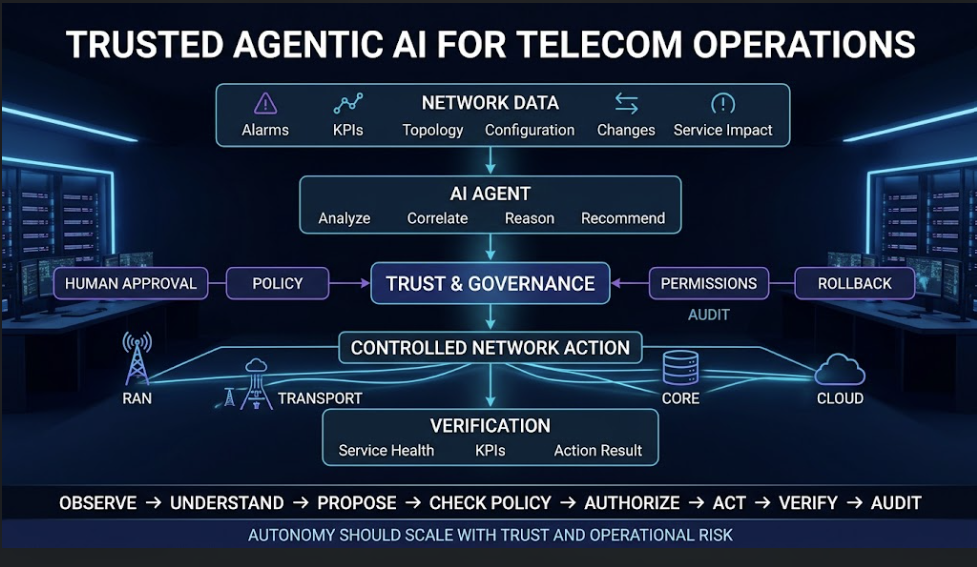
A practical telecom architecture can be viewed as five layers:
1. Network Context Layer
Provides the agent with alarms, KPIs, topology, configuration, service impact, change records and historical incidents.2. Agent Intelligence Layer
The AI agent analyzes the situation, correlates evidence, develops possible actions and estimates confidence and risk.3. Trust & Governance Layer
Checks identity, permissions, policies, action boundaries and whether human approval is required.4. Controlled Execution Layer
Approved actions are executed through controlled automation, APIs or orchestration platforms rather than unrestricted network access.5. Verification & Audit Layer
The network is monitored after the action. Results are verified, decisions are logged and rollback is triggered when necessary.The Trusted Decision Flow
OBSERVE → UNDERSTAND → PROPOSE → CHECK POLICY → AUTHORIZE → ACT → VERIFY → AUDIT
Paragraph:
The critical difference from basic AI automation is that the agent does not move directly from decision to action. A trust layer sits between them.
For example, an agent may be allowed to restart a low-risk application process automatically, while a routing change affecting thousands of customers may require engineer approval.
The level of autonomy should increase or decrease according to the risk of the action—not simply according to the intelligence of the AI agent.
Should Every AI Agent Have the Same Level of Autonomy?
Not every telecom network action carries the same operational risk.
An AI agent summarizing alarms is very different from an AI agent modifying a core-network configuration. Therefore, operators should not give every agent the same level of authority.
A practical approach is to connect autonomy with operational risk.
Risk Level Example Telecom Action AI Authority Human Control Low Alarm correlation, log analysis, incident summary Analyze automatically Review when needed Moderate Recommend parameter optimization or traffic rerouting Recommend action Human approval High Execute configuration or routing change Restricted execution Mandatory approval Critical Core, security or large-scale service-impacting change No independent execution Strict human authorization As an AI agent demonstrates reliability, some actions may gradually move toward greater automation. But this should happen per use case and per action type, not by simply declaring an entire AI platform “autonomous.”
Autonomy should be earned through evidence, bounded by policy and reduced immediately when operational risk increases.
How Can Operators Prove an AI Agent Made the Right Decision?
In traditional network operations, engineers leave evidence behind: alarms, tickets, command logs, approvals and change records.
Agentic AI should not reduce this visibility. It should make the decision trail even clearer.
For every significant network action, the operator should be able to reconstruct:
What happened? — What alarm, KPI or service condition triggered the agent?
What did the agent know? — Which topology, configuration, change and service data were available?
Why did it choose this action? — What evidence supported the recommendation?
Was it authorized? — Which policy and permission allowed the action?
Who approved it? — Was execution autonomous or human-approved?
What exactly changed? — Commands, APIs, parameters and affected network elements should be recorded.
Did it work? — Post-action KPIs and service health should verify the outcome.
Could it be reversed? — The rollback path and previous state should be available.
From Network Logs to AI Decision Records
This suggests that future NOCs may need something beyond traditional command logging: an AI decision record.
For every important action, the record could connect:
Trigger → Evidence → Reasoning → Policy Check → Approval → Action → Network Result → Rollback Status
This creates an auditable chain that engineers, operations management, security teams and governance functions can review.
If an operator cannot reconstruct why an AI agent changed the network, that action was not truly governed—even if the outcome happened to be correct.
What Happens When Two AI Agents Want to Take Different Actions?
A future telecom NOC may not operate with one AI agent.
Different agents could specialize in RAN, transport, core, service assurance, cybersecurity, energy optimization and change management.
That creates a new operational challenge: their objectives may conflict.
Imagine a major event causes congestion in part of the network.
The Service Assurance Agent wants to reroute traffic immediately to protect customer experience.
At the same time, the Transport Agent detects that the alternative path is approaching its capacity threshold and recommends keeping the existing routing.
Meanwhile, an Energy Optimization Agent has already placed some infrastructure into a power-saving state.
Each recommendation may make sense individually.
But they cannot all be executed independently.
From Individual Agents to Coordinated Decisions
A trusted Agentic AI environment therefore needs coordination above individual agents.
A coordinating or orchestration layer should evaluate:
Service priority → Network capacity → Current incidents → Change activity → Security constraints → Business intent → Operational risk
It can then determine whether to approve one action, combine several recommendations, request additional evidence or escalate the decision to a human operator.
SPECIALIZED AGENTS → COORDINATED REASONING → POLICY CHECK → HUMAN APPROVAL WHEN REQUIRED → CONTROLLED ACTION
Multi-agent autonomy without coordination could simply replace operational silos with AI silos.
Is Trusted Agentic AI Already Becoming Real in Telecom?
Trusted Agentic AI is no longer only a future architecture discussion. During 2026, major telecom vendors, operators and industry bodies have started demonstrating how AI agents can operate within controlled network environments.
Nokia: Trust-Based Agentic AI for IP Networks
In June 2026, Nokia introduced an Agentic AI framework for its Network Services Platform. The framework grounds agents in a real-time network view and is designed to support guided and explainable actions within operator-defined policies and security boundaries. Nokia also describes governance, observability and what it calls “glass box autonomy” as important elements of its broader autonomous-network approach.
This is important because it reflects the same principle discussed earlier:
AI Agent → Trusted Network Context → Policy Boundary → Explainable Action
Ericsson: Human Control Before Network Actuation
Ericsson has demonstrated an agentic network-intelligence approach where agents analyze subscriber-impacting events, investigate likely root causes and recommend possible remedies.
Importantly, the proposed remedy can remain under human control. Once the engineer approves the preferred action, an actuation agent can invoke the appropriate automation platform or network interface.
That creates a practical progression:
AI Investigates → AI Recommends → Human Validates → Agent Executes
TM Forum: Trusted Agentic AI With Operators
At DTW Ignite 2026, TM Forum showcased a Trusted Agentic AI for Access Management Catalyst involving organizations including Deutsche Telekom and Vodafone.
The project focuses on secure, consistent and auditable network configuration and combines intelligent automation with permission and compliance controls.
TM Forum’s 2026 Trustworthy AI & Data program also showcased an Agentic NOC, an essential framework for telecom Agentic AI, trusted access management and multi-agent network planning—showing that trust and governance are becoming part of the industry’s Agentic AI discussion rather than an afterthought.
The industry direction is becoming clearer: telecom operators are not simply asking how to give AI agents more control. They are developing mechanisms to make that control observable, explainable, policy-bound and auditable.
Trusted autonomy—not unrestricted autonomy—is emerging as the practical path toward Agentic AI in live telecom networks.
How Should a Telecom NOC Introduce Trusted Agentic AI?
Operators should not begin by giving an AI agent permission to change a live network.
Trust should be built progressively, using real operational evidence.
A practical approach is to move through five stages.
Stage 1: Observe
Connect the agent to approved operational data such as alarms, KPIs, topology, tickets and change records.
The agent can analyze the network, but cannot recommend or execute actions yet.
Stage 2: Recommend
Allow the agent to investigate incidents and recommend actions to engineers.
Compare its recommendations with actual engineering decisions and measure accuracy, context completeness and operational usefulness.
Stage 3: Shadow
Let the agent generate the action it would have taken—but do not allow execution.
Compare:
AI Proposed Action → Engineer Action → Actual Network Outcome
This creates evidence about whether the agent can be trusted.
Stage 4: Human-Approved Execution
For proven use cases, allow the agent to prepare an action while an authorized engineer approves execution.
Every action should include:
Evidence → Risk → Expected Impact → Approval → Rollback Plan
Stage 5: Bounded Autonomy
Only well-proven, low-risk actions should eventually be executed without individual human approval.
Even then, the agent should operate within predefined permissions, thresholds, policies and rollback conditions.
The objective of the first Agentic AI deployment should not be maximum autonomy. It should be measurable trust.
What Should Operators Measure?
Track practical indicators such as recommendation accuracy, false-action rate, human override rate, successful execution rate, rollback rate, service impact avoided and time saved during investigation.
These metrics provide evidence for deciding whether a specific agent or action is ready for greater autonomy.
A Practical 90-Day Trusted Agentic AI Pilot for the NOC
Operators do not need to transform the entire NOC to start testing Agentic AI. A better approach is to select one contained operational use case where decisions can be measured and risk can be controlled.
A strong starting point could be incident investigation and recommended remediation, because the agent can demonstrate value before receiving direct network control.
Days 1–30: Build Trusted Context
Select one use case and connect only the required data sources:
Alarms → KPIs → Topology → Configuration → Change Records → Tickets → Service Impact
Define the agent’s identity, access permissions, prohibited actions and escalation rules.
During this phase, the agent should observe only.
Days 31–60: Shadow the Engineers
Allow the agent to investigate real incidents and produce:
Likely Root Cause → Supporting Evidence → Recommended Action → Risk → Expected Result
Engineers continue operating normally.
Compare the agent’s conclusions with actual engineering decisions and network outcomes.
The goal is to answer:
Does the agent consistently have enough context to make a reliable recommendation?
Days 61–90: Introduce Controlled Action
For actions that performed reliably during the shadow phase, introduce human-approved execution.
Before execution, the agent should present:
What it wants to change → Why → Expected impact → Risk → Rollback plan
After execution, automatically verify service health and relevant KPIs.
Day 90: Decide Whether to Scale
Do not ask simply:
“Did the AI work?”
Ask:
Did investigation become faster?
Were recommendations reliable?
How often did engineers override the agent?
Were actions successfully verified?
Did any action require rollback?
Did customer/service impact reduce?ONE USE CASE → CONTROL THE ACCESS → SHADOW → PROVE TRUST → AUTHORIZE → VERIFY → SCALE
Autonomy should be the result of proven operational trust—not the starting point of an Agentic AI project.
What Could a Trusted Agentic NOC Look Like by 2030?
By 2030, the telecom NOC may operate with multiple specialized AI agents working continuously across different network domains.
A Service Assurance Agent could monitor customer experience.
A RAN Agent could investigate radio degradation.
A Transport Agent could evaluate congestion and path availability.
A Core Agent could analyze service and signaling abnormalities.
A Security Agent could identify suspicious behavior.
A Change Agent could evaluate configuration risk before implementation.
But these agents should not operate as independent automation engines.
They could work through a common trust and orchestration layer that understands business intent, operational policy, permissions, service priority and network risk.
This approach also connects with intent-driven telecom operations, where business objectives and operational policies guide how autonomous systems make network decisions.
Humans Move From Executing Every Action to Governing Autonomy
As confidence grows, the role of NOC engineers may increasingly shift from manually gathering information and executing repetitive actions toward:
Defining operational intent → Setting policy boundaries → Reviewing high-risk decisions → Managing exceptions → Improving automation → Governing AI performance
This does not remove human accountability.
It makes human judgment more important at the points where risk, uncertainty and business impact are highest.
THE FUTURE NOC MAY NOT ASK WHETHER AI OR HUMANS SHOULD OPERATE THE NETWORK. IT MAY ASK WHICH DECISIONS AI CAN SAFELY HANDLE—AND WHICH DECISIONS STILL REQUIRE HUMAN JUDGMENT.
The destination is not a network with no humans. It is a network where autonomy operates within clearly defined trust boundaries.
Conclusion: Autonomy Must Be Earned Through Trust
Agentic AI could fundamentally change telecom network operations by allowing AI systems to investigate incidents, coordinate across domains, recommend actions and eventually execute selected network changes.
But greater intelligence does not automatically create greater trust.
Before an AI agent is allowed to influence a live network, operators need to know what the agent can access, what it is allowed to do, what evidence supports its decision, how the action will be verified and how quickly it can be reversed if something goes wrong.
That means the path toward Agentic AI should not be:
AI Capability → Full Autonomy
It should be:
AI Capability → Operational Evidence → Governance → Controlled Authority → Verification → Trusted Autonomy
The most successful Agentic AI networks may not be those that give AI the most control. They may be those that can prove exactly when, where and why that control can be trusted.
How Ready Is Your NOC for AI-Driven Operations?
Trusted Agentic AI depends on capabilities that must already exist across observability, automation, predictive operations, AIOps, decision intelligence, closed-loop operations and governance.
Use the free TelcoMind AI NOC Maturity Assessment to evaluate your current operations across 8 critical dimensions and identify where your NOC stands on the journey:
Reactive → Automated → Predictive → Intelligent → Autonomous
-

Trusted Agentic AI in Telecom: How Operators Can Prove AI Decisions Are Safe
When an AI Agent Makes a Network Decision, Who Trusts the Decision?
Imagine an AI agent in a telecom NOC detects abnormal congestion in the mobile core.
It correlates alarms, KPIs, recent configuration changes and service-impact information. Within seconds, it concludes that traffic should be rerouted to protect customer services.
Technically, the recommendation may be correct.
But before allowing the agent to execute the change, the operator needs answers to several questions.
Can we verify why the AI made this decision?
Does the agent have permission to perform this action?
What could happen if its reasoning is wrong?
Can the action be reversed immediately?
And who remains accountable for the outcome?
These questions become increasingly important as telecom AI moves from providing recommendations toward taking actions across RAN, transport, core, cloud and service-assurance environments.
This evolution is already visible in practical Agentic AI use cases in telecom, where AI agents can investigate incidents, coordinate decisions and support controlled network actions.
The challenge is therefore no longer simply:
“Can Agentic AI operate the network?”
“Can operators prove that an AI agent is acting safely, within policy and for the right reason?”
That is where Trusted Agentic AI becomes critical.
For telecom operators, trust cannot simply mean believing that an AI model is accurate. Trust must be demonstrated through identity, permissions, explainability, policy controls, verification, audit trails and rollback mechanisms.
The journey toward autonomous networks therefore requires two capabilities to mature together: AI autonomy and AI governance.
H2 — What Does Trusted Agentic AI Actually Mean in Telecom?
Trusted Agentic AI does not mean that an AI agent never makes a mistake.
It means the operator has enough visibility, control and evidence to understand what the agent is doing, why it is doing it and whether it is operating within approved boundaries.
Consider an AI agent investigating degradation in a 5G service.
The agent may collect information from alarms, performance counters, topology, configuration changes, trouble tickets and service-impact data. It may then recommend—or eventually execute—a corrective action.
Before that action can be trusted, several controls should exist.
Identity — The network must know which AI agent is requesting an action.
Permission — The agent should access only the systems and commands required for its assigned role.
Context — Its decision should use reliable and sufficiently current network information.
Policy — Actions must remain within predefined operational and business rules.
Explainability — Engineers should be able to understand the evidence behind important decisions.
Verification — The system must confirm whether the action produced the intended result.
Auditability — Every important decision and action should leave a trace that can be reviewed later.
Rollback — If the outcome is wrong, the network needs a safe path back to the previous state.
Trust is not created by giving an AI agent more autonomy. Trust is created by proving that its autonomy remains controlled, observable and reversible.
In telecom, Trusted Agentic AI should therefore be treated as an operational control architecture—not simply an AI-model feature.
H2 — When the AI Makes the Right Decision Using the Wrong Context
Imagine a telecom AI agent detects rising packet loss on a transport path carrying traffic from several mobile sites.
The agent checks performance data and concludes that the best action is to reroute traffic through an alternative path.
From the data available to the agent, the decision looks correct.
But there is a problem.
A planned maintenance activity is already underway on the alternative path. The information exists in the change-management system, but the AI agent does not have access to it.
If the agent automatically reroutes the traffic, a localized degradation could become a much larger service incident.
The AI reasoning was not necessarily wrong.
The context was incomplete.
What Should a Trusted AI Agent Do?
Before executing the reroute, the agent should verify:
Network health → Active alarms → Topology → Current changes → Maintenance windows → Service impact → Policy restrictions
If critical information is missing or conflicting, the agent should stop autonomous execution and escalate the decision to an engineer.
This creates an important principle for telecom operations:
An AI agent should not only calculate confidence in its answer. It should also understand the completeness and reliability of the context behind that answer.
Trusted Agentic AI needs a mechanism to know when it has enough evidence to act—and when it should ask a human.
What Does a Trusted Agentic AI Architecture Look Like?
Trust should not depend on a single AI model. It should be built around the agent through multiple layers of operational control.
A practical telecom architecture can be viewed as five layers:
1. Network Context Layer
Provides the agent with alarms, KPIs, topology, configuration, service impact, change records and historical incidents.2. Agent Intelligence Layer
The AI agent analyzes the situation, correlates evidence, develops possible actions and estimates confidence and risk.3. Trust & Governance Layer
Checks identity, permissions, policies, action boundaries and whether human approval is required.4. Controlled Execution Layer
Approved actions are executed through controlled automation, APIs or orchestration platforms rather than unrestricted network access.5. Verification & Audit Layer
The network is monitored after the action. Results are verified, decisions are logged and rollback is triggered when necessary.The Trusted Decision Flow
OBSERVE → UNDERSTAND → PROPOSE → CHECK POLICY → AUTHORIZE → ACT → VERIFY → AUDIT
Paragraph:
The critical difference from basic AI automation is that the agent does not move directly from decision to action. A trust layer sits between them.
For example, an agent may be allowed to restart a low-risk application process automatically, while a routing change affecting thousands of customers may require engineer approval.
The level of autonomy should increase or decrease according to the risk of the action—not simply according to the intelligence of the AI agent.
Should Every AI Agent Have the Same Level of Autonomy?
Not every telecom network action carries the same operational risk.
An AI agent summarizing alarms is very different from an AI agent modifying a core-network configuration. Therefore, operators should not give every agent the same level of authority.
A practical approach is to connect autonomy with operational risk.
Risk Level Example Telecom Action AI Authority Human Control Low Alarm correlation, log analysis, incident summary Analyze automatically Review when needed Moderate Recommend parameter optimization or traffic rerouting Recommend action Human approval High Execute configuration or routing change Restricted execution Mandatory approval Critical Core, security or large-scale service-impacting change No independent execution Strict human authorization As an AI agent demonstrates reliability, some actions may gradually move toward greater automation. But this should happen per use case and per action type, not by simply declaring an entire AI platform “autonomous.”
Autonomy should be earned through evidence, bounded by policy and reduced immediately when operational risk increases.
How Can Operators Prove an AI Agent Made the Right Decision?
In traditional network operations, engineers leave evidence behind: alarms, tickets, command logs, approvals and change records.
Agentic AI should not reduce this visibility. It should make the decision trail even clearer.
For every significant network action, the operator should be able to reconstruct:
What happened? — What alarm, KPI or service condition triggered the agent?
What did the agent know? — Which topology, configuration, change and service data were available?
Why did it choose this action? — What evidence supported the recommendation?
Was it authorized? — Which policy and permission allowed the action?
Who approved it? — Was execution autonomous or human-approved?
What exactly changed? — Commands, APIs, parameters and affected network elements should be recorded.
Did it work? — Post-action KPIs and service health should verify the outcome.
Could it be reversed? — The rollback path and previous state should be available.
From Network Logs to AI Decision Records
This suggests that future NOCs may need something beyond traditional command logging: an AI decision record.
For every important action, the record could connect:
Trigger → Evidence → Reasoning → Policy Check → Approval → Action → Network Result → Rollback Status
This creates an auditable chain that engineers, operations management, security teams and governance functions can review.
If an operator cannot reconstruct why an AI agent changed the network, that action was not truly governed—even if the outcome happened to be correct.
What Happens When Two AI Agents Want to Take Different Actions?
A future telecom NOC may not operate with one AI agent.
Different agents could specialize in RAN, transport, core, service assurance, cybersecurity, energy optimization and change management.
That creates a new operational challenge: their objectives may conflict.
Imagine a major event causes congestion in part of the network.
The Service Assurance Agent wants to reroute traffic immediately to protect customer experience.
At the same time, the Transport Agent detects that the alternative path is approaching its capacity threshold and recommends keeping the existing routing.
Meanwhile, an Energy Optimization Agent has already placed some infrastructure into a power-saving state.
Each recommendation may make sense individually.
But they cannot all be executed independently.
From Individual Agents to Coordinated Decisions
A trusted Agentic AI environment therefore needs coordination above individual agents.
A coordinating or orchestration layer should evaluate:
Service priority → Network capacity → Current incidents → Change activity → Security constraints → Business intent → Operational risk
It can then determine whether to approve one action, combine several recommendations, request additional evidence or escalate the decision to a human operator.
SPECIALIZED AGENTS → COORDINATED REASONING → POLICY CHECK → HUMAN APPROVAL WHEN REQUIRED → CONTROLLED ACTION
Multi-agent autonomy without coordination could simply replace operational silos with AI silos.
Is Trusted Agentic AI Already Becoming Real in Telecom?
Trusted Agentic AI is no longer only a future architecture discussion. During 2026, major telecom vendors, operators and industry bodies have started demonstrating how AI agents can operate within controlled network environments.
Nokia: Trust-Based Agentic AI for IP Networks
In June 2026, Nokia introduced an Agentic AI framework for its Network Services Platform. The framework grounds agents in a real-time network view and is designed to support guided and explainable actions within operator-defined policies and security boundaries. Nokia also describes governance, observability and what it calls “glass box autonomy” as important elements of its broader autonomous-network approach.
This is important because it reflects the same principle discussed earlier:
AI Agent → Trusted Network Context → Policy Boundary → Explainable Action
Ericsson: Human Control Before Network Actuation
Ericsson has demonstrated an agentic network-intelligence approach where agents analyze subscriber-impacting events, investigate likely root causes and recommend possible remedies.
Importantly, the proposed remedy can remain under human control. Once the engineer approves the preferred action, an actuation agent can invoke the appropriate automation platform or network interface.
That creates a practical progression:
AI Investigates → AI Recommends → Human Validates → Agent Executes
TM Forum: Trusted Agentic AI With Operators
At DTW Ignite 2026, TM Forum showcased a Trusted Agentic AI for Access Management Catalyst involving organizations including Deutsche Telekom and Vodafone.
The project focuses on secure, consistent and auditable network configuration and combines intelligent automation with permission and compliance controls.
TM Forum’s 2026 Trustworthy AI & Data program also showcased an Agentic NOC, an essential framework for telecom Agentic AI, trusted access management and multi-agent network planning—showing that trust and governance are becoming part of the industry’s Agentic AI discussion rather than an afterthought.
The industry direction is becoming clearer: telecom operators are not simply asking how to give AI agents more control. They are developing mechanisms to make that control observable, explainable, policy-bound and auditable.
Trusted autonomy—not unrestricted autonomy—is emerging as the practical path toward Agentic AI in live telecom networks.
How Should a Telecom NOC Introduce Trusted Agentic AI?
Operators should not begin by giving an AI agent permission to change a live network.
Trust should be built progressively, using real operational evidence.
A practical approach is to move through five stages.
Stage 1: Observe
Connect the agent to approved operational data such as alarms, KPIs, topology, tickets and change records.
The agent can analyze the network, but cannot recommend or execute actions yet.
Stage 2: Recommend
Allow the agent to investigate incidents and recommend actions to engineers.
Compare its recommendations with actual engineering decisions and measure accuracy, context completeness and operational usefulness.
Stage 3: Shadow
Let the agent generate the action it would have taken—but do not allow execution.
Compare:
AI Proposed Action → Engineer Action → Actual Network Outcome
This creates evidence about whether the agent can be trusted.
Stage 4: Human-Approved Execution
For proven use cases, allow the agent to prepare an action while an authorized engineer approves execution.
Every action should include:
Evidence → Risk → Expected Impact → Approval → Rollback Plan
Stage 5: Bounded Autonomy
Only well-proven, low-risk actions should eventually be executed without individual human approval.
Even then, the agent should operate within predefined permissions, thresholds, policies and rollback conditions.
The objective of the first Agentic AI deployment should not be maximum autonomy. It should be measurable trust.
What Should Operators Measure?
Track practical indicators such as recommendation accuracy, false-action rate, human override rate, successful execution rate, rollback rate, service impact avoided and time saved during investigation.
These metrics provide evidence for deciding whether a specific agent or action is ready for greater autonomy.
A Practical 90-Day Trusted Agentic AI Pilot for the NOC
Operators do not need to transform the entire NOC to start testing Agentic AI. A better approach is to select one contained operational use case where decisions can be measured and risk can be controlled.
A strong starting point could be incident investigation and recommended remediation, because the agent can demonstrate value before receiving direct network control.
Days 1–30: Build Trusted Context
Select one use case and connect only the required data sources:
Alarms → KPIs → Topology → Configuration → Change Records → Tickets → Service Impact
Define the agent’s identity, access permissions, prohibited actions and escalation rules.
During this phase, the agent should observe only.
Days 31–60: Shadow the Engineers
Allow the agent to investigate real incidents and produce:
Likely Root Cause → Supporting Evidence → Recommended Action → Risk → Expected Result
Engineers continue operating normally.
Compare the agent’s conclusions with actual engineering decisions and network outcomes.
The goal is to answer:
Does the agent consistently have enough context to make a reliable recommendation?
Days 61–90: Introduce Controlled Action
For actions that performed reliably during the shadow phase, introduce human-approved execution.
Before execution, the agent should present:
What it wants to change → Why → Expected impact → Risk → Rollback plan
After execution, automatically verify service health and relevant KPIs.
Day 90: Decide Whether to Scale
Do not ask simply:
“Did the AI work?”
Ask:
Did investigation become faster?
Were recommendations reliable?
How often did engineers override the agent?
Were actions successfully verified?
Did any action require rollback?
Did customer/service impact reduce?ONE USE CASE → CONTROL THE ACCESS → SHADOW → PROVE TRUST → AUTHORIZE → VERIFY → SCALE
Autonomy should be the result of proven operational trust—not the starting point of an Agentic AI project.
What Could a Trusted Agentic NOC Look Like by 2030?
By 2030, the telecom NOC may operate with multiple specialized AI agents working continuously across different network domains.
A Service Assurance Agent could monitor customer experience.
A RAN Agent could investigate radio degradation.
A Transport Agent could evaluate congestion and path availability.
A Core Agent could analyze service and signaling abnormalities.
A Security Agent could identify suspicious behavior.
A Change Agent could evaluate configuration risk before implementation.
But these agents should not operate as independent automation engines.
They could work through a common trust and orchestration layer that understands business intent, operational policy, permissions, service priority and network risk.
This approach also connects with intent-driven telecom operations, where business objectives and operational policies guide how autonomous systems make network decisions.
Humans Move From Executing Every Action to Governing Autonomy
As confidence grows, the role of NOC engineers may increasingly shift from manually gathering information and executing repetitive actions toward:
Defining operational intent → Setting policy boundaries → Reviewing high-risk decisions → Managing exceptions → Improving automation → Governing AI performance
This does not remove human accountability.
It makes human judgment more important at the points where risk, uncertainty and business impact are highest.
THE FUTURE NOC MAY NOT ASK WHETHER AI OR HUMANS SHOULD OPERATE THE NETWORK. IT MAY ASK WHICH DECISIONS AI CAN SAFELY HANDLE—AND WHICH DECISIONS STILL REQUIRE HUMAN JUDGMENT.
The destination is not a network with no humans. It is a network where autonomy operates within clearly defined trust boundaries.
Conclusion: Autonomy Must Be Earned Through Trust
Agentic AI could fundamentally change telecom network operations by allowing AI systems to investigate incidents, coordinate across domains, recommend actions and eventually execute selected network changes.
But greater intelligence does not automatically create greater trust.
Before an AI agent is allowed to influence a live network, operators need to know what the agent can access, what it is allowed to do, what evidence supports its decision, how the action will be verified and how quickly it can be reversed if something goes wrong.
That means the path toward Agentic AI should not be:
AI Capability → Full Autonomy
It should be:
AI Capability → Operational Evidence → Governance → Controlled Authority → Verification → Trusted Autonomy
The most successful Agentic AI networks may not be those that give AI the most control. They may be those that can prove exactly when, where and why that control can be trusted.
How Ready Is Your NOC for AI-Driven Operations?
Trusted Agentic AI depends on capabilities that must already exist across observability, automation, predictive operations, AIOps, decision intelligence, closed-loop operations and governance.
Use the free TelcoMind AI NOC Maturity Assessment to evaluate your current operations across 8 critical dimensions and identify where your NOC stands on the journey:
Reactive → Automated → Predictive → Intelligent → Autonomous
-

From Level 0 to Level 5: How Close Are We to Truly Autonomous Telecom Networks?
Imagine walking into a telecom Network Operations Center at midnight.
The video wall is alive with traffic maps, service health, customer experience and network performance.
Thousands of network elements are operating.
Millions of subscribers are connected.
Somewhere in the network, congestion is beginning to develop.
A cloud workload is behaving abnormally.
A transport path is approaching a risk threshold.
And yet the room is unusually quiet.
Not because nothing is happening.
Because the network is handling it.
One system detects the abnormal behaviour.
Another determines which services could be affected.
The network evaluates possible actions.
A Digital Twin tests the safest option.
An AI agent coordinates the response.
Automation executes the approved action.
Service assurance verifies the result.
The network learns from what happened.
By the time an engineer looks at the event, the customer impact has already been prevented.
This is the promise of a Level 5 autonomous network.
It sounds impressive.
It also raises an uncomfortable question:
How much of this can telecom networks actually do today?
Because there is a significant difference between automating network operations and creating a network that can truly operate autonomously.
And that gap is where the real story begins.
Level 5 Sounds Impressive. But Where Are We Today?
The midnight NOC described above represents the destination.
The reality today is more complicated.
A telecom operator may already have sophisticated automation in one part of the network, predictive analytics in another, and largely manual processes somewhere else.
A RAN optimization use case might operate with considerable autonomy, while a high-risk core-network change still requires several layers of human approval.
In other words, a telecom network does not necessarily have one single autonomy level.
Autonomy can vary by domain, process, use case and operational risk.
This is why the journey from Level 0 to Level 5 is better understood as a progression of operational capabilities rather than simply a technology upgrade.
From Human-Controlled to Self-Driving Networks
Level Network Behavior Who Takes the Lead? Level 0 — Manual Network detects problems, but investigation and action are manual 👤 Engineer Level 1 — Assisted Tools provide alarms, insights and basic recommendations 👤 Engineer + Tools Level 2 — Automated Repetitive tasks and predefined workflows run automatically ⚙️ Automation Level 3 — Conditional Autonomy The system analyzes situations and handles selected decisions 🧠 AI + Automation Level 4 — High Autonomy Intelligent closed loops detect, decide, act and verify across defined areas 🔄 Network + AI Level 5 — Full Autonomy The network continuously learns, adapts and manages itself 🚀 Autonomous Network 
Think of it like moving from a manually driven car toward a self-driving one.
At the beginning, the human makes almost every decision.
With each level, the system takes responsibility for more of the journey.
But telecom networks have one major difference:
Not every road has the same risk.
Automatically optimizing radio resources is very different from automatically making a critical core-network change affecting millions of customers.
That is why the real question may not be:
“When will telecom reach Level 5?”
It may be:
“Where does Level 5 actually make sense?”
So, Where Is the Telecom Industry Today?
The journey from Level 0 to Level 5 looks simple on paper.
But real telecom networks are much more complicated.
An operator may have advanced automation in one part of the network, while another area still depends heavily on engineers and manual processes.
For example, some activities in RAN optimization, energy management or fault handling can already run with a high level of automation.
But a critical change in the Core Network may still require careful engineering review and approval.
This means telecom operators are not moving toward autonomy at the same speed everywhere.
The journey is happening use case by use case, and domain by domain.
So where are operators today?
Most telecom networks are not yet fully autonomous.
Many operators are working around Level 2 and Level 3, while higher levels of autonomy are appearing in selected use cases and network domains.
Level 4 is becoming the important next target.
At this level, the network moves beyond basic automation. It can use intelligence and closed-loop processes to detect, analyze, decide, act and check the result with much less human involvement.
But reaching Level 4 in one use case does not mean the entire network has reached Level 4.
And this is where the challenge becomes interesting.
Why Is Level 4 Such a Big Step?
Imagine that a group of cell sites suddenly starts showing unusual performance degradation.
In a Level 3 environment, the system may detect the abnormal behavior, correlate several alarms and KPIs, identify a likely cause, and recommend an action to the operations team.
The engineer reviews the recommendation and decides whether to proceed.
Now imagine the same situation in a Level 4 environment.
The system detects the problem, understands the service impact, identifies the likely cause and selects an approved corrective action.
It then executes the action automatically within predefined policies.
But it does not stop there.
It checks whether the action actually solved the problem.
If network performance returns to normal, the loop is closed.
If it does not, the system can reassess the situation or escalate it to the operations team.
That ability to Detect → Decide → Act → Verify is what makes Level 4 much more powerful than simple automation.
Level 3 helps the engineer make the decision. Level 4 increasingly allows the network to complete the operational loop.
Which Parts of the Network Could Become Autonomous First?
Not every part of a telecom network will reach higher autonomy at the same time.
Some operations are repetitive, measurable and relatively low-risk, making them easier to automate.
Others involve complex dependencies and much greater customer or business risk.
This means the journey toward autonomous networks will probably happen domain by domain.
Network Area Autonomy Opportunity Why? 📡 RAN High Continuous optimization of traffic, capacity, interference and energy ⚡ Energy Management High Clear patterns, measurable results and repeatable actions 🔍 Service Assurance High AI can correlate alarms, detect anomalies and identify service impact 🌐 Transport Network Medium–High Traffic rerouting and capacity optimization can support closed loops ☁️ Cloud / Telco Cloud Medium–High Workload scaling and resource optimization are highly programmable 🧠 Core Network Selective Automation is possible, but critical actions may carry much higher service risk This does not mean the Core Network cannot become highly autonomous.
It means the acceptable level of autonomy may depend on the risk of the decision.
Automatically optimizing energy usage is very different from automatically changing a critical routing, subscriber or policy function affecting millions of users.
So perhaps the future is not:
“Everything at Level 5.”
It may be:
“The right level of autonomy for the right operational decision.”
Level 4 Is Starting to Move From Vision to Reality
For many years, autonomous networks were mainly discussed as a future vision.
That is beginning to change.
Telecom operators are now testing and deploying higher levels of autonomy in specific network domains and operational use cases.
The important point is that operators are not trying to make the entire network autonomous overnight.
They are starting with areas where automation can deliver clear, measurable and controlled results.
KDDI — Moving Network Optimization Toward Level 4
In Japan, KDDI and Ericsson have been working on AI-driven network optimization as part of KDDI’s journey toward higher autonomous-network levels.
A large-scale commercial-network trial used AI for uplink optimization across both 4G and 5G cells.
The interesting part is not only the performance improvement.
It shows how AI can increasingly analyze network conditions and support optimization across a large live network—one of the building blocks required for higher autonomy.
China Mobile — Building Autonomy at Scale
China Mobile has also been one of the operators actively developing autonomous-network capabilities across network operations.
Its journey shows an important lesson:
Autonomy becomes meaningful when it can move beyond individual automation scripts and operate across large, complex network environments.
This requires much more than AI alone. It needs reliable data, automation platforms, operational policies and closed-loop assurance working together.
Level 4 is not one technology. It is what happens when AI, automation, data and closed-loop operations begin working together.
What Actually Makes Level 4 Possible?
Level 4 does not come from adding one AI tool to the NOC.
It happens when several capabilities begin working together.
Network data provides visibility into what is happening.
AIOps connects alarms, KPIs and events to identify what matters.
AI and intelligent agents help understand the situation and determine possible actions.
Network Digital Twins can help test selected decisions before they reach the live network.
Automation executes approved actions.
And closed-loop assurance checks whether the action actually worked.
Together, they create something much more powerful than individual automation:
Observe → Understand → Decide → Test → Act → Verify → Learn
If any part of this chain is missing, true autonomy becomes much harder.
A network that can detect a problem but cannot act is still dependent on humans.
A network that can act but cannot verify the result is simply automated—not truly autonomous.
The closed loop is what changes the game.
NETWORK DATA
↓
AIOps
↓
AI / AGENTIC INTELLIGENCE
↓
DIGITAL TWIN
Test the Decision
↓
AUTOMATION
Execute Safely
↓
SERVICE ASSURANCE
Did It Work?
↓
LEARN
↺Do We Really Need Level 5 Everywhere?
Level 5 sounds like the final destination.
A network that can monitor, decide, act and learn with minimal human involvement appears to be the ultimate goal.
But telecom operations are not all the same.
Consider two decisions.
Decision A: Reduce energy consumption at selected radio sites during very low traffic.
Decision B: Make a major configuration change in the Core Network that could affect millions of subscribers.
Both decisions can potentially use AI and automation.
But should they have the same level of autonomy?
Probably not.
The first decision is repetitive, measurable and relatively easy to reverse.
The second may carry much greater service and business risk.
This suggests that the future autonomous network may not operate at one fixed level.
Instead, autonomy could be based on risk, confidence and potential customer impact.
The smartest autonomous network may not be the network that automates everything. It may be the network that knows what should—and should not—be autonomous.
Type of Decision Possible Approach Low risk + repetitive Higher autonomy Predictable + reversible Closed-loop automation Moderate risk AI recommendation + policy control High customer impact Stronger validation Critical / irreversible Human approval may remain appropriate So perhaps Level 5 should not be treated as a target for every network action.
The more practical goal may be something different:
Maximum useful autonomy — with the right level of control.
What Could the Autonomous NOC of 2030 Look Like?
Now return to the NOC we imagined at the beginning.
It is midnight.
The network is busy, but the operations center feels different.
Engineers are no longer spending most of their time moving between hundreds of alarms, dashboards and repetitive operational tasks.
Many routine events are already being handled through intelligent closed loops.
AIOps identifies what matters.
AI analyzes the situation.
Digital Twins test selected high-impact decisions.
Automation executes approved actions.
Service assurance checks the result.
And unusual or high-risk situations are brought to the operations team with the context already available.
The NOC has not disappeared.
Its role has changed.
Instead of managing every network event, operations teams increasingly manage exceptions, policies, risk and service outcomes.
Perhaps this is a more realistic picture of the autonomous NOC.
Not a network without people.
And not a network where AI controls everything.
But a network where machines handle more of what is predictable, while people focus on what requires judgment.
The journey to autonomous networks is not about removing humans from operations. It is about removing unnecessary human intervention from operations.
The Road to Level 5

The journey toward autonomous networks has already started.
Telecom operators are moving from manual operations toward automation, intelligence and increasingly closed-loop networks.
But Level 5 will not arrive everywhere at the same time.
Some network activities will become highly autonomous much faster than others.
The real challenge is not simply adding more AI.
It is building the right combination of trusted data, AIOps, automation, AI, governance and closed-loop assurance.
And perhaps the biggest lesson is this:
The goal should not be autonomy for the sake of autonomy.
The goal should be a network that can make the right decision, at the right time, with the right level of human control.
Level 5 may be the destination on the maturity model.
But the real transformation happens in every step we take toward it.
“But the real transformation happens in every step we take toward it.”
The next evolution may be intent-driven telecom operations, where operators define the required business outcome and AI helps translate it into coordinated network decisions.
As networks progress toward higher levels of autonomy, cybersecurity must evolve with them. AI-driven decisions, automated actions and increasingly connected network domains require security controls that can detect threats, govern autonomous actions and protect services at machine speed.
How Ready Is Your NOC for This Journey?
Before planning for Level 4 or Level 5, operators first need to understand where their operations stand today.
The TelcoMind AI — AI-Ready NOC Maturity Assessment helps evaluate NOC readiness across key areas including data, automation, AIOps, predictive operations, AI-assisted decision-making and closed-loop capabilities.
Take the Free AI-Ready NOC Maturity Assessment →
Discover your current maturity level and identify the areas that need attention on the journey toward intelligent and autonomous operations.
References & Further Reading
1. TM Forum — Autonomous Networks: Exploring the Evolution from Level 0 to Level 5
This is the foundation for the six-level maturity framework used throughout the article. TM Forum describes the journey from Level 0 manual operations through Level 5 full autonomy.
2. TM Forum — Assessing CSPs’ Progress Towards Level 4 Autonomous Networks
This is especially useful because it’s from March 2026 and discusses operators increasingly validating Level 4 autonomy in specific network domains, rather than claiming whole networks are already Level 4.
3. Ericsson & KDDI — AI Uplink Optimization Field Trial Toward Autonomous Networks Level 4
This directly supports the KDDI example in our article. The 2026 commercial-network trial covered approximately 1,500 5G cells and 1,300 4G cells, and the AI optimization application was assessed at Level 3.86 using an adaptation of TM Forum’s methodology.
-
From Level 0 to Level 5: How Close Are We to Truly Autonomous Telecom Networks?
Imagine walking into a telecom Network Operations Center at midnight.
The video wall is alive with traffic maps, service health, customer experience and network performance.
Thousands of network elements are operating.
Millions of subscribers are connected.
Somewhere in the network, congestion is beginning to develop.
A cloud workload is behaving abnormally.
A transport path is approaching a risk threshold.
And yet the room is unusually quiet.
Not because nothing is happening.
Because the network is handling it.
One system detects the abnormal behaviour.
Another determines which services could be affected.
The network evaluates possible actions.
A Digital Twin tests the safest option.
An AI agent coordinates the response.
Automation executes the approved action.
Service assurance verifies the result.
The network learns from what happened.
By the time an engineer looks at the event, the customer impact has already been prevented.
This is the promise of a Level 5 autonomous network.
It sounds impressive.
It also raises an uncomfortable question:
How much of this can telecom networks actually do today?
Because there is a significant difference between automating network operations and creating a network that can truly operate autonomously.
And that gap is where the real story begins.
Level 5 Sounds Impressive. But Where Are We Today?
The midnight NOC described above represents the destination.
The reality today is more complicated.
A telecom operator may already have sophisticated automation in one part of the network, predictive analytics in another, and largely manual processes somewhere else.
A RAN optimization use case might operate with considerable autonomy, while a high-risk core-network change still requires several layers of human approval.
In other words, a telecom network does not necessarily have one single autonomy level.
Autonomy can vary by domain, process, use case and operational risk.
This is why the journey from Level 0 to Level 5 is better understood as a progression of operational capabilities rather than simply a technology upgrade.
From Human-Controlled to Self-Driving Networks
Level Network Behavior Who Takes the Lead? Level 0 — Manual Network detects problems, but investigation and action are manual 👤 Engineer Level 1 — Assisted Tools provide alarms, insights and basic recommendations 👤 Engineer + Tools Level 2 — Automated Repetitive tasks and predefined workflows run automatically ⚙️ Automation Level 3 — Conditional Autonomy The system analyzes situations and handles selected decisions 🧠 AI + Automation Level 4 — High Autonomy Intelligent closed loops detect, decide, act and verify across defined areas 🔄 Network + AI Level 5 — Full Autonomy The network continuously learns, adapts and manages itself 🚀 Autonomous Network Think of it like moving from a manually driven car toward a self-driving one.
At the beginning, the human makes almost every decision.
With each level, the system takes responsibility for more of the journey.
But telecom networks have one major difference:
Not every road has the same risk.
Automatically optimizing radio resources is very different from automatically making a critical core-network change affecting millions of customers.
That is why the real question may not be:
“When will telecom reach Level 5?”
It may be:
“Where does Level 5 actually make sense?”
So, Where Is the Telecom Industry Today?
The journey from Level 0 to Level 5 looks simple on paper.
But real telecom networks are much more complicated.
An operator may have advanced automation in one part of the network, while another area still depends heavily on engineers and manual processes.
For example, some activities in RAN optimization, energy management or fault handling can already run with a high level of automation.
But a critical change in the Core Network may still require careful engineering review and approval.
This means telecom operators are not moving toward autonomy at the same speed everywhere.
The journey is happening use case by use case, and domain by domain.
So where are operators today?
Most telecom networks are not yet fully autonomous.
Many operators are working around Level 2 and Level 3, while higher levels of autonomy are appearing in selected use cases and network domains.
Level 4 is becoming the important next target.
At this level, the network moves beyond basic automation. It can use intelligence and closed-loop processes to detect, analyze, decide, act and check the result with much less human involvement.
But reaching Level 4 in one use case does not mean the entire network has reached Level 4.
And this is where the challenge becomes interesting.
Why Is Level 4 Such a Big Step?
Imagine that a group of cell sites suddenly starts showing unusual performance degradation.
In a Level 3 environment, the system may detect the abnormal behavior, correlate several alarms and KPIs, identify a likely cause, and recommend an action to the operations team.
The engineer reviews the recommendation and decides whether to proceed.
Now imagine the same situation in a Level 4 environment.
The system detects the problem, understands the service impact, identifies the likely cause and selects an approved corrective action.
It then executes the action automatically within predefined policies.
But it does not stop there.
It checks whether the action actually solved the problem.
If network performance returns to normal, the loop is closed.
If it does not, the system can reassess the situation or escalate it to the operations team.
That ability to Detect → Decide → Act → Verify is what makes Level 4 much more powerful than simple automation.
Level 3 helps the engineer make the decision. Level 4 increasingly allows the network to complete the operational loop.
Which Parts of the Network Could Become Autonomous First?
Not every part of a telecom network will reach higher autonomy at the same time.
Some operations are repetitive, measurable and relatively low-risk, making them easier to automate.
Others involve complex dependencies and much greater customer or business risk.
This means the journey toward autonomous networks will probably happen domain by domain.
Network Area Autonomy Opportunity Why? 📡 RAN High Continuous optimization of traffic, capacity, interference and energy ⚡ Energy Management High Clear patterns, measurable results and repeatable actions 🔍 Service Assurance High AI can correlate alarms, detect anomalies and identify service impact 🌐 Transport Network Medium–High Traffic rerouting and capacity optimization can support closed loops ☁️ Cloud / Telco Cloud Medium–High Workload scaling and resource optimization are highly programmable 🧠 Core Network Selective Automation is possible, but critical actions may carry much higher service risk This does not mean the Core Network cannot become highly autonomous.
It means the acceptable level of autonomy may depend on the risk of the decision.
Automatically optimizing energy usage is very different from automatically changing a critical routing, subscriber or policy function affecting millions of users.
So perhaps the future is not:
“Everything at Level 5.”
It may be:
“The right level of autonomy for the right operational decision.”
Level 4 Is Starting to Move From Vision to Reality
For many years, autonomous networks were mainly discussed as a future vision.
That is beginning to change.
Telecom operators are now testing and deploying higher levels of autonomy in specific network domains and operational use cases.
The important point is that operators are not trying to make the entire network autonomous overnight.
They are starting with areas where automation can deliver clear, measurable and controlled results.
KDDI — Moving Network Optimization Toward Level 4
In Japan, KDDI and Ericsson have been working on AI-driven network optimization as part of KDDI’s journey toward higher autonomous-network levels.
A large-scale commercial-network trial used AI for uplink optimization across both 4G and 5G cells.
The interesting part is not only the performance improvement.
It shows how AI can increasingly analyze network conditions and support optimization across a large live network—one of the building blocks required for higher autonomy.
China Mobile — Building Autonomy at Scale
China Mobile has also been one of the operators actively developing autonomous-network capabilities across network operations.
Its journey shows an important lesson:
Autonomy becomes meaningful when it can move beyond individual automation scripts and operate across large, complex network environments.
This requires much more than AI alone. It needs reliable data, automation platforms, operational policies and closed-loop assurance working together.
Level 4 is not one technology. It is what happens when AI, automation, data and closed-loop operations begin working together.
What Actually Makes Level 4 Possible?
Level 4 does not come from adding one AI tool to the NOC.
It happens when several capabilities begin working together.
Network data provides visibility into what is happening.
AIOps connects alarms, KPIs and events to identify what matters.
AI and intelligent agents help understand the situation and determine possible actions.
Network Digital Twins can help test selected decisions before they reach the live network.
Automation executes approved actions.
And closed-loop assurance checks whether the action actually worked.
Together, they create something much more powerful than individual automation:
Observe → Understand → Decide → Test → Act → Verify → Learn
If any part of this chain is missing, true autonomy becomes much harder.
A network that can detect a problem but cannot act is still dependent on humans.
A network that can act but cannot verify the result is simply automated—not truly autonomous.
The closed loop is what changes the game.
NETWORK DATA
↓
AIOps
↓
AI / AGENTIC INTELLIGENCE
↓
DIGITAL TWIN
Test the Decision
↓
AUTOMATION
Execute Safely
↓
SERVICE ASSURANCE
Did It Work?
↓
LEARN
↺Do We Really Need Level 5 Everywhere?
Level 5 sounds like the final destination.
A network that can monitor, decide, act and learn with minimal human involvement appears to be the ultimate goal.
But telecom operations are not all the same.
Consider two decisions.
Decision A: Reduce energy consumption at selected radio sites during very low traffic.
Decision B: Make a major configuration change in the Core Network that could affect millions of subscribers.
Both decisions can potentially use AI and automation.
But should they have the same level of autonomy?
Probably not.
The first decision is repetitive, measurable and relatively easy to reverse.
The second may carry much greater service and business risk.
This suggests that the future autonomous network may not operate at one fixed level.
Instead, autonomy could be based on risk, confidence and potential customer impact.
The smartest autonomous network may not be the network that automates everything. It may be the network that knows what should—and should not—be autonomous.
Type of Decision Possible Approach Low risk + repetitive Higher autonomy Predictable + reversible Closed-loop automation Moderate risk AI recommendation + policy control High customer impact Stronger validation Critical / irreversible Human approval may remain appropriate So perhaps Level 5 should not be treated as a target for every network action.
The more practical goal may be something different:
Maximum useful autonomy — with the right level of control.
What Could the Autonomous NOC of 2030 Look Like?
Now return to the NOC we imagined at the beginning.
It is midnight.
The network is busy, but the operations center feels different.
Engineers are no longer spending most of their time moving between hundreds of alarms, dashboards and repetitive operational tasks.
Many routine events are already being handled through intelligent closed loops.
AIOps identifies what matters.
AI analyzes the situation.
Digital Twins test selected high-impact decisions.
Automation executes approved actions.
Service assurance checks the result.
And unusual or high-risk situations are brought to the operations team with the context already available.
The NOC has not disappeared.
Its role has changed.
Instead of managing every network event, operations teams increasingly manage exceptions, policies, risk and service outcomes.
Perhaps this is a more realistic picture of the autonomous NOC.
Not a network without people.
And not a network where AI controls everything.
But a network where machines handle more of what is predictable, while people focus on what requires judgment.
The journey to autonomous networks is not about removing humans from operations. It is about removing unnecessary human intervention from operations.
The Road to Level 5
The journey toward autonomous networks has already started.
Telecom operators are moving from manual operations toward automation, intelligence and increasingly closed-loop networks.
But Level 5 will not arrive everywhere at the same time.
Some network activities will become highly autonomous much faster than others.
The real challenge is not simply adding more AI.
It is building the right combination of trusted data, AIOps, automation, AI, governance and closed-loop assurance.
And perhaps the biggest lesson is this:
The goal should not be autonomy for the sake of autonomy.
The goal should be a network that can make the right decision, at the right time, with the right level of human control.
Level 5 may be the destination on the maturity model.
But the real transformation happens in every step we take toward it.
“But the real transformation happens in every step we take toward it.”
The next evolution may be intent-driven telecom operations, where operators define the required business outcome and AI helps translate it into coordinated network decisions.
As networks progress toward higher levels of autonomy, cybersecurity must evolve with them. AI-driven decisions, automated actions and increasingly connected network domains require security controls that can detect threats, govern autonomous actions and protect services at machine speed.
How Ready Is Your NOC for This Journey?
Before planning for Level 4 or Level 5, operators first need to understand where their operations stand today.
The TelcoMind AI — AI-Ready NOC Maturity Assessment helps evaluate NOC readiness across key areas including data, automation, AIOps, predictive operations, AI-assisted decision-making and closed-loop capabilities.
Take the Free AI-Ready NOC Maturity Assessment →
Discover your current maturity level and identify the areas that need attention on the journey toward intelligent and autonomous operations.
References & Further Reading
1. TM Forum — Autonomous Networks: Exploring the Evolution from Level 0 to Level 5
This is the foundation for the six-level maturity framework used throughout the article. TM Forum describes the journey from Level 0 manual operations through Level 5 full autonomy.
2. TM Forum — Assessing CSPs’ Progress Towards Level 4 Autonomous Networks
This is especially useful because it’s from March 2026 and discusses operators increasingly validating Level 4 autonomy in specific network domains, rather than claiming whole networks are already Level 4.
3. Ericsson & KDDI — AI Uplink Optimization Field Trial Toward Autonomous Networks Level 4
This directly supports the KDDI example in our article. The 2026 commercial-network trial covered approximately 1,500 5G cells and 1,300 4G cells, and the AI optimization application was assessed at Level 3.86 using an adaptation of TM Forum’s methodology.