
What If the Network Detects the Attack Before the Security Team Sees the Alarm?
Telecom networks are becoming more intelligent, automated and software-driven. But the same transformation that makes networks faster and more flexible is also changing the cybersecurity challenge.
A modern attack may not begin with an obvious network outage.
It could start with an unusual API request, a compromised account, abnormal signaling traffic, a suspicious configuration change or thousands of devices suddenly behaving differently.
Individually, these signals may look harmless.
Together, they may tell a completely different story.
Traditional security operations often depend on a familiar sequence:
DETECT → ALERT → INVESTIGATE → DECIDE → RESPOND
But what happens when an attack develops faster than this operational cycle?
This is where AI could fundamentally change telecom cybersecurity—not simply by generating more alerts, but by helping the network understand abnormal behavior, connect evidence across multiple domains and respond before a security event becomes a customer-impacting incident.
The future of telecom cybersecurity may not be about detecting attacks faster. It may be about stopping them before customers realize an attack has started.
Why Is the Telecom Attack Surface Becoming Bigger?
A telecom network is no longer only a collection of radio sites, routers and core network elements.
Modern telecom infrastructure increasingly combines 5G, cloud-native network functions, APIs, edge computing, virtualization, IoT, automation platforms and AI-driven operations.
Each capability creates business value—but it can also create another path that must be protected.
Consider a 5G service. A security problem may originate in one area but quickly affect several others:
Device → RAN → Transport → 5G Core → Cloud / Edge → API → Application
The challenge becomes even greater as networks become more automated. An attacker may not need to directly take down a network element. Compromising an account, API, automation workflow or privileged system could potentially allow legitimate network capabilities to be used in the wrong way.
This changes the security question from:
“Has someone attacked my firewall?”
to:
“Is something happening anywhere across the service chain that does not match normal, authorized network behavior?”
That is a much harder question—and one where AI becomes particularly interesting.
MORE CONNECTIVITY + MORE SOFTWARE + MORE APIs + MORE AUTOMATION = MORE BEHAVIOR TO UNDERSTAND AND PROTECT
As telecom networks become more intelligent, cybersecurity must understand not only individual threats, but how abnormal behavior moves across the entire network.
Imagine traffic toward an important telecom service begins increasing rapidly.
At first, there is no outage.
Customers are still connected. Network availability looks normal. The NOC may only see increasing traffic, while the security platform generates several separate alerts.
But underneath those alarms, something unusual is developing.
An AI-driven security system could correlate:
Traffic volume increasing abnormally
Thousands of sources showing similar behavior
Unexpected geographic or device patterns
Firewall and gateway anomalies
Changes in latency, packet loss or service performance
Historical behavior from previous attacks
Instead of treating each signal separately, AI could identify that these events together resemble an emerging DDoS attack.
The important difference is what happens next.
A traditional workflow may be:
ALARM → TICKET → INVESTIGATION → SECURITY TEAM → NETWORK TEAM → MITIGATION
An AI-assisted workflow could become:
ANOMALY → CORRELATION → ATTACK PROBABILITY → IMPACT ANALYSIS → RECOMMENDED RESPONSE → CONTROLLED MITIGATION → VERIFICATION
Depending on operator policy and confidence level, low-risk defensive actions could be automated, while higher-risk actions remain subject to engineer or security-team approval.
The objective is not simply to detect the DDoS attack. It is to protect the service before abnormal traffic becomes customer impact.
In cybersecurity, the minutes saved before service degradation can be more valuable than the minutes saved after the outage begins.
What If the Attacker Uses a Valid Account?
Not every cyberattack looks like an attack.
Imagine an engineer’s privileged account successfully logs into a network management platform.
The username is valid.
The password is correct.
The authentication succeeds.
But something is different.
The account suddenly connects at an unusual time, accesses network elements it rarely touches and begins attempting configuration changes outside its normal operational pattern.
A traditional security control may see an authorized user.
AI-based behavioral analysis could see an authorized account behaving abnormally.
It could correlate:
Login context → User behavior → Network access → Configuration activity → Change history → Service risk
For example, the system might determine:
Valid credentials + unusual behavior + sensitive network access + unexpected change = HIGH-RISK EVENT
Instead of immediately blocking every unusual action, the response could depend on risk.
A suspicious low-impact activity might trigger additional authentication.
A high-risk configuration attempt could be temporarily stopped and sent for approval.
An extremely abnormal privileged action affecting critical infrastructure could trigger immediate containment according to predefined security policy.
IDENTITY TELLS US WHO LOGGED IN. BEHAVIOR HELPS US UNDERSTAND WHETHER WHAT THEY ARE DOING MAKES SENSE.
The most dangerous network action may not come from an unknown attacker. It may come through credentials the network already trusts.
What Happens When an AI Agent Has Permission to Change the Network?
This may become one of the most important telecom cybersecurity questions of the autonomous-network era.
Imagine an AI agent inside the NOC is authorized to investigate incidents and perform selected operational actions.
It can collect alarms, analyze KPIs, query network systems and recommend—or eventually execute—changes.
Now imagine the agent receives manipulated information, a malicious instruction or compromised data that causes it to recommend the wrong action.
The attacker may no longer need to attack the network element directly.
The attacker could try to influence the intelligence controlling the network.
For example:
Manipulated Input → AI Agent Misinterprets Situation → Wrong Decision → Automated Network Action → Service Impact
This creates a new security requirement.
Operators must protect not only network elements and user accounts, but also:
AI agents, their identities, permissions, data sources, tools, actions and communication with other agents.
An AI agent responsible for alarm analysis should not automatically have unlimited authority to modify routing, security policies or critical core-network configurations.
The principle should be simple:
AN AI AGENT SHOULD HAVE ONLY THE ACCESS AND AUTHORITY REQUIRED FOR ITS SPECIFIC ROLE.
Every important autonomous action should also be traceable, policy-controlled and reversible.
As AI gains the ability to operate the network, securing the intelligence becomes part of securing the network itself.
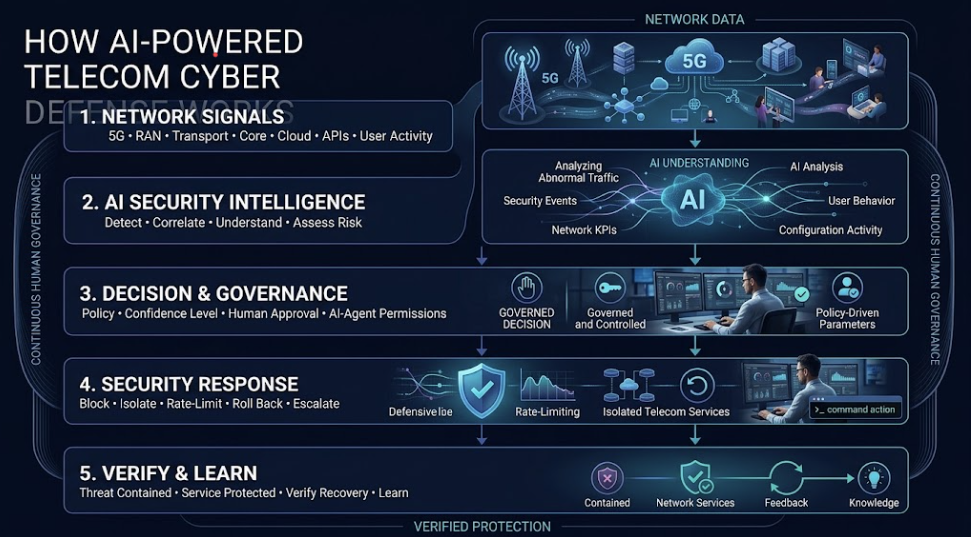
Traditional Cybersecurity vs AI-Powered Cyber Defense
The biggest change is not that AI creates another security tool. The change is that security can become more contextual, predictive and coordinated with live network operations.
| Traditional Approach | AI-Powered Approach |
|---|---|
| Detect individual alerts | Correlate signals across multiple systems |
| Depend heavily on predefined rules | Detect unusual behavior and emerging patterns |
| Investigate after an alert | Assess potential impact while the event develops |
| Security and network data may remain separated | Connect security events with network and service context |
| Manual response can increase reaction time | Recommend or automate approved defensive actions |
| Focus on detecting the threat | Focus on protecting the service outcome |
| Review incidents afterward | Verify response and continuously improve detection |
The real opportunity is not AI replacing traditional security controls. It is AI helping those controls understand what is happening across the network as one connected security event.
Is AI-Powered Telecom Cybersecurity Already Happening?
Yes—but the industry is still at different stages of maturity.
Telecom operators are already using machine learning, behavioral analytics, automation and real-time network intelligence for areas such as anomaly detection, fraud prevention, DDoS protection and security monitoring.
The bigger shift now is toward connecting these capabilities with 5G, network APIs, cloud-native infrastructure and increasingly autonomous operations.
This matters because the industry itself is preparing for the security implications of AI-driven networks. GSMA’s 2026 security work highlights Generative AI and Agentic AI among emerging security considerations, while TM Forum is developing security and governance approaches for agentic interactions as telecom operations become increasingly AI-native.
The direction is therefore moving from:
AI HELPS DETECT THE THREAT
toward:
AI DETECTS → CORRELATES → ASSESSES RISK → RECOMMENDS RESPONSE → GOVERNED AUTOMATION ACTS → SERVICE IS VERIFIED
But this does not mean every operator is already running fully autonomous cyber defense.
Most importantly, the maturity of data, identity management, security policies, automation controls and governance will determine how much decision-making can safely be automated.
The technology is moving toward autonomous cyber defense, but trust, governance and operational maturity will determine how quickly telecom operators can follow.
Real-World Signals: Telecom Cyber Defense Is Already Evolving
This transition is no longer limited to research papers and security labs. Several developments in 2026 show telecom cybersecurity moving toward real-time intelligence, network-level fraud prevention and governed AI automation.
Example 1 — Telecom Network Intelligence for Fraud Prevention
In August 2026, BlackDice joined the GSMA Open Gateway ecosystem to bring AI-powered behavioral intelligence and cyber-defense capabilities into standardized telecom network APIs. The objective includes fraud prevention and subscriber protection using network-level intelligence.
This demonstrates an important change:
The telecom network itself can become a source of security intelligence—not simply the infrastructure carrying the transaction.
Example 2 — Operators Using Network APIs Against SIM-Swap and Identity Fraud
Operators are also exposing trusted network signals such as Number Verification and SIM Swap information for fraud prevention.
In Poland, T-Mobile, Orange, Plus and Play announced cooperation around GSMA Open Gateway network APIs for digital security and fraud prevention. Similar initiatives have appeared in Greece and Taiwan.
Imagine a bank receiving a high-value transaction request immediately after an unexpected SIM change.
Instead of relying only on a password or OTP, telecom intelligence could contribute another risk signal:
Transaction Request + Recent SIM Swap + Identity Context → Higher Fraud Risk
Example 3 — Securing the Agentic Telecom Era
TM Forum launched Agentic Interactions Security in March 2026 as one of the first projects within its AI-Native Blueprint. The objective is to help create the governance and security foundations needed as telecom companies move AI from isolated experiments toward production-scale operations.
More recently, TM Forum demonstrated frameworks where AI agents can perform operational tasks while consequential write actions remain protected through policy controls, auditability and human oversight.
This brings cybersecurity directly into the autonomous-network discussion.
What These Examples Tell Us
The direction is becoming clearer:
NETWORK SECURITY → NETWORK INTELLIGENCE → AI-ASSISTED DEFENSE → GOVERNED AUTONOMOUS DEFENSE
Telecom cybersecurity is gradually moving from protecting individual systems toward understanding identity, behavior, network context and service risk together.
The next generation of telecom security may not live only at the network perimeter. Intelligence will increasingly need to exist throughout the network itself.
What Is the Cost of Waiting?
The risk is not simply that telecom operators will experience more cybersecurity alarms.
The bigger problem is that attacks are becoming faster while networks are becoming more interconnected and automated.
A security event that begins with one compromised identity, API or cloud workload could potentially move across several systems before traditional operational teams fully understand what is happening.
The consequences can extend far beyond the security department:
Service disruption — attacks can affect network availability and customer experience.
Revenue impact — outages, fraud and service degradation can directly affect business.
Customer trust — subscribers expect operators to protect both connectivity and identity.
Operational pressure — security, NOC, cloud and network teams may spend hours correlating information manually during a fast-moving incident.
Regulatory exposure — inadequate controls around sensitive data, critical infrastructure and automated decisions can create additional compliance risk.
And there is a newer danger.
As telecom networks move toward Agentic AI, closed-loop automation and autonomous operations, weak cybersecurity could allow a compromised system to influence increasingly powerful operational capabilities.
The same automation that can restore a service quickly could create greater impact if it is manipulated or given excessive authority.
THE MORE AUTONOMOUS THE NETWORK BECOMES, THE MORE IMPORTANT SECURITY, IDENTITY AND GOVERNANCE BECOME.
Autonomy can increase the speed of recovery—but without the right controls, it can also increase the speed of a bad decision.
How Can a Telecom Operator Start AI-Powered Cyber Defense?
The starting point should not be “deploy AI across the entire security operation.”
A better approach is to choose one security problem where the operator already has data, measurable business impact and a clear response process.
For example, an operator could start with:
DDoS detection and mitigation
Instead of immediately allowing AI to control defensive actions, the operator can gradually increase intelligence and automation.
1. Establish the Security Baseline
First understand normal behavior.
Measure typical traffic patterns, attack frequency, false alarms, detection time, investigation time, mitigation time and service impact.
Without a baseline, it becomes difficult to prove whether AI actually improves security.
2. Connect Security and Network Context
Bring together relevant signals from:
Network traffic + Firewalls + DDoS platforms + Network KPIs + Logs + Identity + Configuration changes + Service assurance
The objective is not simply collecting more data.
It is giving AI enough context to understand what is happening to the service.
3. Start in Observation Mode
Let AI detect anomalies, correlate events and recommend possible responses—but initially allow engineers and security teams to make the final decision.
Compare:
What AI detected → What engineers concluded → What action worked
This helps build confidence before increasing automation.
4. Automate Only Proven, Low-Risk Responses
Once accuracy is demonstrated, selected actions can gradually become automated within predefined boundaries.
For example:
High-confidence DDoS pattern → Approved mitigation policy → Rate-limit or redirect malicious traffic → Verify legitimate service
Critical or uncertain actions should still escalate for approval.
OBSERVE → CORRELATE → RECOMMEND → PROVE → CONTROL → AUTOMATE → VERIFY
Do not begin by asking how much cybersecurity AI can automate. Begin by proving which decisions it can make safely.
Can AI-Powered Cyber Defense Deliver Measurable ROI?
Cybersecurity ROI should not be measured simply by counting how many alerts AI processes.
The stronger business case is the operational and financial impact that better detection and faster response can prevent.
For a telecom operator, useful measurements can include:
Mean Time to Detect (MTTD) — How quickly is suspicious activity identified?
Mean Time to Respond (MTTR) — How long does containment or mitigation take?
Service-impact minutes — How much customer-facing degradation was avoided?
Engineering effort — How many security and network-operation hours were required?
Fraud losses — Did improved detection prevent measurable fraudulent activity?
Incident cost — What was previously spent on escalation, recovery, penalties or service credits?
Then calculate value using the operator’s own historical incidents, rather than assuming a generic AI saving.
Annual Benefit = Avoided Service Impact + Reduced Incident Effort + Avoided Fraud Loss + Avoided Recovery / Escalation Cost
ROI (%) = (Annual Benefit − Annual AI Security Cost) ÷ Annual AI Security Cost × 100
The important point is that the business case should begin with real incidents the operator already experiences.
If a particular attack type repeatedly consumes engineering hours, causes service degradation or creates financial losses, it becomes a strong candidate for an AI-security pilot.
The value of AI cybersecurity is not how many threats it analyzes. It is how much business impact it helps prevent.
What Could Telecom Cybersecurity Look Like by 2030?
The next phase of telecom cybersecurity may be very different from today’s model of security tools generating alerts for humans to investigate.
As networks move toward 5G-Advanced, cloud-native infrastructure, network APIs, edge services, autonomous networks and eventually 6G, the number and speed of operational decisions will continue to increase.
Cyber defense will need to evolve with them.
One possible direction is AI-versus-AI security.
Attackers may increasingly use AI to discover vulnerabilities, automate reconnaissance, create convincing social-engineering attacks or adapt their behavior to defensive controls.
Defenders will increasingly use AI to identify those changing patterns, correlate evidence and coordinate responses at machine speed.
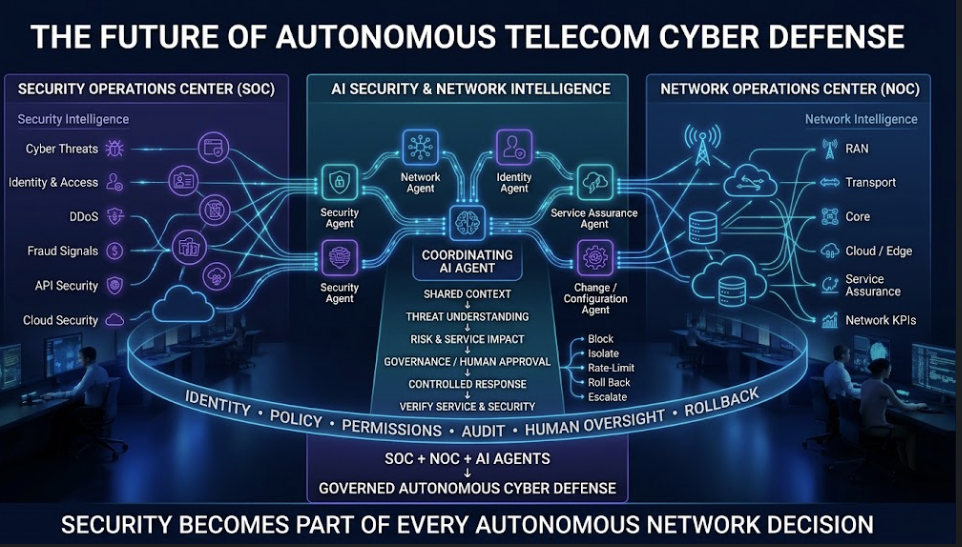
Another major development could be closer cooperation between the SOC and NOC.
Instead of:
SOC detects security problem → NOC investigates network impact
the future workflow could become:
SECURITY AI + NETWORK AI → SHARED CONTEXT → COORDINATED DECISION → GOVERNED RESPONSE → SERVICE VERIFICATION
Agentic AI could push this further.
Specialized agents might investigate identity, traffic, cloud infrastructure, network performance and service impact simultaneously—while a coordinating layer determines whether the evidence represents one connected attack.
But increasing intelligence also creates a new responsibility:
Who secures the AI that is securing the network?
Operators will need strong controls around AI-agent identity, permissions, trusted data, model behavior, audit trails, human authorization and rollback.
THE FUTURE MAY NOT BE AN AUTONOMOUS NETWORK WITH A SEPARATE SECURITY SYSTEM. IT MAY BE A NETWORK WHERE SECURITY IS BUILT INTO EVERY AUTONOMOUS DECISION.
The closer telecom moves toward autonomous operations, the closer cybersecurity must move toward autonomous—but governed—defense.
Why Most Operators Cannot Jump Straight to Autonomous Cyber Defense
The vision is attractive, but there is an important reality.
A telecom operator cannot safely introduce autonomous cyber defense simply by adding an AI platform.
AI depends on the quality of the operational environment around it.
If security data is fragmented, identities are poorly controlled, network topology is incomplete or automation permissions are unclear, AI may make decisions using only part of the picture.
For many operators, the biggest barriers may therefore be less about the AI model itself and more about:
Data quality and visibility
SOC and NOC working in separate operational silos
Legacy network platforms
Incomplete service and topology context
Weak identity and privileged-access controls
Unclear automation permissions
Limited explainability and auditability
No reliable rollback mechanism
This creates an important maturity principle:
AI SHOULD NOT RECEIVE MORE OPERATIONAL AUTHORITY THAN THE ORGANIZATION CAN SAFELY GOVERN.
An operator with fragmented data might begin with AI-assisted detection.
An operator with stronger correlation and operational context could progress toward AI-recommended responses.
Only after decisions have been repeatedly proven should selected security actions move toward controlled autonomous execution.
Autonomous cyber defense is not primarily a race toward more automation. It is a progression toward automation that can be trusted.
A Practical 90-Day AI Cyber Defense Pilot
Operators do not need to transform the entire SOC and NOC to prove the value of AI-powered cyber defense.
Choose one measurable security problem—for example, DDoS detection and response—and run a controlled 90-day pilot.
Days 1–30: Understand and Baseline
Select the use case and measure today’s performance.
Capture attack frequency, detection time, investigation time, response time, false positives, engineering effort and service impact.
Connect the minimum security and network data required to understand the event end to end.
At this stage:
AI OBSERVES — HUMANS DECIDE
Days 31–60: AI-Assisted Investigation
Allow AI to detect anomalies, correlate events and recommend responses.
But keep execution under human control.
Compare AI recommendations against actual SOC and NOC decisions.
Measure whether AI improves detection accuracy, investigation speed and understanding of service impact.
At this stage:
AI DETECTS + RECOMMENDS — HUMANS APPROVE + ACT
Days 61–90: Controlled Automation
Automate only high-confidence, low-risk and previously proven defensive actions.
Keep strict policies, permissions, audit trails and rollback mechanisms.
After every action, verify both:
Was the threat contained?
and
Was the legitimate service protected?
At this stage:
AI DETECTS → RECOMMENDS → APPROVED AUTOMATION ACTS → SYSTEM VERIFIES
Day 90: Make the Scale Decision
Do not ask:
“Did we deploy AI?”
Ask:
Did we detect threats earlier? Did response time improve? Did false positives decrease? Did we protect more service-impact minutes? Did we reduce operational effort without increasing risk?
If the evidence is positive, expand gradually to another security use case.
Start with one threat, prove one closed loop, measure the outcome—and only then increase autonomy.
From Cybersecurity Alerts to Cyber Resilience
Telecom cybersecurity is entering a different era.
The challenge is no longer simply detecting more threats. It is understanding which threats matter, how they could affect the network and what action can be taken before customers experience the impact.
AI can help connect signals that traditional tools may examine separately.
It can correlate security events, network behavior, identity, configuration activity and service performance to create a more complete picture of an emerging threat.
But faster intelligence must come with stronger control.
As telecom networks move toward Agentic AI, intent-driven operations, self-healing and higher levels of autonomy, cybersecurity cannot remain a separate layer added afterward.
It must become part of the network’s decision-making architecture.
The strongest future model may therefore combine:
AI SPEED + NETWORK CONTEXT + SECURITY INTELLIGENCE + AUTOMATION + HUMAN GOVERNANCE
The objective is not a network that never experiences a cyberattack.
The objective is a network that can detect abnormal behavior early, understand the risk, respond safely and protect the service before the threat becomes a major incident.
The autonomous telecom network will only be as trustworthy as the security protecting every decision it is allowed to make.
How Ready Is Your NOC for AI-Driven Operations?
AI-powered cyber defense becomes much more effective when the underlying network operation already has strong data visibility, automation, decision intelligence, closed-loop capabilities and governance.
Before moving toward more autonomous security and network operations, it helps to understand where your NOC stands today.
TelcoMind AI has created a free NOC AI Maturity Assessment to help telecom teams evaluate their current maturity and identify where improvement is needed.
→ Take the Free NOC AI Maturity Assessment
Related TelcoMind AI Insights
1. Agentic AI in Telecom Operations: From AI Assistance to Autonomous Action
2. From Level 0 to Level 5: How Close Are We to Truly Autonomous Telecom Networks?
3. From Network Commands to Business Intent: How AI Could Transform Telecom Operations