Tag: Agentic AI

  • From Level 0 to Level 5: How Close Are We to Truly Autonomous Telecom Networks?

    From Level 0 to Level 5: How Close Are We to Truly Autonomous Telecom Networks?

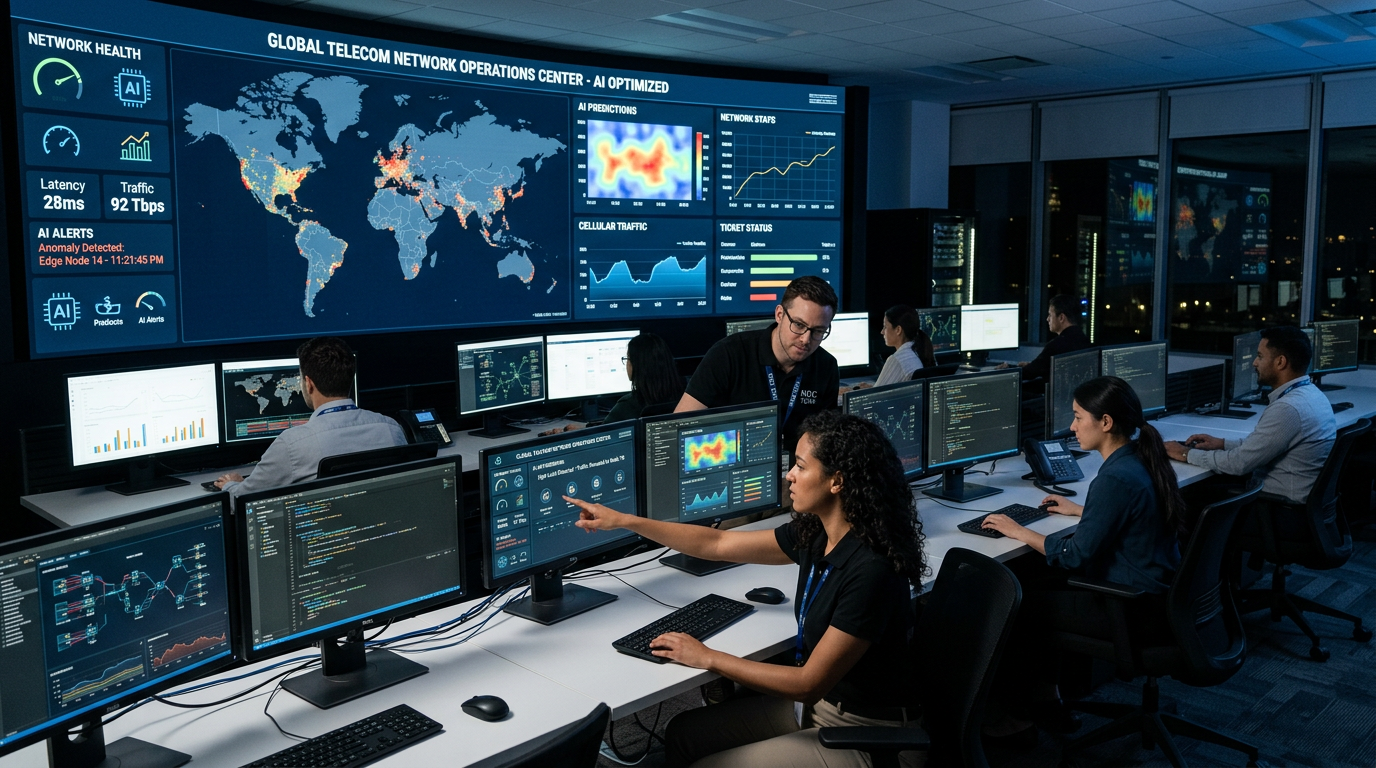
    Imagine walking into a telecom Network Operations Center at midnight.

    The video wall is alive with traffic maps, service health, customer experience and network performance.

    Thousands of network elements are operating.

    Millions of subscribers are connected.

    Somewhere in the network, congestion is beginning to develop.

    A cloud workload is behaving abnormally.

    A transport path is approaching a risk threshold.

    And yet the room is unusually quiet.

    Not because nothing is happening.

    Because the network is handling it.

    One system detects the abnormal behaviour.

    Another determines which services could be affected.

    The network evaluates possible actions.

    A Digital Twin tests the safest option.

    An AI agent coordinates the response.

    Automation executes the approved action.

    Service assurance verifies the result.

    The network learns from what happened.

    By the time an engineer looks at the event, the customer impact has already been prevented.

    This is the promise of a Level 5 autonomous network.

    It sounds impressive.

    It also raises an uncomfortable question:

    How much of this can telecom networks actually do today?

    Because there is a significant difference between automating network operations and creating a network that can truly operate autonomously.

    And that gap is where the real story begins.

    Level 5 Sounds Impressive. But Where Are We Today?

    The midnight NOC described above represents the destination.

    The reality today is more complicated.

    A telecom operator may already have sophisticated automation in one part of the network, predictive analytics in another, and largely manual processes somewhere else.

    A RAN optimization use case might operate with considerable autonomy, while a high-risk core-network change still requires several layers of human approval.

    In other words, a telecom network does not necessarily have one single autonomy level.

    Autonomy can vary by domain, process, use case and operational risk.

    This is why the journey from Level 0 to Level 5 is better understood as a progression of operational capabilities rather than simply a technology upgrade.

    From Human-Controlled to Self-Driving Networks

    LevelNetwork BehaviorWho Takes the Lead?
    Level 0 — ManualNetwork detects problems, but investigation and action are manual👤 Engineer
    Level 1 — AssistedTools provide alarms, insights and basic recommendations👤 Engineer + Tools
    Level 2 — AutomatedRepetitive tasks and predefined workflows run automatically⚙️ Automation
    Level 3 — Conditional AutonomyThe system analyzes situations and handles selected decisions🧠 AI + Automation
    Level 4 — High AutonomyIntelligent closed loops detect, decide, act and verify across defined areas🔄 Network + AI
    Level 5 — Full AutonomyThe network continuously learns, adapts and manages itself🚀 Autonomous Network

    Think of it like moving from a manually driven car toward a self-driving one.

    At the beginning, the human makes almost every decision.

    With each level, the system takes responsibility for more of the journey.

    But telecom networks have one major difference:

    Not every road has the same risk.

    Automatically optimizing radio resources is very different from automatically making a critical core-network change affecting millions of customers.

    That is why the real question may not be:

    “When will telecom reach Level 5?”

    It may be:

    “Where does Level 5 actually make sense?”

    So, Where Is the Telecom Industry Today?

    The journey from Level 0 to Level 5 looks simple on paper.

    But real telecom networks are much more complicated.

    An operator may have advanced automation in one part of the network, while another area still depends heavily on engineers and manual processes.

    For example, some activities in RAN optimization, energy management or fault handling can already run with a high level of automation.

    But a critical change in the Core Network may still require careful engineering review and approval.

    This means telecom operators are not moving toward autonomy at the same speed everywhere.

    The journey is happening use case by use case, and domain by domain.

    So where are operators today?

    Most telecom networks are not yet fully autonomous.

    Many operators are working around Level 2 and Level 3, while higher levels of autonomy are appearing in selected use cases and network domains.

    Level 4 is becoming the important next target.

    At this level, the network moves beyond basic automation. It can use intelligence and closed-loop processes to detect, analyze, decide, act and check the result with much less human involvement.

    But reaching Level 4 in one use case does not mean the entire network has reached Level 4.

    And this is where the challenge becomes interesting.

    Why Is Level 4 Such a Big Step?

    Imagine that a group of cell sites suddenly starts showing unusual performance degradation.

    In a Level 3 environment, the system may detect the abnormal behavior, correlate several alarms and KPIs, identify a likely cause, and recommend an action to the operations team.

    The engineer reviews the recommendation and decides whether to proceed.

    Now imagine the same situation in a Level 4 environment.

    The system detects the problem, understands the service impact, identifies the likely cause and selects an approved corrective action.

    It then executes the action automatically within predefined policies.

    But it does not stop there.

    It checks whether the action actually solved the problem.

    If network performance returns to normal, the loop is closed.

    If it does not, the system can reassess the situation or escalate it to the operations team.

    That ability to Detect → Decide → Act → Verify is what makes Level 4 much more powerful than simple automation.

    Level 3 helps the engineer make the decision. Level 4 increasingly allows the network to complete the operational loop.

    Which Parts of the Network Could Become Autonomous First?

    Not every part of a telecom network will reach higher autonomy at the same time.

    Some operations are repetitive, measurable and relatively low-risk, making them easier to automate.

    Others involve complex dependencies and much greater customer or business risk.

    This means the journey toward autonomous networks will probably happen domain by domain.

    Network AreaAutonomy OpportunityWhy?
    📡 RANHighContinuous optimization of traffic, capacity, interference and energy
    Energy ManagementHighClear patterns, measurable results and repeatable actions
    🔍 Service AssuranceHighAI can correlate alarms, detect anomalies and identify service impact
    🌐 Transport NetworkMedium–HighTraffic rerouting and capacity optimization can support closed loops
    ☁️ Cloud / Telco CloudMedium–HighWorkload scaling and resource optimization are highly programmable
    🧠 Core NetworkSelectiveAutomation is possible, but critical actions may carry much higher service risk

    This does not mean the Core Network cannot become highly autonomous.

    It means the acceptable level of autonomy may depend on the risk of the decision.

    Automatically optimizing energy usage is very different from automatically changing a critical routing, subscriber or policy function affecting millions of users.

    So perhaps the future is not:

    “Everything at Level 5.”

    It may be:

    “The right level of autonomy for the right operational decision.”

    Level 4 Is Starting to Move From Vision to Reality

    For many years, autonomous networks were mainly discussed as a future vision.

    That is beginning to change.

    Telecom operators are now testing and deploying higher levels of autonomy in specific network domains and operational use cases.

    The important point is that operators are not trying to make the entire network autonomous overnight.

    They are starting with areas where automation can deliver clear, measurable and controlled results.

    KDDI — Moving Network Optimization Toward Level 4

    In Japan, KDDI and Ericsson have been working on AI-driven network optimization as part of KDDI’s journey toward higher autonomous-network levels.

    A large-scale commercial-network trial used AI for uplink optimization across both 4G and 5G cells.

    The interesting part is not only the performance improvement.

    It shows how AI can increasingly analyze network conditions and support optimization across a large live network—one of the building blocks required for higher autonomy.

    China Mobile — Building Autonomy at Scale

    China Mobile has also been one of the operators actively developing autonomous-network capabilities across network operations.

    Its journey shows an important lesson:

    Autonomy becomes meaningful when it can move beyond individual automation scripts and operate across large, complex network environments.

    This requires much more than AI alone. It needs reliable data, automation platforms, operational policies and closed-loop assurance working together.

    Level 4 is not one technology. It is what happens when AI, automation, data and closed-loop operations begin working together.

    What Actually Makes Level 4 Possible?

    Level 4 does not come from adding one AI tool to the NOC.

    It happens when several capabilities begin working together.

    Network data provides visibility into what is happening.

    AIOps connects alarms, KPIs and events to identify what matters.

    AI and intelligent agents help understand the situation and determine possible actions.

    Network Digital Twins can help test selected decisions before they reach the live network.

    Automation executes approved actions.

    And closed-loop assurance checks whether the action actually worked.

    Together, they create something much more powerful than individual automation:

    Observe → Understand → Decide → Test → Act → Verify → Learn

    If any part of this chain is missing, true autonomy becomes much harder.

    A network that can detect a problem but cannot act is still dependent on humans.

    A network that can act but cannot verify the result is simply automated—not truly autonomous.

    The closed loop is what changes the game.

    NETWORK DATA

    AIOps

    AI / AGENTIC INTELLIGENCE

    DIGITAL TWIN
    Test the Decision

    AUTOMATION
    Execute Safely

    SERVICE ASSURANCE
    Did It Work?

    LEARN

    Do We Really Need Level 5 Everywhere?

    Level 5 sounds like the final destination.

    A network that can monitor, decide, act and learn with minimal human involvement appears to be the ultimate goal.

    But telecom operations are not all the same.

    Consider two decisions.

    Decision A: Reduce energy consumption at selected radio sites during very low traffic.

    Decision B: Make a major configuration change in the Core Network that could affect millions of subscribers.

    Both decisions can potentially use AI and automation.

    But should they have the same level of autonomy?

    Probably not.

    The first decision is repetitive, measurable and relatively easy to reverse.

    The second may carry much greater service and business risk.

    This suggests that the future autonomous network may not operate at one fixed level.

    Instead, autonomy could be based on risk, confidence and potential customer impact.

    The smartest autonomous network may not be the network that automates everything. It may be the network that knows what should—and should not—be autonomous.

    Type of DecisionPossible Approach
    Low risk + repetitiveHigher autonomy
    Predictable + reversibleClosed-loop automation
    Moderate riskAI recommendation + policy control
    High customer impactStronger validation
    Critical / irreversibleHuman approval may remain appropriate

    So perhaps Level 5 should not be treated as a target for every network action.

    The more practical goal may be something different:

    Maximum useful autonomy — with the right level of control.

    What Could the Autonomous NOC of 2030 Look Like?

    Now return to the NOC we imagined at the beginning.

    It is midnight.

    The network is busy, but the operations center feels different.

    Engineers are no longer spending most of their time moving between hundreds of alarms, dashboards and repetitive operational tasks.

    Many routine events are already being handled through intelligent closed loops.

    AIOps identifies what matters.

    AI analyzes the situation.

    Digital Twins test selected high-impact decisions.

    Automation executes approved actions.

    Service assurance checks the result.

    And unusual or high-risk situations are brought to the operations team with the context already available.

    The NOC has not disappeared.

    Its role has changed.

    Instead of managing every network event, operations teams increasingly manage exceptions, policies, risk and service outcomes.

    Perhaps this is a more realistic picture of the autonomous NOC.

    Not a network without people.

    And not a network where AI controls everything.

    But a network where machines handle more of what is predictable, while people focus on what requires judgment.

    The journey to autonomous networks is not about removing humans from operations. It is about removing unnecessary human intervention from operations.

    The Road to Level 5

    The journey toward autonomous networks has already started.

    Telecom operators are moving from manual operations toward automation, intelligence and increasingly closed-loop networks.

    But Level 5 will not arrive everywhere at the same time.

    Some network activities will become highly autonomous much faster than others.

    The real challenge is not simply adding more AI.

    It is building the right combination of trusted data, AIOps, automation, AI, governance and closed-loop assurance.

    And perhaps the biggest lesson is this:

    The goal should not be autonomy for the sake of autonomy.

    The goal should be a network that can make the right decision, at the right time, with the right level of human control.

    Level 5 may be the destination on the maturity model.

    But the real transformation happens in every step we take toward it.

    One of the most practical capabilities on this journey is the self-healing network—where AI can detect, diagnose and recover from network failures through governed closed-loop operations.

    “But the real transformation happens in every step we take toward it.”

    The next evolution may be intent-driven telecom operations, where operators define the required business outcome and AI helps translate it into coordinated network decisions.

    As networks progress toward higher levels of autonomy, cybersecurity must evolve with them. AI-driven decisions, automated actions and increasingly connected network domains require security controls that can detect threats, govern autonomous actions and protect services at machine speed.

    How Ready Is Your NOC for This Journey?

    Before planning for Level 4 or Level 5, operators first need to understand where their operations stand today.

    The TelcoMind AI — AI-Ready NOC Maturity Assessment helps evaluate NOC readiness across key areas including data, automation, AIOps, predictive operations, AI-assisted decision-making and closed-loop capabilities.

    Take the Free AI-Ready NOC Maturity Assessment →

    Discover your current maturity level and identify the areas that need attention on the journey toward intelligent and autonomous operations.

    References & Further Reading

    1. TM Forum — Autonomous Networks: Exploring the Evolution from Level 0 to Level 5

    This is the foundation for the six-level maturity framework used throughout the article. TM Forum describes the journey from Level 0 manual operations through Level 5 full autonomy.

    2. TM Forum — Assessing CSPs’ Progress Towards Level 4 Autonomous Networks

    This is especially useful because it’s from March 2026 and discusses operators increasingly validating Level 4 autonomy in specific network domains, rather than claiming whole networks are already Level 4.

    3. Ericsson & KDDI — AI Uplink Optimization Field Trial Toward Autonomous Networks Level 4

    This directly supports the KDDI example in our article. The 2026 commercial-network trial covered approximately 1,500 5G cells and 1,300 4G cells, and the AI optimization application was assessed at Level 3.86 using an adaptation of TM Forum’s methodology.

  • AI Use Cases in Telecom: 10 Real-World Applications Transforming Network Operations

    AI Use Cases in Telecom: 10 Real-World Applications Transforming Network Operations

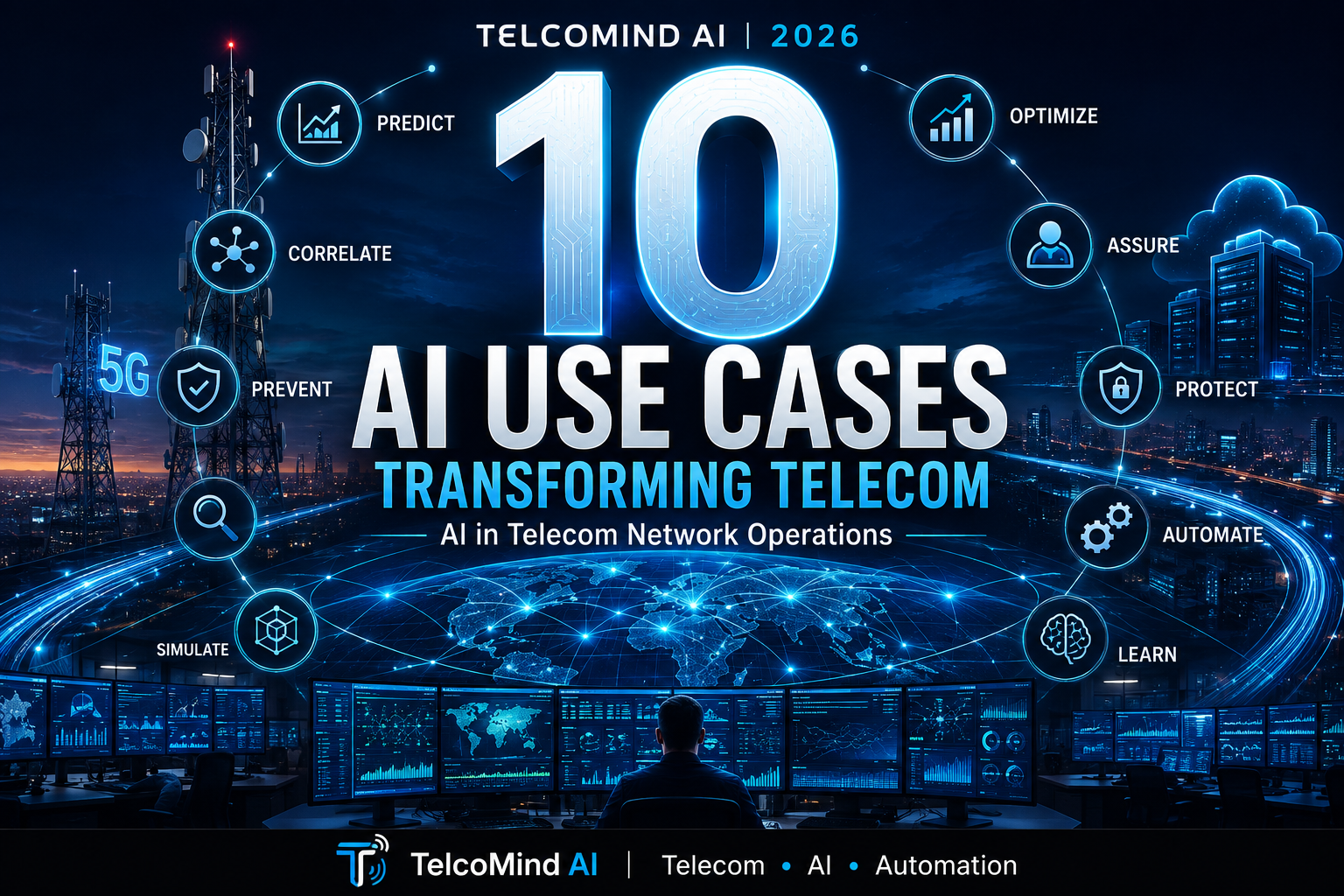
    AI use cases in telecom are moving beyond isolated automation toward intelligent network operations. Across the NOC, AI can help correlate alarms, predict failures, investigate root causes, optimize network performance and support increasingly autonomous operational decisions.

    2:17 AM in the NOC

    2:17 AM.

    The NOC is relatively quiet.

    Then the screens begin to change.

    A cluster of alarms appears from the transport network.

    Within seconds, additional alarms arrive from the RAN.

    Traffic begins shifting.

    A service-quality indicator starts deteriorating.

    The traditional response is familiar.

    Engineers open multiple monitoring systems, correlate alarms, check topology, review recent changes and begin tracing the problem across network domains.

    But imagine the same incident inside an AI-enabled telecom operation.

    Before the alarm flood overwhelms the screen, AI correlates hundreds of events into one probable incident.

    It identifies the most likely originating fault.

    It checks historical behaviour and predicts which services could be affected next.

    An AI agent begins gathering evidence across systems.

    A Digital Twin evaluates a proposed recovery action.

    And before any automated change reaches the production network, operational policies determine whether the action can proceed automatically or requires engineer approval.

    One incident.

    Several forms of intelligence.

    And this is where the conversation about AI in telecom becomes much more interesting than simply asking whether operators are “using AI.”

    The real question is no longer whether AI will enter telecom operations. It is where intelligence can create measurable operational value.

    AI in Telecom Is Moving Beyond a Single Use Case

    AI in telecom is not one technology solving one problem.

    It is increasingly appearing across different stages of the operational lifecycle—from detecting anomalies and predicting failures to investigating incidents, optimizing resources, testing network decisions and supporting controlled automation.

    Some of these capabilities are already deployed in operational environments. Others are still evolving toward broader scale and greater autonomy.

    For telecom operators, the opportunity is therefore not simply to “implement AI.”

    The more important question is:

    Where should AI be applied first, and what operational problem should it actually solve?

    AI in telecom is increasingly being applied across network operations to predict failures, correlate alarms, automate root-cause analysis, optimize 5G networks, reduce energy consumption, improve customer experience and enable increasingly autonomous operations. This article explores 10 practical AI use cases in telecom network operations and how they are changing the way modern networks are managed.

    The following ten use cases provide a practical view of where AI can create value across modern telecom network operations.

    10 AI Use Cases Transforming Telecom Network Operations

    1. Predictive Network Operations — See the Problem Before the Alarm

    raditional network operations often begin when something has already happened.

    A link goes down.

    A KPI crosses a threshold.

    Customers begin experiencing degradation.

    An alarm reaches the NOC.

    AI introduces a different possibility:

    What if the network could recognize the pattern before the failure becomes obvious?

    Imagine a transmission link that normally operates within stable performance boundaries.

    Nothing is down.

    No critical alarm exists.

    But over several days, AI detects a combination of small changes: increasing errors, unusual latency behaviour and a gradual shift from the link’s normal performance pattern.

    Individually, none of these signals may justify an incident.

    Together, they may tell a different story.

    AI can compare current behaviour with historical patterns and identify that the link is moving toward an abnormal condition.

    The NOC therefore receives something much more valuable than another alarm:

    An early warning—and time to act.

    This changes the operating model from:

    Failure → Alarm → Investigation → Recovery

    toward:

    Weak Signal → Prediction → Investigation → Preventive Action

    The objective is not to predict every network failure perfectly.

    It is to identify enough developing risks early enough that operations teams have more options before customers are affected.

    Deep Dive: We explored this transition in this article
    From Reactive NOC to Predictive Operations

    2. Intelligent Alarm Correlation & Root Cause Analysis — From Alarm Flood to One Story

    When a major network element fails, the first alarm is rarely the last.

    One fault can trigger alarms across transmission, RAN, core platforms and dependent services.

    The NOC may suddenly see hundreds of events even though the network has only one underlying problem.

    This is where AIOps can create immediate operational value.

    Instead of treating every alarm as an independent event, AI can correlate information using time, topology, dependency, historical patterns and network behaviour.

    Hundreds of alarms can potentially become:

    One incident. One probable root cause. One affected service picture.

    Imagine 300 sites becoming unreachable.

    Traditional monitoring may show hundreds of site alarms.

    But topology-aware correlation may identify that those sites share the same upstream transmission dependency.

    The question changes from:

    “Why are 300 sites down?”

    to:

    “What happened to the common dependency serving these 300 sites?”

    That is a very different investigation.

    AI does not create value simply by reducing the number of alarms on a screen.

    Its real value comes when it converts network noise into operational context.

    Deep Dive: Read Article
    AIOps — Autonomous Telecom Operations

    3. AI-Powered Preventive Maintenance — Fix It Before It Fails

    Prediction becomes much more valuable when it leads to action.

    Imagine a critical network element that has not failed yet.

    Its alarms are normal.

    Traffic is flowing.

    Customers are unaffected.

    But AI notices something different.

    Temperature behaviour is gradually changing.

    Error patterns are appearing more frequently.

    Performance after peak traffic is taking longer to return to normal.

    Historical data shows that similar behaviour has previously appeared before equipment degradation.

    The question is no longer:

    “Is this equipment down?”

    It becomes:

    “How long should we wait before this becomes a service-affecting problem?”

    This is where AI-powered preventive maintenance can change network operations.

    Instead of maintaining equipment only according to a fixed schedule—or waiting for failure—AI can help identify assets showing unusual behaviour and prioritize where technical attention is actually required.

    But identifying the risk is only half of the story.

    Operations still need to understand:

    Can maintenance be performed safely?

    Is redundancy available?

    What services depend on this asset?

    When is the lowest-risk maintenance window?

    What happens if we do nothing?

    Preventive maintenance therefore becomes more powerful when prediction is connected with network context, operational workflows and controlled action.

    The goal is simple:

    Move maintenance closer to the developing problem—and further away from the customer-impacting failure.

    Deep Dive: Read Article
    Preventive Maintenance Automation in Telecom

    4. Agentic AI — From Finding the Problem to Investigating It

    So far, AI has detected patterns, predicted risks and correlated alarms.

    But what happens when AI begins participating in the investigation itself?

    Consider a service degradation crossing several network domains.

    Instead of waiting for an engineer to manually open multiple tools, an AI agent could begin gathering the relevant evidence.

    It checks the alarms.

    It reviews performance trends.

    It examines topology.

    It looks at recent configuration changes.

    It checks whether similar incidents have occurred before.

    It identifies affected services.

    Then it brings those pieces together into a working hypothesis:

    “This is the probable cause, these services are at risk, and this is the recommended next action.”

    That is fundamentally different from a chatbot simply answering a question.

    Agentic AI introduces the idea of AI that can pursue an operational objective across multiple steps, using tools and information available within defined boundaries.

    For a telecom NOC, that could mean moving from:

    Engineer asks → AI answers

    toward:

    Network event → AI investigates → AI correlates → AI recommends → Engineer/policy validates → Action

    The important point is not removing the telecom professional from operations.

    It is reducing the amount of repetitive investigation required before expertise can be applied to the decision that actually matters.

    The value of an AI agent is not that it can replace the NOC. It is that it can help the NOC move faster from symptoms to understanding.

    Deep Dive: Read Article
    Agentic AI in Telecom Operations: From AI Assistance to Autonomous Action

    But Agentic AI creates a new challenge.

    If an AI agent recommends a network action, how do we know what that action will do before it reaches production?

    That takes us directly to our fifth use case.

    5. Network Digital Twins — Test the Decision Before Touching the Network

    An AI agent has investigated the problem.

    It understands the likely cause.

    And it recommends:

    “Move the affected traffic to the protection path.”

    Technically, the recommendation looks correct.

    But there is another question:

    What happens after the traffic moves?

    Could another interface become congested?

    Could an enterprise service sharing that route experience higher latency?

    Could solving one network problem quietly create another?

    This is where a Network Digital Twin introduces an interesting possibility.

    Instead of moving directly from:

    AI Recommendation → Live Execution

    the proposed action can first be evaluated against a digital representation of the network.

    AI Recommendation → Digital Twin → What-If Simulation → Risk Evaluation → Controlled Execution

    The purpose is not to predict the future perfectly.

    It is to discover more of the possible consequences before the production network discovers them for us.

    As telecom networks move toward greater autonomy, this capability could become increasingly important.

    AI may become better at deciding what should be done.

    Digital Twins could help answer:

    “What might happen if we do it?”

    Explore deeper: See how a Network Digital Twin can simulate network changes, predict potential impact and reduce operational risk before implementation.

    6. AI-RAN & 5G Optimization — When the Radio Network Starts Learning

    The RAN has always been one of the most dynamic parts of a mobile network.

    Traffic changes by location and time.

    Users move continuously between cells.

    Interference conditions change.

    Capacity demand shifts.

    Events can transform the traffic profile of an entire area within minutes.

    Traditional optimization therefore relies heavily on rules, thresholds, parameters and engineering expertise.

    AI introduces another layer.

    Instead of applying the same optimization logic repeatedly, machine-learning models can analyze network conditions and identify patterns across large numbers of cells.

    Imagine a busy 5G cluster during evening peak hours.

    One group of cells is becoming congested.

    Another has spare capacity.

    Cell-edge users are experiencing lower throughput.

    AI can analyze traffic distribution, radio conditions and historical behaviour and recommend how network resources could be optimized.

    The objective is not simply:

    “Increase capacity.”

    It is:

    “Use the available radio resources more intelligently as network conditions change.”

    This is already moving beyond laboratory discussion.

    Recent operator/vendor work is demonstrating AI-driven optimization directly in commercial mobile networks.

    For example, T-Mobile and Ericsson reported in 2026 that AI-powered RAN optimization trials on T-Mobile’s live 5G Advanced network achieved up to 15% higher downlink throughput and close to 10% improvement in spectral efficiency compared with legacy rule-based approaches.

    In another live-network example, KDDI and Ericsson reported an AI-driven uplink optimization field trial covering approximately 1,500 5G cells and 1,300 4G cells, with a reported 27% improvement in 5G uplink SINR.

    These examples matter because AI-RAN is beginning to demonstrate something measurable:

    AI is not only analyzing the radio network—it is increasingly influencing how radio resources are optimized.

    And this is where AI-RAN connects naturally with our previous use case.

    If AI proposes an optimization across hundreds or thousands of cells, a Digital Twin could potentially provide an environment to evaluate the wider consequences before selected changes reach production.

    AI-RAN asks: “How can we optimize this network?”

    The Digital Twin asks: “What else changes if we do?”

    Together, those capabilities point toward a much more adaptive 5G operating model.

         5G NETWORK STATE
                ↓
         AI / ML ANALYSIS
                ↓
     Traffic • SINR • Load
     Mobility • Interference
                ↓
        OPTIMIZATION MODEL
                ↓
       Proposed RAN Action
                ↓
        DIGITAL TWIN
           “What if?”
                ↓
        Controlled Change
                ↓
         Measure Result

    The future RAN may not simply be configured. It may continuously learn how to perform better.

    7. AI-Powered Energy Optimization — When the Network Learns When to Save

    A mobile network cannot simply switch itself off when traffic becomes quiet.

    Coverage must remain available.

    Critical services must continue.

    Customer experience cannot be sacrificed just to reduce the electricity bill.

    But network demand is far from constant.

    A cell carrying heavy traffic during the evening may be lightly loaded several hours later.

    Another site may experience completely different traffic behaviour.

    Yet network resources have traditionally been operated using relatively fixed configurations and predefined energy-saving rules.

    AI creates an opportunity to make this behaviour more adaptive.

    By learning traffic patterns, utilization behaviour and historical demand, AI can help determine where network resources are required—and where energy consumption may potentially be reduced without compromising service.

    Imagine a group of 5G sites after midnight.

    Traffic has fallen significantly.

    AI predicts that demand will remain low for the next several hours.

    Instead of keeping every available radio resource operating at the same level, selected resources can potentially enter energy-saving states while the remaining network continues serving the expected demand.

    But then traffic begins increasing earlier than usual.

    The model detects the change.

    Resources are restored before congestion develops.

    The objective is therefore not simply:

    “Use less energy.”

    It is:

    “Use energy when and where the network actually needs it.”

    This has direct business significance.

    Energy is a major operating cost for mobile networks, and AI-driven energy optimization can connect network intelligence with OPEX reduction and sustainability objectives.

    The value becomes measurable not only through network KPIs, but through energy saved, operating cost reduced and emissions avoided.

    That makes energy optimization one of the clearest examples of AI moving from a technology initiative toward a business outcome.

    A smarter network should not only know how to carry more traffic. It should also know when it does not need to consume the same resources.

    8. Customer Experience & Service Assurance — From “The Network Is Green” to “Is the Customer Okay?”

    Every NOC engineer has seen some version of this situation.

    The dashboard looks healthy.

    Major network elements are green.

    No critical outage is visible.

    Yet customers are complaining.

    A video call is freezing.

    Gaming latency has increased.

    An enterprise application feels slow.

    A group of 5G users is experiencing poor throughput.

    From an infrastructure perspective, the network may appear available.

    From the customer’s perspective, something is clearly wrong.

    This exposes one of the limitations of traditional network assurance:

    Network availability and customer experience are not always the same thing.

    AI can help connect information that traditionally lives in different operational environments.

    Network KPIs.

    Service performance.

    Device behaviour.

    Location.

    Traffic patterns.

    Customer complaints.

    Historical incidents.

    Service dependencies.

    Instead of asking only:

    “Which network element has an alarm?”

    an AI-enabled assurance system can increasingly ask:

    “Which customers and services are experiencing degradation—and what network condition is most likely responsible?”

    The Customer May Become the Alarm

    Imagine that no critical network alarm exists.

    But AI detects a sudden deterioration in video-session quality across users connected to a particular geographic area.

    At the same time, latency has begun increasing along a shared service path.

    Individually, neither condition may cross a traditional critical threshold.

    Together, they indicate that customer experience is deteriorating.

    The NOC can therefore begin investigating before complaint volumes become the primary indication of the problem.

    This changes service assurance from infrastructure-centric monitoring toward experience-aware operations.

    And commercially, this matters enormously.

    Customers do not buy a green network dashboard.

    They buy connectivity, applications, voice, video, gaming, enterprise services and digital experiences.

    The closer AI can bring network operations to understanding those experiences, the closer network intelligence moves toward actual business value.

    The ultimate network KPI may not be whether every element is green—but whether the customer experience is healthy.

    So far, AI has helped us predict failures, understand incidents, optimize resources, reduce energy consumption and protect customer experience.

    But increasingly intelligent networks also create another requirement:

    They must become better at recognizing threats.

    9. AI-Powered Network Security — Finding the Behaviour That Doesn’t Belong

    Telecom networks generate enormous volumes of traffic and operational data every second.

    Somewhere inside that normal activity, a security threat may begin with something very small.

    An unusual traffic pattern.

    An unexpected increase in requests.

    Abnormal signalling behaviour.

    A device communicating differently from its historical pattern.

    Or traffic suddenly appearing from an unexpected source.

    Traditional security controls remain essential, but many depend on known signatures, predefined rules and thresholds.

    AI introduces another capability:

    Learning what normal behaviour looks like—and identifying when something begins to move away from it.

    Imagine signalling traffic suddenly increasing across part of the network.

    No single event appears catastrophic.

    But AI detects that the volume, timing and distribution are significantly different from the normal pattern.

    It correlates the anomaly with other network and security information and raises the event for investigation before the condition develops further.

    This does not mean AI independently decides that every anomaly is an attack.

    Networks naturally produce unusual behaviour during major events, software changes, failures and sudden traffic shifts.

    Context therefore matters.

    The value comes from helping security and operations teams move faster from:

    Millions of events → Unusual behaviour → Correlated evidence → Prioritized investigation

    As telecom networks become increasingly software-defined, cloud-native and API-driven, the ability to detect abnormal behaviour quickly will become even more important.

    The same intelligence helping us understand network performance can also help us recognize when the network is behaving in a way it should not.

    10. Autonomous Network Operations — When the Pieces Begin Working Together

    Now bring the previous nine use cases together.

    A network condition begins changing.

    Predictive analytics detects the weak signal.

    AIOps correlates the resulting events.

    Agentic AI investigates the probable cause.

    Service assurance identifies the customers and services at risk.

    An AI agent develops a recommended action.

    The Network Digital Twin evaluates what may happen if that action is executed.

    Operational policies determine whether the action requires approval or can proceed automatically.

    Automation executes the approved change.

    The live network is monitored again.

    Performance improves.

    Customer experience recovers.

    And the difference between the expected and actual result becomes new information for the next decision.

    This is where the individual AI use cases begin to look less like separate tools and more like parts of a future operating model.

    The journey can be represented simply:

    Observe → Predict → Understand → Decide → Simulate → Execute → Validate → Learn

    This is the direction behind the industry’s movement toward increasingly autonomous networks.

    But autonomy should not be confused with removing all human involvement.

    Different network actions carry very different levels of risk.

    Automatically adjusting a low-risk optimization parameter is not the same as changing a critical core-network configuration.

    The practical journey toward autonomy will therefore require policy boundaries, governance, confidence levels, rollback mechanisms and appropriate human authorization based on the risk of the action.

    The most mature autonomous network may therefore not be the one that performs the greatest number of actions without people.

    It may be the one that understands:

    what it can do automatically,

    what it should test first,

    what requires expert approval,

    and

    how to verify that the action actually worked.

    That is a much more meaningful form of network autonomy.

              AI IN TELECOM OPERATIONS
    
                       NETWORK
                          │
                          ▼
                  1. PREDICT
                          │
                  2. CORRELATE
                          │
                  3. PREVENT
                          │
                  4. INVESTIGATE
                          │
                  5. SIMULATE
                          │
                  6. OPTIMIZE RAN
                          │
                  7. OPTIMIZE ENERGY
                          │
                  8. PROTECT EXPERIENCE
                          │
                  9. DETECT THREATS
                          │
                         10.
                  AUTONOMOUS ACTION
                          │
                          ▼
                     VALIDATE
                          │
                          ▼
                       LEARN

    AI in telecom is not one use case. Its real potential appears when intelligence begins connecting decisions across the operational lifecycle.

    10 AI Use Cases in Telecom at a Glance

    AI Use CaseOperational ProblemWhat AI BringsPotential Business Value
    1. Predictive OperationsProblems discovered after degradationEarly anomaly and risk detectionFewer service-impacting incidents
    2. Alarm Correlation & RCAAlarm floods and slow troubleshootingEvent correlation and probable root causeLower MTTR and faster response
    3. Preventive MaintenanceReactive/fixed maintenanceFailure-risk prediction and prioritizationBetter availability and maintenance efficiency
    4. Agentic AIManual multi-tool investigationMulti-step investigation and recommendationsFaster operational decisions
    5. Network Digital TwinRisk of changes affecting productionWhat-if simulation before executionSafer network changes
    6. AI-RAN & 5G OptimizationDynamic traffic and radio conditionsAdaptive resource optimizationBetter capacity and network performance
    7. Energy OptimizationHigh network energy consumptionDemand-aware resource managementLower OPEX and energy consumption
    8. Customer Experience AssuranceHealthy KPIs but poor user experienceNetwork-to-service correlationBetter customer experience
    9. AI-Powered SecurityMassive volumes of security/network eventsBehavioural anomaly detectionEarlier threat identification
    10. Autonomous OperationsManual operational loopsDecision, execution and validation loopsGreater operational efficiency and scalability

    The important point is that these use cases should not be viewed as ten isolated AI projects.

    Their greater value may emerge when they begin sharing network context, operational data and decision workflows.

    Predictive analytics identifies the risk.

    AIOps provides context.

    Agentic AI investigates.

    A Digital Twin tests the proposed response.

    Automation executes within defined boundaries.

    Service assurance verifies the outcome.

    That is when AI begins moving from individual tools toward an intelligent operating model.

    Frequently Asked Questions About AI in Telecom

    How is AI used in telecom network operations?

    AI is used across telecom operations for anomaly detection, predictive maintenance, alarm correlation, root-cause analysis, RAN optimization, capacity forecasting, energy optimization, customer-experience assurance, security analytics and network automation. Increasingly, AI agents are also being explored for multi-step operational investigation and decision support.

    What is AIOps in telecom?

    AIOps combines AI, machine learning and operational data to help telecom teams understand large volumes of network events. In a NOC environment, it can support alarm correlation, anomaly detection, probable root-cause identification, incident prioritization and automated operational workflows.

    What is Agentic AI in telecom?

    Agentic AI goes beyond generating answers. An AI agent can potentially pursue an operational objective across multiple steps—for example, gathering alarms, checking topology, reviewing performance, examining recent changes and developing a recommended response within defined operational boundaries.

    How can AI improve 5G networks?

    AI can analyze changing traffic, radio conditions, interference, mobility and utilization to support more adaptive 5G optimization. Current industry trials are already demonstrating measurable improvements from AI-driven RAN optimization.

    What is a Network Digital Twin?

    A Network Digital Twin is a dynamic digital representation of a telecom network that can help operators understand network conditions and evaluate what-if scenarios. One emerging application is testing a proposed AI or automation action before applying it to the production network.

    Will AI replace telecom NOC engineers?

    The more realistic transformation is a change in how operational work is divided. AI can increasingly handle repetitive correlation, data gathering, pattern detection and workflow execution, while telecom professionals remain critical for complex engineering judgment, governance, architecture, risk management and high-impact decisions.

    Can telecom networks become fully autonomous?

    Increasing levels of autonomy are technically possible, but telecom networks contain actions with very different risk levels. The journey will therefore likely be progressive, combining AI, automation, Digital Twins, policies, rollback mechanisms and human authorization according to the operational risk involved.

    Where Does Telecom Go From Here?

    The telecom industry has spent decades making networks faster, larger and more connected.

    The next challenge may be making them more intelligent.

    Not intelligence for its own sake.

    Intelligence that can recognize a developing problem.

    Understand what is happening.

    Predict what may happen next.

    Recommend an appropriate response.

    Test the consequence.

    Act within defined boundaries.

    And verify whether the customer actually benefited.

    The ten use cases in this article represent different stages of that journey.

    Some are already delivering value in live networks.

    Others are still developing.

    But together they point toward a telecom operating model where AI increasingly becomes part of how networks are observed, optimized, protected and operated.

    And perhaps the biggest transformation will not be a single AI technology.

    It will be what happens when all these forms of intelligence begin working together.

    The future telecom network will not simply carry intelligence. Increasingly, intelligence will help operate the network itself.

    TelcoMind AI | Telecom • AI • Automation

    Where Does Your NOC Stand Today?

    Understanding AI use cases is the first step. The next is knowing which capabilities your NOC already has—and where the biggest gaps remain.

    Use the free TelcoMind AI NOC Maturity Assessment to evaluate your operations across 8 critical dimensions and identify where your NOC stands on the journey from Reactive → Automated → Predictive → Intelligent → Autonomous.

    Take the Free NOC AI Maturity Assessment →

  • AI Use Cases in Telecom: 10 Real-World Applications Transforming Network Operations

    AI Use Cases in Telecom: 10 Real-World Applications Transforming Network Operations

    AI use cases in telecom are moving beyond isolated automation toward intelligent network operations. Across the NOC, AI can help correlate alarms, predict failures, investigate root causes, optimize network performance and support increasingly autonomous operational decisions.

    2:17 AM in the NOC

    2:17 AM.

    The NOC is relatively quiet.

    Then the screens begin to change.

    A cluster of alarms appears from the transport network.

    Within seconds, additional alarms arrive from the RAN.

    Traffic begins shifting.

    A service-quality indicator starts deteriorating.

    The traditional response is familiar.

    Engineers open multiple monitoring systems, correlate alarms, check topology, review recent changes and begin tracing the problem across network domains.

    But imagine the same incident inside an AI-enabled telecom operation.

    Before the alarm flood overwhelms the screen, AI correlates hundreds of events into one probable incident.

    It identifies the most likely originating fault.

    It checks historical behaviour and predicts which services could be affected next.

    An AI agent begins gathering evidence across systems.

    A Digital Twin evaluates a proposed recovery action.

    And before any automated change reaches the production network, operational policies determine whether the action can proceed automatically or requires engineer approval.

    One incident.

    Several forms of intelligence.

    And this is where the conversation about AI in telecom becomes much more interesting than simply asking whether operators are “using AI.”

    The real question is no longer whether AI will enter telecom operations. It is where intelligence can create measurable operational value.

    AI in Telecom Is Moving Beyond a Single Use Case

    AI in telecom is not one technology solving one problem.

    It is increasingly appearing across different stages of the operational lifecycle—from detecting anomalies and predicting failures to investigating incidents, optimizing resources, testing network decisions and supporting controlled automation.

    Some of these capabilities are already deployed in operational environments. Others are still evolving toward broader scale and greater autonomy.

    For telecom operators, the opportunity is therefore not simply to “implement AI.”

    The more important question is:

    Where should AI be applied first, and what operational problem should it actually solve?

    AI in telecom is increasingly being applied across network operations to predict failures, correlate alarms, automate root-cause analysis, optimize 5G networks, reduce energy consumption, improve customer experience and enable increasingly autonomous operations. This article explores 10 practical AI use cases in telecom network operations and how they are changing the way modern networks are managed.

    The following ten use cases provide a practical view of where AI can create value across modern telecom network operations.

    10 AI Use Cases Transforming Telecom Network Operations

    1. Predictive Network Operations — See the Problem Before the Alarm

    raditional network operations often begin when something has already happened.

    A link goes down.

    A KPI crosses a threshold.

    Customers begin experiencing degradation.

    An alarm reaches the NOC.

    AI introduces a different possibility:

    What if the network could recognize the pattern before the failure becomes obvious?

    Imagine a transmission link that normally operates within stable performance boundaries.

    Nothing is down.

    No critical alarm exists.

    But over several days, AI detects a combination of small changes: increasing errors, unusual latency behaviour and a gradual shift from the link’s normal performance pattern.

    Individually, none of these signals may justify an incident.

    Together, they may tell a different story.

    AI can compare current behaviour with historical patterns and identify that the link is moving toward an abnormal condition.

    The NOC therefore receives something much more valuable than another alarm:

    An early warning—and time to act.

    This changes the operating model from:

    Failure → Alarm → Investigation → Recovery

    toward:

    Weak Signal → Prediction → Investigation → Preventive Action

    The objective is not to predict every network failure perfectly.

    It is to identify enough developing risks early enough that operations teams have more options before customers are affected.

    Deep Dive: We explored this transition in this article
    From Reactive NOC to Predictive Operations

    2. Intelligent Alarm Correlation & Root Cause Analysis — From Alarm Flood to One Story

    When a major network element fails, the first alarm is rarely the last.

    One fault can trigger alarms across transmission, RAN, core platforms and dependent services.

    The NOC may suddenly see hundreds of events even though the network has only one underlying problem.

    This is where AIOps can create immediate operational value.

    Instead of treating every alarm as an independent event, AI can correlate information using time, topology, dependency, historical patterns and network behaviour.

    Hundreds of alarms can potentially become:

    One incident. One probable root cause. One affected service picture.

    Imagine 300 sites becoming unreachable.

    Traditional monitoring may show hundreds of site alarms.

    But topology-aware correlation may identify that those sites share the same upstream transmission dependency.

    The question changes from:

    “Why are 300 sites down?”

    to:

    “What happened to the common dependency serving these 300 sites?”

    That is a very different investigation.

    AI does not create value simply by reducing the number of alarms on a screen.

    Its real value comes when it converts network noise into operational context.

    Deep Dive: Read Article
    AIOps — Autonomous Telecom Operations

    3. AI-Powered Preventive Maintenance — Fix It Before It Fails

    Prediction becomes much more valuable when it leads to action.

    Imagine a critical network element that has not failed yet.

    Its alarms are normal.

    Traffic is flowing.

    Customers are unaffected.

    But AI notices something different.

    Temperature behaviour is gradually changing.

    Error patterns are appearing more frequently.

    Performance after peak traffic is taking longer to return to normal.

    Historical data shows that similar behaviour has previously appeared before equipment degradation.

    The question is no longer:

    “Is this equipment down?”

    It becomes:

    “How long should we wait before this becomes a service-affecting problem?”

    This is where AI-powered preventive maintenance can change network operations.

    Instead of maintaining equipment only according to a fixed schedule—or waiting for failure—AI can help identify assets showing unusual behaviour and prioritize where technical attention is actually required.

    But identifying the risk is only half of the story.

    Operations still need to understand:

    Can maintenance be performed safely?

    Is redundancy available?

    What services depend on this asset?

    When is the lowest-risk maintenance window?

    What happens if we do nothing?

    Preventive maintenance therefore becomes more powerful when prediction is connected with network context, operational workflows and controlled action.

    The goal is simple:

    Move maintenance closer to the developing problem—and further away from the customer-impacting failure.

    Deep Dive: Read Article
    Preventive Maintenance Automation in Telecom

    4. Agentic AI — From Finding the Problem to Investigating It

    So far, AI has detected patterns, predicted risks and correlated alarms.

    But what happens when AI begins participating in the investigation itself?

    Consider a service degradation crossing several network domains.

    Instead of waiting for an engineer to manually open multiple tools, an AI agent could begin gathering the relevant evidence.

    It checks the alarms.

    It reviews performance trends.

    It examines topology.

    It looks at recent configuration changes.

    It checks whether similar incidents have occurred before.

    It identifies affected services.

    Then it brings those pieces together into a working hypothesis:

    “This is the probable cause, these services are at risk, and this is the recommended next action.”

    That is fundamentally different from a chatbot simply answering a question.

    Agentic AI introduces the idea of AI that can pursue an operational objective across multiple steps, using tools and information available within defined boundaries.

    For a telecom NOC, that could mean moving from:

    Engineer asks → AI answers

    toward:

    Network event → AI investigates → AI correlates → AI recommends → Engineer/policy validates → Action

    The important point is not removing the telecom professional from operations.

    It is reducing the amount of repetitive investigation required before expertise can be applied to the decision that actually matters.

    The value of an AI agent is not that it can replace the NOC. It is that it can help the NOC move faster from symptoms to understanding.

    Deep Dive: Read Article
    Agentic AI in Telecom Operations: From AI Assistance to Autonomous Action

    But Agentic AI creates a new challenge.

    If an AI agent recommends a network action, how do we know what that action will do before it reaches production?

    That takes us directly to our fifth use case.

    5. Network Digital Twins — Test the Decision Before Touching the Network

    An AI agent has investigated the problem.

    It understands the likely cause.

    And it recommends:

    “Move the affected traffic to the protection path.”

    Technically, the recommendation looks correct.

    But there is another question:

    What happens after the traffic moves?

    Could another interface become congested?

    Could an enterprise service sharing that route experience higher latency?

    Could solving one network problem quietly create another?

    This is where a Network Digital Twin introduces an interesting possibility.

    Instead of moving directly from:

    AI Recommendation → Live Execution

    the proposed action can first be evaluated against a digital representation of the network.

    AI Recommendation → Digital Twin → What-If Simulation → Risk Evaluation → Controlled Execution

    The purpose is not to predict the future perfectly.

    It is to discover more of the possible consequences before the production network discovers them for us.

    As telecom networks move toward greater autonomy, this capability could become increasingly important.

    AI may become better at deciding what should be done.

    Digital Twins could help answer:

    “What might happen if we do it?”

    Explore deeper: See how a Network Digital Twin can simulate network changes, predict potential impact and reduce operational risk before implementation.

    6. AI-RAN & 5G Optimization — When the Radio Network Starts Learning

    The RAN has always been one of the most dynamic parts of a mobile network.

    Traffic changes by location and time.

    Users move continuously between cells.

    Interference conditions change.

    Capacity demand shifts.

    Events can transform the traffic profile of an entire area within minutes.

    Traditional optimization therefore relies heavily on rules, thresholds, parameters and engineering expertise.

    AI introduces another layer.

    Instead of applying the same optimization logic repeatedly, machine-learning models can analyze network conditions and identify patterns across large numbers of cells.

    Imagine a busy 5G cluster during evening peak hours.

    One group of cells is becoming congested.

    Another has spare capacity.

    Cell-edge users are experiencing lower throughput.

    AI can analyze traffic distribution, radio conditions and historical behaviour and recommend how network resources could be optimized.

    The objective is not simply:

    “Increase capacity.”

    It is:

    “Use the available radio resources more intelligently as network conditions change.”

    This is already moving beyond laboratory discussion.

    Recent operator/vendor work is demonstrating AI-driven optimization directly in commercial mobile networks.

    For example, T-Mobile and Ericsson reported in 2026 that AI-powered RAN optimization trials on T-Mobile’s live 5G Advanced network achieved up to 15% higher downlink throughput and close to 10% improvement in spectral efficiency compared with legacy rule-based approaches.

    In another live-network example, KDDI and Ericsson reported an AI-driven uplink optimization field trial covering approximately 1,500 5G cells and 1,300 4G cells, with a reported 27% improvement in 5G uplink SINR.

    These examples matter because AI-RAN is beginning to demonstrate something measurable:

    AI is not only analyzing the radio network—it is increasingly influencing how radio resources are optimized.

    And this is where AI-RAN connects naturally with our previous use case.

    If AI proposes an optimization across hundreds or thousands of cells, a Digital Twin could potentially provide an environment to evaluate the wider consequences before selected changes reach production.

    AI-RAN asks: “How can we optimize this network?”

    The Digital Twin asks: “What else changes if we do?”

    Together, those capabilities point toward a much more adaptive 5G operating model.

         5G NETWORK STATE
                ↓
         AI / ML ANALYSIS
                ↓
     Traffic • SINR • Load
     Mobility • Interference
                ↓
        OPTIMIZATION MODEL
                ↓
       Proposed RAN Action
                ↓
        DIGITAL TWIN
           “What if?”
                ↓
        Controlled Change
                ↓
         Measure Result

    The future RAN may not simply be configured. It may continuously learn how to perform better.

    7. AI-Powered Energy Optimization — When the Network Learns When to Save

    A mobile network cannot simply switch itself off when traffic becomes quiet.

    Coverage must remain available.

    Critical services must continue.

    Customer experience cannot be sacrificed just to reduce the electricity bill.

    But network demand is far from constant.

    A cell carrying heavy traffic during the evening may be lightly loaded several hours later.

    Another site may experience completely different traffic behaviour.

    Yet network resources have traditionally been operated using relatively fixed configurations and predefined energy-saving rules.

    AI creates an opportunity to make this behaviour more adaptive.

    By learning traffic patterns, utilization behaviour and historical demand, AI can help determine where network resources are required—and where energy consumption may potentially be reduced without compromising service.

    Imagine a group of 5G sites after midnight.

    Traffic has fallen significantly.

    AI predicts that demand will remain low for the next several hours.

    Instead of keeping every available radio resource operating at the same level, selected resources can potentially enter energy-saving states while the remaining network continues serving the expected demand.

    But then traffic begins increasing earlier than usual.

    The model detects the change.

    Resources are restored before congestion develops.

    The objective is therefore not simply:

    “Use less energy.”

    It is:

    “Use energy when and where the network actually needs it.”

    This has direct business significance.

    Energy is a major operating cost for mobile networks, and AI-driven energy optimization can connect network intelligence with OPEX reduction and sustainability objectives.

    The value becomes measurable not only through network KPIs, but through energy saved, operating cost reduced and emissions avoided.

    That makes energy optimization one of the clearest examples of AI moving from a technology initiative toward a business outcome.

    A smarter network should not only know how to carry more traffic. It should also know when it does not need to consume the same resources.

    8. Customer Experience & Service Assurance — From “The Network Is Green” to “Is the Customer Okay?”

    Every NOC engineer has seen some version of this situation.

    The dashboard looks healthy.

    Major network elements are green.

    No critical outage is visible.

    Yet customers are complaining.

    A video call is freezing.

    Gaming latency has increased.

    An enterprise application feels slow.

    A group of 5G users is experiencing poor throughput.

    From an infrastructure perspective, the network may appear available.

    From the customer’s perspective, something is clearly wrong.

    This exposes one of the limitations of traditional network assurance:

    Network availability and customer experience are not always the same thing.

    AI can help connect information that traditionally lives in different operational environments.

    Network KPIs.

    Service performance.

    Device behaviour.

    Location.

    Traffic patterns.

    Customer complaints.

    Historical incidents.

    Service dependencies.

    Instead of asking only:

    “Which network element has an alarm?”

    an AI-enabled assurance system can increasingly ask:

    “Which customers and services are experiencing degradation—and what network condition is most likely responsible?”

    The Customer May Become the Alarm

    Imagine that no critical network alarm exists.

    But AI detects a sudden deterioration in video-session quality across users connected to a particular geographic area.

    At the same time, latency has begun increasing along a shared service path.

    Individually, neither condition may cross a traditional critical threshold.

    Together, they indicate that customer experience is deteriorating.

    The NOC can therefore begin investigating before complaint volumes become the primary indication of the problem.

    This changes service assurance from infrastructure-centric monitoring toward experience-aware operations.

    And commercially, this matters enormously.

    Customers do not buy a green network dashboard.

    They buy connectivity, applications, voice, video, gaming, enterprise services and digital experiences.

    The closer AI can bring network operations to understanding those experiences, the closer network intelligence moves toward actual business value.

    The ultimate network KPI may not be whether every element is green—but whether the customer experience is healthy.

    So far, AI has helped us predict failures, understand incidents, optimize resources, reduce energy consumption and protect customer experience.

    But increasingly intelligent networks also create another requirement:

    They must become better at recognizing threats.

    9. AI-Powered Network Security — Finding the Behaviour That Doesn’t Belong

    Telecom networks generate enormous volumes of traffic and operational data every second.

    Somewhere inside that normal activity, a security threat may begin with something very small.

    An unusual traffic pattern.

    An unexpected increase in requests.

    Abnormal signalling behaviour.

    A device communicating differently from its historical pattern.

    Or traffic suddenly appearing from an unexpected source.

    Traditional security controls remain essential, but many depend on known signatures, predefined rules and thresholds.

    AI introduces another capability:

    Learning what normal behaviour looks like—and identifying when something begins to move away from it.

    Imagine signalling traffic suddenly increasing across part of the network.

    No single event appears catastrophic.

    But AI detects that the volume, timing and distribution are significantly different from the normal pattern.

    It correlates the anomaly with other network and security information and raises the event for investigation before the condition develops further.

    This does not mean AI independently decides that every anomaly is an attack.

    Networks naturally produce unusual behaviour during major events, software changes, failures and sudden traffic shifts.

    Context therefore matters.

    The value comes from helping security and operations teams move faster from:

    Millions of events → Unusual behaviour → Correlated evidence → Prioritized investigation

    As telecom networks become increasingly software-defined, cloud-native and API-driven, the ability to detect abnormal behaviour quickly will become even more important.

    The same intelligence helping us understand network performance can also help us recognize when the network is behaving in a way it should not.

    10. Autonomous Network Operations — When the Pieces Begin Working Together

    Now bring the previous nine use cases together.

    A network condition begins changing.

    Predictive analytics detects the weak signal.

    AIOps correlates the resulting events.

    Agentic AI investigates the probable cause.

    Service assurance identifies the customers and services at risk.

    An AI agent develops a recommended action.

    The Network Digital Twin evaluates what may happen if that action is executed.

    Operational policies determine whether the action requires approval or can proceed automatically.

    Automation executes the approved change.

    The live network is monitored again.

    Performance improves.

    Customer experience recovers.

    And the difference between the expected and actual result becomes new information for the next decision.

    This is where the individual AI use cases begin to look less like separate tools and more like parts of a future operating model.

    The journey can be represented simply:

    Observe → Predict → Understand → Decide → Simulate → Execute → Validate → Learn

    This is the direction behind the industry’s movement toward increasingly autonomous networks.

    But autonomy should not be confused with removing all human involvement.

    Different network actions carry very different levels of risk.

    Automatically adjusting a low-risk optimization parameter is not the same as changing a critical core-network configuration.

    The practical journey toward autonomy will therefore require policy boundaries, governance, confidence levels, rollback mechanisms and appropriate human authorization based on the risk of the action.

    The most mature autonomous network may therefore not be the one that performs the greatest number of actions without people.

    It may be the one that understands:

    what it can do automatically,

    what it should test first,

    what requires expert approval,

    and

    how to verify that the action actually worked.

    That is a much more meaningful form of network autonomy.

              AI IN TELECOM OPERATIONS
    
                       NETWORK
                          │
                          ▼
                  1. PREDICT
                          │
                  2. CORRELATE
                          │
                  3. PREVENT
                          │
                  4. INVESTIGATE
                          │
                  5. SIMULATE
                          │
                  6. OPTIMIZE RAN
                          │
                  7. OPTIMIZE ENERGY
                          │
                  8. PROTECT EXPERIENCE
                          │
                  9. DETECT THREATS
                          │
                         10.
                  AUTONOMOUS ACTION
                          │
                          ▼
                     VALIDATE
                          │
                          ▼
                       LEARN

    AI in telecom is not one use case. Its real potential appears when intelligence begins connecting decisions across the operational lifecycle.

    10 AI Use Cases in Telecom at a Glance

    AI Use CaseOperational ProblemWhat AI BringsPotential Business Value
    1. Predictive OperationsProblems discovered after degradationEarly anomaly and risk detectionFewer service-impacting incidents
    2. Alarm Correlation & RCAAlarm floods and slow troubleshootingEvent correlation and probable root causeLower MTTR and faster response
    3. Preventive MaintenanceReactive/fixed maintenanceFailure-risk prediction and prioritizationBetter availability and maintenance efficiency
    4. Agentic AIManual multi-tool investigationMulti-step investigation and recommendationsFaster operational decisions
    5. Network Digital TwinRisk of changes affecting productionWhat-if simulation before executionSafer network changes
    6. AI-RAN & 5G OptimizationDynamic traffic and radio conditionsAdaptive resource optimizationBetter capacity and network performance
    7. Energy OptimizationHigh network energy consumptionDemand-aware resource managementLower OPEX and energy consumption
    8. Customer Experience AssuranceHealthy KPIs but poor user experienceNetwork-to-service correlationBetter customer experience
    9. AI-Powered SecurityMassive volumes of security/network eventsBehavioural anomaly detectionEarlier threat identification
    10. Autonomous OperationsManual operational loopsDecision, execution and validation loopsGreater operational efficiency and scalability

    The important point is that these use cases should not be viewed as ten isolated AI projects.

    Their greater value may emerge when they begin sharing network context, operational data and decision workflows.

    Predictive analytics identifies the risk.

    AIOps provides context.

    Agentic AI investigates.

    A Digital Twin tests the proposed response.

    Automation executes within defined boundaries.

    Service assurance verifies the outcome.

    That is when AI begins moving from individual tools toward an intelligent operating model.

    Frequently Asked Questions About AI in Telecom

    How is AI used in telecom network operations?

    AI is used across telecom operations for anomaly detection, predictive maintenance, alarm correlation, root-cause analysis, RAN optimization, capacity forecasting, energy optimization, customer-experience assurance, security analytics and network automation. Increasingly, AI agents are also being explored for multi-step operational investigation and decision support.

    What is AIOps in telecom?

    AIOps combines AI, machine learning and operational data to help telecom teams understand large volumes of network events. In a NOC environment, it can support alarm correlation, anomaly detection, probable root-cause identification, incident prioritization and automated operational workflows.

    What is Agentic AI in telecom?

    Agentic AI goes beyond generating answers. An AI agent can potentially pursue an operational objective across multiple steps—for example, gathering alarms, checking topology, reviewing performance, examining recent changes and developing a recommended response within defined operational boundaries.

    How can AI improve 5G networks?

    AI can analyze changing traffic, radio conditions, interference, mobility and utilization to support more adaptive 5G optimization. Current industry trials are already demonstrating measurable improvements from AI-driven RAN optimization.

    What is a Network Digital Twin?

    A Network Digital Twin is a dynamic digital representation of a telecom network that can help operators understand network conditions and evaluate what-if scenarios. One emerging application is testing a proposed AI or automation action before applying it to the production network.

    Will AI replace telecom NOC engineers?

    The more realistic transformation is a change in how operational work is divided. AI can increasingly handle repetitive correlation, data gathering, pattern detection and workflow execution, while telecom professionals remain critical for complex engineering judgment, governance, architecture, risk management and high-impact decisions.

    Can telecom networks become fully autonomous?

    Increasing levels of autonomy are technically possible, but telecom networks contain actions with very different risk levels. The journey will therefore likely be progressive, combining AI, automation, Digital Twins, policies, rollback mechanisms and human authorization according to the operational risk involved.

    Where Does Telecom Go From Here?

    The telecom industry has spent decades making networks faster, larger and more connected.

    The next challenge may be making them more intelligent.

    Not intelligence for its own sake.

    Intelligence that can recognize a developing problem.

    Understand what is happening.

    Predict what may happen next.

    Recommend an appropriate response.

    Test the consequence.

    Act within defined boundaries.

    And verify whether the customer actually benefited.

    The ten use cases in this article represent different stages of that journey.

    Some are already delivering value in live networks.

    Others are still developing.

    But together they point toward a telecom operating model where AI increasingly becomes part of how networks are observed, optimized, protected and operated.

    And perhaps the biggest transformation will not be a single AI technology.

    It will be what happens when all these forms of intelligence begin working together.

    The future telecom network will not simply carry intelligence. Increasingly, intelligence will help operate the network itself.

    TelcoMind AI | Telecom • AI • Automation

    Where Does Your NOC Stand Today?

    Understanding AI use cases is the first step. The next is knowing which capabilities your NOC already has—and where the biggest gaps remain.

    Use the free TelcoMind AI NOC Maturity Assessment to evaluate your operations across 8 critical dimensions and identify where your NOC stands on the journey from Reactive → Automated → Predictive → Intelligent → Autonomous.

    Take the Free NOC AI Maturity Assessment →

  • Agentic AI in Telecom Operations: From AI Assistance to Autonomous Action

    Agentic AI in Telecom Operations: From AI Assistance to Autonomous Action

    Introduction: When AI Moves Beyond Recommendations

    Agentic AI in telecom represents a shift from AI systems that simply analyze network data and recommend actions toward systems that can reason across operational context, coordinate workflows and take controlled actions toward defined network objectives. In telecom operations, this could transform how NOCs investigate incidents, identify root causes, automate repetitive decisions and move toward increasingly autonomous network operations.

    It is 2:17 AM. Something unusual starts happening in the network.

    A cluster of cell alarms appears almost simultaneously. Seconds later, transmission alarms follow. Packet Core KPIs begin moving in the wrong direction, while service-impact indicators start rising.

    The NOC screens are getting busier, but the most important question remains unanswered:

    Where did the problem actually start?

    An experienced NOC engineer begins doing what telecom operations teams have done for years—checking topology, comparing alarms, reviewing performance counters, looking for recent changes and engaging the relevant Back Office teams.

    The RAN team sees affected cells. The transmission team sees path degradation. The Core team sees session failures.

    Everyone can see a symptom.

    Someone still has to connect the story.

    Modern operational tools have made this process faster. AIOps can correlate alarms, reduce noise and identify patterns across large volumes of network data. Generative AI can summarize information and help engineers investigate unfamiliar conditions.

    But there is still a gap between understanding what is happening and carrying the incident toward resolution.

    This is where Agentic AI introduces an interesting possibility.

    Imagine giving an AI agent a clear operational objective:

    “Investigate the developing service degradation and identify the safest next action.”

    Instead of simply returning an answer, the agent begins working through the problem. It checks alarms and KPIs, examines topology, looks at recent network changes, compares current behavior with historical patterns and queries authorized operational systems.

    A few moments later, the engineer is no longer staring at hundreds of unrelated events.

    The engineer receives a focused operational picture:

    What changed.
    Where the problem most likely started.
    Which services are exposed.
    What evidence supports the conclusion.
    What action could be considered next.

    But this is precisely where expert engineering judgment becomes more important—not less.

    An AI agent may process thousands of data points faster than a person can manually, but an experienced telecom engineer understands the operational context behind those numbers. Is the proposed action safe under the current network condition? Is redundancy genuinely available? Could another service be affected? Has something similar happened before? Should we act immediately, or would further investigation be safer?

    The real opportunity of Agentic AI is therefore not to remove engineers from network operations.

    It is to reduce the time experts spend searching, collecting and repeatedly checking information, allowing them to spend more time on what requires experience: technical judgment, risk assessment and the right decision.

    And that leads to the question at the heart of this article:

    If today’s AI can tell an engineer what might be happening, what changes when AI can actually pursue an operational task?

    From GenAI to AIOps to Agentic AI — What Actually Changes?

    Return to the incident for a moment.

    Suppose the engineer gives a Generative AI assistant the alarms and performance information already collected. It can summarize what it sees, explain possible relationships and suggest troubleshooting steps.

    Useful—but the engineer is still driving the investigation.

    An AIOps platform can go further. It continuously processes operational data, correlates related alarms, identifies anomalies and may reduce hundreds of network events into one meaningful incident.

    Now the engineer has a much clearer picture.

    Agentic AI introduces another step: the ability to pursue an objective through a sequence of actions rather than answering one question and stopping.

    The agent can determine what information it needs next, query an authorized system, evaluate the result, decide which investigation step should follow and continue until it reaches an operational conclusion—or reaches a point where expert intervention is required.

    GENERATIVE AI
    Explain & Assist

    AIOps
    Correlate & Detect

    AGENTIC AI
    Investigate → Plan → Act → Validate

    EXPERT ENGINEER
    Judge → Approve → Govern

    The progression is not about removing people as automation becomes more capable. It is about moving repetitive investigation and execution away from engineers while keeping expert judgment at the center of high-risk decisions.

    Generative AI:
    “Here is what these alarms could mean.”

    AIOps:
    “These 300 alarms appear to represent one cross-domain incident, and this is the probable root cause.”

    Agentic AI:
    “I correlated the alarms, checked the affected topology, reviewed recent changes and examined service KPIs. Here is the probable cause, the supporting evidence, the customer exposure and the recommended recovery action. Engineer approval is required before execution.

    That final sentence matters.

    In telecom operations, the ability to execute an action does not automatically mean that an AI agent should be allowed to execute it independently.

    But our incident is still developing.

    It is now 2:21 AM. Customer impact is increasing. The agent believes it has found where the problem started.

    What happens next?

    Scenario 1: The 2:21 AM Cross-Domain Incident

    It is now 2:21 AM.

    The first alarms appeared only four minutes ago, but the incident has already crossed several network domains.

    The RAN team can see a group of affected cells. The Packet Core team is seeing an increase in session failures. Customer-impact indicators are moving upward.

    At first glance, it looks like three different problems.

    The agent starts with a different question:

    What do these symptoms have in common?

    It maps the affected cells against the transmission topology. A pattern emerges: many of them depend on the same transport path.

    The agent then checks that path. Interface errors have increased sharply, and traffic behavior changed shortly before the first RAN alarms appeared.

    But it does not stop there.

    It checks recent network activities and finds that a configuration change was completed on an upstream network element shortly before the degradation began. It compares pre-change and post-change performance, checks the available redundant path and reviews whether any other services depend on the same infrastructure.

    Within minutes, what initially looked like hundreds of alarms across several domains has become one working hypothesis:

    The RAN alarms and Core KPI degradation may be downstream symptoms of a transport-related problem associated with the recent change.

    The Agent Has a Recommendation. The Engineer Has a Decision.

    The agent proposes restoring the previous configuration.

    This is the moment where a poorly designed automation model could become dangerous.

    A recommendation may look technically correct based on the available data, but the experienced engineer does not approve it immediately.

    The engineer asks three questions:

    Is the previous configuration still valid?
    Is the redundant path healthy enough to carry the traffic during recovery?
    Could the rollback affect another service that is currently stable?

    The agent performs the additional checks and returns the evidence. The engineer also recognizes a dependency from previous operational experience that was not obvious from the alarm sequence alone.

    The recovery plan is adjusted accordingly.

    The agent accelerated the investigation. The engineer improved the decision.

    Once the engineer approves the controlled recovery action, the agent can support the execution according to its authorized workflow.

    But the job is still not finished.

    A configuration command completing successfully does not necessarily mean that the service has recovered.

    The agent continues monitoring.

    Transmission errors begin falling. RAN alarms start clearing. Session-success KPIs recover. Customer-impact indicators return toward their normal baseline.

    Only after the technical and service-level post-checks pass does the workflow recommend incident closure.

    The sequence therefore becomes:

    Detect → Investigate → Correlate → Recommend → Expert Decision → Execute → Validate

        RAN ALARMS

    TRANSPORT ERRORS

    CORE KPI IMPACT

    CUSTOMER IMPACT

    ┌─────────────┐
    │ AI AGENT │
    └─────────────┘

    Investigate
    Correlate
    Check Changes
    Assess Impact

    PROPOSED ACTION

    ┌─────────────────┐
    │ EXPERT ENGINEER │
    └─────────────────┘

    Challenge • Assess
    Modify • Approve

    CONTROLLED ACTION

    VALIDATE RECOVERY


    Agentic operations should shorten the path from detection to decision—not remove expert control from that path.

    What Changed Compared with Today’s NOC?

    None of the individual troubleshooting activities in this scenario are unfamiliar to an experienced telecom engineer.

    Engineers already check alarms, topology, KPIs, recent changes, redundancy and customer impact during major incidents.

    What changes is how much of the investigative workload can happen simultaneously and automatically.

    Instead of several engineers spending the first part of an incident gathering information from separate systems, an agent can assemble much of that evidence continuously and present it in operational context.

    The expert team can therefore enter the decision-making stage earlier.

    That may ultimately be one of the most valuable applications of Agentic AI in the NOC—not replacing troubleshooting expertise, but giving experts a better starting point when every minute matters.

    Our 2:21 AM incident began after customers were already at risk.

    But the more interesting question is what happens when the network has not failed yet.

    Suppose there are no major alarms, no flood of customer complaints and no active war room—only a small pattern of deterioration developing quietly over several days.

    Can an agent recognize the story before it becomes an incident?

    Scenario 2: The Failure That Hasn’t Happened Yet

    This time, there is no 2:00 AM emergency.

    No major alarms. No customer complaints. No war room.

    The network appears healthy.

    But over several days, an agent notices something that would be easy to overlook during routine operations: the receive signal level on a microwave link is slowly deteriorating.

    The value is still within the operational threshold, so a traditional threshold-based monitoring system does not raise a critical alarm.

    The agent, however, is not looking only at today’s value. It examines the trend.

    It reviews historical performance, error counters, modulation behavior, weather and environmental information, previous maintenance records and the services depending on the link.

    Individually, none of these indicators justifies an emergency response.

    Together, they tell a different story.

    The link is still working—but its operating margin is gradually disappearing.

    From Observation to Preventive Action

    The agent checks whether an alternative path is available and evaluates the services that would be exposed if the link eventually failed.

    It then presents the transmission engineer with a concise finding:

    “No current service impact. Link performance has shown sustained deterioration over the last several days. Based on the current trend and service dependency, preventive investigation is recommended.”

    This is very different from waking an engineer because a threshold was crossed.

    The engineer reviews the trend and applies domain expertise. Perhaps the deterioration resembles an alignment issue seen previously. Perhaps environmental conditions explain part of the movement. Or perhaps the link is known to have limited fade margin and deserves earlier attention.

    The engineer decides whether the condition requires continued observation, remote investigation or a planned field intervention.

    Once again, the agent provides continuity and scale; the engineer provides technical interpretation and judgment.

    If maintenance is initiated, the agent can continue following the case—tracking the work order, checking whether the deterioration continues and automatically comparing performance before and after the intervention.

    The value is not simply that AI predicted a failure.

    The value is that an early signal was converted into a controlled preventive-maintenance workflow before customers knew there was a problem.

    NETWORK STILL HEALTHY

    Small Performance Change

    Long-Term Trend Detected

    Agent Investigates Context

    Potential Risk Identified

    EXPERT ENGINEER
    Review • Interpret • Decide

    Preventive Action

    Post-Maintenance Validation

    INCIDENT AVOIDED

    The smartest incident may be the one the NOC never has to manage.

    So far, our two scenarios have involved network connectivity.

    But modern telecom operations are increasingly dependent on software platforms, databases and real-time digital transactions. A network can have healthy radio coverage, stable transmission and an available Core—and customers can still be unable to use a service.

    Consider what happens when the problem is not a failed link at all.

    The OCS is online. Nothing is technically down. But charging transactions are getting slower.

    Scenario 3: The OCS Is Up—but Something Is Wrong

    It is a busy evening period. The Online Charging System is available. There is no major platform-down alarm, and the infrastructure dashboard is mostly green.

    Yet something is beginning to change.

    Charging transactions are taking slightly longer to complete. A few application queues are growing. Some transaction failures appear intermittently, but not yet at a level that would normally trigger a major incident.

    To an individual monitoring system, each condition may look manageable.

    To an agent following the service end to end, the combination deserves attention.

    Instead of waiting for a hard threshold to be crossed, the agent begins investigating.

    It checks transaction success rates and latency, then looks at application queues. It reviews CPU and memory, database performance, storage utilization and replication status. It checks interfaces toward dependent systems and looks for recent configuration or application changes.

    One finding leads to the next.

    The platform is technically up, but its behavior is gradually moving away from normal.

    Availability Does Not Always Mean Service Health

    This distinction matters in telecom operations.

    A platform can report 100% availability while customers are already experiencing slower transactions, intermittent failures or degraded service.

    The agent correlates the evidence and finds that database utilization has been steadily increasing. At the same time, transaction latency and queue depth are moving upward.

    It presents the OCS and database engineers with the developing picture rather than simply generating another alarm:

    “Platform remains available. Transaction latency and queue depth are increasing alongside abnormal database resource growth. Service degradation risk is increasing. Database and application-level investigation is recommended.”

    At this point, the agent has done something valuable: it has connected technical resource behavior with service performance.

    But it has not decided to modify the production database.

    That decision belongs with the experts.

    The OCS engineer understands the transaction behavior and application dependencies. The database engineer understands the database state, housekeeping history and risks associated with any intervention.

    Together, they review the evidence assembled by the agent.

    They may decide that controlled housekeeping is sufficient. They may identify a capacity issue. They may discover an abnormal process. Or they may conclude that the apparent correlation is misleading and another dependency needs investigation.

    This is where domain expertise protects the network from a dangerous assumption:

    Correlation is evidence. It is not automatically proof of root cause.

    Once the engineers determine the appropriate action, the agent can support the approved workflow—collecting pre-checks, tracking the activity and continuously monitoring transaction performance.

    After the intervention, it compares the same indicators again.

    Did transaction latency recover?
    Are queues returning to normal?
    Has database behavior stabilized?
    Did any new service degradation appear?

    The task is complete only when the service—not merely the maintenance command—has recovered.

    TRANSACTIONS SLOWING

    Queue Growth

    No Major Alarm Yet

    ┌─────────────┐
    │ AI AGENT │
    └─────────────┘

    Transactions • Application
    CPU/Memory • Database • Storage
    Replication • Interfaces • Changes

    DEVELOPING RISK

    ┌─────────────────────┐
    │ DOMAIN EXPERTS │
    │ OCS + DB Engineers │
    └─────────────────────┘

    Interpret → Challenge → Decide

    APPROVED ACTION

    SERVICE VALIDATION

    A healthy node does not always mean a healthy service. Agentic operations need to understand both.

    Our three scenarios have something in common.

    In each case, the agent needed information from more than one system and, often, more than one technical domain.

    The cross-domain incident required RAN, transport and Core information. The preventive-maintenance case required performance history and infrastructure context. The OCS case crossed application, database and service behavior.

    That creates another practical question.

    Can one AI agent realistically become an expert in every part of a telecom network?

    Probably not—and perhaps it should not try.

    A telecom network is already operated by specialized teams because RAN, transmission, IP, Core, charging, cloud and service assurance require different expertise.

    Agentic operations may develop in much the same way.

    Instead of one all-powerful agent controlling the network, imagine a group of specialized agents working alongside specialized engineering teams.

    When One Agent Isn’t Enough: The Multi-Agent NOC

    Telecom networks are built around specialization for a reason.

    A RAN engineer understands radio behavior in a way that a database engineer does not. A Core engineer sees signaling and session behavior differently from a transmission engineer. An OCS specialist understands charging flows, while a service-assurance team sees how problems ultimately reach the customer.

    Agentic operations may need a similar structure.

    Rather than creating one enormous AI agent expected to understand every technology, operator and operational process, a more practical model could involve specialized agents working together, each operating within a clearly defined domain and set of permissions.

    Imagine the NOC Receives a Customer-Service Degradation Alert

    A service-assurance agent notices that customers in one region are experiencing increased data-session failures.

    Instead of immediately declaring a root cause, an orchestrating agent asks several specialized agents to investigate the same problem from different perspectives.

    The RAN Agent checks cell availability, accessibility, radio KPIs and recent RAN changes.

    The Transport Agent checks affected paths, interface errors, packet loss, latency and redundancy.

    The Core Agent examines registration, session establishment, signaling behavior and relevant Core resources.

    The Service Agent continues measuring the actual customer impact.

    Each agent returns evidence—not simply an opinion.

                 SERVICE DEGRADATION
                         ↓
              ┌────────────────────┐
              │ ORCHESTRATOR AGENT │
              └────────────────────┘
                         │
          ┌──────────────┼──────────────┐
          ↓              ↓              ↓
     RAN AGENT     TRANSPORT AGENT   CORE AGENT
          │              │              │
    Radio Health     Path Health    Sessions &
    Cell KPIs        Loss/Latency    Signaling
          │              │              │
          └──────────────┼──────────────┘
                         ↓
                  SERVICE AGENT
                         ↓
                  Customer Impact
                         ↓
              ┌────────────────────┐
              │  EXPERT ENGINEERS  │
              └────────────────────┘
                         ↓
             JUDGMENT • DECISION • CONTROL

    The orchestrator can compare these findings and build a cross-domain view. But importantly, disagreement between agents should not be hidden.

    Suppose the RAN Agent sees radio degradation and identifies it as the likely cause, while the Transport Agent detects packet loss on a shared upstream path.

    A weak system might simply select whichever conclusion has the highest confidence score.

    A stronger operational model would present the conflicting evidence to the relevant experts.

    An experienced engineer may immediately recognize that the radio degradation is actually a downstream symptom of transport instability.

    This illustrates an important principle:

    Multiple AI agents do not replace multiple areas of engineering expertise. They can help those experts reach a shared operational picture faster.

    The Engineer Becomes the Technical Authority, Not the Data Collector

    In today’s NOC, experienced engineers can spend significant time gathering information before they are able to apply their expertise.

    In an agent-supported NOC, much of that collection could happen continuously in the background.

    The role of the expert moves upward:

    From searching dashboards → to interpreting evidence
    From collecting logs → to challenging conclusions
    From following repetitive checks → to assessing risk
    From executing every routine action → to governing automation
    From viewing individual nodes → to understanding end-to-end service behavior

    This does not make telecom expertise less valuable.

    It makes deep expertise more valuable because the engineer can spend more time on decisions that actually require it.

    But there is an uncomfortable question hiding inside this model.

    If agents can investigate problems, communicate with other agents, access operational tools and recommend actions, how much authority should they actually have?

    Should an agent be allowed to perform a health check automatically? Probably.

    Create a preventive ticket? In many cases, yes.

    Restart a live OCS process?

    Change Core configuration?

    Reroute major traffic?

    Roll back a production change?

    Those questions cannot be answered simply by saying that the AI has a high confidence score.

    The real challenge of Agentic AI in telecom may not be making agents capable enough to act. It may be deciding when they should be allowed to act.

    Who Gets the Final Say? Designing Authority and Guardrails

    Imagine our agent has completed its investigation.

    It has identified the likely problem, checked the dependencies and calculated a high level of confidence in the recommended action.

    But confidence alone should not determine authority.

    In telecom operations, two actions can have completely different consequences. Collecting a health check from a router is not the same as changing its routing configuration. Creating a preventive ticket is not the same as restarting a live charging platform.

    Agentic AI therefore needs something telecom engineers already understand very well: operational boundaries.

    A practical approach is to classify actions according to their potential service impact, complexity and reversibility.

    A Simple Green–Amber–Red Model

    🟢 GREEN — Agent Can Act

    These are low-risk, repeatable activities with clearly understood outcomes.

    Examples could include collecting health checks, checking KPIs, gathering logs, validating backups, monitoring capacity, checking certificate expiry, creating tickets, generating reports and performing approved post-checks.

    The agent can execute these tasks within predefined permissions while keeping a complete record of what it did.

    🟠 AMBER — Agent Prepares, Expert Approves

    Here, the agent can investigate the condition, collect evidence, prepare the proposed action and explain the expected impact—but execution requires authorization from the responsible engineer.

    Examples could include controlled service restarts, selected traffic shifts, approved configuration changes, database housekeeping, rollback of a recent change or actions on service platforms.

    The engineer can approve, modify or reject the proposed action.

    🔴 RED — Expert-Led

    Some activities carry too much operational or customer risk to be delegated simply because an agent believes the action is correct.

    Examples may include major Core changes, large-scale routing modifications, charging changes affecting subscriber balances, critical database modifications, major traffic migrations and activities involving uncertain dependencies.

    In these cases, AI remains valuable—but as an assistant to the expert team. It can gather evidence, simulate possibilities, prepare pre-checks and monitor the outcome while the engineering authority remains firmly human.

    🔴 RED — Expert-Led

    Some activities carry too much operational or customer risk to be delegated simply because an agent believes the action is correct.

    Examples may include major Core changes, large-scale routing modifications, charging changes affecting subscriber balances, critical database modifications, major traffic migrations and activities involving uncertain dependencies.

    In these cases, AI remains valuable—but as an assistant to the expert team. It can gather evidence, simulate possibilities, prepare pre-checks and monitor the outcome while the engineering authority remains firmly human.

    The goal is not maximum autonomy. The goal is the right level of autonomy for the right operational risk.

    And What If the Agent Gets It Wrong?

    There is another reason expert control matters.

    AI agents will not always be right.

    An agent may misunderstand an alarm relationship. Historical data may be incomplete. An inventory record may be outdated. A dependency may exist that is not visible to the system. Two agents may reach different conclusions. A recommended action may have worked successfully ten times before and still be wrong on the eleventh.

    Telecom engineers already work with uncertainty. Agentic AI does not remove that uncertainty—it introduces another participant whose conclusions must also be questioned.

    This is why every important agent action should leave a clear operational trail:

    What did the agent observe?
    Which systems did it access?
    What evidence did it use?
    Why did it recommend the action?
    Who approved it?
    What exactly was executed?
    What happened afterward?

    If the expected recovery does not occur, the agent should not continue experimenting indefinitely with a live network. It should stop, preserve the evidence and escalate to the responsible experts.

    Knowing when to stop may be just as important as knowing how to act.

    By now, the Agentic NOC may sound technologically ambitious.

    But operators do not need to move from today’s NOC directly to autonomous agents controlling production networks.

    In fact, that would probably be the wrong place to start.

    The safer question is:

    What is the first useful job we could give an AI agent tomorrow without handing it control of the network?

    Starting Small: A Practical Path to Agentic Operations

    The first AI agent in a telecom NOC probably should not be given permission to change the network.

    It should be given permission to understand it.

    Consider a routine morning shift. Before the operations team begins its daily review, an agent has already checked overnight alarms, recurring faults, major KPI deviations, capacity warnings, failed backups, open incidents and recent changes.

    Instead of presenting another dashboard, it prepares a short operational brief:

    “Three conditions require attention this morning. One transmission link is showing repeated degradation, database utilization on a service platform is increasing faster than normal, and a cluster of RAN alarms has recurred for the third night.”

    Nothing has been changed.

    But the engineering team begins the day with a better question:

    “Which risk should we investigate first?”

    That alone can be a useful starting point for Agentic AI.

    Build Trust Before Building Autonomy

    From there, the agent can gradually be given greater responsibility—but only after its performance has been demonstrated in real operational conditions.

    Stage 1 — Observe

    Give the agent read-only access to selected alarms, KPIs, topology, logs, tickets and operational information.

    Let it learn how to assemble a network-health picture without touching the live network.

    Stage 2 — Investigate

    Allow the agent to follow approved troubleshooting procedures: query additional systems, correlate information, compare historical behavior and prepare evidence for the engineer.

    Stage 3 — Recommend

    The agent can now propose a probable root cause and next action—but the expert engineer decides whether the recommendation makes operational sense.

    Stage 4 — Execute with Approval

    For proven workflows, the engineer approves an action and the agent executes the authorized steps, performs post-checks and reports the outcome.

    Stage 5 — Limited Autonomous Action

    Only mature, repetitive and low-risk workflows move into controlled autonomous execution. Exceptions, uncertainty and high-risk conditions automatically return control to the engineering team.

    Autonomy should be earned through operational evidence, not granted because the technology is capable of it.

    What Happens to the Telecom Engineer?

    Whenever automation becomes more capable, one question inevitably follows:

    What happens to the engineer?

    Return once more to our 2:17 AM incident.

    The experienced engineer originally spent valuable minutes opening different systems, collecting evidence and asking several teams for information.

    In an Agentic NOC, much of that work may arrive already assembled.

    But the difficult questions remain.

    Is the diagnosis technically credible?
    What risk does the proposed action create?
    Is the network behaving differently because of something the agent cannot see?
    Should we intervene now or continue observing?
    What happens to other services if this action fails?

    These are not simply data-processing questions. They require experience, technical depth and operational judgment.

    The engineer’s role therefore does not disappear. It moves away from some of the repetitive mechanics of network operations and toward technical authority.

    The future NOC engineer may spend less time collecting information and more time:

    challenging AI-generated conclusions,
    understanding end-to-end service dependencies,
    assessing operational risk,
    designing automation policies and guardrails,
    handling complex exceptions,
    and making decisions when the network does something nobody expected.

    This also changes what expertise means.

    Deep knowledge of RAN, transmission, IP, Core, charging, cloud or databases will remain important. But engineers who can combine that domain knowledge with automation, data interpretation, AI literacy and cross-domain understanding may become particularly valuable in increasingly autonomous operations environments.

    Agentic AI does not make telecom expertise obsolete. It gives that expertise a different place to create value.

    The 2:17 AM engineer is therefore still in the NOC.

    What has changed is what surrounds that engineer.

    Instead of hundreds of disconnected alarms, there is a developing operational story. Instead of manually searching every system, specialized agents can gather and correlate evidence. Instead of automation executing blindly, authority is determined by risk.

    And when the situation becomes uncertain, complex or potentially service-affecting, the expert takes control.

    That may be a more realistic picture of the Agentic NOC than the idea of a completely human-free control room.

    So perhaps the future question is not “Will AI run the NOC?”

    It is “How should engineers and AI agents run it together?”

    The Agentic NOC: What Comes Next?

    The journey from today’s NOC to an Agentic NOC will probably not happen through one major technology deployment.

    It is more likely to happen quietly, one operational workflow at a time.

    First, an agent prepares the morning health check.

    Then it begins investigating recurring alarms.

    Later, it correlates information across RAN, transport and Core before an engineer even opens the incident.

    Eventually, trusted agents may execute selected low-risk actions, validate the outcome and involve engineers only when the situation moves outside clearly defined operational boundaries.

    The important change is not that AI suddenly “runs the network.”

    It is that operations gradually move from tools waiting for engineers to ask questions toward agents actively pursuing operational objectives alongside engineers.

    This could also change how different technical domains work together.

    A RAN Agent may detect degradation. A Transport Agent may discover the common dependency. A Core Agent may quantify the session impact. A Service Agent may determine which customers are affected.

    But the final operational picture still needs technical context, accountability and judgment.

    The future NOC may therefore become a partnership between specialized AI agents and specialized human experts, coordinated around the health of the service rather than around isolated alarms.

    The destination is not a NOC without people. It is a NOC where people spend more of their time on the decisions that deserve human expertise.

    Return one last time to 2:17 AM.

    The alarms begin appearing. RAN sees cell failures. Transmission sees degradation. Core KPIs start deteriorating.

    In today’s operating model, experienced engineers immediately begin collecting information and building the incident picture.

    In an Agentic NOC, the engineers are still there.

    What changes is what happens around them.

    While the incident is developing, agents are already correlating alarms, checking topology, reviewing recent changes, examining service KPIs and bringing evidence together across domains.

    Instead of spending the first critical minutes asking “What is happening?”, the engineering team can reach the more important questions earlier:

    “Does this diagnosis make sense?”
    “What is the safest action?”
    “What could this action affect?”
    “Are we ready to execute?”

    That is where Agentic AI could create real operational value.

    Not because an AI agent knows more about the network than the engineers who designed, operate and troubleshoot it.

    But because it can help those engineers reach the point where their expertise matters most—faster.

    Agentic AI should therefore not be measured simply by how many network actions can be performed without human involvement.

    A better measure may be whether it helps operations teams detect earlier, investigate faster, make better-informed decisions, prevent avoidable incidents and recover services with greater confidence.

    Some activities will eventually become autonomous. Others will remain under expert approval. And the most complex situations will continue to depend heavily on experienced engineers who understand the network beyond what any individual alarm, KPI or model can explain.

    The strongest future may therefore be neither a completely manual NOC nor a completely autonomous one.

    It may be a NOC where machine speed and human expertise work together—each doing what it does best.

    The future of telecom operations is not AI versus engineers. It is what becomes possible when AI works with them.

    Industry Perspective: Agentic AI Is Moving Beyond the Concept Stage

    Agentic AI in telecom is still developing, but the industry is already moving from conceptual discussions toward practical experimentation and operational use cases.

    As Agentic AI becomes more capable, the next question is not only what actions AI agents can perform, but what outcome the network should achieve. This is where intent-driven telecom operations can provide the business objective that guides intelligent network decisions.

    As AI agents gain greater access to network data, tools and operational actions, cybersecurity becomes part of the autonomous-network architecture itself. Protecting agent identities, permissions, data sources and actions will be essential before operators can safely increase AI autonomy.

    In 2026, the GSMA launched an Agentic AI Testbed designed specifically to allow telecom operators to evaluate AI agents against real-world telecommunications challenges. The GSMA has also published work examining how agentic systems could support increasingly intelligent and autonomous telecom environments.

    TM Forum is similarly exploring the Agentic NOC through industry collaboration. Its 2026 Agentic NOC Catalyst includes practical work around agentic fault and incident management, anomaly detection and service/business-impact assessment—areas closely connected to the operational scenarios discussed in this article.

    The vendor ecosystem is also beginning to productize these ideas. Nokia, for example, announced an Autonomous Networks Agent Library in June 2026 and an agentic AI framework for IP network operations designed around guided actions, trusted network data and operator-defined policies.

    Ericsson has described an agentic operations approach where specialized agents can perform functions such as root-cause and impact analysis while using telecom-specific operational knowledge and maintaining appropriate human control.

    These developments do not mean that fully autonomous Agentic NOCs have suddenly arrived. They do, however, indicate that the discussion is shifting from “Could AI agents work in telecom operations?” toward the much more practical question:

    “How can they be introduced safely, usefully and at telecom-grade reliability?”

    Further Reading

    GSMA — Agentic AI for Telecom: Charting the Course for an Intelligent Future
    GSMA Agentic AI for Telecom

    TM Forum — Agentic NOC: AI-Native Operations for the Autonomous Telco
    TM Forum Agentic NOC Catalyst

    Ericsson — From Data to Decisions: Making Agentic AI-Driven Telecom Operations a Reality
    Ericsson Agentic AI-Driven Telecom Operations

    Nokia — Agentic AI Framework for IP Network Operations
    Nokia Agentic AI for IP Networks

    Agentic AI Is One Piece of the Intelligent NOC

    Agentic AI could fundamentally change how network incidents are investigated and operational decisions are developed.

    But an AI agent does not operate in isolation.

    Its real potential becomes more interesting when combined with predictive analytics, AIOps, Network Digital Twins, AI-RAN, service assurance and controlled network automation.

    Together, these capabilities point toward an operating model where AI can increasingly help the network predict, understand, simulate, decide, execute and validate.

    Explore how Agentic AI fits into the wider telecom AI landscape:
    AI in Telecom: 10 Real-World Use Cases Transforming Network Operations in 2026

    How Ready Is Your NOC for AI?

    Agentic AI requires more than intelligent models. It depends on strong observability, automation, operational data, governance and the ability to move safely toward closed-loop operations.

    Use the free TelcoMind AI NOC Maturity Assessment to evaluate your operations across 8 critical dimensions and identify your current maturity level—from Reactive to Autonomous.

    Take the Free NOC AI Maturity Assessment →
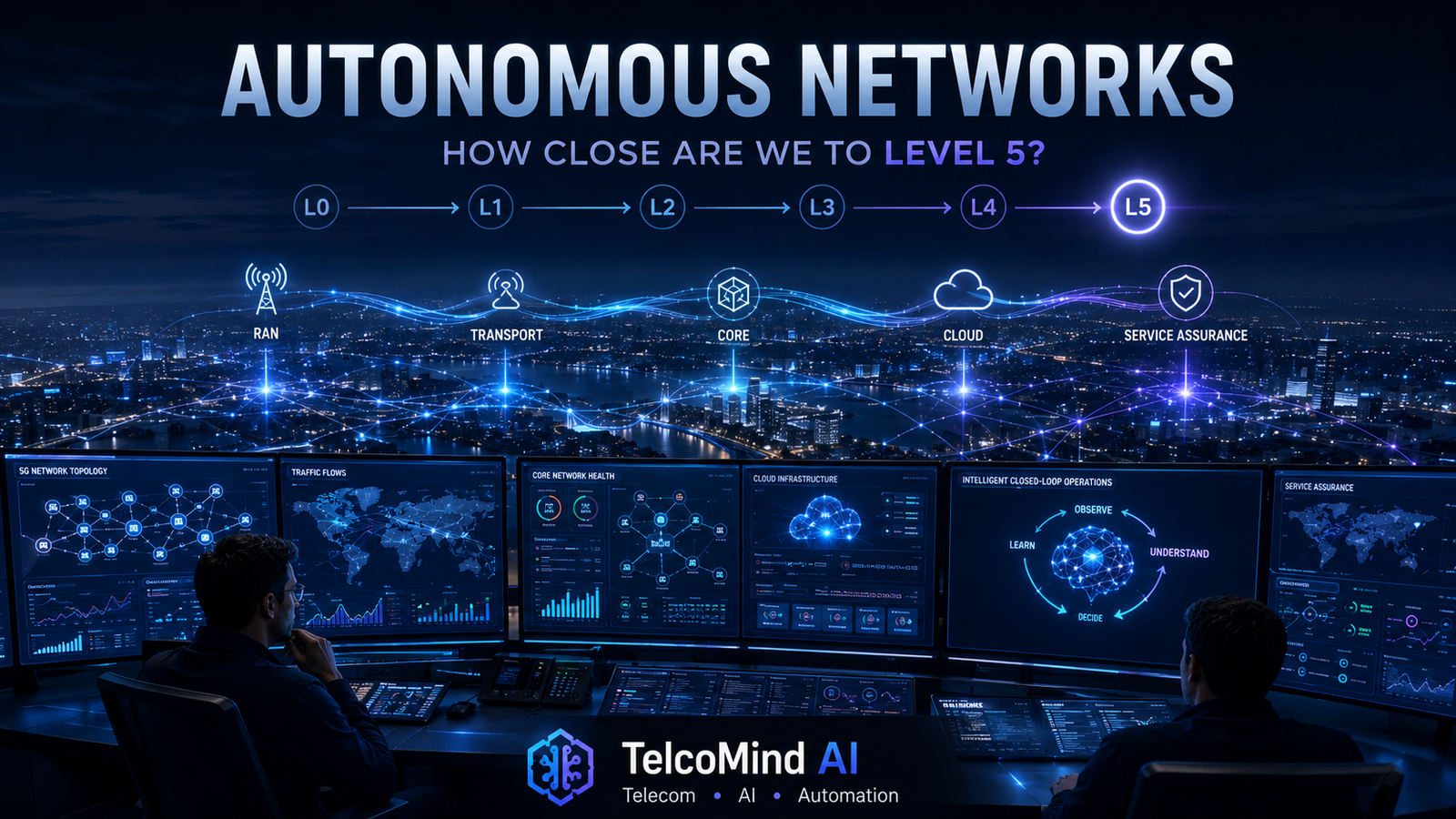
  • Agentic AI in Telecom Operations: From AI Assistance to Autonomous Action

    Agentic AI in Telecom Operations: From AI Assistance to Autonomous Action

    Introduction: When AI Moves Beyond Recommendations

    Agentic AI in telecom represents a shift from AI systems that simply analyze network data and recommend actions toward systems that can reason across operational context, coordinate workflows and take controlled actions toward defined network objectives. In telecom operations, this could transform how NOCs investigate incidents, identify root causes, automate repetitive decisions and move toward increasingly autonomous network operations.

    It is 2:17 AM. Something unusual starts happening in the network.

    A cluster of cell alarms appears almost simultaneously. Seconds later, transmission alarms follow. Packet Core KPIs begin moving in the wrong direction, while service-impact indicators start rising.

    The NOC screens are getting busier, but the most important question remains unanswered:

    Where did the problem actually start?

    An experienced NOC engineer begins doing what telecom operations teams have done for years—checking topology, comparing alarms, reviewing performance counters, looking for recent changes and engaging the relevant Back Office teams.

    The RAN team sees affected cells. The transmission team sees path degradation. The Core team sees session failures.

    Everyone can see a symptom.

    Someone still has to connect the story.

    Modern operational tools have made this process faster. AIOps can correlate alarms, reduce noise and identify patterns across large volumes of network data. Generative AI can summarize information and help engineers investigate unfamiliar conditions.

    But there is still a gap between understanding what is happening and carrying the incident toward resolution.

    This is where Agentic AI introduces an interesting possibility.

    Imagine giving an AI agent a clear operational objective:

    “Investigate the developing service degradation and identify the safest next action.”

    Instead of simply returning an answer, the agent begins working through the problem. It checks alarms and KPIs, examines topology, looks at recent network changes, compares current behavior with historical patterns and queries authorized operational systems.

    A few moments later, the engineer is no longer staring at hundreds of unrelated events.

    The engineer receives a focused operational picture:

    What changed.
    Where the problem most likely started.
    Which services are exposed.
    What evidence supports the conclusion.
    What action could be considered next.

    But this is precisely where expert engineering judgment becomes more important—not less.

    An AI agent may process thousands of data points faster than a person can manually, but an experienced telecom engineer understands the operational context behind those numbers. Is the proposed action safe under the current network condition? Is redundancy genuinely available? Could another service be affected? Has something similar happened before? Should we act immediately, or would further investigation be safer?

    The real opportunity of Agentic AI is therefore not to remove engineers from network operations.

    It is to reduce the time experts spend searching, collecting and repeatedly checking information, allowing them to spend more time on what requires experience: technical judgment, risk assessment and the right decision.

    And that leads to the question at the heart of this article:

    If today’s AI can tell an engineer what might be happening, what changes when AI can actually pursue an operational task?

    From GenAI to AIOps to Agentic AI — What Actually Changes?

    Return to the incident for a moment.

    Suppose the engineer gives a Generative AI assistant the alarms and performance information already collected. It can summarize what it sees, explain possible relationships and suggest troubleshooting steps.

    Useful—but the engineer is still driving the investigation.

    An AIOps platform can go further. It continuously processes operational data, correlates related alarms, identifies anomalies and may reduce hundreds of network events into one meaningful incident.

    Now the engineer has a much clearer picture.

    Agentic AI introduces another step: the ability to pursue an objective through a sequence of actions rather than answering one question and stopping.

    The agent can determine what information it needs next, query an authorized system, evaluate the result, decide which investigation step should follow and continue until it reaches an operational conclusion—or reaches a point where expert intervention is required.

    GENERATIVE AI
    Explain & Assist

    AIOps
    Correlate & Detect

    AGENTIC AI
    Investigate → Plan → Act → Validate

    EXPERT ENGINEER
    Judge → Approve → Govern

    The progression is not about removing people as automation becomes more capable. It is about moving repetitive investigation and execution away from engineers while keeping expert judgment at the center of high-risk decisions.

    Generative AI:
    “Here is what these alarms could mean.”

    AIOps:
    “These 300 alarms appear to represent one cross-domain incident, and this is the probable root cause.”

    Agentic AI:
    “I correlated the alarms, checked the affected topology, reviewed recent changes and examined service KPIs. Here is the probable cause, the supporting evidence, the customer exposure and the recommended recovery action. Engineer approval is required before execution.

    That final sentence matters.

    In telecom operations, the ability to execute an action does not automatically mean that an AI agent should be allowed to execute it independently.

    But our incident is still developing.

    It is now 2:21 AM. Customer impact is increasing. The agent believes it has found where the problem started.

    What happens next?

    Scenario 1: The 2:21 AM Cross-Domain Incident

    It is now 2:21 AM.

    The first alarms appeared only four minutes ago, but the incident has already crossed several network domains.

    The RAN team can see a group of affected cells. The Packet Core team is seeing an increase in session failures. Customer-impact indicators are moving upward.

    At first glance, it looks like three different problems.

    The agent starts with a different question:

    What do these symptoms have in common?

    It maps the affected cells against the transmission topology. A pattern emerges: many of them depend on the same transport path.

    The agent then checks that path. Interface errors have increased sharply, and traffic behavior changed shortly before the first RAN alarms appeared.

    But it does not stop there.

    It checks recent network activities and finds that a configuration change was completed on an upstream network element shortly before the degradation began. It compares pre-change and post-change performance, checks the available redundant path and reviews whether any other services depend on the same infrastructure.

    Within minutes, what initially looked like hundreds of alarms across several domains has become one working hypothesis:

    The RAN alarms and Core KPI degradation may be downstream symptoms of a transport-related problem associated with the recent change.

    The Agent Has a Recommendation. The Engineer Has a Decision.

    The agent proposes restoring the previous configuration.

    This is the moment where a poorly designed automation model could become dangerous.

    A recommendation may look technically correct based on the available data, but the experienced engineer does not approve it immediately.

    The engineer asks three questions:

    Is the previous configuration still valid?
    Is the redundant path healthy enough to carry the traffic during recovery?
    Could the rollback affect another service that is currently stable?

    The agent performs the additional checks and returns the evidence. The engineer also recognizes a dependency from previous operational experience that was not obvious from the alarm sequence alone.

    The recovery plan is adjusted accordingly.

    The agent accelerated the investigation. The engineer improved the decision.

    Once the engineer approves the controlled recovery action, the agent can support the execution according to its authorized workflow.

    But the job is still not finished.

    A configuration command completing successfully does not necessarily mean that the service has recovered.

    The agent continues monitoring.

    Transmission errors begin falling. RAN alarms start clearing. Session-success KPIs recover. Customer-impact indicators return toward their normal baseline.

    Only after the technical and service-level post-checks pass does the workflow recommend incident closure.

    The sequence therefore becomes:

    Detect → Investigate → Correlate → Recommend → Expert Decision → Execute → Validate

        RAN ALARMS

    TRANSPORT ERRORS

    CORE KPI IMPACT

    CUSTOMER IMPACT

    ┌─────────────┐
    │ AI AGENT │
    └─────────────┘

    Investigate
    Correlate
    Check Changes
    Assess Impact

    PROPOSED ACTION

    ┌─────────────────┐
    │ EXPERT ENGINEER │
    └─────────────────┘

    Challenge • Assess
    Modify • Approve

    CONTROLLED ACTION

    VALIDATE RECOVERY


    Agentic operations should shorten the path from detection to decision—not remove expert control from that path.

    What Changed Compared with Today’s NOC?

    None of the individual troubleshooting activities in this scenario are unfamiliar to an experienced telecom engineer.

    Engineers already check alarms, topology, KPIs, recent changes, redundancy and customer impact during major incidents.

    What changes is how much of the investigative workload can happen simultaneously and automatically.

    Instead of several engineers spending the first part of an incident gathering information from separate systems, an agent can assemble much of that evidence continuously and present it in operational context.

    The expert team can therefore enter the decision-making stage earlier.

    That may ultimately be one of the most valuable applications of Agentic AI in the NOC—not replacing troubleshooting expertise, but giving experts a better starting point when every minute matters.

    Our 2:21 AM incident began after customers were already at risk.

    But the more interesting question is what happens when the network has not failed yet.

    Suppose there are no major alarms, no flood of customer complaints and no active war room—only a small pattern of deterioration developing quietly over several days.

    Can an agent recognize the story before it becomes an incident?

    Scenario 2: The Failure That Hasn’t Happened Yet

    This time, there is no 2:00 AM emergency.

    No major alarms. No customer complaints. No war room.

    The network appears healthy.

    But over several days, an agent notices something that would be easy to overlook during routine operations: the receive signal level on a microwave link is slowly deteriorating.

    The value is still within the operational threshold, so a traditional threshold-based monitoring system does not raise a critical alarm.

    The agent, however, is not looking only at today’s value. It examines the trend.

    It reviews historical performance, error counters, modulation behavior, weather and environmental information, previous maintenance records and the services depending on the link.

    Individually, none of these indicators justifies an emergency response.

    Together, they tell a different story.

    The link is still working—but its operating margin is gradually disappearing.

    From Observation to Preventive Action

    The agent checks whether an alternative path is available and evaluates the services that would be exposed if the link eventually failed.

    It then presents the transmission engineer with a concise finding:

    “No current service impact. Link performance has shown sustained deterioration over the last several days. Based on the current trend and service dependency, preventive investigation is recommended.”

    This is very different from waking an engineer because a threshold was crossed.

    The engineer reviews the trend and applies domain expertise. Perhaps the deterioration resembles an alignment issue seen previously. Perhaps environmental conditions explain part of the movement. Or perhaps the link is known to have limited fade margin and deserves earlier attention.

    The engineer decides whether the condition requires continued observation, remote investigation or a planned field intervention.

    Once again, the agent provides continuity and scale; the engineer provides technical interpretation and judgment.

    If maintenance is initiated, the agent can continue following the case—tracking the work order, checking whether the deterioration continues and automatically comparing performance before and after the intervention.

    The value is not simply that AI predicted a failure.

    The value is that an early signal was converted into a controlled preventive-maintenance workflow before customers knew there was a problem.

    NETWORK STILL HEALTHY

    Small Performance Change

    Long-Term Trend Detected

    Agent Investigates Context

    Potential Risk Identified

    EXPERT ENGINEER
    Review • Interpret • Decide

    Preventive Action

    Post-Maintenance Validation

    INCIDENT AVOIDED

    The smartest incident may be the one the NOC never has to manage.

    So far, our two scenarios have involved network connectivity.

    But modern telecom operations are increasingly dependent on software platforms, databases and real-time digital transactions. A network can have healthy radio coverage, stable transmission and an available Core—and customers can still be unable to use a service.

    Consider what happens when the problem is not a failed link at all.

    The OCS is online. Nothing is technically down. But charging transactions are getting slower.

    Scenario 3: The OCS Is Up—but Something Is Wrong

    It is a busy evening period. The Online Charging System is available. There is no major platform-down alarm, and the infrastructure dashboard is mostly green.

    Yet something is beginning to change.

    Charging transactions are taking slightly longer to complete. A few application queues are growing. Some transaction failures appear intermittently, but not yet at a level that would normally trigger a major incident.

    To an individual monitoring system, each condition may look manageable.

    To an agent following the service end to end, the combination deserves attention.

    Instead of waiting for a hard threshold to be crossed, the agent begins investigating.

    It checks transaction success rates and latency, then looks at application queues. It reviews CPU and memory, database performance, storage utilization and replication status. It checks interfaces toward dependent systems and looks for recent configuration or application changes.

    One finding leads to the next.

    The platform is technically up, but its behavior is gradually moving away from normal.

    Availability Does Not Always Mean Service Health

    This distinction matters in telecom operations.

    A platform can report 100% availability while customers are already experiencing slower transactions, intermittent failures or degraded service.

    The agent correlates the evidence and finds that database utilization has been steadily increasing. At the same time, transaction latency and queue depth are moving upward.

    It presents the OCS and database engineers with the developing picture rather than simply generating another alarm:

    “Platform remains available. Transaction latency and queue depth are increasing alongside abnormal database resource growth. Service degradation risk is increasing. Database and application-level investigation is recommended.”

    At this point, the agent has done something valuable: it has connected technical resource behavior with service performance.

    But it has not decided to modify the production database.

    That decision belongs with the experts.

    The OCS engineer understands the transaction behavior and application dependencies. The database engineer understands the database state, housekeeping history and risks associated with any intervention.

    Together, they review the evidence assembled by the agent.

    They may decide that controlled housekeeping is sufficient. They may identify a capacity issue. They may discover an abnormal process. Or they may conclude that the apparent correlation is misleading and another dependency needs investigation.

    This is where domain expertise protects the network from a dangerous assumption:

    Correlation is evidence. It is not automatically proof of root cause.

    Once the engineers determine the appropriate action, the agent can support the approved workflow—collecting pre-checks, tracking the activity and continuously monitoring transaction performance.

    After the intervention, it compares the same indicators again.

    Did transaction latency recover?
    Are queues returning to normal?
    Has database behavior stabilized?
    Did any new service degradation appear?

    The task is complete only when the service—not merely the maintenance command—has recovered.

    TRANSACTIONS SLOWING

    Queue Growth

    No Major Alarm Yet

    ┌─────────────┐
    │ AI AGENT │
    └─────────────┘

    Transactions • Application
    CPU/Memory • Database • Storage
    Replication • Interfaces • Changes

    DEVELOPING RISK

    ┌─────────────────────┐
    │ DOMAIN EXPERTS │
    │ OCS + DB Engineers │
    └─────────────────────┘

    Interpret → Challenge → Decide

    APPROVED ACTION

    SERVICE VALIDATION

    A healthy node does not always mean a healthy service. Agentic operations need to understand both.

    Our three scenarios have something in common.

    In each case, the agent needed information from more than one system and, often, more than one technical domain.

    The cross-domain incident required RAN, transport and Core information. The preventive-maintenance case required performance history and infrastructure context. The OCS case crossed application, database and service behavior.

    That creates another practical question.

    Can one AI agent realistically become an expert in every part of a telecom network?

    Probably not—and perhaps it should not try.

    A telecom network is already operated by specialized teams because RAN, transmission, IP, Core, charging, cloud and service assurance require different expertise.

    Agentic operations may develop in much the same way.

    Instead of one all-powerful agent controlling the network, imagine a group of specialized agents working alongside specialized engineering teams.

    When One Agent Isn’t Enough: The Multi-Agent NOC

    Telecom networks are built around specialization for a reason.

    A RAN engineer understands radio behavior in a way that a database engineer does not. A Core engineer sees signaling and session behavior differently from a transmission engineer. An OCS specialist understands charging flows, while a service-assurance team sees how problems ultimately reach the customer.

    Agentic operations may need a similar structure.

    Rather than creating one enormous AI agent expected to understand every technology, operator and operational process, a more practical model could involve specialized agents working together, each operating within a clearly defined domain and set of permissions.

    Imagine the NOC Receives a Customer-Service Degradation Alert

    A service-assurance agent notices that customers in one region are experiencing increased data-session failures.

    Instead of immediately declaring a root cause, an orchestrating agent asks several specialized agents to investigate the same problem from different perspectives.

    The RAN Agent checks cell availability, accessibility, radio KPIs and recent RAN changes.

    The Transport Agent checks affected paths, interface errors, packet loss, latency and redundancy.

    The Core Agent examines registration, session establishment, signaling behavior and relevant Core resources.

    The Service Agent continues measuring the actual customer impact.

    Each agent returns evidence—not simply an opinion.

                 SERVICE DEGRADATION
                         ↓
              ┌────────────────────┐
              │ ORCHESTRATOR AGENT │
              └────────────────────┘
                         │
          ┌──────────────┼──────────────┐
          ↓              ↓              ↓
     RAN AGENT     TRANSPORT AGENT   CORE AGENT
          │              │              │
    Radio Health     Path Health    Sessions &
    Cell KPIs        Loss/Latency    Signaling
          │              │              │
          └──────────────┼──────────────┘
                         ↓
                  SERVICE AGENT
                         ↓
                  Customer Impact
                         ↓
              ┌────────────────────┐
              │  EXPERT ENGINEERS  │
              └────────────────────┘
                         ↓
             JUDGMENT • DECISION • CONTROL

    The orchestrator can compare these findings and build a cross-domain view. But importantly, disagreement between agents should not be hidden.

    Suppose the RAN Agent sees radio degradation and identifies it as the likely cause, while the Transport Agent detects packet loss on a shared upstream path.

    A weak system might simply select whichever conclusion has the highest confidence score.

    A stronger operational model would present the conflicting evidence to the relevant experts.

    An experienced engineer may immediately recognize that the radio degradation is actually a downstream symptom of transport instability.

    This illustrates an important principle:

    Multiple AI agents do not replace multiple areas of engineering expertise. They can help those experts reach a shared operational picture faster.

    The Engineer Becomes the Technical Authority, Not the Data Collector

    In today’s NOC, experienced engineers can spend significant time gathering information before they are able to apply their expertise.

    In an agent-supported NOC, much of that collection could happen continuously in the background.

    The role of the expert moves upward:

    From searching dashboards → to interpreting evidence
    From collecting logs → to challenging conclusions
    From following repetitive checks → to assessing risk
    From executing every routine action → to governing automation
    From viewing individual nodes → to understanding end-to-end service behavior

    This does not make telecom expertise less valuable.

    It makes deep expertise more valuable because the engineer can spend more time on decisions that actually require it.

    But there is an uncomfortable question hiding inside this model.

    If agents can investigate problems, communicate with other agents, access operational tools and recommend actions, how much authority should they actually have?

    Should an agent be allowed to perform a health check automatically? Probably.

    Create a preventive ticket? In many cases, yes.

    Restart a live OCS process?

    Change Core configuration?

    Reroute major traffic?

    Roll back a production change?

    Those questions cannot be answered simply by saying that the AI has a high confidence score.

    The real challenge of Agentic AI in telecom may not be making agents capable enough to act. It may be deciding when they should be allowed to act.

    Who Gets the Final Say? Designing Authority and Guardrails

    Imagine our agent has completed its investigation.

    It has identified the likely problem, checked the dependencies and calculated a high level of confidence in the recommended action.

    But confidence alone should not determine authority.

    In telecom operations, two actions can have completely different consequences. Collecting a health check from a router is not the same as changing its routing configuration. Creating a preventive ticket is not the same as restarting a live charging platform.

    Agentic AI therefore needs something telecom engineers already understand very well: operational boundaries.

    A practical approach is to classify actions according to their potential service impact, complexity and reversibility.

    A Simple Green–Amber–Red Model

    🟢 GREEN — Agent Can Act

    These are low-risk, repeatable activities with clearly understood outcomes.

    Examples could include collecting health checks, checking KPIs, gathering logs, validating backups, monitoring capacity, checking certificate expiry, creating tickets, generating reports and performing approved post-checks.

    The agent can execute these tasks within predefined permissions while keeping a complete record of what it did.

    🟠 AMBER — Agent Prepares, Expert Approves

    Here, the agent can investigate the condition, collect evidence, prepare the proposed action and explain the expected impact—but execution requires authorization from the responsible engineer.

    Examples could include controlled service restarts, selected traffic shifts, approved configuration changes, database housekeeping, rollback of a recent change or actions on service platforms.

    The engineer can approve, modify or reject the proposed action.

    🔴 RED — Expert-Led

    Some activities carry too much operational or customer risk to be delegated simply because an agent believes the action is correct.

    Examples may include major Core changes, large-scale routing modifications, charging changes affecting subscriber balances, critical database modifications, major traffic migrations and activities involving uncertain dependencies.

    In these cases, AI remains valuable—but as an assistant to the expert team. It can gather evidence, simulate possibilities, prepare pre-checks and monitor the outcome while the engineering authority remains firmly human.

    🔴 RED — Expert-Led

    Some activities carry too much operational or customer risk to be delegated simply because an agent believes the action is correct.

    Examples may include major Core changes, large-scale routing modifications, charging changes affecting subscriber balances, critical database modifications, major traffic migrations and activities involving uncertain dependencies.

    In these cases, AI remains valuable—but as an assistant to the expert team. It can gather evidence, simulate possibilities, prepare pre-checks and monitor the outcome while the engineering authority remains firmly human.

    The goal is not maximum autonomy. The goal is the right level of autonomy for the right operational risk.

    And What If the Agent Gets It Wrong?

    There is another reason expert control matters.

    AI agents will not always be right.

    An agent may misunderstand an alarm relationship. Historical data may be incomplete. An inventory record may be outdated. A dependency may exist that is not visible to the system. Two agents may reach different conclusions. A recommended action may have worked successfully ten times before and still be wrong on the eleventh.

    Telecom engineers already work with uncertainty. Agentic AI does not remove that uncertainty—it introduces another participant whose conclusions must also be questioned.

    This is why every important agent action should leave a clear operational trail:

    What did the agent observe?
    Which systems did it access?
    What evidence did it use?
    Why did it recommend the action?
    Who approved it?
    What exactly was executed?
    What happened afterward?

    If the expected recovery does not occur, the agent should not continue experimenting indefinitely with a live network. It should stop, preserve the evidence and escalate to the responsible experts.

    Knowing when to stop may be just as important as knowing how to act.

    By now, the Agentic NOC may sound technologically ambitious.

    But operators do not need to move from today’s NOC directly to autonomous agents controlling production networks.

    In fact, that would probably be the wrong place to start.

    The safer question is:

    What is the first useful job we could give an AI agent tomorrow without handing it control of the network?

    Starting Small: A Practical Path to Agentic Operations

    The first AI agent in a telecom NOC probably should not be given permission to change the network.

    It should be given permission to understand it.

    Consider a routine morning shift. Before the operations team begins its daily review, an agent has already checked overnight alarms, recurring faults, major KPI deviations, capacity warnings, failed backups, open incidents and recent changes.

    Instead of presenting another dashboard, it prepares a short operational brief:

    “Three conditions require attention this morning. One transmission link is showing repeated degradation, database utilization on a service platform is increasing faster than normal, and a cluster of RAN alarms has recurred for the third night.”

    Nothing has been changed.

    But the engineering team begins the day with a better question:

    “Which risk should we investigate first?”

    That alone can be a useful starting point for Agentic AI.

    Build Trust Before Building Autonomy

    From there, the agent can gradually be given greater responsibility—but only after its performance has been demonstrated in real operational conditions.

    Stage 1 — Observe

    Give the agent read-only access to selected alarms, KPIs, topology, logs, tickets and operational information.

    Let it learn how to assemble a network-health picture without touching the live network.

    Stage 2 — Investigate

    Allow the agent to follow approved troubleshooting procedures: query additional systems, correlate information, compare historical behavior and prepare evidence for the engineer.

    Stage 3 — Recommend

    The agent can now propose a probable root cause and next action—but the expert engineer decides whether the recommendation makes operational sense.

    Stage 4 — Execute with Approval

    For proven workflows, the engineer approves an action and the agent executes the authorized steps, performs post-checks and reports the outcome.

    Stage 5 — Limited Autonomous Action

    Only mature, repetitive and low-risk workflows move into controlled autonomous execution. Exceptions, uncertainty and high-risk conditions automatically return control to the engineering team.

    Autonomy should be earned through operational evidence, not granted because the technology is capable of it.

    What Happens to the Telecom Engineer?

    Whenever automation becomes more capable, one question inevitably follows:

    What happens to the engineer?

    Return once more to our 2:17 AM incident.

    The experienced engineer originally spent valuable minutes opening different systems, collecting evidence and asking several teams for information.

    In an Agentic NOC, much of that work may arrive already assembled.

    But the difficult questions remain.

    Is the diagnosis technically credible?
    What risk does the proposed action create?
    Is the network behaving differently because of something the agent cannot see?
    Should we intervene now or continue observing?
    What happens to other services if this action fails?

    These are not simply data-processing questions. They require experience, technical depth and operational judgment.

    The engineer’s role therefore does not disappear. It moves away from some of the repetitive mechanics of network operations and toward technical authority.

    The future NOC engineer may spend less time collecting information and more time:

    challenging AI-generated conclusions,
    understanding end-to-end service dependencies,
    assessing operational risk,
    designing automation policies and guardrails,
    handling complex exceptions,
    and making decisions when the network does something nobody expected.

    This also changes what expertise means.

    Deep knowledge of RAN, transmission, IP, Core, charging, cloud or databases will remain important. But engineers who can combine that domain knowledge with automation, data interpretation, AI literacy and cross-domain understanding may become particularly valuable in increasingly autonomous operations environments.

    Agentic AI does not make telecom expertise obsolete. It gives that expertise a different place to create value.

    The 2:17 AM engineer is therefore still in the NOC.

    What has changed is what surrounds that engineer.

    Instead of hundreds of disconnected alarms, there is a developing operational story. Instead of manually searching every system, specialized agents can gather and correlate evidence. Instead of automation executing blindly, authority is determined by risk.

    And when the situation becomes uncertain, complex or potentially service-affecting, the expert takes control.

    That may be a more realistic picture of the Agentic NOC than the idea of a completely human-free control room.

    So perhaps the future question is not “Will AI run the NOC?”

    It is “How should engineers and AI agents run it together?”

    The Agentic NOC: What Comes Next?

    The journey from today’s NOC to an Agentic NOC will probably not happen through one major technology deployment.

    It is more likely to happen quietly, one operational workflow at a time.

    First, an agent prepares the morning health check.

    Then it begins investigating recurring alarms.

    Later, it correlates information across RAN, transport and Core before an engineer even opens the incident.

    Eventually, trusted agents may execute selected low-risk actions, validate the outcome and involve engineers only when the situation moves outside clearly defined operational boundaries.

    The important change is not that AI suddenly “runs the network.”

    It is that operations gradually move from tools waiting for engineers to ask questions toward agents actively pursuing operational objectives alongside engineers.

    This could also change how different technical domains work together.

    A RAN Agent may detect degradation. A Transport Agent may discover the common dependency. A Core Agent may quantify the session impact. A Service Agent may determine which customers are affected.

    But the final operational picture still needs technical context, accountability and judgment.

    The future NOC may therefore become a partnership between specialized AI agents and specialized human experts, coordinated around the health of the service rather than around isolated alarms.

    The destination is not a NOC without people. It is a NOC where people spend more of their time on the decisions that deserve human expertise.

    Return one last time to 2:17 AM.

    The alarms begin appearing. RAN sees cell failures. Transmission sees degradation. Core KPIs start deteriorating.

    In today’s operating model, experienced engineers immediately begin collecting information and building the incident picture.

    In an Agentic NOC, the engineers are still there.

    What changes is what happens around them.

    While the incident is developing, agents are already correlating alarms, checking topology, reviewing recent changes, examining service KPIs and bringing evidence together across domains.

    Instead of spending the first critical minutes asking “What is happening?”, the engineering team can reach the more important questions earlier:

    “Does this diagnosis make sense?”
    “What is the safest action?”
    “What could this action affect?”
    “Are we ready to execute?”

    That is where Agentic AI could create real operational value.

    Not because an AI agent knows more about the network than the engineers who designed, operate and troubleshoot it.

    But because it can help those engineers reach the point where their expertise matters most—faster.

    Agentic AI should therefore not be measured simply by how many network actions can be performed without human involvement.

    A better measure may be whether it helps operations teams detect earlier, investigate faster, make better-informed decisions, prevent avoidable incidents and recover services with greater confidence.

    Some activities will eventually become autonomous. Others will remain under expert approval. And the most complex situations will continue to depend heavily on experienced engineers who understand the network beyond what any individual alarm, KPI or model can explain.

    The strongest future may therefore be neither a completely manual NOC nor a completely autonomous one.

    It may be a NOC where machine speed and human expertise work together—each doing what it does best.

    The future of telecom operations is not AI versus engineers. It is what becomes possible when AI works with them.

    Industry Perspective: Agentic AI Is Moving Beyond the Concept Stage

    Agentic AI in telecom is still developing, but the industry is already moving from conceptual discussions toward practical experimentation and operational use cases.

    As Agentic AI becomes more capable, the next question is not only what actions AI agents can perform, but what outcome the network should achieve. This is where intent-driven telecom operations can provide the business objective that guides intelligent network decisions.

    As AI agents gain greater access to network data, tools and operational actions, cybersecurity becomes part of the autonomous-network architecture itself. Protecting agent identities, permissions, data sources and actions will be essential before operators can safely increase AI autonomy.

    In 2026, the GSMA launched an Agentic AI Testbed designed specifically to allow telecom operators to evaluate AI agents against real-world telecommunications challenges. The GSMA has also published work examining how agentic systems could support increasingly intelligent and autonomous telecom environments.

    TM Forum is similarly exploring the Agentic NOC through industry collaboration. Its 2026 Agentic NOC Catalyst includes practical work around agentic fault and incident management, anomaly detection and service/business-impact assessment—areas closely connected to the operational scenarios discussed in this article.

    The vendor ecosystem is also beginning to productize these ideas. Nokia, for example, announced an Autonomous Networks Agent Library in June 2026 and an agentic AI framework for IP network operations designed around guided actions, trusted network data and operator-defined policies.

    Ericsson has described an agentic operations approach where specialized agents can perform functions such as root-cause and impact analysis while using telecom-specific operational knowledge and maintaining appropriate human control.

    These developments do not mean that fully autonomous Agentic NOCs have suddenly arrived. They do, however, indicate that the discussion is shifting from “Could AI agents work in telecom operations?” toward the much more practical question:

    “How can they be introduced safely, usefully and at telecom-grade reliability?”

    Further Reading

    GSMA — Agentic AI for Telecom: Charting the Course for an Intelligent Future
    GSMA Agentic AI for Telecom

    TM Forum — Agentic NOC: AI-Native Operations for the Autonomous Telco
    TM Forum Agentic NOC Catalyst

    Ericsson — From Data to Decisions: Making Agentic AI-Driven Telecom Operations a Reality
    Ericsson Agentic AI-Driven Telecom Operations

    Nokia — Agentic AI Framework for IP Network Operations
    Nokia Agentic AI for IP Networks

    Agentic AI Is One Piece of the Intelligent NOC

    Agentic AI could fundamentally change how network incidents are investigated and operational decisions are developed.

    But an AI agent does not operate in isolation.

    Its real potential becomes more interesting when combined with predictive analytics, AIOps, Network Digital Twins, AI-RAN, service assurance and controlled network automation.

    Together, these capabilities point toward an operating model where AI can increasingly help the network predict, understand, simulate, decide, execute and validate.

    Explore how Agentic AI fits into the wider telecom AI landscape:
    AI in Telecom: 10 Real-World Use Cases Transforming Network Operations in 2026

    How Ready Is Your NOC for AI?

    Agentic AI requires more than intelligent models. It depends on strong observability, automation, operational data, governance and the ability to move safely toward closed-loop operations.

    Use the free TelcoMind AI NOC Maturity Assessment to evaluate your operations across 8 critical dimensions and identify your current maturity level—from Reactive to Autonomous.

    Take the Free NOC AI Maturity Assessment →

  • Agentic AI in Telecom Operations: From AI Assistance to Autonomous Action

    Agentic AI in Telecom Operations: From AI Assistance to Autonomous Action

    Introduction: When AI Moves Beyond Recommendations

    Agentic AI in telecom represents a shift from AI systems that simply analyze network data and recommend actions toward systems that can reason across operational context, coordinate workflows and take controlled actions toward defined network objectives. In telecom operations, this could transform how NOCs investigate incidents, identify root causes, automate repetitive decisions and move toward increasingly autonomous network operations.

    It is 2:17 AM. Something unusual starts happening in the network.

    A cluster of cell alarms appears almost simultaneously. Seconds later, transmission alarms follow. Packet Core KPIs begin moving in the wrong direction, while service-impact indicators start rising.

    The NOC screens are getting busier, but the most important question remains unanswered:

    Where did the problem actually start?

    An experienced NOC engineer begins doing what telecom operations teams have done for years—checking topology, comparing alarms, reviewing performance counters, looking for recent changes and engaging the relevant Back Office teams.

    The RAN team sees affected cells. The transmission team sees path degradation. The Core team sees session failures.

    Everyone can see a symptom.

    Someone still has to connect the story.

    Modern operational tools have made this process faster. AIOps can correlate alarms, reduce noise and identify patterns across large volumes of network data. Generative AI can summarize information and help engineers investigate unfamiliar conditions.

    But there is still a gap between understanding what is happening and carrying the incident toward resolution.

    This is where Agentic AI introduces an interesting possibility.

    Imagine giving an AI agent a clear operational objective:

    “Investigate the developing service degradation and identify the safest next action.”

    Instead of simply returning an answer, the agent begins working through the problem. It checks alarms and KPIs, examines topology, looks at recent network changes, compares current behavior with historical patterns and queries authorized operational systems.

    A few moments later, the engineer is no longer staring at hundreds of unrelated events.

    The engineer receives a focused operational picture:

    What changed.
    Where the problem most likely started.
    Which services are exposed.
    What evidence supports the conclusion.
    What action could be considered next.

    But this is precisely where expert engineering judgment becomes more important—not less.

    An AI agent may process thousands of data points faster than a person can manually, but an experienced telecom engineer understands the operational context behind those numbers. Is the proposed action safe under the current network condition? Is redundancy genuinely available? Could another service be affected? Has something similar happened before? Should we act immediately, or would further investigation be safer?

    The real opportunity of Agentic AI is therefore not to remove engineers from network operations.

    It is to reduce the time experts spend searching, collecting and repeatedly checking information, allowing them to spend more time on what requires experience: technical judgment, risk assessment and the right decision.

    And that leads to the question at the heart of this article:

    If today’s AI can tell an engineer what might be happening, what changes when AI can actually pursue an operational task?

    From GenAI to AIOps to Agentic AI — What Actually Changes?

    Return to the incident for a moment.

    Suppose the engineer gives a Generative AI assistant the alarms and performance information already collected. It can summarize what it sees, explain possible relationships and suggest troubleshooting steps.

    Useful—but the engineer is still driving the investigation.

    An AIOps platform can go further. It continuously processes operational data, correlates related alarms, identifies anomalies and may reduce hundreds of network events into one meaningful incident.

    Now the engineer has a much clearer picture.

    Agentic AI introduces another step: the ability to pursue an objective through a sequence of actions rather than answering one question and stopping.

    The agent can determine what information it needs next, query an authorized system, evaluate the result, decide which investigation step should follow and continue until it reaches an operational conclusion—or reaches a point where expert intervention is required.

    GENERATIVE AI
    Explain & Assist

    AIOps
    Correlate & Detect

    AGENTIC AI
    Investigate → Plan → Act → Validate

    EXPERT ENGINEER
    Judge → Approve → Govern

    The progression is not about removing people as automation becomes more capable. It is about moving repetitive investigation and execution away from engineers while keeping expert judgment at the center of high-risk decisions.

    Generative AI:
    “Here is what these alarms could mean.”

    AIOps:
    “These 300 alarms appear to represent one cross-domain incident, and this is the probable root cause.”

    Agentic AI:
    “I correlated the alarms, checked the affected topology, reviewed recent changes and examined service KPIs. Here is the probable cause, the supporting evidence, the customer exposure and the recommended recovery action. Engineer approval is required before execution.

    That final sentence matters.

    In telecom operations, the ability to execute an action does not automatically mean that an AI agent should be allowed to execute it independently.

    But our incident is still developing.

    It is now 2:21 AM. Customer impact is increasing. The agent believes it has found where the problem started.

    What happens next?

    Scenario 1: The 2:21 AM Cross-Domain Incident

    It is now 2:21 AM.

    The first alarms appeared only four minutes ago, but the incident has already crossed several network domains.

    The RAN team can see a group of affected cells. The Packet Core team is seeing an increase in session failures. Customer-impact indicators are moving upward.

    At first glance, it looks like three different problems.

    The agent starts with a different question:

    What do these symptoms have in common?

    It maps the affected cells against the transmission topology. A pattern emerges: many of them depend on the same transport path.

    The agent then checks that path. Interface errors have increased sharply, and traffic behavior changed shortly before the first RAN alarms appeared.

    But it does not stop there.

    It checks recent network activities and finds that a configuration change was completed on an upstream network element shortly before the degradation began. It compares pre-change and post-change performance, checks the available redundant path and reviews whether any other services depend on the same infrastructure.

    Within minutes, what initially looked like hundreds of alarms across several domains has become one working hypothesis:

    The RAN alarms and Core KPI degradation may be downstream symptoms of a transport-related problem associated with the recent change.

    The Agent Has a Recommendation. The Engineer Has a Decision.

    The agent proposes restoring the previous configuration.

    This is the moment where a poorly designed automation model could become dangerous.

    A recommendation may look technically correct based on the available data, but the experienced engineer does not approve it immediately.

    The engineer asks three questions:

    Is the previous configuration still valid?
    Is the redundant path healthy enough to carry the traffic during recovery?
    Could the rollback affect another service that is currently stable?

    The agent performs the additional checks and returns the evidence. The engineer also recognizes a dependency from previous operational experience that was not obvious from the alarm sequence alone.

    The recovery plan is adjusted accordingly.

    The agent accelerated the investigation. The engineer improved the decision.

    Once the engineer approves the controlled recovery action, the agent can support the execution according to its authorized workflow.

    But the job is still not finished.

    A configuration command completing successfully does not necessarily mean that the service has recovered.

    The agent continues monitoring.

    Transmission errors begin falling. RAN alarms start clearing. Session-success KPIs recover. Customer-impact indicators return toward their normal baseline.

    Only after the technical and service-level post-checks pass does the workflow recommend incident closure.

    The sequence therefore becomes:

    Detect → Investigate → Correlate → Recommend → Expert Decision → Execute → Validate

        RAN ALARMS

    TRANSPORT ERRORS

    CORE KPI IMPACT

    CUSTOMER IMPACT

    ┌─────────────┐
    │ AI AGENT │
    └─────────────┘

    Investigate
    Correlate
    Check Changes
    Assess Impact

    PROPOSED ACTION

    ┌─────────────────┐
    │ EXPERT ENGINEER │
    └─────────────────┘

    Challenge • Assess
    Modify • Approve

    CONTROLLED ACTION

    VALIDATE RECOVERY


    Agentic operations should shorten the path from detection to decision—not remove expert control from that path.

    What Changed Compared with Today’s NOC?

    None of the individual troubleshooting activities in this scenario are unfamiliar to an experienced telecom engineer.

    Engineers already check alarms, topology, KPIs, recent changes, redundancy and customer impact during major incidents.

    What changes is how much of the investigative workload can happen simultaneously and automatically.

    Instead of several engineers spending the first part of an incident gathering information from separate systems, an agent can assemble much of that evidence continuously and present it in operational context.

    The expert team can therefore enter the decision-making stage earlier.

    That may ultimately be one of the most valuable applications of Agentic AI in the NOC—not replacing troubleshooting expertise, but giving experts a better starting point when every minute matters.

    Our 2:21 AM incident began after customers were already at risk.

    But the more interesting question is what happens when the network has not failed yet.

    Suppose there are no major alarms, no flood of customer complaints and no active war room—only a small pattern of deterioration developing quietly over several days.

    Can an agent recognize the story before it becomes an incident?

    Scenario 2: The Failure That Hasn’t Happened Yet

    This time, there is no 2:00 AM emergency.

    No major alarms. No customer complaints. No war room.

    The network appears healthy.

    But over several days, an agent notices something that would be easy to overlook during routine operations: the receive signal level on a microwave link is slowly deteriorating.

    The value is still within the operational threshold, so a traditional threshold-based monitoring system does not raise a critical alarm.

    The agent, however, is not looking only at today’s value. It examines the trend.

    It reviews historical performance, error counters, modulation behavior, weather and environmental information, previous maintenance records and the services depending on the link.

    Individually, none of these indicators justifies an emergency response.

    Together, they tell a different story.

    The link is still working—but its operating margin is gradually disappearing.

    From Observation to Preventive Action

    The agent checks whether an alternative path is available and evaluates the services that would be exposed if the link eventually failed.

    It then presents the transmission engineer with a concise finding:

    “No current service impact. Link performance has shown sustained deterioration over the last several days. Based on the current trend and service dependency, preventive investigation is recommended.”

    This is very different from waking an engineer because a threshold was crossed.

    The engineer reviews the trend and applies domain expertise. Perhaps the deterioration resembles an alignment issue seen previously. Perhaps environmental conditions explain part of the movement. Or perhaps the link is known to have limited fade margin and deserves earlier attention.

    The engineer decides whether the condition requires continued observation, remote investigation or a planned field intervention.

    Once again, the agent provides continuity and scale; the engineer provides technical interpretation and judgment.

    If maintenance is initiated, the agent can continue following the case—tracking the work order, checking whether the deterioration continues and automatically comparing performance before and after the intervention.

    The value is not simply that AI predicted a failure.

    The value is that an early signal was converted into a controlled preventive-maintenance workflow before customers knew there was a problem.

    NETWORK STILL HEALTHY

    Small Performance Change

    Long-Term Trend Detected

    Agent Investigates Context

    Potential Risk Identified

    EXPERT ENGINEER
    Review • Interpret • Decide

    Preventive Action

    Post-Maintenance Validation

    INCIDENT AVOIDED

    The smartest incident may be the one the NOC never has to manage.

    So far, our two scenarios have involved network connectivity.

    But modern telecom operations are increasingly dependent on software platforms, databases and real-time digital transactions. A network can have healthy radio coverage, stable transmission and an available Core—and customers can still be unable to use a service.

    Consider what happens when the problem is not a failed link at all.

    The OCS is online. Nothing is technically down. But charging transactions are getting slower.

    Scenario 3: The OCS Is Up—but Something Is Wrong

    It is a busy evening period. The Online Charging System is available. There is no major platform-down alarm, and the infrastructure dashboard is mostly green.

    Yet something is beginning to change.

    Charging transactions are taking slightly longer to complete. A few application queues are growing. Some transaction failures appear intermittently, but not yet at a level that would normally trigger a major incident.

    To an individual monitoring system, each condition may look manageable.

    To an agent following the service end to end, the combination deserves attention.

    Instead of waiting for a hard threshold to be crossed, the agent begins investigating.

    It checks transaction success rates and latency, then looks at application queues. It reviews CPU and memory, database performance, storage utilization and replication status. It checks interfaces toward dependent systems and looks for recent configuration or application changes.

    One finding leads to the next.

    The platform is technically up, but its behavior is gradually moving away from normal.

    Availability Does Not Always Mean Service Health

    This distinction matters in telecom operations.

    A platform can report 100% availability while customers are already experiencing slower transactions, intermittent failures or degraded service.

    The agent correlates the evidence and finds that database utilization has been steadily increasing. At the same time, transaction latency and queue depth are moving upward.

    It presents the OCS and database engineers with the developing picture rather than simply generating another alarm:

    “Platform remains available. Transaction latency and queue depth are increasing alongside abnormal database resource growth. Service degradation risk is increasing. Database and application-level investigation is recommended.”

    At this point, the agent has done something valuable: it has connected technical resource behavior with service performance.

    But it has not decided to modify the production database.

    That decision belongs with the experts.

    The OCS engineer understands the transaction behavior and application dependencies. The database engineer understands the database state, housekeeping history and risks associated with any intervention.

    Together, they review the evidence assembled by the agent.

    They may decide that controlled housekeeping is sufficient. They may identify a capacity issue. They may discover an abnormal process. Or they may conclude that the apparent correlation is misleading and another dependency needs investigation.

    This is where domain expertise protects the network from a dangerous assumption:

    Correlation is evidence. It is not automatically proof of root cause.

    Once the engineers determine the appropriate action, the agent can support the approved workflow—collecting pre-checks, tracking the activity and continuously monitoring transaction performance.

    After the intervention, it compares the same indicators again.

    Did transaction latency recover?
    Are queues returning to normal?
    Has database behavior stabilized?
    Did any new service degradation appear?

    The task is complete only when the service—not merely the maintenance command—has recovered.

    TRANSACTIONS SLOWING

    Queue Growth

    No Major Alarm Yet

    ┌─────────────┐
    │ AI AGENT │
    └─────────────┘

    Transactions • Application
    CPU/Memory • Database • Storage
    Replication • Interfaces • Changes

    DEVELOPING RISK

    ┌─────────────────────┐
    │ DOMAIN EXPERTS │
    │ OCS + DB Engineers │
    └─────────────────────┘

    Interpret → Challenge → Decide

    APPROVED ACTION

    SERVICE VALIDATION

    A healthy node does not always mean a healthy service. Agentic operations need to understand both.

    Our three scenarios have something in common.

    In each case, the agent needed information from more than one system and, often, more than one technical domain.

    The cross-domain incident required RAN, transport and Core information. The preventive-maintenance case required performance history and infrastructure context. The OCS case crossed application, database and service behavior.

    That creates another practical question.

    Can one AI agent realistically become an expert in every part of a telecom network?

    Probably not—and perhaps it should not try.

    A telecom network is already operated by specialized teams because RAN, transmission, IP, Core, charging, cloud and service assurance require different expertise.

    Agentic operations may develop in much the same way.

    Instead of one all-powerful agent controlling the network, imagine a group of specialized agents working alongside specialized engineering teams.

    When One Agent Isn’t Enough: The Multi-Agent NOC

    Telecom networks are built around specialization for a reason.

    A RAN engineer understands radio behavior in a way that a database engineer does not. A Core engineer sees signaling and session behavior differently from a transmission engineer. An OCS specialist understands charging flows, while a service-assurance team sees how problems ultimately reach the customer.

    Agentic operations may need a similar structure.

    Rather than creating one enormous AI agent expected to understand every technology, operator and operational process, a more practical model could involve specialized agents working together, each operating within a clearly defined domain and set of permissions.

    Imagine the NOC Receives a Customer-Service Degradation Alert

    A service-assurance agent notices that customers in one region are experiencing increased data-session failures.

    Instead of immediately declaring a root cause, an orchestrating agent asks several specialized agents to investigate the same problem from different perspectives.

    The RAN Agent checks cell availability, accessibility, radio KPIs and recent RAN changes.

    The Transport Agent checks affected paths, interface errors, packet loss, latency and redundancy.

    The Core Agent examines registration, session establishment, signaling behavior and relevant Core resources.

    The Service Agent continues measuring the actual customer impact.

    Each agent returns evidence—not simply an opinion.

                 SERVICE DEGRADATION
                         ↓
              ┌────────────────────┐
              │ ORCHESTRATOR AGENT │
              └────────────────────┘
                         │
          ┌──────────────┼──────────────┐
          ↓              ↓              ↓
     RAN AGENT     TRANSPORT AGENT   CORE AGENT
          │              │              │
    Radio Health     Path Health    Sessions &
    Cell KPIs        Loss/Latency    Signaling
          │              │              │
          └──────────────┼──────────────┘
                         ↓
                  SERVICE AGENT
                         ↓
                  Customer Impact
                         ↓
              ┌────────────────────┐
              │  EXPERT ENGINEERS  │
              └────────────────────┘
                         ↓
             JUDGMENT • DECISION • CONTROL

    The orchestrator can compare these findings and build a cross-domain view. But importantly, disagreement between agents should not be hidden.

    Suppose the RAN Agent sees radio degradation and identifies it as the likely cause, while the Transport Agent detects packet loss on a shared upstream path.

    A weak system might simply select whichever conclusion has the highest confidence score.

    A stronger operational model would present the conflicting evidence to the relevant experts.

    An experienced engineer may immediately recognize that the radio degradation is actually a downstream symptom of transport instability.

    This illustrates an important principle:

    Multiple AI agents do not replace multiple areas of engineering expertise. They can help those experts reach a shared operational picture faster.

    The Engineer Becomes the Technical Authority, Not the Data Collector

    In today’s NOC, experienced engineers can spend significant time gathering information before they are able to apply their expertise.

    In an agent-supported NOC, much of that collection could happen continuously in the background.

    The role of the expert moves upward:

    From searching dashboards → to interpreting evidence
    From collecting logs → to challenging conclusions
    From following repetitive checks → to assessing risk
    From executing every routine action → to governing automation
    From viewing individual nodes → to understanding end-to-end service behavior

    This does not make telecom expertise less valuable.

    It makes deep expertise more valuable because the engineer can spend more time on decisions that actually require it.

    But there is an uncomfortable question hiding inside this model.

    If agents can investigate problems, communicate with other agents, access operational tools and recommend actions, how much authority should they actually have?

    Should an agent be allowed to perform a health check automatically? Probably.

    Create a preventive ticket? In many cases, yes.

    Restart a live OCS process?

    Change Core configuration?

    Reroute major traffic?

    Roll back a production change?

    Those questions cannot be answered simply by saying that the AI has a high confidence score.

    The real challenge of Agentic AI in telecom may not be making agents capable enough to act. It may be deciding when they should be allowed to act.

    Who Gets the Final Say? Designing Authority and Guardrails

    Imagine our agent has completed its investigation.

    It has identified the likely problem, checked the dependencies and calculated a high level of confidence in the recommended action.

    But confidence alone should not determine authority.

    In telecom operations, two actions can have completely different consequences. Collecting a health check from a router is not the same as changing its routing configuration. Creating a preventive ticket is not the same as restarting a live charging platform.

    Agentic AI therefore needs something telecom engineers already understand very well: operational boundaries.

    A practical approach is to classify actions according to their potential service impact, complexity and reversibility.

    A Simple Green–Amber–Red Model

    🟢 GREEN — Agent Can Act

    These are low-risk, repeatable activities with clearly understood outcomes.

    Examples could include collecting health checks, checking KPIs, gathering logs, validating backups, monitoring capacity, checking certificate expiry, creating tickets, generating reports and performing approved post-checks.

    The agent can execute these tasks within predefined permissions while keeping a complete record of what it did.

    🟠 AMBER — Agent Prepares, Expert Approves

    Here, the agent can investigate the condition, collect evidence, prepare the proposed action and explain the expected impact—but execution requires authorization from the responsible engineer.

    Examples could include controlled service restarts, selected traffic shifts, approved configuration changes, database housekeeping, rollback of a recent change or actions on service platforms.

    The engineer can approve, modify or reject the proposed action.

    🔴 RED — Expert-Led

    Some activities carry too much operational or customer risk to be delegated simply because an agent believes the action is correct.

    Examples may include major Core changes, large-scale routing modifications, charging changes affecting subscriber balances, critical database modifications, major traffic migrations and activities involving uncertain dependencies.

    In these cases, AI remains valuable—but as an assistant to the expert team. It can gather evidence, simulate possibilities, prepare pre-checks and monitor the outcome while the engineering authority remains firmly human.

    🔴 RED — Expert-Led

    Some activities carry too much operational or customer risk to be delegated simply because an agent believes the action is correct.

    Examples may include major Core changes, large-scale routing modifications, charging changes affecting subscriber balances, critical database modifications, major traffic migrations and activities involving uncertain dependencies.

    In these cases, AI remains valuable—but as an assistant to the expert team. It can gather evidence, simulate possibilities, prepare pre-checks and monitor the outcome while the engineering authority remains firmly human.

    The goal is not maximum autonomy. The goal is the right level of autonomy for the right operational risk.

    And What If the Agent Gets It Wrong?

    There is another reason expert control matters.

    AI agents will not always be right.

    An agent may misunderstand an alarm relationship. Historical data may be incomplete. An inventory record may be outdated. A dependency may exist that is not visible to the system. Two agents may reach different conclusions. A recommended action may have worked successfully ten times before and still be wrong on the eleventh.

    Telecom engineers already work with uncertainty. Agentic AI does not remove that uncertainty—it introduces another participant whose conclusions must also be questioned.

    This is why every important agent action should leave a clear operational trail:

    What did the agent observe?
    Which systems did it access?
    What evidence did it use?
    Why did it recommend the action?
    Who approved it?
    What exactly was executed?
    What happened afterward?

    If the expected recovery does not occur, the agent should not continue experimenting indefinitely with a live network. It should stop, preserve the evidence and escalate to the responsible experts.

    Knowing when to stop may be just as important as knowing how to act.

    By now, the Agentic NOC may sound technologically ambitious.

    But operators do not need to move from today’s NOC directly to autonomous agents controlling production networks.

    In fact, that would probably be the wrong place to start.

    The safer question is:

    What is the first useful job we could give an AI agent tomorrow without handing it control of the network?

    Starting Small: A Practical Path to Agentic Operations

    The first AI agent in a telecom NOC probably should not be given permission to change the network.

    It should be given permission to understand it.

    Consider a routine morning shift. Before the operations team begins its daily review, an agent has already checked overnight alarms, recurring faults, major KPI deviations, capacity warnings, failed backups, open incidents and recent changes.

    Instead of presenting another dashboard, it prepares a short operational brief:

    “Three conditions require attention this morning. One transmission link is showing repeated degradation, database utilization on a service platform is increasing faster than normal, and a cluster of RAN alarms has recurred for the third night.”

    Nothing has been changed.

    But the engineering team begins the day with a better question:

    “Which risk should we investigate first?”

    That alone can be a useful starting point for Agentic AI.

    Build Trust Before Building Autonomy

    From there, the agent can gradually be given greater responsibility—but only after its performance has been demonstrated in real operational conditions.

    Stage 1 — Observe

    Give the agent read-only access to selected alarms, KPIs, topology, logs, tickets and operational information.

    Let it learn how to assemble a network-health picture without touching the live network.

    Stage 2 — Investigate

    Allow the agent to follow approved troubleshooting procedures: query additional systems, correlate information, compare historical behavior and prepare evidence for the engineer.

    Stage 3 — Recommend

    The agent can now propose a probable root cause and next action—but the expert engineer decides whether the recommendation makes operational sense.

    Stage 4 — Execute with Approval

    For proven workflows, the engineer approves an action and the agent executes the authorized steps, performs post-checks and reports the outcome.

    Stage 5 — Limited Autonomous Action

    Only mature, repetitive and low-risk workflows move into controlled autonomous execution. Exceptions, uncertainty and high-risk conditions automatically return control to the engineering team.

    Autonomy should be earned through operational evidence, not granted because the technology is capable of it.

    What Happens to the Telecom Engineer?

    Whenever automation becomes more capable, one question inevitably follows:

    What happens to the engineer?

    Return once more to our 2:17 AM incident.

    The experienced engineer originally spent valuable minutes opening different systems, collecting evidence and asking several teams for information.

    In an Agentic NOC, much of that work may arrive already assembled.

    But the difficult questions remain.

    Is the diagnosis technically credible?
    What risk does the proposed action create?
    Is the network behaving differently because of something the agent cannot see?
    Should we intervene now or continue observing?
    What happens to other services if this action fails?

    These are not simply data-processing questions. They require experience, technical depth and operational judgment.

    The engineer’s role therefore does not disappear. It moves away from some of the repetitive mechanics of network operations and toward technical authority.

    The future NOC engineer may spend less time collecting information and more time:

    challenging AI-generated conclusions,
    understanding end-to-end service dependencies,
    assessing operational risk,
    designing automation policies and guardrails,
    handling complex exceptions,
    and making decisions when the network does something nobody expected.

    This also changes what expertise means.

    Deep knowledge of RAN, transmission, IP, Core, charging, cloud or databases will remain important. But engineers who can combine that domain knowledge with automation, data interpretation, AI literacy and cross-domain understanding may become particularly valuable in increasingly autonomous operations environments.

    Agentic AI does not make telecom expertise obsolete. It gives that expertise a different place to create value.

    The 2:17 AM engineer is therefore still in the NOC.

    What has changed is what surrounds that engineer.

    Instead of hundreds of disconnected alarms, there is a developing operational story. Instead of manually searching every system, specialized agents can gather and correlate evidence. Instead of automation executing blindly, authority is determined by risk.

    And when the situation becomes uncertain, complex or potentially service-affecting, the expert takes control.

    That may be a more realistic picture of the Agentic NOC than the idea of a completely human-free control room.

    So perhaps the future question is not “Will AI run the NOC?”

    It is “How should engineers and AI agents run it together?”

    The Agentic NOC: What Comes Next?

    The journey from today’s NOC to an Agentic NOC will probably not happen through one major technology deployment.

    It is more likely to happen quietly, one operational workflow at a time.

    First, an agent prepares the morning health check.

    Then it begins investigating recurring alarms.

    Later, it correlates information across RAN, transport and Core before an engineer even opens the incident.

    Eventually, trusted agents may execute selected low-risk actions, validate the outcome and involve engineers only when the situation moves outside clearly defined operational boundaries.

    The important change is not that AI suddenly “runs the network.”

    It is that operations gradually move from tools waiting for engineers to ask questions toward agents actively pursuing operational objectives alongside engineers.

    This could also change how different technical domains work together.

    A RAN Agent may detect degradation. A Transport Agent may discover the common dependency. A Core Agent may quantify the session impact. A Service Agent may determine which customers are affected.

    But the final operational picture still needs technical context, accountability and judgment.

    The future NOC may therefore become a partnership between specialized AI agents and specialized human experts, coordinated around the health of the service rather than around isolated alarms.

    The destination is not a NOC without people. It is a NOC where people spend more of their time on the decisions that deserve human expertise.

    Return one last time to 2:17 AM.

    The alarms begin appearing. RAN sees cell failures. Transmission sees degradation. Core KPIs start deteriorating.

    In today’s operating model, experienced engineers immediately begin collecting information and building the incident picture.

    In an Agentic NOC, the engineers are still there.

    What changes is what happens around them.

    While the incident is developing, agents are already correlating alarms, checking topology, reviewing recent changes, examining service KPIs and bringing evidence together across domains.

    Instead of spending the first critical minutes asking “What is happening?”, the engineering team can reach the more important questions earlier:

    “Does this diagnosis make sense?”
    “What is the safest action?”
    “What could this action affect?”
    “Are we ready to execute?”

    That is where Agentic AI could create real operational value.

    Not because an AI agent knows more about the network than the engineers who designed, operate and troubleshoot it.

    But because it can help those engineers reach the point where their expertise matters most—faster.

    Agentic AI should therefore not be measured simply by how many network actions can be performed without human involvement.

    A better measure may be whether it helps operations teams detect earlier, investigate faster, make better-informed decisions, prevent avoidable incidents and recover services with greater confidence.

    Some activities will eventually become autonomous. Others will remain under expert approval. And the most complex situations will continue to depend heavily on experienced engineers who understand the network beyond what any individual alarm, KPI or model can explain.

    The strongest future may therefore be neither a completely manual NOC nor a completely autonomous one.

    It may be a NOC where machine speed and human expertise work together—each doing what it does best.

    The future of telecom operations is not AI versus engineers. It is what becomes possible when AI works with them.

    Industry Perspective: Agentic AI Is Moving Beyond the Concept Stage

    Agentic AI in telecom is still developing, but the industry is already moving from conceptual discussions toward practical experimentation and operational use cases.

    As Agentic AI becomes more capable, the next question is not only what actions AI agents can perform, but what outcome the network should achieve. This is where intent-driven telecom operations can provide the business objective that guides intelligent network decisions.

    As AI agents gain greater access to network data, tools and operational actions, cybersecurity becomes part of the autonomous-network architecture itself. Protecting agent identities, permissions, data sources and actions will be essential before operators can safely increase AI autonomy.

    In 2026, the GSMA launched an Agentic AI Testbed designed specifically to allow telecom operators to evaluate AI agents against real-world telecommunications challenges. The GSMA has also published work examining how agentic systems could support increasingly intelligent and autonomous telecom environments.

    TM Forum is similarly exploring the Agentic NOC through industry collaboration. Its 2026 Agentic NOC Catalyst includes practical work around agentic fault and incident management, anomaly detection and service/business-impact assessment—areas closely connected to the operational scenarios discussed in this article.

    The vendor ecosystem is also beginning to productize these ideas. Nokia, for example, announced an Autonomous Networks Agent Library in June 2026 and an agentic AI framework for IP network operations designed around guided actions, trusted network data and operator-defined policies.

    Ericsson has described an agentic operations approach where specialized agents can perform functions such as root-cause and impact analysis while using telecom-specific operational knowledge and maintaining appropriate human control.

    These developments do not mean that fully autonomous Agentic NOCs have suddenly arrived. They do, however, indicate that the discussion is shifting from “Could AI agents work in telecom operations?” toward the much more practical question:

    “How can they be introduced safely, usefully and at telecom-grade reliability?”

    Further Reading

    GSMA — Agentic AI for Telecom: Charting the Course for an Intelligent Future
    GSMA Agentic AI for Telecom

    TM Forum — Agentic NOC: AI-Native Operations for the Autonomous Telco
    TM Forum Agentic NOC Catalyst

    Ericsson — From Data to Decisions: Making Agentic AI-Driven Telecom Operations a Reality
    Ericsson Agentic AI-Driven Telecom Operations

    Nokia — Agentic AI Framework for IP Network Operations
    Nokia Agentic AI for IP Networks

    Agentic AI Is One Piece of the Intelligent NOC

    Agentic AI could fundamentally change how network incidents are investigated and operational decisions are developed.

    But an AI agent does not operate in isolation.

    Its real potential becomes more interesting when combined with predictive analytics, AIOps, Network Digital Twins, AI-RAN, service assurance and controlled network automation.

    Together, these capabilities point toward an operating model where AI can increasingly help the network predict, understand, simulate, decide, execute and validate.

    Explore how Agentic AI fits into the wider telecom AI landscape:
    AI in Telecom: 10 Real-World Use Cases Transforming Network Operations in 2026

    How Ready Is Your NOC for AI?

    Agentic AI requires more than intelligent models. It depends on strong observability, automation, operational data, governance and the ability to move safely toward closed-loop operations.

    Use the free TelcoMind AI NOC Maturity Assessment to evaluate your operations across 8 critical dimensions and identify your current maturity level—from Reactive to Autonomous.

    Take the Free NOC AI Maturity Assessment →

  • AI-Powered AIOps in Telecom: From Alarm Management to Autonomous Network Operations

    AI-Powered AIOps in Telecom: From Alarm Management to Autonomous Network Operations

    Telecom network operations are reaching an important inflection point. For decades, Network Operations Centers (NOCs) have relied heavily on alarms, dashboards, trouble tickets and human expertise to maintain network availability. This operating model has served the industry well, but the scale and complexity of modern telecom networks are making purely reactive operations increasingly difficult.

    5G, cloud-native network functions, edge computing, virtualization, APIs and increasingly distributed infrastructure generate enormous volumes of operational data. A single service degradation can create alarms across several interconnected domains—including radio, transport, IP, core, cloud and applications.

    The challenge for the modern NOC is therefore no longer simply detecting alarms.

    The real challenge is determining: What is happening? Why is it happening? What services and customers are affected? What is likely to happen next? And what action should be taken?

    This is where Artificial Intelligence for IT Operations (AIOps) is becoming strategically important for telecom operators.

    AIOps has the potential to transform the NOC from an environment dominated by alarm monitoring and manual correlation into an intelligent operations function capable of detecting patterns, identifying anomalies, supporting root-cause analysis, predicting emerging risks and ultimately enabling controlled automated actions.

    What Is AIOps in Telecom?

    AIOps combines operational data, analytics, machine learning and automation to improve how complex technology environments are monitored, understood and managed. In telecom, however, its potential extends well beyond traditional IT monitoring.

    A modern telecom network generates information from multiple operational layers: network alarms, performance counters, KPIs, logs, topology, configuration changes, trouble tickets, customer-experience indicators, historical incidents, traffic patterns and OSS/BSS platforms.

    Traditionally, much of this information is viewed through separate tools and dashboards. Engineers must manually connect the pieces to understand what is happening across the network.

    AIOps introduces an intelligence layer across these datasets. By correlating events, identifying abnormal patterns and learning from historical behaviour, it can help transform large volumes of operational data into actionable insight.

    The difference can be summarized simply:

    Traditional NOC:
    Alarm → Human Investigation → Diagnosis → Action

    AI-Enabled NOC:
    Data → Correlation → Anomaly Detection → Prediction → Decision → Assisted or Automated Action

    AIOps therefore should not be viewed as simply another monitoring platform. Its real value lies in introducing intelligence into the operational decision cycle.

    The Problem with Traditional Alarm Management

    Consider a transmission failure affecting several mobile sites. One underlying network problem may trigger multiple alarms across different network domains.

    The NOC may simultaneously receive indications such as:

    Link Down
    Node Unreachable
    Cell Unavailable
    Transport Connectivity Failure
    Service Degradation
    Customer Complaints

    To an engineer looking at individual monitoring systems, these may initially appear to be separate problems. In reality, many of them could be symptoms of a single underlying failure.

    This creates one of the biggest challenges in modern network operations: the NOC does not necessarily suffer from a lack of information. It often suffers from too much information without sufficient context

    1. Alarm Overload

    Large telecom networks can generate enormous numbers of alarms and events. During a major incident, engineers may need to distinguish a relatively small number of meaningful signals from hundreds of secondary or consequential alarms. This increases operational workload and can delay incident prioritization.

    2. Slow Root-Cause Identification

    Modern services depend on multiple interconnected domains including RAN, transport, IP, core, cloud and applications. A fault originating in one layer may therefore produce symptoms across several others, making manual correlation increasingly difficult.

    3. Reactive Decision-Making

    Traditional monitoring frequently initiates action only after a threshold has been breached, an alarm has been generated or service degradation has already occurred. By that stage, customers may already be experiencing the impact.

    From Alarm Correlation to Operational Intelligence

    One of the first major opportunities for AIOps in telecom is intelligent event correlation. Instead of treating every alarm as an independent event, AIOps can analyze relationships among alarms, network topology, performance indicators, historical incidents and recent network changes.

    For example, imagine that dozens of mobile sites become unreachable within a short period. At the same time, the NOC receives transmission alarms, IP connectivity alarms and customer-impact indicators. A traditional monitoring environment may present these as separate events requiring engineers from several domains to investigate simultaneously.

    An intelligent operations platform could instead examine several dimensions of the incident:

    Time correlation — Which alarms appeared first, and which followed afterward?

    Topology correlation — Do the affected sites depend on a common router, transmission path or infrastructure element?

    Performance correlation — Did any KPI begin behaving abnormally before the alarms appeared?

    Change correlation — Was a configuration change, software upgrade or maintenance activity performed shortly before the incident?

    Historical correlation — Has a similar combination of symptoms occurred previously, and what was the root cause?

    Service correlation — Which services and customer segments depend on the affected infrastructure?

    The objective is to transform operational noise into context.

    100+ alarms

    1 correlated incident

    Probable root cause

    Service/customer impact

    Recommended investigation or action

    This changes the role of the NOC. Engineers can spend less time manually collecting and correlating information and more time validating the diagnosis, assessing operational risk and deciding the appropriate response.

    The value of AIOps therefore does not come simply from processing more data. It comes from reducing the distance between detecting a problem and understanding what the problem actually means.

    Predicting Problems Before Customers Experience Them

    Event correlation helps the NOC understand what is happening now. The next stage of intelligent operations is more powerful: identifying abnormal behaviour early enough to understand what may happen next.

    Traditional monitoring usually depends on predefined thresholds. For example, an alarm may be generated when CPU utilization exceeds a specified level, packet loss crosses a limit or an interface goes down. These mechanisms remain important, but they often detect a problem only after a predefined condition has already been reached.

    AI-based anomaly detection can complement this approach by learning normal patterns of network behaviour and identifying deviations that may not yet have crossed a conventional alarm threshold.

    Potential examples include:

    Gradually increasing packet loss
    Abnormal CPU or memory behaviour
    Optical power degradation
    Increasing network latency
    Unusual traffic patterns
    Repeated interface instability
    Capacity exhaustion trends
    Power or battery deterioration
    Temperature abnormalities
    Changing radio-performance patterns

    Consider a network interface whose utilization normally remains between 40% and 60%. If traffic begins increasing unusually every evening and the trend indicates that available capacity may soon become insufficient, a traditional system may remain silent until a fixed congestion threshold is crossed.

    A predictive AIOps approach could recognize the abnormal trend earlier, estimate the probability of future congestion and alert the operations team before customers experience significant degradation.

    The operational question therefore changes from:

    “What has failed?”

    to:

    “What is beginning to behave abnormally, why is it changing, and what could happen if no action is taken?”

    This shift from failure detection to failure anticipation is one of the most important characteristics of predictive network operations.

    This predictive capability is part of the broader evolution from reactive monitoring toward intelligent network operations, which we explored in From Reactive NOC to Predictive Operations: How AI Is Changing Telecom Network Management.

    AIOps and AI-Assisted Root Cause Analysis

    Identifying that a service is degraded is only the beginning of incident management. The more difficult question is often: What actually caused the degradation?

    In a modern telecom environment, a customer-experience problem may originate from several interconnected domains:

    RAN → Transport → IP Network → Core Network → Cloud Infrastructure → Applications and Services

    A symptom observed in one domain does not necessarily mean that the root cause exists in that domain. For example, multiple cell outages may appear to be a radio-network problem while the actual cause is a common transport failure. Similarly, poor application performance may ultimately originate from IP congestion, DNS behaviour or an upstream infrastructure issue.

    Traditional Root Cause Analysis (RCA) therefore requires engineers to examine alarms, logs, KPIs, topology, configuration changes and historical incidents—often across multiple tools and technical teams.

    AIOps can potentially accelerate this process by bringing these signals together and ranking the most probable causes.

    Alarm correlation — Which events are related?

    Topology analysis — What infrastructure dependencies exist?

    KPI analysis — Which performance indicators changed first?

    Log analysis — What abnormal system behaviour was recorded?

    Change correlation — Was anything modified immediately before the incident?

    Historical learning — Have similar symptoms occurred before?

    Customer-impact analysis — Which services and users are actually affected?

    Instead of requiring engineers to begin every investigation from zero, an intelligent RCA capability can provide a prioritized hypothesis:

    Observed symptoms

    Correlated evidence

    Probable root causes ranked by confidence

    Recommended investigation

    Engineer validation

    This does not mean AI should automatically be trusted to determine the cause of every major network incident. Telecom networks are complex, and correlation does not always prove causation. The real operational value is in helping engineers narrow the investigation faster and focus attention on the most relevant evidence.

    The industry is already experimenting with more advanced approaches. In a GSMA-published case study involving China Mobile and ZTE, an AI-based fault-management approach combined knowledge graphs, graph neural networks and large language models to analyze information including alarms, logs, performance data and customer complaints. The reported trials achieved more than 90% root-cause identification accuracy and reduced average diagnosis time from approximately 15 minutes to around three minutes.

    Such results should not be assumed to apply universally across every telecom environment, but they demonstrate the potential operational impact when AI is combined with high-quality network data and domain knowledge.

    From AI Recommendations to Closed-Loop Automation

    Prediction and diagnosis can make network operations faster, but they do not by themselves create an autonomous network. The next stage is connecting intelligence with controlled operational action.

    A mature AIOps environment can progressively support an operational loop such as:

    Observe

    Detect

    Correlate

    Diagnose

    Decide

    Act

    Verify

    Learn

    Consider a simplified capacity-management scenario. An AIOps platform detects an abnormal traffic pattern and predicts that a network resource is approaching congestion. It correlates the condition with topology, utilization and service-impact information and determines that additional capacity or traffic optimization may be required.

    At a lower level of automation, the system may simply alert an engineer and recommend an action.

    At a more advanced level, the platform could execute a pre-approved remediation workflow, monitor the affected KPIs and verify whether network performance has returned to the desired state.

    If the action does not produce the expected result, the workflow should stop, escalate or initiate a controlled rollback rather than continuing blindly.

    This creates a closed operational cycle:

    Detect abnormal condition → Determine probable cause → Select approved action → Execute → Measure outcome → Validate or Roll Back

    The important distinction is that closed-loop automation is not simply automation without humans. It is automation operating within clearly defined policies, confidence thresholds, safeguards and escalation mechanisms.

    For telecom operators, this distinction is critical because an incorrect automated action can sometimes create a larger service impact than the original problem.

    The objective should therefore be progressive autonomy: automate repetitive, predictable and well-understood decisions first, while retaining human oversight for high-risk, ambiguous or business-critical situations.

    The Emerging Role of Agentic AI in Telecom Operations

    AIOps is itself beginning to evolve. One of the most important emerging developments is Agentic AI—AI systems designed not only to analyze information, but also to reason about objectives, use available tools and coordinate actions toward a defined operational goal.

    Traditional automation generally follows predefined instructions:

    If condition X occurs → execute action Y

    AIOps adds intelligence:

    Observe data → detect patterns → correlate events → predict or recommend

    Agentic AI potentially takes this further:

    Understand objective → gather evidence → reason about alternatives → coordinate tools or agents → recommend or execute action → evaluate the outcome

    In a future telecom operations environment, different specialized AI agents could support different operational responsibilities.

    Fault Management Agent — investigates alarms, identifies relationships between events and develops probable fault hypotheses.

    Performance Agent — analyzes KPIs, capacity trends and abnormal performance behaviour.

    Topology Agent — understands dependencies between network elements, services and infrastructure.

    Customer Experience Agent — evaluates whether network conditions are affecting particular services or customer segments.

    Change Intelligence Agent — examines recent configuration changes, upgrades and maintenance activities that may be associated with an incident.

    Remediation Agent — identifies possible corrective actions and, where governance permits, executes approved workflows.

    These agents would not necessarily operate independently. A coordinating intelligence layer could potentially combine their findings around a common objective such as:

    “Restore service while minimizing customer impact and avoiding additional network risk.”

    Imagine a major service degradation occurring shortly after a network change. The Fault Management Agent identifies a cluster of related alarms. The Change Intelligence Agent detects a strong temporal relationship with the recent activity. The Topology Agent identifies the affected service dependencies, while the Customer Experience Agent determines the scale of customer impact.

    Instead of several engineering teams manually collecting the same information from different systems, an agentic operations environment could potentially assemble the evidence, develop a prioritized diagnosis and propose the safest recovery options.

    However, Agentic AI should not be confused with unrestricted autonomous control. Giving AI systems access to operational tools introduces significant questions around security, authorization, explainability, accountability and operational safety.

    The progression should therefore be controlled:

    AI observes

    AI recommends

    Human approves

    AI executes within policy

    AI verifies

    Greater autonomy is introduced only where confidence and governance justify it

    This may ultimately become one of the defining characteristics of autonomous telecom operations: not a single AI controlling the entire network, but an ecosystem of specialized intelligence working within clearly defined operational boundaries.

    Why Human Engineers Will Remain Critical

    The evolution toward autonomous operations does not mean that human expertise becomes unnecessary. In fact, as AI assumes responsibility for more routine analysis and automation, the value of experienced engineers may shift toward judgment, governance, validation and complex decision-making.

    Telecom networks are critical infrastructure. A recommendation that appears technically correct from one operational perspective may create unintended consequences elsewhere in the network. Engineers therefore remain essential for understanding business priorities, service dependencies, operational risk and exceptional conditions that may not be fully represented in historical data.

    Human oversight becomes particularly important in several areas:

    High-impact incidents — Major outages and national-level service disruptions may require decisions that extend beyond what an automated model should be authorized to make.

    Low-confidence diagnoses — When evidence is incomplete or contradictory, AI should escalate rather than act with unjustified certainty.

    Major network changes — Software upgrades, migrations and architecture changes may introduce conditions that historical models have never encountered.

    Security-sensitive actions — Automated systems must operate within strict authorization and access-control boundaries.

    Business and customer priorities — The technically optimal action may not always be the most appropriate business decision.

    Governance and accountability — Operators need clear ownership of automated decisions, policies and outcomes.

    The role of the NOC engineer therefore evolves rather than disappears.

    Traditional role:
    Monitor → Investigate → Troubleshoot → Restore

    Emerging role:
    Validate → Decide → Govern → Orchestrate → Improve

    Engineers will increasingly need to understand not only network technologies, but also data, automation logic, AI outputs, confidence levels and the operational policies governing autonomous actions.

    The future NOC may therefore require fewer repetitive manual activities while demanding a higher level of cross-domain knowledge and decision-making capability from its people.

    The autonomous NOC should not be viewed as a NOC without engineers. It should be viewed as a NOC where human expertise is amplified by machine intelligence.

    The Journey Toward Autonomous Network Operations

    The transition from traditional network operations to autonomous operations will not happen in a single technology deployment. It is better understood as a progressive maturity journey, where operators increase automation and decision intelligence as their data, processes, governance and operational confidence improve.

    A practical evolution can be viewed across five stages:

    Stage 1 — Reactive Operations

    Network monitoring is primarily alarm-driven. Engineers identify incidents, collect information, troubleshoot the problem and manually execute corrective actions. Automation is limited and operational knowledge depends heavily on individual experience.

    Stage 2 — Automated Operations

    Repetitive and well-understood activities begin to use scripts, workflows and rule-based automation. This improves operational efficiency, but most decisions still depend on predefined conditions rather than intelligent analysis.

    Stage 3 — AI-Assisted Operations

    AIOps introduces event correlation, anomaly detection, intelligent prioritization and AI-assisted root-cause analysis. Engineers remain responsible for most operational decisions, but AI helps reduce the time required to understand complex incidents.

    Stage 4 — Predictive and Prescriptive Operations

    The operational model begins shifting from detecting failures to anticipating them. AI identifies emerging risks, predicts potential service degradation and recommends preventive or corrective actions based on network context.

    Stage 5 — Closed-Loop Autonomous Operations

    For suitable use cases, the network can detect abnormal conditions, determine probable causes, select policy-approved actions, execute remediation and verify the outcome with limited human intervention. Engineers increasingly focus on governance, exceptions, optimization and continuous improvement.

    Reactive

    Automated

    AI-Assisted

    Predictive & Prescriptive

    Closed-Loop Autonomous

    Not every network function needs to reach the highest level of autonomy. A low-risk optimization activity may be suitable for closed-loop execution, while a major core-network change or national service incident may continue to require explicit human authorization.

    The appropriate level of autonomy should therefore depend on factors such as operational risk, confidence, service criticality, reversibility, security and business impact.

    The objective should not be:

    “Automate everything.”

    A better objective is:

    “Apply the right level of intelligence and autonomy to each operational decision.”

    Conclusion: Building the Intelligent NOC

    AIOps represents much more than a new generation of monitoring tools. It reflects a fundamental change in how telecom operators can understand, manage and eventually automate increasingly complex networks.

    The traditional NOC was largely designed around visibility and reaction: detect an alarm, investigate the problem and restore the affected service.

    The intelligent NOC extends that operating model toward:

    Observe → Understand → Correlate → Predict → Decide → Act → Verify → Learn

    Event correlation can reduce operational noise. Anomaly detection can identify unusual behaviour before conventional thresholds are breached. AI-assisted root-cause analysis can help engineers narrow complex investigations. Predictive analytics can provide earlier warning of emerging risks, while controlled closed-loop automation can progressively connect operational intelligence with action.

    Agentic AI may take this evolution further by enabling specialized intelligence to collaborate across fault management, performance, topology, customer experience, change analysis and remediation.

    But technology alone will not create an autonomous network.

    Telecom operators will also need high-quality data, reliable observability, well-designed operational processes, strong governance, security controls, workforce capabilities and trust in automated decision-making.

    The most successful operators may therefore not be those that deploy the greatest number of AI tools. They will be those that successfully integrate people, processes, data, network intelligence and automation into one coherent operational system.

    The destination is not a NOC without people.

    The destination is a NOC where human expertise and machine intelligence work together to detect earlier, understand faster, decide more intelligently and act with greater confidence.

    Continue Exploring

    The journey toward AIOps begins with understanding the broader transition from reactive monitoring to predictive network operations. From Reactive NOC to Predictive Operations: How AI Is Changing Telecom Network Management

    Industry Perspectives & Further Reading

    GSMA — AI for Networks

    Industry perspectives on how AI, automation and intelligent operations are supporting the evolution toward increasingly autonomous telecom networks.

    TM Forum — AI-Native Intelligent Operations

    Industry frameworks and research covering AI-enabled operations, autonomous networks and the transformation of telecom operating models.

    Ericsson — Autonomous Network Operations

    Technical perspectives on the evolution from reactive network management toward intent-driven, AI-enabled and autonomous operations.

    Nokia — Digital Operations Center

    Industry approaches to AIOps, service assurance and closed-loop automation across complex multi-domain telecom environments.

    AIOps Is Part of a Bigger AI Transformation

    AIOps provides an important intelligence layer for modern telecom operations, particularly through anomaly detection, alarm correlation, root-cause analysis and operational automation.

    But it is only one part of a much wider transformation.

    Predictive operations, preventive maintenance, Agentic AI, Network Digital Twins, AI-RAN, energy optimization and service assurance are increasingly becoming connected parts of the journey toward intelligent and autonomous telecom networks.

    The next evolution is self-healing operations, where AI moves beyond detecting and correlating problems to diagnosing failures, selecting controlled recovery actions and verifying that services have actually recovered.

    Explore the broader picture:
    AI in Telecom: 10 Real-World Use Cases Transforming Network Operations in 2026