Tag: business

  • AI-Powered Service Assurance: Can Telecom Networks Detect Customer Problems Before Customers Complain?

    AI-Powered Service Assurance: Can Telecom Networks Detect Customer Problems Before Customers Complain?

    The Complaint That the Network Couldn’t See

    A customer walks into a telecom operator’s service center with a simple complaint:

    “My internet has been terrible every evening this week.”

    The customer-care agent checks the account.

    The subscription is active. There is no reported outage in the area. Coverage appears normal. Nothing obvious explains the problem.

    A ticket is opened.

    Later, the case reaches the network operations team.

    The engineer checks the serving cells.

    Availability? Normal.

    Traffic? High, but within expected range.

    Major alarms? None.

    Accessibility and retainability? Within thresholds.

    From the traditional network view, there is no clear incident to investigate.

    But the customer is not imagining the problem.

    When the data is examined more deeply, a different picture begins to appear.

    Every evening, traffic gradually increases across a cluster of cells. Radio conditions remain acceptable, but user throughput starts falling. Latency begins to rise. Retransmissions increase. A transport link serving the area approaches congestion during short periods.

    No single KPI crosses the threshold required to generate a major alarm.

    Yet together, these small changes are creating a very real service degradation.

    And there is an even bigger problem:

    This customer may not be the only one experiencing it.

    There could already be hundreds—or thousands—of subscribers in the same area receiving degraded service.

    The network has the data.

    The monitoring systems have the KPIs.

    The NOC has the dashboards.

    But nobody has yet connected all those signals into one simple conclusion:

    Customer experience is deteriorating here.

    Now imagine a different scenario.

    Before the first complaint arrives, an AI-powered assurance platform detects the unusual combination of declining throughput, increasing latency, changing traffic patterns and transport utilization.

    It compares the behavior with historical patterns.

    It identifies the affected location and services.

    It estimates the potential customer impact.

    And instead of waiting for a traditional alarm, it alerts operations:

    “Emerging service degradation detected. Customer impact likely. Investigation recommended.”

    The operational model has now changed.

    Customer complains → Ticket created → Network investigates

    becomes:

    Network detects → AI correlates → Customer impact predicted → Operations act

    That is the real opportunity behind AI-powered service assurance.

    It is not simply about creating smarter dashboards.

    It is about giving the network the intelligence to recognize when technical changes are becoming customer problems—before customers have to tell us.

    The Signals Were There — Just Not Connected

    When the operations team looks deeper, the picture begins to change. During the evening busy hour, traffic gradually increases across a cluster of cells. User throughput starts falling. Latency begins to rise. Retransmissions increase, while a transport link serving the area periodically approaches congestion.

    Individually, none of these changes appears serious enough to trigger a major incident. Together, however, they tell a completely different story.

    The network is technically available — but the service experience is deteriorating. And the customer who complained may represent only a small fraction of the people actually affected.

    The network had the data. The monitoring systems had the KPIs. What was missing was the intelligence to connect them.

    What If the Network Could See the Problem First?

    Now imagine the same situation unfolding differently. Before the first customer complaint arrives, an AI-powered assurance platform begins detecting subtle changes across multiple parts of the network.

    Instead of Watching One KPI, AI Connects the Signals

    The system observes declining user throughput, increasing latency, changing traffic patterns, retransmissions and rising transport utilization. Individually, these signals may not justify an alarm. But AI can correlate them across RAN, Transport, Core and service-level data, compare them with historical behavior, and recognize that something unusual is developing. The important difference is timing. Operations no longer need to wait for a major alarm or a growing number of customer complaints before starting the investigation. The network begins identifying customer-impacting degradation before the customer has to report it.

    CapabilityTraditional AssuranceAI-Powered Assurance
    DetectionThreshold-basedPattern & anomaly-based
    Data ViewIndividual KPIs & domainsCross-domain correlation
    Customer ImpactOften identified after degradationPredicted before wider impact
    OperationsReactive investigationProactive intervention
    Decision SupportEngineer interprets multiple toolsAI provides context & recommendations

    One Customer Complaint. Three Network Domains.

    Consider a customer experiencing poor video performance during the evening busy hour.

    What does the network see?

    RAN: User throughput is gradually declining as cell utilization increases. Transport: Packet latency and utilization are increasing on the aggregation path. Core: Sessions remain established and the service is technically available.

    Individually, none of these domains may show a major failure. Together, they may explain exactly why the customer experience is deteriorating.

    When Separate Network Signals Become One Service Story

    RAN Signals + Transport Signals + Core Signals

    AI Correlation & Service Intelligence

    Affected Customers & Services Identified

    Probable Cause + Recommended Action

    Instead of asking engineers to manually move between multiple monitoring systems and piece together the service impact, AI can bring the signals into a single operational context.

    The Problem Can Start Before the Alarm

    Traditional thresholds are useful, but customer experience can begin deteriorating long before a KPI reaches the point that triggers a major alarm.

    Illustrative view of the AI opportunity window between emerging customer-experience degradation and a traditional threshold-based alarm.

    When Everything Is “Within Threshold” — But the Service Is Not

    Consider an evening busy-hour scenario in a dense urban area.

    Network LayerWhat the NOC SeesIndividual ViewCustomer Reality
    RANCell utilization rising; user throughput decliningStill within operational thresholdSlower data experience begins
    TransportLatency and utilization gradually increasingNo major alarmVideo/application response deteriorates
    CoreSessions established normallyService appears availableCustomer remains connected but experience is poor
    AI AssuranceCorrelates RAN + Transport + Core behaviorCross-domain pattern identifiedEmerging customer impact detected

    The AI Has Detected the Risk. Should It Act?

    Detecting potential customer impact is only half the challenge. The next question is more difficult: how much authority should the AI actually have?

    The assurance platform now estimates a high probability of customer degradation and identifies congestion developing across the service path. It recommends traffic optimization before the condition becomes critical. Technically, the network could execute the action automatically. But should it?

    If the recommended action affects a limited, low-risk part of the network and the AI has seen the same pattern many times before, controlled automation may be appropriate.

    But if the action could influence a wider customer base, critical services or multiple network domains, the recommendation should reach an experienced engineer with the evidence behind it — what changed, what customers may be affected, why the AI reached its conclusion and what could happen if the action is taken.

    The goal is not AI making every decision. The goal is AI helping operations make the right decision earlier.

    From Prediction to Action: How Much Autonomy Is Enough?

    As AI confidence improves, service assurance can gradually move from simply detecting problems to recommending—and eventually executing—controlled actions.

    As AI-powered service assurance becomes more mature, its role can gradually move beyond detecting degradation. The system may first identify an unusual pattern, then estimate which customers and services could be affected, recommend an operational response and eventually execute proven low-risk actions automatically. But this progression should not mean removing human control. Higher-risk decisions — especially those affecting critical services, large customer populations or multiple network domains — should continue to involve experienced engineers. The real objective is therefore not maximum automation, but the right level of autonomy for the right operational decision.

    Detect → Understand → Recommend → Act → Verify

    So, Can Telecom Networks Really Detect Problems Before Customers Complain?

    Increasingly, yes — but not perfectly, and not in every situation.Telecom networks already generate many of the signals needed to identify emerging service degradation. The bigger challenge is bringing those signals together across network domains, understanding their relationship to customer experience and separating meaningful patterns from normal network variation.

    AI can make that process faster and more predictive. It can recognize combinations of weak signals that may be difficult to identify through static thresholds alone, estimate potential service impact and give operations teams an earlier opportunity to intervene.

    The real transformation is not from alarms to more intelligent alarms. It is from monitoring network health to protecting service experience.

    The Future NOC May Know Before the Customer Does

    The future of telecom operations may not be defined by how quickly the NOC responds to a customer-impacting incident, but by how often that incident can be identified before the customer ever needs to report it.

    Imagine a service-assurance environment continuously observing signals across RAN, Transport, Core and digital services. AI detects an emerging pattern, estimates the likely customer impact, identifies the probable contributing domains and gives the operations team an actionable recommendation — while the service is still functioning.

    For repetitive and well-understood scenarios, controlled automation could take the next step: execute the approved action, verify whether service performance has recovered and learn from the outcome.

    The best customer complaint may eventually be the one that never needs to happen.

    That is where AI-powered service assurance becomes more than another monitoring capability. It becomes a bridge between network intelligence, customer experience and increasingly autonomous operations — with experienced engineers providing the judgement, governance and control needed when the network situation demands it.

    How Ready Is Your NOC for AI-Powered Operations?

    Moving from reactive monitoring toward predictive and intelligent operations requires more than AI technology. It requires the right data, observability, automation, operational processes and governance.

    TelcoMind AI has developed a practical AI-Ready NOC Maturity Assessment to help telecom professionals evaluate where their operations stand today and identify the capabilities that may need further development.

    Assess your NOC across 8 dimensions and 32 operational areas — from Data & Observability to Closed-Loop Operations and Governance.

    Take the Free NOC AI Maturity Assessment →

    Continue Exploring Telecom AI

    From Reactive NOC to Predictive Operations: How AI Is Changing Telecom Network ManagementAI-Powered AIOps in Telecom:

    From Alarm Management to Autonomous Network Operations

    From Level 0 to Level 5: How Close Are We to Truly Autonomous Telecom Networks?

  • AI-Powered Service Assurance: Can Telecom Networks Detect Customer Problems Before Customers Complain?

    AI-Powered Service Assurance: Can Telecom Networks Detect Customer Problems Before Customers Complain?

    The Complaint That the Network Couldn’t See

    A customer walks into a telecom operator’s service center with a simple complaint:

    “My internet has been terrible every evening this week.”

    The customer-care agent checks the account.

    The subscription is active. There is no reported outage in the area. Coverage appears normal. Nothing obvious explains the problem.

    A ticket is opened.

    Later, the case reaches the network operations team.

    The engineer checks the serving cells.

    Availability? Normal.

    Traffic? High, but within expected range.

    Major alarms? None.

    Accessibility and retainability? Within thresholds.

    From the traditional network view, there is no clear incident to investigate.

    But the customer is not imagining the problem.

    When the data is examined more deeply, a different picture begins to appear.

    Every evening, traffic gradually increases across a cluster of cells. Radio conditions remain acceptable, but user throughput starts falling. Latency begins to rise. Retransmissions increase. A transport link serving the area approaches congestion during short periods.

    No single KPI crosses the threshold required to generate a major alarm.

    Yet together, these small changes are creating a very real service degradation.

    And there is an even bigger problem:

    This customer may not be the only one experiencing it.

    There could already be hundreds—or thousands—of subscribers in the same area receiving degraded service.

    The network has the data.

    The monitoring systems have the KPIs.

    The NOC has the dashboards.

    But nobody has yet connected all those signals into one simple conclusion:

    Customer experience is deteriorating here.

    Now imagine a different scenario.

    Before the first complaint arrives, an AI-powered assurance platform detects the unusual combination of declining throughput, increasing latency, changing traffic patterns and transport utilization.

    It compares the behavior with historical patterns.

    It identifies the affected location and services.

    It estimates the potential customer impact.

    And instead of waiting for a traditional alarm, it alerts operations:

    “Emerging service degradation detected. Customer impact likely. Investigation recommended.”

    The operational model has now changed.

    Customer complains → Ticket created → Network investigates

    becomes:

    Network detects → AI correlates → Customer impact predicted → Operations act

    That is the real opportunity behind AI-powered service assurance.

    It is not simply about creating smarter dashboards.

    It is about giving the network the intelligence to recognize when technical changes are becoming customer problems—before customers have to tell us.

    The Signals Were There — Just Not Connected

    When the operations team looks deeper, the picture begins to change. During the evening busy hour, traffic gradually increases across a cluster of cells. User throughput starts falling. Latency begins to rise. Retransmissions increase, while a transport link serving the area periodically approaches congestion.

    Individually, none of these changes appears serious enough to trigger a major incident. Together, however, they tell a completely different story.

    The network is technically available — but the service experience is deteriorating. And the customer who complained may represent only a small fraction of the people actually affected.

    The network had the data. The monitoring systems had the KPIs. What was missing was the intelligence to connect them.

    What If the Network Could See the Problem First?

    Now imagine the same situation unfolding differently. Before the first customer complaint arrives, an AI-powered assurance platform begins detecting subtle changes across multiple parts of the network.

    Instead of Watching One KPI, AI Connects the Signals

    The system observes declining user throughput, increasing latency, changing traffic patterns, retransmissions and rising transport utilization. Individually, these signals may not justify an alarm. But AI can correlate them across RAN, Transport, Core and service-level data, compare them with historical behavior, and recognize that something unusual is developing. The important difference is timing. Operations no longer need to wait for a major alarm or a growing number of customer complaints before starting the investigation. The network begins identifying customer-impacting degradation before the customer has to report it.

    CapabilityTraditional AssuranceAI-Powered Assurance
    DetectionThreshold-basedPattern & anomaly-based
    Data ViewIndividual KPIs & domainsCross-domain correlation
    Customer ImpactOften identified after degradationPredicted before wider impact
    OperationsReactive investigationProactive intervention
    Decision SupportEngineer interprets multiple toolsAI provides context & recommendations

    One Customer Complaint. Three Network Domains.

    Consider a customer experiencing poor video performance during the evening busy hour.

    What does the network see?

    RAN: User throughput is gradually declining as cell utilization increases. Transport: Packet latency and utilization are increasing on the aggregation path. Core: Sessions remain established and the service is technically available.

    Individually, none of these domains may show a major failure. Together, they may explain exactly why the customer experience is deteriorating.

    When Separate Network Signals Become One Service Story

    RAN Signals + Transport Signals + Core Signals

    AI Correlation & Service Intelligence

    Affected Customers & Services Identified

    Probable Cause + Recommended Action

    Instead of asking engineers to manually move between multiple monitoring systems and piece together the service impact, AI can bring the signals into a single operational context.

    The Problem Can Start Before the Alarm

    Traditional thresholds are useful, but customer experience can begin deteriorating long before a KPI reaches the point that triggers a major alarm.

    Illustrative view of the AI opportunity window between emerging customer-experience degradation and a traditional threshold-based alarm.

    When Everything Is “Within Threshold” — But the Service Is Not

    Consider an evening busy-hour scenario in a dense urban area.

    Network LayerWhat the NOC SeesIndividual ViewCustomer Reality
    RANCell utilization rising; user throughput decliningStill within operational thresholdSlower data experience begins
    TransportLatency and utilization gradually increasingNo major alarmVideo/application response deteriorates
    CoreSessions established normallyService appears availableCustomer remains connected but experience is poor
    AI AssuranceCorrelates RAN + Transport + Core behaviorCross-domain pattern identifiedEmerging customer impact detected

    The AI Has Detected the Risk. Should It Act?

    Detecting potential customer impact is only half the challenge. The next question is more difficult: how much authority should the AI actually have?

    The assurance platform now estimates a high probability of customer degradation and identifies congestion developing across the service path. It recommends traffic optimization before the condition becomes critical. Technically, the network could execute the action automatically. But should it?

    If the recommended action affects a limited, low-risk part of the network and the AI has seen the same pattern many times before, controlled automation may be appropriate.

    But if the action could influence a wider customer base, critical services or multiple network domains, the recommendation should reach an experienced engineer with the evidence behind it — what changed, what customers may be affected, why the AI reached its conclusion and what could happen if the action is taken.

    The goal is not AI making every decision. The goal is AI helping operations make the right decision earlier.

    From Prediction to Action: How Much Autonomy Is Enough?

    As AI confidence improves, service assurance can gradually move from simply detecting problems to recommending—and eventually executing—controlled actions.

    As AI-powered service assurance becomes more mature, its role can gradually move beyond detecting degradation. The system may first identify an unusual pattern, then estimate which customers and services could be affected, recommend an operational response and eventually execute proven low-risk actions automatically. But this progression should not mean removing human control. Higher-risk decisions — especially those affecting critical services, large customer populations or multiple network domains — should continue to involve experienced engineers. The real objective is therefore not maximum automation, but the right level of autonomy for the right operational decision.

    Detect → Understand → Recommend → Act → Verify

    So, Can Telecom Networks Really Detect Problems Before Customers Complain?

    Increasingly, yes — but not perfectly, and not in every situation.Telecom networks already generate many of the signals needed to identify emerging service degradation. The bigger challenge is bringing those signals together across network domains, understanding their relationship to customer experience and separating meaningful patterns from normal network variation.

    AI can make that process faster and more predictive. It can recognize combinations of weak signals that may be difficult to identify through static thresholds alone, estimate potential service impact and give operations teams an earlier opportunity to intervene.

    The real transformation is not from alarms to more intelligent alarms. It is from monitoring network health to protecting service experience.

    The Future NOC May Know Before the Customer Does

    The future of telecom operations may not be defined by how quickly the NOC responds to a customer-impacting incident, but by how often that incident can be identified before the customer ever needs to report it.

    Imagine a service-assurance environment continuously observing signals across RAN, Transport, Core and digital services. AI detects an emerging pattern, estimates the likely customer impact, identifies the probable contributing domains and gives the operations team an actionable recommendation — while the service is still functioning.

    For repetitive and well-understood scenarios, controlled automation could take the next step: execute the approved action, verify whether service performance has recovered and learn from the outcome.

    The best customer complaint may eventually be the one that never needs to happen.

    That is where AI-powered service assurance becomes more than another monitoring capability. It becomes a bridge between network intelligence, customer experience and increasingly autonomous operations — with experienced engineers providing the judgement, governance and control needed when the network situation demands it.

    How Ready Is Your NOC for AI-Powered Operations?

    Moving from reactive monitoring toward predictive and intelligent operations requires more than AI technology. It requires the right data, observability, automation, operational processes and governance.

    TelcoMind AI has developed a practical AI-Ready NOC Maturity Assessment to help telecom professionals evaluate where their operations stand today and identify the capabilities that may need further development.

    Assess your NOC across 8 dimensions and 32 operational areas — from Data & Observability to Closed-Loop Operations and Governance.

    Take the Free NOC AI Maturity Assessment →

    Continue Exploring Telecom AI

    From Reactive NOC to Predictive Operations: How AI Is Changing Telecom Network ManagementAI-Powered AIOps in Telecom:

    From Alarm Management to Autonomous Network Operations

    From Level 0 to Level 5: How Close Are We to Truly Autonomous Telecom Networks?

  • AI-Powered Service Assurance: Can Telecom Networks Detect Customer Problems Before Customers Complain?

    AI-Powered Service Assurance: Can Telecom Networks Detect Customer Problems Before Customers Complain?

    The Complaint That the Network Couldn’t See

    A customer walks into a telecom operator’s service center with a simple complaint:

    “My internet has been terrible every evening this week.”

    The customer-care agent checks the account.

    The subscription is active. There is no reported outage in the area. Coverage appears normal. Nothing obvious explains the problem.

    A ticket is opened.

    Later, the case reaches the network operations team.

    The engineer checks the serving cells.

    Availability? Normal.

    Traffic? High, but within expected range.

    Major alarms? None.

    Accessibility and retainability? Within thresholds.

    From the traditional network view, there is no clear incident to investigate.

    But the customer is not imagining the problem.

    When the data is examined more deeply, a different picture begins to appear.

    Every evening, traffic gradually increases across a cluster of cells. Radio conditions remain acceptable, but user throughput starts falling. Latency begins to rise. Retransmissions increase. A transport link serving the area approaches congestion during short periods.

    No single KPI crosses the threshold required to generate a major alarm.

    Yet together, these small changes are creating a very real service degradation.

    And there is an even bigger problem:

    This customer may not be the only one experiencing it.

    There could already be hundreds—or thousands—of subscribers in the same area receiving degraded service.

    The network has the data.

    The monitoring systems have the KPIs.

    The NOC has the dashboards.

    But nobody has yet connected all those signals into one simple conclusion:

    Customer experience is deteriorating here.

    Now imagine a different scenario.

    Before the first complaint arrives, an AI-powered assurance platform detects the unusual combination of declining throughput, increasing latency, changing traffic patterns and transport utilization.

    It compares the behavior with historical patterns.

    It identifies the affected location and services.

    It estimates the potential customer impact.

    And instead of waiting for a traditional alarm, it alerts operations:

    “Emerging service degradation detected. Customer impact likely. Investigation recommended.”

    The operational model has now changed.

    Customer complains → Ticket created → Network investigates

    becomes:

    Network detects → AI correlates → Customer impact predicted → Operations act

    That is the real opportunity behind AI-powered service assurance.

    It is not simply about creating smarter dashboards.

    It is about giving the network the intelligence to recognize when technical changes are becoming customer problems—before customers have to tell us.

    The Signals Were There — Just Not Connected

    When the operations team looks deeper, the picture begins to change. During the evening busy hour, traffic gradually increases across a cluster of cells. User throughput starts falling. Latency begins to rise. Retransmissions increase, while a transport link serving the area periodically approaches congestion.

    Individually, none of these changes appears serious enough to trigger a major incident. Together, however, they tell a completely different story.

    The network is technically available — but the service experience is deteriorating. And the customer who complained may represent only a small fraction of the people actually affected.

    The network had the data. The monitoring systems had the KPIs. What was missing was the intelligence to connect them.

    What If the Network Could See the Problem First?

    Now imagine the same situation unfolding differently. Before the first customer complaint arrives, an AI-powered assurance platform begins detecting subtle changes across multiple parts of the network.

    Instead of Watching One KPI, AI Connects the Signals

    The system observes declining user throughput, increasing latency, changing traffic patterns, retransmissions and rising transport utilization. Individually, these signals may not justify an alarm. But AI can correlate them across RAN, Transport, Core and service-level data, compare them with historical behavior, and recognize that something unusual is developing. The important difference is timing. Operations no longer need to wait for a major alarm or a growing number of customer complaints before starting the investigation. The network begins identifying customer-impacting degradation before the customer has to report it.

    CapabilityTraditional AssuranceAI-Powered Assurance
    DetectionThreshold-basedPattern & anomaly-based
    Data ViewIndividual KPIs & domainsCross-domain correlation
    Customer ImpactOften identified after degradationPredicted before wider impact
    OperationsReactive investigationProactive intervention
    Decision SupportEngineer interprets multiple toolsAI provides context & recommendations

    One Customer Complaint. Three Network Domains.

    Consider a customer experiencing poor video performance during the evening busy hour.

    What does the network see?

    RAN: User throughput is gradually declining as cell utilization increases. Transport: Packet latency and utilization are increasing on the aggregation path. Core: Sessions remain established and the service is technically available.

    Individually, none of these domains may show a major failure. Together, they may explain exactly why the customer experience is deteriorating.

    When Separate Network Signals Become One Service Story

    RAN Signals + Transport Signals + Core Signals

    AI Correlation & Service Intelligence

    Affected Customers & Services Identified

    Probable Cause + Recommended Action

    Instead of asking engineers to manually move between multiple monitoring systems and piece together the service impact, AI can bring the signals into a single operational context.

    The Problem Can Start Before the Alarm

    Traditional thresholds are useful, but customer experience can begin deteriorating long before a KPI reaches the point that triggers a major alarm.

    Illustrative view of the AI opportunity window between emerging customer-experience degradation and a traditional threshold-based alarm.

    When Everything Is “Within Threshold” — But the Service Is Not

    Consider an evening busy-hour scenario in a dense urban area.

    Network LayerWhat the NOC SeesIndividual ViewCustomer Reality
    RANCell utilization rising; user throughput decliningStill within operational thresholdSlower data experience begins
    TransportLatency and utilization gradually increasingNo major alarmVideo/application response deteriorates
    CoreSessions established normallyService appears availableCustomer remains connected but experience is poor
    AI AssuranceCorrelates RAN + Transport + Core behaviorCross-domain pattern identifiedEmerging customer impact detected

    The AI Has Detected the Risk. Should It Act?

    Detecting potential customer impact is only half the challenge. The next question is more difficult: how much authority should the AI actually have?

    The assurance platform now estimates a high probability of customer degradation and identifies congestion developing across the service path. It recommends traffic optimization before the condition becomes critical. Technically, the network could execute the action automatically. But should it?

    If the recommended action affects a limited, low-risk part of the network and the AI has seen the same pattern many times before, controlled automation may be appropriate.

    But if the action could influence a wider customer base, critical services or multiple network domains, the recommendation should reach an experienced engineer with the evidence behind it — what changed, what customers may be affected, why the AI reached its conclusion and what could happen if the action is taken.

    The goal is not AI making every decision. The goal is AI helping operations make the right decision earlier.

    From Prediction to Action: How Much Autonomy Is Enough?

    As AI confidence improves, service assurance can gradually move from simply detecting problems to recommending—and eventually executing—controlled actions.

    As AI-powered service assurance becomes more mature, its role can gradually move beyond detecting degradation. The system may first identify an unusual pattern, then estimate which customers and services could be affected, recommend an operational response and eventually execute proven low-risk actions automatically. But this progression should not mean removing human control. Higher-risk decisions — especially those affecting critical services, large customer populations or multiple network domains — should continue to involve experienced engineers. The real objective is therefore not maximum automation, but the right level of autonomy for the right operational decision.

    Detect → Understand → Recommend → Act → Verify

    So, Can Telecom Networks Really Detect Problems Before Customers Complain?

    Increasingly, yes — but not perfectly, and not in every situation.Telecom networks already generate many of the signals needed to identify emerging service degradation. The bigger challenge is bringing those signals together across network domains, understanding their relationship to customer experience and separating meaningful patterns from normal network variation.

    AI can make that process faster and more predictive. It can recognize combinations of weak signals that may be difficult to identify through static thresholds alone, estimate potential service impact and give operations teams an earlier opportunity to intervene.

    The real transformation is not from alarms to more intelligent alarms. It is from monitoring network health to protecting service experience.

    The Future NOC May Know Before the Customer Does

    The future of telecom operations may not be defined by how quickly the NOC responds to a customer-impacting incident, but by how often that incident can be identified before the customer ever needs to report it.

    Imagine a service-assurance environment continuously observing signals across RAN, Transport, Core and digital services. AI detects an emerging pattern, estimates the likely customer impact, identifies the probable contributing domains and gives the operations team an actionable recommendation — while the service is still functioning.

    For repetitive and well-understood scenarios, controlled automation could take the next step: execute the approved action, verify whether service performance has recovered and learn from the outcome.

    The best customer complaint may eventually be the one that never needs to happen.

    That is where AI-powered service assurance becomes more than another monitoring capability. It becomes a bridge between network intelligence, customer experience and increasingly autonomous operations — with experienced engineers providing the judgement, governance and control needed when the network situation demands it.

    How Ready Is Your NOC for AI-Powered Operations?

    Moving from reactive monitoring toward predictive and intelligent operations requires more than AI technology. It requires the right data, observability, automation, operational processes and governance.

    TelcoMind AI has developed a practical AI-Ready NOC Maturity Assessment to help telecom professionals evaluate where their operations stand today and identify the capabilities that may need further development.

    Assess your NOC across 8 dimensions and 32 operational areas — from Data & Observability to Closed-Loop Operations and Governance.

    Take the Free NOC AI Maturity Assessment →

    Continue Exploring Telecom AI

    From Reactive NOC to Predictive Operations: How AI Is Changing Telecom Network ManagementAI-Powered AIOps in Telecom:

    From Alarm Management to Autonomous Network Operations

    From Level 0 to Level 5: How Close Are We to Truly Autonomous Telecom Networks?

  • AI-RAN: How Artificial Intelligence Is Transforming Radio Access Networks

    AI-RAN: How Artificial Intelligence Is Transforming Radio Access Networks

    What if the radio network could predict congestion before users experience it, adjust capacity automatically, reduce energy consumption during low-traffic periods, and help engineers identify the right action before service quality deteriorates?

    That is increasingly the direction of AI-RAN — the application of artificial intelligence across Radio Access Network operations and optimization.

    Traditional RAN operations depend heavily on thresholds, alarms, historical KPIs and engineer-driven analysis. AI introduces another layer: the ability to learn from network behavior, identify patterns across large volumes of data, predict potential degradation and recommend—or, under controlled conditions, execute—optimization actions.

    But AI-RAN is not simply about automating the RAN.

    The bigger opportunity is creating a network where AI and experienced engineers work together, combining machine-scale analysis with operational judgment, governance and network knowledge.

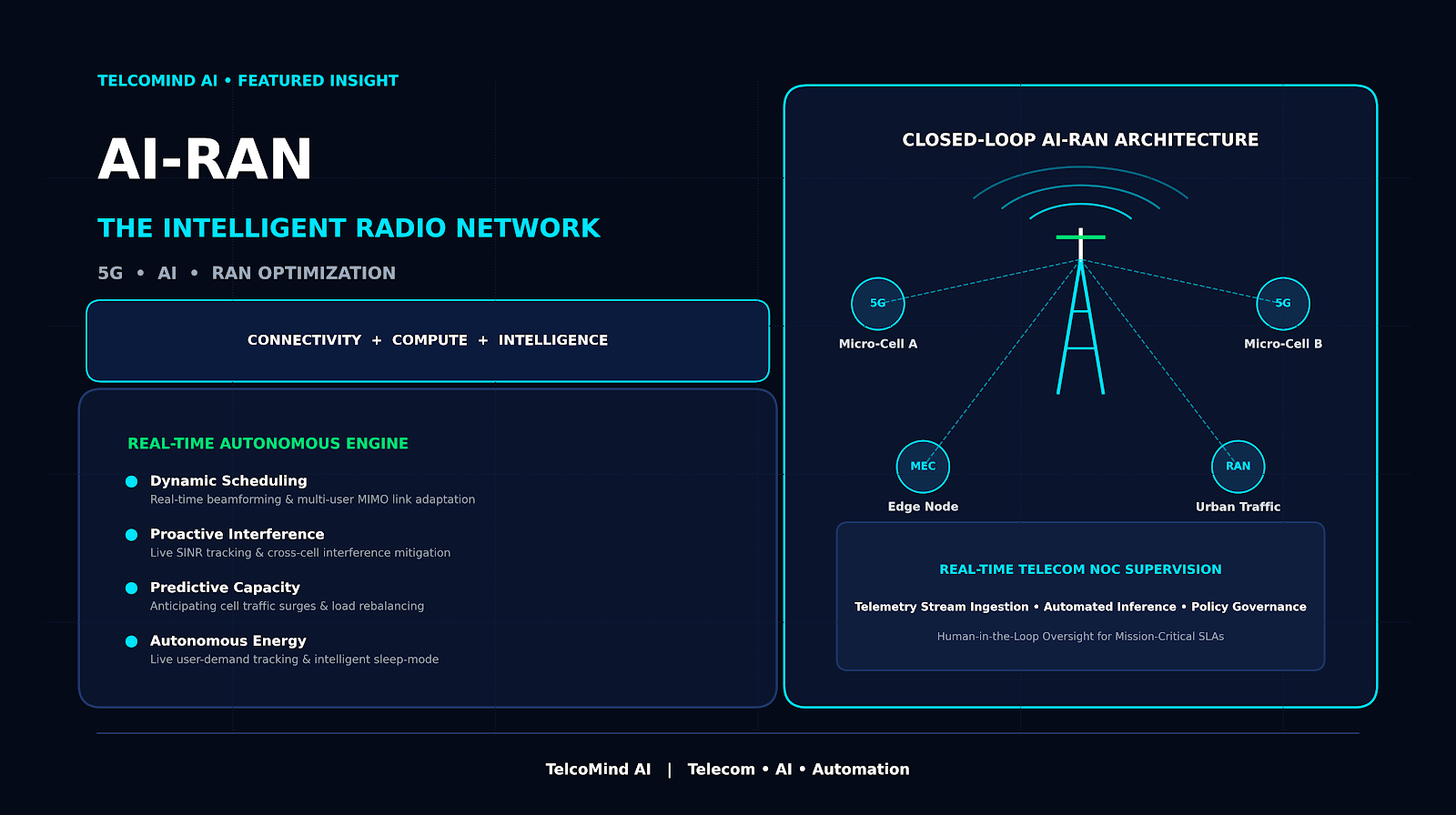
    AI-RAN transforming traditional radio access network operations through AI-driven prediction, optimization and automation
    From reactive RAN operations to AI-driven, adaptive network optimization.

    Why Does RAN Need AI?

    At 8:30 PM, traffic begins climbing across a busy urban 5G cluster.

    One cell is approaching congestion.

    A neighboring cell still has available capacity.

    Interference is increasing at the cell edge.

    Some users begin experiencing lower throughput, while others continue receiving perfectly normal service.

    Nothing is completely down.

    But the network is no longer operating at its best.

    Traditionally, RAN teams investigate such conditions through KPIs, counters, alarms, drive-test information, performance reports and optimization tools.

    The challenge is scale.

    A modern mobile network may contain thousands of cells, continuously producing performance information while traffic, mobility, interference and radio conditions change throughout the day.

    AI can analyze these changing conditions together and identify patterns that would be difficult to recognize manually across such a large environment.

    The value of AI-RAN is not simply automating another RAN task. It is helping the network understand changing conditions faster and respond more intelligently.

    How AI-RAN Actually Works

    AI-RAN starts with a simple idea:

    The radio network continuously produces signals about its own condition. AI turns those signals into operational intelligence.

    Instead of looking at one KPI or alarm in isolation, AI models can analyze multiple dimensions of network behaviour together.

    1. Observe — Collect the Network Signals

    The process begins with data from the RAN environment, including traffic load, throughput, latency, SINR, interference, mobility, resource utilization, alarms and historical performance.

    This creates a continuously evolving picture of how the radio network is behaving.

    2. Understand — Find the Pattern

    AI analyzes relationships across this data to identify patterns that may not be obvious from individual counters.

    For example, rising traffic alone may not be a problem. But rising traffic combined with deteriorating radio quality, increasing resource utilization and changing mobility patterns may indicate developing congestion.

    3. Predict — What Happens Next?

    The next step is moving from understanding the current network toward anticipating its future state.

    Will this cell become congested?

    Will customer throughput deteriorate?

    Will additional capacity be required during the next traffic peak?

    4. Optimize — What Should We Change?

    Based on the predicted condition, AI can recommend an optimization action—for example, adjusting resource allocation, load balancing, mobility behaviour or energy-saving strategies.

    Depending on the maturity and risk of the use case, the recommendation may be reviewed by an engineer or executed automatically within predefined operational policies.

    5. Validate & Learn — Did It Actually Work?

    This is one of the most important steps.

    After an optimization is applied, the network must be measured again.

    Did throughput improve?

    Did congestion decrease?

    Was customer experience better?

    Did another KPI deteriorate?

    The result becomes new information for future decisions.

            AI-RAN INTELLIGENCE LOOP

    ┌─────────────┐
    │ OBSERVE │
    │ Network Data│
    └──────┬──────┘

    ┌─────────────┐
    │ UNDERSTAND │
    │Find Patterns│
    └──────┬──────┘

    ┌─────────────┐
    │ PREDICT │
    │ What's Next?│
    └──────┬──────┘

    ┌─────────────┐
    │ OPTIMIZE │
    │ What to Do? │
    └──────┬──────┘

    ┌─────────────┐
    │ VALIDATE │
    │ Did It Work?│
    └──────┬──────┘

    └──────→ LEARN

    Where Is AI-RAN Creating Real Value?

    AI-RAN becomes meaningful when intelligence produces a measurable improvement in the live network.

    The value can appear in different forms: higher throughput, better spectrum utilization, lower interference, improved energy efficiency, more accurate capacity decisions, or a more consistent customer experience.

    Six areas are particularly important.

    1. Intelligent RAN Optimization

    Radio conditions can change within seconds.

    Traffic moves.

    Interference changes.

    Users enter and leave cells.

    Channel quality fluctuates.

    Traditional rule-based algorithms are designed to respond to these conditions, but AI models can learn more complex relationships between network conditions and optimization decisions.

    This makes areas such as scheduling, link adaptation, beamforming and resource allocation particularly interesting for AI-RAN.

    Real Network Example — T-Mobile + Ericsson

    In 2026, T-Mobile and Ericsson reported large-scale commercial trials of an AI-native Scheduler with Link Adaptation on T-Mobile’s live 5G Advanced network. Compared with legacy rule-based methods, the trial achieved up to 15% higher downlink throughput and close to 10% improvement in spectral efficiency.

    2. Interference Optimization

    Interference is one of the persistent challenges in radio networks.

    The difficult part is that changing one parameter to improve one cell can affect neighbouring cells.

    AI can analyze relationships across multiple cells and identify optimization opportunities that are difficult to capture through isolated threshold-based decisions.

    This becomes particularly valuable in dense networks where traffic, coverage and interference continuously interact.

    Real Network Example — KDDI + Ericsson

    In 2026, Ericsson and KDDI completed a large-scale AI-driven uplink optimization field trial on KDDI’s commercial network across both 4G and 5G, demonstrating performance improvements while uplink traffic was also increasing. The trial was positioned as part of KDDI’s progression toward higher levels of autonomous network operations.

    3. AI-Driven Capacity & Traffic Management

    Capacity planning traditionally relies heavily on historical trends.

    But tomorrow’s traffic does not always behave like yesterday’s.

    A stadium event, transport hub, business district, holiday period or unexpected crowd movement can rapidly change demand.

    AI can combine historical traffic, current utilization, mobility patterns and network behaviour to predict where capacity pressure may develop.

    Instead of asking:

    “Which cells were congested last month?”

    the operational question becomes:

    “Which cells are likely to become congested next?”

    That gives RAN teams something extremely valuable:

    time to act before capacity becomes customer impact.

    4. AI-Powered Energy Optimization

    A radio network does not experience the same traffic load 24 hours a day.

    During low-demand periods, AI can help identify where selected network resources may safely enter energy-saving states while maintaining required coverage and service quality.

    When traffic begins increasing again, resources can be restored dynamically.

    This changes the objective from simply:

    “Reduce energy.”

    to:

    “Use energy intelligently according to network demand.”

    The business value is particularly important because energy optimization connects AI-RAN directly with OPEX reduction and sustainability objectives.

    5. Customer Experience Optimization

    A cell can technically remain available while some users still experience poor service.

    AI-RAN can analyze radio conditions at a more granular level and help identify patterns affecting throughput, latency, coverage and user experience.

    This allows optimization to move beyond:

    “Is the cell healthy?”

    toward:

    “Are users actually receiving the experience the network was designed to provide?”

    eal Network Example — Optus + Ericsson

    In a 2026 Australian trial, Optus and Ericsson reported that AI-native RAN link adaptation delivered more than 20% cell-level throughput improvement in medium-to-poor radio-frequency conditions, without requiring additional spectrum or hardware.

    6. Toward Self-Optimizing RAN

    he most interesting stage appears when these capabilities begin working together.

    AI detects developing congestion.

    It predicts the likely impact.

    It identifies an optimization opportunity.

    A controlled action is recommended.

    The network measures the result.

    The outcome becomes feedback for the next decision.

    That creates a closed intelligence loop:

    Observe → Predict → Optimize → Execute → Validate → Learn

    This does not mean every RAN change should become autonomous.

    The level of automation should depend on risk, confidence, operational policy and the potential customer impact of the action.

    But it shows where AI-RAN is ultimately heading:

    from a network that follows predefined rules toward one that can increasingly adapt to changing conditions.

    AI-RAN Is Already Moving Into Live Networks

    AI-RAN is often discussed as part of the future of 6G.

    But some of its most interesting capabilities are already being tested—and in some cases scaled—across live commercial 4G and 5G networks today.

    The important shift is that operators are beginning to measure AI-RAN through actual network outcomes:

    Does throughput improve?

    Can spectrum be used more efficiently?

    Can interference be reduced?

    Can optimization scale across thousands of cells?

    Recent deployments and trials provide some useful answers.

    T-Mobile — AI-Native Scheduling at Scale

    In May 2026, T-Mobile and Ericsson reported large-scale commercial trials of an AI-native Scheduler with Link Adaptation using live 5G Advanced traffic.

    The AI model predicts rapidly changing radio conditions in real time and adapts transmission decisions accordingly.

    The reported result:

    Up to 15% improvement in downlink throughput
    Close to 10% improvement in spectral efficiency

    compared with legacy rule-based methods.

    This is significant because spectrum is one of an operator’s most valuable assets. Improving spectral efficiency means extracting more performance from infrastructure and spectrum already deployed.

    KDDI — AI Optimization Across Thousands of Cells

    KDDI and Ericsson approached AI-RAN from another direction: uplink interference optimization.

    Their 2026 commercial-network field trial covered approximately 1,500 5G cells and 1,300 4G cells.

    Ericsson reported average throughput improvements of 9.6% in 4G and 3.1% in 5G, alongside a 27% improvement in 5G SINR.

    What makes this example particularly interesting is scale.

    AI optimization becomes much more valuable when it can move beyond a handful of test cells toward large multi-band, multi-technology network environments.

    Optus — Improving 5G Without More Spectrum

    In Australia, Optus and Ericsson tested AI-native Link Adaptation in challenging radio conditions.

    The field trial reported more than 20% improvement in cell-level throughput under medium-to-poor RF conditions—without adding new spectrum or hardware.

    That illustrates an important business case for AI-RAN:

    Before asking how much more infrastructure should be added, ask whether intelligence can extract more value from what is already deployed.

    AT&T — Bringing AI Into Cloud RAN

    AI-RAN is also converging with Cloud RAN.

    In 2026, AT&T and Ericsson demonstrated AI-native Link Adaptation on a Cloud RAN stack running on Intel Xeon 6 infrastructure, using AT&T-specific frequency bands and propagation characteristics.

    This matters because it points toward a future where AI capabilities become increasingly portable across cloud-based RAN architectures rather than remaining tied to one fixed implementation.

    SoftBank — AI-RAN Meets Physical AI

    Another direction is emerging beyond network optimization itself.

    SoftBank and Ericsson demonstrated a proof of concept combining 5G connectivity, AI-RAN-related edge computing and Physical AI workloads, allowing robotic systems to dynamically offload AI processing toward nearby edge compute resources.

    This introduces a broader possibility:

    The RAN may not only use AI to optimize itself—it may eventually help provide the distributed connectivity and compute environment required by AI applications.

    AI-RAN is moving from “Can AI improve the radio network?” toward a more commercially relevant question: “Where can AI produce measurable network and business value at scale?”

    The Bigger Shift: From AI for RAN to AI on RAN

    Until recently, most conversations about AI and the RAN focused on one question:

    How can AI improve the network?

    Better optimization.

    Better traffic prediction.

    Better energy efficiency.

    Better interference management.

    Better utilization of spectrum.

    But another question is emerging:

    Can the RAN itself become part of the infrastructure that runs AI?

    This changes the conversation significantly.

    Instead of thinking only about AI for RAN, the industry is beginning to explore AI on RAN.

    In this model, distributed telecom infrastructure could potentially support both traditional radio workloads and AI workloads closer to where users, devices, machines and applications actually generate data.

            THE AI-RAN EVOLUTION
    
     AI FOR RAN                 AI ON RAN
         │                          │
         ▼                          ▼
    

    Optimize Network Run AI Workloads
    Predict Traffic Edge Intelligence
    Reduce Energy Computer Vision
    Manage Interference Physical AI
    Improve Experience Intelligent Devices
    │ │
    └──────────┬───────────────┘

    AI-RAN PLATFORM


    CONNECTIVITY + COMPUTE + AI

    This is why AI-RAN could eventually become much bigger than another network-optimization technology.

    The radio network already provides something extremely valuable: distributed infrastructure located close to users and devices.

    If connectivity, compute and AI can increasingly coexist across that infrastructure, telecom operators may have an opportunity to move beyond providing connectivity alone.

    And that raises a much bigger strategic question:

    Could AI-RAN eventually create new revenue opportunities for telecom operators—not only operational savings?

    From Network Efficiency to New Revenue Opportunities

    Most AI-RAN discussions begin with operational efficiency.

    Improve throughput.

    Optimize spectrum.

    Reduce energy consumption.

    Automate network decisions.

    These benefits are important because they can improve network performance while reducing operational cost.

    But there may be a second, potentially bigger opportunity.

    What if telecom infrastructure could also become distributed AI infrastructure?

    Mobile operators already have assets that many AI companies need: nationwide infrastructure, connectivity, edge locations, data centers, cloud platforms and proximity to millions of users and devices.

    AI-RAN could potentially bring connectivity, computing and AI processing closer together.

    1. Edge AI Inference

    Many AI applications cannot always afford to send every piece of data to a distant hyperscale cloud.

    Industrial automation, video analytics, robotics, autonomous systems and immersive applications may benefit from processing closer to where data is generated.

    Telecom edge infrastructure could potentially provide that environment.

    Instead of selling only connectivity, an operator could eventually provide:

    Connectivity + Edge Compute + AI Inference

    as an integrated enterprise service.

    2. AI Compute as a Service

    Distributed telecom infrastructure may also create opportunities to make underutilized computing resources available for AI workloads.

    The commercial model could gradually move from charging primarily for GBs, bandwidth and connectivity toward charging for combinations of connectivity and compute capacity.

    This does not mean every base station becomes an AI data center.

    It means the boundary between telecom infrastructure and distributed computing infrastructure may become less distinct.

    3. Physical AI & Robotics

    Robots, drones, industrial machines and autonomous systems need more than intelligence.

    They need reliable connectivity, low latency and access to computing resources.

    This creates an interesting role for telecom networks.

    A robot could perform some processing locally, offload more demanding AI workloads to nearby edge infrastructure, and use the mobile network to maintain reliable communication.

    In that scenario, the telecom network becomes part of the AI execution environment, not simply the transport layer.

    4. Enterprise & Sovereign AI Infrastructure

    Telecom operators also have another strategic advantage: they operate infrastructure inside national markets and under local regulatory frameworks.

    As enterprises and governments become more concerned about data residency, security and sovereign AI, locally operated telecom and edge infrastructure could become increasingly relevant.

    This could open opportunities for operators to participate in national or enterprise AI ecosystems beyond traditional connectivity services.

    The commercial promise of AI-RAN may ultimately be bigger than making the RAN cheaper to operate. It could help transform parts of the telecom network into infrastructure on which AI services themselves are delivered.

    What Could Slow AI-RAN Adoption?

    The technical potential of AI-RAN is significant.

    But moving from a successful trial to large-scale operational deployment is a different challenge.

    For operators, the question is not only:

    “Does the AI model work?”

    It is also:

    “Does it create enough value to justify deploying, integrating and operating it at scale?”

    1. The ROI Must Be Measurable

    A 5% or 10% improvement in a technical KPI sounds attractive.

    But operators ultimately need to translate that improvement into business value.

    Does higher spectral efficiency delay additional spectrum or capacity investment?

    Does better optimization reduce congestion?

    Does energy optimization materially lower OPEX?

    Does improved radio performance reduce customer complaints or churn?

    AI-RAN will scale faster when operators can connect technical improvement → operational impact → financial value.

    2. AI Is Only as Good as Its Network Data

    RAN environments generate enormous volumes of information, but more data does not automatically mean better intelligence.

    Missing counters, inconsistent data, configuration differences, topology inaccuracies or poor historical records can weaken model performance.

    AI-RAN therefore depends heavily on data quality, context and governance.

    Before asking whether the AI model is intelligent enough, operators may first need to ask:

    “Is the network data reliable enough for the model to learn from?”

    3. Multi-Vendor Networks Make Integration Harder

    Real telecom networks are rarely built from one technology generation, one architecture or one vendor.

    Operators may have multiple RAN vendors, legacy technologies, Open RAN components, different OSS platforms and years of accumulated configuration.

    An AI capability that performs well inside one isolated environment may be much harder to scale across the complete network.

    This makes interoperability, common data models, APIs and open interfaces strategically important to AI-RAN adoption.

    4. AI Itself Requires Compute and Energy

    There is an interesting paradox in AI-RAN.

    AI can help the network reduce energy consumption.

    But AI models themselves require compute, accelerators, storage and power.

    As AI workloads move closer to the network edge, operators will need to balance the intelligence gained against the infrastructure required to provide it.

    The winning architecture may therefore not be the one running the largest AI model everywhere.

    It may be the one using the right intelligence, at the right location, for the right operational problem.

    The success of AI-RAN will not be measured by how much AI an operator deploys. It will be measured by how much network and business value that intelligence creates.

    Where Does AI-RAN Go From Here?

    The first generation of mobile networks was primarily about connecting people.

    Later generations expanded that role—connecting smartphones, enterprises, machines, industries and increasingly complex digital services.

    AI-RAN introduces another possibility.

    The radio network may begin to evolve from infrastructure that simply carries data into infrastructure that can increasingly understand, optimize and potentially process intelligence closer to where that data is created.

    In the near term, the strongest business cases are likely to remain practical:

    Better spectrum utilization.

    Higher network performance.

    Lower energy consumption.

    More accurate capacity decisions.

    Improved customer experience.

    These are measurable problems with measurable value.

    But the longer-term opportunity could be much larger.

    As RAN, cloud, edge computing and AI infrastructure converge, operators may eventually ask a different question.

    Not simply:

    “How can AI make our radio network better?”

    But:

    “What new AI services can our network enable?”

    That is where AI-RAN becomes more than another optimization technology.

    It potentially becomes part of a new telecom infrastructure model built around:

    Connectivity + Compute + Intelligence

    The biggest opportunity in AI-RAN may not be teaching the network how to operate better. It may be discovering what becomes possible when the network itself becomes part of the AI infrastructure.

    Frequently Asked Questions About AI-RAN

    What is AI-RAN?

    AI-RAN refers to the integration of artificial intelligence with Radio Access Network technologies. AI can be used to analyze network conditions, predict traffic and performance, optimize radio resources, improve energy efficiency and support increasingly adaptive RAN operations.

    How is AI used in 5G networks?

    AI can support 5G networks through traffic prediction, radio-resource optimization, interference management, anomaly detection, energy optimization, capacity planning and customer-experience improvement.

    What is the difference between AI for RAN and AI on RAN?

    AI for RAN uses artificial intelligence to improve how the radio network performs and operates. AI on RAN explores using telecom infrastructure to support AI workloads, potentially combining connectivity, edge computing and AI inference.

    Can AI-RAN reduce telecom operating costs?

    Potentially, yes. AI-RAN can contribute to lower operating costs through areas such as energy optimization, more efficient spectrum utilization, predictive operations and automation. The actual financial benefit depends on deployment scale, infrastructure requirements and the specific use case.

    Is AI-RAN already being used in commercial networks?

    AI-driven RAN capabilities are already being tested and deployed in live commercial-network environments. Recent operator/vendor examples include work involving T-Mobile, KDDI, Optus, AT&T and SoftBank, covering AI-native scheduling, interference optimization, Cloud RAN and edge-AI use cases.

    Explore More: AI Across Telecom Operations

    AI-RAN is one part of a much wider transformation taking place across telecom operations—from predictive maintenance and AIOps to Agentic AI, Network Digital Twins and autonomous networks.

    Explore the complete guide:
    AI in Telecom: 10 Real-World Use Cases Transforming Network Operations in 2026

    TelcoMind AI | Telecom • AI • Automation

  • AI-RAN: How Artificial Intelligence Is Transforming Radio Access Networks

    AI-RAN: How Artificial Intelligence Is Transforming Radio Access Networks

    What if the radio network could predict congestion before users experience it, adjust capacity automatically, reduce energy consumption during low-traffic periods, and help engineers identify the right action before service quality deteriorates?

    That is increasingly the direction of AI-RAN — the application of artificial intelligence across Radio Access Network operations and optimization.

    Traditional RAN operations depend heavily on thresholds, alarms, historical KPIs and engineer-driven analysis. AI introduces another layer: the ability to learn from network behavior, identify patterns across large volumes of data, predict potential degradation and recommend—or, under controlled conditions, execute—optimization actions.

    But AI-RAN is not simply about automating the RAN.

    The bigger opportunity is creating a network where AI and experienced engineers work together, combining machine-scale analysis with operational judgment, governance and network knowledge.

    AI-RAN transforming traditional radio access network operations through AI-driven prediction, optimization and automation
    From reactive RAN operations to AI-driven, adaptive network optimization.

    Why Does RAN Need AI?

    At 8:30 PM, traffic begins climbing across a busy urban 5G cluster.

    One cell is approaching congestion.

    A neighboring cell still has available capacity.

    Interference is increasing at the cell edge.

    Some users begin experiencing lower throughput, while others continue receiving perfectly normal service.

    Nothing is completely down.

    But the network is no longer operating at its best.

    Traditionally, RAN teams investigate such conditions through KPIs, counters, alarms, drive-test information, performance reports and optimization tools.

    The challenge is scale.

    A modern mobile network may contain thousands of cells, continuously producing performance information while traffic, mobility, interference and radio conditions change throughout the day.

    AI can analyze these changing conditions together and identify patterns that would be difficult to recognize manually across such a large environment.

    The value of AI-RAN is not simply automating another RAN task. It is helping the network understand changing conditions faster and respond more intelligently.

    How AI-RAN Actually Works

    AI-RAN starts with a simple idea:

    The radio network continuously produces signals about its own condition. AI turns those signals into operational intelligence.

    Instead of looking at one KPI or alarm in isolation, AI models can analyze multiple dimensions of network behaviour together.

    1. Observe — Collect the Network Signals

    The process begins with data from the RAN environment, including traffic load, throughput, latency, SINR, interference, mobility, resource utilization, alarms and historical performance.

    This creates a continuously evolving picture of how the radio network is behaving.

    2. Understand — Find the Pattern

    AI analyzes relationships across this data to identify patterns that may not be obvious from individual counters.

    For example, rising traffic alone may not be a problem. But rising traffic combined with deteriorating radio quality, increasing resource utilization and changing mobility patterns may indicate developing congestion.

    3. Predict — What Happens Next?

    The next step is moving from understanding the current network toward anticipating its future state.

    Will this cell become congested?

    Will customer throughput deteriorate?

    Will additional capacity be required during the next traffic peak?

    4. Optimize — What Should We Change?

    Based on the predicted condition, AI can recommend an optimization action—for example, adjusting resource allocation, load balancing, mobility behaviour or energy-saving strategies.

    Depending on the maturity and risk of the use case, the recommendation may be reviewed by an engineer or executed automatically within predefined operational policies.

    5. Validate & Learn — Did It Actually Work?

    This is one of the most important steps.

    After an optimization is applied, the network must be measured again.

    Did throughput improve?

    Did congestion decrease?

    Was customer experience better?

    Did another KPI deteriorate?

    The result becomes new information for future decisions.

            AI-RAN INTELLIGENCE LOOP

    ┌─────────────┐
    │ OBSERVE │
    │ Network Data│
    └──────┬──────┘

    ┌─────────────┐
    │ UNDERSTAND │
    │Find Patterns│
    └──────┬──────┘

    ┌─────────────┐
    │ PREDICT │
    │ What's Next?│
    └──────┬──────┘

    ┌─────────────┐
    │ OPTIMIZE │
    │ What to Do? │
    └──────┬──────┘

    ┌─────────────┐
    │ VALIDATE │
    │ Did It Work?│
    └──────┬──────┘

    └──────→ LEARN

    Where Is AI-RAN Creating Real Value?

    AI-RAN becomes meaningful when intelligence produces a measurable improvement in the live network.

    The value can appear in different forms: higher throughput, better spectrum utilization, lower interference, improved energy efficiency, more accurate capacity decisions, or a more consistent customer experience.

    Six areas are particularly important.

    1. Intelligent RAN Optimization

    Radio conditions can change within seconds.

    Traffic moves.

    Interference changes.

    Users enter and leave cells.

    Channel quality fluctuates.

    Traditional rule-based algorithms are designed to respond to these conditions, but AI models can learn more complex relationships between network conditions and optimization decisions.

    This makes areas such as scheduling, link adaptation, beamforming and resource allocation particularly interesting for AI-RAN.

    Real Network Example — T-Mobile + Ericsson

    In 2026, T-Mobile and Ericsson reported large-scale commercial trials of an AI-native Scheduler with Link Adaptation on T-Mobile’s live 5G Advanced network. Compared with legacy rule-based methods, the trial achieved up to 15% higher downlink throughput and close to 10% improvement in spectral efficiency.

    2. Interference Optimization

    Interference is one of the persistent challenges in radio networks.

    The difficult part is that changing one parameter to improve one cell can affect neighbouring cells.

    AI can analyze relationships across multiple cells and identify optimization opportunities that are difficult to capture through isolated threshold-based decisions.

    This becomes particularly valuable in dense networks where traffic, coverage and interference continuously interact.

    Real Network Example — KDDI + Ericsson

    In 2026, Ericsson and KDDI completed a large-scale AI-driven uplink optimization field trial on KDDI’s commercial network across both 4G and 5G, demonstrating performance improvements while uplink traffic was also increasing. The trial was positioned as part of KDDI’s progression toward higher levels of autonomous network operations.

    3. AI-Driven Capacity & Traffic Management

    Capacity planning traditionally relies heavily on historical trends.

    But tomorrow’s traffic does not always behave like yesterday’s.

    A stadium event, transport hub, business district, holiday period or unexpected crowd movement can rapidly change demand.

    AI can combine historical traffic, current utilization, mobility patterns and network behaviour to predict where capacity pressure may develop.

    Instead of asking:

    “Which cells were congested last month?”

    the operational question becomes:

    “Which cells are likely to become congested next?”

    That gives RAN teams something extremely valuable:

    time to act before capacity becomes customer impact.

    4. AI-Powered Energy Optimization

    A radio network does not experience the same traffic load 24 hours a day.

    During low-demand periods, AI can help identify where selected network resources may safely enter energy-saving states while maintaining required coverage and service quality.

    When traffic begins increasing again, resources can be restored dynamically.

    This changes the objective from simply:

    “Reduce energy.”

    to:

    “Use energy intelligently according to network demand.”

    The business value is particularly important because energy optimization connects AI-RAN directly with OPEX reduction and sustainability objectives.

    5. Customer Experience Optimization

    A cell can technically remain available while some users still experience poor service.

    AI-RAN can analyze radio conditions at a more granular level and help identify patterns affecting throughput, latency, coverage and user experience.

    This allows optimization to move beyond:

    “Is the cell healthy?”

    toward:

    “Are users actually receiving the experience the network was designed to provide?”

    eal Network Example — Optus + Ericsson

    In a 2026 Australian trial, Optus and Ericsson reported that AI-native RAN link adaptation delivered more than 20% cell-level throughput improvement in medium-to-poor radio-frequency conditions, without requiring additional spectrum or hardware.

    6. Toward Self-Optimizing RAN

    he most interesting stage appears when these capabilities begin working together.

    AI detects developing congestion.

    It predicts the likely impact.

    It identifies an optimization opportunity.

    A controlled action is recommended.

    The network measures the result.

    The outcome becomes feedback for the next decision.

    That creates a closed intelligence loop:

    Observe → Predict → Optimize → Execute → Validate → Learn

    This does not mean every RAN change should become autonomous.

    The level of automation should depend on risk, confidence, operational policy and the potential customer impact of the action.

    But it shows where AI-RAN is ultimately heading:

    from a network that follows predefined rules toward one that can increasingly adapt to changing conditions.

    AI-RAN Is Already Moving Into Live Networks

    AI-RAN is often discussed as part of the future of 6G.

    But some of its most interesting capabilities are already being tested—and in some cases scaled—across live commercial 4G and 5G networks today.

    The important shift is that operators are beginning to measure AI-RAN through actual network outcomes:

    Does throughput improve?

    Can spectrum be used more efficiently?

    Can interference be reduced?

    Can optimization scale across thousands of cells?

    Recent deployments and trials provide some useful answers.

    T-Mobile — AI-Native Scheduling at Scale

    In May 2026, T-Mobile and Ericsson reported large-scale commercial trials of an AI-native Scheduler with Link Adaptation using live 5G Advanced traffic.

    The AI model predicts rapidly changing radio conditions in real time and adapts transmission decisions accordingly.

    The reported result:

    Up to 15% improvement in downlink throughput
    Close to 10% improvement in spectral efficiency

    compared with legacy rule-based methods.

    This is significant because spectrum is one of an operator’s most valuable assets. Improving spectral efficiency means extracting more performance from infrastructure and spectrum already deployed.

    KDDI — AI Optimization Across Thousands of Cells

    KDDI and Ericsson approached AI-RAN from another direction: uplink interference optimization.

    Their 2026 commercial-network field trial covered approximately 1,500 5G cells and 1,300 4G cells.

    Ericsson reported average throughput improvements of 9.6% in 4G and 3.1% in 5G, alongside a 27% improvement in 5G SINR.

    What makes this example particularly interesting is scale.

    AI optimization becomes much more valuable when it can move beyond a handful of test cells toward large multi-band, multi-technology network environments.

    Optus — Improving 5G Without More Spectrum

    In Australia, Optus and Ericsson tested AI-native Link Adaptation in challenging radio conditions.

    The field trial reported more than 20% improvement in cell-level throughput under medium-to-poor RF conditions—without adding new spectrum or hardware.

    That illustrates an important business case for AI-RAN:

    Before asking how much more infrastructure should be added, ask whether intelligence can extract more value from what is already deployed.

    AT&T — Bringing AI Into Cloud RAN

    AI-RAN is also converging with Cloud RAN.

    In 2026, AT&T and Ericsson demonstrated AI-native Link Adaptation on a Cloud RAN stack running on Intel Xeon 6 infrastructure, using AT&T-specific frequency bands and propagation characteristics.

    This matters because it points toward a future where AI capabilities become increasingly portable across cloud-based RAN architectures rather than remaining tied to one fixed implementation.

    SoftBank — AI-RAN Meets Physical AI

    Another direction is emerging beyond network optimization itself.

    SoftBank and Ericsson demonstrated a proof of concept combining 5G connectivity, AI-RAN-related edge computing and Physical AI workloads, allowing robotic systems to dynamically offload AI processing toward nearby edge compute resources.

    This introduces a broader possibility:

    The RAN may not only use AI to optimize itself—it may eventually help provide the distributed connectivity and compute environment required by AI applications.

    AI-RAN is moving from “Can AI improve the radio network?” toward a more commercially relevant question: “Where can AI produce measurable network and business value at scale?”

    The Bigger Shift: From AI for RAN to AI on RAN

    Until recently, most conversations about AI and the RAN focused on one question:

    How can AI improve the network?

    Better optimization.

    Better traffic prediction.

    Better energy efficiency.

    Better interference management.

    Better utilization of spectrum.

    But another question is emerging:

    Can the RAN itself become part of the infrastructure that runs AI?

    This changes the conversation significantly.

    Instead of thinking only about AI for RAN, the industry is beginning to explore AI on RAN.

    In this model, distributed telecom infrastructure could potentially support both traditional radio workloads and AI workloads closer to where users, devices, machines and applications actually generate data.

            THE AI-RAN EVOLUTION
    
     AI FOR RAN                 AI ON RAN
         │                          │
         ▼                          ▼
    

    Optimize Network Run AI Workloads
    Predict Traffic Edge Intelligence
    Reduce Energy Computer Vision
    Manage Interference Physical AI
    Improve Experience Intelligent Devices
    │ │
    └──────────┬───────────────┘

    AI-RAN PLATFORM


    CONNECTIVITY + COMPUTE + AI

    This is why AI-RAN could eventually become much bigger than another network-optimization technology.

    The radio network already provides something extremely valuable: distributed infrastructure located close to users and devices.

    If connectivity, compute and AI can increasingly coexist across that infrastructure, telecom operators may have an opportunity to move beyond providing connectivity alone.

    And that raises a much bigger strategic question:

    Could AI-RAN eventually create new revenue opportunities for telecom operators—not only operational savings?

    From Network Efficiency to New Revenue Opportunities

    Most AI-RAN discussions begin with operational efficiency.

    Improve throughput.

    Optimize spectrum.

    Reduce energy consumption.

    Automate network decisions.

    These benefits are important because they can improve network performance while reducing operational cost.

    But there may be a second, potentially bigger opportunity.

    What if telecom infrastructure could also become distributed AI infrastructure?

    Mobile operators already have assets that many AI companies need: nationwide infrastructure, connectivity, edge locations, data centers, cloud platforms and proximity to millions of users and devices.

    AI-RAN could potentially bring connectivity, computing and AI processing closer together.

    1. Edge AI Inference

    Many AI applications cannot always afford to send every piece of data to a distant hyperscale cloud.

    Industrial automation, video analytics, robotics, autonomous systems and immersive applications may benefit from processing closer to where data is generated.

    Telecom edge infrastructure could potentially provide that environment.

    Instead of selling only connectivity, an operator could eventually provide:

    Connectivity + Edge Compute + AI Inference

    as an integrated enterprise service.

    2. AI Compute as a Service

    Distributed telecom infrastructure may also create opportunities to make underutilized computing resources available for AI workloads.

    The commercial model could gradually move from charging primarily for GBs, bandwidth and connectivity toward charging for combinations of connectivity and compute capacity.

    This does not mean every base station becomes an AI data center.

    It means the boundary between telecom infrastructure and distributed computing infrastructure may become less distinct.

    3. Physical AI & Robotics

    Robots, drones, industrial machines and autonomous systems need more than intelligence.

    They need reliable connectivity, low latency and access to computing resources.

    This creates an interesting role for telecom networks.

    A robot could perform some processing locally, offload more demanding AI workloads to nearby edge infrastructure, and use the mobile network to maintain reliable communication.

    In that scenario, the telecom network becomes part of the AI execution environment, not simply the transport layer.

    4. Enterprise & Sovereign AI Infrastructure

    Telecom operators also have another strategic advantage: they operate infrastructure inside national markets and under local regulatory frameworks.

    As enterprises and governments become more concerned about data residency, security and sovereign AI, locally operated telecom and edge infrastructure could become increasingly relevant.

    This could open opportunities for operators to participate in national or enterprise AI ecosystems beyond traditional connectivity services.

    The commercial promise of AI-RAN may ultimately be bigger than making the RAN cheaper to operate. It could help transform parts of the telecom network into infrastructure on which AI services themselves are delivered.

    What Could Slow AI-RAN Adoption?

    The technical potential of AI-RAN is significant.

    But moving from a successful trial to large-scale operational deployment is a different challenge.

    For operators, the question is not only:

    “Does the AI model work?”

    It is also:

    “Does it create enough value to justify deploying, integrating and operating it at scale?”

    1. The ROI Must Be Measurable

    A 5% or 10% improvement in a technical KPI sounds attractive.

    But operators ultimately need to translate that improvement into business value.

    Does higher spectral efficiency delay additional spectrum or capacity investment?

    Does better optimization reduce congestion?

    Does energy optimization materially lower OPEX?

    Does improved radio performance reduce customer complaints or churn?

    AI-RAN will scale faster when operators can connect technical improvement → operational impact → financial value.

    2. AI Is Only as Good as Its Network Data

    RAN environments generate enormous volumes of information, but more data does not automatically mean better intelligence.

    Missing counters, inconsistent data, configuration differences, topology inaccuracies or poor historical records can weaken model performance.

    AI-RAN therefore depends heavily on data quality, context and governance.

    Before asking whether the AI model is intelligent enough, operators may first need to ask:

    “Is the network data reliable enough for the model to learn from?”

    3. Multi-Vendor Networks Make Integration Harder

    Real telecom networks are rarely built from one technology generation, one architecture or one vendor.

    Operators may have multiple RAN vendors, legacy technologies, Open RAN components, different OSS platforms and years of accumulated configuration.

    An AI capability that performs well inside one isolated environment may be much harder to scale across the complete network.

    This makes interoperability, common data models, APIs and open interfaces strategically important to AI-RAN adoption.

    4. AI Itself Requires Compute and Energy

    There is an interesting paradox in AI-RAN.

    AI can help the network reduce energy consumption.

    But AI models themselves require compute, accelerators, storage and power.

    As AI workloads move closer to the network edge, operators will need to balance the intelligence gained against the infrastructure required to provide it.

    The winning architecture may therefore not be the one running the largest AI model everywhere.

    It may be the one using the right intelligence, at the right location, for the right operational problem.

    The success of AI-RAN will not be measured by how much AI an operator deploys. It will be measured by how much network and business value that intelligence creates.

    Where Does AI-RAN Go From Here?

    The first generation of mobile networks was primarily about connecting people.

    Later generations expanded that role—connecting smartphones, enterprises, machines, industries and increasingly complex digital services.

    AI-RAN introduces another possibility.

    The radio network may begin to evolve from infrastructure that simply carries data into infrastructure that can increasingly understand, optimize and potentially process intelligence closer to where that data is created.

    In the near term, the strongest business cases are likely to remain practical:

    Better spectrum utilization.

    Higher network performance.

    Lower energy consumption.

    More accurate capacity decisions.

    Improved customer experience.

    These are measurable problems with measurable value.

    But the longer-term opportunity could be much larger.

    As RAN, cloud, edge computing and AI infrastructure converge, operators may eventually ask a different question.

    Not simply:

    “How can AI make our radio network better?”

    But:

    “What new AI services can our network enable?”

    That is where AI-RAN becomes more than another optimization technology.

    It potentially becomes part of a new telecom infrastructure model built around:

    Connectivity + Compute + Intelligence

    The biggest opportunity in AI-RAN may not be teaching the network how to operate better. It may be discovering what becomes possible when the network itself becomes part of the AI infrastructure.

    Frequently Asked Questions About AI-RAN

    What is AI-RAN?

    AI-RAN refers to the integration of artificial intelligence with Radio Access Network technologies. AI can be used to analyze network conditions, predict traffic and performance, optimize radio resources, improve energy efficiency and support increasingly adaptive RAN operations.

    How is AI used in 5G networks?

    AI can support 5G networks through traffic prediction, radio-resource optimization, interference management, anomaly detection, energy optimization, capacity planning and customer-experience improvement.

    What is the difference between AI for RAN and AI on RAN?

    AI for RAN uses artificial intelligence to improve how the radio network performs and operates. AI on RAN explores using telecom infrastructure to support AI workloads, potentially combining connectivity, edge computing and AI inference.

    Can AI-RAN reduce telecom operating costs?

    Potentially, yes. AI-RAN can contribute to lower operating costs through areas such as energy optimization, more efficient spectrum utilization, predictive operations and automation. The actual financial benefit depends on deployment scale, infrastructure requirements and the specific use case.

    Is AI-RAN already being used in commercial networks?

    AI-driven RAN capabilities are already being tested and deployed in live commercial-network environments. Recent operator/vendor examples include work involving T-Mobile, KDDI, Optus, AT&T and SoftBank, covering AI-native scheduling, interference optimization, Cloud RAN and edge-AI use cases.

    Explore More: AI Across Telecom Operations

    AI-RAN is one part of a much wider transformation taking place across telecom operations—from predictive maintenance and AIOps to Agentic AI, Network Digital Twins and autonomous networks.

    Explore the complete guide:
    AI in Telecom: 10 Real-World Use Cases Transforming Network Operations in 2026

    TelcoMind AI | Telecom • AI • Automation

  • AI-RAN: How Artificial Intelligence Is Transforming Radio Access Networks

    AI-RAN: How Artificial Intelligence Is Transforming Radio Access Networks

    What if the radio network could predict congestion before users experience it, adjust capacity automatically, reduce energy consumption during low-traffic periods, and help engineers identify the right action before service quality deteriorates?

    That is increasingly the direction of AI-RAN — the application of artificial intelligence across Radio Access Network operations and optimization.

    Traditional RAN operations depend heavily on thresholds, alarms, historical KPIs and engineer-driven analysis. AI introduces another layer: the ability to learn from network behavior, identify patterns across large volumes of data, predict potential degradation and recommend—or, under controlled conditions, execute—optimization actions.

    But AI-RAN is not simply about automating the RAN.

    The bigger opportunity is creating a network where AI and experienced engineers work together, combining machine-scale analysis with operational judgment, governance and network knowledge.

    AI-RAN transforming traditional radio access network operations through AI-driven prediction, optimization and automation
    From reactive RAN operations to AI-driven, adaptive network optimization.

    Why Does RAN Need AI?

    At 8:30 PM, traffic begins climbing across a busy urban 5G cluster.

    One cell is approaching congestion.

    A neighboring cell still has available capacity.

    Interference is increasing at the cell edge.

    Some users begin experiencing lower throughput, while others continue receiving perfectly normal service.

    Nothing is completely down.

    But the network is no longer operating at its best.

    Traditionally, RAN teams investigate such conditions through KPIs, counters, alarms, drive-test information, performance reports and optimization tools.

    The challenge is scale.

    A modern mobile network may contain thousands of cells, continuously producing performance information while traffic, mobility, interference and radio conditions change throughout the day.

    AI can analyze these changing conditions together and identify patterns that would be difficult to recognize manually across such a large environment.

    The value of AI-RAN is not simply automating another RAN task. It is helping the network understand changing conditions faster and respond more intelligently.

    How AI-RAN Actually Works

    AI-RAN starts with a simple idea:

    The radio network continuously produces signals about its own condition. AI turns those signals into operational intelligence.

    Instead of looking at one KPI or alarm in isolation, AI models can analyze multiple dimensions of network behaviour together.

    1. Observe — Collect the Network Signals

    The process begins with data from the RAN environment, including traffic load, throughput, latency, SINR, interference, mobility, resource utilization, alarms and historical performance.

    This creates a continuously evolving picture of how the radio network is behaving.

    2. Understand — Find the Pattern

    AI analyzes relationships across this data to identify patterns that may not be obvious from individual counters.

    For example, rising traffic alone may not be a problem. But rising traffic combined with deteriorating radio quality, increasing resource utilization and changing mobility patterns may indicate developing congestion.

    3. Predict — What Happens Next?

    The next step is moving from understanding the current network toward anticipating its future state.

    Will this cell become congested?

    Will customer throughput deteriorate?

    Will additional capacity be required during the next traffic peak?

    4. Optimize — What Should We Change?

    Based on the predicted condition, AI can recommend an optimization action—for example, adjusting resource allocation, load balancing, mobility behaviour or energy-saving strategies.

    Depending on the maturity and risk of the use case, the recommendation may be reviewed by an engineer or executed automatically within predefined operational policies.

    5. Validate & Learn — Did It Actually Work?

    This is one of the most important steps.

    After an optimization is applied, the network must be measured again.

    Did throughput improve?

    Did congestion decrease?

    Was customer experience better?

    Did another KPI deteriorate?

    The result becomes new information for future decisions.

            AI-RAN INTELLIGENCE LOOP

    ┌─────────────┐
    │ OBSERVE │
    │ Network Data│
    └──────┬──────┘

    ┌─────────────┐
    │ UNDERSTAND │
    │Find Patterns│
    └──────┬──────┘

    ┌─────────────┐
    │ PREDICT │
    │ What's Next?│
    └──────┬──────┘

    ┌─────────────┐
    │ OPTIMIZE │
    │ What to Do? │
    └──────┬──────┘

    ┌─────────────┐
    │ VALIDATE │
    │ Did It Work?│
    └──────┬──────┘

    └──────→ LEARN

    Where Is AI-RAN Creating Real Value?

    AI-RAN becomes meaningful when intelligence produces a measurable improvement in the live network.

    The value can appear in different forms: higher throughput, better spectrum utilization, lower interference, improved energy efficiency, more accurate capacity decisions, or a more consistent customer experience.

    Six areas are particularly important.

    1. Intelligent RAN Optimization

    Radio conditions can change within seconds.

    Traffic moves.

    Interference changes.

    Users enter and leave cells.

    Channel quality fluctuates.

    Traditional rule-based algorithms are designed to respond to these conditions, but AI models can learn more complex relationships between network conditions and optimization decisions.

    This makes areas such as scheduling, link adaptation, beamforming and resource allocation particularly interesting for AI-RAN.

    Real Network Example — T-Mobile + Ericsson

    In 2026, T-Mobile and Ericsson reported large-scale commercial trials of an AI-native Scheduler with Link Adaptation on T-Mobile’s live 5G Advanced network. Compared with legacy rule-based methods, the trial achieved up to 15% higher downlink throughput and close to 10% improvement in spectral efficiency.

    2. Interference Optimization

    Interference is one of the persistent challenges in radio networks.

    The difficult part is that changing one parameter to improve one cell can affect neighbouring cells.

    AI can analyze relationships across multiple cells and identify optimization opportunities that are difficult to capture through isolated threshold-based decisions.

    This becomes particularly valuable in dense networks where traffic, coverage and interference continuously interact.

    Real Network Example — KDDI + Ericsson

    In 2026, Ericsson and KDDI completed a large-scale AI-driven uplink optimization field trial on KDDI’s commercial network across both 4G and 5G, demonstrating performance improvements while uplink traffic was also increasing. The trial was positioned as part of KDDI’s progression toward higher levels of autonomous network operations.

    3. AI-Driven Capacity & Traffic Management

    Capacity planning traditionally relies heavily on historical trends.

    But tomorrow’s traffic does not always behave like yesterday’s.

    A stadium event, transport hub, business district, holiday period or unexpected crowd movement can rapidly change demand.

    AI can combine historical traffic, current utilization, mobility patterns and network behaviour to predict where capacity pressure may develop.

    Instead of asking:

    “Which cells were congested last month?”

    the operational question becomes:

    “Which cells are likely to become congested next?”

    That gives RAN teams something extremely valuable:

    time to act before capacity becomes customer impact.

    4. AI-Powered Energy Optimization

    A radio network does not experience the same traffic load 24 hours a day.

    During low-demand periods, AI can help identify where selected network resources may safely enter energy-saving states while maintaining required coverage and service quality.

    When traffic begins increasing again, resources can be restored dynamically.

    This changes the objective from simply:

    “Reduce energy.”

    to:

    “Use energy intelligently according to network demand.”

    The business value is particularly important because energy optimization connects AI-RAN directly with OPEX reduction and sustainability objectives.

    5. Customer Experience Optimization

    A cell can technically remain available while some users still experience poor service.

    AI-RAN can analyze radio conditions at a more granular level and help identify patterns affecting throughput, latency, coverage and user experience.

    This allows optimization to move beyond:

    “Is the cell healthy?”

    toward:

    “Are users actually receiving the experience the network was designed to provide?”

    eal Network Example — Optus + Ericsson

    In a 2026 Australian trial, Optus and Ericsson reported that AI-native RAN link adaptation delivered more than 20% cell-level throughput improvement in medium-to-poor radio-frequency conditions, without requiring additional spectrum or hardware.

    6. Toward Self-Optimizing RAN

    he most interesting stage appears when these capabilities begin working together.

    AI detects developing congestion.

    It predicts the likely impact.

    It identifies an optimization opportunity.

    A controlled action is recommended.

    The network measures the result.

    The outcome becomes feedback for the next decision.

    That creates a closed intelligence loop:

    Observe → Predict → Optimize → Execute → Validate → Learn

    This does not mean every RAN change should become autonomous.

    The level of automation should depend on risk, confidence, operational policy and the potential customer impact of the action.

    But it shows where AI-RAN is ultimately heading:

    from a network that follows predefined rules toward one that can increasingly adapt to changing conditions.

    AI-RAN Is Already Moving Into Live Networks

    AI-RAN is often discussed as part of the future of 6G.

    But some of its most interesting capabilities are already being tested—and in some cases scaled—across live commercial 4G and 5G networks today.

    The important shift is that operators are beginning to measure AI-RAN through actual network outcomes:

    Does throughput improve?

    Can spectrum be used more efficiently?

    Can interference be reduced?

    Can optimization scale across thousands of cells?

    Recent deployments and trials provide some useful answers.

    T-Mobile — AI-Native Scheduling at Scale

    In May 2026, T-Mobile and Ericsson reported large-scale commercial trials of an AI-native Scheduler with Link Adaptation using live 5G Advanced traffic.

    The AI model predicts rapidly changing radio conditions in real time and adapts transmission decisions accordingly.

    The reported result:

    Up to 15% improvement in downlink throughput
    Close to 10% improvement in spectral efficiency

    compared with legacy rule-based methods.

    This is significant because spectrum is one of an operator’s most valuable assets. Improving spectral efficiency means extracting more performance from infrastructure and spectrum already deployed.

    KDDI — AI Optimization Across Thousands of Cells

    KDDI and Ericsson approached AI-RAN from another direction: uplink interference optimization.

    Their 2026 commercial-network field trial covered approximately 1,500 5G cells and 1,300 4G cells.

    Ericsson reported average throughput improvements of 9.6% in 4G and 3.1% in 5G, alongside a 27% improvement in 5G SINR.

    What makes this example particularly interesting is scale.

    AI optimization becomes much more valuable when it can move beyond a handful of test cells toward large multi-band, multi-technology network environments.

    Optus — Improving 5G Without More Spectrum

    In Australia, Optus and Ericsson tested AI-native Link Adaptation in challenging radio conditions.

    The field trial reported more than 20% improvement in cell-level throughput under medium-to-poor RF conditions—without adding new spectrum or hardware.

    That illustrates an important business case for AI-RAN:

    Before asking how much more infrastructure should be added, ask whether intelligence can extract more value from what is already deployed.

    AT&T — Bringing AI Into Cloud RAN

    AI-RAN is also converging with Cloud RAN.

    In 2026, AT&T and Ericsson demonstrated AI-native Link Adaptation on a Cloud RAN stack running on Intel Xeon 6 infrastructure, using AT&T-specific frequency bands and propagation characteristics.

    This matters because it points toward a future where AI capabilities become increasingly portable across cloud-based RAN architectures rather than remaining tied to one fixed implementation.

    SoftBank — AI-RAN Meets Physical AI

    Another direction is emerging beyond network optimization itself.

    SoftBank and Ericsson demonstrated a proof of concept combining 5G connectivity, AI-RAN-related edge computing and Physical AI workloads, allowing robotic systems to dynamically offload AI processing toward nearby edge compute resources.

    This introduces a broader possibility:

    The RAN may not only use AI to optimize itself—it may eventually help provide the distributed connectivity and compute environment required by AI applications.

    AI-RAN is moving from “Can AI improve the radio network?” toward a more commercially relevant question: “Where can AI produce measurable network and business value at scale?”

    The Bigger Shift: From AI for RAN to AI on RAN

    Until recently, most conversations about AI and the RAN focused on one question:

    How can AI improve the network?

    Better optimization.

    Better traffic prediction.

    Better energy efficiency.

    Better interference management.

    Better utilization of spectrum.

    But another question is emerging:

    Can the RAN itself become part of the infrastructure that runs AI?

    This changes the conversation significantly.

    Instead of thinking only about AI for RAN, the industry is beginning to explore AI on RAN.

    In this model, distributed telecom infrastructure could potentially support both traditional radio workloads and AI workloads closer to where users, devices, machines and applications actually generate data.

            THE AI-RAN EVOLUTION
    
     AI FOR RAN                 AI ON RAN
         │                          │
         ▼                          ▼
    

    Optimize Network Run AI Workloads
    Predict Traffic Edge Intelligence
    Reduce Energy Computer Vision
    Manage Interference Physical AI
    Improve Experience Intelligent Devices
    │ │
    └──────────┬───────────────┘

    AI-RAN PLATFORM


    CONNECTIVITY + COMPUTE + AI

    This is why AI-RAN could eventually become much bigger than another network-optimization technology.

    The radio network already provides something extremely valuable: distributed infrastructure located close to users and devices.

    If connectivity, compute and AI can increasingly coexist across that infrastructure, telecom operators may have an opportunity to move beyond providing connectivity alone.

    And that raises a much bigger strategic question:

    Could AI-RAN eventually create new revenue opportunities for telecom operators—not only operational savings?

    From Network Efficiency to New Revenue Opportunities

    Most AI-RAN discussions begin with operational efficiency.

    Improve throughput.

    Optimize spectrum.

    Reduce energy consumption.

    Automate network decisions.

    These benefits are important because they can improve network performance while reducing operational cost.

    But there may be a second, potentially bigger opportunity.

    What if telecom infrastructure could also become distributed AI infrastructure?

    Mobile operators already have assets that many AI companies need: nationwide infrastructure, connectivity, edge locations, data centers, cloud platforms and proximity to millions of users and devices.

    AI-RAN could potentially bring connectivity, computing and AI processing closer together.

    1. Edge AI Inference

    Many AI applications cannot always afford to send every piece of data to a distant hyperscale cloud.

    Industrial automation, video analytics, robotics, autonomous systems and immersive applications may benefit from processing closer to where data is generated.

    Telecom edge infrastructure could potentially provide that environment.

    Instead of selling only connectivity, an operator could eventually provide:

    Connectivity + Edge Compute + AI Inference

    as an integrated enterprise service.

    2. AI Compute as a Service

    Distributed telecom infrastructure may also create opportunities to make underutilized computing resources available for AI workloads.

    The commercial model could gradually move from charging primarily for GBs, bandwidth and connectivity toward charging for combinations of connectivity and compute capacity.

    This does not mean every base station becomes an AI data center.

    It means the boundary between telecom infrastructure and distributed computing infrastructure may become less distinct.

    3. Physical AI & Robotics

    Robots, drones, industrial machines and autonomous systems need more than intelligence.

    They need reliable connectivity, low latency and access to computing resources.

    This creates an interesting role for telecom networks.

    A robot could perform some processing locally, offload more demanding AI workloads to nearby edge infrastructure, and use the mobile network to maintain reliable communication.

    In that scenario, the telecom network becomes part of the AI execution environment, not simply the transport layer.

    4. Enterprise & Sovereign AI Infrastructure

    Telecom operators also have another strategic advantage: they operate infrastructure inside national markets and under local regulatory frameworks.

    As enterprises and governments become more concerned about data residency, security and sovereign AI, locally operated telecom and edge infrastructure could become increasingly relevant.

    This could open opportunities for operators to participate in national or enterprise AI ecosystems beyond traditional connectivity services.

    The commercial promise of AI-RAN may ultimately be bigger than making the RAN cheaper to operate. It could help transform parts of the telecom network into infrastructure on which AI services themselves are delivered.

    What Could Slow AI-RAN Adoption?

    The technical potential of AI-RAN is significant.

    But moving from a successful trial to large-scale operational deployment is a different challenge.

    For operators, the question is not only:

    “Does the AI model work?”

    It is also:

    “Does it create enough value to justify deploying, integrating and operating it at scale?”

    1. The ROI Must Be Measurable

    A 5% or 10% improvement in a technical KPI sounds attractive.

    But operators ultimately need to translate that improvement into business value.

    Does higher spectral efficiency delay additional spectrum or capacity investment?

    Does better optimization reduce congestion?

    Does energy optimization materially lower OPEX?

    Does improved radio performance reduce customer complaints or churn?

    AI-RAN will scale faster when operators can connect technical improvement → operational impact → financial value.

    2. AI Is Only as Good as Its Network Data

    RAN environments generate enormous volumes of information, but more data does not automatically mean better intelligence.

    Missing counters, inconsistent data, configuration differences, topology inaccuracies or poor historical records can weaken model performance.

    AI-RAN therefore depends heavily on data quality, context and governance.

    Before asking whether the AI model is intelligent enough, operators may first need to ask:

    “Is the network data reliable enough for the model to learn from?”

    3. Multi-Vendor Networks Make Integration Harder

    Real telecom networks are rarely built from one technology generation, one architecture or one vendor.

    Operators may have multiple RAN vendors, legacy technologies, Open RAN components, different OSS platforms and years of accumulated configuration.

    An AI capability that performs well inside one isolated environment may be much harder to scale across the complete network.

    This makes interoperability, common data models, APIs and open interfaces strategically important to AI-RAN adoption.

    4. AI Itself Requires Compute and Energy

    There is an interesting paradox in AI-RAN.

    AI can help the network reduce energy consumption.

    But AI models themselves require compute, accelerators, storage and power.

    As AI workloads move closer to the network edge, operators will need to balance the intelligence gained against the infrastructure required to provide it.

    The winning architecture may therefore not be the one running the largest AI model everywhere.

    It may be the one using the right intelligence, at the right location, for the right operational problem.

    The success of AI-RAN will not be measured by how much AI an operator deploys. It will be measured by how much network and business value that intelligence creates.

    Where Does AI-RAN Go From Here?

    The first generation of mobile networks was primarily about connecting people.

    Later generations expanded that role—connecting smartphones, enterprises, machines, industries and increasingly complex digital services.

    AI-RAN introduces another possibility.

    The radio network may begin to evolve from infrastructure that simply carries data into infrastructure that can increasingly understand, optimize and potentially process intelligence closer to where that data is created.

    In the near term, the strongest business cases are likely to remain practical:

    Better spectrum utilization.

    Higher network performance.

    Lower energy consumption.

    More accurate capacity decisions.

    Improved customer experience.

    These are measurable problems with measurable value.

    But the longer-term opportunity could be much larger.

    As RAN, cloud, edge computing and AI infrastructure converge, operators may eventually ask a different question.

    Not simply:

    “How can AI make our radio network better?”

    But:

    “What new AI services can our network enable?”

    That is where AI-RAN becomes more than another optimization technology.

    It potentially becomes part of a new telecom infrastructure model built around:

    Connectivity + Compute + Intelligence

    The biggest opportunity in AI-RAN may not be teaching the network how to operate better. It may be discovering what becomes possible when the network itself becomes part of the AI infrastructure.

    Frequently Asked Questions About AI-RAN

    What is AI-RAN?

    AI-RAN refers to the integration of artificial intelligence with Radio Access Network technologies. AI can be used to analyze network conditions, predict traffic and performance, optimize radio resources, improve energy efficiency and support increasingly adaptive RAN operations.

    How is AI used in 5G networks?

    AI can support 5G networks through traffic prediction, radio-resource optimization, interference management, anomaly detection, energy optimization, capacity planning and customer-experience improvement.

    What is the difference between AI for RAN and AI on RAN?

    AI for RAN uses artificial intelligence to improve how the radio network performs and operates. AI on RAN explores using telecom infrastructure to support AI workloads, potentially combining connectivity, edge computing and AI inference.

    Can AI-RAN reduce telecom operating costs?

    Potentially, yes. AI-RAN can contribute to lower operating costs through areas such as energy optimization, more efficient spectrum utilization, predictive operations and automation. The actual financial benefit depends on deployment scale, infrastructure requirements and the specific use case.

    Is AI-RAN already being used in commercial networks?

    AI-driven RAN capabilities are already being tested and deployed in live commercial-network environments. Recent operator/vendor examples include work involving T-Mobile, KDDI, Optus, AT&T and SoftBank, covering AI-native scheduling, interference optimization, Cloud RAN and edge-AI use cases.

    Explore More: AI Across Telecom Operations

    AI-RAN is one part of a much wider transformation taking place across telecom operations—from predictive maintenance and AIOps to Agentic AI, Network Digital Twins and autonomous networks.

    Explore the complete guide:
    AI in Telecom: 10 Real-World Use Cases Transforming Network Operations in 2026

    TelcoMind AI | Telecom • AI • Automation

  • Network Digital Twin in Telecom: How AI Predicts Network Impact Before Changes Go Live

    Network Digital Twin in Telecom: How AI Predicts Network Impact Before Changes Go Live

    What if a telecom operator could test a network change before touching the live network?

    A Network Digital Twin creates a continuously evolving virtual representation of the telecom network, allowing engineering and operations teams to simulate changes, analyze potential impact, identify risks and optimize decisions before implementation in the production network.

    Combined with AI, real-time telemetry and network data, the digital twin can evolve beyond traditional simulation into an intelligent decision-support capability for increasingly autonomous telecom operations

    One Network. One Decision. Two Possible Outcomes.

    A transmission path is deteriorating.

    Traffic is still flowing, but performance is moving in the wrong direction. Errors are increasing, packet loss has started to appear, and the operations team knows that waiting for a complete failure is not a good option.

    Fortunately, the network has redundancy.

    The protection path is available. Its status is green. Capacity appears sufficient.

    The proposed action looks straightforward:

    Move the affected traffic to the protection path.

    It is the kind of decision telecom operations teams make every day.

    But there is one question the dashboard cannot answer with certainty:

    What will happen to the rest of the network after the traffic moves?

    Instead of answering that question with theory, let’s follow the same network decision into two different futures.

    Future A: Execute First

    The traffic migration begins.

    The affected traffic starts moving away from the deteriorating transmission path.

    For the first few moments, everything looks good.

    Packet loss on the original path begins to disappear. The alarms start clearing. Traffic stabilizes.

    The decision appears successful.

    Then another alarm appears.

    But this alarm is not coming from the original link.

    A downstream interface on the protection route is suddenly approaching its operational limit.

    More traffic has entered the path than expected. Enterprise services already sharing part of that infrastructure begin experiencing increased latency.

    The NOC has solved one problem—but another one is now developing.

    The original diagnosis was not wrong.

    The protection path was available.

    The network did exactly what it was instructed to do.

    What was missing was an understanding of what would happen elsewhere after the traffic moved.

    The team solved the problem directly in front of them.

    But the network responded somewhere else.

    One technically correct action has created an unexpected consequence.

    Now imagine something we normally cannot do with a live production network.

    Rewind the decision.

    Go back to the moment before EXECUTE.

    Same network. Same degradation. Same proposed solution.

    But this time, let’s test the future before we create it.

    Future B: Simulate First

    The same transmission path is deteriorating.

    The same packet loss is developing.

    The same protection path is available.

    And the same recommendation appears:

    Move the affected traffic to the protection path.

    But this time, the engineer does not press Execute.

    Nothing changes in the live network.

    Instead, the proposed action is tested against a digital representation of the current network.

    The model receives the affected topology, current traffic conditions, available capacity, configuration and the services depending on those paths.

    Then the proposed traffic migration begins.

    But only inside the model.

    At first, the result looks promising.

    Traffic successfully leaves the deteriorating path.

    Utilization increases on the protection route—but remains manageable.

    Then the simulation exposes something that was not obvious from the original dashboard.

    A downstream interface begins approaching its operational limit.

    The same secondary problem from our first future is developing again.

    But there is one critical difference:

    This time, no customer experiences it.

    No enterprise service slows down.

    No additional incident is created.

    No emergency rollback is required.

    The failure exists only inside the simulated environment.

    The team modifies the plan.

    Instead of moving all affected traffic through a single protection path, the load is distributed across two available routes.

    The scenario is tested again.

    This time, projected utilization remains within the defined operational limits.

    Critical service dependencies remain protected.

    No secondary congestion develops.

    Now—and only now—the action is approved for the real network.

    Traffic moves.

    The deteriorating path is relieved.

    Performance stabilizes.

    And the second incident from Future A never happens.

    Same network.

    Same problem.

    Same initial recommendation.

    Different decision process.

    In the first future, we discovered the consequence after changing the network.

    In the second, we discovered it before changing the network.

    And that difference brings us to the technology at the center of this article:

    The Network Digital Twin.

    The Network Digital Twin

    What happened in our second future was not simply network simulation.

    The proposed action was tested against a digital representation that understood enough about the current network state to show how the network might respond.

    That is the idea behind a Network Digital Twin (NDT).

    A Network Digital Twin can be thought of as a dynamic digital representation of a real telecom network, built using relevant information such as topology, configuration, traffic, performance, capacity and service relationships.

    But the important word here is not digital.

    It is twin.

    A static network diagram may tell us how nodes are connected. A planning model may help us estimate future capacity. A Digital Twin aims to remain sufficiently connected to the state and behaviour of the real network that we can use it to understand conditions, explore scenarios and evaluate possible changes.

    In simple terms:

    The live network tells us what is happening.

    The Digital Twin can help us explore what might happen next.

    This becomes particularly interesting when combined with AI.

    An AI agent may identify a problem and recommend an action.

    A Digital Twin introduces another question before execution:

    “What happens if we actually do it?”

    That creates a potentially powerful operating sequence:

    Observe → Understand → Recommend → Simulate → Decide → Execute → Validate

    The objective is not to predict the future perfectly.

    Telecom networks are too dynamic and complex for any model to guarantee that.

    The value is more practical:

    Discover more of the risk before the live network—and the customer—has to discover it for us.

                    ONE NETWORK DECISION
                             │
                    Move the Traffic
                             │
              ┌──────────────┴──────────────┐
              ▼                             ▼
         EXECUTE FIRST                 SIMULATE FIRST
              │                             │
              ▼                             ▼
       Problem Improves               DIGITAL TWIN
              │                             │
              ▼                             ▼
       Hidden Congestion              Hidden Risk Found
              │                             │
              ▼                             ▼
       Service Degradation             Plan Modified
                                            │
                                            ▼
                                       Test Again
                                            │
                                            ▼
                                      Safe Execution

    A Digital Twin does not remove uncertainty. It gives us somewhere safer to discover it.

    How Much Does the Twin Need to Know

    Our Digital Twin successfully identified the congestion risk before traffic was moved.

    But there is an important question hiding inside that success:

    How did the twin know?

    Imagine we give the Digital Twin only a network topology.

    It can see Node A, Node B and two possible transmission paths.

    It knows how everything is connected.

    The proposed rerouting looks perfectly safe.

    But topology alone does not tell the twin that the protection path is already carrying significant traffic.

    So we give it capacity information.

    Better.

    Now it knows the maximum capacity of every relevant interface.

    But capacity alone still does not tell it how much of that capacity is being consumed right now.

    So we add real-time traffic and performance data.

    Suddenly, the picture changes.

    The twin can see that one interface on the protection route is already operating at relatively high utilization.

    Now our simulation becomes much more useful.

    But we are still not finished.

    Suppose the path has enough technical capacity—but it carries a critical enterprise service with strict latency requirements.

    Without understanding service dependencies, the twin may consider the rerouting acceptable while the customer experiences something very different.

    Add configuration, and the twin understands how the network is currently designed to behave.

    Add historical behaviour, and it can compare today’s condition with what happened under similar traffic patterns previously.

    Add service relationships, and it begins to understand something far more important than individual links:

    What does this network actually carry—and who could be affected if we change it?

    From a Network Model to an Operational Twin

    The usefulness of a Digital Twin therefore depends heavily on the quality, freshness and depth of the information behind it.

    An operational telecom twin may progressively combine:

    Topology — How is the network connected?

    Configuration — How is it currently designed to behave?

    Capacity — What can each resource support?

    Real-Time State — What is happening right now?

    Performance — How are the network elements behaving?

    Traffic — Where is the load moving?

    Service Dependencies — Which services and customers depend on those resources?

    Historical Behaviour — What happened under similar conditions before?

    The more complete this operational context becomes, the more meaningful a what-if simulation can potentially become.

    But this creates another important reality:

    A Digital Twin can only be as trustworthy as the network information feeding it.

    If inventory is outdated, topology is incomplete, telemetry is delayed or service dependencies are missing, the twin may simulate the wrong reality with impressive confidence.

    And in telecom operations, a convincing wrong answer can be more dangerous than an obvious unknown.

          DIGITAL TWIN MATURITY

    Topology

    • Configuration
    • Capacity
    • Real-Time State
    • Performance & Traffic
    • Service Dependencies
    • Historical Behaviour

      MORE OPERATIONAL CONTEXT

      BETTER WHAT-IF DECISIONS

    Before we ask how intelligent the Digital Twin is, we should ask how accurately it understands today’s network.

    When an Optimization Creates Another Problem

    So far, our Digital Twin has helped us manage a transmission risk.

    But telecom networks are not changed only when something fails.

    Every day, optimization teams make decisions intended to improve coverage, capacity, quality and customer experience.

    Now imagine a busy 5G cluster where traffic demand has been increasing steadily.

    Several cells are experiencing congestion during peak hours, and users at the cell edge are beginning to see lower throughput.

    An AI optimization engine analyzes the cluster and proposes changes to improve radio performance.

    The recommendation looks promising.

    Simulation based only on the target cells suggests:

    Higher capacity. Better utilization. Improved user throughput.

    From the perspective of those cells, the optimization looks successful.

    But a radio network does not operate as a collection of isolated cells.

    Change the behaviour of one part of the RAN, and neighboring cells may respond.

    The Neighbor Nobody Asked About

    Before the recommendation reaches the live network, it is tested against a Digital Twin representing the wider radio environment.

    The proposed optimization is applied.

    Performance improves in the target cells.

    Then something unexpected appears.

    A neighboring sector begins experiencing increased interference.

    Cell-edge performance in another part of the cluster starts deteriorating.

    The optimization has achieved exactly what it was designed to achieve—

    but only where it was looking.

    The Digital Twin allows the team to evaluate the change from a wider perspective.

    What happens to neighboring cells?

    How does traffic redistribute?

    Does interference increase?

    What happens to mobility behaviour?

    Are handovers still performing as expected?

    And most importantly:

    Did we improve the network—or simply move the problem somewhere else?

    The optimization parameters are adjusted.

    The scenario is simulated again.

    This time, the target cells still gain capacity, but the neighboring sectors remain within acceptable performance boundaries.

    The recommendation is now stronger—not because AI produced a different idea, but because the consequence of that idea was explored across a broader network context.

    This reveals an important role for Digital Twins in AI-driven telecom operations:

    AI can search for the best action.

    The Digital Twin can help test what that action might do to the network around it.

    Together, they create something more useful than optimization alone:

    Optimization with consequence awareness.

    The best optimization is not the one that improves a single KPI. It is the one that improves the network without creating the next problem.

    What Happens When AI Agents Meet Digital Twins?

    In the previous article, we explored a different shift in telecom operations: AI moving from answering questions to investigating problems, reasoning across information and recommending actions.

    That creates an obvious next question.

    If an AI agent can recommend a network action, should that recommendation move directly toward execution?

    Consider our transmission scenario again.

    The AI agent detects the degradation.

    It correlates alarms, topology, performance and service information.

    It identifies the probable cause.

    And it recommends:

    Move the traffic to the protection path.

    The recommendation may be technically sound.

    But as we discovered earlier, a correct diagnosis does not automatically guarantee a safe action.

    This is where the Digital Twin can become an important part of the decision loop.

    Give the Agent Somewhere to Test Its Idea

    Instead of moving directly from:

    AI Recommendation → Network Execution

    we introduce another stage:

    AI Recommendation → Digital Twin → What-If Test → Risk Evaluation → Execution

    The agent proposes the action.

    The Digital Twin applies it to a representation of the current network.

    The predicted consequences are evaluated.

    If the scenario exposes congestion, service impact or another unacceptable condition, the action can be modified—or rejected—before touching production.

    If the outcome remains within defined operational boundaries, the recommendation becomes a stronger candidate for execution.

    And after the real action is taken, live network telemetry can tell us whether reality behaved as expected.

    This creates something particularly interesting.

    The Digital Twin is no longer just a planning environment.

    It can potentially become a testing ground inside the AI decision cycle.

    The AI Agent asks: “What should we do?”

    The Digital Twin asks: “What might happen if we do it?”

    The live network answers: “Did it actually work?”

    Autonomy becomes more valuable when intelligence is combined with a way to test consequences before execution.

    Is This Still a Concept—or Is Telecom Already Moving There?

    The scenarios we have explored may sound futuristic, but the building blocks of Network Digital Twins are already appearing across the telecom industry.

    Operators and vendors are increasingly combining network models, real-time telemetry, AI, simulation and automation to understand network behaviour before making operational decisions.

    However, there is an important distinction.

    Not every network simulation platform is a Digital Twin, and not every Digital Twin today has the maturity to represent an entire live telecom network in real time.

    The industry is progressing in stages.

    Some implementations focus on planning and optimization.

    Others are being developed for network validation, fault analysis, capacity assessment and what-if simulation.

    The longer-term direction is much more ambitious:

    A continuously synchronized network representation capable of supporting increasingly autonomous operational decisions.

    These examples point toward the same evolution.

    The Digital Twin is gradually moving from a planning model toward something much closer to an operational decision environment.

    And that transition matters.

    Because as networks become more autonomous, the question will not only be whether AI can make a decision.

    The bigger question may be whether we can safely understand the consequences before that decision reaches the live network.

    From Concept to Real Networks

    The direction toward Network Digital Twins is no longer limited to research papers and future-network discussions. During 2026, several major telecom players have started bringing the concept closer to operational networks.

    KDDI — Building a High-Fidelity RAN Digital Twin

    In June 2026, KDDI Research announced a collaboration with NVIDIA, Keysight and Samsung Research America to develop a high-fidelity RAN Digital Twin.

    The objective is particularly relevant to our story: create a virtual representation of the radio network where AI-driven optimization and algorithms can be evaluated more safely before being applied to the real environment.

    Google Cloud — Digital Twin as Part of Autonomous Network Operations

    Google Cloud is taking the concept beyond a static network replica. Its autonomous-network architecture describes a Network Digital Twin as a dynamic temporal graph representing the network’s physical and logical state, including current performance and fault conditions as well as historical states.

    This gives AI agents something extremely valuable: the ability to understand not only what the network looks like now, but also how conditions developed over time—supporting root-cause analysis and predictive operations.

    NTT — Digital Twin for Optical Networks

    Digital Twin development is also moving into transmission.

    NTT is researching an optical-network Digital Twin in which the optical network is reconstructed in virtual space to support automated design, analysis and control for its All-Photonics Network.

    This is particularly interesting because it brings the Digital Twin concept into the transport layer that quietly carries services across the entire telecom network.

    These examples are different in scope and maturity.

    They should not be interpreted as evidence that fully synchronized, end-to-end autonomous Digital Twins are already operating everywhere.

    But they show something important:

    The industry is beginning to build the environments in which AI can understand, test and eventually help control increasingly complex networks.

    Ericsson describes a similar evolution: Digital Twins have traditionally supported planning and offline validation, but as AI begins making more network decisions, the twin can potentially become part of the operational control loop—allowing proposed actions to be evaluated against network conditions before reaching production.

    That brings us back to the question we started with:

    Before AI changes the network, should it test the decision first?

    Increasingly, the answer may be:

    Whenever the risk justifies it—yes.

    What Could a Digital Twin Change Inside the NOC?

    The real value of a Network Digital Twin will not come from creating an impressive virtual network.

    It will come from the operational decisions we can make differently because that virtual environment exists.

    Think about a normal day inside a telecom NOC.

    A change is waiting for implementation.

    A link is approaching congestion.

    A cluster is showing unusual performance.

    A recurring fault keeps returning.

    Capacity needs to be expanded.

    In each case, the operations team is ultimately trying to answer a similar question:

    “If we do this, what happens next?”

    A Digital Twin could give that question somewhere to be explored before the answer comes from the production network.

    Six Decisions. One Virtual Testing Ground.

    1. Change Management — Test Before Implementation

    Before a high-risk network change reaches production, the proposed configuration could be applied to the twin first.

    Instead of discovering an unexpected dependency during the maintenance window, the team may identify it during simulation.

    Change → Simulate → Assess → Approve → Execute

    2. Fault Management — Explore the Failure Before It Happens

    What happens if this transmission link fails completely?

    Where will the traffic move?

    Which sites become exposed?

    Does redundancy still work under current traffic conditions?

    A Digital Twin could allow the NOC to explore the failure while the real link is still carrying traffic.

    3. Capacity Management — See Tomorrow’s Congestion Today

    Instead of looking only at today’s utilization, traffic growth can be applied to the virtual network.

    The question changes from:

    “Which link is congested?”

    to:

    “Which link is likely to become the next bottleneck?”

    4. RAN Optimization — Look Beyond the Target Cell

    As we saw earlier, improving one cell does not guarantee improvement across the cluster.

    Proposed optimization can be evaluated against neighboring cells, mobility behaviour, interference and traffic redistribution before reaching the live RAN.

    5. Preventive Maintenance — Test the Recovery Plan

    Predicting that an asset may fail is only the first step.

    The twin could help answer what happens when that asset is removed from service for maintenance.

    Can the network safely operate without it?

    6. Service Assurance — Follow the Customer, Not Just the Alarm

    A network element can look healthy while a service still performs poorly.

    By combining network state with service dependencies, a Digital Twin could help teams evaluate how a proposed network action may affect the end-to-end service, rather than only the individual node being changed.

    These use cases may look different, but they share the same underlying idea:

    Move part of the learning from the live network into a virtual environment.

    The objective is not to eliminate operational risk.

    It is to discover more of that risk before customers discover it for us.

    The Digital Twin becomes valuable when it changes a real operational decision—not simply when it creates a digital copy of the network.

    There is one uncomfortable truth behind everything we have discussed so far.

    The real network never stops changing.

    Traffic rises and falls.

    Customers move.

    Links fail and recover.

    New sites are integrated.

    Software is upgraded.

    Configurations change.

    Capacity is expanded.

    Services are created and removed.

    And thousands of network conditions can change while the Digital Twin is trying to represent them.

    This creates perhaps the most important challenge for an operational Network Digital Twin:

    How closely does the twin still represent the network it is supposed to protect?

    Imagine the Twin Is Five Minutes Behind

    Return to our original transmission scenario.

    The Digital Twin receives the topology and evaluates the proposed traffic migration.

    According to the twin, the protection path has enough available capacity.

    The simulation passes.

    Safe to execute.

    But something happened in the real network five minutes earlier.

    A large amount of traffic was already rerouted onto part of that protection path because of another network event.

    The live network knows this.

    The Digital Twin does not.

    Its simulation may be mathematically correct.

    Its recommendation may look convincing.

    But it is solving yesterday’s network condition.

    And that exposes an important principle:

    A highly intelligent Digital Twin with stale data can still make a poor operational decision.

    Building the Twin May Be Harder Than Building the Model

    Telecom networks are particularly challenging because the information needed by a Digital Twin rarely comes from one place.

    The topology may come from one system.

    Configuration from another.

    Performance counters from multiple vendors.

    Traffic information from different network layers.

    Service dependencies from inventory and orchestration platforms.

    Customer experience information from assurance systems.

    Historical incidents from yet another operational environment.

    And in a multi-vendor network, even similar information may be represented differently across domains.

    Creating the model is therefore only part of the challenge.

    Keeping it accurate, synchronized and operationally trustworthy may be the harder problem.

    Before a Digital Twin can influence critical network decisions, operators will need confidence in areas such as:

    Data freshness — Is the twin seeing the current network?

    Model accuracy — Does the simulation represent real network behaviour closely enough?

    Multi-vendor consistency — Can information from different domains and vendors be interpreted correctly?

    Service dependency accuracy — Does the twin know what actually depends on the resource being changed?

    Scalability — Can complex scenarios be evaluated quickly enough to support operational decisions?

    Trust and governance — Which simulated outcomes are reliable enough to influence—or eventually authorize—network actions?

    This means the future of Digital Twins will not be defined only by how sophisticated the simulation looks.

    It will be defined by how much operators trust the twin when the real network is at risk.

    The question is not whether the Digital Twin can simulate the network. The question is whether we trust it enough to influence the network.

    From Digital Twin to Autonomous Network

    Now bring the pieces together.

    The live network is continuously producing signals.

    An AI agent observes those signals and identifies that something is changing.

    It investigates the condition, connects information across systems and develops a recommended action.

    But instead of immediately touching the production network, the recommendation enters the Digital Twin.

    What happens if we execute it?

    The twin simulates the proposed action against the current network context.

    If the result exposes unacceptable risk, the recommendation goes back for adjustment.

    If the outcome remains within defined operational boundaries, the action can move to the next stage.

    Depending on the level of autonomy and the risk involved, that may mean engineer approval, policy-based authorization or controlled automated execution.

    But even execution is not the end.

    The live network must be observed again.

    Did performance actually improve?

    Did the expected traffic movement occur?

    Did another service deteriorate?

    Did reality behave the way the Digital Twin predicted?

    That final comparison is extremely important.

    Because every difference between predicted behaviour and actual behaviour provides an opportunity to improve the model.

    The Closed Learning Loop

    This creates something more powerful than simple automation.

    A potential operational loop begins to emerge:

    Observe → Understand → Recommend → Simulate → Decide → Execute → Validate → Learn

    The AI Agent becomes the reasoning layer.

    The Digital Twin becomes the testing environment.

    Policies and operational controls define what is allowed.

    Automation executes approved actions.

    The live network provides the final evidence.

    And the difference between prediction and reality can help improve the next decision.

    This is where Digital Twin technology becomes particularly relevant to autonomous networks.

    Autonomy should not simply mean:

    “AI can make changes without humans.”

    A more meaningful definition is:

    The network can increasingly understand conditions, evaluate possible actions, operate within defined boundaries, verify outcomes and learn from what actually happened.

    The goal is not automation without control. It is autonomy with consequence awareness.

    And We Are Only at the Beginning

    Fully synchronized, multi-domain Digital Twins capable of supporting autonomous decisions across an entire telecom network are still an evolving ambition.

    But the direction is becoming clearer.

    Network models are becoming more dynamic.

    Telemetry is becoming richer.

    AI agents are becoming more capable.

    Automation is moving closer to closed-loop operations.

    And Digital Twins could provide something increasingly important between AI reasoning and real-world execution:

    A place to test the consequence.

    Interestingly, this convergence is already appearing in current industry research. An IETF Internet-Draft published in August 2026 proposes an architecture combining Agentic AI and Network Digital Twins, where the twin can provide a risk-free environment for evaluating and refining AI-driven network strategies before deployment.

    That does not mean autonomous telecom networks have arrived.

    It means some of the architectural pieces are beginning to come together.

    One Network. One Decision. A Better Way to Decide.

    At the beginning of this article, we followed one network decision into two different futures.

    In the first, the team acted on a technically reasonable recommendation.

    The original problem improved.

    But somewhere else in the network, another problem appeared.

    In the second future, the network was never given the opportunity to surprise us.

    The same action was tested first.

    The hidden consequence appeared inside the Digital Twin.

    The plan changed.

    The scenario was tested again.

    And only then did the decision reach the live network.

    That difference captures the real promise of a Network Digital Twin.

    It is not about creating a beautiful virtual copy of a telecom network.

    It is about giving operators—and increasingly AI agents—a place to ask “what if?” before the customer experiences the answer.

    As telecom operations move from predictive analytics toward Agentic AI and increasingly autonomous networks, the ability to make decisions faster will certainly matter.

    But perhaps something else will matter even more:

    The ability to understand the possible consequences before we act.

    The future NOC may therefore not only ask:

    “What is happening?”

    or

    “What should we do?”

    It may increasingly ask:

    “What happens if we do it?”

    And that may be where the Network Digital Twin earns its place in autonomous telecom operations.

    Before intelligence changes the network, give it somewhere safe to test the future. TelcoMind AI | Telecom • AI • Automation

    Digital Twins Are Part of a Bigger AI Operating Model

    Network Digital Twins provide an important piece of the journey toward autonomous telecom operations: a safer environment to explore the consequences of a network decision before execution.

    But Digital Twins become even more valuable when connected with predictive operations, AIOps, Agentic AI, AI-RAN, service assurance and network automation.

    Explore the complete picture:
    AI in Telecom: 10 Real-World Use Cases Transforming Network Operations in 2026
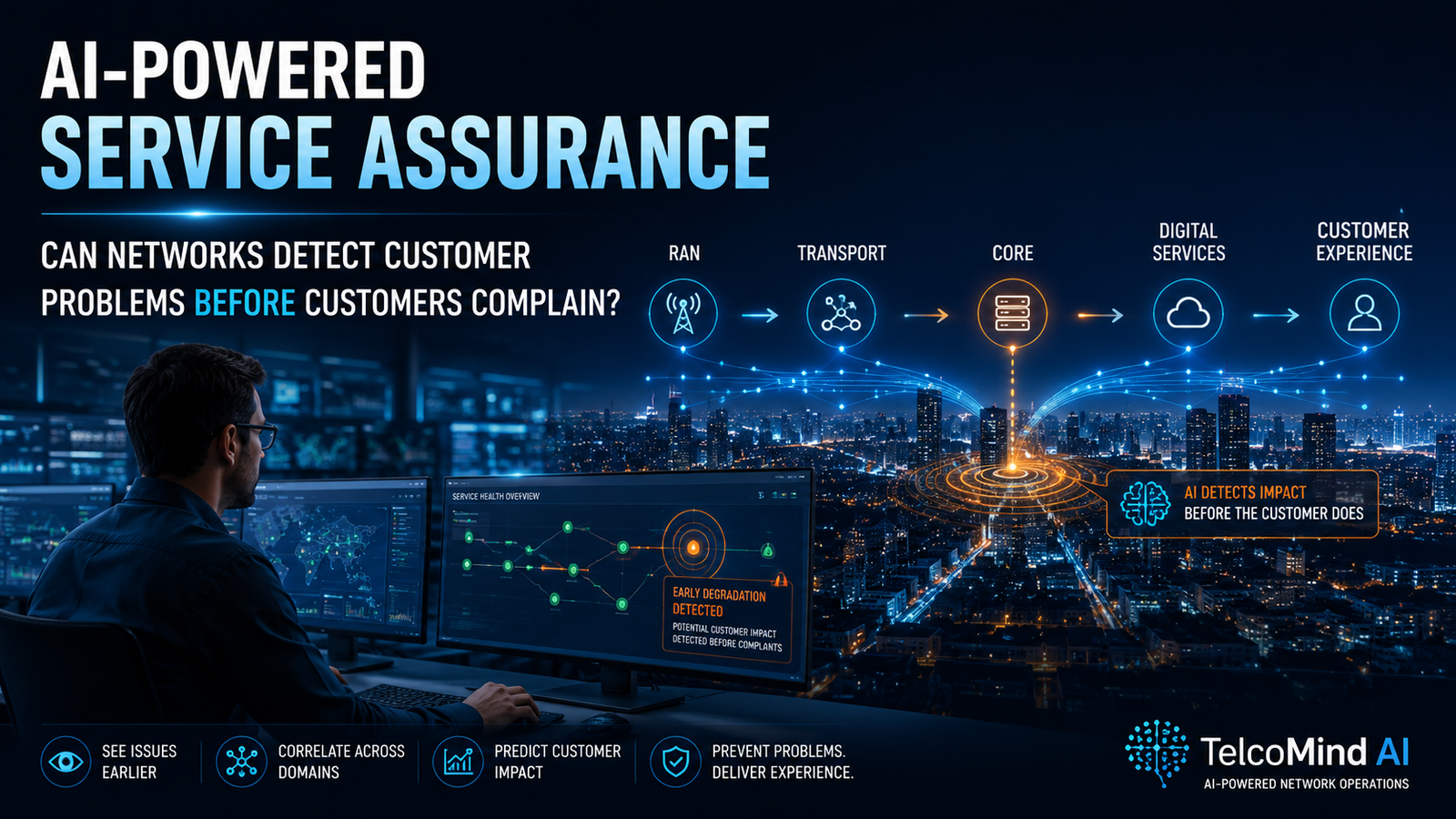
  • Network Digital Twin in Telecom: How AI Predicts Network Impact Before Changes Go Live

    Network Digital Twin in Telecom: How AI Predicts Network Impact Before Changes Go Live

    What if a telecom operator could test a network change before touching the live network?

    A Network Digital Twin creates a continuously evolving virtual representation of the telecom network, allowing engineering and operations teams to simulate changes, analyze potential impact, identify risks and optimize decisions before implementation in the production network.

    Combined with AI, real-time telemetry and network data, the digital twin can evolve beyond traditional simulation into an intelligent decision-support capability for increasingly autonomous telecom operations

    One Network. One Decision. Two Possible Outcomes.

    A transmission path is deteriorating.

    Traffic is still flowing, but performance is moving in the wrong direction. Errors are increasing, packet loss has started to appear, and the operations team knows that waiting for a complete failure is not a good option.

    Fortunately, the network has redundancy.

    The protection path is available. Its status is green. Capacity appears sufficient.

    The proposed action looks straightforward:

    Move the affected traffic to the protection path.

    It is the kind of decision telecom operations teams make every day.

    But there is one question the dashboard cannot answer with certainty:

    What will happen to the rest of the network after the traffic moves?

    Instead of answering that question with theory, let’s follow the same network decision into two different futures.

    Future A: Execute First

    The traffic migration begins.

    The affected traffic starts moving away from the deteriorating transmission path.

    For the first few moments, everything looks good.

    Packet loss on the original path begins to disappear. The alarms start clearing. Traffic stabilizes.

    The decision appears successful.

    Then another alarm appears.

    But this alarm is not coming from the original link.

    A downstream interface on the protection route is suddenly approaching its operational limit.

    More traffic has entered the path than expected. Enterprise services already sharing part of that infrastructure begin experiencing increased latency.

    The NOC has solved one problem—but another one is now developing.

    The original diagnosis was not wrong.

    The protection path was available.

    The network did exactly what it was instructed to do.

    What was missing was an understanding of what would happen elsewhere after the traffic moved.

    The team solved the problem directly in front of them.

    But the network responded somewhere else.

    One technically correct action has created an unexpected consequence.

    Now imagine something we normally cannot do with a live production network.

    Rewind the decision.

    Go back to the moment before EXECUTE.

    Same network. Same degradation. Same proposed solution.

    But this time, let’s test the future before we create it.

    Future B: Simulate First

    The same transmission path is deteriorating.

    The same packet loss is developing.

    The same protection path is available.

    And the same recommendation appears:

    Move the affected traffic to the protection path.

    But this time, the engineer does not press Execute.

    Nothing changes in the live network.

    Instead, the proposed action is tested against a digital representation of the current network.

    The model receives the affected topology, current traffic conditions, available capacity, configuration and the services depending on those paths.

    Then the proposed traffic migration begins.

    But only inside the model.

    At first, the result looks promising.

    Traffic successfully leaves the deteriorating path.

    Utilization increases on the protection route—but remains manageable.

    Then the simulation exposes something that was not obvious from the original dashboard.

    A downstream interface begins approaching its operational limit.

    The same secondary problem from our first future is developing again.

    But there is one critical difference:

    This time, no customer experiences it.

    No enterprise service slows down.

    No additional incident is created.

    No emergency rollback is required.

    The failure exists only inside the simulated environment.

    The team modifies the plan.

    Instead of moving all affected traffic through a single protection path, the load is distributed across two available routes.

    The scenario is tested again.

    This time, projected utilization remains within the defined operational limits.

    Critical service dependencies remain protected.

    No secondary congestion develops.

    Now—and only now—the action is approved for the real network.

    Traffic moves.

    The deteriorating path is relieved.

    Performance stabilizes.

    And the second incident from Future A never happens.

    Same network.

    Same problem.

    Same initial recommendation.

    Different decision process.

    In the first future, we discovered the consequence after changing the network.

    In the second, we discovered it before changing the network.

    And that difference brings us to the technology at the center of this article:

    The Network Digital Twin.

    The Network Digital Twin

    What happened in our second future was not simply network simulation.

    The proposed action was tested against a digital representation that understood enough about the current network state to show how the network might respond.

    That is the idea behind a Network Digital Twin (NDT).

    A Network Digital Twin can be thought of as a dynamic digital representation of a real telecom network, built using relevant information such as topology, configuration, traffic, performance, capacity and service relationships.

    But the important word here is not digital.

    It is twin.

    A static network diagram may tell us how nodes are connected. A planning model may help us estimate future capacity. A Digital Twin aims to remain sufficiently connected to the state and behaviour of the real network that we can use it to understand conditions, explore scenarios and evaluate possible changes.

    In simple terms:

    The live network tells us what is happening.

    The Digital Twin can help us explore what might happen next.

    This becomes particularly interesting when combined with AI.

    An AI agent may identify a problem and recommend an action.

    A Digital Twin introduces another question before execution:

    “What happens if we actually do it?”

    That creates a potentially powerful operating sequence:

    Observe → Understand → Recommend → Simulate → Decide → Execute → Validate

    The objective is not to predict the future perfectly.

    Telecom networks are too dynamic and complex for any model to guarantee that.

    The value is more practical:

    Discover more of the risk before the live network—and the customer—has to discover it for us.

                    ONE NETWORK DECISION
                             │
                    Move the Traffic
                             │
              ┌──────────────┴──────────────┐
              ▼                             ▼
         EXECUTE FIRST                 SIMULATE FIRST
              │                             │
              ▼                             ▼
       Problem Improves               DIGITAL TWIN
              │                             │
              ▼                             ▼
       Hidden Congestion              Hidden Risk Found
              │                             │
              ▼                             ▼
       Service Degradation             Plan Modified
                                            │
                                            ▼
                                       Test Again
                                            │
                                            ▼
                                      Safe Execution

    A Digital Twin does not remove uncertainty. It gives us somewhere safer to discover it.

    How Much Does the Twin Need to Know

    Our Digital Twin successfully identified the congestion risk before traffic was moved.

    But there is an important question hiding inside that success:

    How did the twin know?

    Imagine we give the Digital Twin only a network topology.

    It can see Node A, Node B and two possible transmission paths.

    It knows how everything is connected.

    The proposed rerouting looks perfectly safe.

    But topology alone does not tell the twin that the protection path is already carrying significant traffic.

    So we give it capacity information.

    Better.

    Now it knows the maximum capacity of every relevant interface.

    But capacity alone still does not tell it how much of that capacity is being consumed right now.

    So we add real-time traffic and performance data.

    Suddenly, the picture changes.

    The twin can see that one interface on the protection route is already operating at relatively high utilization.

    Now our simulation becomes much more useful.

    But we are still not finished.

    Suppose the path has enough technical capacity—but it carries a critical enterprise service with strict latency requirements.

    Without understanding service dependencies, the twin may consider the rerouting acceptable while the customer experiences something very different.

    Add configuration, and the twin understands how the network is currently designed to behave.

    Add historical behaviour, and it can compare today’s condition with what happened under similar traffic patterns previously.

    Add service relationships, and it begins to understand something far more important than individual links:

    What does this network actually carry—and who could be affected if we change it?

    From a Network Model to an Operational Twin

    The usefulness of a Digital Twin therefore depends heavily on the quality, freshness and depth of the information behind it.

    An operational telecom twin may progressively combine:

    Topology — How is the network connected?

    Configuration — How is it currently designed to behave?

    Capacity — What can each resource support?

    Real-Time State — What is happening right now?

    Performance — How are the network elements behaving?

    Traffic — Where is the load moving?

    Service Dependencies — Which services and customers depend on those resources?

    Historical Behaviour — What happened under similar conditions before?

    The more complete this operational context becomes, the more meaningful a what-if simulation can potentially become.

    But this creates another important reality:

    A Digital Twin can only be as trustworthy as the network information feeding it.

    If inventory is outdated, topology is incomplete, telemetry is delayed or service dependencies are missing, the twin may simulate the wrong reality with impressive confidence.

    And in telecom operations, a convincing wrong answer can be more dangerous than an obvious unknown.

          DIGITAL TWIN MATURITY

    Topology

    • Configuration
    • Capacity
    • Real-Time State
    • Performance & Traffic
    • Service Dependencies
    • Historical Behaviour

      MORE OPERATIONAL CONTEXT

      BETTER WHAT-IF DECISIONS

    Before we ask how intelligent the Digital Twin is, we should ask how accurately it understands today’s network.

    When an Optimization Creates Another Problem

    So far, our Digital Twin has helped us manage a transmission risk.

    But telecom networks are not changed only when something fails.

    Every day, optimization teams make decisions intended to improve coverage, capacity, quality and customer experience.

    Now imagine a busy 5G cluster where traffic demand has been increasing steadily.

    Several cells are experiencing congestion during peak hours, and users at the cell edge are beginning to see lower throughput.

    An AI optimization engine analyzes the cluster and proposes changes to improve radio performance.

    The recommendation looks promising.

    Simulation based only on the target cells suggests:

    Higher capacity. Better utilization. Improved user throughput.

    From the perspective of those cells, the optimization looks successful.

    But a radio network does not operate as a collection of isolated cells.

    Change the behaviour of one part of the RAN, and neighboring cells may respond.

    The Neighbor Nobody Asked About

    Before the recommendation reaches the live network, it is tested against a Digital Twin representing the wider radio environment.

    The proposed optimization is applied.

    Performance improves in the target cells.

    Then something unexpected appears.

    A neighboring sector begins experiencing increased interference.

    Cell-edge performance in another part of the cluster starts deteriorating.

    The optimization has achieved exactly what it was designed to achieve—

    but only where it was looking.

    The Digital Twin allows the team to evaluate the change from a wider perspective.

    What happens to neighboring cells?

    How does traffic redistribute?

    Does interference increase?

    What happens to mobility behaviour?

    Are handovers still performing as expected?

    And most importantly:

    Did we improve the network—or simply move the problem somewhere else?

    The optimization parameters are adjusted.

    The scenario is simulated again.

    This time, the target cells still gain capacity, but the neighboring sectors remain within acceptable performance boundaries.

    The recommendation is now stronger—not because AI produced a different idea, but because the consequence of that idea was explored across a broader network context.

    This reveals an important role for Digital Twins in AI-driven telecom operations:

    AI can search for the best action.

    The Digital Twin can help test what that action might do to the network around it.

    Together, they create something more useful than optimization alone:

    Optimization with consequence awareness.

    The best optimization is not the one that improves a single KPI. It is the one that improves the network without creating the next problem.

    What Happens When AI Agents Meet Digital Twins?

    In the previous article, we explored a different shift in telecom operations: AI moving from answering questions to investigating problems, reasoning across information and recommending actions.

    That creates an obvious next question.

    If an AI agent can recommend a network action, should that recommendation move directly toward execution?

    Consider our transmission scenario again.

    The AI agent detects the degradation.

    It correlates alarms, topology, performance and service information.

    It identifies the probable cause.

    And it recommends:

    Move the traffic to the protection path.

    The recommendation may be technically sound.

    But as we discovered earlier, a correct diagnosis does not automatically guarantee a safe action.

    This is where the Digital Twin can become an important part of the decision loop.

    Give the Agent Somewhere to Test Its Idea

    Instead of moving directly from:

    AI Recommendation → Network Execution

    we introduce another stage:

    AI Recommendation → Digital Twin → What-If Test → Risk Evaluation → Execution

    The agent proposes the action.

    The Digital Twin applies it to a representation of the current network.

    The predicted consequences are evaluated.

    If the scenario exposes congestion, service impact or another unacceptable condition, the action can be modified—or rejected—before touching production.

    If the outcome remains within defined operational boundaries, the recommendation becomes a stronger candidate for execution.

    And after the real action is taken, live network telemetry can tell us whether reality behaved as expected.

    This creates something particularly interesting.

    The Digital Twin is no longer just a planning environment.

    It can potentially become a testing ground inside the AI decision cycle.

    The AI Agent asks: “What should we do?”

    The Digital Twin asks: “What might happen if we do it?”

    The live network answers: “Did it actually work?”

    Autonomy becomes more valuable when intelligence is combined with a way to test consequences before execution.

    Is This Still a Concept—or Is Telecom Already Moving There?

    The scenarios we have explored may sound futuristic, but the building blocks of Network Digital Twins are already appearing across the telecom industry.

    Operators and vendors are increasingly combining network models, real-time telemetry, AI, simulation and automation to understand network behaviour before making operational decisions.

    However, there is an important distinction.

    Not every network simulation platform is a Digital Twin, and not every Digital Twin today has the maturity to represent an entire live telecom network in real time.

    The industry is progressing in stages.

    Some implementations focus on planning and optimization.

    Others are being developed for network validation, fault analysis, capacity assessment and what-if simulation.

    The longer-term direction is much more ambitious:

    A continuously synchronized network representation capable of supporting increasingly autonomous operational decisions.

    These examples point toward the same evolution.

    The Digital Twin is gradually moving from a planning model toward something much closer to an operational decision environment.

    And that transition matters.

    Because as networks become more autonomous, the question will not only be whether AI can make a decision.

    The bigger question may be whether we can safely understand the consequences before that decision reaches the live network.

    From Concept to Real Networks

    The direction toward Network Digital Twins is no longer limited to research papers and future-network discussions. During 2026, several major telecom players have started bringing the concept closer to operational networks.

    KDDI — Building a High-Fidelity RAN Digital Twin

    In June 2026, KDDI Research announced a collaboration with NVIDIA, Keysight and Samsung Research America to develop a high-fidelity RAN Digital Twin.

    The objective is particularly relevant to our story: create a virtual representation of the radio network where AI-driven optimization and algorithms can be evaluated more safely before being applied to the real environment.

    Google Cloud — Digital Twin as Part of Autonomous Network Operations

    Google Cloud is taking the concept beyond a static network replica. Its autonomous-network architecture describes a Network Digital Twin as a dynamic temporal graph representing the network’s physical and logical state, including current performance and fault conditions as well as historical states.

    This gives AI agents something extremely valuable: the ability to understand not only what the network looks like now, but also how conditions developed over time—supporting root-cause analysis and predictive operations.

    NTT — Digital Twin for Optical Networks

    Digital Twin development is also moving into transmission.

    NTT is researching an optical-network Digital Twin in which the optical network is reconstructed in virtual space to support automated design, analysis and control for its All-Photonics Network.

    This is particularly interesting because it brings the Digital Twin concept into the transport layer that quietly carries services across the entire telecom network.

    These examples are different in scope and maturity.

    They should not be interpreted as evidence that fully synchronized, end-to-end autonomous Digital Twins are already operating everywhere.

    But they show something important:

    The industry is beginning to build the environments in which AI can understand, test and eventually help control increasingly complex networks.

    Ericsson describes a similar evolution: Digital Twins have traditionally supported planning and offline validation, but as AI begins making more network decisions, the twin can potentially become part of the operational control loop—allowing proposed actions to be evaluated against network conditions before reaching production.

    That brings us back to the question we started with:

    Before AI changes the network, should it test the decision first?

    Increasingly, the answer may be:

    Whenever the risk justifies it—yes.

    What Could a Digital Twin Change Inside the NOC?

    The real value of a Network Digital Twin will not come from creating an impressive virtual network.

    It will come from the operational decisions we can make differently because that virtual environment exists.

    Think about a normal day inside a telecom NOC.

    A change is waiting for implementation.

    A link is approaching congestion.

    A cluster is showing unusual performance.

    A recurring fault keeps returning.

    Capacity needs to be expanded.

    In each case, the operations team is ultimately trying to answer a similar question:

    “If we do this, what happens next?”

    A Digital Twin could give that question somewhere to be explored before the answer comes from the production network.

    Six Decisions. One Virtual Testing Ground.

    1. Change Management — Test Before Implementation

    Before a high-risk network change reaches production, the proposed configuration could be applied to the twin first.

    Instead of discovering an unexpected dependency during the maintenance window, the team may identify it during simulation.

    Change → Simulate → Assess → Approve → Execute

    2. Fault Management — Explore the Failure Before It Happens

    What happens if this transmission link fails completely?

    Where will the traffic move?

    Which sites become exposed?

    Does redundancy still work under current traffic conditions?

    A Digital Twin could allow the NOC to explore the failure while the real link is still carrying traffic.

    3. Capacity Management — See Tomorrow’s Congestion Today

    Instead of looking only at today’s utilization, traffic growth can be applied to the virtual network.

    The question changes from:

    “Which link is congested?”

    to:

    “Which link is likely to become the next bottleneck?”

    4. RAN Optimization — Look Beyond the Target Cell

    As we saw earlier, improving one cell does not guarantee improvement across the cluster.

    Proposed optimization can be evaluated against neighboring cells, mobility behaviour, interference and traffic redistribution before reaching the live RAN.

    5. Preventive Maintenance — Test the Recovery Plan

    Predicting that an asset may fail is only the first step.

    The twin could help answer what happens when that asset is removed from service for maintenance.

    Can the network safely operate without it?

    6. Service Assurance — Follow the Customer, Not Just the Alarm

    A network element can look healthy while a service still performs poorly.

    By combining network state with service dependencies, a Digital Twin could help teams evaluate how a proposed network action may affect the end-to-end service, rather than only the individual node being changed.

    These use cases may look different, but they share the same underlying idea:

    Move part of the learning from the live network into a virtual environment.

    The objective is not to eliminate operational risk.

    It is to discover more of that risk before customers discover it for us.

    The Digital Twin becomes valuable when it changes a real operational decision—not simply when it creates a digital copy of the network.

    There is one uncomfortable truth behind everything we have discussed so far.

    The real network never stops changing.

    Traffic rises and falls.

    Customers move.

    Links fail and recover.

    New sites are integrated.

    Software is upgraded.

    Configurations change.

    Capacity is expanded.

    Services are created and removed.

    And thousands of network conditions can change while the Digital Twin is trying to represent them.

    This creates perhaps the most important challenge for an operational Network Digital Twin:

    How closely does the twin still represent the network it is supposed to protect?

    Imagine the Twin Is Five Minutes Behind

    Return to our original transmission scenario.

    The Digital Twin receives the topology and evaluates the proposed traffic migration.

    According to the twin, the protection path has enough available capacity.

    The simulation passes.

    Safe to execute.

    But something happened in the real network five minutes earlier.

    A large amount of traffic was already rerouted onto part of that protection path because of another network event.

    The live network knows this.

    The Digital Twin does not.

    Its simulation may be mathematically correct.

    Its recommendation may look convincing.

    But it is solving yesterday’s network condition.

    And that exposes an important principle:

    A highly intelligent Digital Twin with stale data can still make a poor operational decision.

    Building the Twin May Be Harder Than Building the Model

    Telecom networks are particularly challenging because the information needed by a Digital Twin rarely comes from one place.

    The topology may come from one system.

    Configuration from another.

    Performance counters from multiple vendors.

    Traffic information from different network layers.

    Service dependencies from inventory and orchestration platforms.

    Customer experience information from assurance systems.

    Historical incidents from yet another operational environment.

    And in a multi-vendor network, even similar information may be represented differently across domains.

    Creating the model is therefore only part of the challenge.

    Keeping it accurate, synchronized and operationally trustworthy may be the harder problem.

    Before a Digital Twin can influence critical network decisions, operators will need confidence in areas such as:

    Data freshness — Is the twin seeing the current network?

    Model accuracy — Does the simulation represent real network behaviour closely enough?

    Multi-vendor consistency — Can information from different domains and vendors be interpreted correctly?

    Service dependency accuracy — Does the twin know what actually depends on the resource being changed?

    Scalability — Can complex scenarios be evaluated quickly enough to support operational decisions?

    Trust and governance — Which simulated outcomes are reliable enough to influence—or eventually authorize—network actions?

    This means the future of Digital Twins will not be defined only by how sophisticated the simulation looks.

    It will be defined by how much operators trust the twin when the real network is at risk.

    The question is not whether the Digital Twin can simulate the network. The question is whether we trust it enough to influence the network.

    From Digital Twin to Autonomous Network

    Now bring the pieces together.

    The live network is continuously producing signals.

    An AI agent observes those signals and identifies that something is changing.

    It investigates the condition, connects information across systems and develops a recommended action.

    But instead of immediately touching the production network, the recommendation enters the Digital Twin.

    What happens if we execute it?

    The twin simulates the proposed action against the current network context.

    If the result exposes unacceptable risk, the recommendation goes back for adjustment.

    If the outcome remains within defined operational boundaries, the action can move to the next stage.

    Depending on the level of autonomy and the risk involved, that may mean engineer approval, policy-based authorization or controlled automated execution.

    But even execution is not the end.

    The live network must be observed again.

    Did performance actually improve?

    Did the expected traffic movement occur?

    Did another service deteriorate?

    Did reality behave the way the Digital Twin predicted?

    That final comparison is extremely important.

    Because every difference between predicted behaviour and actual behaviour provides an opportunity to improve the model.

    The Closed Learning Loop

    This creates something more powerful than simple automation.

    A potential operational loop begins to emerge:

    Observe → Understand → Recommend → Simulate → Decide → Execute → Validate → Learn

    The AI Agent becomes the reasoning layer.

    The Digital Twin becomes the testing environment.

    Policies and operational controls define what is allowed.

    Automation executes approved actions.

    The live network provides the final evidence.

    And the difference between prediction and reality can help improve the next decision.

    This is where Digital Twin technology becomes particularly relevant to autonomous networks.

    Autonomy should not simply mean:

    “AI can make changes without humans.”

    A more meaningful definition is:

    The network can increasingly understand conditions, evaluate possible actions, operate within defined boundaries, verify outcomes and learn from what actually happened.

    The goal is not automation without control. It is autonomy with consequence awareness.

    And We Are Only at the Beginning

    Fully synchronized, multi-domain Digital Twins capable of supporting autonomous decisions across an entire telecom network are still an evolving ambition.

    But the direction is becoming clearer.

    Network models are becoming more dynamic.

    Telemetry is becoming richer.

    AI agents are becoming more capable.

    Automation is moving closer to closed-loop operations.

    And Digital Twins could provide something increasingly important between AI reasoning and real-world execution:

    A place to test the consequence.

    Interestingly, this convergence is already appearing in current industry research. An IETF Internet-Draft published in August 2026 proposes an architecture combining Agentic AI and Network Digital Twins, where the twin can provide a risk-free environment for evaluating and refining AI-driven network strategies before deployment.

    That does not mean autonomous telecom networks have arrived.

    It means some of the architectural pieces are beginning to come together.

    One Network. One Decision. A Better Way to Decide.

    At the beginning of this article, we followed one network decision into two different futures.

    In the first, the team acted on a technically reasonable recommendation.

    The original problem improved.

    But somewhere else in the network, another problem appeared.

    In the second future, the network was never given the opportunity to surprise us.

    The same action was tested first.

    The hidden consequence appeared inside the Digital Twin.

    The plan changed.

    The scenario was tested again.

    And only then did the decision reach the live network.

    That difference captures the real promise of a Network Digital Twin.

    It is not about creating a beautiful virtual copy of a telecom network.

    It is about giving operators—and increasingly AI agents—a place to ask “what if?” before the customer experiences the answer.

    As telecom operations move from predictive analytics toward Agentic AI and increasingly autonomous networks, the ability to make decisions faster will certainly matter.

    But perhaps something else will matter even more:

    The ability to understand the possible consequences before we act.

    The future NOC may therefore not only ask:

    “What is happening?”

    or

    “What should we do?”

    It may increasingly ask:

    “What happens if we do it?”

    And that may be where the Network Digital Twin earns its place in autonomous telecom operations.

    Before intelligence changes the network, give it somewhere safe to test the future. TelcoMind AI | Telecom • AI • Automation

    Digital Twins Are Part of a Bigger AI Operating Model

    Network Digital Twins provide an important piece of the journey toward autonomous telecom operations: a safer environment to explore the consequences of a network decision before execution.

    But Digital Twins become even more valuable when connected with predictive operations, AIOps, Agentic AI, AI-RAN, service assurance and network automation.

    Explore the complete picture:
    AI in Telecom: 10 Real-World Use Cases Transforming Network Operations in 2026

  • Network Digital Twin in Telecom: How AI Predicts Network Impact Before Changes Go Live

    Network Digital Twin in Telecom: How AI Predicts Network Impact Before Changes Go Live

    What if a telecom operator could test a network change before touching the live network?

    A Network Digital Twin creates a continuously evolving virtual representation of the telecom network, allowing engineering and operations teams to simulate changes, analyze potential impact, identify risks and optimize decisions before implementation in the production network.

    Combined with AI, real-time telemetry and network data, the digital twin can evolve beyond traditional simulation into an intelligent decision-support capability for increasingly autonomous telecom operations

    One Network. One Decision. Two Possible Outcomes.

    A transmission path is deteriorating.

    Traffic is still flowing, but performance is moving in the wrong direction. Errors are increasing, packet loss has started to appear, and the operations team knows that waiting for a complete failure is not a good option.

    Fortunately, the network has redundancy.

    The protection path is available. Its status is green. Capacity appears sufficient.

    The proposed action looks straightforward:

    Move the affected traffic to the protection path.

    It is the kind of decision telecom operations teams make every day.

    But there is one question the dashboard cannot answer with certainty:

    What will happen to the rest of the network after the traffic moves?

    Instead of answering that question with theory, let’s follow the same network decision into two different futures.

    Future A: Execute First

    The traffic migration begins.

    The affected traffic starts moving away from the deteriorating transmission path.

    For the first few moments, everything looks good.

    Packet loss on the original path begins to disappear. The alarms start clearing. Traffic stabilizes.

    The decision appears successful.

    Then another alarm appears.

    But this alarm is not coming from the original link.

    A downstream interface on the protection route is suddenly approaching its operational limit.

    More traffic has entered the path than expected. Enterprise services already sharing part of that infrastructure begin experiencing increased latency.

    The NOC has solved one problem—but another one is now developing.

    The original diagnosis was not wrong.

    The protection path was available.

    The network did exactly what it was instructed to do.

    What was missing was an understanding of what would happen elsewhere after the traffic moved.

    The team solved the problem directly in front of them.

    But the network responded somewhere else.

    One technically correct action has created an unexpected consequence.

    Now imagine something we normally cannot do with a live production network.

    Rewind the decision.

    Go back to the moment before EXECUTE.

    Same network. Same degradation. Same proposed solution.

    But this time, let’s test the future before we create it.

    Future B: Simulate First

    The same transmission path is deteriorating.

    The same packet loss is developing.

    The same protection path is available.

    And the same recommendation appears:

    Move the affected traffic to the protection path.

    But this time, the engineer does not press Execute.

    Nothing changes in the live network.

    Instead, the proposed action is tested against a digital representation of the current network.

    The model receives the affected topology, current traffic conditions, available capacity, configuration and the services depending on those paths.

    Then the proposed traffic migration begins.

    But only inside the model.

    At first, the result looks promising.

    Traffic successfully leaves the deteriorating path.

    Utilization increases on the protection route—but remains manageable.

    Then the simulation exposes something that was not obvious from the original dashboard.

    A downstream interface begins approaching its operational limit.

    The same secondary problem from our first future is developing again.

    But there is one critical difference:

    This time, no customer experiences it.

    No enterprise service slows down.

    No additional incident is created.

    No emergency rollback is required.

    The failure exists only inside the simulated environment.

    The team modifies the plan.

    Instead of moving all affected traffic through a single protection path, the load is distributed across two available routes.

    The scenario is tested again.

    This time, projected utilization remains within the defined operational limits.

    Critical service dependencies remain protected.

    No secondary congestion develops.

    Now—and only now—the action is approved for the real network.

    Traffic moves.

    The deteriorating path is relieved.

    Performance stabilizes.

    And the second incident from Future A never happens.

    Same network.

    Same problem.

    Same initial recommendation.

    Different decision process.

    In the first future, we discovered the consequence after changing the network.

    In the second, we discovered it before changing the network.

    And that difference brings us to the technology at the center of this article:

    The Network Digital Twin.

    The Network Digital Twin

    What happened in our second future was not simply network simulation.

    The proposed action was tested against a digital representation that understood enough about the current network state to show how the network might respond.

    That is the idea behind a Network Digital Twin (NDT).

    A Network Digital Twin can be thought of as a dynamic digital representation of a real telecom network, built using relevant information such as topology, configuration, traffic, performance, capacity and service relationships.

    But the important word here is not digital.

    It is twin.

    A static network diagram may tell us how nodes are connected. A planning model may help us estimate future capacity. A Digital Twin aims to remain sufficiently connected to the state and behaviour of the real network that we can use it to understand conditions, explore scenarios and evaluate possible changes.

    In simple terms:

    The live network tells us what is happening.

    The Digital Twin can help us explore what might happen next.

    This becomes particularly interesting when combined with AI.

    An AI agent may identify a problem and recommend an action.

    A Digital Twin introduces another question before execution:

    “What happens if we actually do it?”

    That creates a potentially powerful operating sequence:

    Observe → Understand → Recommend → Simulate → Decide → Execute → Validate

    The objective is not to predict the future perfectly.

    Telecom networks are too dynamic and complex for any model to guarantee that.

    The value is more practical:

    Discover more of the risk before the live network—and the customer—has to discover it for us.

                    ONE NETWORK DECISION
                             │
                    Move the Traffic
                             │
              ┌──────────────┴──────────────┐
              ▼                             ▼
         EXECUTE FIRST                 SIMULATE FIRST
              │                             │
              ▼                             ▼
       Problem Improves               DIGITAL TWIN
              │                             │
              ▼                             ▼
       Hidden Congestion              Hidden Risk Found
              │                             │
              ▼                             ▼
       Service Degradation             Plan Modified
                                            │
                                            ▼
                                       Test Again
                                            │
                                            ▼
                                      Safe Execution

    A Digital Twin does not remove uncertainty. It gives us somewhere safer to discover it.

    How Much Does the Twin Need to Know

    Our Digital Twin successfully identified the congestion risk before traffic was moved.

    But there is an important question hiding inside that success:

    How did the twin know?

    Imagine we give the Digital Twin only a network topology.

    It can see Node A, Node B and two possible transmission paths.

    It knows how everything is connected.

    The proposed rerouting looks perfectly safe.

    But topology alone does not tell the twin that the protection path is already carrying significant traffic.

    So we give it capacity information.

    Better.

    Now it knows the maximum capacity of every relevant interface.

    But capacity alone still does not tell it how much of that capacity is being consumed right now.

    So we add real-time traffic and performance data.

    Suddenly, the picture changes.

    The twin can see that one interface on the protection route is already operating at relatively high utilization.

    Now our simulation becomes much more useful.

    But we are still not finished.

    Suppose the path has enough technical capacity—but it carries a critical enterprise service with strict latency requirements.

    Without understanding service dependencies, the twin may consider the rerouting acceptable while the customer experiences something very different.

    Add configuration, and the twin understands how the network is currently designed to behave.

    Add historical behaviour, and it can compare today’s condition with what happened under similar traffic patterns previously.

    Add service relationships, and it begins to understand something far more important than individual links:

    What does this network actually carry—and who could be affected if we change it?

    From a Network Model to an Operational Twin

    The usefulness of a Digital Twin therefore depends heavily on the quality, freshness and depth of the information behind it.

    An operational telecom twin may progressively combine:

    Topology — How is the network connected?

    Configuration — How is it currently designed to behave?

    Capacity — What can each resource support?

    Real-Time State — What is happening right now?

    Performance — How are the network elements behaving?

    Traffic — Where is the load moving?

    Service Dependencies — Which services and customers depend on those resources?

    Historical Behaviour — What happened under similar conditions before?

    The more complete this operational context becomes, the more meaningful a what-if simulation can potentially become.

    But this creates another important reality:

    A Digital Twin can only be as trustworthy as the network information feeding it.

    If inventory is outdated, topology is incomplete, telemetry is delayed or service dependencies are missing, the twin may simulate the wrong reality with impressive confidence.

    And in telecom operations, a convincing wrong answer can be more dangerous than an obvious unknown.

          DIGITAL TWIN MATURITY

    Topology

    • Configuration
    • Capacity
    • Real-Time State
    • Performance & Traffic
    • Service Dependencies
    • Historical Behaviour

      MORE OPERATIONAL CONTEXT

      BETTER WHAT-IF DECISIONS

    Before we ask how intelligent the Digital Twin is, we should ask how accurately it understands today’s network.

    When an Optimization Creates Another Problem

    So far, our Digital Twin has helped us manage a transmission risk.

    But telecom networks are not changed only when something fails.

    Every day, optimization teams make decisions intended to improve coverage, capacity, quality and customer experience.

    Now imagine a busy 5G cluster where traffic demand has been increasing steadily.

    Several cells are experiencing congestion during peak hours, and users at the cell edge are beginning to see lower throughput.

    An AI optimization engine analyzes the cluster and proposes changes to improve radio performance.

    The recommendation looks promising.

    Simulation based only on the target cells suggests:

    Higher capacity. Better utilization. Improved user throughput.

    From the perspective of those cells, the optimization looks successful.

    But a radio network does not operate as a collection of isolated cells.

    Change the behaviour of one part of the RAN, and neighboring cells may respond.

    The Neighbor Nobody Asked About

    Before the recommendation reaches the live network, it is tested against a Digital Twin representing the wider radio environment.

    The proposed optimization is applied.

    Performance improves in the target cells.

    Then something unexpected appears.

    A neighboring sector begins experiencing increased interference.

    Cell-edge performance in another part of the cluster starts deteriorating.

    The optimization has achieved exactly what it was designed to achieve—

    but only where it was looking.

    The Digital Twin allows the team to evaluate the change from a wider perspective.

    What happens to neighboring cells?

    How does traffic redistribute?

    Does interference increase?

    What happens to mobility behaviour?

    Are handovers still performing as expected?

    And most importantly:

    Did we improve the network—or simply move the problem somewhere else?

    The optimization parameters are adjusted.

    The scenario is simulated again.

    This time, the target cells still gain capacity, but the neighboring sectors remain within acceptable performance boundaries.

    The recommendation is now stronger—not because AI produced a different idea, but because the consequence of that idea was explored across a broader network context.

    This reveals an important role for Digital Twins in AI-driven telecom operations:

    AI can search for the best action.

    The Digital Twin can help test what that action might do to the network around it.

    Together, they create something more useful than optimization alone:

    Optimization with consequence awareness.

    The best optimization is not the one that improves a single KPI. It is the one that improves the network without creating the next problem.

    What Happens When AI Agents Meet Digital Twins?

    In the previous article, we explored a different shift in telecom operations: AI moving from answering questions to investigating problems, reasoning across information and recommending actions.

    That creates an obvious next question.

    If an AI agent can recommend a network action, should that recommendation move directly toward execution?

    Consider our transmission scenario again.

    The AI agent detects the degradation.

    It correlates alarms, topology, performance and service information.

    It identifies the probable cause.

    And it recommends:

    Move the traffic to the protection path.

    The recommendation may be technically sound.

    But as we discovered earlier, a correct diagnosis does not automatically guarantee a safe action.

    This is where the Digital Twin can become an important part of the decision loop.

    Give the Agent Somewhere to Test Its Idea

    Instead of moving directly from:

    AI Recommendation → Network Execution

    we introduce another stage:

    AI Recommendation → Digital Twin → What-If Test → Risk Evaluation → Execution

    The agent proposes the action.

    The Digital Twin applies it to a representation of the current network.

    The predicted consequences are evaluated.

    If the scenario exposes congestion, service impact or another unacceptable condition, the action can be modified—or rejected—before touching production.

    If the outcome remains within defined operational boundaries, the recommendation becomes a stronger candidate for execution.

    And after the real action is taken, live network telemetry can tell us whether reality behaved as expected.

    This creates something particularly interesting.

    The Digital Twin is no longer just a planning environment.

    It can potentially become a testing ground inside the AI decision cycle.

    The AI Agent asks: “What should we do?”

    The Digital Twin asks: “What might happen if we do it?”

    The live network answers: “Did it actually work?”

    Autonomy becomes more valuable when intelligence is combined with a way to test consequences before execution.

    Is This Still a Concept—or Is Telecom Already Moving There?

    The scenarios we have explored may sound futuristic, but the building blocks of Network Digital Twins are already appearing across the telecom industry.

    Operators and vendors are increasingly combining network models, real-time telemetry, AI, simulation and automation to understand network behaviour before making operational decisions.

    However, there is an important distinction.

    Not every network simulation platform is a Digital Twin, and not every Digital Twin today has the maturity to represent an entire live telecom network in real time.

    The industry is progressing in stages.

    Some implementations focus on planning and optimization.

    Others are being developed for network validation, fault analysis, capacity assessment and what-if simulation.

    The longer-term direction is much more ambitious:

    A continuously synchronized network representation capable of supporting increasingly autonomous operational decisions.

    These examples point toward the same evolution.

    The Digital Twin is gradually moving from a planning model toward something much closer to an operational decision environment.

    And that transition matters.

    Because as networks become more autonomous, the question will not only be whether AI can make a decision.

    The bigger question may be whether we can safely understand the consequences before that decision reaches the live network.

    From Concept to Real Networks

    The direction toward Network Digital Twins is no longer limited to research papers and future-network discussions. During 2026, several major telecom players have started bringing the concept closer to operational networks.

    KDDI — Building a High-Fidelity RAN Digital Twin

    In June 2026, KDDI Research announced a collaboration with NVIDIA, Keysight and Samsung Research America to develop a high-fidelity RAN Digital Twin.

    The objective is particularly relevant to our story: create a virtual representation of the radio network where AI-driven optimization and algorithms can be evaluated more safely before being applied to the real environment.

    Google Cloud — Digital Twin as Part of Autonomous Network Operations

    Google Cloud is taking the concept beyond a static network replica. Its autonomous-network architecture describes a Network Digital Twin as a dynamic temporal graph representing the network’s physical and logical state, including current performance and fault conditions as well as historical states.

    This gives AI agents something extremely valuable: the ability to understand not only what the network looks like now, but also how conditions developed over time—supporting root-cause analysis and predictive operations.

    NTT — Digital Twin for Optical Networks

    Digital Twin development is also moving into transmission.

    NTT is researching an optical-network Digital Twin in which the optical network is reconstructed in virtual space to support automated design, analysis and control for its All-Photonics Network.

    This is particularly interesting because it brings the Digital Twin concept into the transport layer that quietly carries services across the entire telecom network.

    These examples are different in scope and maturity.

    They should not be interpreted as evidence that fully synchronized, end-to-end autonomous Digital Twins are already operating everywhere.

    But they show something important:

    The industry is beginning to build the environments in which AI can understand, test and eventually help control increasingly complex networks.

    Ericsson describes a similar evolution: Digital Twins have traditionally supported planning and offline validation, but as AI begins making more network decisions, the twin can potentially become part of the operational control loop—allowing proposed actions to be evaluated against network conditions before reaching production.

    That brings us back to the question we started with:

    Before AI changes the network, should it test the decision first?

    Increasingly, the answer may be:

    Whenever the risk justifies it—yes.

    What Could a Digital Twin Change Inside the NOC?

    The real value of a Network Digital Twin will not come from creating an impressive virtual network.

    It will come from the operational decisions we can make differently because that virtual environment exists.

    Think about a normal day inside a telecom NOC.

    A change is waiting for implementation.

    A link is approaching congestion.

    A cluster is showing unusual performance.

    A recurring fault keeps returning.

    Capacity needs to be expanded.

    In each case, the operations team is ultimately trying to answer a similar question:

    “If we do this, what happens next?”

    A Digital Twin could give that question somewhere to be explored before the answer comes from the production network.

    Six Decisions. One Virtual Testing Ground.

    1. Change Management — Test Before Implementation

    Before a high-risk network change reaches production, the proposed configuration could be applied to the twin first.

    Instead of discovering an unexpected dependency during the maintenance window, the team may identify it during simulation.

    Change → Simulate → Assess → Approve → Execute

    2. Fault Management — Explore the Failure Before It Happens

    What happens if this transmission link fails completely?

    Where will the traffic move?

    Which sites become exposed?

    Does redundancy still work under current traffic conditions?

    A Digital Twin could allow the NOC to explore the failure while the real link is still carrying traffic.

    3. Capacity Management — See Tomorrow’s Congestion Today

    Instead of looking only at today’s utilization, traffic growth can be applied to the virtual network.

    The question changes from:

    “Which link is congested?”

    to:

    “Which link is likely to become the next bottleneck?”

    4. RAN Optimization — Look Beyond the Target Cell

    As we saw earlier, improving one cell does not guarantee improvement across the cluster.

    Proposed optimization can be evaluated against neighboring cells, mobility behaviour, interference and traffic redistribution before reaching the live RAN.

    5. Preventive Maintenance — Test the Recovery Plan

    Predicting that an asset may fail is only the first step.

    The twin could help answer what happens when that asset is removed from service for maintenance.

    Can the network safely operate without it?

    6. Service Assurance — Follow the Customer, Not Just the Alarm

    A network element can look healthy while a service still performs poorly.

    By combining network state with service dependencies, a Digital Twin could help teams evaluate how a proposed network action may affect the end-to-end service, rather than only the individual node being changed.

    These use cases may look different, but they share the same underlying idea:

    Move part of the learning from the live network into a virtual environment.

    The objective is not to eliminate operational risk.

    It is to discover more of that risk before customers discover it for us.

    The Digital Twin becomes valuable when it changes a real operational decision—not simply when it creates a digital copy of the network.

    There is one uncomfortable truth behind everything we have discussed so far.

    The real network never stops changing.

    Traffic rises and falls.

    Customers move.

    Links fail and recover.

    New sites are integrated.

    Software is upgraded.

    Configurations change.

    Capacity is expanded.

    Services are created and removed.

    And thousands of network conditions can change while the Digital Twin is trying to represent them.

    This creates perhaps the most important challenge for an operational Network Digital Twin:

    How closely does the twin still represent the network it is supposed to protect?

    Imagine the Twin Is Five Minutes Behind

    Return to our original transmission scenario.

    The Digital Twin receives the topology and evaluates the proposed traffic migration.

    According to the twin, the protection path has enough available capacity.

    The simulation passes.

    Safe to execute.

    But something happened in the real network five minutes earlier.

    A large amount of traffic was already rerouted onto part of that protection path because of another network event.

    The live network knows this.

    The Digital Twin does not.

    Its simulation may be mathematically correct.

    Its recommendation may look convincing.

    But it is solving yesterday’s network condition.

    And that exposes an important principle:

    A highly intelligent Digital Twin with stale data can still make a poor operational decision.

    Building the Twin May Be Harder Than Building the Model

    Telecom networks are particularly challenging because the information needed by a Digital Twin rarely comes from one place.

    The topology may come from one system.

    Configuration from another.

    Performance counters from multiple vendors.

    Traffic information from different network layers.

    Service dependencies from inventory and orchestration platforms.

    Customer experience information from assurance systems.

    Historical incidents from yet another operational environment.

    And in a multi-vendor network, even similar information may be represented differently across domains.

    Creating the model is therefore only part of the challenge.

    Keeping it accurate, synchronized and operationally trustworthy may be the harder problem.

    Before a Digital Twin can influence critical network decisions, operators will need confidence in areas such as:

    Data freshness — Is the twin seeing the current network?

    Model accuracy — Does the simulation represent real network behaviour closely enough?

    Multi-vendor consistency — Can information from different domains and vendors be interpreted correctly?

    Service dependency accuracy — Does the twin know what actually depends on the resource being changed?

    Scalability — Can complex scenarios be evaluated quickly enough to support operational decisions?

    Trust and governance — Which simulated outcomes are reliable enough to influence—or eventually authorize—network actions?

    This means the future of Digital Twins will not be defined only by how sophisticated the simulation looks.

    It will be defined by how much operators trust the twin when the real network is at risk.

    The question is not whether the Digital Twin can simulate the network. The question is whether we trust it enough to influence the network.

    From Digital Twin to Autonomous Network

    Now bring the pieces together.

    The live network is continuously producing signals.

    An AI agent observes those signals and identifies that something is changing.

    It investigates the condition, connects information across systems and develops a recommended action.

    But instead of immediately touching the production network, the recommendation enters the Digital Twin.

    What happens if we execute it?

    The twin simulates the proposed action against the current network context.

    If the result exposes unacceptable risk, the recommendation goes back for adjustment.

    If the outcome remains within defined operational boundaries, the action can move to the next stage.

    Depending on the level of autonomy and the risk involved, that may mean engineer approval, policy-based authorization or controlled automated execution.

    But even execution is not the end.

    The live network must be observed again.

    Did performance actually improve?

    Did the expected traffic movement occur?

    Did another service deteriorate?

    Did reality behave the way the Digital Twin predicted?

    That final comparison is extremely important.

    Because every difference between predicted behaviour and actual behaviour provides an opportunity to improve the model.

    The Closed Learning Loop

    This creates something more powerful than simple automation.

    A potential operational loop begins to emerge:

    Observe → Understand → Recommend → Simulate → Decide → Execute → Validate → Learn

    The AI Agent becomes the reasoning layer.

    The Digital Twin becomes the testing environment.

    Policies and operational controls define what is allowed.

    Automation executes approved actions.

    The live network provides the final evidence.

    And the difference between prediction and reality can help improve the next decision.

    This is where Digital Twin technology becomes particularly relevant to autonomous networks.

    Autonomy should not simply mean:

    “AI can make changes without humans.”

    A more meaningful definition is:

    The network can increasingly understand conditions, evaluate possible actions, operate within defined boundaries, verify outcomes and learn from what actually happened.

    The goal is not automation without control. It is autonomy with consequence awareness.

    And We Are Only at the Beginning

    Fully synchronized, multi-domain Digital Twins capable of supporting autonomous decisions across an entire telecom network are still an evolving ambition.

    But the direction is becoming clearer.

    Network models are becoming more dynamic.

    Telemetry is becoming richer.

    AI agents are becoming more capable.

    Automation is moving closer to closed-loop operations.

    And Digital Twins could provide something increasingly important between AI reasoning and real-world execution:

    A place to test the consequence.

    Interestingly, this convergence is already appearing in current industry research. An IETF Internet-Draft published in August 2026 proposes an architecture combining Agentic AI and Network Digital Twins, where the twin can provide a risk-free environment for evaluating and refining AI-driven network strategies before deployment.

    That does not mean autonomous telecom networks have arrived.

    It means some of the architectural pieces are beginning to come together.

    One Network. One Decision. A Better Way to Decide.

    At the beginning of this article, we followed one network decision into two different futures.

    In the first, the team acted on a technically reasonable recommendation.

    The original problem improved.

    But somewhere else in the network, another problem appeared.

    In the second future, the network was never given the opportunity to surprise us.

    The same action was tested first.

    The hidden consequence appeared inside the Digital Twin.

    The plan changed.

    The scenario was tested again.

    And only then did the decision reach the live network.

    That difference captures the real promise of a Network Digital Twin.

    It is not about creating a beautiful virtual copy of a telecom network.

    It is about giving operators—and increasingly AI agents—a place to ask “what if?” before the customer experiences the answer.

    As telecom operations move from predictive analytics toward Agentic AI and increasingly autonomous networks, the ability to make decisions faster will certainly matter.

    But perhaps something else will matter even more:

    The ability to understand the possible consequences before we act.

    The future NOC may therefore not only ask:

    “What is happening?”

    or

    “What should we do?”

    It may increasingly ask:

    “What happens if we do it?”

    And that may be where the Network Digital Twin earns its place in autonomous telecom operations.

    Before intelligence changes the network, give it somewhere safe to test the future. TelcoMind AI | Telecom • AI • Automation

    Digital Twins Are Part of a Bigger AI Operating Model

    Network Digital Twins provide an important piece of the journey toward autonomous telecom operations: a safer environment to explore the consequences of a network decision before execution.

    But Digital Twins become even more valuable when connected with predictive operations, AIOps, Agentic AI, AI-RAN, service assurance and network automation.

    Explore the complete picture:
    AI in Telecom: 10 Real-World Use Cases Transforming Network Operations in 2026