
Tag: chatgpt

  • From Level 0 to Level 5: How Close Are We to Truly Autonomous Telecom Networks?

    From Level 0 to Level 5: How Close Are We to Truly Autonomous Telecom Networks?

    Imagine walking into a telecom Network Operations Center at midnight.

    The video wall is alive with traffic maps, service health, customer experience and network performance.

    Thousands of network elements are operating.

    Millions of subscribers are connected.

    Somewhere in the network, congestion is beginning to develop.

    A cloud workload is behaving abnormally.

    A transport path is approaching a risk threshold.

    And yet the room is unusually quiet.

    Not because nothing is happening.

    Because the network is handling it.

    One system detects the abnormal behaviour.

    Another determines which services could be affected.

    The network evaluates possible actions.

    A Digital Twin tests the safest option.

    An AI agent coordinates the response.

    Automation executes the approved action.

    Service assurance verifies the result.

    The network learns from what happened.

    By the time an engineer looks at the event, the customer impact has already been prevented.

    This is the promise of a Level 5 autonomous network.

    It sounds impressive.

    It also raises an uncomfortable question:

    How much of this can telecom networks actually do today?

    Because there is a significant difference between automating network operations and creating a network that can truly operate autonomously.

    And that gap is where the real story begins.

    Level 5 Sounds Impressive. But Where Are We Today?

    The midnight NOC described above represents the destination.

    The reality today is more complicated.

    A telecom operator may already have sophisticated automation in one part of the network, predictive analytics in another, and largely manual processes somewhere else.

    A RAN optimization use case might operate with considerable autonomy, while a high-risk core-network change still requires several layers of human approval.

    In other words, a telecom network does not necessarily have one single autonomy level.

    Autonomy can vary by domain, process, use case and operational risk.

    This is why the journey from Level 0 to Level 5 is better understood as a progression of operational capabilities rather than simply a technology upgrade.

    From Human-Controlled to Self-Driving Networks

    LevelNetwork BehaviorWho Takes the Lead?
    Level 0 β€” ManualNetwork detects problems, but investigation and action are manualπŸ‘€ Engineer
    Level 1 β€” AssistedTools provide alarms, insights and basic recommendationsπŸ‘€ Engineer + Tools
    Level 2 β€” AutomatedRepetitive tasks and predefined workflows run automaticallyβš™οΈ Automation
    Level 3 β€” Conditional AutonomyThe system analyzes situations and handles selected decisions🧠 AI + Automation
    Level 4 β€” High AutonomyIntelligent closed loops detect, decide, act and verify across defined areasπŸ”„ Network + AI
    Level 5 β€” Full AutonomyThe network continuously learns, adapts and manages itselfπŸš€ Autonomous Network

    Think of it like moving from a manually driven car toward a self-driving one.

    At the beginning, the human makes almost every decision.

    With each level, the system takes responsibility for more of the journey.

    But telecom networks have one major difference:

    Not every road has the same risk.

    Automatically optimizing radio resources is very different from automatically making a critical core-network change affecting millions of customers.

    That is why the real question may not be:

    β€œWhen will telecom reach Level 5?”

    It may be:

    β€œWhere does Level 5 actually make sense?”

    So, Where Is the Telecom Industry Today?

    The journey from Level 0 to Level 5 looks simple on paper.

    But real telecom networks are much more complicated.

    An operator may have advanced automation in one part of the network, while another area still depends heavily on engineers and manual processes.

    For example, some activities in RAN optimization, energy management or fault handling can already run with a high level of automation.

    But a critical change in the Core Network may still require careful engineering review and approval.

    This means telecom operators are not moving toward autonomy at the same speed everywhere.

    The journey is happening use case by use case, and domain by domain.

    So where are operators today?

    Most telecom networks are not yet fully autonomous.

    Many operators are working around Level 2 and Level 3, while higher levels of autonomy are appearing in selected use cases and network domains.

    Level 4 is becoming the important next target.

    At this level, the network moves beyond basic automation. It can use intelligence and closed-loop processes to detect, analyze, decide, act and check the result with much less human involvement.

    But reaching Level 4 in one use case does not mean the entire network has reached Level 4.

    And this is where the challenge becomes interesting.

    Why Is Level 4 Such a Big Step?

    Imagine that a group of cell sites suddenly starts showing unusual performance degradation.

    In a Level 3 environment, the system may detect the abnormal behavior, correlate several alarms and KPIs, identify a likely cause, and recommend an action to the operations team.

    The engineer reviews the recommendation and decides whether to proceed.

    Now imagine the same situation in a Level 4 environment.

    The system detects the problem, understands the service impact, identifies the likely cause and selects an approved corrective action.

    It then executes the action automatically within predefined policies.

    But it does not stop there.

    It checks whether the action actually solved the problem.

    If network performance returns to normal, the loop is closed.

    If it does not, the system can reassess the situation or escalate it to the operations team.

    That ability to Detect β†’ Decide β†’ Act β†’ Verify is what makes Level 4 much more powerful than simple automation.

    Level 3 helps the engineer make the decision. Level 4 increasingly allows the network to complete the operational loop.

    Which Parts of the Network Could Become Autonomous First?

    Not every part of a telecom network will reach higher autonomy at the same time.

    Some operations are repetitive, measurable and relatively low-risk, making them easier to automate.

    Others involve complex dependencies and much greater customer or business risk.

    This means the journey toward autonomous networks will probably happen domain by domain.

    Network AreaAutonomy OpportunityWhy?
    πŸ“‘ RANHighContinuous optimization of traffic, capacity, interference and energy
    ⚑ Energy ManagementHighClear patterns, measurable results and repeatable actions
    πŸ” Service AssuranceHighAI can correlate alarms, detect anomalies and identify service impact
    🌐 Transport NetworkMedium–HighTraffic rerouting and capacity optimization can support closed loops
    ☁️ Cloud / Telco CloudMedium–HighWorkload scaling and resource optimization are highly programmable
    🧠 Core NetworkSelectiveAutomation is possible, but critical actions may carry much higher service risk

    This does not mean the Core Network cannot become highly autonomous.

    It means the acceptable level of autonomy may depend on the risk of the decision.

    Automatically optimizing energy usage is very different from automatically changing a critical routing, subscriber or policy function affecting millions of users.

    So perhaps the future is not:

    β€œEverything at Level 5.”

    It may be:

    β€œThe right level of autonomy for the right operational decision.”

    Level 4 Is Starting to Move From Vision to Reality

    For many years, autonomous networks were mainly discussed as a future vision.

    That is beginning to change.

    Telecom operators are now testing and deploying higher levels of autonomy in specific network domains and operational use cases.

    The important point is that operators are not trying to make the entire network autonomous overnight.

    They are starting with areas where automation can deliver clear, measurable and controlled results.

    KDDI β€” Moving Network Optimization Toward Level 4

    In Japan, KDDI and Ericsson have been working on AI-driven network optimization as part of KDDI’s journey toward higher autonomous-network levels.

    A large-scale commercial-network trial used AI for uplink optimization across both 4G and 5G cells.

    The interesting part is not only the performance improvement.

    It shows how AI can increasingly analyze network conditions and support optimization across a large live networkβ€”one of the building blocks required for higher autonomy.

    China Mobile β€” Building Autonomy at Scale

    China Mobile has also been one of the operators actively developing autonomous-network capabilities across network operations.

    Its journey shows an important lesson:

    Autonomy becomes meaningful when it can move beyond individual automation scripts and operate across large, complex network environments.

    This requires much more than AI alone. It needs reliable data, automation platforms, operational policies and closed-loop assurance working together.

    Level 4 is not one technology. It is what happens when AI, automation, data and closed-loop operations begin working together.

    What Actually Makes Level 4 Possible?

    Level 4 does not come from adding one AI tool to the NOC.

    It happens when several capabilities begin working together.

    Network data provides visibility into what is happening.

    AIOps connects alarms, KPIs and events to identify what matters.

    AI and intelligent agents help understand the situation and determine possible actions.

    Network Digital Twins can help test selected decisions before they reach the live network.

    Automation executes approved actions.

    And closed-loop assurance checks whether the action actually worked.

    Together, they create something much more powerful than individual automation:

    Observe β†’ Understand β†’ Decide β†’ Test β†’ Act β†’ Verify β†’ Learn

    If any part of this chain is missing, true autonomy becomes much harder.

    A network that can detect a problem but cannot act is still dependent on humans.

    A network that can act but cannot verify the result is simply automatedβ€”not truly autonomous.

    The closed loop is what changes the game.

    NETWORK DATA
    ↓
    AIOps
    ↓
    AI / AGENTIC INTELLIGENCE
    ↓
    DIGITAL TWIN
    Test the Decision
    ↓
    AUTOMATION
    Execute Safely
    ↓
    SERVICE ASSURANCE
    Did It Work?
    ↓
    LEARN
    β†Ί

    Do We Really Need Level 5 Everywhere?

    Level 5 sounds like the final destination.

    A network that can monitor, decide, act and learn with minimal human involvement appears to be the ultimate goal.

    But telecom operations are not all the same.

    Consider two decisions.

    Decision A: Reduce energy consumption at selected radio sites during very low traffic.

    Decision B: Make a major configuration change in the Core Network that could affect millions of subscribers.

    Both decisions can potentially use AI and automation.

    But should they have the same level of autonomy?

    Probably not.

    The first decision is repetitive, measurable and relatively easy to reverse.

    The second may carry much greater service and business risk.

    This suggests that the future autonomous network may not operate at one fixed level.

    Instead, autonomy could be based on risk, confidence and potential customer impact.

    The smartest autonomous network may not be the network that automates everything. It may be the network that knows what shouldβ€”and should notβ€”be autonomous.

    Type of DecisionPossible Approach
    Low risk + repetitiveHigher autonomy
    Predictable + reversibleClosed-loop automation
    Moderate riskAI recommendation + policy control
    High customer impactStronger validation
    Critical / irreversibleHuman approval may remain appropriate

    So perhaps Level 5 should not be treated as a target for every network action.

    The more practical goal may be something different:

    Maximum useful autonomy β€” with the right level of control.

    What Could the Autonomous NOC of 2030 Look Like?

    Now return to the NOC we imagined at the beginning.

    It is midnight.

    The network is busy, but the operations center feels different.

    Engineers are no longer spending most of their time moving between hundreds of alarms, dashboards and repetitive operational tasks.

    Many routine events are already being handled through intelligent closed loops.

    AIOps identifies what matters.

    AI analyzes the situation.

    Digital Twins test selected high-impact decisions.

    Automation executes approved actions.

    Service assurance checks the result.

    And unusual or high-risk situations are brought to the operations team with the context already available.

    The NOC has not disappeared.

    Its role has changed.

    Instead of managing every network event, operations teams increasingly manage exceptions, policies, risk and service outcomes.

    Perhaps this is a more realistic picture of the autonomous NOC.

    Not a network without people.

    And not a network where AI controls everything.

    But a network where machines handle more of what is predictable, while people focus on what requires judgment.

    The journey to autonomous networks is not about removing humans from operations. It is about removing unnecessary human intervention from operations.

    The Road to Level 5

    The journey toward autonomous networks has already started.

    Telecom operators are moving from manual operations toward automation, intelligence and increasingly closed-loop networks.

    But Level 5 will not arrive everywhere at the same time.

    Some network activities will become highly autonomous much faster than others.

    The real challenge is not simply adding more AI.

    It is building the right combination of trusted data, AIOps, automation, AI, governance and closed-loop assurance.

    And perhaps the biggest lesson is this:

    The goal should not be autonomy for the sake of autonomy.

    The goal should be a network that can make the right decision, at the right time, with the right level of human control.

    Level 5 may be the destination on the maturity model.

    But the real transformation happens in every step we take toward it.

    One of the most practical capabilities on this journey is the self-healing networkβ€”where AI can detect, diagnose and recover from network failures through governed closed-loop operations.

    β€œBut the real transformation happens in every step we take toward it.”

    The next evolution may be intent-driven telecom operations, where operators define the required business outcome and AI helps translate it into coordinated network decisions.

    As networks progress toward higher levels of autonomy, cybersecurity must evolve with them. AI-driven decisions, automated actions and increasingly connected network domains require security controls that can detect threats, govern autonomous actions and protect services at machine speed.

    How Ready Is Your NOC for This Journey?

    Before planning for Level 4 or Level 5, operators first need to understand where their operations stand today.

    The TelcoMind AI β€” AI-Ready NOC Maturity Assessment helps evaluate NOC readiness across key areas including data, automation, AIOps, predictive operations, AI-assisted decision-making and closed-loop capabilities.

    Take the Free AI-Ready NOC Maturity Assessment β†’

    Discover your current maturity level and identify the areas that need attention on the journey toward intelligent and autonomous operations.

    References & Further Reading

    1. TM Forum β€” Autonomous Networks: Exploring the Evolution from Level 0 to Level 5

    This is the foundation for the six-level maturity framework used throughout the article. TM Forum describes the journey from Level 0 manual operations through Level 5 full autonomy.

    2. TM Forum β€” Assessing CSPs’ Progress Towards Level 4 Autonomous Networks

    This is especially useful because it’s from March 2026 and discusses operators increasingly validating Level 4 autonomy in specific network domains, rather than claiming whole networks are already Level 4.

    3. Ericsson & KDDI β€” AI Uplink Optimization Field Trial Toward Autonomous Networks Level 4

    This directly supports the KDDI example in our article. The 2026 commercial-network trial covered approximately 1,500 5G cells and 1,300 4G cells, and the AI optimization application was assessed at Level 3.86 using an adaptation of TM Forum’s methodology.
  • From Level 0 to Level 5: How Close Are We to Truly Autonomous Telecom Networks?

    From Level 0 to Level 5: How Close Are We to Truly Autonomous Telecom Networks?

    Imagine walking into a telecom Network Operations Center at midnight.

    The video wall is alive with traffic maps, service health, customer experience and network performance.

    Thousands of network elements are operating.

    Millions of subscribers are connected.

    Somewhere in the network, congestion is beginning to develop.

    A cloud workload is behaving abnormally.

    A transport path is approaching a risk threshold.

    And yet the room is unusually quiet.

    Not because nothing is happening.

    Because the network is handling it.

    One system detects the abnormal behaviour.

    Another determines which services could be affected.

    The network evaluates possible actions.

    A Digital Twin tests the safest option.

    An AI agent coordinates the response.

    Automation executes the approved action.

    Service assurance verifies the result.

    The network learns from what happened.

    By the time an engineer looks at the event, the customer impact has already been prevented.

    This is the promise of a Level 5 autonomous network.

    It sounds impressive.

    It also raises an uncomfortable question:

    How much of this can telecom networks actually do today?

    Because there is a significant difference between automating network operations and creating a network that can truly operate autonomously.

    And that gap is where the real story begins.

    Level 5 Sounds Impressive. But Where Are We Today?

    The midnight NOC described above represents the destination.

    The reality today is more complicated.

    A telecom operator may already have sophisticated automation in one part of the network, predictive analytics in another, and largely manual processes somewhere else.

    A RAN optimization use case might operate with considerable autonomy, while a high-risk core-network change still requires several layers of human approval.

    In other words, a telecom network does not necessarily have one single autonomy level.

    Autonomy can vary by domain, process, use case and operational risk.

    This is why the journey from Level 0 to Level 5 is better understood as a progression of operational capabilities rather than simply a technology upgrade.

    From Human-Controlled to Self-Driving Networks

    LevelNetwork BehaviorWho Takes the Lead?
    Level 0 β€” ManualNetwork detects problems, but investigation and action are manualπŸ‘€ Engineer
    Level 1 β€” AssistedTools provide alarms, insights and basic recommendationsπŸ‘€ Engineer + Tools
    Level 2 β€” AutomatedRepetitive tasks and predefined workflows run automaticallyβš™οΈ Automation
    Level 3 β€” Conditional AutonomyThe system analyzes situations and handles selected decisions🧠 AI + Automation
    Level 4 β€” High AutonomyIntelligent closed loops detect, decide, act and verify across defined areasπŸ”„ Network + AI
    Level 5 β€” Full AutonomyThe network continuously learns, adapts and manages itselfπŸš€ Autonomous Network

    Think of it like moving from a manually driven car toward a self-driving one.

    At the beginning, the human makes almost every decision.

    With each level, the system takes responsibility for more of the journey.

    But telecom networks have one major difference:

    Not every road has the same risk.

    Automatically optimizing radio resources is very different from automatically making a critical core-network change affecting millions of customers.

    That is why the real question may not be:

    β€œWhen will telecom reach Level 5?”

    It may be:

    β€œWhere does Level 5 actually make sense?”

    So, Where Is the Telecom Industry Today?

    The journey from Level 0 to Level 5 looks simple on paper.

    But real telecom networks are much more complicated.

    An operator may have advanced automation in one part of the network, while another area still depends heavily on engineers and manual processes.

    For example, some activities in RAN optimization, energy management or fault handling can already run with a high level of automation.

    But a critical change in the Core Network may still require careful engineering review and approval.

    This means telecom operators are not moving toward autonomy at the same speed everywhere.

    The journey is happening use case by use case, and domain by domain.

    So where are operators today?

    Most telecom networks are not yet fully autonomous.

    Many operators are working around Level 2 and Level 3, while higher levels of autonomy are appearing in selected use cases and network domains.

    Level 4 is becoming the important next target.

    At this level, the network moves beyond basic automation. It can use intelligence and closed-loop processes to detect, analyze, decide, act and check the result with much less human involvement.

    But reaching Level 4 in one use case does not mean the entire network has reached Level 4.

    And this is where the challenge becomes interesting.

    Why Is Level 4 Such a Big Step?

    Imagine that a group of cell sites suddenly starts showing unusual performance degradation.

    In a Level 3 environment, the system may detect the abnormal behavior, correlate several alarms and KPIs, identify a likely cause, and recommend an action to the operations team.

    The engineer reviews the recommendation and decides whether to proceed.

    Now imagine the same situation in a Level 4 environment.

    The system detects the problem, understands the service impact, identifies the likely cause and selects an approved corrective action.

    It then executes the action automatically within predefined policies.

    But it does not stop there.

    It checks whether the action actually solved the problem.

    If network performance returns to normal, the loop is closed.

    If it does not, the system can reassess the situation or escalate it to the operations team.

    That ability to Detect β†’ Decide β†’ Act β†’ Verify is what makes Level 4 much more powerful than simple automation.

    Level 3 helps the engineer make the decision. Level 4 increasingly allows the network to complete the operational loop.

    Which Parts of the Network Could Become Autonomous First?

    Not every part of a telecom network will reach higher autonomy at the same time.

    Some operations are repetitive, measurable and relatively low-risk, making them easier to automate.

    Others involve complex dependencies and much greater customer or business risk.

    This means the journey toward autonomous networks will probably happen domain by domain.

    Network AreaAutonomy OpportunityWhy?
    πŸ“‘ RANHighContinuous optimization of traffic, capacity, interference and energy
    ⚑ Energy ManagementHighClear patterns, measurable results and repeatable actions
    πŸ” Service AssuranceHighAI can correlate alarms, detect anomalies and identify service impact
    🌐 Transport NetworkMedium–HighTraffic rerouting and capacity optimization can support closed loops
    ☁️ Cloud / Telco CloudMedium–HighWorkload scaling and resource optimization are highly programmable
    🧠 Core NetworkSelectiveAutomation is possible, but critical actions may carry much higher service risk

    This does not mean the Core Network cannot become highly autonomous.

    It means the acceptable level of autonomy may depend on the risk of the decision.

    Automatically optimizing energy usage is very different from automatically changing a critical routing, subscriber or policy function affecting millions of users.

    So perhaps the future is not:

    β€œEverything at Level 5.”

    It may be:

    β€œThe right level of autonomy for the right operational decision.”

    Level 4 Is Starting to Move From Vision to Reality

    For many years, autonomous networks were mainly discussed as a future vision.

    That is beginning to change.

    Telecom operators are now testing and deploying higher levels of autonomy in specific network domains and operational use cases.

    The important point is that operators are not trying to make the entire network autonomous overnight.

    They are starting with areas where automation can deliver clear, measurable and controlled results.

    KDDI β€” Moving Network Optimization Toward Level 4

    In Japan, KDDI and Ericsson have been working on AI-driven network optimization as part of KDDI’s journey toward higher autonomous-network levels.

    A large-scale commercial-network trial used AI for uplink optimization across both 4G and 5G cells.

    The interesting part is not only the performance improvement.

    It shows how AI can increasingly analyze network conditions and support optimization across a large live networkβ€”one of the building blocks required for higher autonomy.

    China Mobile β€” Building Autonomy at Scale

    China Mobile has also been one of the operators actively developing autonomous-network capabilities across network operations.

    Its journey shows an important lesson:

    Autonomy becomes meaningful when it can move beyond individual automation scripts and operate across large, complex network environments.

    This requires much more than AI alone. It needs reliable data, automation platforms, operational policies and closed-loop assurance working together.

    Level 4 is not one technology. It is what happens when AI, automation, data and closed-loop operations begin working together.

    What Actually Makes Level 4 Possible?

    Level 4 does not come from adding one AI tool to the NOC.

    It happens when several capabilities begin working together.

    Network data provides visibility into what is happening.

    AIOps connects alarms, KPIs and events to identify what matters.

    AI and intelligent agents help understand the situation and determine possible actions.

    Network Digital Twins can help test selected decisions before they reach the live network.

    Automation executes approved actions.

    And closed-loop assurance checks whether the action actually worked.

    Together, they create something much more powerful than individual automation:

    Observe β†’ Understand β†’ Decide β†’ Test β†’ Act β†’ Verify β†’ Learn

    If any part of this chain is missing, true autonomy becomes much harder.

    A network that can detect a problem but cannot act is still dependent on humans.

    A network that can act but cannot verify the result is simply automatedβ€”not truly autonomous.

    The closed loop is what changes the game.

    NETWORK DATA
    ↓
    AIOps
    ↓
    AI / AGENTIC INTELLIGENCE
    ↓
    DIGITAL TWIN
    Test the Decision
    ↓
    AUTOMATION
    Execute Safely
    ↓
    SERVICE ASSURANCE
    Did It Work?
    ↓
    LEARN
    β†Ί

    Do We Really Need Level 5 Everywhere?

    Level 5 sounds like the final destination.

    A network that can monitor, decide, act and learn with minimal human involvement appears to be the ultimate goal.

    But telecom operations are not all the same.

    Consider two decisions.

    Decision A: Reduce energy consumption at selected radio sites during very low traffic.

    Decision B: Make a major configuration change in the Core Network that could affect millions of subscribers.

    Both decisions can potentially use AI and automation.

    But should they have the same level of autonomy?

    Probably not.

    The first decision is repetitive, measurable and relatively easy to reverse.

    The second may carry much greater service and business risk.

    This suggests that the future autonomous network may not operate at one fixed level.

    Instead, autonomy could be based on risk, confidence and potential customer impact.

    The smartest autonomous network may not be the network that automates everything. It may be the network that knows what shouldβ€”and should notβ€”be autonomous.

    Type of DecisionPossible Approach
    Low risk + repetitiveHigher autonomy
    Predictable + reversibleClosed-loop automation
    Moderate riskAI recommendation + policy control
    High customer impactStronger validation
    Critical / irreversibleHuman approval may remain appropriate

    So perhaps Level 5 should not be treated as a target for every network action.

    The more practical goal may be something different:

    Maximum useful autonomy β€” with the right level of control.

    What Could the Autonomous NOC of 2030 Look Like?

    Now return to the NOC we imagined at the beginning.

    It is midnight.

    The network is busy, but the operations center feels different.

    Engineers are no longer spending most of their time moving between hundreds of alarms, dashboards and repetitive operational tasks.

    Many routine events are already being handled through intelligent closed loops.

    AIOps identifies what matters.

    AI analyzes the situation.

    Digital Twins test selected high-impact decisions.

    Automation executes approved actions.

    Service assurance checks the result.

    And unusual or high-risk situations are brought to the operations team with the context already available.

    The NOC has not disappeared.

    Its role has changed.

    Instead of managing every network event, operations teams increasingly manage exceptions, policies, risk and service outcomes.

    Perhaps this is a more realistic picture of the autonomous NOC.

    Not a network without people.

    And not a network where AI controls everything.

    But a network where machines handle more of what is predictable, while people focus on what requires judgment.

    The journey to autonomous networks is not about removing humans from operations. It is about removing unnecessary human intervention from operations.

    The Road to Level 5

    The journey toward autonomous networks has already started.

    Telecom operators are moving from manual operations toward automation, intelligence and increasingly closed-loop networks.

    But Level 5 will not arrive everywhere at the same time.

    Some network activities will become highly autonomous much faster than others.

    The real challenge is not simply adding more AI.

    It is building the right combination of trusted data, AIOps, automation, AI, governance and closed-loop assurance.

    And perhaps the biggest lesson is this:

    The goal should not be autonomy for the sake of autonomy.

    The goal should be a network that can make the right decision, at the right time, with the right level of human control.

    Level 5 may be the destination on the maturity model.

    But the real transformation happens in every step we take toward it.

    One of the most practical capabilities on this journey is the self-healing networkβ€”where AI can detect, diagnose and recover from network failures through governed closed-loop operations.

    β€œBut the real transformation happens in every step we take toward it.”

    The next evolution may be intent-driven telecom operations, where operators define the required business outcome and AI helps translate it into coordinated network decisions.

    As networks progress toward higher levels of autonomy, cybersecurity must evolve with them. AI-driven decisions, automated actions and increasingly connected network domains require security controls that can detect threats, govern autonomous actions and protect services at machine speed.

    How Ready Is Your NOC for This Journey?

    Before planning for Level 4 or Level 5, operators first need to understand where their operations stand today.

    The TelcoMind AI β€” AI-Ready NOC Maturity Assessment helps evaluate NOC readiness across key areas including data, automation, AIOps, predictive operations, AI-assisted decision-making and closed-loop capabilities.

    Take the Free AI-Ready NOC Maturity Assessment β†’

    Discover your current maturity level and identify the areas that need attention on the journey toward intelligent and autonomous operations.

    References & Further Reading

    1. TM Forum β€” Autonomous Networks: Exploring the Evolution from Level 0 to Level 5

    This is the foundation for the six-level maturity framework used throughout the article. TM Forum describes the journey from Level 0 manual operations through Level 5 full autonomy.

    2. TM Forum β€” Assessing CSPs’ Progress Towards Level 4 Autonomous Networks

    This is especially useful because it’s from March 2026 and discusses operators increasingly validating Level 4 autonomy in specific network domains, rather than claiming whole networks are already Level 4.

    3. Ericsson & KDDI β€” AI Uplink Optimization Field Trial Toward Autonomous Networks Level 4

    This directly supports the KDDI example in our article. The 2026 commercial-network trial covered approximately 1,500 5G cells and 1,300 4G cells, and the AI optimization application was assessed at Level 3.86 using an adaptation of TM Forum’s methodology.

  • AI-RAN: How Artificial Intelligence Is Transforming Radio Access Networks

    AI-RAN: How Artificial Intelligence Is Transforming Radio Access Networks

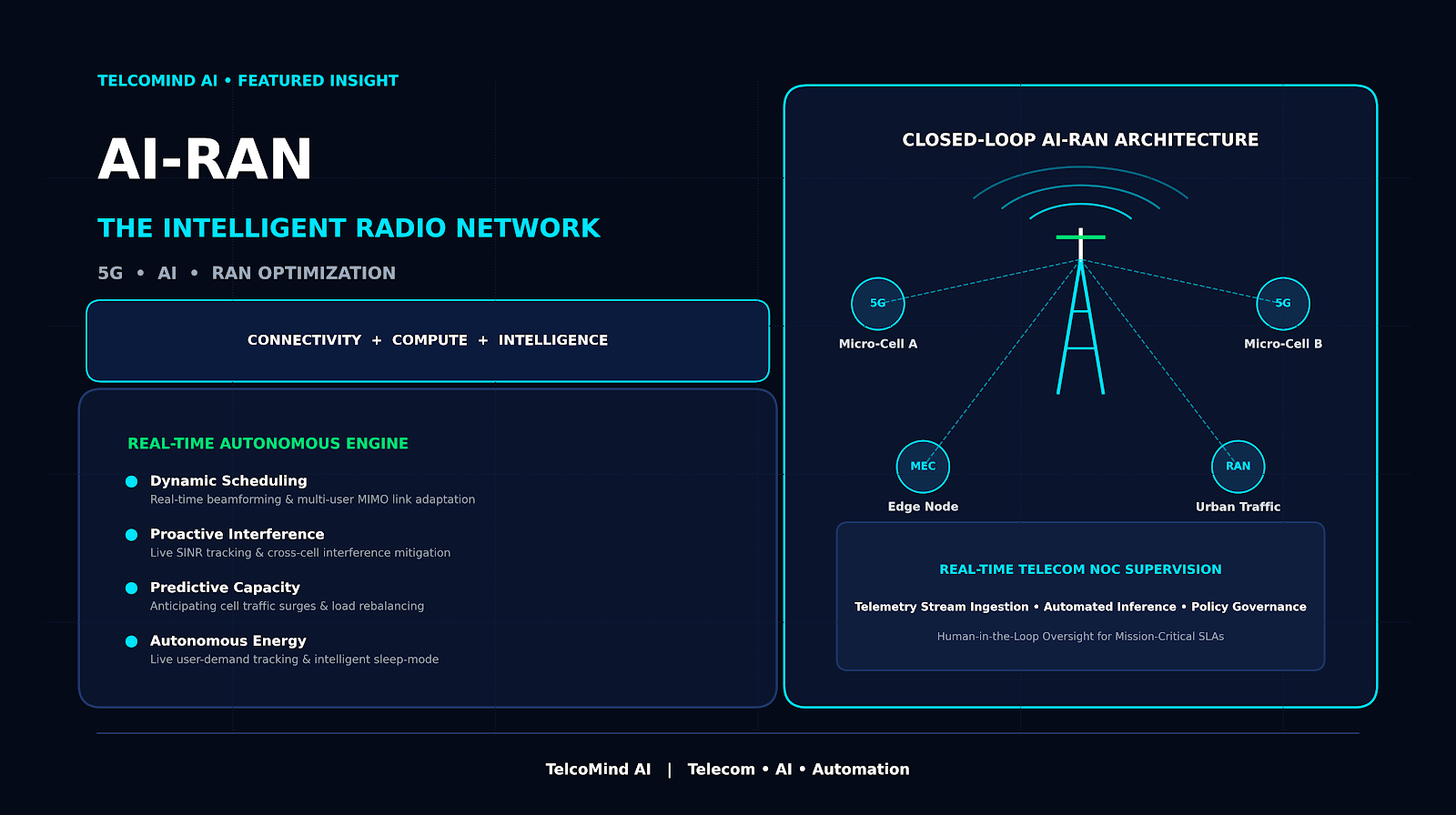
    What if the radio network could predict congestion before users experience it, adjust capacity automatically, reduce energy consumption during low-traffic periods, and help engineers identify the right action before service quality deteriorates?

    That is increasingly the direction of AI-RAN β€” the application of artificial intelligence across Radio Access Network operations and optimization.

    Traditional RAN operations depend heavily on thresholds, alarms, historical KPIs and engineer-driven analysis. AI introduces another layer: the ability to learn from network behavior, identify patterns across large volumes of data, predict potential degradation and recommendβ€”or, under controlled conditions, executeβ€”optimization actions.

    But AI-RAN is not simply about automating the RAN.

    The bigger opportunity is creating a network where AI and experienced engineers work together, combining machine-scale analysis with operational judgment, governance and network knowledge.

    AI-RAN transforming traditional radio access network operations through AI-driven prediction, optimization and automation
    From reactive RAN operations to AI-driven, adaptive network optimization.

    Why Does RAN Need AI?

    At 8:30 PM, traffic begins climbing across a busy urban 5G cluster.

    One cell is approaching congestion.

    A neighboring cell still has available capacity.

    Interference is increasing at the cell edge.

    Some users begin experiencing lower throughput, while others continue receiving perfectly normal service.

    Nothing is completely down.

    But the network is no longer operating at its best.

    Traditionally, RAN teams investigate such conditions through KPIs, counters, alarms, drive-test information, performance reports and optimization tools.

    The challenge is scale.

    A modern mobile network may contain thousands of cells, continuously producing performance information while traffic, mobility, interference and radio conditions change throughout the day.

    AI can analyze these changing conditions together and identify patterns that would be difficult to recognize manually across such a large environment.

    The value of AI-RAN is not simply automating another RAN task. It is helping the network understand changing conditions faster and respond more intelligently.

    How AI-RAN Actually Works

    AI-RAN starts with a simple idea:

    The radio network continuously produces signals about its own condition. AI turns those signals into operational intelligence.

    Instead of looking at one KPI or alarm in isolation, AI models can analyze multiple dimensions of network behaviour together.

    1. Observe β€” Collect the Network Signals

    The process begins with data from the RAN environment, including traffic load, throughput, latency, SINR, interference, mobility, resource utilization, alarms and historical performance.

    This creates a continuously evolving picture of how the radio network is behaving.

    2. Understand β€” Find the Pattern

    AI analyzes relationships across this data to identify patterns that may not be obvious from individual counters.

    For example, rising traffic alone may not be a problem. But rising traffic combined with deteriorating radio quality, increasing resource utilization and changing mobility patterns may indicate developing congestion.

    3. Predict β€” What Happens Next?

    The next step is moving from understanding the current network toward anticipating its future state.

    Will this cell become congested?

    Will customer throughput deteriorate?

    Will additional capacity be required during the next traffic peak?

    4. Optimize β€” What Should We Change?

    Based on the predicted condition, AI can recommend an optimization actionβ€”for example, adjusting resource allocation, load balancing, mobility behaviour or energy-saving strategies.

    Depending on the maturity and risk of the use case, the recommendation may be reviewed by an engineer or executed automatically within predefined operational policies.

    5. Validate & Learn β€” Did It Actually Work?

    This is one of the most important steps.

    After an optimization is applied, the network must be measured again.

    Did throughput improve?

    Did congestion decrease?

    Was customer experience better?

    Did another KPI deteriorate?

    The result becomes new information for future decisions.

            AI-RAN INTELLIGENCE LOOP

    β”Œβ”€β”€β”€β”€β”€β”€β”€β”€β”€β”€β”€β”€β”€β”
    β”‚ OBSERVE β”‚
    β”‚ Network Dataβ”‚
    β””β”€β”€β”€β”€β”€β”€β”¬β”€β”€β”€β”€β”€β”€β”˜
    ↓
    β”Œβ”€β”€β”€β”€β”€β”€β”€β”€β”€β”€β”€β”€β”€β”
    β”‚ UNDERSTAND β”‚
    β”‚Find Patternsβ”‚
    β””β”€β”€β”€β”€β”€β”€β”¬β”€β”€β”€β”€β”€β”€β”˜
    ↓
    β”Œβ”€β”€β”€β”€β”€β”€β”€β”€β”€β”€β”€β”€β”€β”
    β”‚ PREDICT β”‚
    β”‚ What's Next?β”‚
    β””β”€β”€β”€β”€β”€β”€β”¬β”€β”€β”€β”€β”€β”€β”˜
    ↓
    β”Œβ”€β”€β”€β”€β”€β”€β”€β”€β”€β”€β”€β”€β”€β”
    β”‚ OPTIMIZE β”‚
    β”‚ What to Do? β”‚
    β””β”€β”€β”€β”€β”€β”€β”¬β”€β”€β”€β”€β”€β”€β”˜
    ↓
    β”Œβ”€β”€β”€β”€β”€β”€β”€β”€β”€β”€β”€β”€β”€β”
    β”‚ VALIDATE β”‚
    β”‚ Did It Work?β”‚
    β””β”€β”€β”€β”€β”€β”€β”¬β”€β”€β”€β”€β”€β”€β”˜
    β”‚
    └──────→ LEARN

    Where Is AI-RAN Creating Real Value?

    AI-RAN becomes meaningful when intelligence produces a measurable improvement in the live network.

    The value can appear in different forms: higher throughput, better spectrum utilization, lower interference, improved energy efficiency, more accurate capacity decisions, or a more consistent customer experience.

    Six areas are particularly important.

    1. Intelligent RAN Optimization

    Radio conditions can change within seconds.

    Traffic moves.

    Interference changes.

    Users enter and leave cells.

    Channel quality fluctuates.

    Traditional rule-based algorithms are designed to respond to these conditions, but AI models can learn more complex relationships between network conditions and optimization decisions.

    This makes areas such as scheduling, link adaptation, beamforming and resource allocation particularly interesting for AI-RAN.

    Real Network Example β€” T-Mobile + Ericsson

    In 2026, T-Mobile and Ericsson reported large-scale commercial trials of an AI-native Scheduler with Link Adaptation on T-Mobile’s live 5G Advanced network. Compared with legacy rule-based methods, the trial achieved up to 15% higher downlink throughput and close to 10% improvement in spectral efficiency.

    2. Interference Optimization

    Interference is one of the persistent challenges in radio networks.

    The difficult part is that changing one parameter to improve one cell can affect neighbouring cells.

    AI can analyze relationships across multiple cells and identify optimization opportunities that are difficult to capture through isolated threshold-based decisions.

    This becomes particularly valuable in dense networks where traffic, coverage and interference continuously interact.

    Real Network Example β€” KDDI + Ericsson

    In 2026, Ericsson and KDDI completed a large-scale AI-driven uplink optimization field trial on KDDI’s commercial network across both 4G and 5G, demonstrating performance improvements while uplink traffic was also increasing. The trial was positioned as part of KDDI’s progression toward higher levels of autonomous network operations.

    3. AI-Driven Capacity & Traffic Management

    Capacity planning traditionally relies heavily on historical trends.

    But tomorrow’s traffic does not always behave like yesterday’s.

    A stadium event, transport hub, business district, holiday period or unexpected crowd movement can rapidly change demand.

    AI can combine historical traffic, current utilization, mobility patterns and network behaviour to predict where capacity pressure may develop.

    Instead of asking:

    β€œWhich cells were congested last month?”

    the operational question becomes:

    β€œWhich cells are likely to become congested next?”

    That gives RAN teams something extremely valuable:

    time to act before capacity becomes customer impact.

    4. AI-Powered Energy Optimization

    A radio network does not experience the same traffic load 24 hours a day.

    During low-demand periods, AI can help identify where selected network resources may safely enter energy-saving states while maintaining required coverage and service quality.

    When traffic begins increasing again, resources can be restored dynamically.

    This changes the objective from simply:

    β€œReduce energy.”

    to:

    β€œUse energy intelligently according to network demand.”

    The business value is particularly important because energy optimization connects AI-RAN directly with OPEX reduction and sustainability objectives.

    5. Customer Experience Optimization

    A cell can technically remain available while some users still experience poor service.

    AI-RAN can analyze radio conditions at a more granular level and help identify patterns affecting throughput, latency, coverage and user experience.

    This allows optimization to move beyond:

    β€œIs the cell healthy?”

    toward:

    β€œAre users actually receiving the experience the network was designed to provide?”

    eal Network Example β€” Optus + Ericsson

    In a 2026 Australian trial, Optus and Ericsson reported that AI-native RAN link adaptation delivered more than 20% cell-level throughput improvement in medium-to-poor radio-frequency conditions, without requiring additional spectrum or hardware.

    6. Toward Self-Optimizing RAN

    he most interesting stage appears when these capabilities begin working together.

    AI detects developing congestion.

    It predicts the likely impact.

    It identifies an optimization opportunity.

    A controlled action is recommended.

    The network measures the result.

    The outcome becomes feedback for the next decision.

    That creates a closed intelligence loop:

    Observe β†’ Predict β†’ Optimize β†’ Execute β†’ Validate β†’ Learn

    This does not mean every RAN change should become autonomous.

    The level of automation should depend on risk, confidence, operational policy and the potential customer impact of the action.

    But it shows where AI-RAN is ultimately heading:

    from a network that follows predefined rules toward one that can increasingly adapt to changing conditions.

    AI-RAN Is Already Moving Into Live Networks

    AI-RAN is often discussed as part of the future of 6G.

    But some of its most interesting capabilities are already being testedβ€”and in some cases scaledβ€”across live commercial 4G and 5G networks today.

    The important shift is that operators are beginning to measure AI-RAN through actual network outcomes:

    Does throughput improve?

    Can spectrum be used more efficiently?

    Can interference be reduced?

    Can optimization scale across thousands of cells?

    Recent deployments and trials provide some useful answers.

    T-Mobile β€” AI-Native Scheduling at Scale

    In May 2026, T-Mobile and Ericsson reported large-scale commercial trials of an AI-native Scheduler with Link Adaptation using live 5G Advanced traffic.

    The AI model predicts rapidly changing radio conditions in real time and adapts transmission decisions accordingly.

    The reported result:

    Up to 15% improvement in downlink throughput
    Close to 10% improvement in spectral efficiency

    compared with legacy rule-based methods.

    This is significant because spectrum is one of an operator’s most valuable assets. Improving spectral efficiency means extracting more performance from infrastructure and spectrum already deployed.

    KDDI β€” AI Optimization Across Thousands of Cells

    KDDI and Ericsson approached AI-RAN from another direction: uplink interference optimization.

    Their 2026 commercial-network field trial covered approximately 1,500 5G cells and 1,300 4G cells.

    Ericsson reported average throughput improvements of 9.6% in 4G and 3.1% in 5G, alongside a 27% improvement in 5G SINR.

    What makes this example particularly interesting is scale.

    AI optimization becomes much more valuable when it can move beyond a handful of test cells toward large multi-band, multi-technology network environments.

    Optus β€” Improving 5G Without More Spectrum

    In Australia, Optus and Ericsson tested AI-native Link Adaptation in challenging radio conditions.

    The field trial reported more than 20% improvement in cell-level throughput under medium-to-poor RF conditionsβ€”without adding new spectrum or hardware.

    That illustrates an important business case for AI-RAN:

    Before asking how much more infrastructure should be added, ask whether intelligence can extract more value from what is already deployed.

    AT&T β€” Bringing AI Into Cloud RAN

    AI-RAN is also converging with Cloud RAN.

    In 2026, AT&T and Ericsson demonstrated AI-native Link Adaptation on a Cloud RAN stack running on Intel Xeon 6 infrastructure, using AT&T-specific frequency bands and propagation characteristics.

    This matters because it points toward a future where AI capabilities become increasingly portable across cloud-based RAN architectures rather than remaining tied to one fixed implementation.

    SoftBank β€” AI-RAN Meets Physical AI

    Another direction is emerging beyond network optimization itself.

    SoftBank and Ericsson demonstrated a proof of concept combining 5G connectivity, AI-RAN-related edge computing and Physical AI workloads, allowing robotic systems to dynamically offload AI processing toward nearby edge compute resources.

    This introduces a broader possibility:

    The RAN may not only use AI to optimize itselfβ€”it may eventually help provide the distributed connectivity and compute environment required by AI applications.

    AI-RAN is moving from β€œCan AI improve the radio network?” toward a more commercially relevant question: β€œWhere can AI produce measurable network and business value at scale?”

    The Bigger Shift: From AI for RAN to AI on RAN

    Until recently, most conversations about AI and the RAN focused on one question:

    How can AI improve the network?

    Better optimization.

    Better traffic prediction.

    Better energy efficiency.

    Better interference management.

    Better utilization of spectrum.

    But another question is emerging:

    Can the RAN itself become part of the infrastructure that runs AI?

    This changes the conversation significantly.

    Instead of thinking only about AI for RAN, the industry is beginning to explore AI on RAN.

    In this model, distributed telecom infrastructure could potentially support both traditional radio workloads and AI workloads closer to where users, devices, machines and applications actually generate data.

            THE AI-RAN EVOLUTION
    
     AI FOR RAN                 AI ON RAN
         β”‚                          β”‚
         β–Ό                          β–Ό
    

    Optimize Network Run AI Workloads
    Predict Traffic Edge Intelligence
    Reduce Energy Computer Vision
    Manage Interference Physical AI
    Improve Experience Intelligent Devices
    β”‚ β”‚
    β””β”€β”€β”€β”€β”€β”€β”€β”€β”€β”€β”¬β”€β”€β”€β”€β”€β”€β”€β”€β”€β”€β”€β”€β”€β”€β”€β”˜
    β–Ό
    AI-RAN PLATFORM
    β”‚
    β–Ό
    CONNECTIVITY + COMPUTE + AI

    This is why AI-RAN could eventually become much bigger than another network-optimization technology.

    The radio network already provides something extremely valuable: distributed infrastructure located close to users and devices.

    If connectivity, compute and AI can increasingly coexist across that infrastructure, telecom operators may have an opportunity to move beyond providing connectivity alone.

    And that raises a much bigger strategic question:

    Could AI-RAN eventually create new revenue opportunities for telecom operatorsβ€”not only operational savings?

    From Network Efficiency to New Revenue Opportunities

    Most AI-RAN discussions begin with operational efficiency.

    Improve throughput.

    Optimize spectrum.

    Reduce energy consumption.

    Automate network decisions.

    These benefits are important because they can improve network performance while reducing operational cost.

    But there may be a second, potentially bigger opportunity.

    What if telecom infrastructure could also become distributed AI infrastructure?

    Mobile operators already have assets that many AI companies need: nationwide infrastructure, connectivity, edge locations, data centers, cloud platforms and proximity to millions of users and devices.

    AI-RAN could potentially bring connectivity, computing and AI processing closer together.

    1. Edge AI Inference

    Many AI applications cannot always afford to send every piece of data to a distant hyperscale cloud.

    Industrial automation, video analytics, robotics, autonomous systems and immersive applications may benefit from processing closer to where data is generated.

    Telecom edge infrastructure could potentially provide that environment.

    Instead of selling only connectivity, an operator could eventually provide:

    Connectivity + Edge Compute + AI Inference

    as an integrated enterprise service.

    2. AI Compute as a Service

    Distributed telecom infrastructure may also create opportunities to make underutilized computing resources available for AI workloads.

    The commercial model could gradually move from charging primarily for GBs, bandwidth and connectivity toward charging for combinations of connectivity and compute capacity.

    This does not mean every base station becomes an AI data center.

    It means the boundary between telecom infrastructure and distributed computing infrastructure may become less distinct.

    3. Physical AI & Robotics

    Robots, drones, industrial machines and autonomous systems need more than intelligence.

    They need reliable connectivity, low latency and access to computing resources.

    This creates an interesting role for telecom networks.

    A robot could perform some processing locally, offload more demanding AI workloads to nearby edge infrastructure, and use the mobile network to maintain reliable communication.

    In that scenario, the telecom network becomes part of the AI execution environment, not simply the transport layer.

    4. Enterprise & Sovereign AI Infrastructure

    Telecom operators also have another strategic advantage: they operate infrastructure inside national markets and under local regulatory frameworks.

    As enterprises and governments become more concerned about data residency, security and sovereign AI, locally operated telecom and edge infrastructure could become increasingly relevant.

    This could open opportunities for operators to participate in national or enterprise AI ecosystems beyond traditional connectivity services.

    The commercial promise of AI-RAN may ultimately be bigger than making the RAN cheaper to operate. It could help transform parts of the telecom network into infrastructure on which AI services themselves are delivered.

    What Could Slow AI-RAN Adoption?

    The technical potential of AI-RAN is significant.

    But moving from a successful trial to large-scale operational deployment is a different challenge.

    For operators, the question is not only:

    β€œDoes the AI model work?”

    It is also:

    β€œDoes it create enough value to justify deploying, integrating and operating it at scale?”

    1. The ROI Must Be Measurable

    A 5% or 10% improvement in a technical KPI sounds attractive.

    But operators ultimately need to translate that improvement into business value.

    Does higher spectral efficiency delay additional spectrum or capacity investment?

    Does better optimization reduce congestion?

    Does energy optimization materially lower OPEX?

    Does improved radio performance reduce customer complaints or churn?

    AI-RAN will scale faster when operators can connect technical improvement β†’ operational impact β†’ financial value.

    2. AI Is Only as Good as Its Network Data

    RAN environments generate enormous volumes of information, but more data does not automatically mean better intelligence.

    Missing counters, inconsistent data, configuration differences, topology inaccuracies or poor historical records can weaken model performance.

    AI-RAN therefore depends heavily on data quality, context and governance.

    Before asking whether the AI model is intelligent enough, operators may first need to ask:

    β€œIs the network data reliable enough for the model to learn from?”

    3. Multi-Vendor Networks Make Integration Harder

    Real telecom networks are rarely built from one technology generation, one architecture or one vendor.

    Operators may have multiple RAN vendors, legacy technologies, Open RAN components, different OSS platforms and years of accumulated configuration.

    An AI capability that performs well inside one isolated environment may be much harder to scale across the complete network.

    This makes interoperability, common data models, APIs and open interfaces strategically important to AI-RAN adoption.

    4. AI Itself Requires Compute and Energy

    There is an interesting paradox in AI-RAN.

    AI can help the network reduce energy consumption.

    But AI models themselves require compute, accelerators, storage and power.

    As AI workloads move closer to the network edge, operators will need to balance the intelligence gained against the infrastructure required to provide it.

    The winning architecture may therefore not be the one running the largest AI model everywhere.

    It may be the one using the right intelligence, at the right location, for the right operational problem.

    The success of AI-RAN will not be measured by how much AI an operator deploys. It will be measured by how much network and business value that intelligence creates.

    Where Does AI-RAN Go From Here?

    The first generation of mobile networks was primarily about connecting people.

    Later generations expanded that roleβ€”connecting smartphones, enterprises, machines, industries and increasingly complex digital services.

    AI-RAN introduces another possibility.

    The radio network may begin to evolve from infrastructure that simply carries data into infrastructure that can increasingly understand, optimize and potentially process intelligence closer to where that data is created.

    In the near term, the strongest business cases are likely to remain practical:

    Better spectrum utilization.

    Higher network performance.

    Lower energy consumption.

    More accurate capacity decisions.

    Improved customer experience.

    These are measurable problems with measurable value.

    But the longer-term opportunity could be much larger.

    As RAN, cloud, edge computing and AI infrastructure converge, operators may eventually ask a different question.

    Not simply:

    β€œHow can AI make our radio network better?”

    But:

    β€œWhat new AI services can our network enable?”

    That is where AI-RAN becomes more than another optimization technology.

    It potentially becomes part of a new telecom infrastructure model built around:

    Connectivity + Compute + Intelligence

    The biggest opportunity in AI-RAN may not be teaching the network how to operate better. It may be discovering what becomes possible when the network itself becomes part of the AI infrastructure.

    Frequently Asked Questions About AI-RAN

    What is AI-RAN?

    AI-RAN refers to the integration of artificial intelligence with Radio Access Network technologies. AI can be used to analyze network conditions, predict traffic and performance, optimize radio resources, improve energy efficiency and support increasingly adaptive RAN operations.

    How is AI used in 5G networks?

    AI can support 5G networks through traffic prediction, radio-resource optimization, interference management, anomaly detection, energy optimization, capacity planning and customer-experience improvement.

    What is the difference between AI for RAN and AI on RAN?

    AI for RAN uses artificial intelligence to improve how the radio network performs and operates. AI on RAN explores using telecom infrastructure to support AI workloads, potentially combining connectivity, edge computing and AI inference.

    Can AI-RAN reduce telecom operating costs?

    Potentially, yes. AI-RAN can contribute to lower operating costs through areas such as energy optimization, more efficient spectrum utilization, predictive operations and automation. The actual financial benefit depends on deployment scale, infrastructure requirements and the specific use case.

    Is AI-RAN already being used in commercial networks?

    AI-driven RAN capabilities are already being tested and deployed in live commercial-network environments. Recent operator/vendor examples include work involving T-Mobile, KDDI, Optus, AT&T and SoftBank, covering AI-native scheduling, interference optimization, Cloud RAN and edge-AI use cases.

    Explore More: AI Across Telecom Operations

    AI-RAN is one part of a much wider transformation taking place across telecom operationsβ€”from predictive maintenance and AIOps to Agentic AI, Network Digital Twins and autonomous networks.

    Explore the complete guide:
    AI in Telecom: 10 Real-World Use Cases Transforming Network Operations in 2026

    TelcoMind AI | Telecom β€’ AI β€’ Automation

  • AI-RAN: How Artificial Intelligence Is Transforming Radio Access Networks

    AI-RAN: How Artificial Intelligence Is Transforming Radio Access Networks

    What if the radio network could predict congestion before users experience it, adjust capacity automatically, reduce energy consumption during low-traffic periods, and help engineers identify the right action before service quality deteriorates?

    That is increasingly the direction of AI-RAN β€” the application of artificial intelligence across Radio Access Network operations and optimization.

    Traditional RAN operations depend heavily on thresholds, alarms, historical KPIs and engineer-driven analysis. AI introduces another layer: the ability to learn from network behavior, identify patterns across large volumes of data, predict potential degradation and recommendβ€”or, under controlled conditions, executeβ€”optimization actions.

    But AI-RAN is not simply about automating the RAN.

    The bigger opportunity is creating a network where AI and experienced engineers work together, combining machine-scale analysis with operational judgment, governance and network knowledge.

    AI-RAN transforming traditional radio access network operations through AI-driven prediction, optimization and automation
    From reactive RAN operations to AI-driven, adaptive network optimization.

    Why Does RAN Need AI?

    At 8:30 PM, traffic begins climbing across a busy urban 5G cluster.

    One cell is approaching congestion.

    A neighboring cell still has available capacity.

    Interference is increasing at the cell edge.

    Some users begin experiencing lower throughput, while others continue receiving perfectly normal service.

    Nothing is completely down.

    But the network is no longer operating at its best.

    Traditionally, RAN teams investigate such conditions through KPIs, counters, alarms, drive-test information, performance reports and optimization tools.

    The challenge is scale.

    A modern mobile network may contain thousands of cells, continuously producing performance information while traffic, mobility, interference and radio conditions change throughout the day.

    AI can analyze these changing conditions together and identify patterns that would be difficult to recognize manually across such a large environment.

    The value of AI-RAN is not simply automating another RAN task. It is helping the network understand changing conditions faster and respond more intelligently.

    How AI-RAN Actually Works

    AI-RAN starts with a simple idea:

    The radio network continuously produces signals about its own condition. AI turns those signals into operational intelligence.

    Instead of looking at one KPI or alarm in isolation, AI models can analyze multiple dimensions of network behaviour together.

    1. Observe β€” Collect the Network Signals

    The process begins with data from the RAN environment, including traffic load, throughput, latency, SINR, interference, mobility, resource utilization, alarms and historical performance.

    This creates a continuously evolving picture of how the radio network is behaving.

    2. Understand β€” Find the Pattern

    AI analyzes relationships across this data to identify patterns that may not be obvious from individual counters.

    For example, rising traffic alone may not be a problem. But rising traffic combined with deteriorating radio quality, increasing resource utilization and changing mobility patterns may indicate developing congestion.

    3. Predict β€” What Happens Next?

    The next step is moving from understanding the current network toward anticipating its future state.

    Will this cell become congested?

    Will customer throughput deteriorate?

    Will additional capacity be required during the next traffic peak?

    4. Optimize β€” What Should We Change?

    Based on the predicted condition, AI can recommend an optimization actionβ€”for example, adjusting resource allocation, load balancing, mobility behaviour or energy-saving strategies.

    Depending on the maturity and risk of the use case, the recommendation may be reviewed by an engineer or executed automatically within predefined operational policies.

    5. Validate & Learn β€” Did It Actually Work?

    This is one of the most important steps.

    After an optimization is applied, the network must be measured again.

    Did throughput improve?

    Did congestion decrease?

    Was customer experience better?

    Did another KPI deteriorate?

    The result becomes new information for future decisions.

            AI-RAN INTELLIGENCE LOOP

    β”Œβ”€β”€β”€β”€β”€β”€β”€β”€β”€β”€β”€β”€β”€β”
    β”‚ OBSERVE β”‚
    β”‚ Network Dataβ”‚
    β””β”€β”€β”€β”€β”€β”€β”¬β”€β”€β”€β”€β”€β”€β”˜
    ↓
    β”Œβ”€β”€β”€β”€β”€β”€β”€β”€β”€β”€β”€β”€β”€β”
    β”‚ UNDERSTAND β”‚
    β”‚Find Patternsβ”‚
    β””β”€β”€β”€β”€β”€β”€β”¬β”€β”€β”€β”€β”€β”€β”˜
    ↓
    β”Œβ”€β”€β”€β”€β”€β”€β”€β”€β”€β”€β”€β”€β”€β”
    β”‚ PREDICT β”‚
    β”‚ What's Next?β”‚
    β””β”€β”€β”€β”€β”€β”€β”¬β”€β”€β”€β”€β”€β”€β”˜
    ↓
    β”Œβ”€β”€β”€β”€β”€β”€β”€β”€β”€β”€β”€β”€β”€β”
    β”‚ OPTIMIZE β”‚
    β”‚ What to Do? β”‚
    β””β”€β”€β”€β”€β”€β”€β”¬β”€β”€β”€β”€β”€β”€β”˜
    ↓
    β”Œβ”€β”€β”€β”€β”€β”€β”€β”€β”€β”€β”€β”€β”€β”
    β”‚ VALIDATE β”‚
    β”‚ Did It Work?β”‚
    β””β”€β”€β”€β”€β”€β”€β”¬β”€β”€β”€β”€β”€β”€β”˜
    β”‚
    └──────→ LEARN

    Where Is AI-RAN Creating Real Value?

    AI-RAN becomes meaningful when intelligence produces a measurable improvement in the live network.

    The value can appear in different forms: higher throughput, better spectrum utilization, lower interference, improved energy efficiency, more accurate capacity decisions, or a more consistent customer experience.

    Six areas are particularly important.

    1. Intelligent RAN Optimization

    Radio conditions can change within seconds.

    Traffic moves.

    Interference changes.

    Users enter and leave cells.

    Channel quality fluctuates.

    Traditional rule-based algorithms are designed to respond to these conditions, but AI models can learn more complex relationships between network conditions and optimization decisions.

    This makes areas such as scheduling, link adaptation, beamforming and resource allocation particularly interesting for AI-RAN.

    Real Network Example β€” T-Mobile + Ericsson

    In 2026, T-Mobile and Ericsson reported large-scale commercial trials of an AI-native Scheduler with Link Adaptation on T-Mobile’s live 5G Advanced network. Compared with legacy rule-based methods, the trial achieved up to 15% higher downlink throughput and close to 10% improvement in spectral efficiency.

    2. Interference Optimization

    Interference is one of the persistent challenges in radio networks.

    The difficult part is that changing one parameter to improve one cell can affect neighbouring cells.

    AI can analyze relationships across multiple cells and identify optimization opportunities that are difficult to capture through isolated threshold-based decisions.

    This becomes particularly valuable in dense networks where traffic, coverage and interference continuously interact.

    Real Network Example β€” KDDI + Ericsson

    In 2026, Ericsson and KDDI completed a large-scale AI-driven uplink optimization field trial on KDDI’s commercial network across both 4G and 5G, demonstrating performance improvements while uplink traffic was also increasing. The trial was positioned as part of KDDI’s progression toward higher levels of autonomous network operations.

    3. AI-Driven Capacity & Traffic Management

    Capacity planning traditionally relies heavily on historical trends.

    But tomorrow’s traffic does not always behave like yesterday’s.

    A stadium event, transport hub, business district, holiday period or unexpected crowd movement can rapidly change demand.

    AI can combine historical traffic, current utilization, mobility patterns and network behaviour to predict where capacity pressure may develop.

    Instead of asking:

    β€œWhich cells were congested last month?”

    the operational question becomes:

    β€œWhich cells are likely to become congested next?”

    That gives RAN teams something extremely valuable:

    time to act before capacity becomes customer impact.

    4. AI-Powered Energy Optimization

    A radio network does not experience the same traffic load 24 hours a day.

    During low-demand periods, AI can help identify where selected network resources may safely enter energy-saving states while maintaining required coverage and service quality.

    When traffic begins increasing again, resources can be restored dynamically.

    This changes the objective from simply:

    β€œReduce energy.”

    to:

    β€œUse energy intelligently according to network demand.”

    The business value is particularly important because energy optimization connects AI-RAN directly with OPEX reduction and sustainability objectives.

    5. Customer Experience Optimization

    A cell can technically remain available while some users still experience poor service.

    AI-RAN can analyze radio conditions at a more granular level and help identify patterns affecting throughput, latency, coverage and user experience.

    This allows optimization to move beyond:

    β€œIs the cell healthy?”

    toward:

    β€œAre users actually receiving the experience the network was designed to provide?”

    eal Network Example β€” Optus + Ericsson

    In a 2026 Australian trial, Optus and Ericsson reported that AI-native RAN link adaptation delivered more than 20% cell-level throughput improvement in medium-to-poor radio-frequency conditions, without requiring additional spectrum or hardware.

    6. Toward Self-Optimizing RAN

    he most interesting stage appears when these capabilities begin working together.

    AI detects developing congestion.

    It predicts the likely impact.

    It identifies an optimization opportunity.

    A controlled action is recommended.

    The network measures the result.

    The outcome becomes feedback for the next decision.

    That creates a closed intelligence loop:

    Observe β†’ Predict β†’ Optimize β†’ Execute β†’ Validate β†’ Learn

    This does not mean every RAN change should become autonomous.

    The level of automation should depend on risk, confidence, operational policy and the potential customer impact of the action.

    But it shows where AI-RAN is ultimately heading:

    from a network that follows predefined rules toward one that can increasingly adapt to changing conditions.

    AI-RAN Is Already Moving Into Live Networks

    AI-RAN is often discussed as part of the future of 6G.

    But some of its most interesting capabilities are already being testedβ€”and in some cases scaledβ€”across live commercial 4G and 5G networks today.

    The important shift is that operators are beginning to measure AI-RAN through actual network outcomes:

    Does throughput improve?

    Can spectrum be used more efficiently?

    Can interference be reduced?

    Can optimization scale across thousands of cells?

    Recent deployments and trials provide some useful answers.

    T-Mobile β€” AI-Native Scheduling at Scale

    In May 2026, T-Mobile and Ericsson reported large-scale commercial trials of an AI-native Scheduler with Link Adaptation using live 5G Advanced traffic.

    The AI model predicts rapidly changing radio conditions in real time and adapts transmission decisions accordingly.

    The reported result:

    Up to 15% improvement in downlink throughput
    Close to 10% improvement in spectral efficiency

    compared with legacy rule-based methods.

    This is significant because spectrum is one of an operator’s most valuable assets. Improving spectral efficiency means extracting more performance from infrastructure and spectrum already deployed.

    KDDI β€” AI Optimization Across Thousands of Cells

    KDDI and Ericsson approached AI-RAN from another direction: uplink interference optimization.

    Their 2026 commercial-network field trial covered approximately 1,500 5G cells and 1,300 4G cells.

    Ericsson reported average throughput improvements of 9.6% in 4G and 3.1% in 5G, alongside a 27% improvement in 5G SINR.

    What makes this example particularly interesting is scale.

    AI optimization becomes much more valuable when it can move beyond a handful of test cells toward large multi-band, multi-technology network environments.

    Optus β€” Improving 5G Without More Spectrum

    In Australia, Optus and Ericsson tested AI-native Link Adaptation in challenging radio conditions.

    The field trial reported more than 20% improvement in cell-level throughput under medium-to-poor RF conditionsβ€”without adding new spectrum or hardware.

    That illustrates an important business case for AI-RAN:

    Before asking how much more infrastructure should be added, ask whether intelligence can extract more value from what is already deployed.

    AT&T β€” Bringing AI Into Cloud RAN

    AI-RAN is also converging with Cloud RAN.

    In 2026, AT&T and Ericsson demonstrated AI-native Link Adaptation on a Cloud RAN stack running on Intel Xeon 6 infrastructure, using AT&T-specific frequency bands and propagation characteristics.

    This matters because it points toward a future where AI capabilities become increasingly portable across cloud-based RAN architectures rather than remaining tied to one fixed implementation.

    SoftBank β€” AI-RAN Meets Physical AI

    Another direction is emerging beyond network optimization itself.

    SoftBank and Ericsson demonstrated a proof of concept combining 5G connectivity, AI-RAN-related edge computing and Physical AI workloads, allowing robotic systems to dynamically offload AI processing toward nearby edge compute resources.

    This introduces a broader possibility:

    The RAN may not only use AI to optimize itselfβ€”it may eventually help provide the distributed connectivity and compute environment required by AI applications.

    AI-RAN is moving from β€œCan AI improve the radio network?” toward a more commercially relevant question: β€œWhere can AI produce measurable network and business value at scale?”

    The Bigger Shift: From AI for RAN to AI on RAN

    Until recently, most conversations about AI and the RAN focused on one question:

    How can AI improve the network?

    Better optimization.

    Better traffic prediction.

    Better energy efficiency.

    Better interference management.

    Better utilization of spectrum.

    But another question is emerging:

    Can the RAN itself become part of the infrastructure that runs AI?

    This changes the conversation significantly.

    Instead of thinking only about AI for RAN, the industry is beginning to explore AI on RAN.

    In this model, distributed telecom infrastructure could potentially support both traditional radio workloads and AI workloads closer to where users, devices, machines and applications actually generate data.

            THE AI-RAN EVOLUTION
    
     AI FOR RAN                 AI ON RAN
         β”‚                          β”‚
         β–Ό                          β–Ό
    

    Optimize Network Run AI Workloads
    Predict Traffic Edge Intelligence
    Reduce Energy Computer Vision
    Manage Interference Physical AI
    Improve Experience Intelligent Devices
    β”‚ β”‚
    β””β”€β”€β”€β”€β”€β”€β”€β”€β”€β”€β”¬β”€β”€β”€β”€β”€β”€β”€β”€β”€β”€β”€β”€β”€β”€β”€β”˜
    β–Ό
    AI-RAN PLATFORM
    β”‚
    β–Ό
    CONNECTIVITY + COMPUTE + AI

    This is why AI-RAN could eventually become much bigger than another network-optimization technology.

    The radio network already provides something extremely valuable: distributed infrastructure located close to users and devices.

    If connectivity, compute and AI can increasingly coexist across that infrastructure, telecom operators may have an opportunity to move beyond providing connectivity alone.

    And that raises a much bigger strategic question:

    Could AI-RAN eventually create new revenue opportunities for telecom operatorsβ€”not only operational savings?

    From Network Efficiency to New Revenue Opportunities

    Most AI-RAN discussions begin with operational efficiency.

    Improve throughput.

    Optimize spectrum.

    Reduce energy consumption.

    Automate network decisions.

    These benefits are important because they can improve network performance while reducing operational cost.

    But there may be a second, potentially bigger opportunity.

    What if telecom infrastructure could also become distributed AI infrastructure?

    Mobile operators already have assets that many AI companies need: nationwide infrastructure, connectivity, edge locations, data centers, cloud platforms and proximity to millions of users and devices.

    AI-RAN could potentially bring connectivity, computing and AI processing closer together.

    1. Edge AI Inference

    Many AI applications cannot always afford to send every piece of data to a distant hyperscale cloud.

    Industrial automation, video analytics, robotics, autonomous systems and immersive applications may benefit from processing closer to where data is generated.

    Telecom edge infrastructure could potentially provide that environment.

    Instead of selling only connectivity, an operator could eventually provide:

    Connectivity + Edge Compute + AI Inference

    as an integrated enterprise service.

    2. AI Compute as a Service

    Distributed telecom infrastructure may also create opportunities to make underutilized computing resources available for AI workloads.

    The commercial model could gradually move from charging primarily for GBs, bandwidth and connectivity toward charging for combinations of connectivity and compute capacity.

    This does not mean every base station becomes an AI data center.

    It means the boundary between telecom infrastructure and distributed computing infrastructure may become less distinct.

    3. Physical AI & Robotics

    Robots, drones, industrial machines and autonomous systems need more than intelligence.

    They need reliable connectivity, low latency and access to computing resources.

    This creates an interesting role for telecom networks.

    A robot could perform some processing locally, offload more demanding AI workloads to nearby edge infrastructure, and use the mobile network to maintain reliable communication.

    In that scenario, the telecom network becomes part of the AI execution environment, not simply the transport layer.

    4. Enterprise & Sovereign AI Infrastructure

    Telecom operators also have another strategic advantage: they operate infrastructure inside national markets and under local regulatory frameworks.

    As enterprises and governments become more concerned about data residency, security and sovereign AI, locally operated telecom and edge infrastructure could become increasingly relevant.

    This could open opportunities for operators to participate in national or enterprise AI ecosystems beyond traditional connectivity services.

    The commercial promise of AI-RAN may ultimately be bigger than making the RAN cheaper to operate. It could help transform parts of the telecom network into infrastructure on which AI services themselves are delivered.

    What Could Slow AI-RAN Adoption?

    The technical potential of AI-RAN is significant.

    But moving from a successful trial to large-scale operational deployment is a different challenge.

    For operators, the question is not only:

    β€œDoes the AI model work?”

    It is also:

    β€œDoes it create enough value to justify deploying, integrating and operating it at scale?”

    1. The ROI Must Be Measurable

    A 5% or 10% improvement in a technical KPI sounds attractive.

    But operators ultimately need to translate that improvement into business value.

    Does higher spectral efficiency delay additional spectrum or capacity investment?

    Does better optimization reduce congestion?

    Does energy optimization materially lower OPEX?

    Does improved radio performance reduce customer complaints or churn?

    AI-RAN will scale faster when operators can connect technical improvement β†’ operational impact β†’ financial value.

    2. AI Is Only as Good as Its Network Data

    RAN environments generate enormous volumes of information, but more data does not automatically mean better intelligence.

    Missing counters, inconsistent data, configuration differences, topology inaccuracies or poor historical records can weaken model performance.

    AI-RAN therefore depends heavily on data quality, context and governance.

    Before asking whether the AI model is intelligent enough, operators may first need to ask:

    β€œIs the network data reliable enough for the model to learn from?”

    3. Multi-Vendor Networks Make Integration Harder

    Real telecom networks are rarely built from one technology generation, one architecture or one vendor.

    Operators may have multiple RAN vendors, legacy technologies, Open RAN components, different OSS platforms and years of accumulated configuration.

    An AI capability that performs well inside one isolated environment may be much harder to scale across the complete network.

    This makes interoperability, common data models, APIs and open interfaces strategically important to AI-RAN adoption.

    4. AI Itself Requires Compute and Energy

    There is an interesting paradox in AI-RAN.

    AI can help the network reduce energy consumption.

    But AI models themselves require compute, accelerators, storage and power.

    As AI workloads move closer to the network edge, operators will need to balance the intelligence gained against the infrastructure required to provide it.

    The winning architecture may therefore not be the one running the largest AI model everywhere.

    It may be the one using the right intelligence, at the right location, for the right operational problem.

    The success of AI-RAN will not be measured by how much AI an operator deploys. It will be measured by how much network and business value that intelligence creates.

    Where Does AI-RAN Go From Here?

    The first generation of mobile networks was primarily about connecting people.

    Later generations expanded that roleβ€”connecting smartphones, enterprises, machines, industries and increasingly complex digital services.

    AI-RAN introduces another possibility.

    The radio network may begin to evolve from infrastructure that simply carries data into infrastructure that can increasingly understand, optimize and potentially process intelligence closer to where that data is created.

    In the near term, the strongest business cases are likely to remain practical:

    Better spectrum utilization.

    Higher network performance.

    Lower energy consumption.

    More accurate capacity decisions.

    Improved customer experience.

    These are measurable problems with measurable value.

    But the longer-term opportunity could be much larger.

    As RAN, cloud, edge computing and AI infrastructure converge, operators may eventually ask a different question.

    Not simply:

    β€œHow can AI make our radio network better?”

    But:

    β€œWhat new AI services can our network enable?”

    That is where AI-RAN becomes more than another optimization technology.

    It potentially becomes part of a new telecom infrastructure model built around:

    Connectivity + Compute + Intelligence

    The biggest opportunity in AI-RAN may not be teaching the network how to operate better. It may be discovering what becomes possible when the network itself becomes part of the AI infrastructure.

    Frequently Asked Questions About AI-RAN

    What is AI-RAN?

    AI-RAN refers to the integration of artificial intelligence with Radio Access Network technologies. AI can be used to analyze network conditions, predict traffic and performance, optimize radio resources, improve energy efficiency and support increasingly adaptive RAN operations.

    How is AI used in 5G networks?

    AI can support 5G networks through traffic prediction, radio-resource optimization, interference management, anomaly detection, energy optimization, capacity planning and customer-experience improvement.

    What is the difference between AI for RAN and AI on RAN?

    AI for RAN uses artificial intelligence to improve how the radio network performs and operates. AI on RAN explores using telecom infrastructure to support AI workloads, potentially combining connectivity, edge computing and AI inference.

    Can AI-RAN reduce telecom operating costs?

    Potentially, yes. AI-RAN can contribute to lower operating costs through areas such as energy optimization, more efficient spectrum utilization, predictive operations and automation. The actual financial benefit depends on deployment scale, infrastructure requirements and the specific use case.

    Is AI-RAN already being used in commercial networks?

    AI-driven RAN capabilities are already being tested and deployed in live commercial-network environments. Recent operator/vendor examples include work involving T-Mobile, KDDI, Optus, AT&T and SoftBank, covering AI-native scheduling, interference optimization, Cloud RAN and edge-AI use cases.

    Explore More: AI Across Telecom Operations

    AI-RAN is one part of a much wider transformation taking place across telecom operationsβ€”from predictive maintenance and AIOps to Agentic AI, Network Digital Twins and autonomous networks.

    Explore the complete guide:
    AI in Telecom: 10 Real-World Use Cases Transforming Network Operations in 2026

    TelcoMind AI | Telecom β€’ AI β€’ Automation

  • AI-RAN: How Artificial Intelligence Is Transforming Radio Access Networks

    AI-RAN: How Artificial Intelligence Is Transforming Radio Access Networks

    What if the radio network could predict congestion before users experience it, adjust capacity automatically, reduce energy consumption during low-traffic periods, and help engineers identify the right action before service quality deteriorates?

    That is increasingly the direction of AI-RAN β€” the application of artificial intelligence across Radio Access Network operations and optimization.

    Traditional RAN operations depend heavily on thresholds, alarms, historical KPIs and engineer-driven analysis. AI introduces another layer: the ability to learn from network behavior, identify patterns across large volumes of data, predict potential degradation and recommendβ€”or, under controlled conditions, executeβ€”optimization actions.

    But AI-RAN is not simply about automating the RAN.

    The bigger opportunity is creating a network where AI and experienced engineers work together, combining machine-scale analysis with operational judgment, governance and network knowledge.

    AI-RAN transforming traditional radio access network operations through AI-driven prediction, optimization and automation
    From reactive RAN operations to AI-driven, adaptive network optimization.

    Why Does RAN Need AI?

    At 8:30 PM, traffic begins climbing across a busy urban 5G cluster.

    One cell is approaching congestion.

    A neighboring cell still has available capacity.

    Interference is increasing at the cell edge.

    Some users begin experiencing lower throughput, while others continue receiving perfectly normal service.

    Nothing is completely down.

    But the network is no longer operating at its best.

    Traditionally, RAN teams investigate such conditions through KPIs, counters, alarms, drive-test information, performance reports and optimization tools.

    The challenge is scale.

    A modern mobile network may contain thousands of cells, continuously producing performance information while traffic, mobility, interference and radio conditions change throughout the day.

    AI can analyze these changing conditions together and identify patterns that would be difficult to recognize manually across such a large environment.

    The value of AI-RAN is not simply automating another RAN task. It is helping the network understand changing conditions faster and respond more intelligently.

    How AI-RAN Actually Works

    AI-RAN starts with a simple idea:

    The radio network continuously produces signals about its own condition. AI turns those signals into operational intelligence.

    Instead of looking at one KPI or alarm in isolation, AI models can analyze multiple dimensions of network behaviour together.

    1. Observe β€” Collect the Network Signals

    The process begins with data from the RAN environment, including traffic load, throughput, latency, SINR, interference, mobility, resource utilization, alarms and historical performance.

    This creates a continuously evolving picture of how the radio network is behaving.

    2. Understand β€” Find the Pattern

    AI analyzes relationships across this data to identify patterns that may not be obvious from individual counters.

    For example, rising traffic alone may not be a problem. But rising traffic combined with deteriorating radio quality, increasing resource utilization and changing mobility patterns may indicate developing congestion.

    3. Predict β€” What Happens Next?

    The next step is moving from understanding the current network toward anticipating its future state.

    Will this cell become congested?

    Will customer throughput deteriorate?

    Will additional capacity be required during the next traffic peak?

    4. Optimize β€” What Should We Change?

    Based on the predicted condition, AI can recommend an optimization actionβ€”for example, adjusting resource allocation, load balancing, mobility behaviour or energy-saving strategies.

    Depending on the maturity and risk of the use case, the recommendation may be reviewed by an engineer or executed automatically within predefined operational policies.

    5. Validate & Learn β€” Did It Actually Work?

    This is one of the most important steps.

    After an optimization is applied, the network must be measured again.

    Did throughput improve?

    Did congestion decrease?

    Was customer experience better?

    Did another KPI deteriorate?

    The result becomes new information for future decisions.

            AI-RAN INTELLIGENCE LOOP

    β”Œβ”€β”€β”€β”€β”€β”€β”€β”€β”€β”€β”€β”€β”€β”
    β”‚ OBSERVE β”‚
    β”‚ Network Dataβ”‚
    β””β”€β”€β”€β”€β”€β”€β”¬β”€β”€β”€β”€β”€β”€β”˜
    ↓
    β”Œβ”€β”€β”€β”€β”€β”€β”€β”€β”€β”€β”€β”€β”€β”
    β”‚ UNDERSTAND β”‚
    β”‚Find Patternsβ”‚
    β””β”€β”€β”€β”€β”€β”€β”¬β”€β”€β”€β”€β”€β”€β”˜
    ↓
    β”Œβ”€β”€β”€β”€β”€β”€β”€β”€β”€β”€β”€β”€β”€β”
    β”‚ PREDICT β”‚
    β”‚ What's Next?β”‚
    β””β”€β”€β”€β”€β”€β”€β”¬β”€β”€β”€β”€β”€β”€β”˜
    ↓
    β”Œβ”€β”€β”€β”€β”€β”€β”€β”€β”€β”€β”€β”€β”€β”
    β”‚ OPTIMIZE β”‚
    β”‚ What to Do? β”‚
    β””β”€β”€β”€β”€β”€β”€β”¬β”€β”€β”€β”€β”€β”€β”˜
    ↓
    β”Œβ”€β”€β”€β”€β”€β”€β”€β”€β”€β”€β”€β”€β”€β”
    β”‚ VALIDATE β”‚
    β”‚ Did It Work?β”‚
    β””β”€β”€β”€β”€β”€β”€β”¬β”€β”€β”€β”€β”€β”€β”˜
    β”‚
    └──────→ LEARN

    Where Is AI-RAN Creating Real Value?

    AI-RAN becomes meaningful when intelligence produces a measurable improvement in the live network.

    The value can appear in different forms: higher throughput, better spectrum utilization, lower interference, improved energy efficiency, more accurate capacity decisions, or a more consistent customer experience.

    Six areas are particularly important.

    1. Intelligent RAN Optimization

    Radio conditions can change within seconds.

    Traffic moves.

    Interference changes.

    Users enter and leave cells.

    Channel quality fluctuates.

    Traditional rule-based algorithms are designed to respond to these conditions, but AI models can learn more complex relationships between network conditions and optimization decisions.

    This makes areas such as scheduling, link adaptation, beamforming and resource allocation particularly interesting for AI-RAN.

    Real Network Example β€” T-Mobile + Ericsson

    In 2026, T-Mobile and Ericsson reported large-scale commercial trials of an AI-native Scheduler with Link Adaptation on T-Mobile’s live 5G Advanced network. Compared with legacy rule-based methods, the trial achieved up to 15% higher downlink throughput and close to 10% improvement in spectral efficiency.

    2. Interference Optimization

    Interference is one of the persistent challenges in radio networks.

    The difficult part is that changing one parameter to improve one cell can affect neighbouring cells.

    AI can analyze relationships across multiple cells and identify optimization opportunities that are difficult to capture through isolated threshold-based decisions.

    This becomes particularly valuable in dense networks where traffic, coverage and interference continuously interact.

    Real Network Example β€” KDDI + Ericsson

    In 2026, Ericsson and KDDI completed a large-scale AI-driven uplink optimization field trial on KDDI’s commercial network across both 4G and 5G, demonstrating performance improvements while uplink traffic was also increasing. The trial was positioned as part of KDDI’s progression toward higher levels of autonomous network operations.

    3. AI-Driven Capacity & Traffic Management

    Capacity planning traditionally relies heavily on historical trends.

    But tomorrow’s traffic does not always behave like yesterday’s.

    A stadium event, transport hub, business district, holiday period or unexpected crowd movement can rapidly change demand.

    AI can combine historical traffic, current utilization, mobility patterns and network behaviour to predict where capacity pressure may develop.

    Instead of asking:

    β€œWhich cells were congested last month?”

    the operational question becomes:

    β€œWhich cells are likely to become congested next?”

    That gives RAN teams something extremely valuable:

    time to act before capacity becomes customer impact.

    4. AI-Powered Energy Optimization

    A radio network does not experience the same traffic load 24 hours a day.

    During low-demand periods, AI can help identify where selected network resources may safely enter energy-saving states while maintaining required coverage and service quality.

    When traffic begins increasing again, resources can be restored dynamically.

    This changes the objective from simply:

    β€œReduce energy.”

    to:

    β€œUse energy intelligently according to network demand.”

    The business value is particularly important because energy optimization connects AI-RAN directly with OPEX reduction and sustainability objectives.

    5. Customer Experience Optimization

    A cell can technically remain available while some users still experience poor service.

    AI-RAN can analyze radio conditions at a more granular level and help identify patterns affecting throughput, latency, coverage and user experience.

    This allows optimization to move beyond:

    β€œIs the cell healthy?”

    toward:

    β€œAre users actually receiving the experience the network was designed to provide?”

    eal Network Example β€” Optus + Ericsson

    In a 2026 Australian trial, Optus and Ericsson reported that AI-native RAN link adaptation delivered more than 20% cell-level throughput improvement in medium-to-poor radio-frequency conditions, without requiring additional spectrum or hardware.

    6. Toward Self-Optimizing RAN

    he most interesting stage appears when these capabilities begin working together.

    AI detects developing congestion.

    It predicts the likely impact.

    It identifies an optimization opportunity.

    A controlled action is recommended.

    The network measures the result.

    The outcome becomes feedback for the next decision.

    That creates a closed intelligence loop:

    Observe β†’ Predict β†’ Optimize β†’ Execute β†’ Validate β†’ Learn

    This does not mean every RAN change should become autonomous.

    The level of automation should depend on risk, confidence, operational policy and the potential customer impact of the action.

    But it shows where AI-RAN is ultimately heading:

    from a network that follows predefined rules toward one that can increasingly adapt to changing conditions.

    AI-RAN Is Already Moving Into Live Networks

    AI-RAN is often discussed as part of the future of 6G.

    But some of its most interesting capabilities are already being testedβ€”and in some cases scaledβ€”across live commercial 4G and 5G networks today.

    The important shift is that operators are beginning to measure AI-RAN through actual network outcomes:

    Does throughput improve?

    Can spectrum be used more efficiently?

    Can interference be reduced?

    Can optimization scale across thousands of cells?

    Recent deployments and trials provide some useful answers.

    T-Mobile β€” AI-Native Scheduling at Scale

    In May 2026, T-Mobile and Ericsson reported large-scale commercial trials of an AI-native Scheduler with Link Adaptation using live 5G Advanced traffic.

    The AI model predicts rapidly changing radio conditions in real time and adapts transmission decisions accordingly.

    The reported result:

    Up to 15% improvement in downlink throughput
    Close to 10% improvement in spectral efficiency

    compared with legacy rule-based methods.

    This is significant because spectrum is one of an operator’s most valuable assets. Improving spectral efficiency means extracting more performance from infrastructure and spectrum already deployed.

    KDDI β€” AI Optimization Across Thousands of Cells

    KDDI and Ericsson approached AI-RAN from another direction: uplink interference optimization.

    Their 2026 commercial-network field trial covered approximately 1,500 5G cells and 1,300 4G cells.

    Ericsson reported average throughput improvements of 9.6% in 4G and 3.1% in 5G, alongside a 27% improvement in 5G SINR.

    What makes this example particularly interesting is scale.

    AI optimization becomes much more valuable when it can move beyond a handful of test cells toward large multi-band, multi-technology network environments.

    Optus β€” Improving 5G Without More Spectrum

    In Australia, Optus and Ericsson tested AI-native Link Adaptation in challenging radio conditions.

    The field trial reported more than 20% improvement in cell-level throughput under medium-to-poor RF conditionsβ€”without adding new spectrum or hardware.

    That illustrates an important business case for AI-RAN:

    Before asking how much more infrastructure should be added, ask whether intelligence can extract more value from what is already deployed.

    AT&T β€” Bringing AI Into Cloud RAN

    AI-RAN is also converging with Cloud RAN.

    In 2026, AT&T and Ericsson demonstrated AI-native Link Adaptation on a Cloud RAN stack running on Intel Xeon 6 infrastructure, using AT&T-specific frequency bands and propagation characteristics.

    This matters because it points toward a future where AI capabilities become increasingly portable across cloud-based RAN architectures rather than remaining tied to one fixed implementation.

    SoftBank β€” AI-RAN Meets Physical AI

    Another direction is emerging beyond network optimization itself.

    SoftBank and Ericsson demonstrated a proof of concept combining 5G connectivity, AI-RAN-related edge computing and Physical AI workloads, allowing robotic systems to dynamically offload AI processing toward nearby edge compute resources.

    This introduces a broader possibility:

    The RAN may not only use AI to optimize itselfβ€”it may eventually help provide the distributed connectivity and compute environment required by AI applications.

    AI-RAN is moving from β€œCan AI improve the radio network?” toward a more commercially relevant question: β€œWhere can AI produce measurable network and business value at scale?”

    The Bigger Shift: From AI for RAN to AI on RAN

    Until recently, most conversations about AI and the RAN focused on one question:

    How can AI improve the network?

    Better optimization.

    Better traffic prediction.

    Better energy efficiency.

    Better interference management.

    Better utilization of spectrum.

    But another question is emerging:

    Can the RAN itself become part of the infrastructure that runs AI?

    This changes the conversation significantly.

    Instead of thinking only about AI for RAN, the industry is beginning to explore AI on RAN.

    In this model, distributed telecom infrastructure could potentially support both traditional radio workloads and AI workloads closer to where users, devices, machines and applications actually generate data.

            THE AI-RAN EVOLUTION
    
     AI FOR RAN                 AI ON RAN
         β”‚                          β”‚
         β–Ό                          β–Ό
    

    Optimize Network Run AI Workloads
    Predict Traffic Edge Intelligence
    Reduce Energy Computer Vision
    Manage Interference Physical AI
    Improve Experience Intelligent Devices
    β”‚ β”‚
    β””β”€β”€β”€β”€β”€β”€β”€β”€β”€β”€β”¬β”€β”€β”€β”€β”€β”€β”€β”€β”€β”€β”€β”€β”€β”€β”€β”˜
    β–Ό
    AI-RAN PLATFORM
    β”‚
    β–Ό
    CONNECTIVITY + COMPUTE + AI

    This is why AI-RAN could eventually become much bigger than another network-optimization technology.

    The radio network already provides something extremely valuable: distributed infrastructure located close to users and devices.

    If connectivity, compute and AI can increasingly coexist across that infrastructure, telecom operators may have an opportunity to move beyond providing connectivity alone.

    And that raises a much bigger strategic question:

    Could AI-RAN eventually create new revenue opportunities for telecom operatorsβ€”not only operational savings?

    From Network Efficiency to New Revenue Opportunities

    Most AI-RAN discussions begin with operational efficiency.

    Improve throughput.

    Optimize spectrum.

    Reduce energy consumption.

    Automate network decisions.

    These benefits are important because they can improve network performance while reducing operational cost.

    But there may be a second, potentially bigger opportunity.

    What if telecom infrastructure could also become distributed AI infrastructure?

    Mobile operators already have assets that many AI companies need: nationwide infrastructure, connectivity, edge locations, data centers, cloud platforms and proximity to millions of users and devices.

    AI-RAN could potentially bring connectivity, computing and AI processing closer together.

    1. Edge AI Inference

    Many AI applications cannot always afford to send every piece of data to a distant hyperscale cloud.

    Industrial automation, video analytics, robotics, autonomous systems and immersive applications may benefit from processing closer to where data is generated.

    Telecom edge infrastructure could potentially provide that environment.

    Instead of selling only connectivity, an operator could eventually provide:

    Connectivity + Edge Compute + AI Inference

    as an integrated enterprise service.

    2. AI Compute as a Service

    Distributed telecom infrastructure may also create opportunities to make underutilized computing resources available for AI workloads.

    The commercial model could gradually move from charging primarily for GBs, bandwidth and connectivity toward charging for combinations of connectivity and compute capacity.

    This does not mean every base station becomes an AI data center.

    It means the boundary between telecom infrastructure and distributed computing infrastructure may become less distinct.

    3. Physical AI & Robotics

    Robots, drones, industrial machines and autonomous systems need more than intelligence.

    They need reliable connectivity, low latency and access to computing resources.

    This creates an interesting role for telecom networks.

    A robot could perform some processing locally, offload more demanding AI workloads to nearby edge infrastructure, and use the mobile network to maintain reliable communication.

    In that scenario, the telecom network becomes part of the AI execution environment, not simply the transport layer.

    4. Enterprise & Sovereign AI Infrastructure

    Telecom operators also have another strategic advantage: they operate infrastructure inside national markets and under local regulatory frameworks.

    As enterprises and governments become more concerned about data residency, security and sovereign AI, locally operated telecom and edge infrastructure could become increasingly relevant.

    This could open opportunities for operators to participate in national or enterprise AI ecosystems beyond traditional connectivity services.

    The commercial promise of AI-RAN may ultimately be bigger than making the RAN cheaper to operate. It could help transform parts of the telecom network into infrastructure on which AI services themselves are delivered.

    What Could Slow AI-RAN Adoption?

    The technical potential of AI-RAN is significant.

    But moving from a successful trial to large-scale operational deployment is a different challenge.

    For operators, the question is not only:

    β€œDoes the AI model work?”

    It is also:

    β€œDoes it create enough value to justify deploying, integrating and operating it at scale?”

    1. The ROI Must Be Measurable

    A 5% or 10% improvement in a technical KPI sounds attractive.

    But operators ultimately need to translate that improvement into business value.

    Does higher spectral efficiency delay additional spectrum or capacity investment?

    Does better optimization reduce congestion?

    Does energy optimization materially lower OPEX?

    Does improved radio performance reduce customer complaints or churn?

    AI-RAN will scale faster when operators can connect technical improvement β†’ operational impact β†’ financial value.

    2. AI Is Only as Good as Its Network Data

    RAN environments generate enormous volumes of information, but more data does not automatically mean better intelligence.

    Missing counters, inconsistent data, configuration differences, topology inaccuracies or poor historical records can weaken model performance.

    AI-RAN therefore depends heavily on data quality, context and governance.

    Before asking whether the AI model is intelligent enough, operators may first need to ask:

    β€œIs the network data reliable enough for the model to learn from?”

    3. Multi-Vendor Networks Make Integration Harder

    Real telecom networks are rarely built from one technology generation, one architecture or one vendor.

    Operators may have multiple RAN vendors, legacy technologies, Open RAN components, different OSS platforms and years of accumulated configuration.

    An AI capability that performs well inside one isolated environment may be much harder to scale across the complete network.

    This makes interoperability, common data models, APIs and open interfaces strategically important to AI-RAN adoption.

    4. AI Itself Requires Compute and Energy

    There is an interesting paradox in AI-RAN.

    AI can help the network reduce energy consumption.

    But AI models themselves require compute, accelerators, storage and power.

    As AI workloads move closer to the network edge, operators will need to balance the intelligence gained against the infrastructure required to provide it.

    The winning architecture may therefore not be the one running the largest AI model everywhere.

    It may be the one using the right intelligence, at the right location, for the right operational problem.

    The success of AI-RAN will not be measured by how much AI an operator deploys. It will be measured by how much network and business value that intelligence creates.

    Where Does AI-RAN Go From Here?

    The first generation of mobile networks was primarily about connecting people.

    Later generations expanded that roleβ€”connecting smartphones, enterprises, machines, industries and increasingly complex digital services.

    AI-RAN introduces another possibility.

    The radio network may begin to evolve from infrastructure that simply carries data into infrastructure that can increasingly understand, optimize and potentially process intelligence closer to where that data is created.

    In the near term, the strongest business cases are likely to remain practical:

    Better spectrum utilization.

    Higher network performance.

    Lower energy consumption.

    More accurate capacity decisions.

    Improved customer experience.

    These are measurable problems with measurable value.

    But the longer-term opportunity could be much larger.

    As RAN, cloud, edge computing and AI infrastructure converge, operators may eventually ask a different question.

    Not simply:

    β€œHow can AI make our radio network better?”

    But:

    β€œWhat new AI services can our network enable?”

    That is where AI-RAN becomes more than another optimization technology.

    It potentially becomes part of a new telecom infrastructure model built around:

    Connectivity + Compute + Intelligence

    The biggest opportunity in AI-RAN may not be teaching the network how to operate better. It may be discovering what becomes possible when the network itself becomes part of the AI infrastructure.

    Frequently Asked Questions About AI-RAN

    What is AI-RAN?

    AI-RAN refers to the integration of artificial intelligence with Radio Access Network technologies. AI can be used to analyze network conditions, predict traffic and performance, optimize radio resources, improve energy efficiency and support increasingly adaptive RAN operations.

    How is AI used in 5G networks?

    AI can support 5G networks through traffic prediction, radio-resource optimization, interference management, anomaly detection, energy optimization, capacity planning and customer-experience improvement.

    What is the difference between AI for RAN and AI on RAN?

    AI for RAN uses artificial intelligence to improve how the radio network performs and operates. AI on RAN explores using telecom infrastructure to support AI workloads, potentially combining connectivity, edge computing and AI inference.

    Can AI-RAN reduce telecom operating costs?

    Potentially, yes. AI-RAN can contribute to lower operating costs through areas such as energy optimization, more efficient spectrum utilization, predictive operations and automation. The actual financial benefit depends on deployment scale, infrastructure requirements and the specific use case.

    Is AI-RAN already being used in commercial networks?

    AI-driven RAN capabilities are already being tested and deployed in live commercial-network environments. Recent operator/vendor examples include work involving T-Mobile, KDDI, Optus, AT&T and SoftBank, covering AI-native scheduling, interference optimization, Cloud RAN and edge-AI use cases.

    Explore More: AI Across Telecom Operations

    AI-RAN is one part of a much wider transformation taking place across telecom operationsβ€”from predictive maintenance and AIOps to Agentic AI, Network Digital Twins and autonomous networks.

    Explore the complete guide:
    AI in Telecom: 10 Real-World Use Cases Transforming Network Operations in 2026

    TelcoMind AI | Telecom β€’ AI β€’ Automation