For Decades, We Have Told Networks Exactly What to Do
Telecom engineers are used to speaking to networks in instructions.
Configure this route.
Change this parameter.
Increase this capacity.
Apply this QoS policy.
Move this traffic to another path.
Even when these actions are automated, someone usually has to define how the network should achieve the required result.
But imagine changing the conversation.
Instead of telling the network:
“Increase capacity on this interface and modify the QoS policy for this traffic.”
we tell it:
“Maintain premium video service quality during tonight’s major event.”
Now we have described the outcome, not the commands.
The network must determine what that outcome means, understand its current condition, decide what needs to change, execute within approved boundaries and continuously check whether the required service level is being maintained.
That desired outcome is the intent.
So What Does “Intent” Actually Mean in a Telecom Network?
Intent is simply a way of expressing what outcome we want from the network, without manually specifying every technical step required to achieve it.
Consider a high-value enterprise customer.
The traditional operational approach might require engineers or automation systems to define several actions across the network:
Increase bandwidth → Adjust QoS → Check transport capacity → Optimize radio resources → Monitor service KPIs
An intent-driven approach starts differently:
Business Intent: “Maintain the agreed service experience for this enterprise customer.”
The network then has to translate that outcome into technical objectives, determine which domains are involved and decide what actions are required.
This creates an important separation:
Humans define the desired outcome.
Network intelligence determines how that outcome can be achieved within approved policies and operational boundaries.
Intent changes the conversation from “What commands should I execute?” to “What outcome must the network achieve?”
From Commands to Outcomes: How Network Operations Are Evolving
The easiest way to understand intent-driven operations is to look at how network decision-making has evolved.
Manual Operations
The engineer identifies the problem, decides what needs to change and executes the commands.
Rule-Based Automation
The engineer defines the condition and the response in advance:
IF X happens → Execute Y
Self-Healing Operations
The network can detect a problem, diagnose its probable cause, select an approved recovery action and verify whether the service recovered.
Intent-Driven Operations
The starting point moves even higher:
“This is the outcome the service must maintain.”
The network continuously observes whether that intent is being satisfied and determines what actions may be required when reality begins moving away from the desired outcome.
So the evolution is not simply about executing commands faster.
It is about gradually moving intelligence from execution toward decision-making.
COMMAND → AUTOMATE → UNDERSTAND → DECIDE → MAINTAIN THE INTENT
The more autonomous the network becomes, the less we should need to describe every individual action—and the more clearly we need to define the desired outcome.

How Does Business Intent Become a Network Action?
This is where intent-driven operations become challenging.
A statement such as:
“Maintain premium video service quality during tonight’s major event.”
cannot be sent directly to a router, base station or core network function.
The network first needs to translate that business intent into measurable technical objectives.
For example, the intent may translate into requirements such as:
Service latency must remain within the agreed target.
Packet loss must remain below the defined service threshold.
Sufficient RAN and transport capacity must remain available.
Critical traffic must receive the required QoS treatment.
Service availability must remain within the agreed SLA.
Now the intent has moved from a human-readable business objective toward something the network can actually observe and measure.
But measurement alone is not enough.
The next question is much harder:
What should the network do when one of those objectives is at risk?
Intent is useful only when the network can translate an outcome into measurable objectives—and measurable objectives into safe operational decisions.
One Service Intent Can Trigger Decisions Across the Entire Network
Suppose the system detects that premium video experience is beginning to move away from the required intent.
There may be no single network element responsible.
The RAN may be approaching congestion in the event area.
The transport network may need to provide additional capacity or prioritize critical traffic.
The core network may need to maintain sufficient session and user-plane performance.
The cloud infrastructure may need to scale the application or network-function resources supporting the service.
Service assurance must then continuously determine whether the combined actions are actually maintaining the required customer experience.
This means the network cannot simply optimize each domain independently.
A RAN decision that improves radio performance could create additional traffic pressure on transport. A transport change could affect another service. Scaling cloud resources may achieve little if the real bottleneck remains in the access network.
The intent therefore needs to be understood end to end.
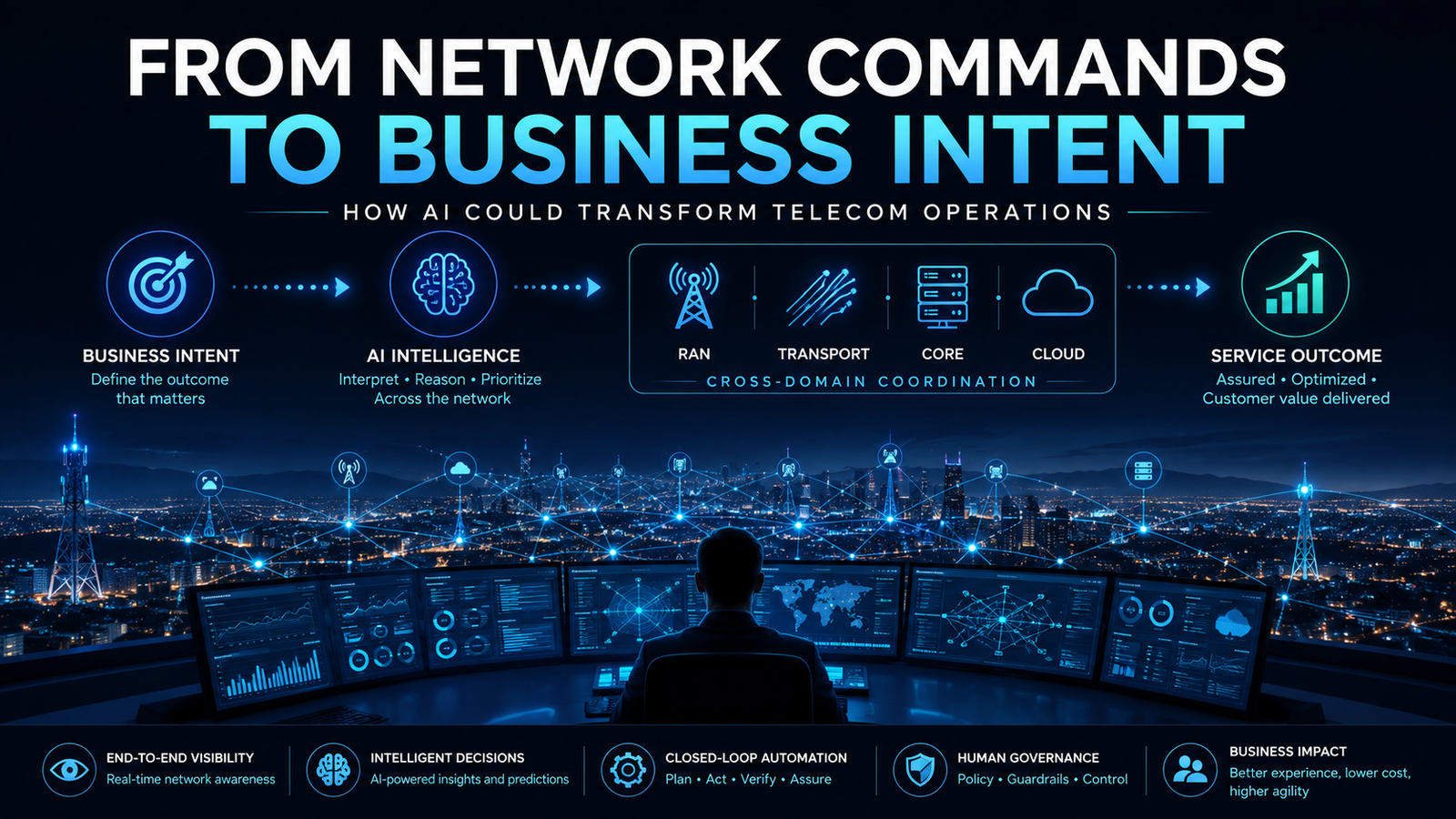
ONE INTENT → MULTIPLE DOMAINS → COORDINATED DECISIONS → ONE SERVICE OUTCOME
Customers experience a service—not a RAN, transport, core or cloud domain. Intent-driven operations must think the same way.
The Intent Closed Loop: From Business Goal to Continuous Assurance
Defining an intent is only the beginning.
The network must continuously compare what the business wants with what the network is actually delivering.
Using our event example, the loop could work like this:
UNDERSTAND — Interpret the requested outcome: maintain premium video experience.
TRANSLATE — Convert that outcome into measurable service and network objectives.
PLAN — Determine which RAN, transport, core or cloud actions could maintain those objectives.
VALIDATE — Check capacity, dependencies, policies and operational risk before making changes.
ACT — Execute only the actions permitted within defined governance boundaries.
ASSURE — Measure whether the service is actually meeting the original intent.
ADAPT — If conditions change, reassess the situation and adjust the plan.
This creates a continuous relationship between the desired business outcome and the real network state.
INTENT → UNDERSTAND → TRANSLATE → PLAN → VALIDATE → ACT → ASSURE → ADAPT
Intent-driven operations are not about executing one intelligent command. They are about continuously keeping the network aligned with the required outcome.
What Happens When Two Business Intents Conflict?
Real telecom networks rarely operate around a single objective.
Imagine the network is simultaneously given two valid intents:
Intent A: Maintain premium video experience during a major event.
Intent B: Keep network energy consumption within an efficiency target.
Under normal conditions, both may be achievable.
But during peak traffic, maintaining premium service quality may require activating additional capacity or cloud resources—exactly the opposite of what the energy-efficiency intent is trying to achieve.
Now the network faces something that a simple automation rule cannot easily solve:
Which intent has priority?
The answer should not be left to AI to invent.
Operators need policies that define business priority, service criticality, SLA commitments, risk limits and acceptable trade-offs.
For example:
Critical Service SLA → Higher Priority
Energy Optimization → Apply only when service objectives remain protected
This introduces an important principle:
AI can optimize the decision. The operator must define the boundaries of that decision.
Intent-driven autonomy requires more than intelligence. It requires clear rules for what matters most when business objectives compete.
Who Remains Accountable When the Network Makes the Decision?
Intent-driven operations introduce a different kind of operational responsibility.
Today, when an engineer changes a routing policy or modifies a network parameter, there is usually a clear chain:
Who requested the change → Who approved it → What was changed → When it was executed
An autonomous system needs the same level of accountability—possibly even more.
If AI translates a business intent into several cross-domain actions, the operator should still be able to answer:
Why was this action selected?
Which intent triggered it?
What evidence supported the decision?
Which policy allowed the action?
What changed in the network?
Did the action achieve the intended outcome?
This means governance cannot sit outside the intent-driven architecture.
It must be part of the decision loop itself.
For high-risk actions, the system may prepare the complete recommendation while requiring engineer approval.
For proven low-risk actions, execution may happen automatically—but with policy controls, audit trails, rollback mechanisms and post-action verification.
INTENT → DECISION → AUTHORIZATION → ACTION → EVIDENCE
Autonomy should not make network decisions less visible. It should make every decision more explainable, traceable and governable.
Is Intent-Driven Networking Already Becoming Real?
Yes—but the industry is still on the journey toward full intent-driven autonomy.
Intent-driven operations are now appearing in formal telecom frameworks and autonomous-network strategies rather than remaining only a research concept.
The ITU-T M.3043 framework addresses intent-driven telecom operations and management, providing a structured foundation for moving from operational goals toward intelligent network management.
At the same time, operators and vendors are increasingly connecting intent, AI, closed-loop automation and autonomous networks.
For example, e& and TM Forum announced a strategic autonomous-network blueprint in 2026 focused on AI-native, intent-driven and closed-loop operations as part of the journey toward higher levels of network autonomy.
This is important because it shows where the industry direction is heading:
Intent defines the desired outcome.
AI helps understand and reason about the network state.
Automation executes permitted actions.
Closed loops continuously verify whether the intent is being achieved.
Intent is becoming the bridge between what the business wants and what an autonomous network needs to do.
If Intent Is So Powerful, What Is Holding Telecom Networks Back?
The difficult part is making sure the network understands exactly what that statement means—and can safely translate it into the correct technical actions.
Several gaps appear immediately.
The network needs accurate end-to-end topology and service context.
Data from RAN, transport, core, cloud and service assurance must be connected rather than isolated.
The system must understand which actions are available, which policies restrict them and what dependencies could be affected.
It must also distinguish between:
What is technically possible
and
What is operationally safe.
Then comes an even harder problem.
Business language can be ambiguous.
“Provide the best customer experience” sounds reasonable to a person, but it is not precise enough for an autonomous network. What does best mean? Lowest latency? Highest throughput? Maximum availability? And at what cost?
Intent therefore needs a translation layer between human objectives and measurable network outcomes.
The real challenge is not expressing intent. It is translating intent into safe, measurable and conflict-free network behavior.
Before networks can act on human intent, they must learn how to remove ambiguity from it.
This is where the convergence becomes particularly interesting.
An intent tells the network what outcome is required.
But something still needs to determine:
What is happening now?
Why is the intent at risk?
Which network domains are involved?
What actions are available?
Which action is safest?
Did the action actually restore the required outcome?
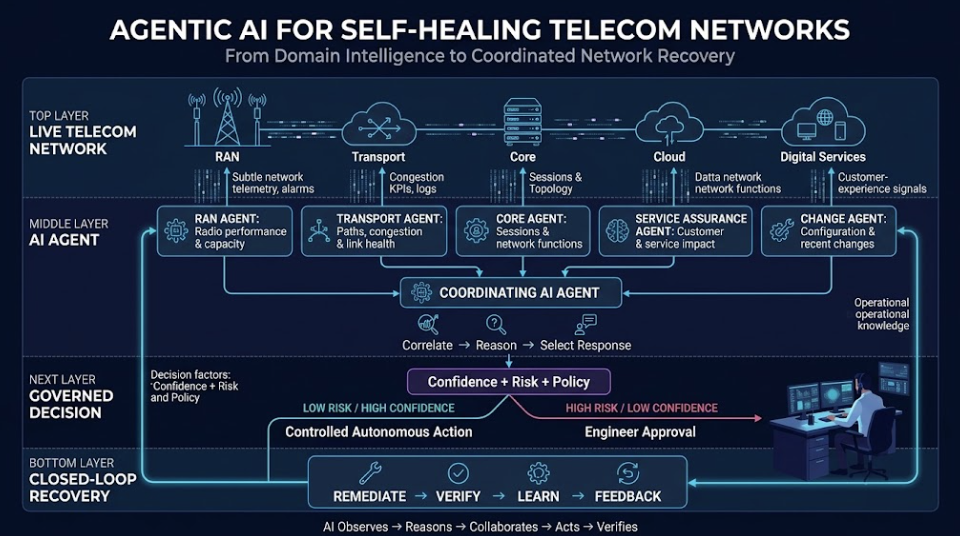
Agentic AI could provide part of this reasoning layer.
Imagine our premium video intent begins moving outside its required performance target.
A Service Assurance Agent identifies the experience degradation.
A RAN Agent checks congestion and radio conditions.
A Transport Agent evaluates capacity and path health.
A Core Agent checks session and user-plane performance.
A Change Agent determines whether a recent network change contributed to the problem.
A coordinating agent could combine these findings and propose the best cross-domain response—while governance policies determine what can be executed automatically and what requires approval.
The architecture starts to look like:
BUSINESS INTENT → AI AGENTS → CROSS-DOMAIN DECISION → GOVERNED ACTION → CONTINUOUS ASSURANCE
This connects several technologies that are often discussed separately:
Intent defines the outcome.
Agentic AI provides reasoning and coordination.
Digital Twin can help validate risky actions.
Automation executes approved changes.
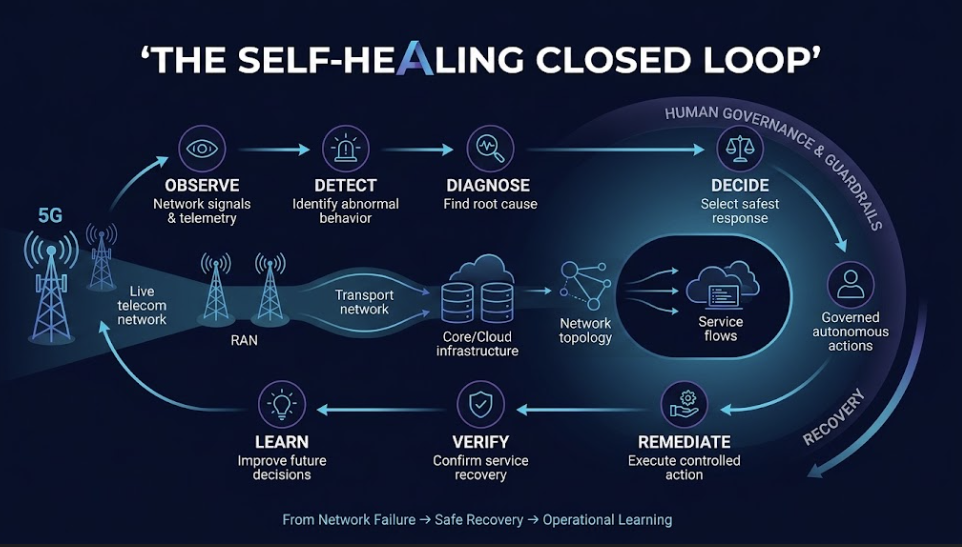
Self-healing closes the recovery loop.
Intent may tell the autonomous network where it needs to go. Agentic AI could help it reason about how to get there.

How Do You Start Intent-Driven Operations Without Transforming the Entire Network?
The wrong starting point would be:
“Let us make the network intent-driven.”
That ambition is too broad.
A better starting point is to select one service outcome that the business already understands and the network can already measure.
For example:
“Maintain enterprise customer latency within the agreed SLA.”
Now the operator has something concrete to work with.
The team can identify:
Which KPI proves the intent is being achieved?
Which RAN, transport, core or cloud resources influence that KPI?
Which network conditions could put the intent at risk?
Which corrective actions are already known and operationally proven?
Which actions can be automated safely?
Which decisions still require engineer approval?
This turns an abstract concept such as intent-driven networking into a specific operational use case that can be tested.
ONE SERVICE → ONE INTENT → MEASURABLE KPIs → CONTROLLED ACTIONS → PROVE THE OUTCOME
Do not start by making the network autonomous. Start by proving that one business intent can be translated, protected and continuously assured.
1. Translate the Business Intent Into Something the Network Can Measure
Start with the business statement:
“Maintain enterprise customer latency within the agreed SLA.”
That statement needs to become technically precise.
The operator must define:
Target: What latency level must be maintained?
Scope: Which customer, service, sites or geographic area does the intent cover?
Time: Is the requirement permanent or only during specific business hours?
Priority: How important is this intent compared with other network objectives?
Tolerance: How much deviation is acceptable before action is required?
Now the network has something it can continuously evaluate.
For example:
Business Intent
Maintain enterprise service performance within SLA.
↓
Measurable Objective
Latency ≤ agreed threshold for the defined service and scope.
↓
Trigger
Performance begins approaching or exceeding the allowed boundary.
This translation is critical because AI should not be expected to make autonomous decisions from vague business language.
Before the network can protect an intent, the intent must become measurable.
2. Identify What Can Influence the Intent
Once the intent is measurable, the next question is:
What parts of the network can actually cause that objective to succeed or fail?
For our enterprise latency example, the answer may cross several domains.
RAN — radio congestion, coverage conditions and scheduler performance.
Transport — path latency, packet loss, utilization and congestion.
Core — session handling, user-plane performance and network-function health.
Cloud / Edge — workload location, resource utilization and processing delay.
Service Assurance — the end-to-end experience actually being delivered to the customer.
This creates an intent dependency map.
Instead of monitoring hundreds of unrelated KPIs, the system begins understanding which network conditions are directly relevant to the business outcome.
For example:
Enterprise Latency Intent
↓
RAN + Transport + Core + Edge
↓
Relevant KPIs + Topology + Service Dependencies
↓
Possible Corrective Actions
This is where intent-driven operations become much more powerful than traditional threshold monitoring.
The network should not only know that an intent is at risk. It needs to know which dependencies can change the outcome.
3. Define the Action Boundaries Before Giving the Network Control
Knowing that an intent is at risk does not automatically mean the network should be allowed to change itself.
Suppose enterprise latency begins approaching the agreed limit.
Several actions might improve the situation:
Optimize traffic routing
Adjust QoS treatment
Move traffic to a healthier path
Scale cloud or edge resources
Modify selected network parameters
But these actions do not carry the same operational risk.
The operator therefore needs to define boundaries before automation begins:
Low-risk + proven action → Automatic execution
Medium-risk action → Execute only within approved conditions
High-risk or uncertain action → Engineer approval required
The system should also know when not to act.
If confidence is low, data is incomplete, another critical change is underway or two intents are conflicting, escalation may be safer than autonomous execution.
INTENT AT RISK → OPTIONS → RISK CHECK → AUTHORIZATION → ACTION
Intent tells the network what outcome matters. Governance determines how far the network may go to protect it.
4. Test the Decision Before Executing High-Risk Actions
Suppose the system concludes that changing the transport path could protect the enterprise latency intent.
The action may look correct—but one question remains:
What else could this change affect?
Moving traffic to another path could create congestion there. A QoS adjustment could affect another service. Scaling one resource may shift the bottleneck somewhere else.
For higher-risk decisions, the operator needs a validation layer before execution.
This is where a Network Digital Twin can become particularly valuable.
The proposed action could first be evaluated against a digital representation of the network to understand:
Will the alternative path have enough capacity?
Could another SLA be affected?
Does the action conflict with another active intent?
What happens if traffic increases further?
Can the change be safely reversed?
The Digital Twin does not need to make the final decision. Its role is to provide additional evidence before the live network is changed.
The more autonomous the decision, the more important it becomes to understand its consequences before execution.
5. Verify That the Business Intent Was Actually Achieved
The network action has been executed.
But intent-driven operations cannot stop there.
The system must return to the original question:
“Are we now delivering the outcome the business requested?”
For our enterprise service example, it should verify whether latency has returned within the agreed SLA—and whether the corrective action created any unintended impact elsewhere.
If the intent is satisfied:
Continue monitoring.
If the intent remains at risk:
Reassess → Generate another option → Validate → Act again
If the system cannot find a safe solution:
Escalate to the engineer with the evidence already collected.
This creates the real closed loop:
DEFINE INTENT → MEASURE → UNDERSTAND → DECIDE → VALIDATE → ACT → ASSURE → ADAPT ↻
The important difference is that success is no longer measured by whether a command executed successfully.
Success is measured by whether the business outcome was restored and maintained.
The network action is not the objective. The business outcome is.
Where Is the Business Value?
The value of intent-driven operations is not that engineers need to type fewer commands.
The bigger opportunity is reducing the operational distance between a business requirement and the network response needed to protect it.
Consider an enterprise SLA.
Today, protecting that SLA may require monitoring across several tools, identifying which domain is creating the degradation, coordinating multiple teams, deciding on corrective actions and then confirming whether service performance has recovered.
Intent-driven operations could compress that cycle.
Faster response — detect when a business outcome is moving toward risk before a major SLA breach occurs.
Cross-domain coordination — connect RAN, transport, core, cloud and service assurance around the same service objective.
Lower operational effort — reduce repetitive investigation and coordination for well-understood scenarios.
Better SLA protection — make network decisions based on service outcomes rather than isolated domain KPIs.
More scalable operations — manage increasing network complexity without requiring the same increase in manual coordination.
The ROI should therefore not be measured simply as:
“How many network changes did AI automate?”
A better question is:
“How much business impact did the network prevent by continuously protecting the required outcome?”
The strongest business case for intent-driven operations may be the value of protecting outcomes—not the number of tasks automated.
A Practical Way to Measure the Value
Take one enterprise service with a contractual SLA.
Instead of trying to calculate the value of the entire intent-driven platform, measure what happens around that one business outcome.
For example, track:
SLA breaches per year
Average duration of service degradation
Engineering hours required per incident
Escalation and customer-care effort
SLA penalties or service credits
Estimated revenue or customer-retention risk
Then compare today’s operating model with the intent-driven model.
Annual Benefit = Avoided SLA Impact + Reduced Engineering Effort + Reduced Escalation Cost + Avoided Service-Impact Cost
Then:
ROI (%) = (Annual Benefit − Annual Implementation Cost) ÷ Annual Implementation Cost × 100
But there is an important discipline here:
Do not build the business case around assumed AI savings.
Use actual historical incidents and ask:
“If this intent-driven closed loop had existed last year, which incidents could realistically have been detected earlier, prevented or resolved faster?”
That creates a much more credible investment case.
Start the ROI calculation with business impact already visible in your operational data—not with an AI savings assumption.
For decades, telecom operations have been organized largely around technology domains.
RAN teams manage radio.
Transport teams manage connectivity.
Core teams manage network functions and services.
Cloud teams manage infrastructure and workloads.
That structure will not disappear overnight.
But intent-driven operations introduce another operational view:
What business or service outcome are all these domains collectively trying to protect?
A future NOC dashboard may therefore show more than alarms and element health.
It could show:
Enterprise SLA Intent — Satisfied
Premium Video Experience — At Risk
Emergency Service Availability — Protected
Energy Efficiency Intent — Temporarily Relaxed
Engineers could then move from manually connecting hundreds of technical symptoms toward supervising how network intelligence is maintaining business and service outcomes across domains.
The skill set also evolves.
Understanding network architecture, service dependencies, automation policies, AI decisions, risk and business impact becomes increasingly important.
The future NOC may still monitor the network—but increasingly through the lens of the outcomes the network exists to deliver.
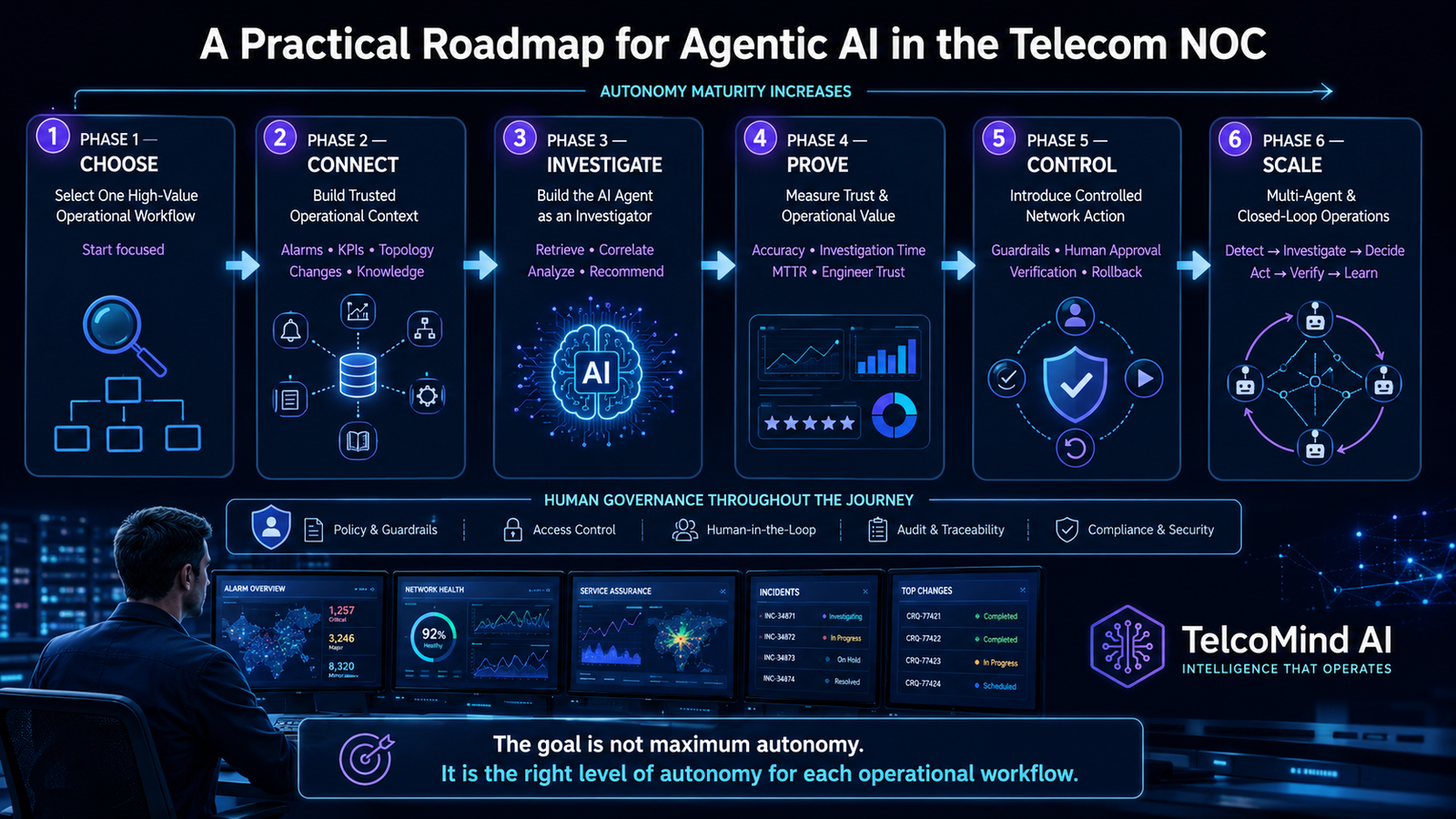
The Journey Should Be Gradual, Not a Jump to Full Autonomy
Intent-driven operations should not begin by giving AI unrestricted authority across the network.
The safer journey is progressive.
Start with intent visibility—define the business outcome and measure whether the network is achieving it.
Then move toward intent assurance—use AI to identify why an outcome is at risk and recommend corrective actions.
Next comes human-approved intent execution—the system proposes cross-domain actions, but engineers approve significant changes.
Only after repeated operational evidence should selected low-risk scenarios move toward governed autonomous execution.
The progression could look like:
Define Intent → Measure → Recommend → Human Approves → Controlled Automation → Governed Autonomy
Different services may deliberately stop at different stages.
A low-risk optimization use case may eventually operate autonomously, while a critical core-network or emergency-service intent may continue requiring human authorization.
The goal is not to give the network maximum autonomy. It is to give it the right autonomy for each business outcome.
From Managing the Network to Managing the Outcome
Telecom networks have spent decades becoming more programmable, automated and intelligent.
Intent-driven operations represent another important shift.
Instead of defining every command required to operate the network, we begin by defining what the network needs to achieve.
AI can help interpret the network state.
Agentic AI can help reason and coordinate across domains.
Digital Twins can help validate complex decisions.
Automation can execute approved actions.
Self-healing can restore services when conditions move away from the desired outcome.
But one principle remains essential:
The operator defines the objective, the priorities and the boundaries.
The technology determines how those objectives can be maintained safely and efficiently.
The evolution therefore looks less like:
Human → Command → Network
and increasingly like:
Human Defines Intent → AI Reasons → Network Acts → Service Is Assured → Human Governs
The autonomous network of the future may not wait for us to tell it every action to take. But we must become much better at telling it what outcomes truly matter.
DEFINE THE OUTCOME → TRANSLATE → REASON → VALIDATE → ACT → ASSURE → ADAPT
How Ready Is Your NOC for Intent-Driven Operations?
Moving toward intent-driven operations requires more than AI.
It depends on capabilities such as data and observability, automation, AIOps, decision intelligence, closed-loop operations and governance.
Before deciding where to introduce more autonomy, operators need to understand where their NOC stands today.
TelcoMind AI has created a free NOC AI Maturity Assessment to help telecom teams evaluate their current maturity and identify the capabilities they need to strengthen next.
→ Take the Free NOC AI Maturity Assessment
Related TelcoMind AI Insights
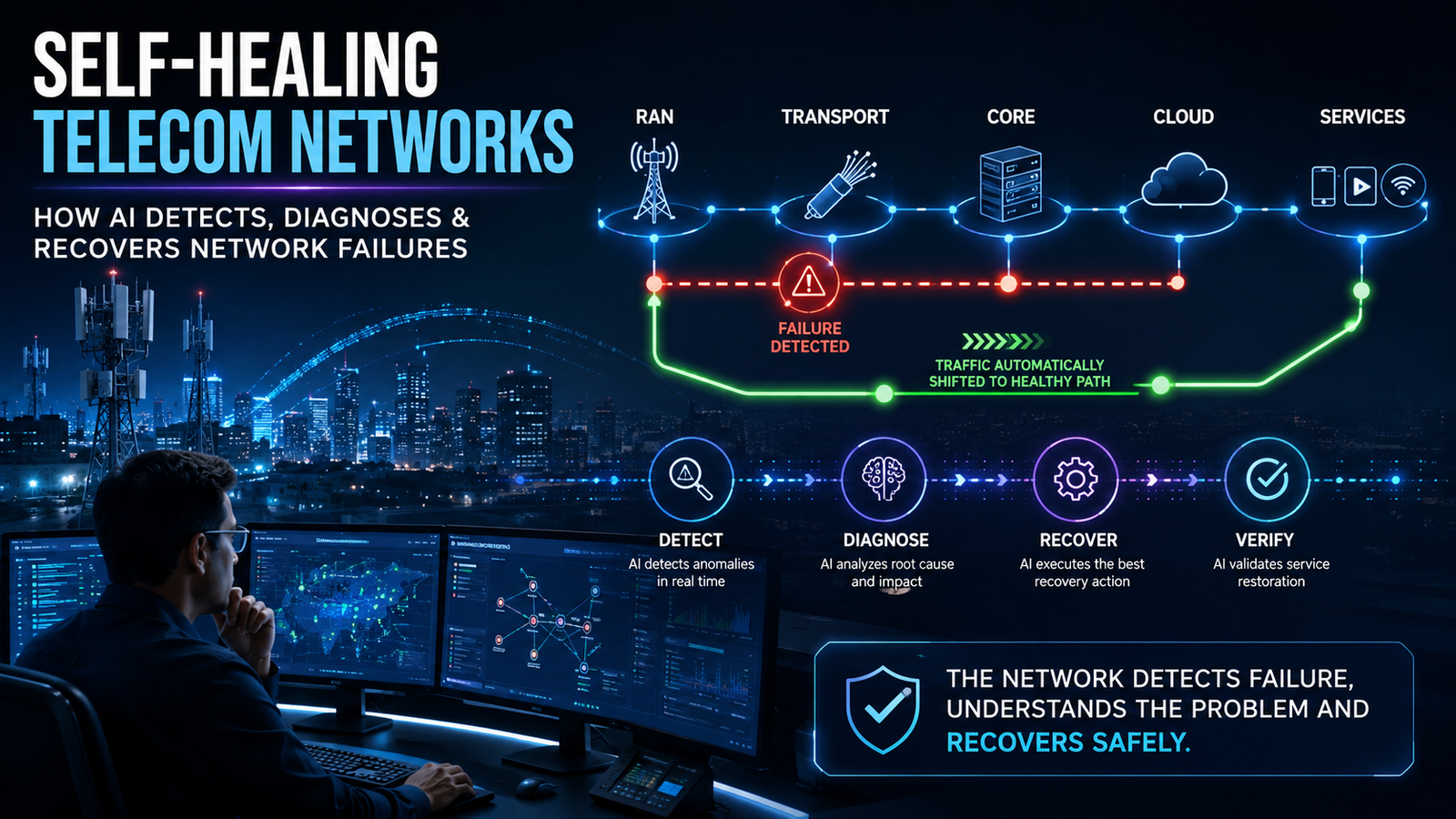
1. Self-Healing Telecom Networks: How AI Detects, Diagnoses and Recovers Network Failures
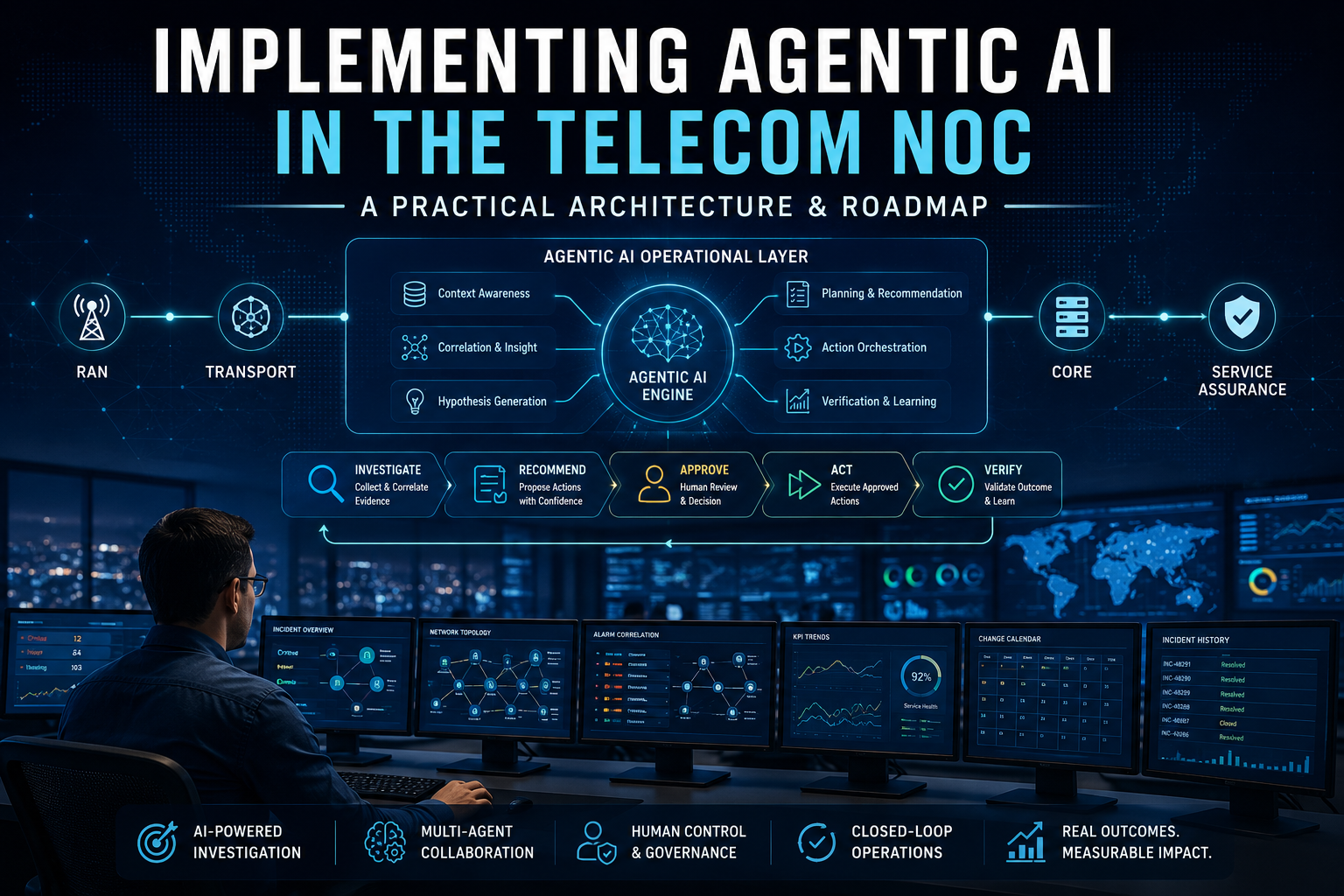
2. Agentic AI in Telecom Operations: From AI Assistance to Autonomous Action
3. From Level 0 to Level 5: How Close Are We to Truly Autonomous Telecom Networks?