Tag: Customer Experience

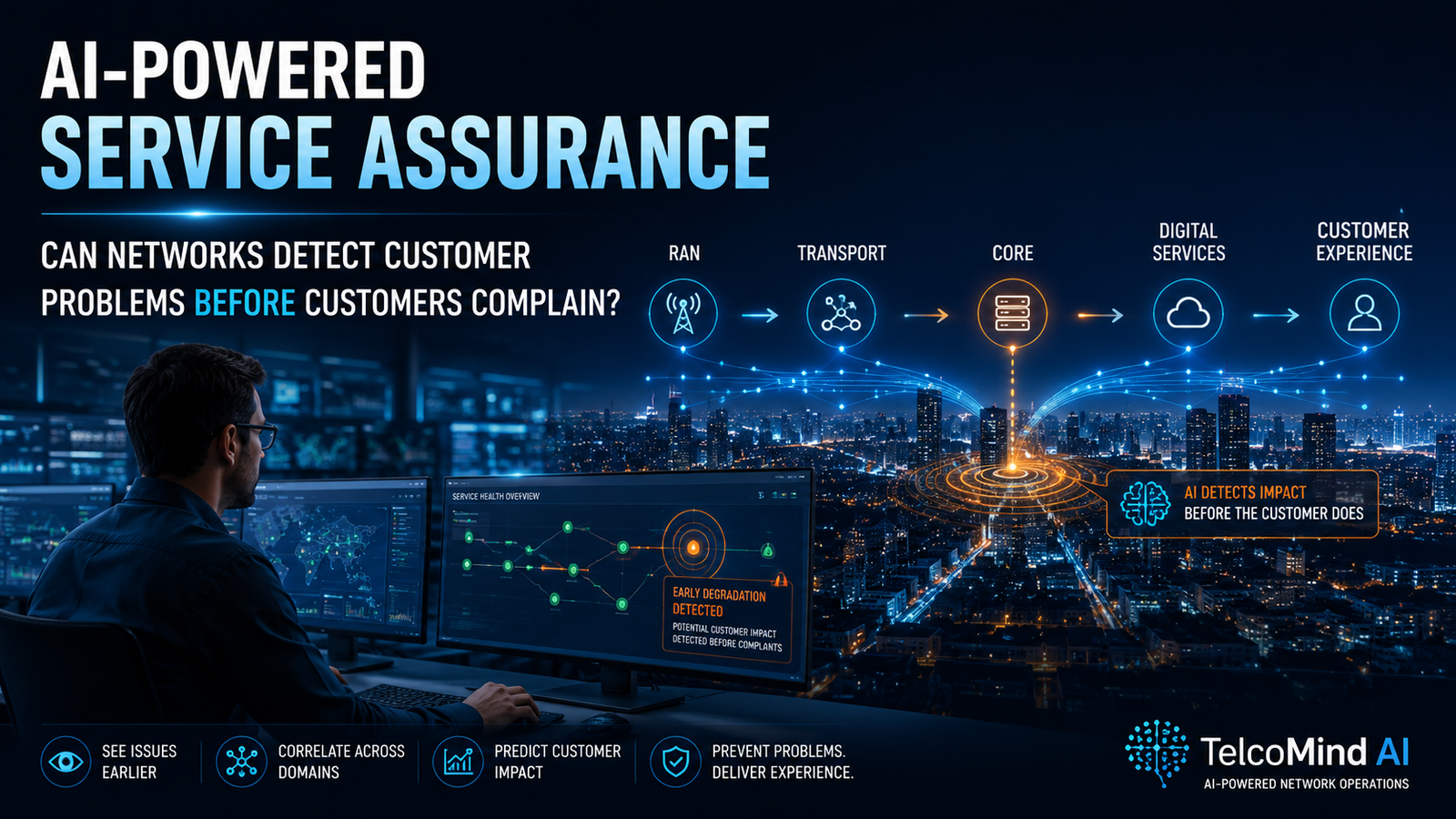
  • AI-Powered Service Assurance: Can Telecom Networks Detect Customer Problems Before Customers Complain?

    AI-Powered Service Assurance: Can Telecom Networks Detect Customer Problems Before Customers Complain?

    The Complaint That the Network Couldn’t See

    A customer walks into a telecom operator’s service center with a simple complaint:

    “My internet has been terrible every evening this week.”

    The customer-care agent checks the account.

    The subscription is active. There is no reported outage in the area. Coverage appears normal. Nothing obvious explains the problem.

    A ticket is opened.

    Later, the case reaches the network operations team.

    The engineer checks the serving cells.

    Availability? Normal.

    Traffic? High, but within expected range.

    Major alarms? None.

    Accessibility and retainability? Within thresholds.

    From the traditional network view, there is no clear incident to investigate.

    But the customer is not imagining the problem.

    When the data is examined more deeply, a different picture begins to appear.

    Every evening, traffic gradually increases across a cluster of cells. Radio conditions remain acceptable, but user throughput starts falling. Latency begins to rise. Retransmissions increase. A transport link serving the area approaches congestion during short periods.

    No single KPI crosses the threshold required to generate a major alarm.

    Yet together, these small changes are creating a very real service degradation.

    And there is an even bigger problem:

    This customer may not be the only one experiencing it.

    There could already be hundreds—or thousands—of subscribers in the same area receiving degraded service.

    The network has the data.

    The monitoring systems have the KPIs.

    The NOC has the dashboards.

    But nobody has yet connected all those signals into one simple conclusion:

    Customer experience is deteriorating here.

    Now imagine a different scenario.

    Before the first complaint arrives, an AI-powered assurance platform detects the unusual combination of declining throughput, increasing latency, changing traffic patterns and transport utilization.

    It compares the behavior with historical patterns.

    It identifies the affected location and services.

    It estimates the potential customer impact.

    And instead of waiting for a traditional alarm, it alerts operations:

    “Emerging service degradation detected. Customer impact likely. Investigation recommended.”

    The operational model has now changed.

    Customer complains → Ticket created → Network investigates

    becomes:

    Network detects → AI correlates → Customer impact predicted → Operations act

    That is the real opportunity behind AI-powered service assurance.

    It is not simply about creating smarter dashboards.

    It is about giving the network the intelligence to recognize when technical changes are becoming customer problems—before customers have to tell us.

    The Signals Were There — Just Not Connected

    When the operations team looks deeper, the picture begins to change. During the evening busy hour, traffic gradually increases across a cluster of cells. User throughput starts falling. Latency begins to rise. Retransmissions increase, while a transport link serving the area periodically approaches congestion.

    Individually, none of these changes appears serious enough to trigger a major incident. Together, however, they tell a completely different story.

    The network is technically available — but the service experience is deteriorating. And the customer who complained may represent only a small fraction of the people actually affected.

    The network had the data. The monitoring systems had the KPIs. What was missing was the intelligence to connect them.

    What If the Network Could See the Problem First?

    Now imagine the same situation unfolding differently. Before the first customer complaint arrives, an AI-powered assurance platform begins detecting subtle changes across multiple parts of the network.

    Instead of Watching One KPI, AI Connects the Signals

    The system observes declining user throughput, increasing latency, changing traffic patterns, retransmissions and rising transport utilization. Individually, these signals may not justify an alarm. But AI can correlate them across RAN, Transport, Core and service-level data, compare them with historical behavior, and recognize that something unusual is developing. The important difference is timing. Operations no longer need to wait for a major alarm or a growing number of customer complaints before starting the investigation. The network begins identifying customer-impacting degradation before the customer has to report it.

    CapabilityTraditional AssuranceAI-Powered Assurance
    DetectionThreshold-basedPattern & anomaly-based
    Data ViewIndividual KPIs & domainsCross-domain correlation
    Customer ImpactOften identified after degradationPredicted before wider impact
    OperationsReactive investigationProactive intervention
    Decision SupportEngineer interprets multiple toolsAI provides context & recommendations

    One Customer Complaint. Three Network Domains.

    Consider a customer experiencing poor video performance during the evening busy hour.

    What does the network see?

    RAN: User throughput is gradually declining as cell utilization increases. Transport: Packet latency and utilization are increasing on the aggregation path. Core: Sessions remain established and the service is technically available.

    Individually, none of these domains may show a major failure. Together, they may explain exactly why the customer experience is deteriorating.

    When Separate Network Signals Become One Service Story

    RAN Signals + Transport Signals + Core Signals

    AI Correlation & Service Intelligence

    Affected Customers & Services Identified

    Probable Cause + Recommended Action

    Instead of asking engineers to manually move between multiple monitoring systems and piece together the service impact, AI can bring the signals into a single operational context.

    The Problem Can Start Before the Alarm

    Traditional thresholds are useful, but customer experience can begin deteriorating long before a KPI reaches the point that triggers a major alarm.

    Illustrative view of the AI opportunity window between emerging customer-experience degradation and a traditional threshold-based alarm.

    When Everything Is “Within Threshold” — But the Service Is Not

    Consider an evening busy-hour scenario in a dense urban area.

    Network LayerWhat the NOC SeesIndividual ViewCustomer Reality
    RANCell utilization rising; user throughput decliningStill within operational thresholdSlower data experience begins
    TransportLatency and utilization gradually increasingNo major alarmVideo/application response deteriorates
    CoreSessions established normallyService appears availableCustomer remains connected but experience is poor
    AI AssuranceCorrelates RAN + Transport + Core behaviorCross-domain pattern identifiedEmerging customer impact detected

    The AI Has Detected the Risk. Should It Act?

    Detecting potential customer impact is only half the challenge. The next question is more difficult: how much authority should the AI actually have?

    The assurance platform now estimates a high probability of customer degradation and identifies congestion developing across the service path. It recommends traffic optimization before the condition becomes critical. Technically, the network could execute the action automatically. But should it?

    If the recommended action affects a limited, low-risk part of the network and the AI has seen the same pattern many times before, controlled automation may be appropriate.

    But if the action could influence a wider customer base, critical services or multiple network domains, the recommendation should reach an experienced engineer with the evidence behind it — what changed, what customers may be affected, why the AI reached its conclusion and what could happen if the action is taken.

    The goal is not AI making every decision. The goal is AI helping operations make the right decision earlier.

    From Prediction to Action: How Much Autonomy Is Enough?

    As AI confidence improves, service assurance can gradually move from simply detecting problems to recommending—and eventually executing—controlled actions.

    As AI-powered service assurance becomes more mature, its role can gradually move beyond detecting degradation. The system may first identify an unusual pattern, then estimate which customers and services could be affected, recommend an operational response and eventually execute proven low-risk actions automatically. But this progression should not mean removing human control. Higher-risk decisions — especially those affecting critical services, large customer populations or multiple network domains — should continue to involve experienced engineers. The real objective is therefore not maximum automation, but the right level of autonomy for the right operational decision.

    Detect → Understand → Recommend → Act → Verify

    So, Can Telecom Networks Really Detect Problems Before Customers Complain?

    Increasingly, yes — but not perfectly, and not in every situation.Telecom networks already generate many of the signals needed to identify emerging service degradation. The bigger challenge is bringing those signals together across network domains, understanding their relationship to customer experience and separating meaningful patterns from normal network variation.

    AI can make that process faster and more predictive. It can recognize combinations of weak signals that may be difficult to identify through static thresholds alone, estimate potential service impact and give operations teams an earlier opportunity to intervene.

    The real transformation is not from alarms to more intelligent alarms. It is from monitoring network health to protecting service experience.

    The Future NOC May Know Before the Customer Does

    The future of telecom operations may not be defined by how quickly the NOC responds to a customer-impacting incident, but by how often that incident can be identified before the customer ever needs to report it.

    Imagine a service-assurance environment continuously observing signals across RAN, Transport, Core and digital services. AI detects an emerging pattern, estimates the likely customer impact, identifies the probable contributing domains and gives the operations team an actionable recommendation — while the service is still functioning.

    For repetitive and well-understood scenarios, controlled automation could take the next step: execute the approved action, verify whether service performance has recovered and learn from the outcome.

    The best customer complaint may eventually be the one that never needs to happen.

    That is where AI-powered service assurance becomes more than another monitoring capability. It becomes a bridge between network intelligence, customer experience and increasingly autonomous operations — with experienced engineers providing the judgement, governance and control needed when the network situation demands it.

    How Ready Is Your NOC for AI-Powered Operations?

    Moving from reactive monitoring toward predictive and intelligent operations requires more than AI technology. It requires the right data, observability, automation, operational processes and governance.

    TelcoMind AI has developed a practical AI-Ready NOC Maturity Assessment to help telecom professionals evaluate where their operations stand today and identify the capabilities that may need further development.

    Assess your NOC across 8 dimensions and 32 operational areas — from Data & Observability to Closed-Loop Operations and Governance.

    Take the Free NOC AI Maturity Assessment →

    Continue Exploring Telecom AI

    From Reactive NOC to Predictive Operations: How AI Is Changing Telecom Network ManagementAI-Powered AIOps in Telecom:

    From Alarm Management to Autonomous Network Operations

    From Level 0 to Level 5: How Close Are We to Truly Autonomous Telecom Networks?

  • AI-Powered Service Assurance: Can Telecom Networks Detect Customer Problems Before Customers Complain?

    AI-Powered Service Assurance: Can Telecom Networks Detect Customer Problems Before Customers Complain?

    The Complaint That the Network Couldn’t See

    A customer walks into a telecom operator’s service center with a simple complaint:

    “My internet has been terrible every evening this week.”

    The customer-care agent checks the account.

    The subscription is active. There is no reported outage in the area. Coverage appears normal. Nothing obvious explains the problem.

    A ticket is opened.

    Later, the case reaches the network operations team.

    The engineer checks the serving cells.

    Availability? Normal.

    Traffic? High, but within expected range.

    Major alarms? None.

    Accessibility and retainability? Within thresholds.

    From the traditional network view, there is no clear incident to investigate.

    But the customer is not imagining the problem.

    When the data is examined more deeply, a different picture begins to appear.

    Every evening, traffic gradually increases across a cluster of cells. Radio conditions remain acceptable, but user throughput starts falling. Latency begins to rise. Retransmissions increase. A transport link serving the area approaches congestion during short periods.

    No single KPI crosses the threshold required to generate a major alarm.

    Yet together, these small changes are creating a very real service degradation.

    And there is an even bigger problem:

    This customer may not be the only one experiencing it.

    There could already be hundreds—or thousands—of subscribers in the same area receiving degraded service.

    The network has the data.

    The monitoring systems have the KPIs.

    The NOC has the dashboards.

    But nobody has yet connected all those signals into one simple conclusion:

    Customer experience is deteriorating here.

    Now imagine a different scenario.

    Before the first complaint arrives, an AI-powered assurance platform detects the unusual combination of declining throughput, increasing latency, changing traffic patterns and transport utilization.

    It compares the behavior with historical patterns.

    It identifies the affected location and services.

    It estimates the potential customer impact.

    And instead of waiting for a traditional alarm, it alerts operations:

    “Emerging service degradation detected. Customer impact likely. Investigation recommended.”

    The operational model has now changed.

    Customer complains → Ticket created → Network investigates

    becomes:

    Network detects → AI correlates → Customer impact predicted → Operations act

    That is the real opportunity behind AI-powered service assurance.

    It is not simply about creating smarter dashboards.

    It is about giving the network the intelligence to recognize when technical changes are becoming customer problems—before customers have to tell us.

    The Signals Were There — Just Not Connected

    When the operations team looks deeper, the picture begins to change. During the evening busy hour, traffic gradually increases across a cluster of cells. User throughput starts falling. Latency begins to rise. Retransmissions increase, while a transport link serving the area periodically approaches congestion.

    Individually, none of these changes appears serious enough to trigger a major incident. Together, however, they tell a completely different story.

    The network is technically available — but the service experience is deteriorating. And the customer who complained may represent only a small fraction of the people actually affected.

    The network had the data. The monitoring systems had the KPIs. What was missing was the intelligence to connect them.

    What If the Network Could See the Problem First?

    Now imagine the same situation unfolding differently. Before the first customer complaint arrives, an AI-powered assurance platform begins detecting subtle changes across multiple parts of the network.

    Instead of Watching One KPI, AI Connects the Signals

    The system observes declining user throughput, increasing latency, changing traffic patterns, retransmissions and rising transport utilization. Individually, these signals may not justify an alarm. But AI can correlate them across RAN, Transport, Core and service-level data, compare them with historical behavior, and recognize that something unusual is developing. The important difference is timing. Operations no longer need to wait for a major alarm or a growing number of customer complaints before starting the investigation. The network begins identifying customer-impacting degradation before the customer has to report it.

    CapabilityTraditional AssuranceAI-Powered Assurance
    DetectionThreshold-basedPattern & anomaly-based
    Data ViewIndividual KPIs & domainsCross-domain correlation
    Customer ImpactOften identified after degradationPredicted before wider impact
    OperationsReactive investigationProactive intervention
    Decision SupportEngineer interprets multiple toolsAI provides context & recommendations

    One Customer Complaint. Three Network Domains.

    Consider a customer experiencing poor video performance during the evening busy hour.

    What does the network see?

    RAN: User throughput is gradually declining as cell utilization increases. Transport: Packet latency and utilization are increasing on the aggregation path. Core: Sessions remain established and the service is technically available.

    Individually, none of these domains may show a major failure. Together, they may explain exactly why the customer experience is deteriorating.

    When Separate Network Signals Become One Service Story

    RAN Signals + Transport Signals + Core Signals

    AI Correlation & Service Intelligence

    Affected Customers & Services Identified

    Probable Cause + Recommended Action

    Instead of asking engineers to manually move between multiple monitoring systems and piece together the service impact, AI can bring the signals into a single operational context.

    The Problem Can Start Before the Alarm

    Traditional thresholds are useful, but customer experience can begin deteriorating long before a KPI reaches the point that triggers a major alarm.

    Illustrative view of the AI opportunity window between emerging customer-experience degradation and a traditional threshold-based alarm.

    When Everything Is “Within Threshold” — But the Service Is Not

    Consider an evening busy-hour scenario in a dense urban area.

    Network LayerWhat the NOC SeesIndividual ViewCustomer Reality
    RANCell utilization rising; user throughput decliningStill within operational thresholdSlower data experience begins
    TransportLatency and utilization gradually increasingNo major alarmVideo/application response deteriorates
    CoreSessions established normallyService appears availableCustomer remains connected but experience is poor
    AI AssuranceCorrelates RAN + Transport + Core behaviorCross-domain pattern identifiedEmerging customer impact detected

    The AI Has Detected the Risk. Should It Act?

    Detecting potential customer impact is only half the challenge. The next question is more difficult: how much authority should the AI actually have?

    The assurance platform now estimates a high probability of customer degradation and identifies congestion developing across the service path. It recommends traffic optimization before the condition becomes critical. Technically, the network could execute the action automatically. But should it?

    If the recommended action affects a limited, low-risk part of the network and the AI has seen the same pattern many times before, controlled automation may be appropriate.

    But if the action could influence a wider customer base, critical services or multiple network domains, the recommendation should reach an experienced engineer with the evidence behind it — what changed, what customers may be affected, why the AI reached its conclusion and what could happen if the action is taken.

    The goal is not AI making every decision. The goal is AI helping operations make the right decision earlier.

    From Prediction to Action: How Much Autonomy Is Enough?

    As AI confidence improves, service assurance can gradually move from simply detecting problems to recommending—and eventually executing—controlled actions.

    As AI-powered service assurance becomes more mature, its role can gradually move beyond detecting degradation. The system may first identify an unusual pattern, then estimate which customers and services could be affected, recommend an operational response and eventually execute proven low-risk actions automatically. But this progression should not mean removing human control. Higher-risk decisions — especially those affecting critical services, large customer populations or multiple network domains — should continue to involve experienced engineers. The real objective is therefore not maximum automation, but the right level of autonomy for the right operational decision.

    Detect → Understand → Recommend → Act → Verify

    So, Can Telecom Networks Really Detect Problems Before Customers Complain?

    Increasingly, yes — but not perfectly, and not in every situation.Telecom networks already generate many of the signals needed to identify emerging service degradation. The bigger challenge is bringing those signals together across network domains, understanding their relationship to customer experience and separating meaningful patterns from normal network variation.

    AI can make that process faster and more predictive. It can recognize combinations of weak signals that may be difficult to identify through static thresholds alone, estimate potential service impact and give operations teams an earlier opportunity to intervene.

    The real transformation is not from alarms to more intelligent alarms. It is from monitoring network health to protecting service experience.

    The Future NOC May Know Before the Customer Does

    The future of telecom operations may not be defined by how quickly the NOC responds to a customer-impacting incident, but by how often that incident can be identified before the customer ever needs to report it.

    Imagine a service-assurance environment continuously observing signals across RAN, Transport, Core and digital services. AI detects an emerging pattern, estimates the likely customer impact, identifies the probable contributing domains and gives the operations team an actionable recommendation — while the service is still functioning.

    For repetitive and well-understood scenarios, controlled automation could take the next step: execute the approved action, verify whether service performance has recovered and learn from the outcome.

    The best customer complaint may eventually be the one that never needs to happen.

    That is where AI-powered service assurance becomes more than another monitoring capability. It becomes a bridge between network intelligence, customer experience and increasingly autonomous operations — with experienced engineers providing the judgement, governance and control needed when the network situation demands it.

    How Ready Is Your NOC for AI-Powered Operations?

    Moving from reactive monitoring toward predictive and intelligent operations requires more than AI technology. It requires the right data, observability, automation, operational processes and governance.

    TelcoMind AI has developed a practical AI-Ready NOC Maturity Assessment to help telecom professionals evaluate where their operations stand today and identify the capabilities that may need further development.

    Assess your NOC across 8 dimensions and 32 operational areas — from Data & Observability to Closed-Loop Operations and Governance.

    Take the Free NOC AI Maturity Assessment →

    Continue Exploring Telecom AI

    From Reactive NOC to Predictive Operations: How AI Is Changing Telecom Network ManagementAI-Powered AIOps in Telecom:

    From Alarm Management to Autonomous Network Operations

    From Level 0 to Level 5: How Close Are We to Truly Autonomous Telecom Networks?

  • AI-Powered Service Assurance: Can Telecom Networks Detect Customer Problems Before Customers Complain?

    AI-Powered Service Assurance: Can Telecom Networks Detect Customer Problems Before Customers Complain?

    The Complaint That the Network Couldn’t See

    A customer walks into a telecom operator’s service center with a simple complaint:

    “My internet has been terrible every evening this week.”

    The customer-care agent checks the account.

    The subscription is active. There is no reported outage in the area. Coverage appears normal. Nothing obvious explains the problem.

    A ticket is opened.

    Later, the case reaches the network operations team.

    The engineer checks the serving cells.

    Availability? Normal.

    Traffic? High, but within expected range.

    Major alarms? None.

    Accessibility and retainability? Within thresholds.

    From the traditional network view, there is no clear incident to investigate.

    But the customer is not imagining the problem.

    When the data is examined more deeply, a different picture begins to appear.

    Every evening, traffic gradually increases across a cluster of cells. Radio conditions remain acceptable, but user throughput starts falling. Latency begins to rise. Retransmissions increase. A transport link serving the area approaches congestion during short periods.

    No single KPI crosses the threshold required to generate a major alarm.

    Yet together, these small changes are creating a very real service degradation.

    And there is an even bigger problem:

    This customer may not be the only one experiencing it.

    There could already be hundreds—or thousands—of subscribers in the same area receiving degraded service.

    The network has the data.

    The monitoring systems have the KPIs.

    The NOC has the dashboards.

    But nobody has yet connected all those signals into one simple conclusion:

    Customer experience is deteriorating here.

    Now imagine a different scenario.

    Before the first complaint arrives, an AI-powered assurance platform detects the unusual combination of declining throughput, increasing latency, changing traffic patterns and transport utilization.

    It compares the behavior with historical patterns.

    It identifies the affected location and services.

    It estimates the potential customer impact.

    And instead of waiting for a traditional alarm, it alerts operations:

    “Emerging service degradation detected. Customer impact likely. Investigation recommended.”

    The operational model has now changed.

    Customer complains → Ticket created → Network investigates

    becomes:

    Network detects → AI correlates → Customer impact predicted → Operations act

    That is the real opportunity behind AI-powered service assurance.

    It is not simply about creating smarter dashboards.

    It is about giving the network the intelligence to recognize when technical changes are becoming customer problems—before customers have to tell us.

    The Signals Were There — Just Not Connected

    When the operations team looks deeper, the picture begins to change. During the evening busy hour, traffic gradually increases across a cluster of cells. User throughput starts falling. Latency begins to rise. Retransmissions increase, while a transport link serving the area periodically approaches congestion.

    Individually, none of these changes appears serious enough to trigger a major incident. Together, however, they tell a completely different story.

    The network is technically available — but the service experience is deteriorating. And the customer who complained may represent only a small fraction of the people actually affected.

    The network had the data. The monitoring systems had the KPIs. What was missing was the intelligence to connect them.

    What If the Network Could See the Problem First?

    Now imagine the same situation unfolding differently. Before the first customer complaint arrives, an AI-powered assurance platform begins detecting subtle changes across multiple parts of the network.

    Instead of Watching One KPI, AI Connects the Signals

    The system observes declining user throughput, increasing latency, changing traffic patterns, retransmissions and rising transport utilization. Individually, these signals may not justify an alarm. But AI can correlate them across RAN, Transport, Core and service-level data, compare them with historical behavior, and recognize that something unusual is developing. The important difference is timing. Operations no longer need to wait for a major alarm or a growing number of customer complaints before starting the investigation. The network begins identifying customer-impacting degradation before the customer has to report it.

    CapabilityTraditional AssuranceAI-Powered Assurance
    DetectionThreshold-basedPattern & anomaly-based
    Data ViewIndividual KPIs & domainsCross-domain correlation
    Customer ImpactOften identified after degradationPredicted before wider impact
    OperationsReactive investigationProactive intervention
    Decision SupportEngineer interprets multiple toolsAI provides context & recommendations

    One Customer Complaint. Three Network Domains.

    Consider a customer experiencing poor video performance during the evening busy hour.

    What does the network see?

    RAN: User throughput is gradually declining as cell utilization increases. Transport: Packet latency and utilization are increasing on the aggregation path. Core: Sessions remain established and the service is technically available.

    Individually, none of these domains may show a major failure. Together, they may explain exactly why the customer experience is deteriorating.

    When Separate Network Signals Become One Service Story

    RAN Signals + Transport Signals + Core Signals

    AI Correlation & Service Intelligence

    Affected Customers & Services Identified

    Probable Cause + Recommended Action

    Instead of asking engineers to manually move between multiple monitoring systems and piece together the service impact, AI can bring the signals into a single operational context.

    The Problem Can Start Before the Alarm

    Traditional thresholds are useful, but customer experience can begin deteriorating long before a KPI reaches the point that triggers a major alarm.

    Illustrative view of the AI opportunity window between emerging customer-experience degradation and a traditional threshold-based alarm.

    When Everything Is “Within Threshold” — But the Service Is Not

    Consider an evening busy-hour scenario in a dense urban area.

    Network LayerWhat the NOC SeesIndividual ViewCustomer Reality
    RANCell utilization rising; user throughput decliningStill within operational thresholdSlower data experience begins
    TransportLatency and utilization gradually increasingNo major alarmVideo/application response deteriorates
    CoreSessions established normallyService appears availableCustomer remains connected but experience is poor
    AI AssuranceCorrelates RAN + Transport + Core behaviorCross-domain pattern identifiedEmerging customer impact detected

    The AI Has Detected the Risk. Should It Act?

    Detecting potential customer impact is only half the challenge. The next question is more difficult: how much authority should the AI actually have?

    The assurance platform now estimates a high probability of customer degradation and identifies congestion developing across the service path. It recommends traffic optimization before the condition becomes critical. Technically, the network could execute the action automatically. But should it?

    If the recommended action affects a limited, low-risk part of the network and the AI has seen the same pattern many times before, controlled automation may be appropriate.

    But if the action could influence a wider customer base, critical services or multiple network domains, the recommendation should reach an experienced engineer with the evidence behind it — what changed, what customers may be affected, why the AI reached its conclusion and what could happen if the action is taken.

    The goal is not AI making every decision. The goal is AI helping operations make the right decision earlier.

    From Prediction to Action: How Much Autonomy Is Enough?

    As AI confidence improves, service assurance can gradually move from simply detecting problems to recommending—and eventually executing—controlled actions.

    As AI-powered service assurance becomes more mature, its role can gradually move beyond detecting degradation. The system may first identify an unusual pattern, then estimate which customers and services could be affected, recommend an operational response and eventually execute proven low-risk actions automatically. But this progression should not mean removing human control. Higher-risk decisions — especially those affecting critical services, large customer populations or multiple network domains — should continue to involve experienced engineers. The real objective is therefore not maximum automation, but the right level of autonomy for the right operational decision.

    Detect → Understand → Recommend → Act → Verify

    So, Can Telecom Networks Really Detect Problems Before Customers Complain?

    Increasingly, yes — but not perfectly, and not in every situation.Telecom networks already generate many of the signals needed to identify emerging service degradation. The bigger challenge is bringing those signals together across network domains, understanding their relationship to customer experience and separating meaningful patterns from normal network variation.

    AI can make that process faster and more predictive. It can recognize combinations of weak signals that may be difficult to identify through static thresholds alone, estimate potential service impact and give operations teams an earlier opportunity to intervene.

    The real transformation is not from alarms to more intelligent alarms. It is from monitoring network health to protecting service experience.

    The Future NOC May Know Before the Customer Does

    The future of telecom operations may not be defined by how quickly the NOC responds to a customer-impacting incident, but by how often that incident can be identified before the customer ever needs to report it.

    Imagine a service-assurance environment continuously observing signals across RAN, Transport, Core and digital services. AI detects an emerging pattern, estimates the likely customer impact, identifies the probable contributing domains and gives the operations team an actionable recommendation — while the service is still functioning.

    For repetitive and well-understood scenarios, controlled automation could take the next step: execute the approved action, verify whether service performance has recovered and learn from the outcome.

    The best customer complaint may eventually be the one that never needs to happen.

    That is where AI-powered service assurance becomes more than another monitoring capability. It becomes a bridge between network intelligence, customer experience and increasingly autonomous operations — with experienced engineers providing the judgement, governance and control needed when the network situation demands it.

    How Ready Is Your NOC for AI-Powered Operations?

    Moving from reactive monitoring toward predictive and intelligent operations requires more than AI technology. It requires the right data, observability, automation, operational processes and governance.

    TelcoMind AI has developed a practical AI-Ready NOC Maturity Assessment to help telecom professionals evaluate where their operations stand today and identify the capabilities that may need further development.

    Assess your NOC across 8 dimensions and 32 operational areas — from Data & Observability to Closed-Loop Operations and Governance.

    Take the Free NOC AI Maturity Assessment →

    Continue Exploring Telecom AI

    From Reactive NOC to Predictive Operations: How AI Is Changing Telecom Network ManagementAI-Powered AIOps in Telecom:

    From Alarm Management to Autonomous Network Operations

    From Level 0 to Level 5: How Close Are We to Truly Autonomous Telecom Networks?