Tag: Multi-Agent AI

  • How to Implement Agentic AI in a Telecom NOC: A Practical Architecture and Roadmap

    How to Implement Agentic AI in a Telecom NOC: A Practical Architecture and Roadmap

    The Real Question Is No Longer “What Can AI Do?”

    Imagine a regional network begins degrading. Nothing has completely failed yet.

    Customer-experience indicators start moving in the wrong direction. A group of sites shows intermittent accessibility degradation. Packet loss appears on part of the transport network. A few alarms are active, but none individually explains the problem.

    The NOC engineer begins investigating.

    First, the alarm-management system. Then performance monitoring. Then topology. Then transmission. Then IP. Then recent network changes. Then previous incidents. Each system contains part of the answer. But the engineer has to connect everything manually.

    Eventually, the team discovers that the symptoms share an upstream dependency and that a configuration change earlier in the day altered the traffic path.

    The experienced engineer can solve the problem.

    The problem is the time and effort required to assemble the evidence.

    Now imagine a different operating model.

    The engineer asks:

    “Investigate the degradation affecting these sites and identify the most probable cause.”

    An AI agent starts working.

    It retrieves the affected alarms, analyzes the KPI deterioration, checks network topology, identifies common dependencies, reviews recent configuration changes, and searches previous incidents with similar symptoms.

    Instead of giving the engineer another dashboard to investigate, the agent brings the evidence together and presents a probable root cause, affected services, supporting evidence, recommended action, and confidence level.

    The engineer reviews the evidence and decides whether the proposed action should proceed.

    This is the important shift:

    AI is no longer simply answering a question. It is performing an operational investigation.

    From AI Assistant to AI Agent

    Most telecom organizations have already experimented with some form of AI.

    An engineer might ask a GenAI assistant:

    “Explain this alarm.”

    The model explains it.

    Or:

    “Summarize this incident report.”

    The model produces a summary.

    Useful? Absolutely. But the engineer is still performing the operational workflow.

    Agentic AI changes this relationship.

    Instead of asking:

    “What does this alarm mean?”

    the engineer can ask:

    “Investigate why this service is degrading.”

    The AI agent can then determine which operational steps are required to investigate the problem.

    AI Assistant vs Agentic AI comparison

    The Difference in One View

    Traditional GenAI Assistant

    Prompt → Answer

    The engineer decides what to investigate, gathers the information, interprets the evidence and decides the next step.

    Agentic AI

    Goal → Plan → Use Tools → Investigate → Correlate → Recommend → Verify

    The engineer defines the objective and remains responsible for critical decisions, while the AI performs multiple investigation steps across operational systems.

    This shift—from answering questions to executing goal-oriented workflows—is what makes Agentic AI particularly relevant to telecom network operations.

    How Does Agentic AI Actually Work Inside a Telecom NOC?

    The real challenge is not connecting a chatbot to the NOC. The challenge is giving AI enough network context, operational knowledge and controlled access to tools to investigate a problem safely.

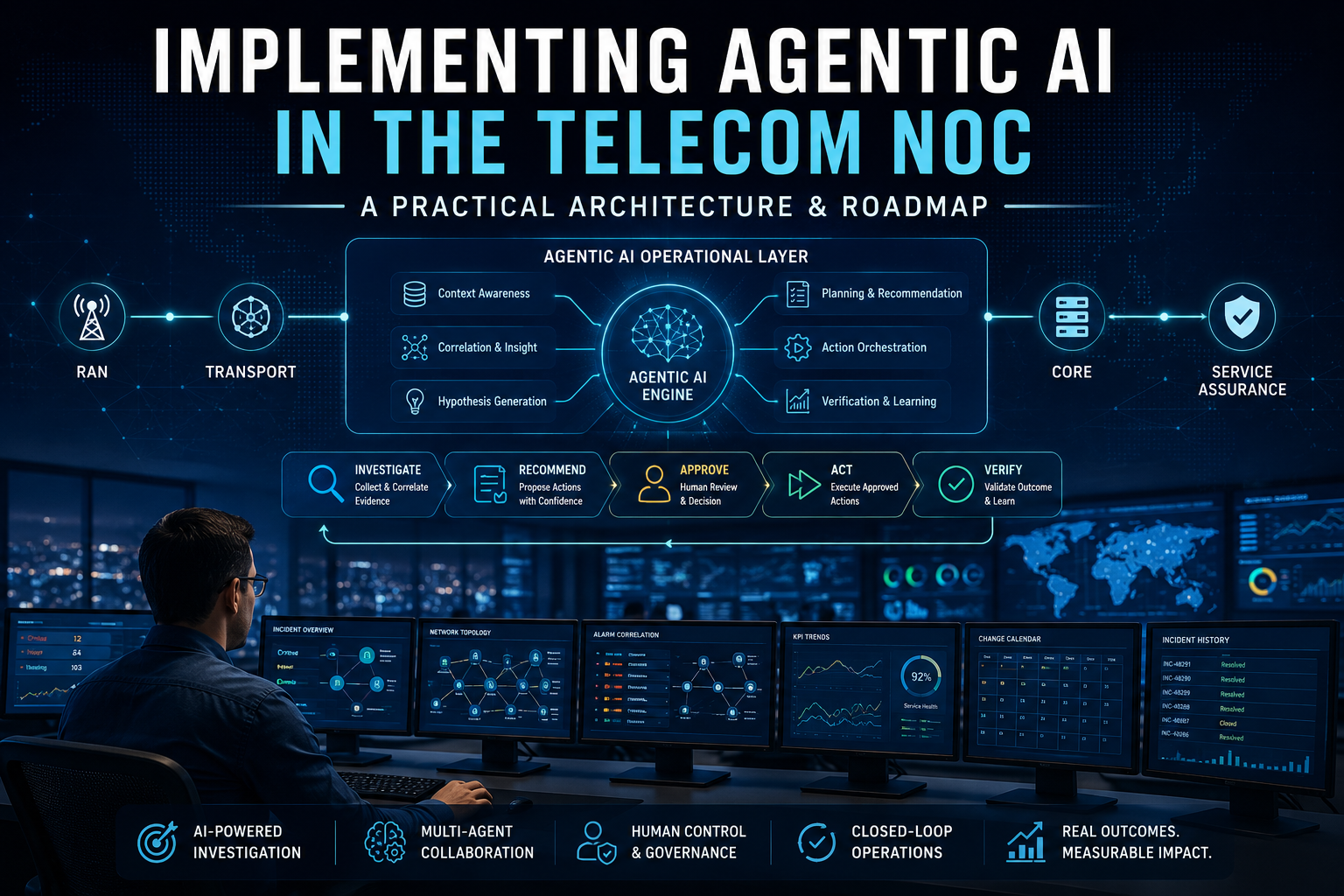
    A practical Agentic AI architecture for telecom operations can be organized into six layers, connecting network data, operational knowledge, specialized AI agents, human governance and closed-loop network actions.

    1. Network & Operational Data
    2. Data Normalization & Context
    3. Operational Knowledge
    4. Agentic AI & Specialized Agents
    5. Governance & Human Control
    6. Action, Verification & Learning

    Together, these layers allow an AI agent to move from simply understanding an alarm to investigating its probable root cause and recommending an operational response.

    From Alarm to Action: What an Agentic AI Investigation Could Look Like

    Imagine the same regional degradation begins again. Several cell sites show accessibility deterioration, transport packet loss increases, and customer-experience KPIs start declining. No single alarm identifies the root cause.

    This time, instead of manually moving between multiple operational systems, the NOC engineer gives the Agentic AI system a goal:

    “Investigate the service degradation, identify the probable root cause, determine the customer impact and recommend the safest recovery action.”

    The agent does not immediately produce an answer. It begins an investigation.

    Step 1 — Understand What Is Actually Affected

    The agent first builds the operational context. It identifies the affected sites, services, customers and network domains, then correlates alarms with the degrading KPIs.

    Instead of treating every alarm as a separate event, it asks a more useful question:

    “What do these symptoms have in common?”

    Step 2 — Trace the Common Dependency

    Using topology and service relationships, the agent traces the affected sites through RAN, transport and core dependencies.

    It discovers that several apparently unrelated symptoms share the same upstream transport path.

    Step 3 — Check What Changed

    The agent then reviews recent configuration changes, maintenance activity and network events associated with that path.

    A routing change implemented earlier in the day becomes a strong candidate.

    Step 4 — Test the Hypothesis Before Touching the Network

    Finding a likely cause is not enough. Before recommending a network change, the agent needs to determine whether the evidence actually supports its hypothesis.

    It can compare the current incident with historical cases, analyze the timing of the configuration change against the KPI degradation, and evaluate whether the suspected dependency explains all affected services.

    Where a Network Digital Twin or simulation capability is available, the proposed recovery action could also be tested against a virtual representation of the network before being considered for production.

    “If we reverse or modify this change, what is likely to happen?”

    Step 5 — Recommend an Action, Not Just a Root Cause

    The agent now brings the investigation together:

    Probable cause: Recent routing configuration change
    Affected area: Regional transport path and dependent sites
    Customer impact: Degraded accessibility and data performance
    Recommended action: Restore the previous validated routing configuration
    Supporting evidence: Alarm correlation, KPI timeline, topology dependency and change history
    Confidence: Presented with the evidence used to reach the conclusion

    This is an important distinction.

    A useful Agentic AI system should not simply say what it thinks happened. It should show why it reached that conclusion.

    Step 7 — Execute, Verify and Learn

    Once approved, the action can be executed through the appropriate automation or orchestration platform.

    But the workflow should not end when the configuration changes.

    The agent continues monitoring the affected services and asks:

    Did the alarms clear?
    Did the KPIs recover?
    Did customer experience return to normal?
    Did the action create any unexpected impact elsewhere?

    If the network recovers as expected, the incident outcome becomes part of the operational knowledge available for future investigations.

    The complete loop becomes:

    Detect → Investigate → Correlate → Hypothesize → Test → Recommend → Approve → Act → Verify → Learn

    Agentic AI becomes operationally valuable when it can close the investigation loop—not merely generate an intelligent answer.

    What Happens When Multiple AI Agents Work Together?

    A telecom incident rarely belongs neatly to one domain.

    A customer-experience problem may appear in the RAN, originate in transport, interact with a core-network dependency and finally become visible through service-assurance KPIs.

    This creates an interesting possibility for Agentic AI: instead of building one AI agent that tries to understand everything, operators could use specialized agents, each responsible for a particular operational capability.

    For example:

    RAN Agent — investigates radio KPIs, cell alarms and accessibility degradation.

    Transport Agent — analyzes packet loss, latency, link utilization and path dependencies.

    Core Agent — checks sessions, signaling, network functions and service dependencies.

    Change Agent — reviews recent configuration changes and maintenance activity.

    Service Assurance Agent — evaluates customer and service impact.

    Coordinator Agent — combines the findings, resolves conflicting evidence and builds the overall incident hypothesis.

    The future NOC may not rely on one AI that knows everything. It may rely on multiple specialized agents that know how to work together.

    A multi-agent NOC architecture allows specialized AI agents to investigate different network domains while a coordinating agent brings the evidence together for human-reviewed operational decisions.

    How Much Autonomy Should an AI Agent Actually Have?

    Giving an AI agent access to operational systems does not mean giving it unrestricted authority to change the network.

    A practical Agentic AI implementation should introduce autonomy progressively, based on operational risk, confidence, reversibility and potential customer impact.

    For example, an agent may be allowed to automatically collect evidence, correlate alarms and analyze KPIs with very little operational risk.

    Recommending a configuration change requires greater confidence.

    Executing that change on a live production network requires an entirely different level of governance.

    A useful progression could therefore be:

    Observe → Investigate → Recommend → Approve → Act → Verify

    The further the agent moves toward Act, the stronger the controls should become.

    Agentic AI maturity should not be measured by how many decisions AI can make alone. It should be measured by how safely intelligence can be converted into operational action.

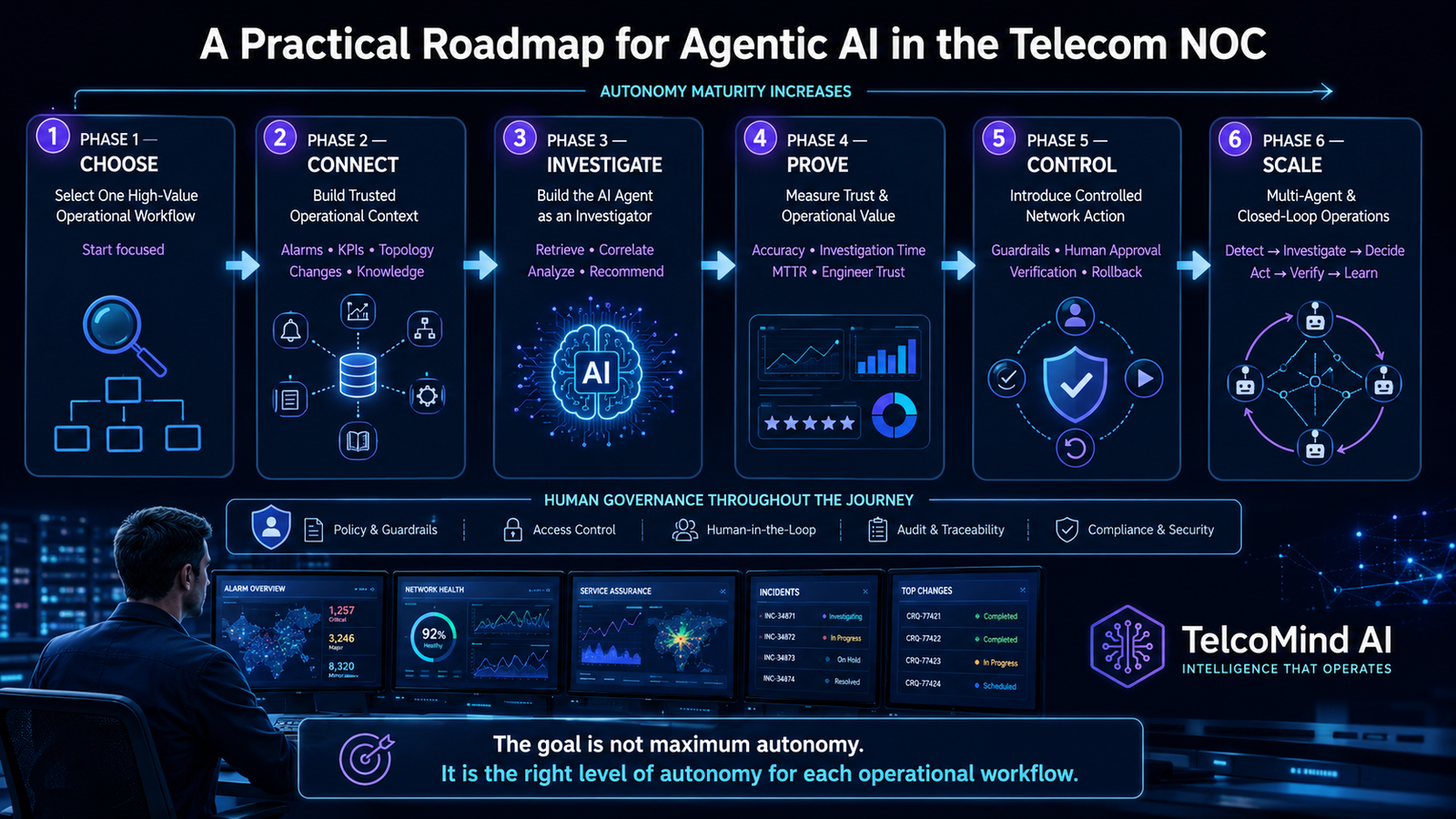
    A Practical Roadmap for Implementing Agentic AI in the NOC

    The biggest mistake would be to start with the question:

    “How do we make the NOC autonomous?”

    A better question is:

    “Which operational workflow is repetitive, data-rich, measurable and safe enough for Agentic AI to improve?”

    The first implementation should not attempt to transform the entire NOC. It should prove that an AI agent can reliably investigate a defined operational problem and create measurable value.

    Phase 1 — Choose One High-Value Operational Workflow

    Start with a workflow where engineers already spend significant time gathering and correlating information.

    Good candidates could include:

    Alarm investigation
    Cross-domain incident correlation
    Recurring degradation analysis
    Change-impact investigation
    Preventive maintenance investigation

    Avoid beginning with autonomous configuration changes.

    The initial objective should be simple:

    Can the AI agent reduce investigation effort while producing evidence that an experienced engineer trusts?

    Phase 2 — Connect the Agent to Trusted Operational Context

    An AI agent cannot investigate a telecom network effectively if it only sees alarms.

    It needs enough operational context to understand what happened, where it happened, what changed and what could be affected.

    Depending on the use case, this context may include:

    Alarms & events — what is happening now?
    Performance KPIs — what is degrading?
    Network topology — how are affected elements connected?
    Configuration & change history — what changed recently?
    Tickets & incident history — has this happened before?
    Service data — which services are affected?
    Operational knowledge — what procedures and engineering rules apply?

    But simply connecting these data sources is not enough.

    The information must be current, normalized, permission-controlled and traceable to its source.

    An AI agent can only be as operationally intelligent as the context it is allowed to understand.

    Phase 3 Build the Agent as an Investigator Before Making It an Operator

    The safest starting point is to give the AI agent permission to investigate, not permission to change the network.

    At this stage, the agent can:

    Retrieve relevant alarms, KPIs and logs.
    Correlate symptoms across network domains.
    Check topology and recent changes.
    Search previous incidents and operational knowledge.
    Develop a probable root-cause hypothesis.
    Recommend the next troubleshooting or recovery action.

    But the final operational decision remains with the engineer.

    This creates an important learning period.

    Engineers can compare the agent’s conclusions with their own investigations, identify where the agent performs well, and discover where additional context or operational rules are required.

    Before trusting an AI agent to operate the network, first prove that you can trust it to investigate the network.

    Phase 4 — Measure Trust and Operational Value

    Before expanding Agentic AI to more workflows, operators should measure whether the first implementation is actually improving NOC operations.

    The evaluation should go beyond asking whether the AI produced the correct answer.

    Measure outcomes such as:

    Investigation time — Did engineers reach the probable cause faster?

    Evidence quality — Did the agent provide enough traceable information to support its conclusion?

    Recommendation accuracy — How often were its recommendations accepted, modified or rejected by engineers?

    Operational impact — Did the workflow help reduce MTTR, repeated investigations or unnecessary escalations?

    Engineer trust — Are experienced engineers becoming comfortable using the agent as part of their normal workflow?

    These measurements create the evidence needed to decide whether the agent is ready for greater responsibility.

    Autonomy should be earned through operational evidence—not granted because the AI appears intelligent.

    Phase 5 — Introduce Controlled Action

    Once the agent has demonstrated reliable investigation and recommendation performance, selected low-risk actions can gradually be introduced.

    This should not mean giving the agent unrestricted access to the production network.

    Instead, every action should operate within clearly defined guardrails.

    For example:

    Low-risk actions may be executed automatically when confidence is high.

    Medium-risk actions may require engineer approval before execution.

    High-risk or customer-impacting actions should remain under explicit human control.

    The agent should also understand:

    What it is allowed to change
    When it must ask for approval
    When it must stop and escalate
    How to verify the result
    How to trigger rollback if the expected outcome does not occur

    This creates a controlled progression:

    Recommend → Approve → Execute → Verify → Roll Back if Required

    The goal is not to give AI control of the network. The goal is to give AI the right level of authority for the right operational situation.

    Phase 6 — Scale Toward Multi-Agent and Closed-Loop Operations

    Once individual agents have demonstrated value in specific workflows, the next step is not simply to deploy more agents.

    The real opportunity is to make them work together across operational domains.

    A RAN agent may detect degradation. A Transport agent may identify a shared dependency. A Change agent may discover a recent configuration modification. A Service Assurance agent may determine which customers and services are affected.

    A coordinating agent can bring these findings together and build a common operational view.

    Over time, selected workflows could then progress toward closed-loop operation, where the system can:

    Detect → Investigate → Decide → Act → Verify → Learn

    But not every workflow needs to reach full autonomy.

    Some may remain AI-assisted.
    Some may become human-approved automation.
    Others may eventually operate autonomously within tightly defined boundaries.

    The destination is not an autonomous NOC at any cost. It is the right level of autonomy for each operational workflow.
    What Usually Stops Agentic AI From Working in a Real NOC?

    The architecture can look impressive on a diagram.

    The real difficulty begins when an operator tries to connect it to a live telecom environment.

    Agentic AI depends on something many NOCs still struggle with: consistent operational context across fragmented systems and network domains.

    An alarm may exist in one platform. Performance data in another. Topology somewhere else. Change records in an ITSM system. Troubleshooting procedures in documents. Historical knowledge may exist mainly in the experience of senior engineers.

    If the AI agent cannot connect these pieces reliably, its reasoning will always be incomplete.

    This means the first major challenge is not necessarily the AI model.

    The hardest part of Agentic AI may be building the operational context the agent needs in order to reason correctly.

    What Should a Telecom Operator Do First?

    Agentic AI should not begin as a large autonomous-network program. It should begin with one operational problem where the value can be demonstrated clearly.

    Choose a workflow that is:

    Repetitive — engineers perform it frequently.
    Data-rich — the required operational information already exists.
    Time-consuming — investigation requires significant manual effort.
    Measurable — improvement can be demonstrated.
    Low-risk — AI can initially investigate without controlling the live network.

    A good starting point could be cross-domain incident investigation, where engineers currently spend time moving between alarms, KPIs, topology, changes and historical incidents.

    Start with AI as an investigator.

    Prove that engineers trust its evidence.

    Measure whether investigation becomes faster and more consistent.

    Then—and only then—consider giving the agent greater operational authority.

    Start with one problem. Prove the value. Build trust. Then expand the autonomy.

    Agentic AI Will Change the NOC — But Not Overnight

    Agentic AI introduces an important change in how AI can support telecom operations.

    The journey starts with AI helping engineers understand the network.

    It progresses toward AI that can investigate, correlate evidence across domains, develop hypotheses and recommend actions.

    Eventually, selected operational workflows may allow AI agents to act and verify outcomes within carefully defined boundaries.

    But the real transformation is not simply:

    Manual NOC → Autonomous NOC

    It is a progressive shift:

    Human Investigation → AI-Assisted Investigation → Agent-Led Investigation → Human-Approved Action → Governed Closed-Loop Operations

    The role of the engineer does not disappear in this journey.

    It evolves from manually collecting operational information toward validating intelligence, governing automation and making higher-risk network decisions.

    The future NOC will not be defined by how much AI it deploys. It will be defined by how intelligently it combines AI agents, automation, network context and human judgment.

    Final Thought

    Agentic AI has the potential to become much more than another interface sitting above telecom operational systems.

    Implemented correctly, it can become an operational intelligence layer connecting network data, engineering knowledge, AI reasoning and automation.

    The operators that make progress will probably not be those attempting to automate everything at once.

    They will be those that start with the right operational problem, build trusted context, prove measurable value and increase autonomy only where it makes operational sense.

    Start small. Prove the intelligence. Control the action. Scale what works.

    How Ready Is Your NOC for Agentic AI?

    Before introducing AI agents into network operations, operators need to understand whether their data, automation, operational processes and governance are ready for the transition.

    TelcoMind AI’s free AI-Ready NOC Maturity Assessment helps you evaluate your current NOC across key capabilities and identify where the biggest gaps exist.

    Assess your NOC → Identify the gaps → Define the next step

    Take the Free NOC AI Maturity Assessment →

    Related TelcoMind AI Insights

    Agentic AI in Telecom Operations: From AI Assistance to Autonomous Action

    AI-Powered AIOps in Telecom: From Alarm Management to Autonomous Network Operations

    From Level 0 to Level 5: How Close Are We to Truly Autonomous Telecom Networks?

  • How to Implement Agentic AI in a Telecom NOC: A Practical Architecture and Roadmap

    How to Implement Agentic AI in a Telecom NOC: A Practical Architecture and Roadmap

    The Real Question Is No Longer “What Can AI Do?”

    Imagine a regional network begins degrading. Nothing has completely failed yet.

    Customer-experience indicators start moving in the wrong direction. A group of sites shows intermittent accessibility degradation. Packet loss appears on part of the transport network. A few alarms are active, but none individually explains the problem.

    The NOC engineer begins investigating.

    First, the alarm-management system. Then performance monitoring. Then topology. Then transmission. Then IP. Then recent network changes. Then previous incidents. Each system contains part of the answer. But the engineer has to connect everything manually.

    Eventually, the team discovers that the symptoms share an upstream dependency and that a configuration change earlier in the day altered the traffic path.

    The experienced engineer can solve the problem.

    The problem is the time and effort required to assemble the evidence.

    Now imagine a different operating model.

    The engineer asks:

    “Investigate the degradation affecting these sites and identify the most probable cause.”

    An AI agent starts working.

    It retrieves the affected alarms, analyzes the KPI deterioration, checks network topology, identifies common dependencies, reviews recent configuration changes, and searches previous incidents with similar symptoms.

    Instead of giving the engineer another dashboard to investigate, the agent brings the evidence together and presents a probable root cause, affected services, supporting evidence, recommended action, and confidence level.

    The engineer reviews the evidence and decides whether the proposed action should proceed.

    This is the important shift:

    AI is no longer simply answering a question. It is performing an operational investigation.

    From AI Assistant to AI Agent

    Most telecom organizations have already experimented with some form of AI.

    An engineer might ask a GenAI assistant:

    “Explain this alarm.”

    The model explains it.

    Or:

    “Summarize this incident report.”

    The model produces a summary.

    Useful? Absolutely. But the engineer is still performing the operational workflow.

    Agentic AI changes this relationship.

    Instead of asking:

    “What does this alarm mean?”

    the engineer can ask:

    “Investigate why this service is degrading.”

    The AI agent can then determine which operational steps are required to investigate the problem.

    AI Assistant vs Agentic AI comparison

    The Difference in One View

    Traditional GenAI Assistant

    Prompt → Answer

    The engineer decides what to investigate, gathers the information, interprets the evidence and decides the next step.

    Agentic AI

    Goal → Plan → Use Tools → Investigate → Correlate → Recommend → Verify

    The engineer defines the objective and remains responsible for critical decisions, while the AI performs multiple investigation steps across operational systems.

    This shift—from answering questions to executing goal-oriented workflows—is what makes Agentic AI particularly relevant to telecom network operations.

    How Does Agentic AI Actually Work Inside a Telecom NOC?

    The real challenge is not connecting a chatbot to the NOC. The challenge is giving AI enough network context, operational knowledge and controlled access to tools to investigate a problem safely.

    A practical Agentic AI architecture for telecom operations can be organized into six layers, connecting network data, operational knowledge, specialized AI agents, human governance and closed-loop network actions.

    1. Network & Operational Data
    2. Data Normalization & Context
    3. Operational Knowledge
    4. Agentic AI & Specialized Agents
    5. Governance & Human Control
    6. Action, Verification & Learning

    Together, these layers allow an AI agent to move from simply understanding an alarm to investigating its probable root cause and recommending an operational response.

    From Alarm to Action: What an Agentic AI Investigation Could Look Like

    Imagine the same regional degradation begins again. Several cell sites show accessibility deterioration, transport packet loss increases, and customer-experience KPIs start declining. No single alarm identifies the root cause.

    This time, instead of manually moving between multiple operational systems, the NOC engineer gives the Agentic AI system a goal:

    “Investigate the service degradation, identify the probable root cause, determine the customer impact and recommend the safest recovery action.”

    The agent does not immediately produce an answer. It begins an investigation.

    Step 1 — Understand What Is Actually Affected

    The agent first builds the operational context. It identifies the affected sites, services, customers and network domains, then correlates alarms with the degrading KPIs.

    Instead of treating every alarm as a separate event, it asks a more useful question:

    “What do these symptoms have in common?”

    Step 2 — Trace the Common Dependency

    Using topology and service relationships, the agent traces the affected sites through RAN, transport and core dependencies.

    It discovers that several apparently unrelated symptoms share the same upstream transport path.

    Step 3 — Check What Changed

    The agent then reviews recent configuration changes, maintenance activity and network events associated with that path.

    A routing change implemented earlier in the day becomes a strong candidate.

    Step 4 — Test the Hypothesis Before Touching the Network

    Finding a likely cause is not enough. Before recommending a network change, the agent needs to determine whether the evidence actually supports its hypothesis.

    It can compare the current incident with historical cases, analyze the timing of the configuration change against the KPI degradation, and evaluate whether the suspected dependency explains all affected services.

    Where a Network Digital Twin or simulation capability is available, the proposed recovery action could also be tested against a virtual representation of the network before being considered for production.

    “If we reverse or modify this change, what is likely to happen?”

    Step 5 — Recommend an Action, Not Just a Root Cause

    The agent now brings the investigation together:

    Probable cause: Recent routing configuration change
    Affected area: Regional transport path and dependent sites
    Customer impact: Degraded accessibility and data performance
    Recommended action: Restore the previous validated routing configuration
    Supporting evidence: Alarm correlation, KPI timeline, topology dependency and change history
    Confidence: Presented with the evidence used to reach the conclusion

    This is an important distinction.

    A useful Agentic AI system should not simply say what it thinks happened. It should show why it reached that conclusion.

    Step 7 — Execute, Verify and Learn

    Once approved, the action can be executed through the appropriate automation or orchestration platform.

    But the workflow should not end when the configuration changes.

    The agent continues monitoring the affected services and asks:

    Did the alarms clear?
    Did the KPIs recover?
    Did customer experience return to normal?
    Did the action create any unexpected impact elsewhere?

    If the network recovers as expected, the incident outcome becomes part of the operational knowledge available for future investigations.

    The complete loop becomes:

    Detect → Investigate → Correlate → Hypothesize → Test → Recommend → Approve → Act → Verify → Learn

    Agentic AI becomes operationally valuable when it can close the investigation loop—not merely generate an intelligent answer.

    What Happens When Multiple AI Agents Work Together?

    A telecom incident rarely belongs neatly to one domain.

    A customer-experience problem may appear in the RAN, originate in transport, interact with a core-network dependency and finally become visible through service-assurance KPIs.

    This creates an interesting possibility for Agentic AI: instead of building one AI agent that tries to understand everything, operators could use specialized agents, each responsible for a particular operational capability.

    For example:

    RAN Agent — investigates radio KPIs, cell alarms and accessibility degradation.

    Transport Agent — analyzes packet loss, latency, link utilization and path dependencies.

    Core Agent — checks sessions, signaling, network functions and service dependencies.

    Change Agent — reviews recent configuration changes and maintenance activity.

    Service Assurance Agent — evaluates customer and service impact.

    Coordinator Agent — combines the findings, resolves conflicting evidence and builds the overall incident hypothesis.

    The future NOC may not rely on one AI that knows everything. It may rely on multiple specialized agents that know how to work together.

    A multi-agent NOC architecture allows specialized AI agents to investigate different network domains while a coordinating agent brings the evidence together for human-reviewed operational decisions.

    How Much Autonomy Should an AI Agent Actually Have?

    Giving an AI agent access to operational systems does not mean giving it unrestricted authority to change the network.

    A practical Agentic AI implementation should introduce autonomy progressively, based on operational risk, confidence, reversibility and potential customer impact.

    For example, an agent may be allowed to automatically collect evidence, correlate alarms and analyze KPIs with very little operational risk.

    Recommending a configuration change requires greater confidence.

    Executing that change on a live production network requires an entirely different level of governance.

    A useful progression could therefore be:

    Observe → Investigate → Recommend → Approve → Act → Verify

    The further the agent moves toward Act, the stronger the controls should become.

    Agentic AI maturity should not be measured by how many decisions AI can make alone. It should be measured by how safely intelligence can be converted into operational action.

    A Practical Roadmap for Implementing Agentic AI in the NOC

    The biggest mistake would be to start with the question:

    “How do we make the NOC autonomous?”

    A better question is:

    “Which operational workflow is repetitive, data-rich, measurable and safe enough for Agentic AI to improve?”

    The first implementation should not attempt to transform the entire NOC. It should prove that an AI agent can reliably investigate a defined operational problem and create measurable value.

    Phase 1 — Choose One High-Value Operational Workflow

    Start with a workflow where engineers already spend significant time gathering and correlating information.

    Good candidates could include:

    Alarm investigation
    Cross-domain incident correlation
    Recurring degradation analysis
    Change-impact investigation
    Preventive maintenance investigation

    Avoid beginning with autonomous configuration changes.

    The initial objective should be simple:

    Can the AI agent reduce investigation effort while producing evidence that an experienced engineer trusts?

    Phase 2 — Connect the Agent to Trusted Operational Context

    An AI agent cannot investigate a telecom network effectively if it only sees alarms.

    It needs enough operational context to understand what happened, where it happened, what changed and what could be affected.

    Depending on the use case, this context may include:

    Alarms & events — what is happening now?
    Performance KPIs — what is degrading?
    Network topology — how are affected elements connected?
    Configuration & change history — what changed recently?
    Tickets & incident history — has this happened before?
    Service data — which services are affected?
    Operational knowledge — what procedures and engineering rules apply?

    But simply connecting these data sources is not enough.

    The information must be current, normalized, permission-controlled and traceable to its source.

    An AI agent can only be as operationally intelligent as the context it is allowed to understand.

    Phase 3 Build the Agent as an Investigator Before Making It an Operator

    The safest starting point is to give the AI agent permission to investigate, not permission to change the network.

    At this stage, the agent can:

    Retrieve relevant alarms, KPIs and logs.
    Correlate symptoms across network domains.
    Check topology and recent changes.
    Search previous incidents and operational knowledge.
    Develop a probable root-cause hypothesis.
    Recommend the next troubleshooting or recovery action.

    But the final operational decision remains with the engineer.

    This creates an important learning period.

    Engineers can compare the agent’s conclusions with their own investigations, identify where the agent performs well, and discover where additional context or operational rules are required.

    Before trusting an AI agent to operate the network, first prove that you can trust it to investigate the network.

    Phase 4 — Measure Trust and Operational Value

    Before expanding Agentic AI to more workflows, operators should measure whether the first implementation is actually improving NOC operations.

    The evaluation should go beyond asking whether the AI produced the correct answer.

    Measure outcomes such as:

    Investigation time — Did engineers reach the probable cause faster?

    Evidence quality — Did the agent provide enough traceable information to support its conclusion?

    Recommendation accuracy — How often were its recommendations accepted, modified or rejected by engineers?

    Operational impact — Did the workflow help reduce MTTR, repeated investigations or unnecessary escalations?

    Engineer trust — Are experienced engineers becoming comfortable using the agent as part of their normal workflow?

    These measurements create the evidence needed to decide whether the agent is ready for greater responsibility.

    Autonomy should be earned through operational evidence—not granted because the AI appears intelligent.

    Phase 5 — Introduce Controlled Action

    Once the agent has demonstrated reliable investigation and recommendation performance, selected low-risk actions can gradually be introduced.

    This should not mean giving the agent unrestricted access to the production network.

    Instead, every action should operate within clearly defined guardrails.

    For example:

    Low-risk actions may be executed automatically when confidence is high.

    Medium-risk actions may require engineer approval before execution.

    High-risk or customer-impacting actions should remain under explicit human control.

    The agent should also understand:

    What it is allowed to change
    When it must ask for approval
    When it must stop and escalate
    How to verify the result
    How to trigger rollback if the expected outcome does not occur

    This creates a controlled progression:

    Recommend → Approve → Execute → Verify → Roll Back if Required

    The goal is not to give AI control of the network. The goal is to give AI the right level of authority for the right operational situation.

    Phase 6 — Scale Toward Multi-Agent and Closed-Loop Operations

    Once individual agents have demonstrated value in specific workflows, the next step is not simply to deploy more agents.

    The real opportunity is to make them work together across operational domains.

    A RAN agent may detect degradation. A Transport agent may identify a shared dependency. A Change agent may discover a recent configuration modification. A Service Assurance agent may determine which customers and services are affected.

    A coordinating agent can bring these findings together and build a common operational view.

    Over time, selected workflows could then progress toward closed-loop operation, where the system can:

    Detect → Investigate → Decide → Act → Verify → Learn

    But not every workflow needs to reach full autonomy.

    Some may remain AI-assisted.
    Some may become human-approved automation.
    Others may eventually operate autonomously within tightly defined boundaries.

    The destination is not an autonomous NOC at any cost. It is the right level of autonomy for each operational workflow.

    What Usually Stops Agentic AI From Working in a Real NOC?

    The architecture can look impressive on a diagram.

    The real difficulty begins when an operator tries to connect it to a live telecom environment.

    Agentic AI depends on something many NOCs still struggle with: consistent operational context across fragmented systems and network domains.

    An alarm may exist in one platform. Performance data in another. Topology somewhere else. Change records in an ITSM system. Troubleshooting procedures in documents. Historical knowledge may exist mainly in the experience of senior engineers.

    If the AI agent cannot connect these pieces reliably, its reasoning will always be incomplete.

    This means the first major challenge is not necessarily the AI model.

    The hardest part of Agentic AI may be building the operational context the agent needs in order to reason correctly.

    What Should a Telecom Operator Do First?

    Agentic AI should not begin as a large autonomous-network program. It should begin with one operational problem where the value can be demonstrated clearly.

    Choose a workflow that is:

    Repetitive — engineers perform it frequently.
    Data-rich — the required operational information already exists.
    Time-consuming — investigation requires significant manual effort.
    Measurable — improvement can be demonstrated.
    Low-risk — AI can initially investigate without controlling the live network.

    A good starting point could be cross-domain incident investigation, where engineers currently spend time moving between alarms, KPIs, topology, changes and historical incidents.

    Start with AI as an investigator.

    Prove that engineers trust its evidence.

    Measure whether investigation becomes faster and more consistent.

    Then—and only then—consider giving the agent greater operational authority.

    Start with one problem. Prove the value. Build trust. Then expand the autonomy.

    Agentic AI Will Change the NOC — But Not Overnight

    Agentic AI introduces an important change in how AI can support telecom operations.

    The journey starts with AI helping engineers understand the network.

    It progresses toward AI that can investigate, correlate evidence across domains, develop hypotheses and recommend actions.

    Eventually, selected operational workflows may allow AI agents to act and verify outcomes within carefully defined boundaries.

    But the real transformation is not simply:

    Manual NOC → Autonomous NOC

    It is a progressive shift:

    Human Investigation → AI-Assisted Investigation → Agent-Led Investigation → Human-Approved Action → Governed Closed-Loop Operations

    The role of the engineer does not disappear in this journey.

    It evolves from manually collecting operational information toward validating intelligence, governing automation and making higher-risk network decisions.

    The future NOC will not be defined by how much AI it deploys. It will be defined by how intelligently it combines AI agents, automation, network context and human judgment.

    Final Thought

    Agentic AI has the potential to become much more than another interface sitting above telecom operational systems.

    Implemented correctly, it can become an operational intelligence layer connecting network data, engineering knowledge, AI reasoning and automation.

    The operators that make progress will probably not be those attempting to automate everything at once.

    They will be those that start with the right operational problem, build trusted context, prove measurable value and increase autonomy only where it makes operational sense.

    Start small. Prove the intelligence. Control the action. Scale what works.

    How Ready Is Your NOC for Agentic AI?

    Before introducing AI agents into network operations, operators need to understand whether their data, automation, operational processes and governance are ready for the transition.

    TelcoMind AI’s free AI-Ready NOC Maturity Assessment helps you evaluate your current NOC across key capabilities and identify where the biggest gaps exist.

    Assess your NOC → Identify the gaps → Define the next step

    Take the Free NOC AI Maturity Assessment →

    Related TelcoMind AI Insights

    Agentic AI in Telecom Operations: From AI Assistance to Autonomous Action

    AI-Powered AIOps in Telecom: From Alarm Management to Autonomous Network Operations

    From Level 0 to Level 5: How Close Are We to Truly Autonomous Telecom Networks?