Tag: NOC

  • Network Digital Twin in Telecom: How AI Predicts Network Impact Before Changes Go Live

    Network Digital Twin in Telecom: How AI Predicts Network Impact Before Changes Go Live

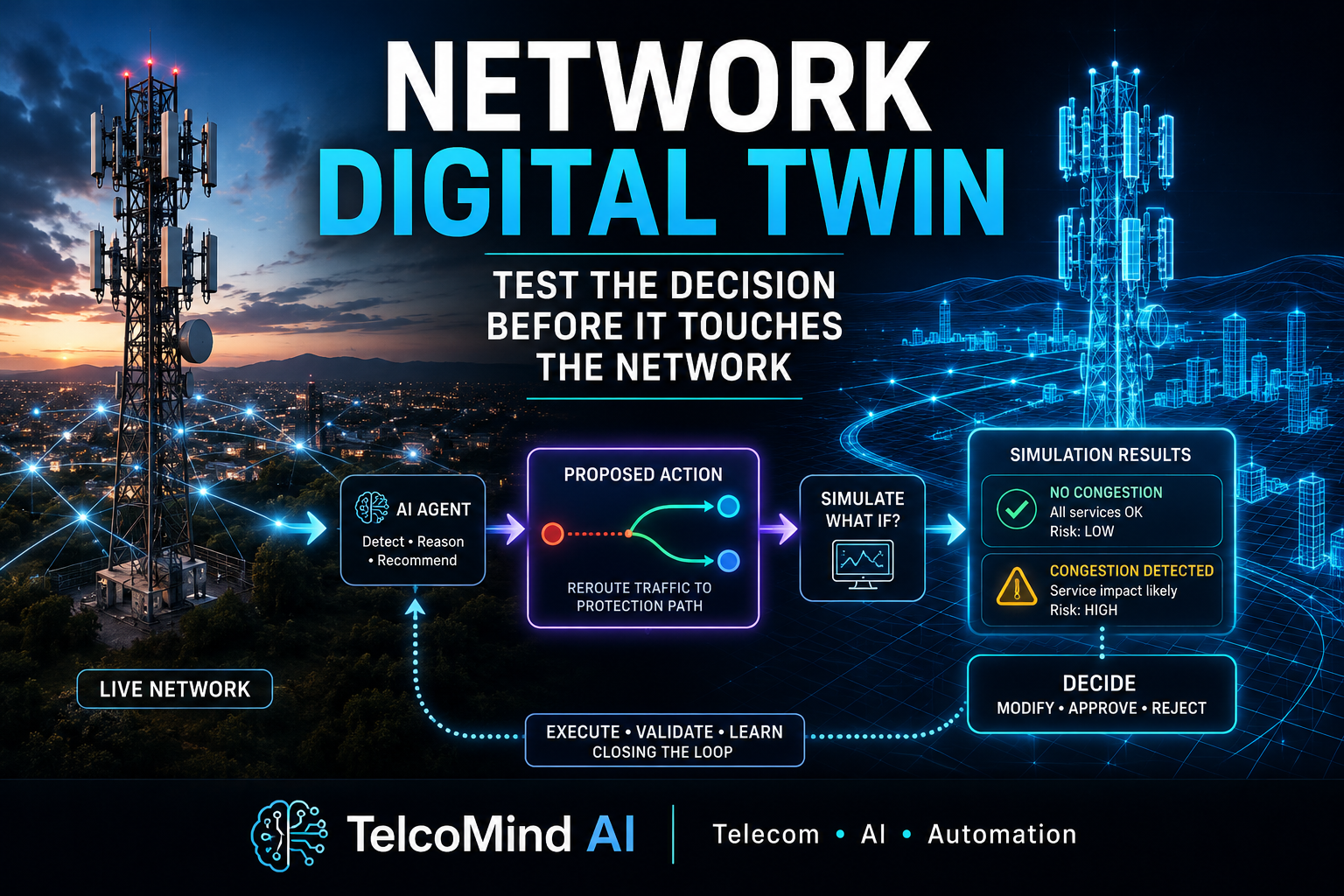
    What if a telecom operator could test a network change before touching the live network?

    A Network Digital Twin creates a continuously evolving virtual representation of the telecom network, allowing engineering and operations teams to simulate changes, analyze potential impact, identify risks and optimize decisions before implementation in the production network.

    Combined with AI, real-time telemetry and network data, the digital twin can evolve beyond traditional simulation into an intelligent decision-support capability for increasingly autonomous telecom operations

    One Network. One Decision. Two Possible Outcomes.

    A transmission path is deteriorating.

    Traffic is still flowing, but performance is moving in the wrong direction. Errors are increasing, packet loss has started to appear, and the operations team knows that waiting for a complete failure is not a good option.

    Fortunately, the network has redundancy.

    The protection path is available. Its status is green. Capacity appears sufficient.

    The proposed action looks straightforward:

    Move the affected traffic to the protection path.

    It is the kind of decision telecom operations teams make every day.

    But there is one question the dashboard cannot answer with certainty:

    What will happen to the rest of the network after the traffic moves?

    Instead of answering that question with theory, let’s follow the same network decision into two different futures.

    Future A: Execute First

    The traffic migration begins.

    The affected traffic starts moving away from the deteriorating transmission path.

    For the first few moments, everything looks good.

    Packet loss on the original path begins to disappear. The alarms start clearing. Traffic stabilizes.

    The decision appears successful.

    Then another alarm appears.

    But this alarm is not coming from the original link.

    A downstream interface on the protection route is suddenly approaching its operational limit.

    More traffic has entered the path than expected. Enterprise services already sharing part of that infrastructure begin experiencing increased latency.

    The NOC has solved one problem—but another one is now developing.

    The original diagnosis was not wrong.

    The protection path was available.

    The network did exactly what it was instructed to do.

    What was missing was an understanding of what would happen elsewhere after the traffic moved.

    The team solved the problem directly in front of them.

    But the network responded somewhere else.

    One technically correct action has created an unexpected consequence.

    Now imagine something we normally cannot do with a live production network.

    Rewind the decision.

    Go back to the moment before EXECUTE.

    Same network. Same degradation. Same proposed solution.

    But this time, let’s test the future before we create it.

    Future B: Simulate First

    The same transmission path is deteriorating.

    The same packet loss is developing.

    The same protection path is available.

    And the same recommendation appears:

    Move the affected traffic to the protection path.

    But this time, the engineer does not press Execute.

    Nothing changes in the live network.

    Instead, the proposed action is tested against a digital representation of the current network.

    The model receives the affected topology, current traffic conditions, available capacity, configuration and the services depending on those paths.

    Then the proposed traffic migration begins.

    But only inside the model.

    At first, the result looks promising.

    Traffic successfully leaves the deteriorating path.

    Utilization increases on the protection route—but remains manageable.

    Then the simulation exposes something that was not obvious from the original dashboard.

    A downstream interface begins approaching its operational limit.

    The same secondary problem from our first future is developing again.

    But there is one critical difference:

    This time, no customer experiences it.

    No enterprise service slows down.

    No additional incident is created.

    No emergency rollback is required.

    The failure exists only inside the simulated environment.

    The team modifies the plan.

    Instead of moving all affected traffic through a single protection path, the load is distributed across two available routes.

    The scenario is tested again.

    This time, projected utilization remains within the defined operational limits.

    Critical service dependencies remain protected.

    No secondary congestion develops.

    Now—and only now—the action is approved for the real network.

    Traffic moves.

    The deteriorating path is relieved.

    Performance stabilizes.

    And the second incident from Future A never happens.

    Same network.

    Same problem.

    Same initial recommendation.

    Different decision process.

    In the first future, we discovered the consequence after changing the network.

    In the second, we discovered it before changing the network.

    And that difference brings us to the technology at the center of this article:

    The Network Digital Twin.

    The Network Digital Twin

    What happened in our second future was not simply network simulation.

    The proposed action was tested against a digital representation that understood enough about the current network state to show how the network might respond.

    That is the idea behind a Network Digital Twin (NDT).

    A Network Digital Twin can be thought of as a dynamic digital representation of a real telecom network, built using relevant information such as topology, configuration, traffic, performance, capacity and service relationships.

    But the important word here is not digital.

    It is twin.

    A static network diagram may tell us how nodes are connected. A planning model may help us estimate future capacity. A Digital Twin aims to remain sufficiently connected to the state and behaviour of the real network that we can use it to understand conditions, explore scenarios and evaluate possible changes.

    In simple terms:

    The live network tells us what is happening.

    The Digital Twin can help us explore what might happen next.

    This becomes particularly interesting when combined with AI.

    An AI agent may identify a problem and recommend an action.

    A Digital Twin introduces another question before execution:

    “What happens if we actually do it?”

    That creates a potentially powerful operating sequence:

    Observe → Understand → Recommend → Simulate → Decide → Execute → Validate

    The objective is not to predict the future perfectly.

    Telecom networks are too dynamic and complex for any model to guarantee that.

    The value is more practical:

    Discover more of the risk before the live network—and the customer—has to discover it for us.

                    ONE NETWORK DECISION
                             │
                    Move the Traffic
                             │
              ┌──────────────┴──────────────┐
              ▼                             ▼
         EXECUTE FIRST                 SIMULATE FIRST
              │                             │
              ▼                             ▼
       Problem Improves               DIGITAL TWIN
              │                             │
              ▼                             ▼
       Hidden Congestion              Hidden Risk Found
              │                             │
              ▼                             ▼
       Service Degradation             Plan Modified
                                            │
                                            ▼
                                       Test Again
                                            │
                                            ▼
                                      Safe Execution

    A Digital Twin does not remove uncertainty. It gives us somewhere safer to discover it.

    How Much Does the Twin Need to Know

    Our Digital Twin successfully identified the congestion risk before traffic was moved.

    But there is an important question hiding inside that success:

    How did the twin know?

    Imagine we give the Digital Twin only a network topology.

    It can see Node A, Node B and two possible transmission paths.

    It knows how everything is connected.

    The proposed rerouting looks perfectly safe.

    But topology alone does not tell the twin that the protection path is already carrying significant traffic.

    So we give it capacity information.

    Better.

    Now it knows the maximum capacity of every relevant interface.

    But capacity alone still does not tell it how much of that capacity is being consumed right now.

    So we add real-time traffic and performance data.

    Suddenly, the picture changes.

    The twin can see that one interface on the protection route is already operating at relatively high utilization.

    Now our simulation becomes much more useful.

    But we are still not finished.

    Suppose the path has enough technical capacity—but it carries a critical enterprise service with strict latency requirements.

    Without understanding service dependencies, the twin may consider the rerouting acceptable while the customer experiences something very different.

    Add configuration, and the twin understands how the network is currently designed to behave.

    Add historical behaviour, and it can compare today’s condition with what happened under similar traffic patterns previously.

    Add service relationships, and it begins to understand something far more important than individual links:

    What does this network actually carry—and who could be affected if we change it?

    From a Network Model to an Operational Twin

    The usefulness of a Digital Twin therefore depends heavily on the quality, freshness and depth of the information behind it.

    An operational telecom twin may progressively combine:

    Topology — How is the network connected?

    Configuration — How is it currently designed to behave?

    Capacity — What can each resource support?

    Real-Time State — What is happening right now?

    Performance — How are the network elements behaving?

    Traffic — Where is the load moving?

    Service Dependencies — Which services and customers depend on those resources?

    Historical Behaviour — What happened under similar conditions before?

    The more complete this operational context becomes, the more meaningful a what-if simulation can potentially become.

    But this creates another important reality:

    A Digital Twin can only be as trustworthy as the network information feeding it.

    If inventory is outdated, topology is incomplete, telemetry is delayed or service dependencies are missing, the twin may simulate the wrong reality with impressive confidence.

    And in telecom operations, a convincing wrong answer can be more dangerous than an obvious unknown.

          DIGITAL TWIN MATURITY

    Topology

    • Configuration
    • Capacity
    • Real-Time State
    • Performance & Traffic
    • Service Dependencies
    • Historical Behaviour

      MORE OPERATIONAL CONTEXT

      BETTER WHAT-IF DECISIONS

    Before we ask how intelligent the Digital Twin is, we should ask how accurately it understands today’s network.

    When an Optimization Creates Another Problem

    So far, our Digital Twin has helped us manage a transmission risk.

    But telecom networks are not changed only when something fails.

    Every day, optimization teams make decisions intended to improve coverage, capacity, quality and customer experience.

    Now imagine a busy 5G cluster where traffic demand has been increasing steadily.

    Several cells are experiencing congestion during peak hours, and users at the cell edge are beginning to see lower throughput.

    An AI optimization engine analyzes the cluster and proposes changes to improve radio performance.

    The recommendation looks promising.

    Simulation based only on the target cells suggests:

    Higher capacity. Better utilization. Improved user throughput.

    From the perspective of those cells, the optimization looks successful.

    But a radio network does not operate as a collection of isolated cells.

    Change the behaviour of one part of the RAN, and neighboring cells may respond.

    The Neighbor Nobody Asked About

    Before the recommendation reaches the live network, it is tested against a Digital Twin representing the wider radio environment.

    The proposed optimization is applied.

    Performance improves in the target cells.

    Then something unexpected appears.

    A neighboring sector begins experiencing increased interference.

    Cell-edge performance in another part of the cluster starts deteriorating.

    The optimization has achieved exactly what it was designed to achieve—

    but only where it was looking.

    The Digital Twin allows the team to evaluate the change from a wider perspective.

    What happens to neighboring cells?

    How does traffic redistribute?

    Does interference increase?

    What happens to mobility behaviour?

    Are handovers still performing as expected?

    And most importantly:

    Did we improve the network—or simply move the problem somewhere else?

    The optimization parameters are adjusted.

    The scenario is simulated again.

    This time, the target cells still gain capacity, but the neighboring sectors remain within acceptable performance boundaries.

    The recommendation is now stronger—not because AI produced a different idea, but because the consequence of that idea was explored across a broader network context.

    This reveals an important role for Digital Twins in AI-driven telecom operations:

    AI can search for the best action.

    The Digital Twin can help test what that action might do to the network around it.

    Together, they create something more useful than optimization alone:

    Optimization with consequence awareness.

    The best optimization is not the one that improves a single KPI. It is the one that improves the network without creating the next problem.

    What Happens When AI Agents Meet Digital Twins?

    In the previous article, we explored a different shift in telecom operations: AI moving from answering questions to investigating problems, reasoning across information and recommending actions.

    That creates an obvious next question.

    If an AI agent can recommend a network action, should that recommendation move directly toward execution?

    Consider our transmission scenario again.

    The AI agent detects the degradation.

    It correlates alarms, topology, performance and service information.

    It identifies the probable cause.

    And it recommends:

    Move the traffic to the protection path.

    The recommendation may be technically sound.

    But as we discovered earlier, a correct diagnosis does not automatically guarantee a safe action.

    This is where the Digital Twin can become an important part of the decision loop.

    Give the Agent Somewhere to Test Its Idea

    Instead of moving directly from:

    AI Recommendation → Network Execution

    we introduce another stage:

    AI Recommendation → Digital Twin → What-If Test → Risk Evaluation → Execution

    The agent proposes the action.

    The Digital Twin applies it to a representation of the current network.

    The predicted consequences are evaluated.

    If the scenario exposes congestion, service impact or another unacceptable condition, the action can be modified—or rejected—before touching production.

    If the outcome remains within defined operational boundaries, the recommendation becomes a stronger candidate for execution.

    And after the real action is taken, live network telemetry can tell us whether reality behaved as expected.

    This creates something particularly interesting.

    The Digital Twin is no longer just a planning environment.

    It can potentially become a testing ground inside the AI decision cycle.

    The AI Agent asks: “What should we do?”

    The Digital Twin asks: “What might happen if we do it?”

    The live network answers: “Did it actually work?”

    Autonomy becomes more valuable when intelligence is combined with a way to test consequences before execution.

    Is This Still a Concept—or Is Telecom Already Moving There?

    The scenarios we have explored may sound futuristic, but the building blocks of Network Digital Twins are already appearing across the telecom industry.

    Operators and vendors are increasingly combining network models, real-time telemetry, AI, simulation and automation to understand network behaviour before making operational decisions.

    However, there is an important distinction.

    Not every network simulation platform is a Digital Twin, and not every Digital Twin today has the maturity to represent an entire live telecom network in real time.

    The industry is progressing in stages.

    Some implementations focus on planning and optimization.

    Others are being developed for network validation, fault analysis, capacity assessment and what-if simulation.

    The longer-term direction is much more ambitious:

    A continuously synchronized network representation capable of supporting increasingly autonomous operational decisions.

    These examples point toward the same evolution.

    The Digital Twin is gradually moving from a planning model toward something much closer to an operational decision environment.

    And that transition matters.

    Because as networks become more autonomous, the question will not only be whether AI can make a decision.

    The bigger question may be whether we can safely understand the consequences before that decision reaches the live network.

    From Concept to Real Networks

    The direction toward Network Digital Twins is no longer limited to research papers and future-network discussions. During 2026, several major telecom players have started bringing the concept closer to operational networks.

    KDDI — Building a High-Fidelity RAN Digital Twin

    In June 2026, KDDI Research announced a collaboration with NVIDIA, Keysight and Samsung Research America to develop a high-fidelity RAN Digital Twin.

    The objective is particularly relevant to our story: create a virtual representation of the radio network where AI-driven optimization and algorithms can be evaluated more safely before being applied to the real environment.

    Google Cloud — Digital Twin as Part of Autonomous Network Operations

    Google Cloud is taking the concept beyond a static network replica. Its autonomous-network architecture describes a Network Digital Twin as a dynamic temporal graph representing the network’s physical and logical state, including current performance and fault conditions as well as historical states.

    This gives AI agents something extremely valuable: the ability to understand not only what the network looks like now, but also how conditions developed over time—supporting root-cause analysis and predictive operations.

    NTT — Digital Twin for Optical Networks

    Digital Twin development is also moving into transmission.

    NTT is researching an optical-network Digital Twin in which the optical network is reconstructed in virtual space to support automated design, analysis and control for its All-Photonics Network.

    This is particularly interesting because it brings the Digital Twin concept into the transport layer that quietly carries services across the entire telecom network.

    These examples are different in scope and maturity.

    They should not be interpreted as evidence that fully synchronized, end-to-end autonomous Digital Twins are already operating everywhere.

    But they show something important:

    The industry is beginning to build the environments in which AI can understand, test and eventually help control increasingly complex networks.

    Ericsson describes a similar evolution: Digital Twins have traditionally supported planning and offline validation, but as AI begins making more network decisions, the twin can potentially become part of the operational control loop—allowing proposed actions to be evaluated against network conditions before reaching production.

    That brings us back to the question we started with:

    Before AI changes the network, should it test the decision first?

    Increasingly, the answer may be:

    Whenever the risk justifies it—yes.

    What Could a Digital Twin Change Inside the NOC?

    The real value of a Network Digital Twin will not come from creating an impressive virtual network.

    It will come from the operational decisions we can make differently because that virtual environment exists.

    Think about a normal day inside a telecom NOC.

    A change is waiting for implementation.

    A link is approaching congestion.

    A cluster is showing unusual performance.

    A recurring fault keeps returning.

    Capacity needs to be expanded.

    In each case, the operations team is ultimately trying to answer a similar question:

    “If we do this, what happens next?”

    A Digital Twin could give that question somewhere to be explored before the answer comes from the production network.

    Six Decisions. One Virtual Testing Ground.

    1. Change Management — Test Before Implementation

    Before a high-risk network change reaches production, the proposed configuration could be applied to the twin first.

    Instead of discovering an unexpected dependency during the maintenance window, the team may identify it during simulation.

    Change → Simulate → Assess → Approve → Execute

    2. Fault Management — Explore the Failure Before It Happens

    What happens if this transmission link fails completely?

    Where will the traffic move?

    Which sites become exposed?

    Does redundancy still work under current traffic conditions?

    A Digital Twin could allow the NOC to explore the failure while the real link is still carrying traffic.

    3. Capacity Management — See Tomorrow’s Congestion Today

    Instead of looking only at today’s utilization, traffic growth can be applied to the virtual network.

    The question changes from:

    “Which link is congested?”

    to:

    “Which link is likely to become the next bottleneck?”

    4. RAN Optimization — Look Beyond the Target Cell

    As we saw earlier, improving one cell does not guarantee improvement across the cluster.

    Proposed optimization can be evaluated against neighboring cells, mobility behaviour, interference and traffic redistribution before reaching the live RAN.

    5. Preventive Maintenance — Test the Recovery Plan

    Predicting that an asset may fail is only the first step.

    The twin could help answer what happens when that asset is removed from service for maintenance.

    Can the network safely operate without it?

    6. Service Assurance — Follow the Customer, Not Just the Alarm

    A network element can look healthy while a service still performs poorly.

    By combining network state with service dependencies, a Digital Twin could help teams evaluate how a proposed network action may affect the end-to-end service, rather than only the individual node being changed.

    These use cases may look different, but they share the same underlying idea:

    Move part of the learning from the live network into a virtual environment.

    The objective is not to eliminate operational risk.

    It is to discover more of that risk before customers discover it for us.

    The Digital Twin becomes valuable when it changes a real operational decision—not simply when it creates a digital copy of the network.

    There is one uncomfortable truth behind everything we have discussed so far.

    The real network never stops changing.

    Traffic rises and falls.

    Customers move.

    Links fail and recover.

    New sites are integrated.

    Software is upgraded.

    Configurations change.

    Capacity is expanded.

    Services are created and removed.

    And thousands of network conditions can change while the Digital Twin is trying to represent them.

    This creates perhaps the most important challenge for an operational Network Digital Twin:

    How closely does the twin still represent the network it is supposed to protect?

    Imagine the Twin Is Five Minutes Behind

    Return to our original transmission scenario.

    The Digital Twin receives the topology and evaluates the proposed traffic migration.

    According to the twin, the protection path has enough available capacity.

    The simulation passes.

    Safe to execute.

    But something happened in the real network five minutes earlier.

    A large amount of traffic was already rerouted onto part of that protection path because of another network event.

    The live network knows this.

    The Digital Twin does not.

    Its simulation may be mathematically correct.

    Its recommendation may look convincing.

    But it is solving yesterday’s network condition.

    And that exposes an important principle:

    A highly intelligent Digital Twin with stale data can still make a poor operational decision.

    Building the Twin May Be Harder Than Building the Model

    Telecom networks are particularly challenging because the information needed by a Digital Twin rarely comes from one place.

    The topology may come from one system.

    Configuration from another.

    Performance counters from multiple vendors.

    Traffic information from different network layers.

    Service dependencies from inventory and orchestration platforms.

    Customer experience information from assurance systems.

    Historical incidents from yet another operational environment.

    And in a multi-vendor network, even similar information may be represented differently across domains.

    Creating the model is therefore only part of the challenge.

    Keeping it accurate, synchronized and operationally trustworthy may be the harder problem.

    Before a Digital Twin can influence critical network decisions, operators will need confidence in areas such as:

    Data freshness — Is the twin seeing the current network?

    Model accuracy — Does the simulation represent real network behaviour closely enough?

    Multi-vendor consistency — Can information from different domains and vendors be interpreted correctly?

    Service dependency accuracy — Does the twin know what actually depends on the resource being changed?

    Scalability — Can complex scenarios be evaluated quickly enough to support operational decisions?

    Trust and governance — Which simulated outcomes are reliable enough to influence—or eventually authorize—network actions?

    This means the future of Digital Twins will not be defined only by how sophisticated the simulation looks.

    It will be defined by how much operators trust the twin when the real network is at risk.

    The question is not whether the Digital Twin can simulate the network. The question is whether we trust it enough to influence the network.

    From Digital Twin to Autonomous Network

    Now bring the pieces together.

    The live network is continuously producing signals.

    An AI agent observes those signals and identifies that something is changing.

    It investigates the condition, connects information across systems and develops a recommended action.

    But instead of immediately touching the production network, the recommendation enters the Digital Twin.

    What happens if we execute it?

    The twin simulates the proposed action against the current network context.

    If the result exposes unacceptable risk, the recommendation goes back for adjustment.

    If the outcome remains within defined operational boundaries, the action can move to the next stage.

    Depending on the level of autonomy and the risk involved, that may mean engineer approval, policy-based authorization or controlled automated execution.

    But even execution is not the end.

    The live network must be observed again.

    Did performance actually improve?

    Did the expected traffic movement occur?

    Did another service deteriorate?

    Did reality behave the way the Digital Twin predicted?

    That final comparison is extremely important.

    Because every difference between predicted behaviour and actual behaviour provides an opportunity to improve the model.

    The Closed Learning Loop

    This creates something more powerful than simple automation.

    A potential operational loop begins to emerge:

    Observe → Understand → Recommend → Simulate → Decide → Execute → Validate → Learn

    The AI Agent becomes the reasoning layer.

    The Digital Twin becomes the testing environment.

    Policies and operational controls define what is allowed.

    Automation executes approved actions.

    The live network provides the final evidence.

    And the difference between prediction and reality can help improve the next decision.

    This is where Digital Twin technology becomes particularly relevant to autonomous networks.

    Autonomy should not simply mean:

    “AI can make changes without humans.”

    A more meaningful definition is:

    The network can increasingly understand conditions, evaluate possible actions, operate within defined boundaries, verify outcomes and learn from what actually happened.

    The goal is not automation without control. It is autonomy with consequence awareness.

    And We Are Only at the Beginning

    Fully synchronized, multi-domain Digital Twins capable of supporting autonomous decisions across an entire telecom network are still an evolving ambition.

    But the direction is becoming clearer.

    Network models are becoming more dynamic.

    Telemetry is becoming richer.

    AI agents are becoming more capable.

    Automation is moving closer to closed-loop operations.

    And Digital Twins could provide something increasingly important between AI reasoning and real-world execution:

    A place to test the consequence.

    Interestingly, this convergence is already appearing in current industry research. An IETF Internet-Draft published in August 2026 proposes an architecture combining Agentic AI and Network Digital Twins, where the twin can provide a risk-free environment for evaluating and refining AI-driven network strategies before deployment.

    That does not mean autonomous telecom networks have arrived.

    It means some of the architectural pieces are beginning to come together.

    One Network. One Decision. A Better Way to Decide.

    At the beginning of this article, we followed one network decision into two different futures.

    In the first, the team acted on a technically reasonable recommendation.

    The original problem improved.

    But somewhere else in the network, another problem appeared.

    In the second future, the network was never given the opportunity to surprise us.

    The same action was tested first.

    The hidden consequence appeared inside the Digital Twin.

    The plan changed.

    The scenario was tested again.

    And only then did the decision reach the live network.

    That difference captures the real promise of a Network Digital Twin.

    It is not about creating a beautiful virtual copy of a telecom network.

    It is about giving operators—and increasingly AI agents—a place to ask “what if?” before the customer experiences the answer.

    As telecom operations move from predictive analytics toward Agentic AI and increasingly autonomous networks, the ability to make decisions faster will certainly matter.

    But perhaps something else will matter even more:

    The ability to understand the possible consequences before we act.

    The future NOC may therefore not only ask:

    “What is happening?”

    or

    “What should we do?”

    It may increasingly ask:

    “What happens if we do it?”

    And that may be where the Network Digital Twin earns its place in autonomous telecom operations.

    Before intelligence changes the network, give it somewhere safe to test the future. TelcoMind AI | Telecom • AI • Automation

    Digital Twins Are Part of a Bigger AI Operating Model

    Network Digital Twins provide an important piece of the journey toward autonomous telecom operations: a safer environment to explore the consequences of a network decision before execution.

    But Digital Twins become even more valuable when connected with predictive operations, AIOps, Agentic AI, AI-RAN, service assurance and network automation.

    Explore the complete picture:
    AI in Telecom: 10 Real-World Use Cases Transforming Network Operations in 2026
  • Network Digital Twin in Telecom: How AI Predicts Network Impact Before Changes Go Live

    Network Digital Twin in Telecom: How AI Predicts Network Impact Before Changes Go Live

    What if a telecom operator could test a network change before touching the live network?

    A Network Digital Twin creates a continuously evolving virtual representation of the telecom network, allowing engineering and operations teams to simulate changes, analyze potential impact, identify risks and optimize decisions before implementation in the production network.

    Combined with AI, real-time telemetry and network data, the digital twin can evolve beyond traditional simulation into an intelligent decision-support capability for increasingly autonomous telecom operations

    One Network. One Decision. Two Possible Outcomes.

    A transmission path is deteriorating.

    Traffic is still flowing, but performance is moving in the wrong direction. Errors are increasing, packet loss has started to appear, and the operations team knows that waiting for a complete failure is not a good option.

    Fortunately, the network has redundancy.

    The protection path is available. Its status is green. Capacity appears sufficient.

    The proposed action looks straightforward:

    Move the affected traffic to the protection path.

    It is the kind of decision telecom operations teams make every day.

    But there is one question the dashboard cannot answer with certainty:

    What will happen to the rest of the network after the traffic moves?

    Instead of answering that question with theory, let’s follow the same network decision into two different futures.

    Future A: Execute First

    The traffic migration begins.

    The affected traffic starts moving away from the deteriorating transmission path.

    For the first few moments, everything looks good.

    Packet loss on the original path begins to disappear. The alarms start clearing. Traffic stabilizes.

    The decision appears successful.

    Then another alarm appears.

    But this alarm is not coming from the original link.

    A downstream interface on the protection route is suddenly approaching its operational limit.

    More traffic has entered the path than expected. Enterprise services already sharing part of that infrastructure begin experiencing increased latency.

    The NOC has solved one problem—but another one is now developing.

    The original diagnosis was not wrong.

    The protection path was available.

    The network did exactly what it was instructed to do.

    What was missing was an understanding of what would happen elsewhere after the traffic moved.

    The team solved the problem directly in front of them.

    But the network responded somewhere else.

    One technically correct action has created an unexpected consequence.

    Now imagine something we normally cannot do with a live production network.

    Rewind the decision.

    Go back to the moment before EXECUTE.

    Same network. Same degradation. Same proposed solution.

    But this time, let’s test the future before we create it.

    Future B: Simulate First

    The same transmission path is deteriorating.

    The same packet loss is developing.

    The same protection path is available.

    And the same recommendation appears:

    Move the affected traffic to the protection path.

    But this time, the engineer does not press Execute.

    Nothing changes in the live network.

    Instead, the proposed action is tested against a digital representation of the current network.

    The model receives the affected topology, current traffic conditions, available capacity, configuration and the services depending on those paths.

    Then the proposed traffic migration begins.

    But only inside the model.

    At first, the result looks promising.

    Traffic successfully leaves the deteriorating path.

    Utilization increases on the protection route—but remains manageable.

    Then the simulation exposes something that was not obvious from the original dashboard.

    A downstream interface begins approaching its operational limit.

    The same secondary problem from our first future is developing again.

    But there is one critical difference:

    This time, no customer experiences it.

    No enterprise service slows down.

    No additional incident is created.

    No emergency rollback is required.

    The failure exists only inside the simulated environment.

    The team modifies the plan.

    Instead of moving all affected traffic through a single protection path, the load is distributed across two available routes.

    The scenario is tested again.

    This time, projected utilization remains within the defined operational limits.

    Critical service dependencies remain protected.

    No secondary congestion develops.

    Now—and only now—the action is approved for the real network.

    Traffic moves.

    The deteriorating path is relieved.

    Performance stabilizes.

    And the second incident from Future A never happens.

    Same network.

    Same problem.

    Same initial recommendation.

    Different decision process.

    In the first future, we discovered the consequence after changing the network.

    In the second, we discovered it before changing the network.

    And that difference brings us to the technology at the center of this article:

    The Network Digital Twin.

    The Network Digital Twin

    What happened in our second future was not simply network simulation.

    The proposed action was tested against a digital representation that understood enough about the current network state to show how the network might respond.

    That is the idea behind a Network Digital Twin (NDT).

    A Network Digital Twin can be thought of as a dynamic digital representation of a real telecom network, built using relevant information such as topology, configuration, traffic, performance, capacity and service relationships.

    But the important word here is not digital.

    It is twin.

    A static network diagram may tell us how nodes are connected. A planning model may help us estimate future capacity. A Digital Twin aims to remain sufficiently connected to the state and behaviour of the real network that we can use it to understand conditions, explore scenarios and evaluate possible changes.

    In simple terms:

    The live network tells us what is happening.

    The Digital Twin can help us explore what might happen next.

    This becomes particularly interesting when combined with AI.

    An AI agent may identify a problem and recommend an action.

    A Digital Twin introduces another question before execution:

    “What happens if we actually do it?”

    That creates a potentially powerful operating sequence:

    Observe → Understand → Recommend → Simulate → Decide → Execute → Validate

    The objective is not to predict the future perfectly.

    Telecom networks are too dynamic and complex for any model to guarantee that.

    The value is more practical:

    Discover more of the risk before the live network—and the customer—has to discover it for us.

                    ONE NETWORK DECISION
                             │
                    Move the Traffic
                             │
              ┌──────────────┴──────────────┐
              ▼                             ▼
         EXECUTE FIRST                 SIMULATE FIRST
              │                             │
              ▼                             ▼
       Problem Improves               DIGITAL TWIN
              │                             │
              ▼                             ▼
       Hidden Congestion              Hidden Risk Found
              │                             │
              ▼                             ▼
       Service Degradation             Plan Modified
                                            │
                                            ▼
                                       Test Again
                                            │
                                            ▼
                                      Safe Execution

    A Digital Twin does not remove uncertainty. It gives us somewhere safer to discover it.

    How Much Does the Twin Need to Know

    Our Digital Twin successfully identified the congestion risk before traffic was moved.

    But there is an important question hiding inside that success:

    How did the twin know?

    Imagine we give the Digital Twin only a network topology.

    It can see Node A, Node B and two possible transmission paths.

    It knows how everything is connected.

    The proposed rerouting looks perfectly safe.

    But topology alone does not tell the twin that the protection path is already carrying significant traffic.

    So we give it capacity information.

    Better.

    Now it knows the maximum capacity of every relevant interface.

    But capacity alone still does not tell it how much of that capacity is being consumed right now.

    So we add real-time traffic and performance data.

    Suddenly, the picture changes.

    The twin can see that one interface on the protection route is already operating at relatively high utilization.

    Now our simulation becomes much more useful.

    But we are still not finished.

    Suppose the path has enough technical capacity—but it carries a critical enterprise service with strict latency requirements.

    Without understanding service dependencies, the twin may consider the rerouting acceptable while the customer experiences something very different.

    Add configuration, and the twin understands how the network is currently designed to behave.

    Add historical behaviour, and it can compare today’s condition with what happened under similar traffic patterns previously.

    Add service relationships, and it begins to understand something far more important than individual links:

    What does this network actually carry—and who could be affected if we change it?

    From a Network Model to an Operational Twin

    The usefulness of a Digital Twin therefore depends heavily on the quality, freshness and depth of the information behind it.

    An operational telecom twin may progressively combine:

    Topology — How is the network connected?

    Configuration — How is it currently designed to behave?

    Capacity — What can each resource support?

    Real-Time State — What is happening right now?

    Performance — How are the network elements behaving?

    Traffic — Where is the load moving?

    Service Dependencies — Which services and customers depend on those resources?

    Historical Behaviour — What happened under similar conditions before?

    The more complete this operational context becomes, the more meaningful a what-if simulation can potentially become.

    But this creates another important reality:

    A Digital Twin can only be as trustworthy as the network information feeding it.

    If inventory is outdated, topology is incomplete, telemetry is delayed or service dependencies are missing, the twin may simulate the wrong reality with impressive confidence.

    And in telecom operations, a convincing wrong answer can be more dangerous than an obvious unknown.

          DIGITAL TWIN MATURITY

    Topology

    • Configuration
    • Capacity
    • Real-Time State
    • Performance & Traffic
    • Service Dependencies
    • Historical Behaviour

      MORE OPERATIONAL CONTEXT

      BETTER WHAT-IF DECISIONS

    Before we ask how intelligent the Digital Twin is, we should ask how accurately it understands today’s network.

    When an Optimization Creates Another Problem

    So far, our Digital Twin has helped us manage a transmission risk.

    But telecom networks are not changed only when something fails.

    Every day, optimization teams make decisions intended to improve coverage, capacity, quality and customer experience.

    Now imagine a busy 5G cluster where traffic demand has been increasing steadily.

    Several cells are experiencing congestion during peak hours, and users at the cell edge are beginning to see lower throughput.

    An AI optimization engine analyzes the cluster and proposes changes to improve radio performance.

    The recommendation looks promising.

    Simulation based only on the target cells suggests:

    Higher capacity. Better utilization. Improved user throughput.

    From the perspective of those cells, the optimization looks successful.

    But a radio network does not operate as a collection of isolated cells.

    Change the behaviour of one part of the RAN, and neighboring cells may respond.

    The Neighbor Nobody Asked About

    Before the recommendation reaches the live network, it is tested against a Digital Twin representing the wider radio environment.

    The proposed optimization is applied.

    Performance improves in the target cells.

    Then something unexpected appears.

    A neighboring sector begins experiencing increased interference.

    Cell-edge performance in another part of the cluster starts deteriorating.

    The optimization has achieved exactly what it was designed to achieve—

    but only where it was looking.

    The Digital Twin allows the team to evaluate the change from a wider perspective.

    What happens to neighboring cells?

    How does traffic redistribute?

    Does interference increase?

    What happens to mobility behaviour?

    Are handovers still performing as expected?

    And most importantly:

    Did we improve the network—or simply move the problem somewhere else?

    The optimization parameters are adjusted.

    The scenario is simulated again.

    This time, the target cells still gain capacity, but the neighboring sectors remain within acceptable performance boundaries.

    The recommendation is now stronger—not because AI produced a different idea, but because the consequence of that idea was explored across a broader network context.

    This reveals an important role for Digital Twins in AI-driven telecom operations:

    AI can search for the best action.

    The Digital Twin can help test what that action might do to the network around it.

    Together, they create something more useful than optimization alone:

    Optimization with consequence awareness.

    The best optimization is not the one that improves a single KPI. It is the one that improves the network without creating the next problem.

    What Happens When AI Agents Meet Digital Twins?

    In the previous article, we explored a different shift in telecom operations: AI moving from answering questions to investigating problems, reasoning across information and recommending actions.

    That creates an obvious next question.

    If an AI agent can recommend a network action, should that recommendation move directly toward execution?

    Consider our transmission scenario again.

    The AI agent detects the degradation.

    It correlates alarms, topology, performance and service information.

    It identifies the probable cause.

    And it recommends:

    Move the traffic to the protection path.

    The recommendation may be technically sound.

    But as we discovered earlier, a correct diagnosis does not automatically guarantee a safe action.

    This is where the Digital Twin can become an important part of the decision loop.

    Give the Agent Somewhere to Test Its Idea

    Instead of moving directly from:

    AI Recommendation → Network Execution

    we introduce another stage:

    AI Recommendation → Digital Twin → What-If Test → Risk Evaluation → Execution

    The agent proposes the action.

    The Digital Twin applies it to a representation of the current network.

    The predicted consequences are evaluated.

    If the scenario exposes congestion, service impact or another unacceptable condition, the action can be modified—or rejected—before touching production.

    If the outcome remains within defined operational boundaries, the recommendation becomes a stronger candidate for execution.

    And after the real action is taken, live network telemetry can tell us whether reality behaved as expected.

    This creates something particularly interesting.

    The Digital Twin is no longer just a planning environment.

    It can potentially become a testing ground inside the AI decision cycle.

    The AI Agent asks: “What should we do?”

    The Digital Twin asks: “What might happen if we do it?”

    The live network answers: “Did it actually work?”

    Autonomy becomes more valuable when intelligence is combined with a way to test consequences before execution.

    Is This Still a Concept—or Is Telecom Already Moving There?

    The scenarios we have explored may sound futuristic, but the building blocks of Network Digital Twins are already appearing across the telecom industry.

    Operators and vendors are increasingly combining network models, real-time telemetry, AI, simulation and automation to understand network behaviour before making operational decisions.

    However, there is an important distinction.

    Not every network simulation platform is a Digital Twin, and not every Digital Twin today has the maturity to represent an entire live telecom network in real time.

    The industry is progressing in stages.

    Some implementations focus on planning and optimization.

    Others are being developed for network validation, fault analysis, capacity assessment and what-if simulation.

    The longer-term direction is much more ambitious:

    A continuously synchronized network representation capable of supporting increasingly autonomous operational decisions.

    These examples point toward the same evolution.

    The Digital Twin is gradually moving from a planning model toward something much closer to an operational decision environment.

    And that transition matters.

    Because as networks become more autonomous, the question will not only be whether AI can make a decision.

    The bigger question may be whether we can safely understand the consequences before that decision reaches the live network.

    From Concept to Real Networks

    The direction toward Network Digital Twins is no longer limited to research papers and future-network discussions. During 2026, several major telecom players have started bringing the concept closer to operational networks.

    KDDI — Building a High-Fidelity RAN Digital Twin

    In June 2026, KDDI Research announced a collaboration with NVIDIA, Keysight and Samsung Research America to develop a high-fidelity RAN Digital Twin.

    The objective is particularly relevant to our story: create a virtual representation of the radio network where AI-driven optimization and algorithms can be evaluated more safely before being applied to the real environment.

    Google Cloud — Digital Twin as Part of Autonomous Network Operations

    Google Cloud is taking the concept beyond a static network replica. Its autonomous-network architecture describes a Network Digital Twin as a dynamic temporal graph representing the network’s physical and logical state, including current performance and fault conditions as well as historical states.

    This gives AI agents something extremely valuable: the ability to understand not only what the network looks like now, but also how conditions developed over time—supporting root-cause analysis and predictive operations.

    NTT — Digital Twin for Optical Networks

    Digital Twin development is also moving into transmission.

    NTT is researching an optical-network Digital Twin in which the optical network is reconstructed in virtual space to support automated design, analysis and control for its All-Photonics Network.

    This is particularly interesting because it brings the Digital Twin concept into the transport layer that quietly carries services across the entire telecom network.

    These examples are different in scope and maturity.

    They should not be interpreted as evidence that fully synchronized, end-to-end autonomous Digital Twins are already operating everywhere.

    But they show something important:

    The industry is beginning to build the environments in which AI can understand, test and eventually help control increasingly complex networks.

    Ericsson describes a similar evolution: Digital Twins have traditionally supported planning and offline validation, but as AI begins making more network decisions, the twin can potentially become part of the operational control loop—allowing proposed actions to be evaluated against network conditions before reaching production.

    That brings us back to the question we started with:

    Before AI changes the network, should it test the decision first?

    Increasingly, the answer may be:

    Whenever the risk justifies it—yes.

    What Could a Digital Twin Change Inside the NOC?

    The real value of a Network Digital Twin will not come from creating an impressive virtual network.

    It will come from the operational decisions we can make differently because that virtual environment exists.

    Think about a normal day inside a telecom NOC.

    A change is waiting for implementation.

    A link is approaching congestion.

    A cluster is showing unusual performance.

    A recurring fault keeps returning.

    Capacity needs to be expanded.

    In each case, the operations team is ultimately trying to answer a similar question:

    “If we do this, what happens next?”

    A Digital Twin could give that question somewhere to be explored before the answer comes from the production network.

    Six Decisions. One Virtual Testing Ground.

    1. Change Management — Test Before Implementation

    Before a high-risk network change reaches production, the proposed configuration could be applied to the twin first.

    Instead of discovering an unexpected dependency during the maintenance window, the team may identify it during simulation.

    Change → Simulate → Assess → Approve → Execute

    2. Fault Management — Explore the Failure Before It Happens

    What happens if this transmission link fails completely?

    Where will the traffic move?

    Which sites become exposed?

    Does redundancy still work under current traffic conditions?

    A Digital Twin could allow the NOC to explore the failure while the real link is still carrying traffic.

    3. Capacity Management — See Tomorrow’s Congestion Today

    Instead of looking only at today’s utilization, traffic growth can be applied to the virtual network.

    The question changes from:

    “Which link is congested?”

    to:

    “Which link is likely to become the next bottleneck?”

    4. RAN Optimization — Look Beyond the Target Cell

    As we saw earlier, improving one cell does not guarantee improvement across the cluster.

    Proposed optimization can be evaluated against neighboring cells, mobility behaviour, interference and traffic redistribution before reaching the live RAN.

    5. Preventive Maintenance — Test the Recovery Plan

    Predicting that an asset may fail is only the first step.

    The twin could help answer what happens when that asset is removed from service for maintenance.

    Can the network safely operate without it?

    6. Service Assurance — Follow the Customer, Not Just the Alarm

    A network element can look healthy while a service still performs poorly.

    By combining network state with service dependencies, a Digital Twin could help teams evaluate how a proposed network action may affect the end-to-end service, rather than only the individual node being changed.

    These use cases may look different, but they share the same underlying idea:

    Move part of the learning from the live network into a virtual environment.

    The objective is not to eliminate operational risk.

    It is to discover more of that risk before customers discover it for us.

    The Digital Twin becomes valuable when it changes a real operational decision—not simply when it creates a digital copy of the network.

    There is one uncomfortable truth behind everything we have discussed so far.

    The real network never stops changing.

    Traffic rises and falls.

    Customers move.

    Links fail and recover.

    New sites are integrated.

    Software is upgraded.

    Configurations change.

    Capacity is expanded.

    Services are created and removed.

    And thousands of network conditions can change while the Digital Twin is trying to represent them.

    This creates perhaps the most important challenge for an operational Network Digital Twin:

    How closely does the twin still represent the network it is supposed to protect?

    Imagine the Twin Is Five Minutes Behind

    Return to our original transmission scenario.

    The Digital Twin receives the topology and evaluates the proposed traffic migration.

    According to the twin, the protection path has enough available capacity.

    The simulation passes.

    Safe to execute.

    But something happened in the real network five minutes earlier.

    A large amount of traffic was already rerouted onto part of that protection path because of another network event.

    The live network knows this.

    The Digital Twin does not.

    Its simulation may be mathematically correct.

    Its recommendation may look convincing.

    But it is solving yesterday’s network condition.

    And that exposes an important principle:

    A highly intelligent Digital Twin with stale data can still make a poor operational decision.

    Building the Twin May Be Harder Than Building the Model

    Telecom networks are particularly challenging because the information needed by a Digital Twin rarely comes from one place.

    The topology may come from one system.

    Configuration from another.

    Performance counters from multiple vendors.

    Traffic information from different network layers.

    Service dependencies from inventory and orchestration platforms.

    Customer experience information from assurance systems.

    Historical incidents from yet another operational environment.

    And in a multi-vendor network, even similar information may be represented differently across domains.

    Creating the model is therefore only part of the challenge.

    Keeping it accurate, synchronized and operationally trustworthy may be the harder problem.

    Before a Digital Twin can influence critical network decisions, operators will need confidence in areas such as:

    Data freshness — Is the twin seeing the current network?

    Model accuracy — Does the simulation represent real network behaviour closely enough?

    Multi-vendor consistency — Can information from different domains and vendors be interpreted correctly?

    Service dependency accuracy — Does the twin know what actually depends on the resource being changed?

    Scalability — Can complex scenarios be evaluated quickly enough to support operational decisions?

    Trust and governance — Which simulated outcomes are reliable enough to influence—or eventually authorize—network actions?

    This means the future of Digital Twins will not be defined only by how sophisticated the simulation looks.

    It will be defined by how much operators trust the twin when the real network is at risk.

    The question is not whether the Digital Twin can simulate the network. The question is whether we trust it enough to influence the network.

    From Digital Twin to Autonomous Network

    Now bring the pieces together.

    The live network is continuously producing signals.

    An AI agent observes those signals and identifies that something is changing.

    It investigates the condition, connects information across systems and develops a recommended action.

    But instead of immediately touching the production network, the recommendation enters the Digital Twin.

    What happens if we execute it?

    The twin simulates the proposed action against the current network context.

    If the result exposes unacceptable risk, the recommendation goes back for adjustment.

    If the outcome remains within defined operational boundaries, the action can move to the next stage.

    Depending on the level of autonomy and the risk involved, that may mean engineer approval, policy-based authorization or controlled automated execution.

    But even execution is not the end.

    The live network must be observed again.

    Did performance actually improve?

    Did the expected traffic movement occur?

    Did another service deteriorate?

    Did reality behave the way the Digital Twin predicted?

    That final comparison is extremely important.

    Because every difference between predicted behaviour and actual behaviour provides an opportunity to improve the model.

    The Closed Learning Loop

    This creates something more powerful than simple automation.

    A potential operational loop begins to emerge:

    Observe → Understand → Recommend → Simulate → Decide → Execute → Validate → Learn

    The AI Agent becomes the reasoning layer.

    The Digital Twin becomes the testing environment.

    Policies and operational controls define what is allowed.

    Automation executes approved actions.

    The live network provides the final evidence.

    And the difference between prediction and reality can help improve the next decision.

    This is where Digital Twin technology becomes particularly relevant to autonomous networks.

    Autonomy should not simply mean:

    “AI can make changes without humans.”

    A more meaningful definition is:

    The network can increasingly understand conditions, evaluate possible actions, operate within defined boundaries, verify outcomes and learn from what actually happened.

    The goal is not automation without control. It is autonomy with consequence awareness.

    And We Are Only at the Beginning

    Fully synchronized, multi-domain Digital Twins capable of supporting autonomous decisions across an entire telecom network are still an evolving ambition.

    But the direction is becoming clearer.

    Network models are becoming more dynamic.

    Telemetry is becoming richer.

    AI agents are becoming more capable.

    Automation is moving closer to closed-loop operations.

    And Digital Twins could provide something increasingly important between AI reasoning and real-world execution:

    A place to test the consequence.

    Interestingly, this convergence is already appearing in current industry research. An IETF Internet-Draft published in August 2026 proposes an architecture combining Agentic AI and Network Digital Twins, where the twin can provide a risk-free environment for evaluating and refining AI-driven network strategies before deployment.

    That does not mean autonomous telecom networks have arrived.

    It means some of the architectural pieces are beginning to come together.

    One Network. One Decision. A Better Way to Decide.

    At the beginning of this article, we followed one network decision into two different futures.

    In the first, the team acted on a technically reasonable recommendation.

    The original problem improved.

    But somewhere else in the network, another problem appeared.

    In the second future, the network was never given the opportunity to surprise us.

    The same action was tested first.

    The hidden consequence appeared inside the Digital Twin.

    The plan changed.

    The scenario was tested again.

    And only then did the decision reach the live network.

    That difference captures the real promise of a Network Digital Twin.

    It is not about creating a beautiful virtual copy of a telecom network.

    It is about giving operators—and increasingly AI agents—a place to ask “what if?” before the customer experiences the answer.

    As telecom operations move from predictive analytics toward Agentic AI and increasingly autonomous networks, the ability to make decisions faster will certainly matter.

    But perhaps something else will matter even more:

    The ability to understand the possible consequences before we act.

    The future NOC may therefore not only ask:

    “What is happening?”

    or

    “What should we do?”

    It may increasingly ask:

    “What happens if we do it?”

    And that may be where the Network Digital Twin earns its place in autonomous telecom operations.

    Before intelligence changes the network, give it somewhere safe to test the future. TelcoMind AI | Telecom • AI • Automation

    Digital Twins Are Part of a Bigger AI Operating Model

    Network Digital Twins provide an important piece of the journey toward autonomous telecom operations: a safer environment to explore the consequences of a network decision before execution.

    But Digital Twins become even more valuable when connected with predictive operations, AIOps, Agentic AI, AI-RAN, service assurance and network automation.

    Explore the complete picture:
    AI in Telecom: 10 Real-World Use Cases Transforming Network Operations in 2026

  • Network Digital Twin in Telecom: How AI Predicts Network Impact Before Changes Go Live

    Network Digital Twin in Telecom: How AI Predicts Network Impact Before Changes Go Live

    What if a telecom operator could test a network change before touching the live network?

    A Network Digital Twin creates a continuously evolving virtual representation of the telecom network, allowing engineering and operations teams to simulate changes, analyze potential impact, identify risks and optimize decisions before implementation in the production network.

    Combined with AI, real-time telemetry and network data, the digital twin can evolve beyond traditional simulation into an intelligent decision-support capability for increasingly autonomous telecom operations

    One Network. One Decision. Two Possible Outcomes.

    A transmission path is deteriorating.

    Traffic is still flowing, but performance is moving in the wrong direction. Errors are increasing, packet loss has started to appear, and the operations team knows that waiting for a complete failure is not a good option.

    Fortunately, the network has redundancy.

    The protection path is available. Its status is green. Capacity appears sufficient.

    The proposed action looks straightforward:

    Move the affected traffic to the protection path.

    It is the kind of decision telecom operations teams make every day.

    But there is one question the dashboard cannot answer with certainty:

    What will happen to the rest of the network after the traffic moves?

    Instead of answering that question with theory, let’s follow the same network decision into two different futures.

    Future A: Execute First

    The traffic migration begins.

    The affected traffic starts moving away from the deteriorating transmission path.

    For the first few moments, everything looks good.

    Packet loss on the original path begins to disappear. The alarms start clearing. Traffic stabilizes.

    The decision appears successful.

    Then another alarm appears.

    But this alarm is not coming from the original link.

    A downstream interface on the protection route is suddenly approaching its operational limit.

    More traffic has entered the path than expected. Enterprise services already sharing part of that infrastructure begin experiencing increased latency.

    The NOC has solved one problem—but another one is now developing.

    The original diagnosis was not wrong.

    The protection path was available.

    The network did exactly what it was instructed to do.

    What was missing was an understanding of what would happen elsewhere after the traffic moved.

    The team solved the problem directly in front of them.

    But the network responded somewhere else.

    One technically correct action has created an unexpected consequence.

    Now imagine something we normally cannot do with a live production network.

    Rewind the decision.

    Go back to the moment before EXECUTE.

    Same network. Same degradation. Same proposed solution.

    But this time, let’s test the future before we create it.

    Future B: Simulate First

    The same transmission path is deteriorating.

    The same packet loss is developing.

    The same protection path is available.

    And the same recommendation appears:

    Move the affected traffic to the protection path.

    But this time, the engineer does not press Execute.

    Nothing changes in the live network.

    Instead, the proposed action is tested against a digital representation of the current network.

    The model receives the affected topology, current traffic conditions, available capacity, configuration and the services depending on those paths.

    Then the proposed traffic migration begins.

    But only inside the model.

    At first, the result looks promising.

    Traffic successfully leaves the deteriorating path.

    Utilization increases on the protection route—but remains manageable.

    Then the simulation exposes something that was not obvious from the original dashboard.

    A downstream interface begins approaching its operational limit.

    The same secondary problem from our first future is developing again.

    But there is one critical difference:

    This time, no customer experiences it.

    No enterprise service slows down.

    No additional incident is created.

    No emergency rollback is required.

    The failure exists only inside the simulated environment.

    The team modifies the plan.

    Instead of moving all affected traffic through a single protection path, the load is distributed across two available routes.

    The scenario is tested again.

    This time, projected utilization remains within the defined operational limits.

    Critical service dependencies remain protected.

    No secondary congestion develops.

    Now—and only now—the action is approved for the real network.

    Traffic moves.

    The deteriorating path is relieved.

    Performance stabilizes.

    And the second incident from Future A never happens.

    Same network.

    Same problem.

    Same initial recommendation.

    Different decision process.

    In the first future, we discovered the consequence after changing the network.

    In the second, we discovered it before changing the network.

    And that difference brings us to the technology at the center of this article:

    The Network Digital Twin.

    The Network Digital Twin

    What happened in our second future was not simply network simulation.

    The proposed action was tested against a digital representation that understood enough about the current network state to show how the network might respond.

    That is the idea behind a Network Digital Twin (NDT).

    A Network Digital Twin can be thought of as a dynamic digital representation of a real telecom network, built using relevant information such as topology, configuration, traffic, performance, capacity and service relationships.

    But the important word here is not digital.

    It is twin.

    A static network diagram may tell us how nodes are connected. A planning model may help us estimate future capacity. A Digital Twin aims to remain sufficiently connected to the state and behaviour of the real network that we can use it to understand conditions, explore scenarios and evaluate possible changes.

    In simple terms:

    The live network tells us what is happening.

    The Digital Twin can help us explore what might happen next.

    This becomes particularly interesting when combined with AI.

    An AI agent may identify a problem and recommend an action.

    A Digital Twin introduces another question before execution:

    “What happens if we actually do it?”

    That creates a potentially powerful operating sequence:

    Observe → Understand → Recommend → Simulate → Decide → Execute → Validate

    The objective is not to predict the future perfectly.

    Telecom networks are too dynamic and complex for any model to guarantee that.

    The value is more practical:

    Discover more of the risk before the live network—and the customer—has to discover it for us.

                    ONE NETWORK DECISION
                             │
                    Move the Traffic
                             │
              ┌──────────────┴──────────────┐
              ▼                             ▼
         EXECUTE FIRST                 SIMULATE FIRST
              │                             │
              ▼                             ▼
       Problem Improves               DIGITAL TWIN
              │                             │
              ▼                             ▼
       Hidden Congestion              Hidden Risk Found
              │                             │
              ▼                             ▼
       Service Degradation             Plan Modified
                                            │
                                            ▼
                                       Test Again
                                            │
                                            ▼
                                      Safe Execution

    A Digital Twin does not remove uncertainty. It gives us somewhere safer to discover it.

    How Much Does the Twin Need to Know

    Our Digital Twin successfully identified the congestion risk before traffic was moved.

    But there is an important question hiding inside that success:

    How did the twin know?

    Imagine we give the Digital Twin only a network topology.

    It can see Node A, Node B and two possible transmission paths.

    It knows how everything is connected.

    The proposed rerouting looks perfectly safe.

    But topology alone does not tell the twin that the protection path is already carrying significant traffic.

    So we give it capacity information.

    Better.

    Now it knows the maximum capacity of every relevant interface.

    But capacity alone still does not tell it how much of that capacity is being consumed right now.

    So we add real-time traffic and performance data.

    Suddenly, the picture changes.

    The twin can see that one interface on the protection route is already operating at relatively high utilization.

    Now our simulation becomes much more useful.

    But we are still not finished.

    Suppose the path has enough technical capacity—but it carries a critical enterprise service with strict latency requirements.

    Without understanding service dependencies, the twin may consider the rerouting acceptable while the customer experiences something very different.

    Add configuration, and the twin understands how the network is currently designed to behave.

    Add historical behaviour, and it can compare today’s condition with what happened under similar traffic patterns previously.

    Add service relationships, and it begins to understand something far more important than individual links:

    What does this network actually carry—and who could be affected if we change it?

    From a Network Model to an Operational Twin

    The usefulness of a Digital Twin therefore depends heavily on the quality, freshness and depth of the information behind it.

    An operational telecom twin may progressively combine:

    Topology — How is the network connected?

    Configuration — How is it currently designed to behave?

    Capacity — What can each resource support?

    Real-Time State — What is happening right now?

    Performance — How are the network elements behaving?

    Traffic — Where is the load moving?

    Service Dependencies — Which services and customers depend on those resources?

    Historical Behaviour — What happened under similar conditions before?

    The more complete this operational context becomes, the more meaningful a what-if simulation can potentially become.

    But this creates another important reality:

    A Digital Twin can only be as trustworthy as the network information feeding it.

    If inventory is outdated, topology is incomplete, telemetry is delayed or service dependencies are missing, the twin may simulate the wrong reality with impressive confidence.

    And in telecom operations, a convincing wrong answer can be more dangerous than an obvious unknown.

          DIGITAL TWIN MATURITY

    Topology

    • Configuration
    • Capacity
    • Real-Time State
    • Performance & Traffic
    • Service Dependencies
    • Historical Behaviour

      MORE OPERATIONAL CONTEXT

      BETTER WHAT-IF DECISIONS

    Before we ask how intelligent the Digital Twin is, we should ask how accurately it understands today’s network.

    When an Optimization Creates Another Problem

    So far, our Digital Twin has helped us manage a transmission risk.

    But telecom networks are not changed only when something fails.

    Every day, optimization teams make decisions intended to improve coverage, capacity, quality and customer experience.

    Now imagine a busy 5G cluster where traffic demand has been increasing steadily.

    Several cells are experiencing congestion during peak hours, and users at the cell edge are beginning to see lower throughput.

    An AI optimization engine analyzes the cluster and proposes changes to improve radio performance.

    The recommendation looks promising.

    Simulation based only on the target cells suggests:

    Higher capacity. Better utilization. Improved user throughput.

    From the perspective of those cells, the optimization looks successful.

    But a radio network does not operate as a collection of isolated cells.

    Change the behaviour of one part of the RAN, and neighboring cells may respond.

    The Neighbor Nobody Asked About

    Before the recommendation reaches the live network, it is tested against a Digital Twin representing the wider radio environment.

    The proposed optimization is applied.

    Performance improves in the target cells.

    Then something unexpected appears.

    A neighboring sector begins experiencing increased interference.

    Cell-edge performance in another part of the cluster starts deteriorating.

    The optimization has achieved exactly what it was designed to achieve—

    but only where it was looking.

    The Digital Twin allows the team to evaluate the change from a wider perspective.

    What happens to neighboring cells?

    How does traffic redistribute?

    Does interference increase?

    What happens to mobility behaviour?

    Are handovers still performing as expected?

    And most importantly:

    Did we improve the network—or simply move the problem somewhere else?

    The optimization parameters are adjusted.

    The scenario is simulated again.

    This time, the target cells still gain capacity, but the neighboring sectors remain within acceptable performance boundaries.

    The recommendation is now stronger—not because AI produced a different idea, but because the consequence of that idea was explored across a broader network context.

    This reveals an important role for Digital Twins in AI-driven telecom operations:

    AI can search for the best action.

    The Digital Twin can help test what that action might do to the network around it.

    Together, they create something more useful than optimization alone:

    Optimization with consequence awareness.

    The best optimization is not the one that improves a single KPI. It is the one that improves the network without creating the next problem.

    What Happens When AI Agents Meet Digital Twins?

    In the previous article, we explored a different shift in telecom operations: AI moving from answering questions to investigating problems, reasoning across information and recommending actions.

    That creates an obvious next question.

    If an AI agent can recommend a network action, should that recommendation move directly toward execution?

    Consider our transmission scenario again.

    The AI agent detects the degradation.

    It correlates alarms, topology, performance and service information.

    It identifies the probable cause.

    And it recommends:

    Move the traffic to the protection path.

    The recommendation may be technically sound.

    But as we discovered earlier, a correct diagnosis does not automatically guarantee a safe action.

    This is where the Digital Twin can become an important part of the decision loop.

    Give the Agent Somewhere to Test Its Idea

    Instead of moving directly from:

    AI Recommendation → Network Execution

    we introduce another stage:

    AI Recommendation → Digital Twin → What-If Test → Risk Evaluation → Execution

    The agent proposes the action.

    The Digital Twin applies it to a representation of the current network.

    The predicted consequences are evaluated.

    If the scenario exposes congestion, service impact or another unacceptable condition, the action can be modified—or rejected—before touching production.

    If the outcome remains within defined operational boundaries, the recommendation becomes a stronger candidate for execution.

    And after the real action is taken, live network telemetry can tell us whether reality behaved as expected.

    This creates something particularly interesting.

    The Digital Twin is no longer just a planning environment.

    It can potentially become a testing ground inside the AI decision cycle.

    The AI Agent asks: “What should we do?”

    The Digital Twin asks: “What might happen if we do it?”

    The live network answers: “Did it actually work?”

    Autonomy becomes more valuable when intelligence is combined with a way to test consequences before execution.

    Is This Still a Concept—or Is Telecom Already Moving There?

    The scenarios we have explored may sound futuristic, but the building blocks of Network Digital Twins are already appearing across the telecom industry.

    Operators and vendors are increasingly combining network models, real-time telemetry, AI, simulation and automation to understand network behaviour before making operational decisions.

    However, there is an important distinction.

    Not every network simulation platform is a Digital Twin, and not every Digital Twin today has the maturity to represent an entire live telecom network in real time.

    The industry is progressing in stages.

    Some implementations focus on planning and optimization.

    Others are being developed for network validation, fault analysis, capacity assessment and what-if simulation.

    The longer-term direction is much more ambitious:

    A continuously synchronized network representation capable of supporting increasingly autonomous operational decisions.

    These examples point toward the same evolution.

    The Digital Twin is gradually moving from a planning model toward something much closer to an operational decision environment.

    And that transition matters.

    Because as networks become more autonomous, the question will not only be whether AI can make a decision.

    The bigger question may be whether we can safely understand the consequences before that decision reaches the live network.

    From Concept to Real Networks

    The direction toward Network Digital Twins is no longer limited to research papers and future-network discussions. During 2026, several major telecom players have started bringing the concept closer to operational networks.

    KDDI — Building a High-Fidelity RAN Digital Twin

    In June 2026, KDDI Research announced a collaboration with NVIDIA, Keysight and Samsung Research America to develop a high-fidelity RAN Digital Twin.

    The objective is particularly relevant to our story: create a virtual representation of the radio network where AI-driven optimization and algorithms can be evaluated more safely before being applied to the real environment.

    Google Cloud — Digital Twin as Part of Autonomous Network Operations

    Google Cloud is taking the concept beyond a static network replica. Its autonomous-network architecture describes a Network Digital Twin as a dynamic temporal graph representing the network’s physical and logical state, including current performance and fault conditions as well as historical states.

    This gives AI agents something extremely valuable: the ability to understand not only what the network looks like now, but also how conditions developed over time—supporting root-cause analysis and predictive operations.

    NTT — Digital Twin for Optical Networks

    Digital Twin development is also moving into transmission.

    NTT is researching an optical-network Digital Twin in which the optical network is reconstructed in virtual space to support automated design, analysis and control for its All-Photonics Network.

    This is particularly interesting because it brings the Digital Twin concept into the transport layer that quietly carries services across the entire telecom network.

    These examples are different in scope and maturity.

    They should not be interpreted as evidence that fully synchronized, end-to-end autonomous Digital Twins are already operating everywhere.

    But they show something important:

    The industry is beginning to build the environments in which AI can understand, test and eventually help control increasingly complex networks.

    Ericsson describes a similar evolution: Digital Twins have traditionally supported planning and offline validation, but as AI begins making more network decisions, the twin can potentially become part of the operational control loop—allowing proposed actions to be evaluated against network conditions before reaching production.

    That brings us back to the question we started with:

    Before AI changes the network, should it test the decision first?

    Increasingly, the answer may be:

    Whenever the risk justifies it—yes.

    What Could a Digital Twin Change Inside the NOC?

    The real value of a Network Digital Twin will not come from creating an impressive virtual network.

    It will come from the operational decisions we can make differently because that virtual environment exists.

    Think about a normal day inside a telecom NOC.

    A change is waiting for implementation.

    A link is approaching congestion.

    A cluster is showing unusual performance.

    A recurring fault keeps returning.

    Capacity needs to be expanded.

    In each case, the operations team is ultimately trying to answer a similar question:

    “If we do this, what happens next?”

    A Digital Twin could give that question somewhere to be explored before the answer comes from the production network.

    Six Decisions. One Virtual Testing Ground.

    1. Change Management — Test Before Implementation

    Before a high-risk network change reaches production, the proposed configuration could be applied to the twin first.

    Instead of discovering an unexpected dependency during the maintenance window, the team may identify it during simulation.

    Change → Simulate → Assess → Approve → Execute

    2. Fault Management — Explore the Failure Before It Happens

    What happens if this transmission link fails completely?

    Where will the traffic move?

    Which sites become exposed?

    Does redundancy still work under current traffic conditions?

    A Digital Twin could allow the NOC to explore the failure while the real link is still carrying traffic.

    3. Capacity Management — See Tomorrow’s Congestion Today

    Instead of looking only at today’s utilization, traffic growth can be applied to the virtual network.

    The question changes from:

    “Which link is congested?”

    to:

    “Which link is likely to become the next bottleneck?”

    4. RAN Optimization — Look Beyond the Target Cell

    As we saw earlier, improving one cell does not guarantee improvement across the cluster.

    Proposed optimization can be evaluated against neighboring cells, mobility behaviour, interference and traffic redistribution before reaching the live RAN.

    5. Preventive Maintenance — Test the Recovery Plan

    Predicting that an asset may fail is only the first step.

    The twin could help answer what happens when that asset is removed from service for maintenance.

    Can the network safely operate without it?

    6. Service Assurance — Follow the Customer, Not Just the Alarm

    A network element can look healthy while a service still performs poorly.

    By combining network state with service dependencies, a Digital Twin could help teams evaluate how a proposed network action may affect the end-to-end service, rather than only the individual node being changed.

    These use cases may look different, but they share the same underlying idea:

    Move part of the learning from the live network into a virtual environment.

    The objective is not to eliminate operational risk.

    It is to discover more of that risk before customers discover it for us.

    The Digital Twin becomes valuable when it changes a real operational decision—not simply when it creates a digital copy of the network.

    There is one uncomfortable truth behind everything we have discussed so far.

    The real network never stops changing.

    Traffic rises and falls.

    Customers move.

    Links fail and recover.

    New sites are integrated.

    Software is upgraded.

    Configurations change.

    Capacity is expanded.

    Services are created and removed.

    And thousands of network conditions can change while the Digital Twin is trying to represent them.

    This creates perhaps the most important challenge for an operational Network Digital Twin:

    How closely does the twin still represent the network it is supposed to protect?

    Imagine the Twin Is Five Minutes Behind

    Return to our original transmission scenario.

    The Digital Twin receives the topology and evaluates the proposed traffic migration.

    According to the twin, the protection path has enough available capacity.

    The simulation passes.

    Safe to execute.

    But something happened in the real network five minutes earlier.

    A large amount of traffic was already rerouted onto part of that protection path because of another network event.

    The live network knows this.

    The Digital Twin does not.

    Its simulation may be mathematically correct.

    Its recommendation may look convincing.

    But it is solving yesterday’s network condition.

    And that exposes an important principle:

    A highly intelligent Digital Twin with stale data can still make a poor operational decision.

    Building the Twin May Be Harder Than Building the Model

    Telecom networks are particularly challenging because the information needed by a Digital Twin rarely comes from one place.

    The topology may come from one system.

    Configuration from another.

    Performance counters from multiple vendors.

    Traffic information from different network layers.

    Service dependencies from inventory and orchestration platforms.

    Customer experience information from assurance systems.

    Historical incidents from yet another operational environment.

    And in a multi-vendor network, even similar information may be represented differently across domains.

    Creating the model is therefore only part of the challenge.

    Keeping it accurate, synchronized and operationally trustworthy may be the harder problem.

    Before a Digital Twin can influence critical network decisions, operators will need confidence in areas such as:

    Data freshness — Is the twin seeing the current network?

    Model accuracy — Does the simulation represent real network behaviour closely enough?

    Multi-vendor consistency — Can information from different domains and vendors be interpreted correctly?

    Service dependency accuracy — Does the twin know what actually depends on the resource being changed?

    Scalability — Can complex scenarios be evaluated quickly enough to support operational decisions?

    Trust and governance — Which simulated outcomes are reliable enough to influence—or eventually authorize—network actions?

    This means the future of Digital Twins will not be defined only by how sophisticated the simulation looks.

    It will be defined by how much operators trust the twin when the real network is at risk.

    The question is not whether the Digital Twin can simulate the network. The question is whether we trust it enough to influence the network.

    From Digital Twin to Autonomous Network

    Now bring the pieces together.

    The live network is continuously producing signals.

    An AI agent observes those signals and identifies that something is changing.

    It investigates the condition, connects information across systems and develops a recommended action.

    But instead of immediately touching the production network, the recommendation enters the Digital Twin.

    What happens if we execute it?

    The twin simulates the proposed action against the current network context.

    If the result exposes unacceptable risk, the recommendation goes back for adjustment.

    If the outcome remains within defined operational boundaries, the action can move to the next stage.

    Depending on the level of autonomy and the risk involved, that may mean engineer approval, policy-based authorization or controlled automated execution.

    But even execution is not the end.

    The live network must be observed again.

    Did performance actually improve?

    Did the expected traffic movement occur?

    Did another service deteriorate?

    Did reality behave the way the Digital Twin predicted?

    That final comparison is extremely important.

    Because every difference between predicted behaviour and actual behaviour provides an opportunity to improve the model.

    The Closed Learning Loop

    This creates something more powerful than simple automation.

    A potential operational loop begins to emerge:

    Observe → Understand → Recommend → Simulate → Decide → Execute → Validate → Learn

    The AI Agent becomes the reasoning layer.

    The Digital Twin becomes the testing environment.

    Policies and operational controls define what is allowed.

    Automation executes approved actions.

    The live network provides the final evidence.

    And the difference between prediction and reality can help improve the next decision.

    This is where Digital Twin technology becomes particularly relevant to autonomous networks.

    Autonomy should not simply mean:

    “AI can make changes without humans.”

    A more meaningful definition is:

    The network can increasingly understand conditions, evaluate possible actions, operate within defined boundaries, verify outcomes and learn from what actually happened.

    The goal is not automation without control. It is autonomy with consequence awareness.

    And We Are Only at the Beginning

    Fully synchronized, multi-domain Digital Twins capable of supporting autonomous decisions across an entire telecom network are still an evolving ambition.

    But the direction is becoming clearer.

    Network models are becoming more dynamic.

    Telemetry is becoming richer.

    AI agents are becoming more capable.

    Automation is moving closer to closed-loop operations.

    And Digital Twins could provide something increasingly important between AI reasoning and real-world execution:

    A place to test the consequence.

    Interestingly, this convergence is already appearing in current industry research. An IETF Internet-Draft published in August 2026 proposes an architecture combining Agentic AI and Network Digital Twins, where the twin can provide a risk-free environment for evaluating and refining AI-driven network strategies before deployment.

    That does not mean autonomous telecom networks have arrived.

    It means some of the architectural pieces are beginning to come together.

    One Network. One Decision. A Better Way to Decide.

    At the beginning of this article, we followed one network decision into two different futures.

    In the first, the team acted on a technically reasonable recommendation.

    The original problem improved.

    But somewhere else in the network, another problem appeared.

    In the second future, the network was never given the opportunity to surprise us.

    The same action was tested first.

    The hidden consequence appeared inside the Digital Twin.

    The plan changed.

    The scenario was tested again.

    And only then did the decision reach the live network.

    That difference captures the real promise of a Network Digital Twin.

    It is not about creating a beautiful virtual copy of a telecom network.

    It is about giving operators—and increasingly AI agents—a place to ask “what if?” before the customer experiences the answer.

    As telecom operations move from predictive analytics toward Agentic AI and increasingly autonomous networks, the ability to make decisions faster will certainly matter.

    But perhaps something else will matter even more:

    The ability to understand the possible consequences before we act.

    The future NOC may therefore not only ask:

    “What is happening?”

    or

    “What should we do?”

    It may increasingly ask:

    “What happens if we do it?”

    And that may be where the Network Digital Twin earns its place in autonomous telecom operations.

    Before intelligence changes the network, give it somewhere safe to test the future. TelcoMind AI | Telecom • AI • Automation

    Digital Twins Are Part of a Bigger AI Operating Model

    Network Digital Twins provide an important piece of the journey toward autonomous telecom operations: a safer environment to explore the consequences of a network decision before execution.

    But Digital Twins become even more valuable when connected with predictive operations, AIOps, Agentic AI, AI-RAN, service assurance and network automation.

    Explore the complete picture:
    AI in Telecom: 10 Real-World Use Cases Transforming Network Operations in 2026

  • Agentic AI in Telecom Operations: From AI Assistance to Autonomous Action

    Agentic AI in Telecom Operations: From AI Assistance to Autonomous Action

    Introduction: When AI Moves Beyond Recommendations

    Agentic AI in telecom represents a shift from AI systems that simply analyze network data and recommend actions toward systems that can reason across operational context, coordinate workflows and take controlled actions toward defined network objectives. In telecom operations, this could transform how NOCs investigate incidents, identify root causes, automate repetitive decisions and move toward increasingly autonomous network operations.

    It is 2:17 AM. Something unusual starts happening in the network.

    A cluster of cell alarms appears almost simultaneously. Seconds later, transmission alarms follow. Packet Core KPIs begin moving in the wrong direction, while service-impact indicators start rising.

    The NOC screens are getting busier, but the most important question remains unanswered:

    Where did the problem actually start?

    An experienced NOC engineer begins doing what telecom operations teams have done for years—checking topology, comparing alarms, reviewing performance counters, looking for recent changes and engaging the relevant Back Office teams.

    The RAN team sees affected cells. The transmission team sees path degradation. The Core team sees session failures.

    Everyone can see a symptom.

    Someone still has to connect the story.

    Modern operational tools have made this process faster. AIOps can correlate alarms, reduce noise and identify patterns across large volumes of network data. Generative AI can summarize information and help engineers investigate unfamiliar conditions.

    But there is still a gap between understanding what is happening and carrying the incident toward resolution.

    This is where Agentic AI introduces an interesting possibility.

    Imagine giving an AI agent a clear operational objective:

    “Investigate the developing service degradation and identify the safest next action.”

    Instead of simply returning an answer, the agent begins working through the problem. It checks alarms and KPIs, examines topology, looks at recent network changes, compares current behavior with historical patterns and queries authorized operational systems.

    A few moments later, the engineer is no longer staring at hundreds of unrelated events.

    The engineer receives a focused operational picture:

    What changed.
    Where the problem most likely started.
    Which services are exposed.
    What evidence supports the conclusion.
    What action could be considered next.

    But this is precisely where expert engineering judgment becomes more important—not less.

    An AI agent may process thousands of data points faster than a person can manually, but an experienced telecom engineer understands the operational context behind those numbers. Is the proposed action safe under the current network condition? Is redundancy genuinely available? Could another service be affected? Has something similar happened before? Should we act immediately, or would further investigation be safer?

    The real opportunity of Agentic AI is therefore not to remove engineers from network operations.

    It is to reduce the time experts spend searching, collecting and repeatedly checking information, allowing them to spend more time on what requires experience: technical judgment, risk assessment and the right decision.

    And that leads to the question at the heart of this article:

    If today’s AI can tell an engineer what might be happening, what changes when AI can actually pursue an operational task?

    From GenAI to AIOps to Agentic AI — What Actually Changes?

    Return to the incident for a moment.

    Suppose the engineer gives a Generative AI assistant the alarms and performance information already collected. It can summarize what it sees, explain possible relationships and suggest troubleshooting steps.

    Useful—but the engineer is still driving the investigation.

    An AIOps platform can go further. It continuously processes operational data, correlates related alarms, identifies anomalies and may reduce hundreds of network events into one meaningful incident.

    Now the engineer has a much clearer picture.

    Agentic AI introduces another step: the ability to pursue an objective through a sequence of actions rather than answering one question and stopping.

    The agent can determine what information it needs next, query an authorized system, evaluate the result, decide which investigation step should follow and continue until it reaches an operational conclusion—or reaches a point where expert intervention is required.

    GENERATIVE AI
    Explain & Assist

    AIOps
    Correlate & Detect

    AGENTIC AI
    Investigate → Plan → Act → Validate

    EXPERT ENGINEER
    Judge → Approve → Govern

    The progression is not about removing people as automation becomes more capable. It is about moving repetitive investigation and execution away from engineers while keeping expert judgment at the center of high-risk decisions.

    Generative AI:
    “Here is what these alarms could mean.”

    AIOps:
    “These 300 alarms appear to represent one cross-domain incident, and this is the probable root cause.”

    Agentic AI:
    “I correlated the alarms, checked the affected topology, reviewed recent changes and examined service KPIs. Here is the probable cause, the supporting evidence, the customer exposure and the recommended recovery action. Engineer approval is required before execution.

    That final sentence matters.

    In telecom operations, the ability to execute an action does not automatically mean that an AI agent should be allowed to execute it independently.

    But our incident is still developing.

    It is now 2:21 AM. Customer impact is increasing. The agent believes it has found where the problem started.

    What happens next?

    Scenario 1: The 2:21 AM Cross-Domain Incident

    It is now 2:21 AM.

    The first alarms appeared only four minutes ago, but the incident has already crossed several network domains.

    The RAN team can see a group of affected cells. The Packet Core team is seeing an increase in session failures. Customer-impact indicators are moving upward.

    At first glance, it looks like three different problems.

    The agent starts with a different question:

    What do these symptoms have in common?

    It maps the affected cells against the transmission topology. A pattern emerges: many of them depend on the same transport path.

    The agent then checks that path. Interface errors have increased sharply, and traffic behavior changed shortly before the first RAN alarms appeared.

    But it does not stop there.

    It checks recent network activities and finds that a configuration change was completed on an upstream network element shortly before the degradation began. It compares pre-change and post-change performance, checks the available redundant path and reviews whether any other services depend on the same infrastructure.

    Within minutes, what initially looked like hundreds of alarms across several domains has become one working hypothesis:

    The RAN alarms and Core KPI degradation may be downstream symptoms of a transport-related problem associated with the recent change.

    The Agent Has a Recommendation. The Engineer Has a Decision.

    The agent proposes restoring the previous configuration.

    This is the moment where a poorly designed automation model could become dangerous.

    A recommendation may look technically correct based on the available data, but the experienced engineer does not approve it immediately.

    The engineer asks three questions:

    Is the previous configuration still valid?
    Is the redundant path healthy enough to carry the traffic during recovery?
    Could the rollback affect another service that is currently stable?

    The agent performs the additional checks and returns the evidence. The engineer also recognizes a dependency from previous operational experience that was not obvious from the alarm sequence alone.

    The recovery plan is adjusted accordingly.

    The agent accelerated the investigation. The engineer improved the decision.

    Once the engineer approves the controlled recovery action, the agent can support the execution according to its authorized workflow.

    But the job is still not finished.

    A configuration command completing successfully does not necessarily mean that the service has recovered.

    The agent continues monitoring.

    Transmission errors begin falling. RAN alarms start clearing. Session-success KPIs recover. Customer-impact indicators return toward their normal baseline.

    Only after the technical and service-level post-checks pass does the workflow recommend incident closure.

    The sequence therefore becomes:

    Detect → Investigate → Correlate → Recommend → Expert Decision → Execute → Validate

        RAN ALARMS

    TRANSPORT ERRORS

    CORE KPI IMPACT

    CUSTOMER IMPACT

    ┌─────────────┐
    │ AI AGENT │
    └─────────────┘

    Investigate
    Correlate
    Check Changes
    Assess Impact

    PROPOSED ACTION

    ┌─────────────────┐
    │ EXPERT ENGINEER │
    └─────────────────┘

    Challenge • Assess
    Modify • Approve

    CONTROLLED ACTION

    VALIDATE RECOVERY


    Agentic operations should shorten the path from detection to decision—not remove expert control from that path.

    What Changed Compared with Today’s NOC?

    None of the individual troubleshooting activities in this scenario are unfamiliar to an experienced telecom engineer.

    Engineers already check alarms, topology, KPIs, recent changes, redundancy and customer impact during major incidents.

    What changes is how much of the investigative workload can happen simultaneously and automatically.

    Instead of several engineers spending the first part of an incident gathering information from separate systems, an agent can assemble much of that evidence continuously and present it in operational context.

    The expert team can therefore enter the decision-making stage earlier.

    That may ultimately be one of the most valuable applications of Agentic AI in the NOC—not replacing troubleshooting expertise, but giving experts a better starting point when every minute matters.

    Our 2:21 AM incident began after customers were already at risk.

    But the more interesting question is what happens when the network has not failed yet.

    Suppose there are no major alarms, no flood of customer complaints and no active war room—only a small pattern of deterioration developing quietly over several days.

    Can an agent recognize the story before it becomes an incident?

    Scenario 2: The Failure That Hasn’t Happened Yet

    This time, there is no 2:00 AM emergency.

    No major alarms. No customer complaints. No war room.

    The network appears healthy.

    But over several days, an agent notices something that would be easy to overlook during routine operations: the receive signal level on a microwave link is slowly deteriorating.

    The value is still within the operational threshold, so a traditional threshold-based monitoring system does not raise a critical alarm.

    The agent, however, is not looking only at today’s value. It examines the trend.

    It reviews historical performance, error counters, modulation behavior, weather and environmental information, previous maintenance records and the services depending on the link.

    Individually, none of these indicators justifies an emergency response.

    Together, they tell a different story.

    The link is still working—but its operating margin is gradually disappearing.

    From Observation to Preventive Action

    The agent checks whether an alternative path is available and evaluates the services that would be exposed if the link eventually failed.

    It then presents the transmission engineer with a concise finding:

    “No current service impact. Link performance has shown sustained deterioration over the last several days. Based on the current trend and service dependency, preventive investigation is recommended.”

    This is very different from waking an engineer because a threshold was crossed.

    The engineer reviews the trend and applies domain expertise. Perhaps the deterioration resembles an alignment issue seen previously. Perhaps environmental conditions explain part of the movement. Or perhaps the link is known to have limited fade margin and deserves earlier attention.

    The engineer decides whether the condition requires continued observation, remote investigation or a planned field intervention.

    Once again, the agent provides continuity and scale; the engineer provides technical interpretation and judgment.

    If maintenance is initiated, the agent can continue following the case—tracking the work order, checking whether the deterioration continues and automatically comparing performance before and after the intervention.

    The value is not simply that AI predicted a failure.

    The value is that an early signal was converted into a controlled preventive-maintenance workflow before customers knew there was a problem.

    NETWORK STILL HEALTHY

    Small Performance Change

    Long-Term Trend Detected

    Agent Investigates Context

    Potential Risk Identified

    EXPERT ENGINEER
    Review • Interpret • Decide

    Preventive Action

    Post-Maintenance Validation

    INCIDENT AVOIDED

    The smartest incident may be the one the NOC never has to manage.

    So far, our two scenarios have involved network connectivity.

    But modern telecom operations are increasingly dependent on software platforms, databases and real-time digital transactions. A network can have healthy radio coverage, stable transmission and an available Core—and customers can still be unable to use a service.

    Consider what happens when the problem is not a failed link at all.

    The OCS is online. Nothing is technically down. But charging transactions are getting slower.

    Scenario 3: The OCS Is Up—but Something Is Wrong

    It is a busy evening period. The Online Charging System is available. There is no major platform-down alarm, and the infrastructure dashboard is mostly green.

    Yet something is beginning to change.

    Charging transactions are taking slightly longer to complete. A few application queues are growing. Some transaction failures appear intermittently, but not yet at a level that would normally trigger a major incident.

    To an individual monitoring system, each condition may look manageable.

    To an agent following the service end to end, the combination deserves attention.

    Instead of waiting for a hard threshold to be crossed, the agent begins investigating.

    It checks transaction success rates and latency, then looks at application queues. It reviews CPU and memory, database performance, storage utilization and replication status. It checks interfaces toward dependent systems and looks for recent configuration or application changes.

    One finding leads to the next.

    The platform is technically up, but its behavior is gradually moving away from normal.

    Availability Does Not Always Mean Service Health

    This distinction matters in telecom operations.

    A platform can report 100% availability while customers are already experiencing slower transactions, intermittent failures or degraded service.

    The agent correlates the evidence and finds that database utilization has been steadily increasing. At the same time, transaction latency and queue depth are moving upward.

    It presents the OCS and database engineers with the developing picture rather than simply generating another alarm:

    “Platform remains available. Transaction latency and queue depth are increasing alongside abnormal database resource growth. Service degradation risk is increasing. Database and application-level investigation is recommended.”

    At this point, the agent has done something valuable: it has connected technical resource behavior with service performance.

    But it has not decided to modify the production database.

    That decision belongs with the experts.

    The OCS engineer understands the transaction behavior and application dependencies. The database engineer understands the database state, housekeeping history and risks associated with any intervention.

    Together, they review the evidence assembled by the agent.

    They may decide that controlled housekeeping is sufficient. They may identify a capacity issue. They may discover an abnormal process. Or they may conclude that the apparent correlation is misleading and another dependency needs investigation.

    This is where domain expertise protects the network from a dangerous assumption:

    Correlation is evidence. It is not automatically proof of root cause.

    Once the engineers determine the appropriate action, the agent can support the approved workflow—collecting pre-checks, tracking the activity and continuously monitoring transaction performance.

    After the intervention, it compares the same indicators again.

    Did transaction latency recover?
    Are queues returning to normal?
    Has database behavior stabilized?
    Did any new service degradation appear?

    The task is complete only when the service—not merely the maintenance command—has recovered.

    TRANSACTIONS SLOWING

    Queue Growth

    No Major Alarm Yet

    ┌─────────────┐
    │ AI AGENT │
    └─────────────┘

    Transactions • Application
    CPU/Memory • Database • Storage
    Replication • Interfaces • Changes

    DEVELOPING RISK

    ┌─────────────────────┐
    │ DOMAIN EXPERTS │
    │ OCS + DB Engineers │
    └─────────────────────┘

    Interpret → Challenge → Decide

    APPROVED ACTION

    SERVICE VALIDATION

    A healthy node does not always mean a healthy service. Agentic operations need to understand both.

    Our three scenarios have something in common.

    In each case, the agent needed information from more than one system and, often, more than one technical domain.

    The cross-domain incident required RAN, transport and Core information. The preventive-maintenance case required performance history and infrastructure context. The OCS case crossed application, database and service behavior.

    That creates another practical question.

    Can one AI agent realistically become an expert in every part of a telecom network?

    Probably not—and perhaps it should not try.

    A telecom network is already operated by specialized teams because RAN, transmission, IP, Core, charging, cloud and service assurance require different expertise.

    Agentic operations may develop in much the same way.

    Instead of one all-powerful agent controlling the network, imagine a group of specialized agents working alongside specialized engineering teams.

    When One Agent Isn’t Enough: The Multi-Agent NOC

    Telecom networks are built around specialization for a reason.

    A RAN engineer understands radio behavior in a way that a database engineer does not. A Core engineer sees signaling and session behavior differently from a transmission engineer. An OCS specialist understands charging flows, while a service-assurance team sees how problems ultimately reach the customer.

    Agentic operations may need a similar structure.

    Rather than creating one enormous AI agent expected to understand every technology, operator and operational process, a more practical model could involve specialized agents working together, each operating within a clearly defined domain and set of permissions.

    Imagine the NOC Receives a Customer-Service Degradation Alert

    A service-assurance agent notices that customers in one region are experiencing increased data-session failures.

    Instead of immediately declaring a root cause, an orchestrating agent asks several specialized agents to investigate the same problem from different perspectives.

    The RAN Agent checks cell availability, accessibility, radio KPIs and recent RAN changes.

    The Transport Agent checks affected paths, interface errors, packet loss, latency and redundancy.

    The Core Agent examines registration, session establishment, signaling behavior and relevant Core resources.

    The Service Agent continues measuring the actual customer impact.

    Each agent returns evidence—not simply an opinion.

                 SERVICE DEGRADATION
                         ↓
              ┌────────────────────┐
              │ ORCHESTRATOR AGENT │
              └────────────────────┘
                         │
          ┌──────────────┼──────────────┐
          ↓              ↓              ↓
     RAN AGENT     TRANSPORT AGENT   CORE AGENT
          │              │              │
    Radio Health     Path Health    Sessions &
    Cell KPIs        Loss/Latency    Signaling
          │              │              │
          └──────────────┼──────────────┘
                         ↓
                  SERVICE AGENT
                         ↓
                  Customer Impact
                         ↓
              ┌────────────────────┐
              │  EXPERT ENGINEERS  │
              └────────────────────┘
                         ↓
             JUDGMENT • DECISION • CONTROL

    The orchestrator can compare these findings and build a cross-domain view. But importantly, disagreement between agents should not be hidden.

    Suppose the RAN Agent sees radio degradation and identifies it as the likely cause, while the Transport Agent detects packet loss on a shared upstream path.

    A weak system might simply select whichever conclusion has the highest confidence score.

    A stronger operational model would present the conflicting evidence to the relevant experts.

    An experienced engineer may immediately recognize that the radio degradation is actually a downstream symptom of transport instability.

    This illustrates an important principle:

    Multiple AI agents do not replace multiple areas of engineering expertise. They can help those experts reach a shared operational picture faster.

    The Engineer Becomes the Technical Authority, Not the Data Collector

    In today’s NOC, experienced engineers can spend significant time gathering information before they are able to apply their expertise.

    In an agent-supported NOC, much of that collection could happen continuously in the background.

    The role of the expert moves upward:

    From searching dashboards → to interpreting evidence
    From collecting logs → to challenging conclusions
    From following repetitive checks → to assessing risk
    From executing every routine action → to governing automation
    From viewing individual nodes → to understanding end-to-end service behavior

    This does not make telecom expertise less valuable.

    It makes deep expertise more valuable because the engineer can spend more time on decisions that actually require it.

    But there is an uncomfortable question hiding inside this model.

    If agents can investigate problems, communicate with other agents, access operational tools and recommend actions, how much authority should they actually have?

    Should an agent be allowed to perform a health check automatically? Probably.

    Create a preventive ticket? In many cases, yes.

    Restart a live OCS process?

    Change Core configuration?

    Reroute major traffic?

    Roll back a production change?

    Those questions cannot be answered simply by saying that the AI has a high confidence score.

    The real challenge of Agentic AI in telecom may not be making agents capable enough to act. It may be deciding when they should be allowed to act.

    Who Gets the Final Say? Designing Authority and Guardrails

    Imagine our agent has completed its investigation.

    It has identified the likely problem, checked the dependencies and calculated a high level of confidence in the recommended action.

    But confidence alone should not determine authority.

    In telecom operations, two actions can have completely different consequences. Collecting a health check from a router is not the same as changing its routing configuration. Creating a preventive ticket is not the same as restarting a live charging platform.

    Agentic AI therefore needs something telecom engineers already understand very well: operational boundaries.

    A practical approach is to classify actions according to their potential service impact, complexity and reversibility.

    A Simple Green–Amber–Red Model

    🟢 GREEN — Agent Can Act

    These are low-risk, repeatable activities with clearly understood outcomes.

    Examples could include collecting health checks, checking KPIs, gathering logs, validating backups, monitoring capacity, checking certificate expiry, creating tickets, generating reports and performing approved post-checks.

    The agent can execute these tasks within predefined permissions while keeping a complete record of what it did.

    🟠 AMBER — Agent Prepares, Expert Approves

    Here, the agent can investigate the condition, collect evidence, prepare the proposed action and explain the expected impact—but execution requires authorization from the responsible engineer.

    Examples could include controlled service restarts, selected traffic shifts, approved configuration changes, database housekeeping, rollback of a recent change or actions on service platforms.

    The engineer can approve, modify or reject the proposed action.

    🔴 RED — Expert-Led

    Some activities carry too much operational or customer risk to be delegated simply because an agent believes the action is correct.

    Examples may include major Core changes, large-scale routing modifications, charging changes affecting subscriber balances, critical database modifications, major traffic migrations and activities involving uncertain dependencies.

    In these cases, AI remains valuable—but as an assistant to the expert team. It can gather evidence, simulate possibilities, prepare pre-checks and monitor the outcome while the engineering authority remains firmly human.

    🔴 RED — Expert-Led

    Some activities carry too much operational or customer risk to be delegated simply because an agent believes the action is correct.

    Examples may include major Core changes, large-scale routing modifications, charging changes affecting subscriber balances, critical database modifications, major traffic migrations and activities involving uncertain dependencies.

    In these cases, AI remains valuable—but as an assistant to the expert team. It can gather evidence, simulate possibilities, prepare pre-checks and monitor the outcome while the engineering authority remains firmly human.

    The goal is not maximum autonomy. The goal is the right level of autonomy for the right operational risk.

    And What If the Agent Gets It Wrong?

    There is another reason expert control matters.

    AI agents will not always be right.

    An agent may misunderstand an alarm relationship. Historical data may be incomplete. An inventory record may be outdated. A dependency may exist that is not visible to the system. Two agents may reach different conclusions. A recommended action may have worked successfully ten times before and still be wrong on the eleventh.

    Telecom engineers already work with uncertainty. Agentic AI does not remove that uncertainty—it introduces another participant whose conclusions must also be questioned.

    This is why every important agent action should leave a clear operational trail:

    What did the agent observe?
    Which systems did it access?
    What evidence did it use?
    Why did it recommend the action?
    Who approved it?
    What exactly was executed?
    What happened afterward?

    If the expected recovery does not occur, the agent should not continue experimenting indefinitely with a live network. It should stop, preserve the evidence and escalate to the responsible experts.

    Knowing when to stop may be just as important as knowing how to act.

    By now, the Agentic NOC may sound technologically ambitious.

    But operators do not need to move from today’s NOC directly to autonomous agents controlling production networks.

    In fact, that would probably be the wrong place to start.

    The safer question is:

    What is the first useful job we could give an AI agent tomorrow without handing it control of the network?

    Starting Small: A Practical Path to Agentic Operations

    The first AI agent in a telecom NOC probably should not be given permission to change the network.

    It should be given permission to understand it.

    Consider a routine morning shift. Before the operations team begins its daily review, an agent has already checked overnight alarms, recurring faults, major KPI deviations, capacity warnings, failed backups, open incidents and recent changes.

    Instead of presenting another dashboard, it prepares a short operational brief:

    “Three conditions require attention this morning. One transmission link is showing repeated degradation, database utilization on a service platform is increasing faster than normal, and a cluster of RAN alarms has recurred for the third night.”

    Nothing has been changed.

    But the engineering team begins the day with a better question:

    “Which risk should we investigate first?”

    That alone can be a useful starting point for Agentic AI.

    Build Trust Before Building Autonomy

    From there, the agent can gradually be given greater responsibility—but only after its performance has been demonstrated in real operational conditions.

    Stage 1 — Observe

    Give the agent read-only access to selected alarms, KPIs, topology, logs, tickets and operational information.

    Let it learn how to assemble a network-health picture without touching the live network.

    Stage 2 — Investigate

    Allow the agent to follow approved troubleshooting procedures: query additional systems, correlate information, compare historical behavior and prepare evidence for the engineer.

    Stage 3 — Recommend

    The agent can now propose a probable root cause and next action—but the expert engineer decides whether the recommendation makes operational sense.

    Stage 4 — Execute with Approval

    For proven workflows, the engineer approves an action and the agent executes the authorized steps, performs post-checks and reports the outcome.

    Stage 5 — Limited Autonomous Action

    Only mature, repetitive and low-risk workflows move into controlled autonomous execution. Exceptions, uncertainty and high-risk conditions automatically return control to the engineering team.

    Autonomy should be earned through operational evidence, not granted because the technology is capable of it.

    What Happens to the Telecom Engineer?

    Whenever automation becomes more capable, one question inevitably follows:

    What happens to the engineer?

    Return once more to our 2:17 AM incident.

    The experienced engineer originally spent valuable minutes opening different systems, collecting evidence and asking several teams for information.

    In an Agentic NOC, much of that work may arrive already assembled.

    But the difficult questions remain.

    Is the diagnosis technically credible?
    What risk does the proposed action create?
    Is the network behaving differently because of something the agent cannot see?
    Should we intervene now or continue observing?
    What happens to other services if this action fails?

    These are not simply data-processing questions. They require experience, technical depth and operational judgment.

    The engineer’s role therefore does not disappear. It moves away from some of the repetitive mechanics of network operations and toward technical authority.

    The future NOC engineer may spend less time collecting information and more time:

    challenging AI-generated conclusions,
    understanding end-to-end service dependencies,
    assessing operational risk,
    designing automation policies and guardrails,
    handling complex exceptions,
    and making decisions when the network does something nobody expected.

    This also changes what expertise means.

    Deep knowledge of RAN, transmission, IP, Core, charging, cloud or databases will remain important. But engineers who can combine that domain knowledge with automation, data interpretation, AI literacy and cross-domain understanding may become particularly valuable in increasingly autonomous operations environments.

    Agentic AI does not make telecom expertise obsolete. It gives that expertise a different place to create value.

    The 2:17 AM engineer is therefore still in the NOC.

    What has changed is what surrounds that engineer.

    Instead of hundreds of disconnected alarms, there is a developing operational story. Instead of manually searching every system, specialized agents can gather and correlate evidence. Instead of automation executing blindly, authority is determined by risk.

    And when the situation becomes uncertain, complex or potentially service-affecting, the expert takes control.

    That may be a more realistic picture of the Agentic NOC than the idea of a completely human-free control room.

    So perhaps the future question is not “Will AI run the NOC?”

    It is “How should engineers and AI agents run it together?”

    The Agentic NOC: What Comes Next?

    The journey from today’s NOC to an Agentic NOC will probably not happen through one major technology deployment.

    It is more likely to happen quietly, one operational workflow at a time.

    First, an agent prepares the morning health check.

    Then it begins investigating recurring alarms.

    Later, it correlates information across RAN, transport and Core before an engineer even opens the incident.

    Eventually, trusted agents may execute selected low-risk actions, validate the outcome and involve engineers only when the situation moves outside clearly defined operational boundaries.

    The important change is not that AI suddenly “runs the network.”

    It is that operations gradually move from tools waiting for engineers to ask questions toward agents actively pursuing operational objectives alongside engineers.

    This could also change how different technical domains work together.

    A RAN Agent may detect degradation. A Transport Agent may discover the common dependency. A Core Agent may quantify the session impact. A Service Agent may determine which customers are affected.

    But the final operational picture still needs technical context, accountability and judgment.

    The future NOC may therefore become a partnership between specialized AI agents and specialized human experts, coordinated around the health of the service rather than around isolated alarms.

    The destination is not a NOC without people. It is a NOC where people spend more of their time on the decisions that deserve human expertise.

    Return one last time to 2:17 AM.

    The alarms begin appearing. RAN sees cell failures. Transmission sees degradation. Core KPIs start deteriorating.

    In today’s operating model, experienced engineers immediately begin collecting information and building the incident picture.

    In an Agentic NOC, the engineers are still there.

    What changes is what happens around them.

    While the incident is developing, agents are already correlating alarms, checking topology, reviewing recent changes, examining service KPIs and bringing evidence together across domains.

    Instead of spending the first critical minutes asking “What is happening?”, the engineering team can reach the more important questions earlier:

    “Does this diagnosis make sense?”
    “What is the safest action?”
    “What could this action affect?”
    “Are we ready to execute?”

    That is where Agentic AI could create real operational value.

    Not because an AI agent knows more about the network than the engineers who designed, operate and troubleshoot it.

    But because it can help those engineers reach the point where their expertise matters most—faster.

    Agentic AI should therefore not be measured simply by how many network actions can be performed without human involvement.

    A better measure may be whether it helps operations teams detect earlier, investigate faster, make better-informed decisions, prevent avoidable incidents and recover services with greater confidence.

    Some activities will eventually become autonomous. Others will remain under expert approval. And the most complex situations will continue to depend heavily on experienced engineers who understand the network beyond what any individual alarm, KPI or model can explain.

    The strongest future may therefore be neither a completely manual NOC nor a completely autonomous one.

    It may be a NOC where machine speed and human expertise work together—each doing what it does best.

    The future of telecom operations is not AI versus engineers. It is what becomes possible when AI works with them.

    Industry Perspective: Agentic AI Is Moving Beyond the Concept Stage

    Agentic AI in telecom is still developing, but the industry is already moving from conceptual discussions toward practical experimentation and operational use cases.

    As Agentic AI becomes more capable, the next question is not only what actions AI agents can perform, but what outcome the network should achieve. This is where intent-driven telecom operations can provide the business objective that guides intelligent network decisions.

    As AI agents gain greater access to network data, tools and operational actions, cybersecurity becomes part of the autonomous-network architecture itself. Protecting agent identities, permissions, data sources and actions will be essential before operators can safely increase AI autonomy.

    In 2026, the GSMA launched an Agentic AI Testbed designed specifically to allow telecom operators to evaluate AI agents against real-world telecommunications challenges. The GSMA has also published work examining how agentic systems could support increasingly intelligent and autonomous telecom environments.

    TM Forum is similarly exploring the Agentic NOC through industry collaboration. Its 2026 Agentic NOC Catalyst includes practical work around agentic fault and incident management, anomaly detection and service/business-impact assessment—areas closely connected to the operational scenarios discussed in this article.

    The vendor ecosystem is also beginning to productize these ideas. Nokia, for example, announced an Autonomous Networks Agent Library in June 2026 and an agentic AI framework for IP network operations designed around guided actions, trusted network data and operator-defined policies.

    Ericsson has described an agentic operations approach where specialized agents can perform functions such as root-cause and impact analysis while using telecom-specific operational knowledge and maintaining appropriate human control.

    These developments do not mean that fully autonomous Agentic NOCs have suddenly arrived. They do, however, indicate that the discussion is shifting from “Could AI agents work in telecom operations?” toward the much more practical question:

    “How can they be introduced safely, usefully and at telecom-grade reliability?”

    Further Reading

    GSMA — Agentic AI for Telecom: Charting the Course for an Intelligent Future
    GSMA Agentic AI for Telecom

    TM Forum — Agentic NOC: AI-Native Operations for the Autonomous Telco
    TM Forum Agentic NOC Catalyst

    Ericsson — From Data to Decisions: Making Agentic AI-Driven Telecom Operations a Reality
    Ericsson Agentic AI-Driven Telecom Operations

    Nokia — Agentic AI Framework for IP Network Operations
    Nokia Agentic AI for IP Networks

    Agentic AI Is One Piece of the Intelligent NOC

    Agentic AI could fundamentally change how network incidents are investigated and operational decisions are developed.

    But an AI agent does not operate in isolation.

    Its real potential becomes more interesting when combined with predictive analytics, AIOps, Network Digital Twins, AI-RAN, service assurance and controlled network automation.

    Together, these capabilities point toward an operating model where AI can increasingly help the network predict, understand, simulate, decide, execute and validate.

    Explore how Agentic AI fits into the wider telecom AI landscape:
    AI in Telecom: 10 Real-World Use Cases Transforming Network Operations in 2026

    How Ready Is Your NOC for AI?

    Agentic AI requires more than intelligent models. It depends on strong observability, automation, operational data, governance and the ability to move safely toward closed-loop operations.

    Use the free TelcoMind AI NOC Maturity Assessment to evaluate your operations across 8 critical dimensions and identify your current maturity level—from Reactive to Autonomous.

    Take the Free NOC AI Maturity Assessment →

  • Agentic AI in Telecom Operations: From AI Assistance to Autonomous Action

    Agentic AI in Telecom Operations: From AI Assistance to Autonomous Action

    Introduction: When AI Moves Beyond Recommendations

    Agentic AI in telecom represents a shift from AI systems that simply analyze network data and recommend actions toward systems that can reason across operational context, coordinate workflows and take controlled actions toward defined network objectives. In telecom operations, this could transform how NOCs investigate incidents, identify root causes, automate repetitive decisions and move toward increasingly autonomous network operations.

    It is 2:17 AM. Something unusual starts happening in the network.

    A cluster of cell alarms appears almost simultaneously. Seconds later, transmission alarms follow. Packet Core KPIs begin moving in the wrong direction, while service-impact indicators start rising.

    The NOC screens are getting busier, but the most important question remains unanswered:

    Where did the problem actually start?

    An experienced NOC engineer begins doing what telecom operations teams have done for years—checking topology, comparing alarms, reviewing performance counters, looking for recent changes and engaging the relevant Back Office teams.

    The RAN team sees affected cells. The transmission team sees path degradation. The Core team sees session failures.

    Everyone can see a symptom.

    Someone still has to connect the story.

    Modern operational tools have made this process faster. AIOps can correlate alarms, reduce noise and identify patterns across large volumes of network data. Generative AI can summarize information and help engineers investigate unfamiliar conditions.

    But there is still a gap between understanding what is happening and carrying the incident toward resolution.

    This is where Agentic AI introduces an interesting possibility.

    Imagine giving an AI agent a clear operational objective:

    “Investigate the developing service degradation and identify the safest next action.”

    Instead of simply returning an answer, the agent begins working through the problem. It checks alarms and KPIs, examines topology, looks at recent network changes, compares current behavior with historical patterns and queries authorized operational systems.

    A few moments later, the engineer is no longer staring at hundreds of unrelated events.

    The engineer receives a focused operational picture:

    What changed.
    Where the problem most likely started.
    Which services are exposed.
    What evidence supports the conclusion.
    What action could be considered next.

    But this is precisely where expert engineering judgment becomes more important—not less.

    An AI agent may process thousands of data points faster than a person can manually, but an experienced telecom engineer understands the operational context behind those numbers. Is the proposed action safe under the current network condition? Is redundancy genuinely available? Could another service be affected? Has something similar happened before? Should we act immediately, or would further investigation be safer?

    The real opportunity of Agentic AI is therefore not to remove engineers from network operations.

    It is to reduce the time experts spend searching, collecting and repeatedly checking information, allowing them to spend more time on what requires experience: technical judgment, risk assessment and the right decision.

    And that leads to the question at the heart of this article:

    If today’s AI can tell an engineer what might be happening, what changes when AI can actually pursue an operational task?

    From GenAI to AIOps to Agentic AI — What Actually Changes?

    Return to the incident for a moment.

    Suppose the engineer gives a Generative AI assistant the alarms and performance information already collected. It can summarize what it sees, explain possible relationships and suggest troubleshooting steps.

    Useful—but the engineer is still driving the investigation.

    An AIOps platform can go further. It continuously processes operational data, correlates related alarms, identifies anomalies and may reduce hundreds of network events into one meaningful incident.

    Now the engineer has a much clearer picture.

    Agentic AI introduces another step: the ability to pursue an objective through a sequence of actions rather than answering one question and stopping.

    The agent can determine what information it needs next, query an authorized system, evaluate the result, decide which investigation step should follow and continue until it reaches an operational conclusion—or reaches a point where expert intervention is required.

    GENERATIVE AI
    Explain & Assist

    AIOps
    Correlate & Detect

    AGENTIC AI
    Investigate → Plan → Act → Validate

    EXPERT ENGINEER
    Judge → Approve → Govern

    The progression is not about removing people as automation becomes more capable. It is about moving repetitive investigation and execution away from engineers while keeping expert judgment at the center of high-risk decisions.

    Generative AI:
    “Here is what these alarms could mean.”

    AIOps:
    “These 300 alarms appear to represent one cross-domain incident, and this is the probable root cause.”

    Agentic AI:
    “I correlated the alarms, checked the affected topology, reviewed recent changes and examined service KPIs. Here is the probable cause, the supporting evidence, the customer exposure and the recommended recovery action. Engineer approval is required before execution.

    That final sentence matters.

    In telecom operations, the ability to execute an action does not automatically mean that an AI agent should be allowed to execute it independently.

    But our incident is still developing.

    It is now 2:21 AM. Customer impact is increasing. The agent believes it has found where the problem started.

    What happens next?

    Scenario 1: The 2:21 AM Cross-Domain Incident

    It is now 2:21 AM.

    The first alarms appeared only four minutes ago, but the incident has already crossed several network domains.

    The RAN team can see a group of affected cells. The Packet Core team is seeing an increase in session failures. Customer-impact indicators are moving upward.

    At first glance, it looks like three different problems.

    The agent starts with a different question:

    What do these symptoms have in common?

    It maps the affected cells against the transmission topology. A pattern emerges: many of them depend on the same transport path.

    The agent then checks that path. Interface errors have increased sharply, and traffic behavior changed shortly before the first RAN alarms appeared.

    But it does not stop there.

    It checks recent network activities and finds that a configuration change was completed on an upstream network element shortly before the degradation began. It compares pre-change and post-change performance, checks the available redundant path and reviews whether any other services depend on the same infrastructure.

    Within minutes, what initially looked like hundreds of alarms across several domains has become one working hypothesis:

    The RAN alarms and Core KPI degradation may be downstream symptoms of a transport-related problem associated with the recent change.

    The Agent Has a Recommendation. The Engineer Has a Decision.

    The agent proposes restoring the previous configuration.

    This is the moment where a poorly designed automation model could become dangerous.

    A recommendation may look technically correct based on the available data, but the experienced engineer does not approve it immediately.

    The engineer asks three questions:

    Is the previous configuration still valid?
    Is the redundant path healthy enough to carry the traffic during recovery?
    Could the rollback affect another service that is currently stable?

    The agent performs the additional checks and returns the evidence. The engineer also recognizes a dependency from previous operational experience that was not obvious from the alarm sequence alone.

    The recovery plan is adjusted accordingly.

    The agent accelerated the investigation. The engineer improved the decision.

    Once the engineer approves the controlled recovery action, the agent can support the execution according to its authorized workflow.

    But the job is still not finished.

    A configuration command completing successfully does not necessarily mean that the service has recovered.

    The agent continues monitoring.

    Transmission errors begin falling. RAN alarms start clearing. Session-success KPIs recover. Customer-impact indicators return toward their normal baseline.

    Only after the technical and service-level post-checks pass does the workflow recommend incident closure.

    The sequence therefore becomes:

    Detect → Investigate → Correlate → Recommend → Expert Decision → Execute → Validate

        RAN ALARMS

    TRANSPORT ERRORS

    CORE KPI IMPACT

    CUSTOMER IMPACT

    ┌─────────────┐
    │ AI AGENT │
    └─────────────┘

    Investigate
    Correlate
    Check Changes
    Assess Impact

    PROPOSED ACTION

    ┌─────────────────┐
    │ EXPERT ENGINEER │
    └─────────────────┘

    Challenge • Assess
    Modify • Approve

    CONTROLLED ACTION

    VALIDATE RECOVERY


    Agentic operations should shorten the path from detection to decision—not remove expert control from that path.

    What Changed Compared with Today’s NOC?

    None of the individual troubleshooting activities in this scenario are unfamiliar to an experienced telecom engineer.

    Engineers already check alarms, topology, KPIs, recent changes, redundancy and customer impact during major incidents.

    What changes is how much of the investigative workload can happen simultaneously and automatically.

    Instead of several engineers spending the first part of an incident gathering information from separate systems, an agent can assemble much of that evidence continuously and present it in operational context.

    The expert team can therefore enter the decision-making stage earlier.

    That may ultimately be one of the most valuable applications of Agentic AI in the NOC—not replacing troubleshooting expertise, but giving experts a better starting point when every minute matters.

    Our 2:21 AM incident began after customers were already at risk.

    But the more interesting question is what happens when the network has not failed yet.

    Suppose there are no major alarms, no flood of customer complaints and no active war room—only a small pattern of deterioration developing quietly over several days.

    Can an agent recognize the story before it becomes an incident?

    Scenario 2: The Failure That Hasn’t Happened Yet

    This time, there is no 2:00 AM emergency.

    No major alarms. No customer complaints. No war room.

    The network appears healthy.

    But over several days, an agent notices something that would be easy to overlook during routine operations: the receive signal level on a microwave link is slowly deteriorating.

    The value is still within the operational threshold, so a traditional threshold-based monitoring system does not raise a critical alarm.

    The agent, however, is not looking only at today’s value. It examines the trend.

    It reviews historical performance, error counters, modulation behavior, weather and environmental information, previous maintenance records and the services depending on the link.

    Individually, none of these indicators justifies an emergency response.

    Together, they tell a different story.

    The link is still working—but its operating margin is gradually disappearing.

    From Observation to Preventive Action

    The agent checks whether an alternative path is available and evaluates the services that would be exposed if the link eventually failed.

    It then presents the transmission engineer with a concise finding:

    “No current service impact. Link performance has shown sustained deterioration over the last several days. Based on the current trend and service dependency, preventive investigation is recommended.”

    This is very different from waking an engineer because a threshold was crossed.

    The engineer reviews the trend and applies domain expertise. Perhaps the deterioration resembles an alignment issue seen previously. Perhaps environmental conditions explain part of the movement. Or perhaps the link is known to have limited fade margin and deserves earlier attention.

    The engineer decides whether the condition requires continued observation, remote investigation or a planned field intervention.

    Once again, the agent provides continuity and scale; the engineer provides technical interpretation and judgment.

    If maintenance is initiated, the agent can continue following the case—tracking the work order, checking whether the deterioration continues and automatically comparing performance before and after the intervention.

    The value is not simply that AI predicted a failure.

    The value is that an early signal was converted into a controlled preventive-maintenance workflow before customers knew there was a problem.

    NETWORK STILL HEALTHY

    Small Performance Change

    Long-Term Trend Detected

    Agent Investigates Context

    Potential Risk Identified

    EXPERT ENGINEER
    Review • Interpret • Decide

    Preventive Action

    Post-Maintenance Validation

    INCIDENT AVOIDED

    The smartest incident may be the one the NOC never has to manage.

    So far, our two scenarios have involved network connectivity.

    But modern telecom operations are increasingly dependent on software platforms, databases and real-time digital transactions. A network can have healthy radio coverage, stable transmission and an available Core—and customers can still be unable to use a service.

    Consider what happens when the problem is not a failed link at all.

    The OCS is online. Nothing is technically down. But charging transactions are getting slower.

    Scenario 3: The OCS Is Up—but Something Is Wrong

    It is a busy evening period. The Online Charging System is available. There is no major platform-down alarm, and the infrastructure dashboard is mostly green.

    Yet something is beginning to change.

    Charging transactions are taking slightly longer to complete. A few application queues are growing. Some transaction failures appear intermittently, but not yet at a level that would normally trigger a major incident.

    To an individual monitoring system, each condition may look manageable.

    To an agent following the service end to end, the combination deserves attention.

    Instead of waiting for a hard threshold to be crossed, the agent begins investigating.

    It checks transaction success rates and latency, then looks at application queues. It reviews CPU and memory, database performance, storage utilization and replication status. It checks interfaces toward dependent systems and looks for recent configuration or application changes.

    One finding leads to the next.

    The platform is technically up, but its behavior is gradually moving away from normal.

    Availability Does Not Always Mean Service Health

    This distinction matters in telecom operations.

    A platform can report 100% availability while customers are already experiencing slower transactions, intermittent failures or degraded service.

    The agent correlates the evidence and finds that database utilization has been steadily increasing. At the same time, transaction latency and queue depth are moving upward.

    It presents the OCS and database engineers with the developing picture rather than simply generating another alarm:

    “Platform remains available. Transaction latency and queue depth are increasing alongside abnormal database resource growth. Service degradation risk is increasing. Database and application-level investigation is recommended.”

    At this point, the agent has done something valuable: it has connected technical resource behavior with service performance.

    But it has not decided to modify the production database.

    That decision belongs with the experts.

    The OCS engineer understands the transaction behavior and application dependencies. The database engineer understands the database state, housekeeping history and risks associated with any intervention.

    Together, they review the evidence assembled by the agent.

    They may decide that controlled housekeeping is sufficient. They may identify a capacity issue. They may discover an abnormal process. Or they may conclude that the apparent correlation is misleading and another dependency needs investigation.

    This is where domain expertise protects the network from a dangerous assumption:

    Correlation is evidence. It is not automatically proof of root cause.

    Once the engineers determine the appropriate action, the agent can support the approved workflow—collecting pre-checks, tracking the activity and continuously monitoring transaction performance.

    After the intervention, it compares the same indicators again.

    Did transaction latency recover?
    Are queues returning to normal?
    Has database behavior stabilized?
    Did any new service degradation appear?

    The task is complete only when the service—not merely the maintenance command—has recovered.

    TRANSACTIONS SLOWING

    Queue Growth

    No Major Alarm Yet

    ┌─────────────┐
    │ AI AGENT │
    └─────────────┘

    Transactions • Application
    CPU/Memory • Database • Storage
    Replication • Interfaces • Changes

    DEVELOPING RISK

    ┌─────────────────────┐
    │ DOMAIN EXPERTS │
    │ OCS + DB Engineers │
    └─────────────────────┘

    Interpret → Challenge → Decide

    APPROVED ACTION

    SERVICE VALIDATION

    A healthy node does not always mean a healthy service. Agentic operations need to understand both.

    Our three scenarios have something in common.

    In each case, the agent needed information from more than one system and, often, more than one technical domain.

    The cross-domain incident required RAN, transport and Core information. The preventive-maintenance case required performance history and infrastructure context. The OCS case crossed application, database and service behavior.

    That creates another practical question.

    Can one AI agent realistically become an expert in every part of a telecom network?

    Probably not—and perhaps it should not try.

    A telecom network is already operated by specialized teams because RAN, transmission, IP, Core, charging, cloud and service assurance require different expertise.

    Agentic operations may develop in much the same way.

    Instead of one all-powerful agent controlling the network, imagine a group of specialized agents working alongside specialized engineering teams.

    When One Agent Isn’t Enough: The Multi-Agent NOC

    Telecom networks are built around specialization for a reason.

    A RAN engineer understands radio behavior in a way that a database engineer does not. A Core engineer sees signaling and session behavior differently from a transmission engineer. An OCS specialist understands charging flows, while a service-assurance team sees how problems ultimately reach the customer.

    Agentic operations may need a similar structure.

    Rather than creating one enormous AI agent expected to understand every technology, operator and operational process, a more practical model could involve specialized agents working together, each operating within a clearly defined domain and set of permissions.

    Imagine the NOC Receives a Customer-Service Degradation Alert

    A service-assurance agent notices that customers in one region are experiencing increased data-session failures.

    Instead of immediately declaring a root cause, an orchestrating agent asks several specialized agents to investigate the same problem from different perspectives.

    The RAN Agent checks cell availability, accessibility, radio KPIs and recent RAN changes.

    The Transport Agent checks affected paths, interface errors, packet loss, latency and redundancy.

    The Core Agent examines registration, session establishment, signaling behavior and relevant Core resources.

    The Service Agent continues measuring the actual customer impact.

    Each agent returns evidence—not simply an opinion.

                 SERVICE DEGRADATION
                         ↓
              ┌────────────────────┐
              │ ORCHESTRATOR AGENT │
              └────────────────────┘
                         │
          ┌──────────────┼──────────────┐
          ↓              ↓              ↓
     RAN AGENT     TRANSPORT AGENT   CORE AGENT
          │              │              │
    Radio Health     Path Health    Sessions &
    Cell KPIs        Loss/Latency    Signaling
          │              │              │
          └──────────────┼──────────────┘
                         ↓
                  SERVICE AGENT
                         ↓
                  Customer Impact
                         ↓
              ┌────────────────────┐
              │  EXPERT ENGINEERS  │
              └────────────────────┘
                         ↓
             JUDGMENT • DECISION • CONTROL

    The orchestrator can compare these findings and build a cross-domain view. But importantly, disagreement between agents should not be hidden.

    Suppose the RAN Agent sees radio degradation and identifies it as the likely cause, while the Transport Agent detects packet loss on a shared upstream path.

    A weak system might simply select whichever conclusion has the highest confidence score.

    A stronger operational model would present the conflicting evidence to the relevant experts.

    An experienced engineer may immediately recognize that the radio degradation is actually a downstream symptom of transport instability.

    This illustrates an important principle:

    Multiple AI agents do not replace multiple areas of engineering expertise. They can help those experts reach a shared operational picture faster.

    The Engineer Becomes the Technical Authority, Not the Data Collector

    In today’s NOC, experienced engineers can spend significant time gathering information before they are able to apply their expertise.

    In an agent-supported NOC, much of that collection could happen continuously in the background.

    The role of the expert moves upward:

    From searching dashboards → to interpreting evidence
    From collecting logs → to challenging conclusions
    From following repetitive checks → to assessing risk
    From executing every routine action → to governing automation
    From viewing individual nodes → to understanding end-to-end service behavior

    This does not make telecom expertise less valuable.

    It makes deep expertise more valuable because the engineer can spend more time on decisions that actually require it.

    But there is an uncomfortable question hiding inside this model.

    If agents can investigate problems, communicate with other agents, access operational tools and recommend actions, how much authority should they actually have?

    Should an agent be allowed to perform a health check automatically? Probably.

    Create a preventive ticket? In many cases, yes.

    Restart a live OCS process?

    Change Core configuration?

    Reroute major traffic?

    Roll back a production change?

    Those questions cannot be answered simply by saying that the AI has a high confidence score.

    The real challenge of Agentic AI in telecom may not be making agents capable enough to act. It may be deciding when they should be allowed to act.

    Who Gets the Final Say? Designing Authority and Guardrails

    Imagine our agent has completed its investigation.

    It has identified the likely problem, checked the dependencies and calculated a high level of confidence in the recommended action.

    But confidence alone should not determine authority.

    In telecom operations, two actions can have completely different consequences. Collecting a health check from a router is not the same as changing its routing configuration. Creating a preventive ticket is not the same as restarting a live charging platform.

    Agentic AI therefore needs something telecom engineers already understand very well: operational boundaries.

    A practical approach is to classify actions according to their potential service impact, complexity and reversibility.

    A Simple Green–Amber–Red Model

    🟢 GREEN — Agent Can Act

    These are low-risk, repeatable activities with clearly understood outcomes.

    Examples could include collecting health checks, checking KPIs, gathering logs, validating backups, monitoring capacity, checking certificate expiry, creating tickets, generating reports and performing approved post-checks.

    The agent can execute these tasks within predefined permissions while keeping a complete record of what it did.

    🟠 AMBER — Agent Prepares, Expert Approves

    Here, the agent can investigate the condition, collect evidence, prepare the proposed action and explain the expected impact—but execution requires authorization from the responsible engineer.

    Examples could include controlled service restarts, selected traffic shifts, approved configuration changes, database housekeeping, rollback of a recent change or actions on service platforms.

    The engineer can approve, modify or reject the proposed action.

    🔴 RED — Expert-Led

    Some activities carry too much operational or customer risk to be delegated simply because an agent believes the action is correct.

    Examples may include major Core changes, large-scale routing modifications, charging changes affecting subscriber balances, critical database modifications, major traffic migrations and activities involving uncertain dependencies.

    In these cases, AI remains valuable—but as an assistant to the expert team. It can gather evidence, simulate possibilities, prepare pre-checks and monitor the outcome while the engineering authority remains firmly human.

    🔴 RED — Expert-Led

    Some activities carry too much operational or customer risk to be delegated simply because an agent believes the action is correct.

    Examples may include major Core changes, large-scale routing modifications, charging changes affecting subscriber balances, critical database modifications, major traffic migrations and activities involving uncertain dependencies.

    In these cases, AI remains valuable—but as an assistant to the expert team. It can gather evidence, simulate possibilities, prepare pre-checks and monitor the outcome while the engineering authority remains firmly human.

    The goal is not maximum autonomy. The goal is the right level of autonomy for the right operational risk.

    And What If the Agent Gets It Wrong?

    There is another reason expert control matters.

    AI agents will not always be right.

    An agent may misunderstand an alarm relationship. Historical data may be incomplete. An inventory record may be outdated. A dependency may exist that is not visible to the system. Two agents may reach different conclusions. A recommended action may have worked successfully ten times before and still be wrong on the eleventh.

    Telecom engineers already work with uncertainty. Agentic AI does not remove that uncertainty—it introduces another participant whose conclusions must also be questioned.

    This is why every important agent action should leave a clear operational trail:

    What did the agent observe?
    Which systems did it access?
    What evidence did it use?
    Why did it recommend the action?
    Who approved it?
    What exactly was executed?
    What happened afterward?

    If the expected recovery does not occur, the agent should not continue experimenting indefinitely with a live network. It should stop, preserve the evidence and escalate to the responsible experts.

    Knowing when to stop may be just as important as knowing how to act.

    By now, the Agentic NOC may sound technologically ambitious.

    But operators do not need to move from today’s NOC directly to autonomous agents controlling production networks.

    In fact, that would probably be the wrong place to start.

    The safer question is:

    What is the first useful job we could give an AI agent tomorrow without handing it control of the network?

    Starting Small: A Practical Path to Agentic Operations

    The first AI agent in a telecom NOC probably should not be given permission to change the network.

    It should be given permission to understand it.

    Consider a routine morning shift. Before the operations team begins its daily review, an agent has already checked overnight alarms, recurring faults, major KPI deviations, capacity warnings, failed backups, open incidents and recent changes.

    Instead of presenting another dashboard, it prepares a short operational brief:

    “Three conditions require attention this morning. One transmission link is showing repeated degradation, database utilization on a service platform is increasing faster than normal, and a cluster of RAN alarms has recurred for the third night.”

    Nothing has been changed.

    But the engineering team begins the day with a better question:

    “Which risk should we investigate first?”

    That alone can be a useful starting point for Agentic AI.

    Build Trust Before Building Autonomy

    From there, the agent can gradually be given greater responsibility—but only after its performance has been demonstrated in real operational conditions.

    Stage 1 — Observe

    Give the agent read-only access to selected alarms, KPIs, topology, logs, tickets and operational information.

    Let it learn how to assemble a network-health picture without touching the live network.

    Stage 2 — Investigate

    Allow the agent to follow approved troubleshooting procedures: query additional systems, correlate information, compare historical behavior and prepare evidence for the engineer.

    Stage 3 — Recommend

    The agent can now propose a probable root cause and next action—but the expert engineer decides whether the recommendation makes operational sense.

    Stage 4 — Execute with Approval

    For proven workflows, the engineer approves an action and the agent executes the authorized steps, performs post-checks and reports the outcome.

    Stage 5 — Limited Autonomous Action

    Only mature, repetitive and low-risk workflows move into controlled autonomous execution. Exceptions, uncertainty and high-risk conditions automatically return control to the engineering team.

    Autonomy should be earned through operational evidence, not granted because the technology is capable of it.

    What Happens to the Telecom Engineer?

    Whenever automation becomes more capable, one question inevitably follows:

    What happens to the engineer?

    Return once more to our 2:17 AM incident.

    The experienced engineer originally spent valuable minutes opening different systems, collecting evidence and asking several teams for information.

    In an Agentic NOC, much of that work may arrive already assembled.

    But the difficult questions remain.

    Is the diagnosis technically credible?
    What risk does the proposed action create?
    Is the network behaving differently because of something the agent cannot see?
    Should we intervene now or continue observing?
    What happens to other services if this action fails?

    These are not simply data-processing questions. They require experience, technical depth and operational judgment.

    The engineer’s role therefore does not disappear. It moves away from some of the repetitive mechanics of network operations and toward technical authority.

    The future NOC engineer may spend less time collecting information and more time:

    challenging AI-generated conclusions,
    understanding end-to-end service dependencies,
    assessing operational risk,
    designing automation policies and guardrails,
    handling complex exceptions,
    and making decisions when the network does something nobody expected.

    This also changes what expertise means.

    Deep knowledge of RAN, transmission, IP, Core, charging, cloud or databases will remain important. But engineers who can combine that domain knowledge with automation, data interpretation, AI literacy and cross-domain understanding may become particularly valuable in increasingly autonomous operations environments.

    Agentic AI does not make telecom expertise obsolete. It gives that expertise a different place to create value.

    The 2:17 AM engineer is therefore still in the NOC.

    What has changed is what surrounds that engineer.

    Instead of hundreds of disconnected alarms, there is a developing operational story. Instead of manually searching every system, specialized agents can gather and correlate evidence. Instead of automation executing blindly, authority is determined by risk.

    And when the situation becomes uncertain, complex or potentially service-affecting, the expert takes control.

    That may be a more realistic picture of the Agentic NOC than the idea of a completely human-free control room.

    So perhaps the future question is not “Will AI run the NOC?”

    It is “How should engineers and AI agents run it together?”

    The Agentic NOC: What Comes Next?

    The journey from today’s NOC to an Agentic NOC will probably not happen through one major technology deployment.

    It is more likely to happen quietly, one operational workflow at a time.

    First, an agent prepares the morning health check.

    Then it begins investigating recurring alarms.

    Later, it correlates information across RAN, transport and Core before an engineer even opens the incident.

    Eventually, trusted agents may execute selected low-risk actions, validate the outcome and involve engineers only when the situation moves outside clearly defined operational boundaries.

    The important change is not that AI suddenly “runs the network.”

    It is that operations gradually move from tools waiting for engineers to ask questions toward agents actively pursuing operational objectives alongside engineers.

    This could also change how different technical domains work together.

    A RAN Agent may detect degradation. A Transport Agent may discover the common dependency. A Core Agent may quantify the session impact. A Service Agent may determine which customers are affected.

    But the final operational picture still needs technical context, accountability and judgment.

    The future NOC may therefore become a partnership between specialized AI agents and specialized human experts, coordinated around the health of the service rather than around isolated alarms.

    The destination is not a NOC without people. It is a NOC where people spend more of their time on the decisions that deserve human expertise.

    Return one last time to 2:17 AM.

    The alarms begin appearing. RAN sees cell failures. Transmission sees degradation. Core KPIs start deteriorating.

    In today’s operating model, experienced engineers immediately begin collecting information and building the incident picture.

    In an Agentic NOC, the engineers are still there.

    What changes is what happens around them.

    While the incident is developing, agents are already correlating alarms, checking topology, reviewing recent changes, examining service KPIs and bringing evidence together across domains.

    Instead of spending the first critical minutes asking “What is happening?”, the engineering team can reach the more important questions earlier:

    “Does this diagnosis make sense?”
    “What is the safest action?”
    “What could this action affect?”
    “Are we ready to execute?”

    That is where Agentic AI could create real operational value.

    Not because an AI agent knows more about the network than the engineers who designed, operate and troubleshoot it.

    But because it can help those engineers reach the point where their expertise matters most—faster.

    Agentic AI should therefore not be measured simply by how many network actions can be performed without human involvement.

    A better measure may be whether it helps operations teams detect earlier, investigate faster, make better-informed decisions, prevent avoidable incidents and recover services with greater confidence.

    Some activities will eventually become autonomous. Others will remain under expert approval. And the most complex situations will continue to depend heavily on experienced engineers who understand the network beyond what any individual alarm, KPI or model can explain.

    The strongest future may therefore be neither a completely manual NOC nor a completely autonomous one.

    It may be a NOC where machine speed and human expertise work together—each doing what it does best.

    The future of telecom operations is not AI versus engineers. It is what becomes possible when AI works with them.

    Industry Perspective: Agentic AI Is Moving Beyond the Concept Stage

    Agentic AI in telecom is still developing, but the industry is already moving from conceptual discussions toward practical experimentation and operational use cases.

    As Agentic AI becomes more capable, the next question is not only what actions AI agents can perform, but what outcome the network should achieve. This is where intent-driven telecom operations can provide the business objective that guides intelligent network decisions.

    As AI agents gain greater access to network data, tools and operational actions, cybersecurity becomes part of the autonomous-network architecture itself. Protecting agent identities, permissions, data sources and actions will be essential before operators can safely increase AI autonomy.

    In 2026, the GSMA launched an Agentic AI Testbed designed specifically to allow telecom operators to evaluate AI agents against real-world telecommunications challenges. The GSMA has also published work examining how agentic systems could support increasingly intelligent and autonomous telecom environments.

    TM Forum is similarly exploring the Agentic NOC through industry collaboration. Its 2026 Agentic NOC Catalyst includes practical work around agentic fault and incident management, anomaly detection and service/business-impact assessment—areas closely connected to the operational scenarios discussed in this article.

    The vendor ecosystem is also beginning to productize these ideas. Nokia, for example, announced an Autonomous Networks Agent Library in June 2026 and an agentic AI framework for IP network operations designed around guided actions, trusted network data and operator-defined policies.

    Ericsson has described an agentic operations approach where specialized agents can perform functions such as root-cause and impact analysis while using telecom-specific operational knowledge and maintaining appropriate human control.

    These developments do not mean that fully autonomous Agentic NOCs have suddenly arrived. They do, however, indicate that the discussion is shifting from “Could AI agents work in telecom operations?” toward the much more practical question:

    “How can they be introduced safely, usefully and at telecom-grade reliability?”

    Further Reading

    GSMA — Agentic AI for Telecom: Charting the Course for an Intelligent Future
    GSMA Agentic AI for Telecom

    TM Forum — Agentic NOC: AI-Native Operations for the Autonomous Telco
    TM Forum Agentic NOC Catalyst

    Ericsson — From Data to Decisions: Making Agentic AI-Driven Telecom Operations a Reality
    Ericsson Agentic AI-Driven Telecom Operations

    Nokia — Agentic AI Framework for IP Network Operations
    Nokia Agentic AI for IP Networks

    Agentic AI Is One Piece of the Intelligent NOC

    Agentic AI could fundamentally change how network incidents are investigated and operational decisions are developed.

    But an AI agent does not operate in isolation.

    Its real potential becomes more interesting when combined with predictive analytics, AIOps, Network Digital Twins, AI-RAN, service assurance and controlled network automation.

    Together, these capabilities point toward an operating model where AI can increasingly help the network predict, understand, simulate, decide, execute and validate.

    Explore how Agentic AI fits into the wider telecom AI landscape:
    AI in Telecom: 10 Real-World Use Cases Transforming Network Operations in 2026

    How Ready Is Your NOC for AI?

    Agentic AI requires more than intelligent models. It depends on strong observability, automation, operational data, governance and the ability to move safely toward closed-loop operations.

    Use the free TelcoMind AI NOC Maturity Assessment to evaluate your operations across 8 critical dimensions and identify your current maturity level—from Reactive to Autonomous.

    Take the Free NOC AI Maturity Assessment →

  • Agentic AI in Telecom Operations: From AI Assistance to Autonomous Action

    Agentic AI in Telecom Operations: From AI Assistance to Autonomous Action

    Introduction: When AI Moves Beyond Recommendations

    Agentic AI in telecom represents a shift from AI systems that simply analyze network data and recommend actions toward systems that can reason across operational context, coordinate workflows and take controlled actions toward defined network objectives. In telecom operations, this could transform how NOCs investigate incidents, identify root causes, automate repetitive decisions and move toward increasingly autonomous network operations.

    It is 2:17 AM. Something unusual starts happening in the network.

    A cluster of cell alarms appears almost simultaneously. Seconds later, transmission alarms follow. Packet Core KPIs begin moving in the wrong direction, while service-impact indicators start rising.

    The NOC screens are getting busier, but the most important question remains unanswered:

    Where did the problem actually start?

    An experienced NOC engineer begins doing what telecom operations teams have done for years—checking topology, comparing alarms, reviewing performance counters, looking for recent changes and engaging the relevant Back Office teams.

    The RAN team sees affected cells. The transmission team sees path degradation. The Core team sees session failures.

    Everyone can see a symptom.

    Someone still has to connect the story.

    Modern operational tools have made this process faster. AIOps can correlate alarms, reduce noise and identify patterns across large volumes of network data. Generative AI can summarize information and help engineers investigate unfamiliar conditions.

    But there is still a gap between understanding what is happening and carrying the incident toward resolution.

    This is where Agentic AI introduces an interesting possibility.

    Imagine giving an AI agent a clear operational objective:

    “Investigate the developing service degradation and identify the safest next action.”

    Instead of simply returning an answer, the agent begins working through the problem. It checks alarms and KPIs, examines topology, looks at recent network changes, compares current behavior with historical patterns and queries authorized operational systems.

    A few moments later, the engineer is no longer staring at hundreds of unrelated events.

    The engineer receives a focused operational picture:

    What changed.
    Where the problem most likely started.
    Which services are exposed.
    What evidence supports the conclusion.
    What action could be considered next.

    But this is precisely where expert engineering judgment becomes more important—not less.

    An AI agent may process thousands of data points faster than a person can manually, but an experienced telecom engineer understands the operational context behind those numbers. Is the proposed action safe under the current network condition? Is redundancy genuinely available? Could another service be affected? Has something similar happened before? Should we act immediately, or would further investigation be safer?

    The real opportunity of Agentic AI is therefore not to remove engineers from network operations.

    It is to reduce the time experts spend searching, collecting and repeatedly checking information, allowing them to spend more time on what requires experience: technical judgment, risk assessment and the right decision.

    And that leads to the question at the heart of this article:

    If today’s AI can tell an engineer what might be happening, what changes when AI can actually pursue an operational task?

    From GenAI to AIOps to Agentic AI — What Actually Changes?

    Return to the incident for a moment.

    Suppose the engineer gives a Generative AI assistant the alarms and performance information already collected. It can summarize what it sees, explain possible relationships and suggest troubleshooting steps.

    Useful—but the engineer is still driving the investigation.

    An AIOps platform can go further. It continuously processes operational data, correlates related alarms, identifies anomalies and may reduce hundreds of network events into one meaningful incident.

    Now the engineer has a much clearer picture.

    Agentic AI introduces another step: the ability to pursue an objective through a sequence of actions rather than answering one question and stopping.

    The agent can determine what information it needs next, query an authorized system, evaluate the result, decide which investigation step should follow and continue until it reaches an operational conclusion—or reaches a point where expert intervention is required.

    GENERATIVE AI
    Explain & Assist

    AIOps
    Correlate & Detect

    AGENTIC AI
    Investigate → Plan → Act → Validate

    EXPERT ENGINEER
    Judge → Approve → Govern

    The progression is not about removing people as automation becomes more capable. It is about moving repetitive investigation and execution away from engineers while keeping expert judgment at the center of high-risk decisions.

    Generative AI:
    “Here is what these alarms could mean.”

    AIOps:
    “These 300 alarms appear to represent one cross-domain incident, and this is the probable root cause.”

    Agentic AI:
    “I correlated the alarms, checked the affected topology, reviewed recent changes and examined service KPIs. Here is the probable cause, the supporting evidence, the customer exposure and the recommended recovery action. Engineer approval is required before execution.

    That final sentence matters.

    In telecom operations, the ability to execute an action does not automatically mean that an AI agent should be allowed to execute it independently.

    But our incident is still developing.

    It is now 2:21 AM. Customer impact is increasing. The agent believes it has found where the problem started.

    What happens next?

    Scenario 1: The 2:21 AM Cross-Domain Incident

    It is now 2:21 AM.

    The first alarms appeared only four minutes ago, but the incident has already crossed several network domains.

    The RAN team can see a group of affected cells. The Packet Core team is seeing an increase in session failures. Customer-impact indicators are moving upward.

    At first glance, it looks like three different problems.

    The agent starts with a different question:

    What do these symptoms have in common?

    It maps the affected cells against the transmission topology. A pattern emerges: many of them depend on the same transport path.

    The agent then checks that path. Interface errors have increased sharply, and traffic behavior changed shortly before the first RAN alarms appeared.

    But it does not stop there.

    It checks recent network activities and finds that a configuration change was completed on an upstream network element shortly before the degradation began. It compares pre-change and post-change performance, checks the available redundant path and reviews whether any other services depend on the same infrastructure.

    Within minutes, what initially looked like hundreds of alarms across several domains has become one working hypothesis:

    The RAN alarms and Core KPI degradation may be downstream symptoms of a transport-related problem associated with the recent change.

    The Agent Has a Recommendation. The Engineer Has a Decision.

    The agent proposes restoring the previous configuration.

    This is the moment where a poorly designed automation model could become dangerous.

    A recommendation may look technically correct based on the available data, but the experienced engineer does not approve it immediately.

    The engineer asks three questions:

    Is the previous configuration still valid?
    Is the redundant path healthy enough to carry the traffic during recovery?
    Could the rollback affect another service that is currently stable?

    The agent performs the additional checks and returns the evidence. The engineer also recognizes a dependency from previous operational experience that was not obvious from the alarm sequence alone.

    The recovery plan is adjusted accordingly.

    The agent accelerated the investigation. The engineer improved the decision.

    Once the engineer approves the controlled recovery action, the agent can support the execution according to its authorized workflow.

    But the job is still not finished.

    A configuration command completing successfully does not necessarily mean that the service has recovered.

    The agent continues monitoring.

    Transmission errors begin falling. RAN alarms start clearing. Session-success KPIs recover. Customer-impact indicators return toward their normal baseline.

    Only after the technical and service-level post-checks pass does the workflow recommend incident closure.

    The sequence therefore becomes:

    Detect → Investigate → Correlate → Recommend → Expert Decision → Execute → Validate

        RAN ALARMS

    TRANSPORT ERRORS

    CORE KPI IMPACT

    CUSTOMER IMPACT

    ┌─────────────┐
    │ AI AGENT │
    └─────────────┘

    Investigate
    Correlate
    Check Changes
    Assess Impact

    PROPOSED ACTION

    ┌─────────────────┐
    │ EXPERT ENGINEER │
    └─────────────────┘

    Challenge • Assess
    Modify • Approve

    CONTROLLED ACTION

    VALIDATE RECOVERY


    Agentic operations should shorten the path from detection to decision—not remove expert control from that path.

    What Changed Compared with Today’s NOC?

    None of the individual troubleshooting activities in this scenario are unfamiliar to an experienced telecom engineer.

    Engineers already check alarms, topology, KPIs, recent changes, redundancy and customer impact during major incidents.

    What changes is how much of the investigative workload can happen simultaneously and automatically.

    Instead of several engineers spending the first part of an incident gathering information from separate systems, an agent can assemble much of that evidence continuously and present it in operational context.

    The expert team can therefore enter the decision-making stage earlier.

    That may ultimately be one of the most valuable applications of Agentic AI in the NOC—not replacing troubleshooting expertise, but giving experts a better starting point when every minute matters.

    Our 2:21 AM incident began after customers were already at risk.

    But the more interesting question is what happens when the network has not failed yet.

    Suppose there are no major alarms, no flood of customer complaints and no active war room—only a small pattern of deterioration developing quietly over several days.

    Can an agent recognize the story before it becomes an incident?

    Scenario 2: The Failure That Hasn’t Happened Yet

    This time, there is no 2:00 AM emergency.

    No major alarms. No customer complaints. No war room.

    The network appears healthy.

    But over several days, an agent notices something that would be easy to overlook during routine operations: the receive signal level on a microwave link is slowly deteriorating.

    The value is still within the operational threshold, so a traditional threshold-based monitoring system does not raise a critical alarm.

    The agent, however, is not looking only at today’s value. It examines the trend.

    It reviews historical performance, error counters, modulation behavior, weather and environmental information, previous maintenance records and the services depending on the link.

    Individually, none of these indicators justifies an emergency response.

    Together, they tell a different story.

    The link is still working—but its operating margin is gradually disappearing.

    From Observation to Preventive Action

    The agent checks whether an alternative path is available and evaluates the services that would be exposed if the link eventually failed.

    It then presents the transmission engineer with a concise finding:

    “No current service impact. Link performance has shown sustained deterioration over the last several days. Based on the current trend and service dependency, preventive investigation is recommended.”

    This is very different from waking an engineer because a threshold was crossed.

    The engineer reviews the trend and applies domain expertise. Perhaps the deterioration resembles an alignment issue seen previously. Perhaps environmental conditions explain part of the movement. Or perhaps the link is known to have limited fade margin and deserves earlier attention.

    The engineer decides whether the condition requires continued observation, remote investigation or a planned field intervention.

    Once again, the agent provides continuity and scale; the engineer provides technical interpretation and judgment.

    If maintenance is initiated, the agent can continue following the case—tracking the work order, checking whether the deterioration continues and automatically comparing performance before and after the intervention.

    The value is not simply that AI predicted a failure.

    The value is that an early signal was converted into a controlled preventive-maintenance workflow before customers knew there was a problem.

    NETWORK STILL HEALTHY

    Small Performance Change

    Long-Term Trend Detected

    Agent Investigates Context

    Potential Risk Identified

    EXPERT ENGINEER
    Review • Interpret • Decide

    Preventive Action

    Post-Maintenance Validation

    INCIDENT AVOIDED

    The smartest incident may be the one the NOC never has to manage.

    So far, our two scenarios have involved network connectivity.

    But modern telecom operations are increasingly dependent on software platforms, databases and real-time digital transactions. A network can have healthy radio coverage, stable transmission and an available Core—and customers can still be unable to use a service.

    Consider what happens when the problem is not a failed link at all.

    The OCS is online. Nothing is technically down. But charging transactions are getting slower.

    Scenario 3: The OCS Is Up—but Something Is Wrong

    It is a busy evening period. The Online Charging System is available. There is no major platform-down alarm, and the infrastructure dashboard is mostly green.

    Yet something is beginning to change.

    Charging transactions are taking slightly longer to complete. A few application queues are growing. Some transaction failures appear intermittently, but not yet at a level that would normally trigger a major incident.

    To an individual monitoring system, each condition may look manageable.

    To an agent following the service end to end, the combination deserves attention.

    Instead of waiting for a hard threshold to be crossed, the agent begins investigating.

    It checks transaction success rates and latency, then looks at application queues. It reviews CPU and memory, database performance, storage utilization and replication status. It checks interfaces toward dependent systems and looks for recent configuration or application changes.

    One finding leads to the next.

    The platform is technically up, but its behavior is gradually moving away from normal.

    Availability Does Not Always Mean Service Health

    This distinction matters in telecom operations.

    A platform can report 100% availability while customers are already experiencing slower transactions, intermittent failures or degraded service.

    The agent correlates the evidence and finds that database utilization has been steadily increasing. At the same time, transaction latency and queue depth are moving upward.

    It presents the OCS and database engineers with the developing picture rather than simply generating another alarm:

    “Platform remains available. Transaction latency and queue depth are increasing alongside abnormal database resource growth. Service degradation risk is increasing. Database and application-level investigation is recommended.”

    At this point, the agent has done something valuable: it has connected technical resource behavior with service performance.

    But it has not decided to modify the production database.

    That decision belongs with the experts.

    The OCS engineer understands the transaction behavior and application dependencies. The database engineer understands the database state, housekeeping history and risks associated with any intervention.

    Together, they review the evidence assembled by the agent.

    They may decide that controlled housekeeping is sufficient. They may identify a capacity issue. They may discover an abnormal process. Or they may conclude that the apparent correlation is misleading and another dependency needs investigation.

    This is where domain expertise protects the network from a dangerous assumption:

    Correlation is evidence. It is not automatically proof of root cause.

    Once the engineers determine the appropriate action, the agent can support the approved workflow—collecting pre-checks, tracking the activity and continuously monitoring transaction performance.

    After the intervention, it compares the same indicators again.

    Did transaction latency recover?
    Are queues returning to normal?
    Has database behavior stabilized?
    Did any new service degradation appear?

    The task is complete only when the service—not merely the maintenance command—has recovered.

    TRANSACTIONS SLOWING

    Queue Growth

    No Major Alarm Yet

    ┌─────────────┐
    │ AI AGENT │
    └─────────────┘

    Transactions • Application
    CPU/Memory • Database • Storage
    Replication • Interfaces • Changes

    DEVELOPING RISK

    ┌─────────────────────┐
    │ DOMAIN EXPERTS │
    │ OCS + DB Engineers │
    └─────────────────────┘

    Interpret → Challenge → Decide

    APPROVED ACTION

    SERVICE VALIDATION

    A healthy node does not always mean a healthy service. Agentic operations need to understand both.

    Our three scenarios have something in common.

    In each case, the agent needed information from more than one system and, often, more than one technical domain.

    The cross-domain incident required RAN, transport and Core information. The preventive-maintenance case required performance history and infrastructure context. The OCS case crossed application, database and service behavior.

    That creates another practical question.

    Can one AI agent realistically become an expert in every part of a telecom network?

    Probably not—and perhaps it should not try.

    A telecom network is already operated by specialized teams because RAN, transmission, IP, Core, charging, cloud and service assurance require different expertise.

    Agentic operations may develop in much the same way.

    Instead of one all-powerful agent controlling the network, imagine a group of specialized agents working alongside specialized engineering teams.

    When One Agent Isn’t Enough: The Multi-Agent NOC

    Telecom networks are built around specialization for a reason.

    A RAN engineer understands radio behavior in a way that a database engineer does not. A Core engineer sees signaling and session behavior differently from a transmission engineer. An OCS specialist understands charging flows, while a service-assurance team sees how problems ultimately reach the customer.

    Agentic operations may need a similar structure.

    Rather than creating one enormous AI agent expected to understand every technology, operator and operational process, a more practical model could involve specialized agents working together, each operating within a clearly defined domain and set of permissions.

    Imagine the NOC Receives a Customer-Service Degradation Alert

    A service-assurance agent notices that customers in one region are experiencing increased data-session failures.

    Instead of immediately declaring a root cause, an orchestrating agent asks several specialized agents to investigate the same problem from different perspectives.

    The RAN Agent checks cell availability, accessibility, radio KPIs and recent RAN changes.

    The Transport Agent checks affected paths, interface errors, packet loss, latency and redundancy.

    The Core Agent examines registration, session establishment, signaling behavior and relevant Core resources.

    The Service Agent continues measuring the actual customer impact.

    Each agent returns evidence—not simply an opinion.

                 SERVICE DEGRADATION
                         ↓
              ┌────────────────────┐
              │ ORCHESTRATOR AGENT │
              └────────────────────┘
                         │
          ┌──────────────┼──────────────┐
          ↓              ↓              ↓
     RAN AGENT     TRANSPORT AGENT   CORE AGENT
          │              │              │
    Radio Health     Path Health    Sessions &
    Cell KPIs        Loss/Latency    Signaling
          │              │              │
          └──────────────┼──────────────┘
                         ↓
                  SERVICE AGENT
                         ↓
                  Customer Impact
                         ↓
              ┌────────────────────┐
              │  EXPERT ENGINEERS  │
              └────────────────────┘
                         ↓
             JUDGMENT • DECISION • CONTROL

    The orchestrator can compare these findings and build a cross-domain view. But importantly, disagreement between agents should not be hidden.

    Suppose the RAN Agent sees radio degradation and identifies it as the likely cause, while the Transport Agent detects packet loss on a shared upstream path.

    A weak system might simply select whichever conclusion has the highest confidence score.

    A stronger operational model would present the conflicting evidence to the relevant experts.

    An experienced engineer may immediately recognize that the radio degradation is actually a downstream symptom of transport instability.

    This illustrates an important principle:

    Multiple AI agents do not replace multiple areas of engineering expertise. They can help those experts reach a shared operational picture faster.

    The Engineer Becomes the Technical Authority, Not the Data Collector

    In today’s NOC, experienced engineers can spend significant time gathering information before they are able to apply their expertise.

    In an agent-supported NOC, much of that collection could happen continuously in the background.

    The role of the expert moves upward:

    From searching dashboards → to interpreting evidence
    From collecting logs → to challenging conclusions
    From following repetitive checks → to assessing risk
    From executing every routine action → to governing automation
    From viewing individual nodes → to understanding end-to-end service behavior

    This does not make telecom expertise less valuable.

    It makes deep expertise more valuable because the engineer can spend more time on decisions that actually require it.

    But there is an uncomfortable question hiding inside this model.

    If agents can investigate problems, communicate with other agents, access operational tools and recommend actions, how much authority should they actually have?

    Should an agent be allowed to perform a health check automatically? Probably.

    Create a preventive ticket? In many cases, yes.

    Restart a live OCS process?

    Change Core configuration?

    Reroute major traffic?

    Roll back a production change?

    Those questions cannot be answered simply by saying that the AI has a high confidence score.

    The real challenge of Agentic AI in telecom may not be making agents capable enough to act. It may be deciding when they should be allowed to act.

    Who Gets the Final Say? Designing Authority and Guardrails

    Imagine our agent has completed its investigation.

    It has identified the likely problem, checked the dependencies and calculated a high level of confidence in the recommended action.

    But confidence alone should not determine authority.

    In telecom operations, two actions can have completely different consequences. Collecting a health check from a router is not the same as changing its routing configuration. Creating a preventive ticket is not the same as restarting a live charging platform.

    Agentic AI therefore needs something telecom engineers already understand very well: operational boundaries.

    A practical approach is to classify actions according to their potential service impact, complexity and reversibility.

    A Simple Green–Amber–Red Model

    🟢 GREEN — Agent Can Act

    These are low-risk, repeatable activities with clearly understood outcomes.

    Examples could include collecting health checks, checking KPIs, gathering logs, validating backups, monitoring capacity, checking certificate expiry, creating tickets, generating reports and performing approved post-checks.

    The agent can execute these tasks within predefined permissions while keeping a complete record of what it did.

    🟠 AMBER — Agent Prepares, Expert Approves

    Here, the agent can investigate the condition, collect evidence, prepare the proposed action and explain the expected impact—but execution requires authorization from the responsible engineer.

    Examples could include controlled service restarts, selected traffic shifts, approved configuration changes, database housekeeping, rollback of a recent change or actions on service platforms.

    The engineer can approve, modify or reject the proposed action.

    🔴 RED — Expert-Led

    Some activities carry too much operational or customer risk to be delegated simply because an agent believes the action is correct.

    Examples may include major Core changes, large-scale routing modifications, charging changes affecting subscriber balances, critical database modifications, major traffic migrations and activities involving uncertain dependencies.

    In these cases, AI remains valuable—but as an assistant to the expert team. It can gather evidence, simulate possibilities, prepare pre-checks and monitor the outcome while the engineering authority remains firmly human.

    🔴 RED — Expert-Led

    Some activities carry too much operational or customer risk to be delegated simply because an agent believes the action is correct.

    Examples may include major Core changes, large-scale routing modifications, charging changes affecting subscriber balances, critical database modifications, major traffic migrations and activities involving uncertain dependencies.

    In these cases, AI remains valuable—but as an assistant to the expert team. It can gather evidence, simulate possibilities, prepare pre-checks and monitor the outcome while the engineering authority remains firmly human.

    The goal is not maximum autonomy. The goal is the right level of autonomy for the right operational risk.

    And What If the Agent Gets It Wrong?

    There is another reason expert control matters.

    AI agents will not always be right.

    An agent may misunderstand an alarm relationship. Historical data may be incomplete. An inventory record may be outdated. A dependency may exist that is not visible to the system. Two agents may reach different conclusions. A recommended action may have worked successfully ten times before and still be wrong on the eleventh.

    Telecom engineers already work with uncertainty. Agentic AI does not remove that uncertainty—it introduces another participant whose conclusions must also be questioned.

    This is why every important agent action should leave a clear operational trail:

    What did the agent observe?
    Which systems did it access?
    What evidence did it use?
    Why did it recommend the action?
    Who approved it?
    What exactly was executed?
    What happened afterward?

    If the expected recovery does not occur, the agent should not continue experimenting indefinitely with a live network. It should stop, preserve the evidence and escalate to the responsible experts.

    Knowing when to stop may be just as important as knowing how to act.

    By now, the Agentic NOC may sound technologically ambitious.

    But operators do not need to move from today’s NOC directly to autonomous agents controlling production networks.

    In fact, that would probably be the wrong place to start.

    The safer question is:

    What is the first useful job we could give an AI agent tomorrow without handing it control of the network?

    Starting Small: A Practical Path to Agentic Operations

    The first AI agent in a telecom NOC probably should not be given permission to change the network.

    It should be given permission to understand it.

    Consider a routine morning shift. Before the operations team begins its daily review, an agent has already checked overnight alarms, recurring faults, major KPI deviations, capacity warnings, failed backups, open incidents and recent changes.

    Instead of presenting another dashboard, it prepares a short operational brief:

    “Three conditions require attention this morning. One transmission link is showing repeated degradation, database utilization on a service platform is increasing faster than normal, and a cluster of RAN alarms has recurred for the third night.”

    Nothing has been changed.

    But the engineering team begins the day with a better question:

    “Which risk should we investigate first?”

    That alone can be a useful starting point for Agentic AI.

    Build Trust Before Building Autonomy

    From there, the agent can gradually be given greater responsibility—but only after its performance has been demonstrated in real operational conditions.

    Stage 1 — Observe

    Give the agent read-only access to selected alarms, KPIs, topology, logs, tickets and operational information.

    Let it learn how to assemble a network-health picture without touching the live network.

    Stage 2 — Investigate

    Allow the agent to follow approved troubleshooting procedures: query additional systems, correlate information, compare historical behavior and prepare evidence for the engineer.

    Stage 3 — Recommend

    The agent can now propose a probable root cause and next action—but the expert engineer decides whether the recommendation makes operational sense.

    Stage 4 — Execute with Approval

    For proven workflows, the engineer approves an action and the agent executes the authorized steps, performs post-checks and reports the outcome.

    Stage 5 — Limited Autonomous Action

    Only mature, repetitive and low-risk workflows move into controlled autonomous execution. Exceptions, uncertainty and high-risk conditions automatically return control to the engineering team.

    Autonomy should be earned through operational evidence, not granted because the technology is capable of it.

    What Happens to the Telecom Engineer?

    Whenever automation becomes more capable, one question inevitably follows:

    What happens to the engineer?

    Return once more to our 2:17 AM incident.

    The experienced engineer originally spent valuable minutes opening different systems, collecting evidence and asking several teams for information.

    In an Agentic NOC, much of that work may arrive already assembled.

    But the difficult questions remain.

    Is the diagnosis technically credible?
    What risk does the proposed action create?
    Is the network behaving differently because of something the agent cannot see?
    Should we intervene now or continue observing?
    What happens to other services if this action fails?

    These are not simply data-processing questions. They require experience, technical depth and operational judgment.

    The engineer’s role therefore does not disappear. It moves away from some of the repetitive mechanics of network operations and toward technical authority.

    The future NOC engineer may spend less time collecting information and more time:

    challenging AI-generated conclusions,
    understanding end-to-end service dependencies,
    assessing operational risk,
    designing automation policies and guardrails,
    handling complex exceptions,
    and making decisions when the network does something nobody expected.

    This also changes what expertise means.

    Deep knowledge of RAN, transmission, IP, Core, charging, cloud or databases will remain important. But engineers who can combine that domain knowledge with automation, data interpretation, AI literacy and cross-domain understanding may become particularly valuable in increasingly autonomous operations environments.

    Agentic AI does not make telecom expertise obsolete. It gives that expertise a different place to create value.

    The 2:17 AM engineer is therefore still in the NOC.

    What has changed is what surrounds that engineer.

    Instead of hundreds of disconnected alarms, there is a developing operational story. Instead of manually searching every system, specialized agents can gather and correlate evidence. Instead of automation executing blindly, authority is determined by risk.

    And when the situation becomes uncertain, complex or potentially service-affecting, the expert takes control.

    That may be a more realistic picture of the Agentic NOC than the idea of a completely human-free control room.

    So perhaps the future question is not “Will AI run the NOC?”

    It is “How should engineers and AI agents run it together?”

    The Agentic NOC: What Comes Next?

    The journey from today’s NOC to an Agentic NOC will probably not happen through one major technology deployment.

    It is more likely to happen quietly, one operational workflow at a time.

    First, an agent prepares the morning health check.

    Then it begins investigating recurring alarms.

    Later, it correlates information across RAN, transport and Core before an engineer even opens the incident.

    Eventually, trusted agents may execute selected low-risk actions, validate the outcome and involve engineers only when the situation moves outside clearly defined operational boundaries.

    The important change is not that AI suddenly “runs the network.”

    It is that operations gradually move from tools waiting for engineers to ask questions toward agents actively pursuing operational objectives alongside engineers.

    This could also change how different technical domains work together.

    A RAN Agent may detect degradation. A Transport Agent may discover the common dependency. A Core Agent may quantify the session impact. A Service Agent may determine which customers are affected.

    But the final operational picture still needs technical context, accountability and judgment.

    The future NOC may therefore become a partnership between specialized AI agents and specialized human experts, coordinated around the health of the service rather than around isolated alarms.

    The destination is not a NOC without people. It is a NOC where people spend more of their time on the decisions that deserve human expertise.

    Return one last time to 2:17 AM.

    The alarms begin appearing. RAN sees cell failures. Transmission sees degradation. Core KPIs start deteriorating.

    In today’s operating model, experienced engineers immediately begin collecting information and building the incident picture.

    In an Agentic NOC, the engineers are still there.

    What changes is what happens around them.

    While the incident is developing, agents are already correlating alarms, checking topology, reviewing recent changes, examining service KPIs and bringing evidence together across domains.

    Instead of spending the first critical minutes asking “What is happening?”, the engineering team can reach the more important questions earlier:

    “Does this diagnosis make sense?”
    “What is the safest action?”
    “What could this action affect?”
    “Are we ready to execute?”

    That is where Agentic AI could create real operational value.

    Not because an AI agent knows more about the network than the engineers who designed, operate and troubleshoot it.

    But because it can help those engineers reach the point where their expertise matters most—faster.

    Agentic AI should therefore not be measured simply by how many network actions can be performed without human involvement.

    A better measure may be whether it helps operations teams detect earlier, investigate faster, make better-informed decisions, prevent avoidable incidents and recover services with greater confidence.

    Some activities will eventually become autonomous. Others will remain under expert approval. And the most complex situations will continue to depend heavily on experienced engineers who understand the network beyond what any individual alarm, KPI or model can explain.

    The strongest future may therefore be neither a completely manual NOC nor a completely autonomous one.

    It may be a NOC where machine speed and human expertise work together—each doing what it does best.

    The future of telecom operations is not AI versus engineers. It is what becomes possible when AI works with them.

    Industry Perspective: Agentic AI Is Moving Beyond the Concept Stage

    Agentic AI in telecom is still developing, but the industry is already moving from conceptual discussions toward practical experimentation and operational use cases.

    As Agentic AI becomes more capable, the next question is not only what actions AI agents can perform, but what outcome the network should achieve. This is where intent-driven telecom operations can provide the business objective that guides intelligent network decisions.

    As AI agents gain greater access to network data, tools and operational actions, cybersecurity becomes part of the autonomous-network architecture itself. Protecting agent identities, permissions, data sources and actions will be essential before operators can safely increase AI autonomy.

    In 2026, the GSMA launched an Agentic AI Testbed designed specifically to allow telecom operators to evaluate AI agents against real-world telecommunications challenges. The GSMA has also published work examining how agentic systems could support increasingly intelligent and autonomous telecom environments.

    TM Forum is similarly exploring the Agentic NOC through industry collaboration. Its 2026 Agentic NOC Catalyst includes practical work around agentic fault and incident management, anomaly detection and service/business-impact assessment—areas closely connected to the operational scenarios discussed in this article.

    The vendor ecosystem is also beginning to productize these ideas. Nokia, for example, announced an Autonomous Networks Agent Library in June 2026 and an agentic AI framework for IP network operations designed around guided actions, trusted network data and operator-defined policies.

    Ericsson has described an agentic operations approach where specialized agents can perform functions such as root-cause and impact analysis while using telecom-specific operational knowledge and maintaining appropriate human control.

    These developments do not mean that fully autonomous Agentic NOCs have suddenly arrived. They do, however, indicate that the discussion is shifting from “Could AI agents work in telecom operations?” toward the much more practical question:

    “How can they be introduced safely, usefully and at telecom-grade reliability?”

    Further Reading

    GSMA — Agentic AI for Telecom: Charting the Course for an Intelligent Future
    GSMA Agentic AI for Telecom

    TM Forum — Agentic NOC: AI-Native Operations for the Autonomous Telco
    TM Forum Agentic NOC Catalyst

    Ericsson — From Data to Decisions: Making Agentic AI-Driven Telecom Operations a Reality
    Ericsson Agentic AI-Driven Telecom Operations

    Nokia — Agentic AI Framework for IP Network Operations
    Nokia Agentic AI for IP Networks

    Agentic AI Is One Piece of the Intelligent NOC

    Agentic AI could fundamentally change how network incidents are investigated and operational decisions are developed.

    But an AI agent does not operate in isolation.

    Its real potential becomes more interesting when combined with predictive analytics, AIOps, Network Digital Twins, AI-RAN, service assurance and controlled network automation.

    Together, these capabilities point toward an operating model where AI can increasingly help the network predict, understand, simulate, decide, execute and validate.

    Explore how Agentic AI fits into the wider telecom AI landscape:
    AI in Telecom: 10 Real-World Use Cases Transforming Network Operations in 2026

    How Ready Is Your NOC for AI?

    Agentic AI requires more than intelligent models. It depends on strong observability, automation, operational data, governance and the ability to move safely toward closed-loop operations.

    Use the free TelcoMind AI NOC Maturity Assessment to evaluate your operations across 8 critical dimensions and identify your current maturity level—from Reactive to Autonomous.

    Take the Free NOC AI Maturity Assessment →