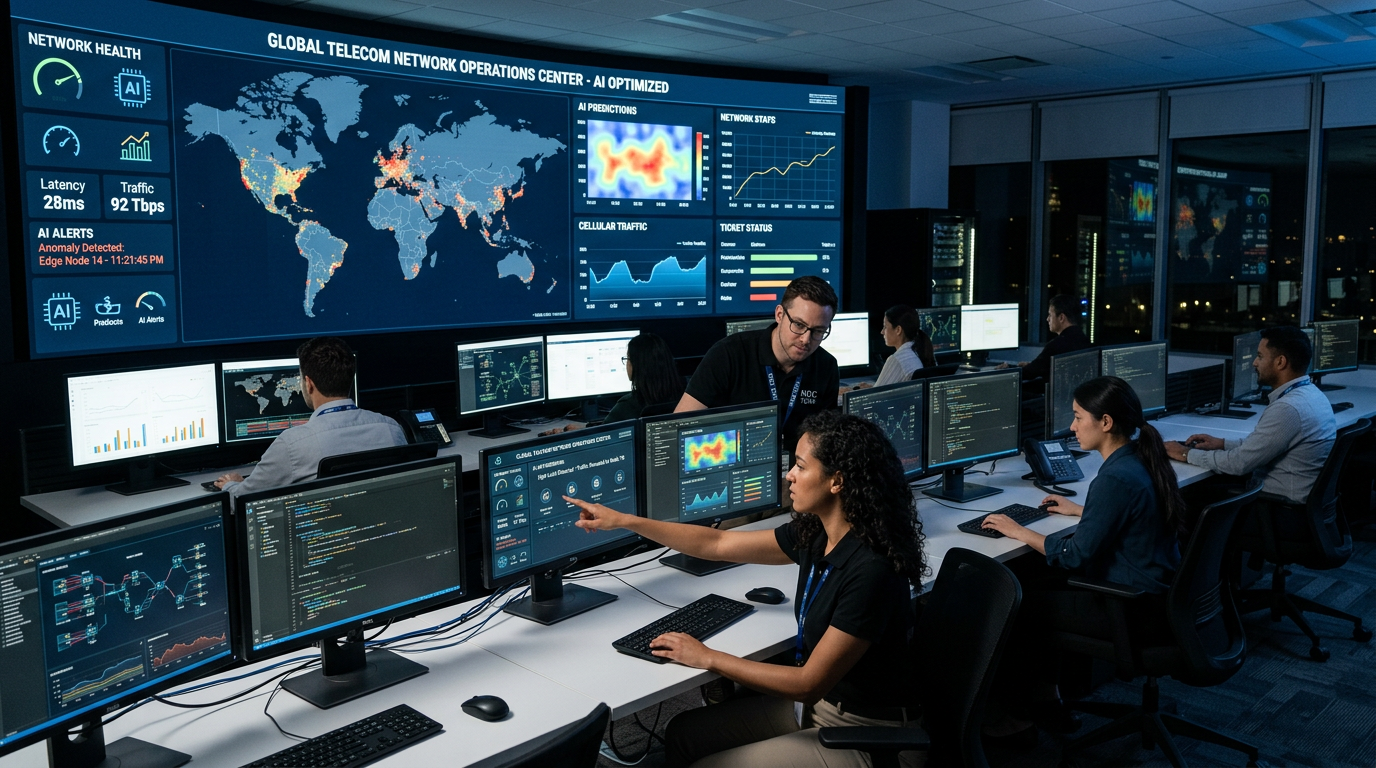
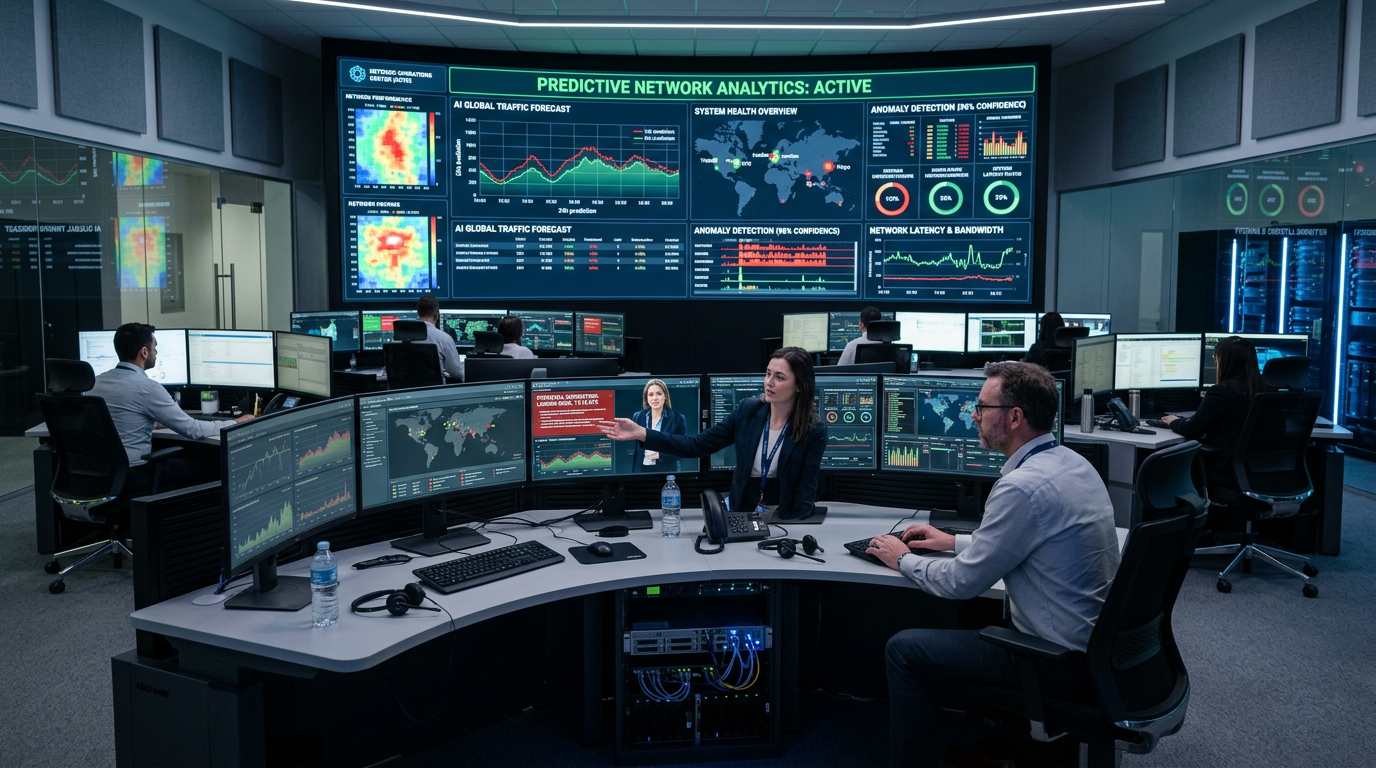
Tag: Predictive Network Operations

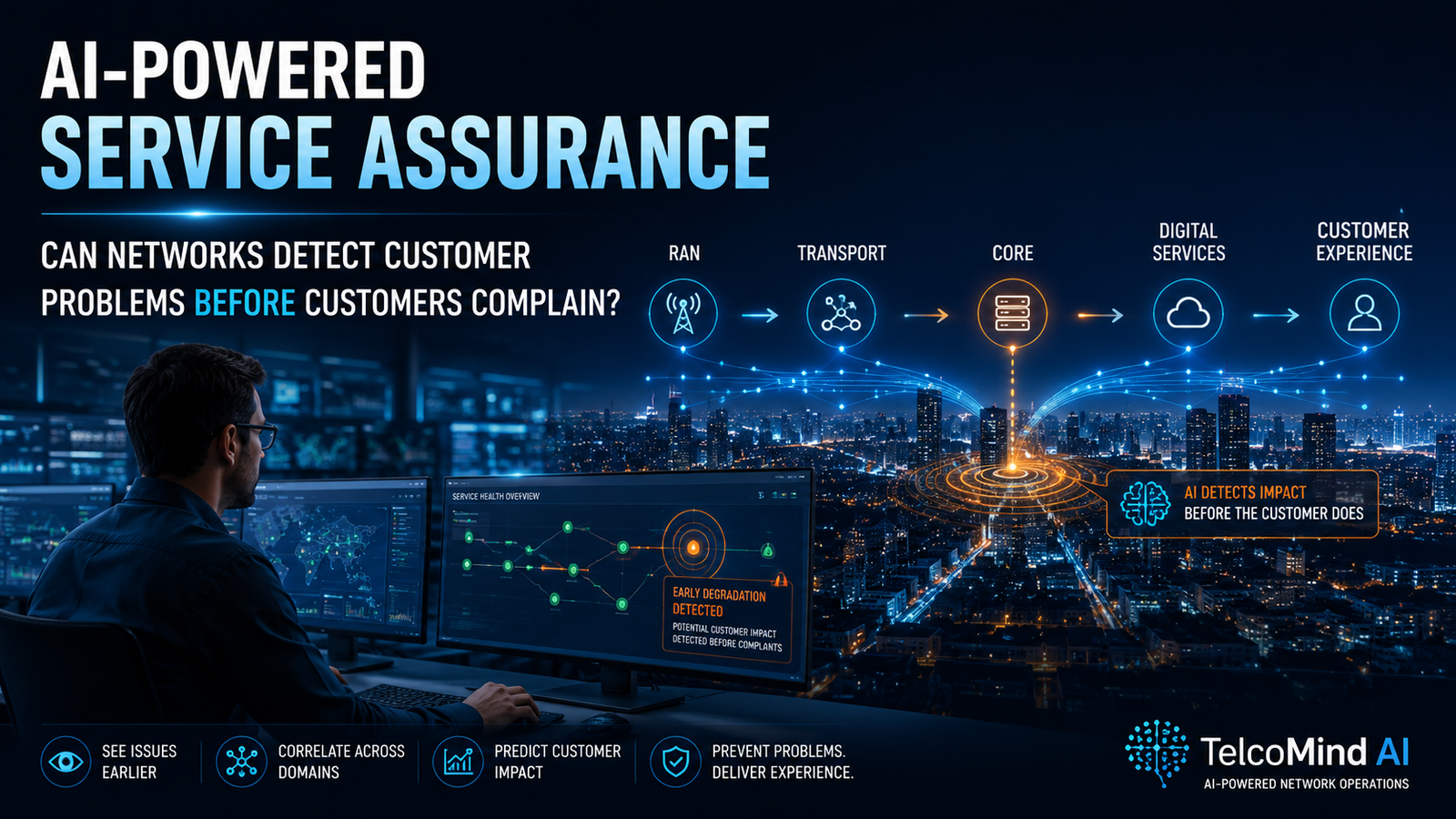
  • AI-Powered Service Assurance: Can Telecom Networks Detect Customer Problems Before Customers Complain?

    AI-Powered Service Assurance: Can Telecom Networks Detect Customer Problems Before Customers Complain?

    The Complaint That the Network Couldn’t See

    A customer walks into a telecom operator’s service center with a simple complaint:

    “My internet has been terrible every evening this week.”

    The customer-care agent checks the account.

    The subscription is active. There is no reported outage in the area. Coverage appears normal. Nothing obvious explains the problem.

    A ticket is opened.

    Later, the case reaches the network operations team.

    The engineer checks the serving cells.

    Availability? Normal.

    Traffic? High, but within expected range.

    Major alarms? None.

    Accessibility and retainability? Within thresholds.

    From the traditional network view, there is no clear incident to investigate.

    But the customer is not imagining the problem.

    When the data is examined more deeply, a different picture begins to appear.

    Every evening, traffic gradually increases across a cluster of cells. Radio conditions remain acceptable, but user throughput starts falling. Latency begins to rise. Retransmissions increase. A transport link serving the area approaches congestion during short periods.

    No single KPI crosses the threshold required to generate a major alarm.

    Yet together, these small changes are creating a very real service degradation.

    And there is an even bigger problem:

    This customer may not be the only one experiencing it.

    There could already be hundreds—or thousands—of subscribers in the same area receiving degraded service.

    The network has the data.

    The monitoring systems have the KPIs.

    The NOC has the dashboards.

    But nobody has yet connected all those signals into one simple conclusion:

    Customer experience is deteriorating here.

    Now imagine a different scenario.

    Before the first complaint arrives, an AI-powered assurance platform detects the unusual combination of declining throughput, increasing latency, changing traffic patterns and transport utilization.

    It compares the behavior with historical patterns.

    It identifies the affected location and services.

    It estimates the potential customer impact.

    And instead of waiting for a traditional alarm, it alerts operations:

    “Emerging service degradation detected. Customer impact likely. Investigation recommended.”

    The operational model has now changed.

    Customer complains → Ticket created → Network investigates

    becomes:

    Network detects → AI correlates → Customer impact predicted → Operations act

    That is the real opportunity behind AI-powered service assurance.

    It is not simply about creating smarter dashboards.

    It is about giving the network the intelligence to recognize when technical changes are becoming customer problems—before customers have to tell us.

    The Signals Were There — Just Not Connected

    When the operations team looks deeper, the picture begins to change. During the evening busy hour, traffic gradually increases across a cluster of cells. User throughput starts falling. Latency begins to rise. Retransmissions increase, while a transport link serving the area periodically approaches congestion.

    Individually, none of these changes appears serious enough to trigger a major incident. Together, however, they tell a completely different story.

    The network is technically available — but the service experience is deteriorating. And the customer who complained may represent only a small fraction of the people actually affected.

    The network had the data. The monitoring systems had the KPIs. What was missing was the intelligence to connect them.

    What If the Network Could See the Problem First?

    Now imagine the same situation unfolding differently. Before the first customer complaint arrives, an AI-powered assurance platform begins detecting subtle changes across multiple parts of the network.

    Instead of Watching One KPI, AI Connects the Signals

    The system observes declining user throughput, increasing latency, changing traffic patterns, retransmissions and rising transport utilization. Individually, these signals may not justify an alarm. But AI can correlate them across RAN, Transport, Core and service-level data, compare them with historical behavior, and recognize that something unusual is developing. The important difference is timing. Operations no longer need to wait for a major alarm or a growing number of customer complaints before starting the investigation. The network begins identifying customer-impacting degradation before the customer has to report it.

    CapabilityTraditional AssuranceAI-Powered Assurance
    DetectionThreshold-basedPattern & anomaly-based
    Data ViewIndividual KPIs & domainsCross-domain correlation
    Customer ImpactOften identified after degradationPredicted before wider impact
    OperationsReactive investigationProactive intervention
    Decision SupportEngineer interprets multiple toolsAI provides context & recommendations

    One Customer Complaint. Three Network Domains.

    Consider a customer experiencing poor video performance during the evening busy hour.

    What does the network see?

    RAN: User throughput is gradually declining as cell utilization increases. Transport: Packet latency and utilization are increasing on the aggregation path. Core: Sessions remain established and the service is technically available.

    Individually, none of these domains may show a major failure. Together, they may explain exactly why the customer experience is deteriorating.

    When Separate Network Signals Become One Service Story

    RAN Signals + Transport Signals + Core Signals

    AI Correlation & Service Intelligence

    Affected Customers & Services Identified

    Probable Cause + Recommended Action

    Instead of asking engineers to manually move between multiple monitoring systems and piece together the service impact, AI can bring the signals into a single operational context.

    The Problem Can Start Before the Alarm

    Traditional thresholds are useful, but customer experience can begin deteriorating long before a KPI reaches the point that triggers a major alarm.

    Illustrative view of the AI opportunity window between emerging customer-experience degradation and a traditional threshold-based alarm.

    When Everything Is “Within Threshold” — But the Service Is Not

    Consider an evening busy-hour scenario in a dense urban area.

    Network LayerWhat the NOC SeesIndividual ViewCustomer Reality
    RANCell utilization rising; user throughput decliningStill within operational thresholdSlower data experience begins
    TransportLatency and utilization gradually increasingNo major alarmVideo/application response deteriorates
    CoreSessions established normallyService appears availableCustomer remains connected but experience is poor
    AI AssuranceCorrelates RAN + Transport + Core behaviorCross-domain pattern identifiedEmerging customer impact detected

    The AI Has Detected the Risk. Should It Act?

    Detecting potential customer impact is only half the challenge. The next question is more difficult: how much authority should the AI actually have?

    The assurance platform now estimates a high probability of customer degradation and identifies congestion developing across the service path. It recommends traffic optimization before the condition becomes critical. Technically, the network could execute the action automatically. But should it?

    If the recommended action affects a limited, low-risk part of the network and the AI has seen the same pattern many times before, controlled automation may be appropriate.

    But if the action could influence a wider customer base, critical services or multiple network domains, the recommendation should reach an experienced engineer with the evidence behind it — what changed, what customers may be affected, why the AI reached its conclusion and what could happen if the action is taken.

    The goal is not AI making every decision. The goal is AI helping operations make the right decision earlier.

    From Prediction to Action: How Much Autonomy Is Enough?

    As AI confidence improves, service assurance can gradually move from simply detecting problems to recommending—and eventually executing—controlled actions.

    As AI-powered service assurance becomes more mature, its role can gradually move beyond detecting degradation. The system may first identify an unusual pattern, then estimate which customers and services could be affected, recommend an operational response and eventually execute proven low-risk actions automatically. But this progression should not mean removing human control. Higher-risk decisions — especially those affecting critical services, large customer populations or multiple network domains — should continue to involve experienced engineers. The real objective is therefore not maximum automation, but the right level of autonomy for the right operational decision.

    Detect → Understand → Recommend → Act → Verify

    So, Can Telecom Networks Really Detect Problems Before Customers Complain?

    Increasingly, yes — but not perfectly, and not in every situation.Telecom networks already generate many of the signals needed to identify emerging service degradation. The bigger challenge is bringing those signals together across network domains, understanding their relationship to customer experience and separating meaningful patterns from normal network variation.

    AI can make that process faster and more predictive. It can recognize combinations of weak signals that may be difficult to identify through static thresholds alone, estimate potential service impact and give operations teams an earlier opportunity to intervene.

    The real transformation is not from alarms to more intelligent alarms. It is from monitoring network health to protecting service experience.

    The Future NOC May Know Before the Customer Does

    The future of telecom operations may not be defined by how quickly the NOC responds to a customer-impacting incident, but by how often that incident can be identified before the customer ever needs to report it.

    Imagine a service-assurance environment continuously observing signals across RAN, Transport, Core and digital services. AI detects an emerging pattern, estimates the likely customer impact, identifies the probable contributing domains and gives the operations team an actionable recommendation — while the service is still functioning.

    For repetitive and well-understood scenarios, controlled automation could take the next step: execute the approved action, verify whether service performance has recovered and learn from the outcome.

    The best customer complaint may eventually be the one that never needs to happen.

    That is where AI-powered service assurance becomes more than another monitoring capability. It becomes a bridge between network intelligence, customer experience and increasingly autonomous operations — with experienced engineers providing the judgement, governance and control needed when the network situation demands it.

    How Ready Is Your NOC for AI-Powered Operations?

    Moving from reactive monitoring toward predictive and intelligent operations requires more than AI technology. It requires the right data, observability, automation, operational processes and governance.

    TelcoMind AI has developed a practical AI-Ready NOC Maturity Assessment to help telecom professionals evaluate where their operations stand today and identify the capabilities that may need further development.

    Assess your NOC across 8 dimensions and 32 operational areas — from Data & Observability to Closed-Loop Operations and Governance.

    Take the Free NOC AI Maturity Assessment →

    Continue Exploring Telecom AI

    From Reactive NOC to Predictive Operations: How AI Is Changing Telecom Network ManagementAI-Powered AIOps in Telecom:

    From Alarm Management to Autonomous Network Operations

    From Level 0 to Level 5: How Close Are We to Truly Autonomous Telecom Networks?

  • AI-Powered Service Assurance: Can Telecom Networks Detect Customer Problems Before Customers Complain?

    AI-Powered Service Assurance: Can Telecom Networks Detect Customer Problems Before Customers Complain?

    The Complaint That the Network Couldn’t See

    A customer walks into a telecom operator’s service center with a simple complaint:

    “My internet has been terrible every evening this week.”

    The customer-care agent checks the account.

    The subscription is active. There is no reported outage in the area. Coverage appears normal. Nothing obvious explains the problem.

    A ticket is opened.

    Later, the case reaches the network operations team.

    The engineer checks the serving cells.

    Availability? Normal.

    Traffic? High, but within expected range.

    Major alarms? None.

    Accessibility and retainability? Within thresholds.

    From the traditional network view, there is no clear incident to investigate.

    But the customer is not imagining the problem.

    When the data is examined more deeply, a different picture begins to appear.

    Every evening, traffic gradually increases across a cluster of cells. Radio conditions remain acceptable, but user throughput starts falling. Latency begins to rise. Retransmissions increase. A transport link serving the area approaches congestion during short periods.

    No single KPI crosses the threshold required to generate a major alarm.

    Yet together, these small changes are creating a very real service degradation.

    And there is an even bigger problem:

    This customer may not be the only one experiencing it.

    There could already be hundreds—or thousands—of subscribers in the same area receiving degraded service.

    The network has the data.

    The monitoring systems have the KPIs.

    The NOC has the dashboards.

    But nobody has yet connected all those signals into one simple conclusion:

    Customer experience is deteriorating here.

    Now imagine a different scenario.

    Before the first complaint arrives, an AI-powered assurance platform detects the unusual combination of declining throughput, increasing latency, changing traffic patterns and transport utilization.

    It compares the behavior with historical patterns.

    It identifies the affected location and services.

    It estimates the potential customer impact.

    And instead of waiting for a traditional alarm, it alerts operations:

    “Emerging service degradation detected. Customer impact likely. Investigation recommended.”

    The operational model has now changed.

    Customer complains → Ticket created → Network investigates

    becomes:

    Network detects → AI correlates → Customer impact predicted → Operations act

    That is the real opportunity behind AI-powered service assurance.

    It is not simply about creating smarter dashboards.

    It is about giving the network the intelligence to recognize when technical changes are becoming customer problems—before customers have to tell us.

    The Signals Were There — Just Not Connected

    When the operations team looks deeper, the picture begins to change. During the evening busy hour, traffic gradually increases across a cluster of cells. User throughput starts falling. Latency begins to rise. Retransmissions increase, while a transport link serving the area periodically approaches congestion.

    Individually, none of these changes appears serious enough to trigger a major incident. Together, however, they tell a completely different story.

    The network is technically available — but the service experience is deteriorating. And the customer who complained may represent only a small fraction of the people actually affected.

    The network had the data. The monitoring systems had the KPIs. What was missing was the intelligence to connect them.

    What If the Network Could See the Problem First?

    Now imagine the same situation unfolding differently. Before the first customer complaint arrives, an AI-powered assurance platform begins detecting subtle changes across multiple parts of the network.

    Instead of Watching One KPI, AI Connects the Signals

    The system observes declining user throughput, increasing latency, changing traffic patterns, retransmissions and rising transport utilization. Individually, these signals may not justify an alarm. But AI can correlate them across RAN, Transport, Core and service-level data, compare them with historical behavior, and recognize that something unusual is developing. The important difference is timing. Operations no longer need to wait for a major alarm or a growing number of customer complaints before starting the investigation. The network begins identifying customer-impacting degradation before the customer has to report it.

    CapabilityTraditional AssuranceAI-Powered Assurance
    DetectionThreshold-basedPattern & anomaly-based
    Data ViewIndividual KPIs & domainsCross-domain correlation
    Customer ImpactOften identified after degradationPredicted before wider impact
    OperationsReactive investigationProactive intervention
    Decision SupportEngineer interprets multiple toolsAI provides context & recommendations

    One Customer Complaint. Three Network Domains.

    Consider a customer experiencing poor video performance during the evening busy hour.

    What does the network see?

    RAN: User throughput is gradually declining as cell utilization increases. Transport: Packet latency and utilization are increasing on the aggregation path. Core: Sessions remain established and the service is technically available.

    Individually, none of these domains may show a major failure. Together, they may explain exactly why the customer experience is deteriorating.

    When Separate Network Signals Become One Service Story

    RAN Signals + Transport Signals + Core Signals

    AI Correlation & Service Intelligence

    Affected Customers & Services Identified

    Probable Cause + Recommended Action

    Instead of asking engineers to manually move between multiple monitoring systems and piece together the service impact, AI can bring the signals into a single operational context.

    The Problem Can Start Before the Alarm

    Traditional thresholds are useful, but customer experience can begin deteriorating long before a KPI reaches the point that triggers a major alarm.

    Illustrative view of the AI opportunity window between emerging customer-experience degradation and a traditional threshold-based alarm.

    When Everything Is “Within Threshold” — But the Service Is Not

    Consider an evening busy-hour scenario in a dense urban area.

    Network LayerWhat the NOC SeesIndividual ViewCustomer Reality
    RANCell utilization rising; user throughput decliningStill within operational thresholdSlower data experience begins
    TransportLatency and utilization gradually increasingNo major alarmVideo/application response deteriorates
    CoreSessions established normallyService appears availableCustomer remains connected but experience is poor
    AI AssuranceCorrelates RAN + Transport + Core behaviorCross-domain pattern identifiedEmerging customer impact detected

    The AI Has Detected the Risk. Should It Act?

    Detecting potential customer impact is only half the challenge. The next question is more difficult: how much authority should the AI actually have?

    The assurance platform now estimates a high probability of customer degradation and identifies congestion developing across the service path. It recommends traffic optimization before the condition becomes critical. Technically, the network could execute the action automatically. But should it?

    If the recommended action affects a limited, low-risk part of the network and the AI has seen the same pattern many times before, controlled automation may be appropriate.

    But if the action could influence a wider customer base, critical services or multiple network domains, the recommendation should reach an experienced engineer with the evidence behind it — what changed, what customers may be affected, why the AI reached its conclusion and what could happen if the action is taken.

    The goal is not AI making every decision. The goal is AI helping operations make the right decision earlier.

    From Prediction to Action: How Much Autonomy Is Enough?

    As AI confidence improves, service assurance can gradually move from simply detecting problems to recommending—and eventually executing—controlled actions.

    As AI-powered service assurance becomes more mature, its role can gradually move beyond detecting degradation. The system may first identify an unusual pattern, then estimate which customers and services could be affected, recommend an operational response and eventually execute proven low-risk actions automatically. But this progression should not mean removing human control. Higher-risk decisions — especially those affecting critical services, large customer populations or multiple network domains — should continue to involve experienced engineers. The real objective is therefore not maximum automation, but the right level of autonomy for the right operational decision.

    Detect → Understand → Recommend → Act → Verify

    So, Can Telecom Networks Really Detect Problems Before Customers Complain?

    Increasingly, yes — but not perfectly, and not in every situation.Telecom networks already generate many of the signals needed to identify emerging service degradation. The bigger challenge is bringing those signals together across network domains, understanding their relationship to customer experience and separating meaningful patterns from normal network variation.

    AI can make that process faster and more predictive. It can recognize combinations of weak signals that may be difficult to identify through static thresholds alone, estimate potential service impact and give operations teams an earlier opportunity to intervene.

    The real transformation is not from alarms to more intelligent alarms. It is from monitoring network health to protecting service experience.

    The Future NOC May Know Before the Customer Does

    The future of telecom operations may not be defined by how quickly the NOC responds to a customer-impacting incident, but by how often that incident can be identified before the customer ever needs to report it.

    Imagine a service-assurance environment continuously observing signals across RAN, Transport, Core and digital services. AI detects an emerging pattern, estimates the likely customer impact, identifies the probable contributing domains and gives the operations team an actionable recommendation — while the service is still functioning.

    For repetitive and well-understood scenarios, controlled automation could take the next step: execute the approved action, verify whether service performance has recovered and learn from the outcome.

    The best customer complaint may eventually be the one that never needs to happen.

    That is where AI-powered service assurance becomes more than another monitoring capability. It becomes a bridge between network intelligence, customer experience and increasingly autonomous operations — with experienced engineers providing the judgement, governance and control needed when the network situation demands it.

    How Ready Is Your NOC for AI-Powered Operations?

    Moving from reactive monitoring toward predictive and intelligent operations requires more than AI technology. It requires the right data, observability, automation, operational processes and governance.

    TelcoMind AI has developed a practical AI-Ready NOC Maturity Assessment to help telecom professionals evaluate where their operations stand today and identify the capabilities that may need further development.

    Assess your NOC across 8 dimensions and 32 operational areas — from Data & Observability to Closed-Loop Operations and Governance.

    Take the Free NOC AI Maturity Assessment →

    Continue Exploring Telecom AI

    From Reactive NOC to Predictive Operations: How AI Is Changing Telecom Network ManagementAI-Powered AIOps in Telecom:

    From Alarm Management to Autonomous Network Operations

    From Level 0 to Level 5: How Close Are We to Truly Autonomous Telecom Networks?

  • AI-Powered Service Assurance: Can Telecom Networks Detect Customer Problems Before Customers Complain?

    AI-Powered Service Assurance: Can Telecom Networks Detect Customer Problems Before Customers Complain?

    The Complaint That the Network Couldn’t See

    A customer walks into a telecom operator’s service center with a simple complaint:

    “My internet has been terrible every evening this week.”

    The customer-care agent checks the account.

    The subscription is active. There is no reported outage in the area. Coverage appears normal. Nothing obvious explains the problem.

    A ticket is opened.

    Later, the case reaches the network operations team.

    The engineer checks the serving cells.

    Availability? Normal.

    Traffic? High, but within expected range.

    Major alarms? None.

    Accessibility and retainability? Within thresholds.

    From the traditional network view, there is no clear incident to investigate.

    But the customer is not imagining the problem.

    When the data is examined more deeply, a different picture begins to appear.

    Every evening, traffic gradually increases across a cluster of cells. Radio conditions remain acceptable, but user throughput starts falling. Latency begins to rise. Retransmissions increase. A transport link serving the area approaches congestion during short periods.

    No single KPI crosses the threshold required to generate a major alarm.

    Yet together, these small changes are creating a very real service degradation.

    And there is an even bigger problem:

    This customer may not be the only one experiencing it.

    There could already be hundreds—or thousands—of subscribers in the same area receiving degraded service.

    The network has the data.

    The monitoring systems have the KPIs.

    The NOC has the dashboards.

    But nobody has yet connected all those signals into one simple conclusion:

    Customer experience is deteriorating here.

    Now imagine a different scenario.

    Before the first complaint arrives, an AI-powered assurance platform detects the unusual combination of declining throughput, increasing latency, changing traffic patterns and transport utilization.

    It compares the behavior with historical patterns.

    It identifies the affected location and services.

    It estimates the potential customer impact.

    And instead of waiting for a traditional alarm, it alerts operations:

    “Emerging service degradation detected. Customer impact likely. Investigation recommended.”

    The operational model has now changed.

    Customer complains → Ticket created → Network investigates

    becomes:

    Network detects → AI correlates → Customer impact predicted → Operations act

    That is the real opportunity behind AI-powered service assurance.

    It is not simply about creating smarter dashboards.

    It is about giving the network the intelligence to recognize when technical changes are becoming customer problems—before customers have to tell us.

    The Signals Were There — Just Not Connected

    When the operations team looks deeper, the picture begins to change. During the evening busy hour, traffic gradually increases across a cluster of cells. User throughput starts falling. Latency begins to rise. Retransmissions increase, while a transport link serving the area periodically approaches congestion.

    Individually, none of these changes appears serious enough to trigger a major incident. Together, however, they tell a completely different story.

    The network is technically available — but the service experience is deteriorating. And the customer who complained may represent only a small fraction of the people actually affected.

    The network had the data. The monitoring systems had the KPIs. What was missing was the intelligence to connect them.

    What If the Network Could See the Problem First?

    Now imagine the same situation unfolding differently. Before the first customer complaint arrives, an AI-powered assurance platform begins detecting subtle changes across multiple parts of the network.

    Instead of Watching One KPI, AI Connects the Signals

    The system observes declining user throughput, increasing latency, changing traffic patterns, retransmissions and rising transport utilization. Individually, these signals may not justify an alarm. But AI can correlate them across RAN, Transport, Core and service-level data, compare them with historical behavior, and recognize that something unusual is developing. The important difference is timing. Operations no longer need to wait for a major alarm or a growing number of customer complaints before starting the investigation. The network begins identifying customer-impacting degradation before the customer has to report it.

    CapabilityTraditional AssuranceAI-Powered Assurance
    DetectionThreshold-basedPattern & anomaly-based
    Data ViewIndividual KPIs & domainsCross-domain correlation
    Customer ImpactOften identified after degradationPredicted before wider impact
    OperationsReactive investigationProactive intervention
    Decision SupportEngineer interprets multiple toolsAI provides context & recommendations

    One Customer Complaint. Three Network Domains.

    Consider a customer experiencing poor video performance during the evening busy hour.

    What does the network see?

    RAN: User throughput is gradually declining as cell utilization increases. Transport: Packet latency and utilization are increasing on the aggregation path. Core: Sessions remain established and the service is technically available.

    Individually, none of these domains may show a major failure. Together, they may explain exactly why the customer experience is deteriorating.

    When Separate Network Signals Become One Service Story

    RAN Signals + Transport Signals + Core Signals

    AI Correlation & Service Intelligence

    Affected Customers & Services Identified

    Probable Cause + Recommended Action

    Instead of asking engineers to manually move between multiple monitoring systems and piece together the service impact, AI can bring the signals into a single operational context.

    The Problem Can Start Before the Alarm

    Traditional thresholds are useful, but customer experience can begin deteriorating long before a KPI reaches the point that triggers a major alarm.

    Illustrative view of the AI opportunity window between emerging customer-experience degradation and a traditional threshold-based alarm.

    When Everything Is “Within Threshold” — But the Service Is Not

    Consider an evening busy-hour scenario in a dense urban area.

    Network LayerWhat the NOC SeesIndividual ViewCustomer Reality
    RANCell utilization rising; user throughput decliningStill within operational thresholdSlower data experience begins
    TransportLatency and utilization gradually increasingNo major alarmVideo/application response deteriorates
    CoreSessions established normallyService appears availableCustomer remains connected but experience is poor
    AI AssuranceCorrelates RAN + Transport + Core behaviorCross-domain pattern identifiedEmerging customer impact detected

    The AI Has Detected the Risk. Should It Act?

    Detecting potential customer impact is only half the challenge. The next question is more difficult: how much authority should the AI actually have?

    The assurance platform now estimates a high probability of customer degradation and identifies congestion developing across the service path. It recommends traffic optimization before the condition becomes critical. Technically, the network could execute the action automatically. But should it?

    If the recommended action affects a limited, low-risk part of the network and the AI has seen the same pattern many times before, controlled automation may be appropriate.

    But if the action could influence a wider customer base, critical services or multiple network domains, the recommendation should reach an experienced engineer with the evidence behind it — what changed, what customers may be affected, why the AI reached its conclusion and what could happen if the action is taken.

    The goal is not AI making every decision. The goal is AI helping operations make the right decision earlier.

    From Prediction to Action: How Much Autonomy Is Enough?

    As AI confidence improves, service assurance can gradually move from simply detecting problems to recommending—and eventually executing—controlled actions.

    As AI-powered service assurance becomes more mature, its role can gradually move beyond detecting degradation. The system may first identify an unusual pattern, then estimate which customers and services could be affected, recommend an operational response and eventually execute proven low-risk actions automatically. But this progression should not mean removing human control. Higher-risk decisions — especially those affecting critical services, large customer populations or multiple network domains — should continue to involve experienced engineers. The real objective is therefore not maximum automation, but the right level of autonomy for the right operational decision.

    Detect → Understand → Recommend → Act → Verify

    So, Can Telecom Networks Really Detect Problems Before Customers Complain?

    Increasingly, yes — but not perfectly, and not in every situation.Telecom networks already generate many of the signals needed to identify emerging service degradation. The bigger challenge is bringing those signals together across network domains, understanding their relationship to customer experience and separating meaningful patterns from normal network variation.

    AI can make that process faster and more predictive. It can recognize combinations of weak signals that may be difficult to identify through static thresholds alone, estimate potential service impact and give operations teams an earlier opportunity to intervene.

    The real transformation is not from alarms to more intelligent alarms. It is from monitoring network health to protecting service experience.

    The Future NOC May Know Before the Customer Does

    The future of telecom operations may not be defined by how quickly the NOC responds to a customer-impacting incident, but by how often that incident can be identified before the customer ever needs to report it.

    Imagine a service-assurance environment continuously observing signals across RAN, Transport, Core and digital services. AI detects an emerging pattern, estimates the likely customer impact, identifies the probable contributing domains and gives the operations team an actionable recommendation — while the service is still functioning.

    For repetitive and well-understood scenarios, controlled automation could take the next step: execute the approved action, verify whether service performance has recovered and learn from the outcome.

    The best customer complaint may eventually be the one that never needs to happen.

    That is where AI-powered service assurance becomes more than another monitoring capability. It becomes a bridge between network intelligence, customer experience and increasingly autonomous operations — with experienced engineers providing the judgement, governance and control needed when the network situation demands it.

    How Ready Is Your NOC for AI-Powered Operations?

    Moving from reactive monitoring toward predictive and intelligent operations requires more than AI technology. It requires the right data, observability, automation, operational processes and governance.

    TelcoMind AI has developed a practical AI-Ready NOC Maturity Assessment to help telecom professionals evaluate where their operations stand today and identify the capabilities that may need further development.

    Assess your NOC across 8 dimensions and 32 operational areas — from Data & Observability to Closed-Loop Operations and Governance.

    Take the Free NOC AI Maturity Assessment →

    Continue Exploring Telecom AI

    From Reactive NOC to Predictive Operations: How AI Is Changing Telecom Network ManagementAI-Powered AIOps in Telecom:

    From Alarm Management to Autonomous Network Operations

    From Level 0 to Level 5: How Close Are We to Truly Autonomous Telecom Networks?

  • AI-Powered AIOps in Telecom: From Alarm Management to Autonomous Network Operations

    AI-Powered AIOps in Telecom: From Alarm Management to Autonomous Network Operations

    Telecom network operations are reaching an important inflection point. For decades, Network Operations Centers (NOCs) have relied heavily on alarms, dashboards, trouble tickets and human expertise to maintain network availability. This operating model has served the industry well, but the scale and complexity of modern telecom networks are making purely reactive operations increasingly difficult.

    5G, cloud-native network functions, edge computing, virtualization, APIs and increasingly distributed infrastructure generate enormous volumes of operational data. A single service degradation can create alarms across several interconnected domains—including radio, transport, IP, core, cloud and applications.

    The challenge for the modern NOC is therefore no longer simply detecting alarms.

    The real challenge is determining: What is happening? Why is it happening? What services and customers are affected? What is likely to happen next? And what action should be taken?

    This is where Artificial Intelligence for IT Operations (AIOps) is becoming strategically important for telecom operators.

    AIOps has the potential to transform the NOC from an environment dominated by alarm monitoring and manual correlation into an intelligent operations function capable of detecting patterns, identifying anomalies, supporting root-cause analysis, predicting emerging risks and ultimately enabling controlled automated actions.

    What Is AIOps in Telecom?

    AIOps combines operational data, analytics, machine learning and automation to improve how complex technology environments are monitored, understood and managed. In telecom, however, its potential extends well beyond traditional IT monitoring.

    A modern telecom network generates information from multiple operational layers: network alarms, performance counters, KPIs, logs, topology, configuration changes, trouble tickets, customer-experience indicators, historical incidents, traffic patterns and OSS/BSS platforms.

    Traditionally, much of this information is viewed through separate tools and dashboards. Engineers must manually connect the pieces to understand what is happening across the network.

    AIOps introduces an intelligence layer across these datasets. By correlating events, identifying abnormal patterns and learning from historical behaviour, it can help transform large volumes of operational data into actionable insight.

    The difference can be summarized simply:

    Traditional NOC:
    Alarm → Human Investigation → Diagnosis → Action

    AI-Enabled NOC:
    Data → Correlation → Anomaly Detection → Prediction → Decision → Assisted or Automated Action

    AIOps therefore should not be viewed as simply another monitoring platform. Its real value lies in introducing intelligence into the operational decision cycle.

    The Problem with Traditional Alarm Management

    Consider a transmission failure affecting several mobile sites. One underlying network problem may trigger multiple alarms across different network domains.

    The NOC may simultaneously receive indications such as:

    Link Down
    Node Unreachable
    Cell Unavailable
    Transport Connectivity Failure
    Service Degradation
    Customer Complaints

    To an engineer looking at individual monitoring systems, these may initially appear to be separate problems. In reality, many of them could be symptoms of a single underlying failure.

    This creates one of the biggest challenges in modern network operations: the NOC does not necessarily suffer from a lack of information. It often suffers from too much information without sufficient context

    1. Alarm Overload

    Large telecom networks can generate enormous numbers of alarms and events. During a major incident, engineers may need to distinguish a relatively small number of meaningful signals from hundreds of secondary or consequential alarms. This increases operational workload and can delay incident prioritization.

    2. Slow Root-Cause Identification

    Modern services depend on multiple interconnected domains including RAN, transport, IP, core, cloud and applications. A fault originating in one layer may therefore produce symptoms across several others, making manual correlation increasingly difficult.

    3. Reactive Decision-Making

    Traditional monitoring frequently initiates action only after a threshold has been breached, an alarm has been generated or service degradation has already occurred. By that stage, customers may already be experiencing the impact.

    From Alarm Correlation to Operational Intelligence

    One of the first major opportunities for AIOps in telecom is intelligent event correlation. Instead of treating every alarm as an independent event, AIOps can analyze relationships among alarms, network topology, performance indicators, historical incidents and recent network changes.

    For example, imagine that dozens of mobile sites become unreachable within a short period. At the same time, the NOC receives transmission alarms, IP connectivity alarms and customer-impact indicators. A traditional monitoring environment may present these as separate events requiring engineers from several domains to investigate simultaneously.

    An intelligent operations platform could instead examine several dimensions of the incident:

    Time correlation — Which alarms appeared first, and which followed afterward?

    Topology correlation — Do the affected sites depend on a common router, transmission path or infrastructure element?

    Performance correlation — Did any KPI begin behaving abnormally before the alarms appeared?

    Change correlation — Was a configuration change, software upgrade or maintenance activity performed shortly before the incident?

    Historical correlation — Has a similar combination of symptoms occurred previously, and what was the root cause?

    Service correlation — Which services and customer segments depend on the affected infrastructure?

    The objective is to transform operational noise into context.

    100+ alarms

    1 correlated incident

    Probable root cause

    Service/customer impact

    Recommended investigation or action

    This changes the role of the NOC. Engineers can spend less time manually collecting and correlating information and more time validating the diagnosis, assessing operational risk and deciding the appropriate response.

    The value of AIOps therefore does not come simply from processing more data. It comes from reducing the distance between detecting a problem and understanding what the problem actually means.

    Predicting Problems Before Customers Experience Them

    Event correlation helps the NOC understand what is happening now. The next stage of intelligent operations is more powerful: identifying abnormal behaviour early enough to understand what may happen next.

    Traditional monitoring usually depends on predefined thresholds. For example, an alarm may be generated when CPU utilization exceeds a specified level, packet loss crosses a limit or an interface goes down. These mechanisms remain important, but they often detect a problem only after a predefined condition has already been reached.

    AI-based anomaly detection can complement this approach by learning normal patterns of network behaviour and identifying deviations that may not yet have crossed a conventional alarm threshold.

    Potential examples include:

    Gradually increasing packet loss
    Abnormal CPU or memory behaviour
    Optical power degradation
    Increasing network latency
    Unusual traffic patterns
    Repeated interface instability
    Capacity exhaustion trends
    Power or battery deterioration
    Temperature abnormalities
    Changing radio-performance patterns

    Consider a network interface whose utilization normally remains between 40% and 60%. If traffic begins increasing unusually every evening and the trend indicates that available capacity may soon become insufficient, a traditional system may remain silent until a fixed congestion threshold is crossed.

    A predictive AIOps approach could recognize the abnormal trend earlier, estimate the probability of future congestion and alert the operations team before customers experience significant degradation.

    The operational question therefore changes from:

    “What has failed?”

    to:

    “What is beginning to behave abnormally, why is it changing, and what could happen if no action is taken?”

    This shift from failure detection to failure anticipation is one of the most important characteristics of predictive network operations.

    This predictive capability is part of the broader evolution from reactive monitoring toward intelligent network operations, which we explored in From Reactive NOC to Predictive Operations: How AI Is Changing Telecom Network Management.

    AIOps and AI-Assisted Root Cause Analysis

    Identifying that a service is degraded is only the beginning of incident management. The more difficult question is often: What actually caused the degradation?

    In a modern telecom environment, a customer-experience problem may originate from several interconnected domains:

    RAN → Transport → IP Network → Core Network → Cloud Infrastructure → Applications and Services

    A symptom observed in one domain does not necessarily mean that the root cause exists in that domain. For example, multiple cell outages may appear to be a radio-network problem while the actual cause is a common transport failure. Similarly, poor application performance may ultimately originate from IP congestion, DNS behaviour or an upstream infrastructure issue.

    Traditional Root Cause Analysis (RCA) therefore requires engineers to examine alarms, logs, KPIs, topology, configuration changes and historical incidents—often across multiple tools and technical teams.

    AIOps can potentially accelerate this process by bringing these signals together and ranking the most probable causes.

    Alarm correlation — Which events are related?

    Topology analysis — What infrastructure dependencies exist?

    KPI analysis — Which performance indicators changed first?

    Log analysis — What abnormal system behaviour was recorded?

    Change correlation — Was anything modified immediately before the incident?

    Historical learning — Have similar symptoms occurred before?

    Customer-impact analysis — Which services and users are actually affected?

    Instead of requiring engineers to begin every investigation from zero, an intelligent RCA capability can provide a prioritized hypothesis:

    Observed symptoms

    Correlated evidence

    Probable root causes ranked by confidence

    Recommended investigation

    Engineer validation

    This does not mean AI should automatically be trusted to determine the cause of every major network incident. Telecom networks are complex, and correlation does not always prove causation. The real operational value is in helping engineers narrow the investigation faster and focus attention on the most relevant evidence.

    The industry is already experimenting with more advanced approaches. In a GSMA-published case study involving China Mobile and ZTE, an AI-based fault-management approach combined knowledge graphs, graph neural networks and large language models to analyze information including alarms, logs, performance data and customer complaints. The reported trials achieved more than 90% root-cause identification accuracy and reduced average diagnosis time from approximately 15 minutes to around three minutes.

    Such results should not be assumed to apply universally across every telecom environment, but they demonstrate the potential operational impact when AI is combined with high-quality network data and domain knowledge.

    From AI Recommendations to Closed-Loop Automation

    Prediction and diagnosis can make network operations faster, but they do not by themselves create an autonomous network. The next stage is connecting intelligence with controlled operational action.

    A mature AIOps environment can progressively support an operational loop such as:

    Observe

    Detect

    Correlate

    Diagnose

    Decide

    Act

    Verify

    Learn

    Consider a simplified capacity-management scenario. An AIOps platform detects an abnormal traffic pattern and predicts that a network resource is approaching congestion. It correlates the condition with topology, utilization and service-impact information and determines that additional capacity or traffic optimization may be required.

    At a lower level of automation, the system may simply alert an engineer and recommend an action.

    At a more advanced level, the platform could execute a pre-approved remediation workflow, monitor the affected KPIs and verify whether network performance has returned to the desired state.

    If the action does not produce the expected result, the workflow should stop, escalate or initiate a controlled rollback rather than continuing blindly.

    This creates a closed operational cycle:

    Detect abnormal condition → Determine probable cause → Select approved action → Execute → Measure outcome → Validate or Roll Back

    The important distinction is that closed-loop automation is not simply automation without humans. It is automation operating within clearly defined policies, confidence thresholds, safeguards and escalation mechanisms.

    For telecom operators, this distinction is critical because an incorrect automated action can sometimes create a larger service impact than the original problem.

    The objective should therefore be progressive autonomy: automate repetitive, predictable and well-understood decisions first, while retaining human oversight for high-risk, ambiguous or business-critical situations.

    The Emerging Role of Agentic AI in Telecom Operations

    AIOps is itself beginning to evolve. One of the most important emerging developments is Agentic AI—AI systems designed not only to analyze information, but also to reason about objectives, use available tools and coordinate actions toward a defined operational goal.

    Traditional automation generally follows predefined instructions:

    If condition X occurs → execute action Y

    AIOps adds intelligence:

    Observe data → detect patterns → correlate events → predict or recommend

    Agentic AI potentially takes this further:

    Understand objective → gather evidence → reason about alternatives → coordinate tools or agents → recommend or execute action → evaluate the outcome

    In a future telecom operations environment, different specialized AI agents could support different operational responsibilities.

    Fault Management Agent — investigates alarms, identifies relationships between events and develops probable fault hypotheses.

    Performance Agent — analyzes KPIs, capacity trends and abnormal performance behaviour.

    Topology Agent — understands dependencies between network elements, services and infrastructure.

    Customer Experience Agent — evaluates whether network conditions are affecting particular services or customer segments.

    Change Intelligence Agent — examines recent configuration changes, upgrades and maintenance activities that may be associated with an incident.

    Remediation Agent — identifies possible corrective actions and, where governance permits, executes approved workflows.

    These agents would not necessarily operate independently. A coordinating intelligence layer could potentially combine their findings around a common objective such as:

    “Restore service while minimizing customer impact and avoiding additional network risk.”

    Imagine a major service degradation occurring shortly after a network change. The Fault Management Agent identifies a cluster of related alarms. The Change Intelligence Agent detects a strong temporal relationship with the recent activity. The Topology Agent identifies the affected service dependencies, while the Customer Experience Agent determines the scale of customer impact.

    Instead of several engineering teams manually collecting the same information from different systems, an agentic operations environment could potentially assemble the evidence, develop a prioritized diagnosis and propose the safest recovery options.

    However, Agentic AI should not be confused with unrestricted autonomous control. Giving AI systems access to operational tools introduces significant questions around security, authorization, explainability, accountability and operational safety.

    The progression should therefore be controlled:

    AI observes

    AI recommends

    Human approves

    AI executes within policy

    AI verifies

    Greater autonomy is introduced only where confidence and governance justify it

    This may ultimately become one of the defining characteristics of autonomous telecom operations: not a single AI controlling the entire network, but an ecosystem of specialized intelligence working within clearly defined operational boundaries.

    Why Human Engineers Will Remain Critical

    The evolution toward autonomous operations does not mean that human expertise becomes unnecessary. In fact, as AI assumes responsibility for more routine analysis and automation, the value of experienced engineers may shift toward judgment, governance, validation and complex decision-making.

    Telecom networks are critical infrastructure. A recommendation that appears technically correct from one operational perspective may create unintended consequences elsewhere in the network. Engineers therefore remain essential for understanding business priorities, service dependencies, operational risk and exceptional conditions that may not be fully represented in historical data.

    Human oversight becomes particularly important in several areas:

    High-impact incidents — Major outages and national-level service disruptions may require decisions that extend beyond what an automated model should be authorized to make.

    Low-confidence diagnoses — When evidence is incomplete or contradictory, AI should escalate rather than act with unjustified certainty.

    Major network changes — Software upgrades, migrations and architecture changes may introduce conditions that historical models have never encountered.

    Security-sensitive actions — Automated systems must operate within strict authorization and access-control boundaries.

    Business and customer priorities — The technically optimal action may not always be the most appropriate business decision.

    Governance and accountability — Operators need clear ownership of automated decisions, policies and outcomes.

    The role of the NOC engineer therefore evolves rather than disappears.

    Traditional role:
    Monitor → Investigate → Troubleshoot → Restore

    Emerging role:
    Validate → Decide → Govern → Orchestrate → Improve

    Engineers will increasingly need to understand not only network technologies, but also data, automation logic, AI outputs, confidence levels and the operational policies governing autonomous actions.

    The future NOC may therefore require fewer repetitive manual activities while demanding a higher level of cross-domain knowledge and decision-making capability from its people.

    The autonomous NOC should not be viewed as a NOC without engineers. It should be viewed as a NOC where human expertise is amplified by machine intelligence.

    The Journey Toward Autonomous Network Operations

    The transition from traditional network operations to autonomous operations will not happen in a single technology deployment. It is better understood as a progressive maturity journey, where operators increase automation and decision intelligence as their data, processes, governance and operational confidence improve.

    A practical evolution can be viewed across five stages:

    Stage 1 — Reactive Operations

    Network monitoring is primarily alarm-driven. Engineers identify incidents, collect information, troubleshoot the problem and manually execute corrective actions. Automation is limited and operational knowledge depends heavily on individual experience.

    Stage 2 — Automated Operations

    Repetitive and well-understood activities begin to use scripts, workflows and rule-based automation. This improves operational efficiency, but most decisions still depend on predefined conditions rather than intelligent analysis.

    Stage 3 — AI-Assisted Operations

    AIOps introduces event correlation, anomaly detection, intelligent prioritization and AI-assisted root-cause analysis. Engineers remain responsible for most operational decisions, but AI helps reduce the time required to understand complex incidents.

    Stage 4 — Predictive and Prescriptive Operations

    The operational model begins shifting from detecting failures to anticipating them. AI identifies emerging risks, predicts potential service degradation and recommends preventive or corrective actions based on network context.

    Stage 5 — Closed-Loop Autonomous Operations

    For suitable use cases, the network can detect abnormal conditions, determine probable causes, select policy-approved actions, execute remediation and verify the outcome with limited human intervention. Engineers increasingly focus on governance, exceptions, optimization and continuous improvement.

    Reactive

    Automated

    AI-Assisted

    Predictive & Prescriptive

    Closed-Loop Autonomous

    Not every network function needs to reach the highest level of autonomy. A low-risk optimization activity may be suitable for closed-loop execution, while a major core-network change or national service incident may continue to require explicit human authorization.

    The appropriate level of autonomy should therefore depend on factors such as operational risk, confidence, service criticality, reversibility, security and business impact.

    The objective should not be:

    “Automate everything.”

    A better objective is:

    “Apply the right level of intelligence and autonomy to each operational decision.”

    Conclusion: Building the Intelligent NOC

    AIOps represents much more than a new generation of monitoring tools. It reflects a fundamental change in how telecom operators can understand, manage and eventually automate increasingly complex networks.

    The traditional NOC was largely designed around visibility and reaction: detect an alarm, investigate the problem and restore the affected service.

    The intelligent NOC extends that operating model toward:

    Observe → Understand → Correlate → Predict → Decide → Act → Verify → Learn

    Event correlation can reduce operational noise. Anomaly detection can identify unusual behaviour before conventional thresholds are breached. AI-assisted root-cause analysis can help engineers narrow complex investigations. Predictive analytics can provide earlier warning of emerging risks, while controlled closed-loop automation can progressively connect operational intelligence with action.

    Agentic AI may take this evolution further by enabling specialized intelligence to collaborate across fault management, performance, topology, customer experience, change analysis and remediation.

    But technology alone will not create an autonomous network.

    Telecom operators will also need high-quality data, reliable observability, well-designed operational processes, strong governance, security controls, workforce capabilities and trust in automated decision-making.

    The most successful operators may therefore not be those that deploy the greatest number of AI tools. They will be those that successfully integrate people, processes, data, network intelligence and automation into one coherent operational system.

    The destination is not a NOC without people.

    The destination is a NOC where human expertise and machine intelligence work together to detect earlier, understand faster, decide more intelligently and act with greater confidence.

    Continue Exploring

    The journey toward AIOps begins with understanding the broader transition from reactive monitoring to predictive network operations. From Reactive NOC to Predictive Operations: How AI Is Changing Telecom Network Management

    Industry Perspectives & Further Reading

    GSMA — AI for Networks

    Industry perspectives on how AI, automation and intelligent operations are supporting the evolution toward increasingly autonomous telecom networks.

    TM Forum — AI-Native Intelligent Operations

    Industry frameworks and research covering AI-enabled operations, autonomous networks and the transformation of telecom operating models.

    Ericsson — Autonomous Network Operations

    Technical perspectives on the evolution from reactive network management toward intent-driven, AI-enabled and autonomous operations.

    Nokia — Digital Operations Center

    Industry approaches to AIOps, service assurance and closed-loop automation across complex multi-domain telecom environments.

    AIOps Is Part of a Bigger AI Transformation

    AIOps provides an important intelligence layer for modern telecom operations, particularly through anomaly detection, alarm correlation, root-cause analysis and operational automation.

    But it is only one part of a much wider transformation.

    Predictive operations, preventive maintenance, Agentic AI, Network Digital Twins, AI-RAN, energy optimization and service assurance are increasingly becoming connected parts of the journey toward intelligent and autonomous telecom networks.

    The next evolution is self-healing operations, where AI moves beyond detecting and correlating problems to diagnosing failures, selecting controlled recovery actions and verifying that services have actually recovered.

    Explore the broader picture:
    AI in Telecom: 10 Real-World Use Cases Transforming Network Operations in 2026
  • From Reactive NOC to Predictive Operations: How AI Is Changing Telecom Network Management

    From Reactive NOC to Predictive Operations: How AI Is Changing Telecom Network Management

    Telecom network operations are entering a fundamental transition. Traditional Network Operations Centers (NOCs) have largely been built around monitoring alarms, identifying failures and responding after service degradation occurs. Artificial Intelligence is changing this model by enabling telecom operators to detect patterns, anticipate network anomalies and support operational decisions before customers experience significant impact.

    From Reactive Monitoring to Predictive Operations

    For decades, telecom operations have followed a largely reactive model: an alarm is generated, the NOC identifies the affected network element, engineers investigate the root cause, and corrective action follows. This model remains essential, but modern networks are becoming too complex, dynamic and interconnected to depend entirely on human-led reaction. AI introduces a different operational capability: learning from alarms, performance indicators, logs, traffic patterns and historical incidents to identify abnormal behaviour earlier and help predict where service degradation may emerge.

    The important shift is therefore not simply from manual operations to automation. It is a shift from “What has failed?” to “What is likely to fail next, why, and what action should we take before customers are affected?” That change fundamentally reshapes the role of the modern NOC.

    Figure 1. The journey from reactive network operations to AI-driven autonomous telecom networks.

    How AI Enables Predictive Network Operations

    AI-driven predictive operations combine network telemetry, performance indicators, alarms, logs and historical incident data to identify patterns that may indicate emerging service degradation. Instead of treating each alarm as an isolated event, AI can correlate signals across multiple network domains and help operations teams understand whether seemingly unrelated events are part of a larger network condition.

    The real operational value appears when prediction is connected with decision support. Detecting an anomaly is useful, but identifying its likely impact, probable cause and recommended response makes the insight actionable. This allows the NOC to move progressively from monitoring events toward anticipating service risks and supporting intervention before customers experience significant degradation.

    A Simple Operational Example

    Consider a mobile network where packet loss begins increasing gradually while interface utilization, latency and retransmissions also start deviating from their normal patterns. A traditional monitoring system may generate separate threshold alarms only after individual KPIs cross predefined limits. An AI-enabled system can instead correlate these weak signals, compare them with historical behaviour and identify an emerging congestion pattern earlier.

    The NOC engineer remains important, but the nature of the work changes. Instead of spending most of the time discovering what is happening, the engineer can focus on validating the predicted risk, understanding business impact and selecting the appropriate corrective action.

    From Prediction to Autonomous Operations

    Predictive capability is only one stage in the evolution toward autonomous telecom operations. The next step is connecting network intelligence with controlled automation. Once an emerging problem is detected and its likely impact is understood, the operational system can recommend or initiate an appropriate response based on predefined policies, risk levels and governance rules.

    However, autonomy should not mean uncontrolled automation. Telecom networks carry critical services, and an incorrect automated decision can potentially create greater impact than the original problem. For this reason, the level of automation should depend on operational risk. Low-risk and repetitive actions may be automated, while high-impact changes should continue to require human validation and approval.

    The Human Role Does Not Disappear

    As networks become more autonomous, the role of the NOC engineer evolves rather than disappears. Engineers increasingly move from repetitive monitoring and manual troubleshooting toward validation, exception management, service-impact assessment and governance of automated decisions.

    The future NOC therefore requires both technical expertise and intelligent automation. AI can process enormous volumes of operational data and identify patterns that humans may not detect quickly, while experienced engineers provide context, judgement and accountability. The strongest operating model combines both capabilities.

    What This Means Inside a Real NOC

    In a real telecom NOC, the journey toward predictive operations does not begin with full autonomy. It begins with improving visibility and connecting information that already exists across the network. Alarms, KPI degradation, traffic behaviour, change activities, customer complaints and historical incidents often provide different pieces of the same operational story.

    Consider a major service degradation occurring shortly after a planned network activity. Traditional troubleshooting may require engineers to manually review alarms, logs, routing behaviour and recent changes while multiple technical teams work in parallel. An intelligent operations platform could correlate the timing of the change with abnormal network behaviour, identify the most probable affected domain and present the NOC with prioritized evidence for investigation.

    The immediate value is not that AI makes the final decision. The value is that it can reduce the time between “something is wrong” and “this is where we should investigate first.” For critical telecom incidents, that reduction can directly contribute to faster restoration and lower customer impact.

    The Path Forward

    The transition from reactive NOCs to predictive and eventually autonomous operations will be gradual. Telecom operators need reliable data, strong observability, clearly defined operational policies and appropriate governance before increasing the level of automation.

    The objective should not be automation for its own sake. The objective is a network operation that can detect earlier, understand faster, decide more intelligently and act with greater confidence.

    The autonomous NOC is therefore not a NOC without people. It is a NOC where human expertise is amplified by machine intelligence.

    Industry Perspectives & Further Reading

    TM Forum — Autonomous Networks & AI-Native Operations
    Industry frameworks and operator case studies on the progression toward higher levels of autonomous network operations.

    ETSI — Zero-touch Network and Service Management (ZSM)
    Standards and frameworks for closed-loop automation, AI-enabled network management and the evolution from automation toward autonomy.

    ITU-T — Intent-Driven Telecommunication Operation and Management
    A standards-based framework connecting intent, artificial intelligence and closed-loop management for autonomous telecom operations.

    Predictive operations are only one part of the wider AI transformation taking place across telecom networks. AI is also being applied to alarm correlation, preventive maintenance, Agentic AI, Network Digital Twins, 5G optimization, energy efficiency, service assurance and increasingly autonomous network operations.

    Explore the complete overview:
    AI in Telecom: 10 Real-World Use Cases Transforming Network Operations in 2026

  • From Reactive NOC to Predictive Operations: How AI Is Changing Telecom Network Management

    From Reactive NOC to Predictive Operations: How AI Is Changing Telecom Network Management

    Telecom network operations are entering a fundamental transition. Traditional Network Operations Centers (NOCs) have largely been built around monitoring alarms, identifying failures and responding after service degradation occurs. Artificial Intelligence is changing this model by enabling telecom operators to detect patterns, anticipate network anomalies and support operational decisions before customers experience significant impact.

    From Reactive Monitoring to Predictive Operations

    For decades, telecom operations have followed a largely reactive model: an alarm is generated, the NOC identifies the affected network element, engineers investigate the root cause, and corrective action follows. This model remains essential, but modern networks are becoming too complex, dynamic and interconnected to depend entirely on human-led reaction. AI introduces a different operational capability: learning from alarms, performance indicators, logs, traffic patterns and historical incidents to identify abnormal behaviour earlier and help predict where service degradation may emerge.

    The important shift is therefore not simply from manual operations to automation. It is a shift from “What has failed?” to “What is likely to fail next, why, and what action should we take before customers are affected?” That change fundamentally reshapes the role of the modern NOC.

    Figure 1. The journey from reactive network operations to AI-driven autonomous telecom networks.

    How AI Enables Predictive Network Operations

    AI-driven predictive operations combine network telemetry, performance indicators, alarms, logs and historical incident data to identify patterns that may indicate emerging service degradation. Instead of treating each alarm as an isolated event, AI can correlate signals across multiple network domains and help operations teams understand whether seemingly unrelated events are part of a larger network condition.

    The real operational value appears when prediction is connected with decision support. Detecting an anomaly is useful, but identifying its likely impact, probable cause and recommended response makes the insight actionable. This allows the NOC to move progressively from monitoring events toward anticipating service risks and supporting intervention before customers experience significant degradation.

    A Simple Operational Example

    Consider a mobile network where packet loss begins increasing gradually while interface utilization, latency and retransmissions also start deviating from their normal patterns. A traditional monitoring system may generate separate threshold alarms only after individual KPIs cross predefined limits. An AI-enabled system can instead correlate these weak signals, compare them with historical behaviour and identify an emerging congestion pattern earlier.

    The NOC engineer remains important, but the nature of the work changes. Instead of spending most of the time discovering what is happening, the engineer can focus on validating the predicted risk, understanding business impact and selecting the appropriate corrective action.

    From Prediction to Autonomous Operations

    Predictive capability is only one stage in the evolution toward autonomous telecom operations. The next step is connecting network intelligence with controlled automation. Once an emerging problem is detected and its likely impact is understood, the operational system can recommend or initiate an appropriate response based on predefined policies, risk levels and governance rules.

    However, autonomy should not mean uncontrolled automation. Telecom networks carry critical services, and an incorrect automated decision can potentially create greater impact than the original problem. For this reason, the level of automation should depend on operational risk. Low-risk and repetitive actions may be automated, while high-impact changes should continue to require human validation and approval.

    The Human Role Does Not Disappear

    As networks become more autonomous, the role of the NOC engineer evolves rather than disappears. Engineers increasingly move from repetitive monitoring and manual troubleshooting toward validation, exception management, service-impact assessment and governance of automated decisions.

    The future NOC therefore requires both technical expertise and intelligent automation. AI can process enormous volumes of operational data and identify patterns that humans may not detect quickly, while experienced engineers provide context, judgement and accountability. The strongest operating model combines both capabilities.

    What This Means Inside a Real NOC

    In a real telecom NOC, the journey toward predictive operations does not begin with full autonomy. It begins with improving visibility and connecting information that already exists across the network. Alarms, KPI degradation, traffic behaviour, change activities, customer complaints and historical incidents often provide different pieces of the same operational story.

    Consider a major service degradation occurring shortly after a planned network activity. Traditional troubleshooting may require engineers to manually review alarms, logs, routing behaviour and recent changes while multiple technical teams work in parallel. An intelligent operations platform could correlate the timing of the change with abnormal network behaviour, identify the most probable affected domain and present the NOC with prioritized evidence for investigation.

    The immediate value is not that AI makes the final decision. The value is that it can reduce the time between “something is wrong” and “this is where we should investigate first.” For critical telecom incidents, that reduction can directly contribute to faster restoration and lower customer impact.

    The Path Forward

    The transition from reactive NOCs to predictive and eventually autonomous operations will be gradual. Telecom operators need reliable data, strong observability, clearly defined operational policies and appropriate governance before increasing the level of automation.

    The objective should not be automation for its own sake. The objective is a network operation that can detect earlier, understand faster, decide more intelligently and act with greater confidence.

    The autonomous NOC is therefore not a NOC without people. It is a NOC where human expertise is amplified by machine intelligence.

    Industry Perspectives & Further Reading

    TM Forum — Autonomous Networks & AI-Native Operations
    Industry frameworks and operator case studies on the progression toward higher levels of autonomous network operations.

    ETSI — Zero-touch Network and Service Management (ZSM)
    Standards and frameworks for closed-loop automation, AI-enabled network management and the evolution from automation toward autonomy.

    ITU-T — Intent-Driven Telecommunication Operation and Management
    A standards-based framework connecting intent, artificial intelligence and closed-loop management for autonomous telecom operations.

    Predictive operations are only one part of the wider AI transformation taking place across telecom networks. AI is also being applied to alarm correlation, preventive maintenance, Agentic AI, Network Digital Twins, 5G optimization, energy efficiency, service assurance and increasingly autonomous network operations.

    Explore the complete overview:
    AI in Telecom: 10 Real-World Use Cases Transforming Network Operations in 2026