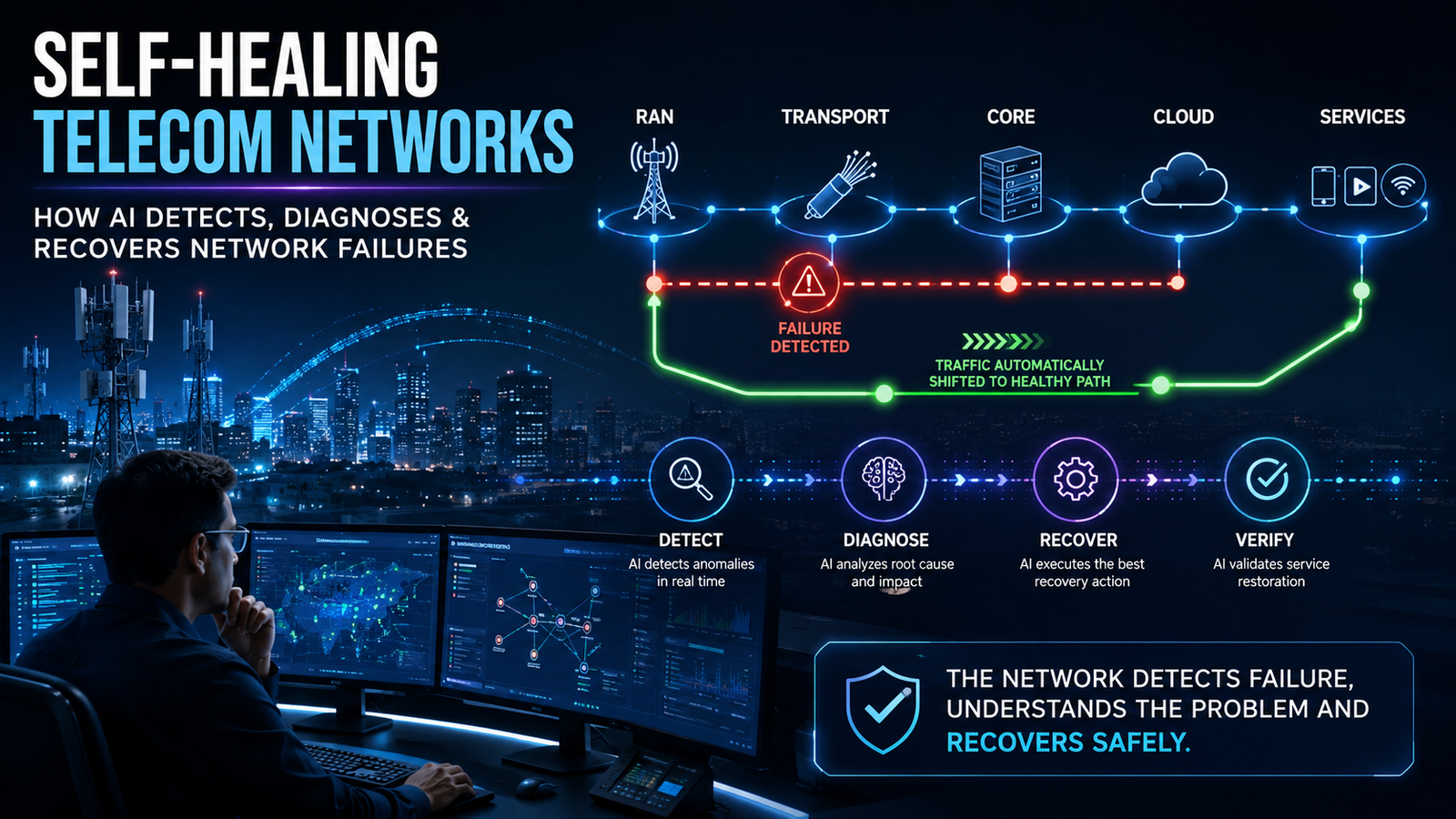
The Network Recovered Before Anyone Opened a Ticket
What if the most successful network incident is the one the NOC never has to manage?
Not because the failure never occurred.
But because the network detected the conditions leading to service degradation, understood what was happening, selected a safe recovery action and verified that the service had recovered—before the situation developed into a major incident.
That sounds simple when written as one sentence.
In a live telecom network, it is anything but simple.
A single recovery decision may require information from RAN, Transport, Core, Cloud, topology, service assurance, configuration history and customer experience. The network must distinguish a symptom from a cause, understand dependencies, evaluate the risk of taking action and make sure that fixing one problem does not create another.
This is where the idea of a self-healing telecom network becomes much more interesting than ordinary automation.
Self-healing is not about automatically fixing alarms. It is about understanding enough of the network to recover safely.
If a Script Restarts a Failed Process, Is That Self-Healing?
A network function becomes unresponsive.
A monitoring system detects the failure and automatically executes a predefined script:
Process Down → Restart Process
The service recovers.
Was that self-healing?
At first glance, it may look like it. The problem was detected and corrected without an engineer manually executing the restart.
But consider a second possibility.
The process became unresponsive because the underlying server was experiencing resource exhaustion. Restarting it restores the service temporarily—but twenty minutes later, the same failure happens again.
The automation fixed the symptom.
It never understood the cause.
Automation asks: “What action should I execute?”
Self-healing must also ask: “Why did this happen, and will this action actually solve it?”
Now imagine the same failure in a more intelligent operating model.
The system does not immediately restart the process.
First, it checks whether this is an isolated failure or part of a wider pattern.
It correlates CPU and memory utilization, application logs, recent configuration changes, infrastructure health, service dependencies and previous incidents.
The evidence shows that memory consumption has been increasing abnormally for several hours.
Now the problem looks different.
The failed process is no longer the root cause. It is evidence of a deeper problem.
Instead of repeatedly restarting the same process, the system could evaluate several recovery options:
Restart the process — fastest recovery, but the problem may return.
Move the workload — potentially restore service on healthy infrastructure.
Scale resources — appropriate if capacity exhaustion is the cause.
Trigger failover — useful where resilient architecture permits it.
Escalate to an engineer — necessary when confidence is low or the action carries significant risk.
The important change is that the network is no longer following a single predefined reaction.
It is using context to decide which recovery action makes sense.
Detecting a failure is monitoring. Executing a predefined response is automation. Understanding the cause, selecting a safe response and verifying recovery moves us toward self-healing.
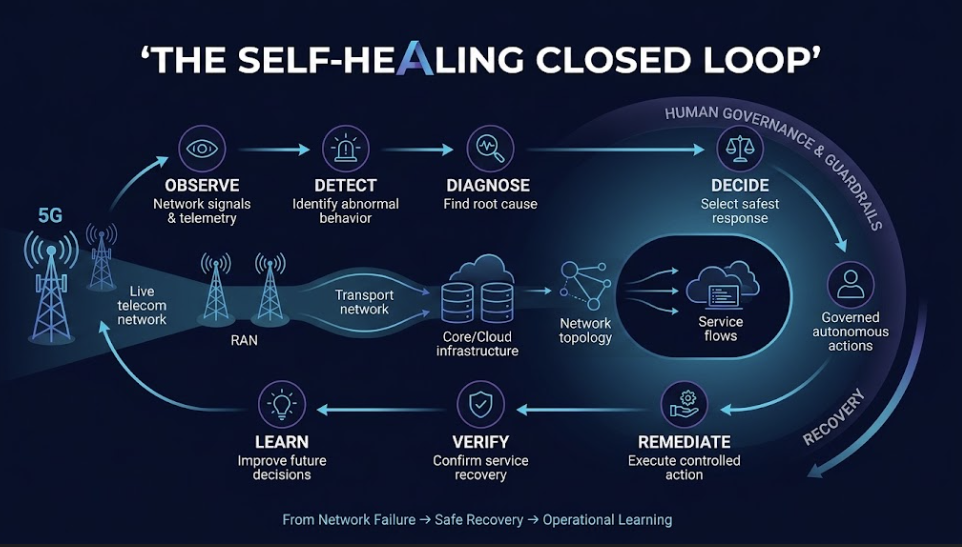
The Self-Healing Closed Loop: From Detection to Learning
Consider a group of mobile sites experiencing intermittent service degradation.
No major element has completely failed. Instead, accessibility begins fluctuating, packet loss appears intermittently, and customer-experience indicators start moving away from their normal baseline.
A self-healing system should not jump immediately to a recovery action.
It first needs to build an understanding of what is happening.
1. OBSERVE — Build the Network Picture
he system continuously collects signals from the operational environment:
Alarms • KPIs • Logs • Topology • Traffic • Configuration • Service Experience
The objective at this stage is not to make a decision.
It is to create enough situational awareness to recognize what normal network behavior looks like—and when that behavior begins to change.
A network cannot heal what it cannot observe.
2. DETECT — Recognize What Has Changed
Observation gives the system data. Detection gives that data meaning.
Instead of waiting for a fixed threshold to generate a critical alarm, the system compares current network behavior with historical patterns, expected baselines and related network conditions.
In our example, it notices something important:
Packet loss is appearing across several sites—but the sites themselves do not share the same RAN equipment.
What they do share is part of the same transport path.
That relationship changes the investigation.
What initially looked like several independent site problems may actually be one developing network issue affecting multiple services.
The value of intelligent detection is not generating more alarms. It is recognizing when separate symptoms belong to the same problem.
3. DIAGNOSE — Find the Common Cause
The system now follows the dependency chain across the network.
It discovers that the affected sites share a common aggregation path. Interface statistics show intermittent errors, while historical data confirms that this behavior is unusual. Configuration records show no recent planned change on the affected sites themselves.
The evidence begins pointing away from the RAN and toward the transport layer.
This is an important capability.
Without cross-domain context, an AI system may simply become a faster alarm analyzer. With topology, dependency and historical context, it can begin reasoning about cause and effect across network domains.
Self-healing becomes powerful when the network can move from “Where is the alarm?” to “Where does the problem actually originate?”
4. DECIDE — Choose the Safest Recovery Action
Finding the probable root cause does not automatically mean the network should act.
Suppose the system identifies degradation on the common transport path. Several recovery options may be available:
Reroute traffic through an alternative path.
Adjust routing parameters to reduce the load.
Isolate the degraded link from service traffic.
Keep monitoring if the degradation remains within a safe limit.
Escalate to an engineer if the diagnosis or recovery risk is uncertain.
The challenge is no longer simply:
“What can the network do?”
It becomes:
“Which action provides the safest recovery with the lowest risk to customers and the rest of the network?”
A mature self-healing system therefore needs more than automation rules. It needs operational context, confidence thresholds, policy constraints and clearly defined guardrails before selecting an action.
Autonomy should increase only when confidence is high and operational risk is controlled.
5. REMEDIATE — Act Within Defined Guardrails
Now the network is ready to act.
In our example, the system determines that an alternative transport path has sufficient capacity and is operating normally. Based on predefined operational policies, traffic can be moved away from the degraded path.
But self-healing should not mean giving AI unlimited permission to change the network.
The action depends on its risk level and confidence.
A low-risk, well-tested action may be executed automatically.
A higher-risk action—such as changing routing across a critical service path—may require engineer approval before execution.
This creates an important principle for self-healing operations:
Low Risk + High Confidence → Automated Action
Higher Risk or Lower Confidence → Human Approval
The objective is not to remove the engineer from operations.
It is to remove unnecessary manual intervention where the network already has enough evidence to recover safely.
The goal of self-healing is controlled autonomy—not uncontrolled automation.
6. VERIFY — Prove That the Service Has Recovered
The recovery action has been executed.
But the closed loop is not complete yet.
The system now checks what happened after traffic was moved to the healthy path.
Did packet loss return to normal?
Did latency improve?
Did the affected sites recover their expected accessibility?
Did customer-experience indicators improve?
And importantly:
Did the recovery action create a new problem somewhere else?
This last question matters because a technically successful network action can still create unintended consequences—for example, shifting too much traffic onto another path and causing congestion there.
A self-healing system therefore needs to compare before-and-after network and service conditions, rather than assuming that a successfully executed command equals a successfully resolved incident.
Execution tells us that an action happened. Verification tells us whether it actually worked.
7. LEARN — Turn Every Recovery Into Operational Knowledge
The service has recovered, but one final opportunity remains.
The system records what happened:
What symptoms appeared first?
Which signals were most useful in identifying the root cause?
Which recovery action was selected?
How quickly did the service recover?
Was engineer intervention required?
Did the same problem return?
Over time, these outcomes can improve future diagnosis and recovery decisions.
For example, if similar transport degradation occurs again, the system does not need to treat it as an entirely new problem. Previous incidents, successful actions and engineer feedback can become part of its operational knowledge.
But learning should also be governed. A network should not automatically turn every past action into a future rule simply because it worked once.
The lesson must be validated against context, risk and repeatability.
A truly intelligent closed loop should not only recover the network. It should make the next recovery better informed.
OBSERVE → DETECT → DIAGNOSE → DECIDE → REMEDIATE → VERIFY → LEARN
Self-Healing Is Moving From Concept to Live Telecom Networks
From Lab Experiment to Live Network: Deutsche Telekom
One of the strongest signs that self-healing is moving beyond research is the shift from isolated AI experiments toward AI operating inside live network environments.
At MWC 2026, Deutsche Telekom and Google Cloud presented work around autonomous and self-healing network operations. One example, RAN Guardian, progressed from concept to live deployment in approximately nine months.
The direction is particularly important.
The ambition is no longer limited to detecting an anomaly inside one network domain. Deutsche Telekom’s broader MINDR approach is aimed at combining service-level intelligence with cross-domain network information so that AI can reason about problems across operational boundaries.
That is much closer to the challenge we described earlier.
A customer-facing service problem may begin in the RAN, transport, core or cloud—but the recovery process needs to understand the service end to end, rather than treating every domain as a separate island.
The important shift is from “AI optimizing a network element” to “AI understanding and protecting a service.”
Deutsche Telekom is not an isolated example. Across the industry, operators are increasingly connecting AI, autonomous-network architectures and closed-loop operations.
e& UAE — Building toward higher autonomy
e& and TM Forum announced a strategic blueprint in 2026 focused on AI-native, intent-driven and closed-loop autonomous networks, with a roadmap toward higher levels of network autonomy.
Mobily — Exploring self-healing across multiple domains
Mobily and Ericsson announced work around autonomous-network capabilities including self-healing, process automation, network optimization and energy management across a multi-vendor environment.
China Mobile — Showing measurable operational impact
China Mobile and ZTE have reported trials using coordinated AI agents for network operations. In the reported scenarios, AI agents combined information from alarms, logs, performance data and customer complaints to support root-cause analysis and operational actions, with improvements reported in diagnosis time and MTTR.
The industry direction is becoming clear: self-healing is moving from isolated automation toward cross-domain, AI-assisted closed loops.
How Do You Actually Build a Self-Healing Network?
The biggest mistake is to start with the ambition:
“We want a self-healing network.”
That is too broad to implement.
A practical transformation starts with something much smaller: one recurring failure scenario where detection, diagnosis and recovery can be clearly defined and measured.
For example, instead of trying to automate the entire transport network, an operator might begin with:
“When degradation develops on a redundant transport path, can the system identify the probable cause, determine whether a healthy alternative path exists and safely recommend—or execute—traffic rerouting?”
That single use case can become the laboratory for building the capabilities needed for wider self-healing operations.
Do not start by automating the network. Start by proving one recovery loop.
1. Define the Failure Scenario and Recovery Objective
Before selecting an AI model, automation platform or agent, define exactly what operational problem the closed loop is expected to solve.
For our transport example, the operator could define:
Failure Scenario: Progressive degradation on a redundant transport path.
Observable Symptoms: Packet loss, interface errors, increasing latency and service KPI degradation.
Recovery Objective: Protect customer traffic before the degraded path develops into a major service outage.
Possible Action: Move traffic to a verified healthy path.
Success Condition: Service KPIs recover without creating congestion or degradation elsewhere.
This sounds simple, but it changes the entire implementation approach.
The team is no longer starting with:
“Where can we use AI?”
It is starting with:
“What operational decision do we want the system to make better?”
A good self-healing use case begins with a clearly defined operational decision—not with an AI technology.
2. Connect the Signals That Explain the Failure
A self-healing system cannot make a reliable recovery decision from alarms alone.
For the transport degradation example, it may need to combine:
Performance data — packet loss, latency, utilization and interface errors.
Topology — which sites, links and services depend on the affected path.
Configuration — how routing, protection and redundancy are currently designed.
Change history — whether a recent configuration or software change could explain the behavior.
Service context — which customer services are affected and how critical they are.
Historical incidents — whether similar symptoms have occurred before and what resolved them.
The real challenge is not collecting more data.
It is connecting these signals so the system can understand their relationship.
For example:
High packet loss alone tells us something is wrong.
But:
High packet loss + interface errors + common topology dependency + no recent RAN change + healthy alternate path
creates enough context to support a much stronger operational decision.
Data tells the system what is happening. Context helps it understand why—and what it can safely do about it.
3. Build the Diagnosis Before Automating the Recovery
At this stage, resist the temptation to close the loop immediately.
Let the system investigate the incident while the engineer remains responsible for the final decision.
For the transport example, the system should be able to produce something like:
Observed: Packet loss and interface errors are increasing.
Affected: 14 sites and two customer-facing services share the degraded path.
Probable Cause: Degradation on the common aggregation link.
Confidence: High, based on correlated performance, topology and historical behavior.
Recommended Action: Reroute affected traffic through the redundant path.
Risk Check: Alternate path has sufficient available capacity and no active degradation.
The NOC engineer then reviews the evidence and either approves or rejects the recommendation.
This stage is extremely valuable because it tests the intelligence without yet giving the system authority to change the live network.
Observe → Diagnose → Recommend → Engineer Decides
Before asking AI to operate the network, prove that it can consistently understand the network.
4. Run the Self-Healing Logic in Shadow Mode
Before allowing the system to execute recovery actions, let it operate silently beside the NOC team.
During shadow mode, the system detects the problem, performs its diagnosis and recommends what it would do—but does not change the live network.
The engineer handles the incident normally.
Afterward, compare the two decisions:
What did the AI diagnose?
What did the engineer diagnose?
Did they identify the same root cause?
Would the AI have selected the correct recovery action?
Did it miss any operational risk that the engineer noticed?
Repeated across real incidents, this creates something extremely important:
Evidence that the closed loop can be trusted before it is closed.
Shadow mode also exposes weaknesses that laboratory testing may miss—unusual topology conditions, incomplete data, unexpected dependencies and operational exceptions.
The safest path to autonomy is to let the system prove its decisions before giving it permission to execute them.
5. Define What the Network Is Allowed to Heal Automatically
Once shadow-mode results show that the system can diagnose incidents reliably, the next step is not full autonomy.
It is controlled autonomy.
Different recovery actions carry very different levels of operational risk.
For example, restarting a non-critical application process may be relatively low risk. Rerouting major traffic, modifying routing policy or triggering a core-network failover may have much wider consequences.
So every self-healing action should have a defined autonomy boundary.
A practical policy could be:
High Confidence + Low Risk → Execute Automatically
High Confidence + Medium Risk → Execute Within Approved Guardrails
Low Confidence or High Risk → Recommend and Request Engineer Approval
This allows automation to grow based on demonstrated reliability rather than ambition.
As successful recoveries accumulate, specific actions can gradually move from:
Recommend → Approve → Auto-Execute
But critical actions may deliberately remain under human approval even when the technology is capable of executing them.
The maturity of a self-healing network should be measured by how safely it can act—not by how many decisions humans are removed from.
6. Measure Recovery, Not Just Automation
A self-healing project should not be considered successful simply because the network executed an action automatically.
The real question is:
Did operations actually improve?
For the pilot use case, track a small set of operational outcomes:
MTTD — Did the system detect degradation earlier?
Diagnosis Time — Did it identify the probable root cause faster?
MTTR — Did the service recover faster?
Successful Remediation Rate — How often did the recommended or automated action actually resolve the problem?
Engineer Intervention — How often was manual investigation still required?
Repeat Incidents — Did the same failure return after recovery?
Customer Impact — Was degradation prevented or reduced before customers experienced it?
This changes the success conversation from:
“We automated 200 actions this month.”
to:
“We prevented service impact, reduced recovery time and required fewer manual interventions.”
That is a much more meaningful measure of self-healing maturity.
Automation volume measures activity. Recovery outcomes measure value.
What Should a Self-Healing Network Be Allowed to Do?
Not every network problem deserves the same level of autonomy. The right question is not whether AI can execute an action, but whether it can execute that action safely, predictably and within an acceptable operational risk.
Not every network problem deserves the same level of autonomy. The right question is not whether AI can execute an action, but whether it can execute that action safely, predictably and within an acceptable operational risk.
| Network Scenario | AI Detect | AI Diagnose | AI Recommend | Auto-Heal? |
|---|
| Non-critical process failure | ✓ | ✓ | ✓ | Yes — within guardrails |
| Degraded redundant transport path | ✓ | ✓ | ✓ | Conditional |
| Capacity congestion | ✓ | ✓ | ✓ | Conditional |
| RAN performance degradation | ✓ | ✓ | ✓ | Conditional |
| Major routing change | ✓ | ✓ | ✓ | Human approval |
| Core network failover | ✓ | ✓ | ✓ | Human approval |
| Unknown / low-confidence incident | ✓ | ✓ | ✓ | No — escalate |
The objective is not maximum autonomy. It is the right autonomy for the right operational risk.
If the Technology Exists, Why Aren’t Telecom Networks Already Self-Healing?
Telecom operators are not short of automation.
Most mature networks already contain scripts, orchestration platforms, assurance tools, optimization systems, AI models and domain-specific automation.
Yet connecting all of these capabilities into a trusted end-to-end recovery loop remains difficult.
The problem is often not:
“Can we automate this action?”
The harder questions are:
Does the system understand the full service impact?
Can it identify the real root cause across multiple domains?
Does it know whether another automation is already acting on the same problem?
Can it predict the consequences of its recovery decision?
Can it verify that the action actually restored the service?
And who remains accountable when an autonomous decision goes wrong?
This creates the current gap between isolated automation and genuine self-healing operations.
A RAN optimizer may understand the radio network.
A transport controller may understand paths and capacity.
A cloud platform may automatically restart workloads.
A service-assurance platform may understand customer impact.
But the customer service often depends on all of them at the same time.
The self-healing challenge is increasingly becoming an automation coordination problem—not simply an automation availability problem.
The Next Shift: Self-Healing Networks Meet Agentic AI
Traditional self-healing has largely been built around a familiar model:
Detect a known condition → Trigger a predefined automation → Verify the result
That works well when the failure pattern is understood and the recovery action is predictable.
But telecom incidents are not always that clean.
A service problem may involve several domains, incomplete evidence, multiple possible causes and recovery options that change depending on the network context.
This is where Agentic AI could change the self-healing model.
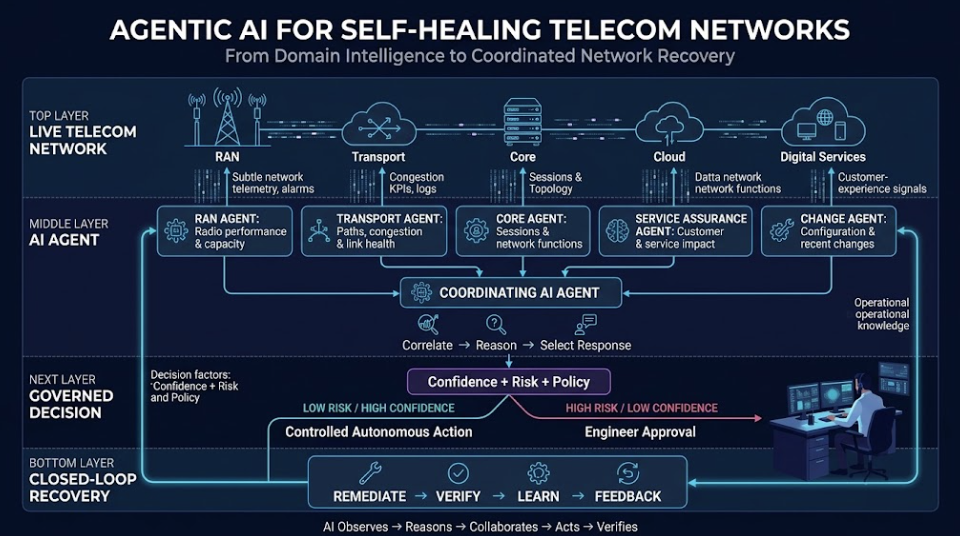
Instead of relying only on a fixed rule, specialized AI agents could collaborate across operational domains:
RAN Agent investigates radio conditions.
Transport Agent checks paths, congestion and link health.
Core Agent evaluates sessions and network functions.
Service Assurance Agent determines customer impact.
Change Agent checks whether a recent change could explain the degradation.
A coordinating agent could then combine their findings, evaluate possible recovery actions and present—or, within approved guardrails, execute—the safest response.
The model begins to change from:
ML Detects → Script Fixes
to:
AI Observes → Reasons → Collaborates → Acts → Verifies
The next generation of self-healing networks may not be built only around automation rules. It may increasingly be built around AI agents operating inside governed closed loops.
Does Self-Healing Actually Deliver ROI?
A self-healing use case should not be justified simply because it uses advanced AI.
It should solve an operational problem that is frequent enough, costly enough or service-critical enough to justify the investment.
Consider a recurring network failure that happens several times each month.
Today, every occurrence may consume NOC investigation time, domain-engineer effort, escalation effort and service-restoration time. If customers are affected, the real cost can extend further into SLA exposure, customer-care contacts and potentially lost revenue.
Self-healing changes the economics when it can detect the problem earlier, shorten diagnosis, reduce manual effort and restore service faster.
A simple business case can start with:
Annual Benefit = Avoided Incident Cost + Engineering Productivity Gain + Reduced Service-Impact Cost + Avoided Escalation Cost
Then:
ROI (%) = (Annual Benefit − Annual Self-Healing Cost) ÷ Annual Self-Healing Cost × 100
The important point is not to manufacture an impressive ROI percentage.
Use the operator’s actual incident volumes, MTTR, engineering effort and service-impact data.
The strongest self-healing use case is not necessarily the most technically impressive one. It is the one where faster, safer recovery creates measurable operational value.
A Simple Self-Healing Business Case
Imagine an operator has a recurring network issue that causes 10 incidents per month.
Each incident currently requires an average of 3 engineering hours across NOC and domain teams, while service degradation lasts approximately 45 minutes before full recovery.
Assume, purely for illustration:
Engineering cost per incident: $150
Estimated service-impact and escalation cost per incident: $500
The current annual incident cost would be:
10 incidents × 12 months × ($150 + $500) = $78,000 per year
Now suppose a self-healing solution reduces the average operational impact by 60% through earlier detection, faster diagnosis and controlled recovery.
The potential annual benefit becomes:
$78,000 × 60% = $46,800
If implementing and operating that specific closed-loop use case costs $25,000 per year, then:
ROI = ($46,800 − $25,000) ÷ $25,000 × 100
Illustrative ROI = 87.2%
This is an illustrative model, not an industry benchmark. Operators should replace these assumptions with their own incident, engineering, service-impact and implementation costs.
Start with the incidents already costing the business money. That is where the self-healing business case becomes easier to prove.
What Is the Industry Seeing?
The potential value is not only theoretical.
Industry studies and operator trials are beginning to report measurable improvements from AI-driven and increasingly autonomous network operations.
For example, McKinsey has reported that scaled AI-driven network operations can contribute to 30–40% faster MTTR in some implementations, alongside reductions in troubleshooting workload and NOC operating costs.
China Mobile and ZTE have also reported results from coordinated AI-agent trials where root-cause diagnosis time was reduced from approximately 15 minutes to 3 minutes in tested scenarios, with MTTR improving by up to 11%.
These figures should not be treated as guaranteed outcomes for every operator.
Network architecture, automation maturity, data quality, incident mix and implementation scope can produce very different results.
The business case for self-healing should be proven in the operator’s own network—not borrowed from someone else’s benchmark.
Why Future Telecom Networks Will Need Self-Healing
Telecom networks are becoming more programmable—but also more interconnected.
5G-Advanced, cloud-native network functions, network slicing, edge computing, APIs and eventually 6G will create more dynamic relationships between infrastructure, software and services.
That creates an operational challenge.
A customer-experience problem may no longer have one obvious network cause. It could emerge from the interaction between radio conditions, transport capacity, cloud resources, network functions, policies and service configuration.
Adding more dashboards will not solve that complexity.
Adding more independent automation may not solve it either.
The network increasingly needs the ability to observe across domains, understand dependencies, coordinate decisions and recover services at machine speed—while keeping critical actions governed.
This changes the role of self-healing.
It is no longer simply:
“Can we automatically recover from a known failure?”
The bigger question becomes:
“Can the network maintain service resilience as operational complexity grows beyond what humans can continuously coordinate manually?”
The future need for self-healing will be driven less by reducing headcount and more by managing network complexity at a speed humans alone cannot sustain.
A Practical 90-Day Self-Healing Pilot
An operator does not need to wait for a fully autonomous network architecture to begin.
Choose one recurring, measurable and relatively controlled failure scenario and use the next 90 days to prove whether a closed-loop approach can improve recovery.
Days 1–30: Observe and Build the Baseline
For the first month, do not automate the recovery.
Study the selected incident and establish how it behaves today.
Capture:
How often does it occur?
Which alarms, KPIs and logs appear first?
How long does diagnosis normally take?
What is the current MTTR?
Which teams become involved?
What recovery action normally works?
What customer or service impact occurs?
The objective is to create a measurable before-self-healing baseline.
At the end of 30 days, the team should be able to answer one important question:
“Do we understand this failure well enough to teach a system how to recognize and investigate it?”
You cannot prove improvement without first understanding the operational baseline.
Days 31–60: Let the System Decide—But Not Act
Now introduce the self-healing intelligence alongside the existing NOC process.
For every occurrence of the selected failure, let the system independently:
Detect the abnormal behavior
Correlate the relevant network signals
Identify the probable root cause
Recommend a recovery action
Estimate confidence and operational risk
But keep one restriction:
The system cannot execute the action.
Engineers continue handling the live incident normally.
After each incident, compare the system’s conclusion with what actually happened.
Did it detect the problem earlier?
Did it identify the same root cause as the engineer?
Was its recommended action correct?
Would that action have been safe?
Did the system miss any dependency that an experienced engineer noticed?
By the end of Day 60, the operator should have evidence showing where the system can be trusted—and where it still needs improvement.
The goal of shadow mode is not to prove that AI is perfect. It is to discover exactly where autonomy is safe.
Days 61–90: Allow Controlled Recovery
By this stage, the operator has observed the failure, established a baseline and tested the system’s decisions in shadow mode.
Now selected recovery actions can move from recommendation to controlled execution.
Start with actions that have:
High diagnostic confidence
Low operational risk
A proven recovery procedure
Clear rollback capability
Reliable post-action verification
For example, the system may be permitted to reroute traffic only when the alternative path is healthy, sufficient spare capacity exists and no conflicting network activity is detected.
Anything outside those conditions should automatically return to:
Recommend → Engineer Approval
After every automated recovery, the system must verify that service KPIs have returned to normal and that the action has not created degradation elsewhere.
If verification fails:
Stop → Roll Back → Escalate
By Day 90, the objective is not to claim that the network has become autonomous.
It is to demonstrate that one complete recovery loop can operate safely, measurably and repeatedly in the live network.
Do not scale self-healing because one automated action worked. Scale it when the complete recovery loop repeatedly proves that it works.
Day 90: Should We Scale It?
At the end of the pilot, management should not ask:
“How many actions did AI automate?”
Instead, compare the pilot against the original operational baseline.
Did MTTD improve?
Did diagnosis time decrease?
Did MTTR improve?
How many recovery recommendations were correct?
How many automated recoveries succeeded without engineer intervention?
Were any incorrect or unsafe actions attempted?
Did repeat incidents decrease?
Was measurable customer or service impact avoided?
And perhaps most importantly:
Do the NOC engineers trust the system enough to expand its responsibility?
If the results are positive, the operator can gradually expand the same closed-loop methodology to additional failure scenarios and network domains.
If the results are weak, that is also valuable.
It tells the operator whether the problem lies in data quality, diagnosis accuracy, topology context, automation reliability, governance or the use case itself—before attempting to scale.
The first 90 days should earn the right to scale—not assume it.
A Self-Healing Network Is Not a Network That Never Fails
Failures will not disappear from telecom networks.
Hardware will fail. Software will behave unexpectedly. Fiber will be cut. Capacity will become constrained. Configuration changes will sometimes produce unintended consequences.
The real transformation is therefore not the elimination of failure.
It is changing how the network responds when failure begins.
Today, much of that journey still depends on engineers moving between alarms, dashboards, logs, topology tools and domain teams to understand what happened and decide what to do next.
Self-healing introduces a different operating model:
OBSERVE → DETECT → DIAGNOSE → DECIDE → REMEDIATE → VERIFY → LEARN
But the journey should not begin with full autonomy.
It should begin with one well-understood failure, one trusted recovery loop and one measurable operational outcome.
Then scale what proves safe.
A self-healing network is not a network that never fails. It is a network that can understand failure, recover safely and learn before the same problem becomes tomorrow’s outage.
START SMALL → OBSERVE → DIAGNOSE → PROVE → CONTROL → HEAL → VERIFY → SCALE
How Ready Is Your NOC for Self-Healing Operations?
Moving toward self-healing does not start with buying another AI platform.
It starts by understanding where your NOC stands today across observability, automation, predictive operations, AIOps, decision intelligence, closed-loop operations and governance.
TelcoMind AI has created a free NOC AI Maturity Assessment to help telecom teams identify their current maturity level and the capabilities they need to develop next.
→ Take the Free NOC AI Maturity Assessment
Related TelcoMind AI Insights
1. Agentic AI in Telecom Operations: From AI Assistance to Autonomous Action
2. AI-Powered AIOps in Telecom: From Alarm Management to Autonomous Network Operations
3. From Level 0 to Level 5: How Close Are We to Truly Autonomous Telecom Networks?