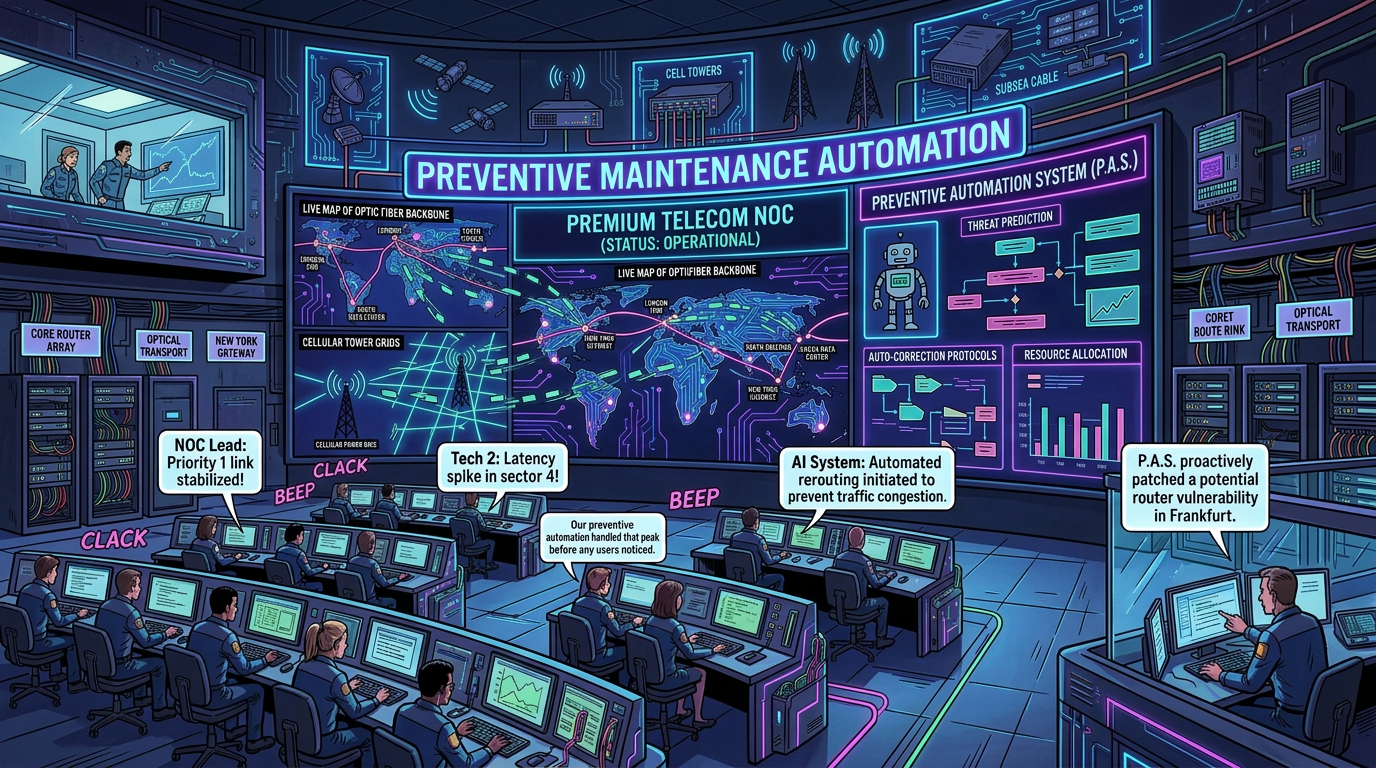
Introduction: Moving from Reactive Maintenance to Preventive Automation
Telecom networks are becoming increasingly complex, software-driven and service-critical. Radio access networks, transmission systems, IP networks, core platforms, charging systems, value-added services, databases and cloud infrastructure operate together to deliver always-on connectivity. A degradation in any one of these domains can eventually affect service quality, customer experience and network availability.
Traditionally, telecom preventive maintenance has relied heavily on scheduled activities, periodic health checks, manual inspections, threshold reports and engineers reviewing network elements one by one. These practices remain important, but the scale and complexity of modern networks make a purely manual approach increasingly difficult to sustain.
Preventive maintenance automation offers a different operating model. Instead of waiting for a failure—or relying only on fixed maintenance schedules—network and platform data can be continuously analyzed to identify abnormal behavior, deteriorating performance, capacity risks and recurring conditions before they develop into service-impacting incidents.
Importantly, preventive maintenance in a modern telecom environment extends far beyond physical equipment. It can include radio and transmission health, router resources, core-network capacity, charging-platform performance, database growth, backup verification, application processes, storage utilization, software housekeeping, certificate validity, power systems and environmental conditions.
The objective is therefore not simply to predict what might fail next. The larger opportunity is to automate the preventive-maintenance lifecycle—from health monitoring and early detection to maintenance initiation, execution, validation and continuous improvement.
This article explores how telecom operators can apply preventive maintenance automation across network and service domains, and how this approach can help operations teams move from periodic maintenance toward continuous, data-driven network assurance.
What Preventive Maintenance Automation Means in Telecom
Preventive maintenance automation in telecom is the systematic use of network data, monitoring systems, analytics and automated workflows to identify and address potential operational risks before they develop into service-impacting failures.
Traditional preventive maintenance is often calendar-based. Engineers perform predefined health checks, inspections, backups, housekeeping activities, capacity reviews and equipment maintenance at scheduled intervals. While this approach remains necessary for many activities, it can result in maintenance being performed when it is not yet required, while emerging problems between maintenance cycles may remain undetected.
A more advanced approach combines scheduled, condition-based and predictive maintenance. Network elements and platforms are continuously assessed using alarms, KPIs, performance counters, resource utilization, logs, environmental information and historical behavior. When deterioration or abnormal trends are detected, the system can initiate an appropriate preventive workflow.
In telecom operations, this may involve much more than replacing physical equipment. A preventive action could include cleaning up storage before a disk becomes full, identifying abnormal CPU or memory growth, verifying database backups, addressing database replication issues, detecting optical-power degradation, resolving increasing interface errors, expanding capacity before congestion occurs, renewing certificates before expiry, or identifying recurring process failures on a core or VAS platform.
The key change is therefore from maintenance by schedule toward maintenance by operational need, supported by automation.
Four Levels of Preventive Maintenance Evolution
1. Manual preventive maintenance: Engineers manually perform periodic checks, analyze reports and execute maintenance activities.
2. Scheduled automated maintenance: Routine activities such as health checks, backups, housekeeping and reports are automatically executed according to predefined schedules.
3. Condition-based maintenance: Preventive actions are initiated when KPIs, alarms, resource utilization or equipment health indicate deterioration.
4. Predictive and automated maintenance: Analytics identify developing risks and predict potential failures, while integrated workflows initiate preventive actions, create work orders or tickets, involve the appropriate operational team and validate network health after completion.
The long-term objective is not to remove engineers from telecom operations. It is to automate repetitive monitoring and maintenance activities so that engineers can concentrate on complex troubleshooting, optimization, network evolution and decisions that require technical judgment.
The End-to-End Preventive Maintenance Automation Lifecycle
Effective preventive maintenance automation should not stop at generating an alarm, dashboard or prediction. Its real value comes from connecting network visibility with operational action. A complete preventive-maintenance lifecycle continuously observes network and platform health, identifies developing risks, determines the appropriate intervention and verifies whether the preventive action actually resolved the condition.
In a telecom environment, this lifecycle can operate across RAN, transmission, IP, CS Core, PS Core/5GC, OCS, VAS, databases, OSS/NMS/EMS, cloud infrastructure, power systems and environmental infrastructure.
1. Collect Operational Data
The process begins by collecting relevant operational information from network elements, platforms and infrastructure. This can include alarms, KPIs, performance counters, logs, CPU and memory utilization, disk and database utilization, interface statistics, signaling loads, traffic trends, optical power levels, environmental measurements, backup status and equipment-health information.
Bringing these data sources together provides a broader picture of network health than relying on individual alarms alone.
2. Detect Degradation and Emerging Risks
Automated rules and analytics can continuously identify abnormal conditions, recurring alarms and deteriorating trends. For example, an optical link may show gradual power degradation, an OCS database may experience continuous storage growth, a core-network element may demonstrate increasing CPU utilization, or an IP interface may accumulate errors long before a complete failure occurs.
The objective is to identify the developing condition early enough for operations teams to intervene before customers are affected.
3. Assess Risk and Prioritize Maintenance
Not every abnormal condition requires immediate intervention. Preventive-maintenance automation should consider factors such as severity, rate of deterioration, redundancy, network criticality, customer exposure, available capacity and historical behavior.
This enables operations teams to distinguish between conditions that can continue to be monitored and those requiring immediate preventive action.
4. Initiate the Preventive Action
Once a maintenance requirement is identified, the workflow can automatically generate a preventive ticket, work order, notification or approved automation task. The appropriate Back Office, NOC, field-maintenance, IT, database or platform team can then be engaged according to predefined operational procedures.
Where safe and technically approved, repetitive low-risk activities may be automated. Higher-risk actions should continue to require engineer validation and appropriate change controls.
5. Execute and Track the Maintenance Activity
Execution may involve a field visit, capacity expansion, hardware replacement, database housekeeping, backup correction, software cleanup, interface remediation, configuration adjustment, certificate renewal or another domain-specific activity.
Automation should track the maintenance task from initiation through completion rather than simply generating another operational alarm or ticket
6. Perform Automated Post-Maintenance Validation
Preventive maintenance should not be considered complete merely because an engineer or automation workflow executed an action. The network or platform should be checked again to verify that alarms have cleared, KPIs have normalized, resources have returned to acceptable levels and no new degradation has been introduced.
Automated post-checks therefore provide an important control point between maintenance execution and operational closure.
The resulting lifecycle can be summarized as:
Monitor → Detect → Assess → Prioritize → Act → Validate → Learn
This closed operational workflow transforms preventive maintenance from a collection of periodic engineering tasks into a continuous network-assurance capability.
Preventive Maintenance Automation Use Cases Across Telecom Domains
The value of preventive maintenance automation becomes clearer when it is applied across the end-to-end telecom environment. Maintenance requirements differ significantly between radio infrastructure, transmission networks, IP networks, core platforms, charging systems and application environments. However, the underlying objective remains the same: identify deterioration early, initiate the appropriate preventive action and validate network health before the condition becomes service-impacting.
The following examples illustrate how preventive automation can be applied across major telecom operational domains.
RAN and Radio Site Infrastructure
Radio access networks contain thousands of distributed network elements, making them particularly suitable for preventive-maintenance automation. Instead of relying primarily on periodic site inspections or waiting for equipment alarms to become service-affecting, operators can continuously evaluate cell and site health using alarms, performance counters, environmental measurements and historical behavior.
Preventive automation can identify recurring hardware alarms, increasing VSWR, abnormal temperature, deteriorating radio performance, board or module instability, unusual CPU or memory utilization, repeated cell resets and capacity trends. Persistent degradation can automatically trigger deeper health checks or preventive work orders before complete equipment failure occurs.
Automation can also correlate multiple symptoms from the same site. For example, increasing temperature combined with equipment alarms and deteriorating radio performance may indicate a cooling or environmental problem rather than independent network faults. This allows maintenance teams to address the underlying condition rather than repeatedly responding to individual alarms.
Transmission and Optical Networks
Transmission degradation frequently develops gradually before a complete link failure occurs. Microwave receive-signal levels, error rates, modulation changes, optical power, interface errors and utilization trends can therefore provide valuable early indicators of developing problems.
Automated preventive monitoring can identify gradual RSL deterioration on microwave links, abnormal modulation changes, increasing errors, deteriorating optical receive power, unstable interfaces and capacity approaching operational limits. These conditions can trigger preventive investigation before they develop into transmission outages or customer-impacting degradation.
Trend analysis is particularly valuable because a parameter may still remain within an acceptable threshold while continuously moving toward an unsafe operating range. Preventive automation should therefore consider both the current value and the direction and speed of deterioration.
IP and Data Networks
IP networks require continuous preventive attention because resource exhaustion, interface degradation and routing instability can affect multiple downstream services simultaneously. Automated health checks can monitor router and switch CPU, memory, interface utilization, errors, discards, packet loss, latency, hardware status and redundancy.
Instead of waiting for a hard threshold violation, automation can identify sustained resource growth, increasing interface errors, repeated routing changes or traffic patterns approaching capacity limits. Preventive workflows can then initiate investigation, capacity augmentation, traffic redistribution or other approved corrective actions.
Configuration and redundancy health can also form part of preventive maintenance. Automated checks can verify whether expected redundant links, routing paths and critical interfaces remain operational, helping operators identify hidden single points of failure before a second failure creates an outage.
CS Core Network
Although telecom networks are progressively moving toward packet-based and 5G architectures, CS Core platforms may continue to support important voice and interworking services in many operator environments. Preventive maintenance should therefore continuously assess the health of MSCs, MGWs, signaling resources, trunks and associated infrastructure.
Automated health checks can monitor processor and memory utilization, signaling-link status, trunk utilization, hardware alarms, interface availability, resource occupancy, recurring process failures and redundancy status.
Trend analysis can identify gradual resource exhaustion or repeated instability before it develops into a major service event. For example, steadily increasing processor utilization, repeated signaling-link fluctuations or abnormal trunk occupancy can trigger preventive investigation before service accessibility or call completion is affected.
Preventive automation can also verify redundancy and standby-resource health. A network element may appear fully operational while its backup component or redundant path is unavailable. Detecting such hidden redundancy failures is critical because the network may otherwise remain exposed to a single subsequent failure.
PS Core and 5G Core
Packet Core networks carry increasingly critical mobile broadband and digital services, making preventive assurance essential across EPC and 5G Core environments. Depending on the network architecture, this may include platforms and functions such as MME, SGW, PGW, AMF, SMF and UPF, together with their associated interfaces and infrastructure.
Preventive automation can continuously analyze CPU and memory utilization, session volumes, signaling loads, interface utilization, attach or registration trends, session-establishment failures, packet-processing resources, process health and capacity consumption.
Rather than waiting for resource exhaustion or a major KPI deterioration, trend-based monitoring can identify unusual growth patterns and initiate preventive capacity or platform investigation.
Cross-domain correlation is particularly valuable in Packet Core operations. For example, increasing session failures may not necessarily originate from the core function reporting the symptom. Correlating core KPIs with transport, DNS, signaling, cloud infrastructure and recent configuration changes can help prevent unnecessary maintenance on the wrong platform.
OCS and Online Charging Platforms
Online Charging Systems are particularly sensitive because degradation can directly affect customer charging, balance queries, service authorization, recharge-related processes and revenue-generating services. Preventive maintenance automation should therefore extend beyond basic server availability to the complete charging transaction environment.
Automated monitoring can track transaction success rates, response latency, queue buildup, CPU and memory utilization, database growth, storage consumption, process availability, replication health, interface connectivity and recurring application errors.
For example, gradually increasing transaction latency combined with database growth and high resource utilization may indicate an emerging platform constraint long before a complete charging failure occurs.
Preventive workflows can initiate database housekeeping, storage expansion, application-health investigation, capacity review or other approved maintenance activities before customers experience transaction failures.
This is especially important because an OCS platform can technically remain “up” while its performance is already deteriorating. Preventive assurance must therefore focus on service health, not simply node availability.
VAS and Digital Service Platforms
Value-Added Services and digital-service platforms introduce another important preventive-maintenance domain. Depending on the operator, these environments may include SMSC, MMSC, voicemail, messaging platforms, service-delivery systems and other customer-facing applications.
Preventive automation can monitor application-process health, transaction success rates, message queues, database and storage growth, CPU and memory utilization, license consumption, interface connectivity, recurring errors and service-response times.
Queue growth is a particularly useful preventive indicator. A messaging platform may remain operational while messages gradually accumulate because downstream processing cannot keep pace with incoming traffic. Detecting abnormal queue behavior early allows operations teams to intervene before customers experience significant delays or failures.
Similarly, automated monitoring of storage, database growth and license utilization can identify approaching capacity constraints and initiate preventive expansion before the platform reaches a hard operational limit
These examples demonstrate why modern telecom preventive maintenance cannot be restricted to physical network equipment. Increasingly, service continuity depends on the health of software processes, databases, interfaces, virtual resources, signaling systems and application platforms as much as it depends on physical hardware.
Preventive Maintenance Automation Use Cases Across Telecom Domains
Databases and Automated Backup Assurance
Databases support many of the most critical functions in telecom networks, including subscriber information, charging, service configuration, messaging, network management and operational data. Database preventive maintenance should therefore focus not only on availability, but also on data protection, capacity, replication, performance and recoverability.
Automated preventive checks can monitor database size and growth, tablespace utilization, disk consumption, transaction performance, replication status, synchronization health, database processes, recurring errors and backup-job status.
Database growth is particularly suitable for trend-based preventive automation. Instead of waiting for a tablespace or disk to reach a critical threshold, the system can analyze the rate of growth and initiate housekeeping or capacity expansion before available storage becomes operationally unsafe.
Backup activities should also be automated and continuously monitored. A scheduled backup job that silently fails for several days can create significant operational risk even though the production platform continues to operate normally.
Preventive backup automation can therefore verify:
Scheduled backup completion
Backup-job failures or delays
Backup file availability and integrity
Replication and synchronization status
Available backup-storage capacity
Retention and housekeeping activities
Periodic controlled restore verification
An important operational principle is that a completed backup job should not automatically be assumed to represent a usable backup. Periodic verification helps ensure that backup data is actually available and can be restored when required.
Any failed backup, abnormal replication condition, rapidly growing database or storage constraint can automatically generate an operational notification or preventive-maintenance ticket for the responsible team.
Cloud, NFV and Virtualized Infrastructure
As telecom networks increasingly move toward virtualized and cloud-native architectures, preventive maintenance must extend into the infrastructure hosting network functions and applications.
Automated monitoring can evaluate virtual-machine health, host utilization, CPU and memory consumption, storage capacity, container status, Kubernetes resources, node availability, process health, resource allocation and infrastructure alarms.
A virtualized network function may remain operational while its underlying infrastructure gradually approaches resource exhaustion. Preventive automation can identify these trends early and trigger resource optimization, capacity expansion or engineering investigation before application performance deteriorates.
The same principle applies to cloud-native environments, where repeated container restarts, abnormal resource consumption, node pressure or storage growth may provide early warning of an emerging platform problem
OSS, NMS and EMS Platforms
Network operations themselves depend on reliable OSS, NMS and EMS platforms. If monitoring, mediation, performance-management or alarm-processing systems degrade, the network may continue operating while the NOC gradually loses visibility of what is happening.
Preventive automation should therefore monitor application availability, server resources, database health, disk utilization, alarm collectors, mediation processes, performance-data collection, interface connectivity, synchronization jobs and recurring application failures.
Automated checks can also identify missing or delayed performance files, failed collectors and abnormal alarm-processing behavior. This is particularly important because failures in management systems may create a dangerous situation where network problems exist but operational teams cannot see them clearly.
Automated Software Housekeeping
Routine software housekeeping is one of the simplest areas in which telecom operators can reduce avoidable incidents through automation. Many platform failures begin with predictable conditions such as full disks, uncontrolled log growth, temporary-file accumulation, stalled processes or gradual memory consumption.
Preventive workflows can automate or supervise activities including:
Log rotation and cleanup
Temporary-file cleanup
Disk-space monitoring
Database housekeeping
Application-process health checks
Memory-leak trend detection
Service-status verification
Controlled process or service restart where operationally approved
These activities may appear routine, but automating them consistently across hundreds of network and service platforms can eliminate a significant amount of repetitive operational work while reducing preventable failures.
Certificate, License and Software Lifecycle Monitoring
Some telecom service disruptions occur not because equipment fails, but because an operational dependency quietly reaches its limit. Expired certificates, exhausted licenses or unsupported software can therefore become important preventive-maintenance concerns.
Automated monitoring can track certificate-expiry dates, license utilization, software versions, patch status and platform lifecycle information and generate advance notifications before operational limits are reached.
For example, rather than discovering an expired certificate after an interface or application stops communicating, the system can identify upcoming expiry well in advance and automatically initiate the renewal workflow.
Similarly, license-consumption trends can be monitored so that additional capacity is planned before subscriber growth or traffic demand reaches the licensed limit.
Preventive Maintenance Automation Use Cases Across Telecom Domains
Power Systems and Battery Health
Reliable power is fundamental to telecom service availability, particularly at remote radio sites, transmission locations, data centers and core-network facilities. Power-related degradation can develop gradually, making it well suited to automated preventive monitoring.
Preventive automation can monitor battery voltage, charging behavior, battery health, rectifier performance, power-module alarms, backup-power availability, discharge patterns and repeated mains-power failures.
Rather than discovering weak batteries during an actual commercial-power outage, health trends can identify deteriorating battery performance earlier and initiate inspection or replacement before backup capability is compromised.
Automation can also correlate repeated power events with battery performance and equipment behavior, helping maintenance teams prioritize sites with the greatest operational exposure.
Generators and Fuel Management
iesel generators remain an important backup-power source at many telecom facilities. Preventive maintenance automation can continuously evaluate generator availability, start-test results, operating hours, fuel levels, battery condition, maintenance status and recurring generator alarms.
Automated periodic test routines can verify that generators are capable of starting when required, while fuel-level monitoring can identify sites requiring replenishment before extended commercial-power interruptions occur.
This shifts generator assurance from simply checking whether a generator is installed toward continuously verifying whether the backup-power system is actually ready for operation.
HVAC and Environmental Monitoring
Telecom equipment depends heavily on controlled environmental conditions. Cooling degradation, excessive temperature, humidity or airflow problems can accelerate hardware deterioration and eventually cause equipment shutdowns.
Preventive automation can monitor shelter and room temperature, humidity, HVAC performance, cooling alarms and abnormal environmental trends.
Temperature trend analysis can be particularly useful. A gradual increase in equipment-room temperature may indicate deteriorating cooling performance before a high-temperature alarm is generated.
By correlating environmental information with equipment alarms and resource behavior, operations teams can distinguish between an equipment problem and an underlying cooling or site-infrastructure issue.
Capacity and Resource Exhaustion Prevention
Capacity management is another important form of preventive maintenance. Network resources often degrade operationally not because they fail physically, but because traffic, subscribers, transactions or stored data gradually exceed available capacity.
Automated preventive monitoring can track link utilization, processor utilization, memory consumption, signaling capacity, session volumes, database growth, storage consumption, license usage, interface capacity and application transaction volumes.
Instead of relying only on fixed utilization thresholds, trend analysis can estimate when a resource is likely to approach an operational limit and provide sufficient time for capacity expansion or optimization.
This principle applies across the telecom environment—from RAN capacity and transmission links to IP interfaces, Core resources, OCS transaction capacity, VAS platforms, databases and cloud infrastructure.
Preventive capacity management therefore converts growth trends into planned engineering actions rather than emergency operational incidents.
Building a Unified Preventive Maintenance Automation Framework
The greatest value of preventive maintenance automation emerges when individual domain checks are brought together into a common operational framework. A telecom network should not be viewed as a collection of isolated RAN, transmission, IP, Core, charging and application platforms. These domains combine to deliver end-to-end customer services.
A unified preventive-maintenance platform can provide operations teams with a consolidated view of developing risks across the network.
RAN & Sites
↓
Transmission & IP
↓
CS Core / PS Core / 5G Core
↓
OCS & VAS
↓
Databases & Cloud Infrastructure
↓
OSS / NMS / EMS
↓
Service & Customer Experience
Rather than presenting thousands of individual maintenance indicators, the objective should be to convert operational information into a prioritized view of what requires attention, why it requires attention, what could happen if no action is taken and which team should act.
A centralized preventive-maintenance dashboard could therefore combine:
Network health scores
Developing degradation trends
Recurring alarms and faults
Capacity risks
Backup and database health
Power and environmental risks
Certificate and license expiry
Open preventive-maintenance actions
Maintenance ownership and status
Post-maintenance validation results
This creates an operational model where preventive maintenance becomes part of continuous network assurance, rather than a collection of disconnected periodic activities performed independently by different technical teams.
What Should Be Automated—and What Should Require Human Approval?
Preventive maintenance automation does not mean that every maintenance activity should be executed automatically. Telecom networks carry critical voice, data, charging and digital services, and an incorrect automated action can potentially create greater service impact than the condition it was intended to prevent.
A practical automation strategy should therefore classify preventive activities according to operational risk, service impact, technical complexity and reversibility.
Low-risk, repetitive and well-understood activities are strong candidates for end-to-end automation. Higher-risk activities should use automation for detection, analysis, recommendation and preparation while retaining human authorization for execution.
Activities Suitable for Higher Levels of Automation
Examples of relatively low-risk preventive activities may include:
Automated network and platform health checks
CPU, memory and storage monitoring
Database and tablespace growth monitoring
Backup-job verification
Log rotation and approved housekeeping
Certificate and license expiry notifications
Capacity trend reporting
Recurring alarm identification
Environmental and battery-health monitoring
Automated preventive ticket creation
Maintenance notifications and escalation
Automated post-maintenance health checks
Where operational procedures permit, some approved housekeeping activities may also execute automatically within clearly defined thresholds and safeguards.
Activities That Should Generally Retain Human Control
Preventive activities with significant potential service impact should normally retain engineer validation and appropriate operational or change-management controls.
Examples may include:
Core-network configuration changes
Routing modifications
Major traffic migrations
Database changes affecting live services
Software upgrades and patches on critical platforms
Network-element restarts
Failover or switchover of critical systems
Capacity changes requiring architecture modification
Changes affecting charging or subscriber data
Actions with broad customer or service impact
In these cases, automation can still provide substantial value by collecting evidence, performing pre-checks, identifying risks, generating the change workflow and preparing recommended actions. However, the final execution decision can remain with the responsible engineer or operational authority.
Use Automation Confidence and Guardrails
The level of automation should increase only when the underlying use case is sufficiently understood and operational confidence has been established.
Useful safeguards can include pre-checks, authorization rules, maintenance windows, threshold validation, rollback procedures, post-checks and automatic escalation when expected results are not achieved.
For example, an automated housekeeping workflow should first verify that the targeted files are safe to remove. A capacity workflow should validate current and projected utilization before initiating an expansion request. A maintenance workflow should verify network redundancy before recommending work on an active element.
The objective is therefore not maximum automation.
The objective is safe automation: automate what is predictable and controlled, assist engineers where judgment is required, and maintain human authority over high-risk network actions.
From Preventive Maintenance to Predictive Network Assurance
Once preventive activities are digitized and automated, telecom operators can begin moving beyond fixed schedules and thresholds toward predictive network assurance.
Historical maintenance records, alarms, KPIs, resource utilization and failure patterns can be analyzed together to identify conditions that frequently appear before particular faults or degradations.
For example:
Increasing optical degradation + rising errors → potential transmission deterioration
Growing database utilization + increasing transaction latency → potential platform capacity constraint
Repeated process restarts + increasing memory consumption → potential software instability
Battery deterioration + repeated power interruptions → increased site-outage exposure
Increasing interface utilization + packet drops → emerging congestion risk
This allows maintenance to become increasingly condition-driven and predictive, rather than relying exclusively on calendar schedules.
This evolution connects directly with the broader shift toward predictive telecom operations discussed in From Reactive NOC to Predictive Operations: How AI Is Changing Telecom Network Management.
As predictive capabilities mature, they can also become part of the wider AIOps journey explored in AI-Powered AIOps in Telecom: From Alarm Management to Autonomous Network Operations.
Operational and Business Benefits of Preventive Maintenance Automation
Preventive maintenance automation should ultimately deliver measurable operational and business value. The objective is not simply to automate engineering activities, but to improve network reliability, reduce avoidable incidents and allow technical teams to use their time more effectively.
When implemented across multiple telecom domains, preventive automation can contribute to several important outcomes.
Reduced Preventable Network Outages
Early identification of deteriorating equipment, capacity constraints, database growth, backup failures, power-system weaknesses and software issues allows operations teams to intervene before these conditions develop into major incidents.
Preventive maintenance therefore shifts operational effort from emergency restoration toward planned intervention.
Improved Network and Service Availability
Continuous health monitoring can identify hidden weaknesses that may not immediately affect service, such as failed redundancy, deteriorating backup batteries, unstable standby components, abnormal resource growth or degraded transmission parameters.
Correcting these conditions proactively strengthens overall network resilience and service availability.
Lower Operational Workload
Many preventive activities involve repetitive tasks such as health checks, report generation, backup verification, capacity reviews, storage checks, certificate monitoring and housekeeping.
Automating these activities reduces manual workload and allows NOC and Back Office engineers to focus more attention on complex troubleshooting, optimization and network improvement.
Fewer Emergency Field Visits
Condition-based monitoring can help distinguish between sites requiring genuine physical intervention and those that can continue operating safely. Maintenance teams can therefore prioritize field visits according to actual equipment and infrastructure health rather than relying exclusively on fixed schedules.
Better prioritization can reduce unnecessary site visits while ensuring that deteriorating sites receive attention earlier.
Better Capacity Planning
Automated trend analysis across RAN, transmission, IP, Core, OCS, VAS, databases and cloud resources can identify where demand is approaching operational limits.
This gives planning and operations teams more time to expand capacity before congestion or resource exhaustion becomes customer-impacting.
Improved Customer Experience
Customers generally experience the result of network maintenance, not the maintenance process itself. When potential failures are identified and corrected before service degradation occurs, customers experience greater service stability and fewer disruptions.
Preventive maintenance automation therefore creates a direct connection between operational intelligence and customer experience.
More Consistent Operational Governance
Automation can standardize preventive checks across network domains, ensuring that important maintenance activities are performed consistently and that results are recorded, escalated and validated according to defined operational procedures.
This reduces dependence on individual memory and manual follow-up while improving visibility of preventive-maintenance performance across the organization.
The strongest business case for preventive maintenance automation is therefore not simply doing maintenance faster. It is reducing the number of situations in which maintenance becomes necessary only after customers are already affected.
H2: A Practical Roadmap for Implementing Preventive Maintenance Automation
Preventive maintenance automation should not begin with an attempt to automate every network domain and maintenance activity simultaneously. Telecom environments contain legacy systems, multi-vendor platforms, different levels of observability and activities with very different operational risks.
A more practical approach is to begin with repetitive, measurable and low-risk preventive activities, establish operational confidence, and progressively expand automation toward condition-based and predictive maintenance.
Phase 1 — Build the Preventive Maintenance Baseline
The first step is to identify existing preventive-maintenance activities across RAN, transmission, IP, Core, OCS, VAS, databases, cloud platforms, OSS and site infrastructure.
Operators should document which activities are currently performed manually, how frequently they are performed, what data is required, who owns the activity and what operational risk exists if the activity is missed.
This exercise often reveals opportunities for immediate automation, particularly around repetitive health checks, reports, backup verification, resource monitoring, housekeeping and capacity reviews.
Phase 2 — Automate Routine Health Checks
The next phase should focus on high-volume, repetitive and relatively low-risk activities. Automated scripts, monitoring platforms and workflow tools can continuously collect health information and generate standardized preventive-maintenance results.
Examples include CPU and memory checks, disk utilization, interface errors, database growth, backup status, certificate expiry, license utilization, battery health, environmental conditions and recurring alarm analysis.
This phase can provide significant operational efficiency without requiring autonomous changes to live network services.
Phase 3 — Introduce Condition-Based Maintenance
Once reliable data collection and automated health checks are established, preventive maintenance can become increasingly condition-driven.
Instead of generating a maintenance activity simply because a calendar date has arrived, the system can initiate preventive action when equipment health, KPIs, resource utilization or platform behavior begins to deteriorate.
This enables maintenance resources to be directed toward the network elements and platforms where intervention is actually required.
Phase 4 — Integrate Ticketing and Operational Workflows
Detection alone does not complete the preventive-maintenance lifecycle. Identified risks should connect directly with operational workflows.
Depending on the condition, automation can create a preventive ticket, assign the responsible team, attach health-check evidence, recommend the required action, track progress and trigger escalation when the activity is not completed within the expected timeframe.
Integrating monitoring with workflow management prevents valuable preventive insights from remaining only on dashboards.
Phase 5 — Introduce Predictive Analytics
With sufficient historical data, operators can begin identifying patterns that frequently precede equipment or platform degradation.
Predictive models can analyze trends across alarms, KPIs, resource utilization, maintenance history and failure records to estimate where future intervention may be required.
Importantly, predictive analytics should initially support engineering decisions rather than automatically executing high-risk network changes. Model accuracy and operational value should be demonstrated before greater levels of automation are introduced.
Phase 6 — Automate Execution and Validation Where Appropriate
Mature preventive-maintenance environments can progressively automate selected corrective activities where the action is well understood, repeatable and operationally safe.
Every automated execution should include appropriate safeguards such as pre-checks, authorization rules, execution conditions and post-maintenance validation.
Higher-risk actions should remain under engineer and change-management control, while automation provides the analysis, evidence and recommended action.
The progression can therefore be summarized as:
Manual Checks → Automated Monitoring → Condition-Based Maintenance → Workflow Automation → Predictive Maintenance → Controlled Automated Action
The objective should be progressive operational maturity rather than automation for its own sake.
Challenges in Automating Preventive Maintenance in Telecom
The benefits of preventive maintenance automation are significant, but implementation across a telecom network is not straightforward. Operators typically manage multi-vendor environments, legacy platforms, different data formats and network domains with varying levels of automation maturity. Successful implementation therefore requires attention to technology, processes, governance and people.
Data Quality and Visibility
Preventive automation depends on reliable operational data. Missing performance counters, inconsistent alarms, incomplete logs, inaccurate inventory information or gaps in historical maintenance records can reduce the effectiveness of automated analysis.
Before introducing advanced analytics, operators should therefore establish reliable data collection and ensure that the information used for maintenance decisions accurately represents network and platform health.
Multi-Vendor and Legacy Environments
Telecom networks commonly contain equipment and platforms from multiple vendors and different technology generations. Some systems provide modern APIs and detailed telemetry, while older platforms may depend on proprietary interfaces, command-line access or limited management capabilities.
A practical preventive-maintenance architecture must therefore accommodate different integration methods rather than assuming that every network element can support the same level of automation.
Alarm and Threshold Quality
oorly configured thresholds can generate excessive preventive notifications, creating another form of alarm fatigue. Conversely, thresholds that are too relaxed may fail to identify developing problems early enough.
Preventive rules should therefore be continuously reviewed against actual network behavior, historical incidents and engineering experience.
False Positives and Unnecessary Maintenance
Not every abnormal trend represents an impending failure. If automated systems generate too many unnecessary maintenance actions, engineers may gradually lose confidence in the platform.
Preventive automation should therefore consider multiple indicators, historical behavior, persistence of the condition and operational context before recommending intervention.
Skills and Organizational Adoption
Preventive maintenance automation changes the role of operations teams. Engineers increasingly need to understand not only individual network elements but also automation workflows, data interpretation and cross-domain service dependencies.
Successful adoption therefore requires technical training and collaboration between NOC, Back Office, field operations, IT, automation and engineering teams.
These challenges do not reduce the value of preventive maintenance automation. They highlight why successful automation should be introduced progressively, measured carefully and supported by strong operational governance.
How Should Telecom Operators Measure Success?
Preventive maintenance automation should be measured by its operational outcomes rather than by the number of scripts, dashboards or automated workflows deployed.
Useful indicators can include:
Percentage of preventive-maintenance checks automated
Number of developing risks detected before service impact
Reduction in recurring faults
Reduction in preventable incidents and outages
Reduction in emergency maintenance interventions
Reduction in unnecessary field visits
Percentage of successful automated backup checks
Capacity risks identified before congestion
Preventive work orders completed on time
Percentage of automated post-maintenance validations successfully completed
Network and service availability trends
Engineering hours saved through automation
Operators should also examine whether automation is improving the quality of maintenance. A large number of automatically generated preventive tickets is not necessarily a sign of success if most are false positives or provide little operational value.
A stronger measure is whether automation helps the organization identify fewer but more meaningful risks earlier, act on them efficiently and prevent those conditions from becoming customer-impacting incidents.
The Future of Preventive Maintenance in Telecom
Preventive maintenance in telecom is likely to evolve from periodic engineering activity into a continuous component of intelligent network operations. As networks become increasingly virtualized, cloud-native and software-driven, the distinction between network monitoring, maintenance, assurance and automation will continue to narrow.
The next stage will involve stronger correlation across domains. Instead of independently identifying a radio problem, transmission degradation, Core resource constraint or charging-platform issue, operations platforms will increasingly analyze how conditions across multiple domains interact and influence end-to-end services.
Artificial intelligence and machine learning can further strengthen this capability by identifying patterns that may be difficult to capture through static thresholds alone. Historical faults, performance behavior, resource trends, environmental conditions and previous maintenance actions can be combined to identify developing risks and recommend appropriate interventions.
However, the future should not be defined simply by how many maintenance activities can be automated. The more important objective is to create a network environment capable of identifying deterioration early, selecting the appropriate response and ensuring that preventive actions actually improve network health.
This represents an important bridge between today’s preventive-maintenance practices and the longer-term evolution toward increasingly autonomous telecom operations.
From Calendar-Based PM to Continuous Preventive Assurance
The traditional preventive-maintenance calendar will not disappear completely. Physical inspections, regulatory requirements and certain vendor-recommended maintenance activities will continue to require scheduled execution.
What will change is the dependence on the calendar as the primary trigger for maintenance.
Increasingly, operators can combine scheduled activities with real-time network health, equipment condition, resource trends and predictive insights. Maintenance can then be prioritized according to actual operational risk.
The evolution can be viewed as:
Calendar-Based Maintenance → Automated Health Checks → Condition-Based Maintenance → Predictive Maintenance → Continuous Preventive Assurance
At the most mature stage, preventive maintenance becomes embedded within everyday network operations rather than functioning as a separate periodic exercise.
Conclusion
Preventive maintenance has always been an essential part of telecom operations, but the scale and complexity of modern networks require a different approach. Thousands of network elements, virtualized platforms, databases, applications, power systems and service dependencies can no longer be efficiently protected through manual periodic checks alone.
Preventive maintenance automation provides an opportunity to continuously evaluate network health across RAN, transmission, IP, CS Core, PS Core and 5G Core, OCS, VAS, databases, cloud infrastructure, OSS/NMS/EMS and site infrastructure.
The greatest value comes not from automating a single health check, but from connecting the complete operational lifecycle:
Monitor → Detect → Assess → Prioritize → Act → Validate → Learn
Routine checks, backup verification, housekeeping, capacity monitoring, certificate management and environmental assurance can increasingly be automated. Condition-based and predictive analytics can identify developing risks earlier, while engineers retain authority over actions that carry significant service or operational risk.
The result is a shift from maintenance performed because “it is time to check” toward maintenance performed because “the network indicates that intervention is required.”
For telecom operators, this transition can reduce preventable incidents, improve operational efficiency, strengthen network reliability and allow engineering teams to spend more time improving the network rather than repeatedly responding to avoidable failures.
The future of telecom preventive maintenance is therefore not simply automated maintenance. It is continuous, intelligent and risk-driven preventive assurance.
Industry Perspectives & Further Reading
Then add these four references as a simple list:
- ETSI — Zero-touch Network and Service Management (ZSM)
ETSI’s ZSM work provides an industry framework for end-to-end automation across network and service management, including assurance and optimization. Its current work also covers the progression from automation toward network autonomy.
ETSI Zero-touch Network and Service Management - TM Forum — Autonomous Networks in the AI Era
TM Forum and e& published a 2026 blueprint describing the evolution from traditional automation toward AI-native, intent-driven and closed-loop network operations while retaining human governance.
TM Forum Autonomous Networks Blueprint - Ericsson — From Data to Decisions in Telecom Operations
Ericsson discusses the evolution of traditional reactive network management toward predictive, data-driven and AI-enabled telecom operations, particularly across OSS/BSS environments.
Ericsson: From Data to Decisions - ETSI — Closed-Loop End-to-End Network and Service Automation
This ETSI material explains how closed-loop automation can support continuous network and service assurance across increasingly complex telecom environments.
ETSI Closed-Loop Automation Overview
Preventive Maintenance Is Only One Part of the AI Journey
Predicting a developing failure and acting before customer impact is one of the most practical applications of AI in telecom operations.
But preventive maintenance becomes even more powerful when connected with AIOps, Agentic AI, Network Digital Twins, service assurance and network automation.
Together, these capabilities can move operations beyond simply predicting what may fail toward understanding what action should be taken, what the consequences may be, and whether the action actually worked.
See how preventive maintenance fits into the wider AI landscape:
AI in Telecom: 10 Real-World Use Cases Transforming Network Operations in 2026