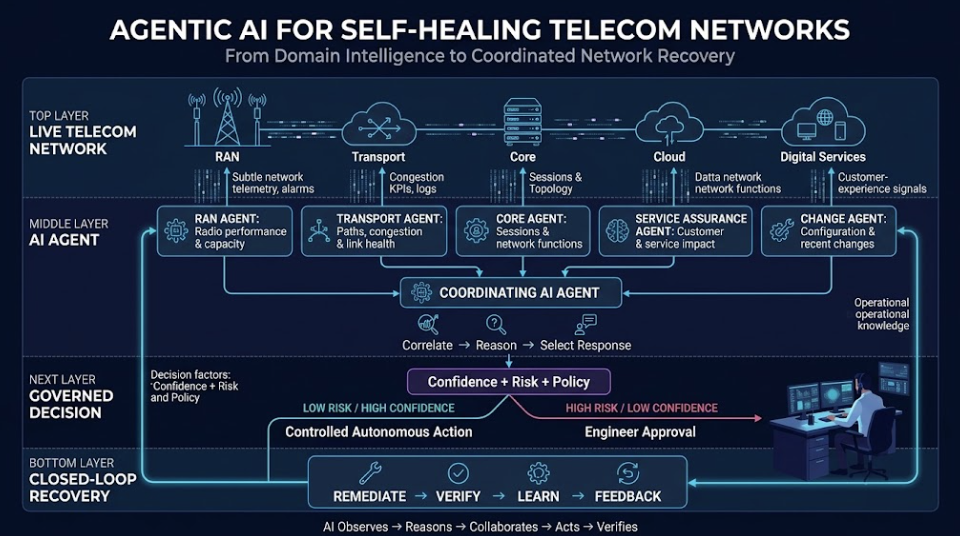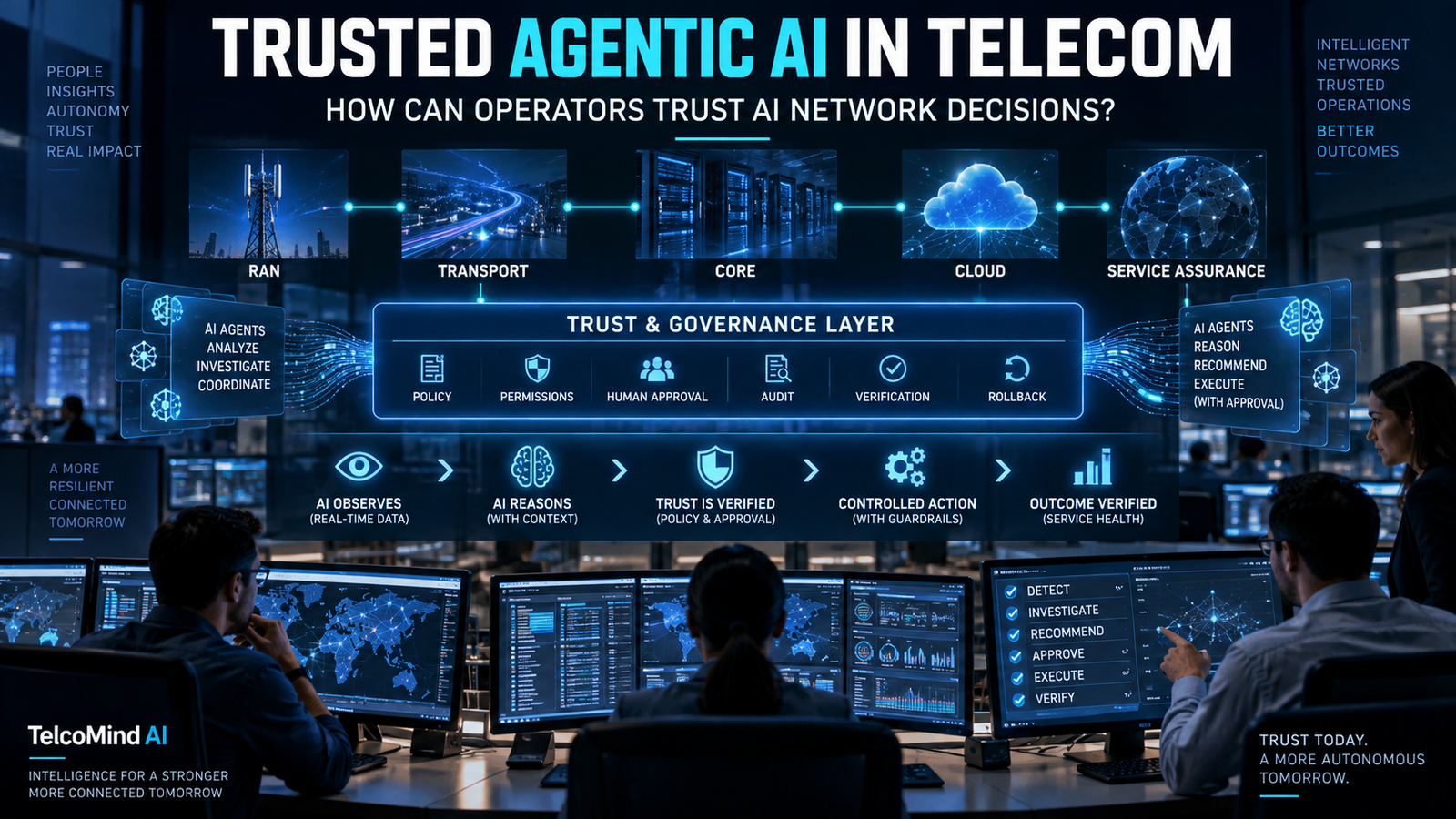
Category: AI & Telecom Networks

  • Trusted Agentic AI in Telecom: How Operators Can Prove AI Decisions Are Safe

    Trusted Agentic AI in Telecom: How Operators Can Prove AI Decisions Are Safe

    When an AI Agent Makes a Network Decision, Who Trusts the Decision?

    Imagine an AI agent in a telecom NOC detects abnormal congestion in the mobile core.

    It correlates alarms, KPIs, recent configuration changes and service-impact information. Within seconds, it concludes that traffic should be rerouted to protect customer services.

    Technically, the recommendation may be correct.

    But before allowing the agent to execute the change, the operator needs answers to several questions.

    Can we verify why the AI made this decision?

    Does the agent have permission to perform this action?

    What could happen if its reasoning is wrong?

    Can the action be reversed immediately?

    And who remains accountable for the outcome?

    These questions become increasingly important as telecom AI moves from providing recommendations toward taking actions across RAN, transport, core, cloud and service-assurance environments.

    This evolution is already visible in practical Agentic AI use cases in telecom, where AI agents can investigate incidents, coordinate decisions and support controlled network actions.

    The challenge is therefore no longer simply:

    “Can Agentic AI operate the network?”

    “Can operators prove that an AI agent is acting safely, within policy and for the right reason?”

    That is where Trusted Agentic AI becomes critical.

    For telecom operators, trust cannot simply mean believing that an AI model is accurate. Trust must be demonstrated through identity, permissions, explainability, policy controls, verification, audit trails and rollback mechanisms.

    The journey toward autonomous networks therefore requires two capabilities to mature together: AI autonomy and AI governance.

    H2 — What Does Trusted Agentic AI Actually Mean in Telecom?

    Trusted Agentic AI does not mean that an AI agent never makes a mistake.

    It means the operator has enough visibility, control and evidence to understand what the agent is doing, why it is doing it and whether it is operating within approved boundaries.

    Consider an AI agent investigating degradation in a 5G service.

    The agent may collect information from alarms, performance counters, topology, configuration changes, trouble tickets and service-impact data. It may then recommend—or eventually execute—a corrective action.

    Before that action can be trusted, several controls should exist.

    Identity — The network must know which AI agent is requesting an action.

    Permission — The agent should access only the systems and commands required for its assigned role.

    Context — Its decision should use reliable and sufficiently current network information.

    Policy — Actions must remain within predefined operational and business rules.

    Explainability — Engineers should be able to understand the evidence behind important decisions.

    Verification — The system must confirm whether the action produced the intended result.

    Auditability — Every important decision and action should leave a trace that can be reviewed later.

    Rollback — If the outcome is wrong, the network needs a safe path back to the previous state.

    Trust is not created by giving an AI agent more autonomy. Trust is created by proving that its autonomy remains controlled, observable and reversible.

    In telecom, Trusted Agentic AI should therefore be treated as an operational control architecture—not simply an AI-model feature.

    H2 — When the AI Makes the Right Decision Using the Wrong Context

    Imagine a telecom AI agent detects rising packet loss on a transport path carrying traffic from several mobile sites.

    The agent checks performance data and concludes that the best action is to reroute traffic through an alternative path.

    From the data available to the agent, the decision looks correct.

    But there is a problem.

    A planned maintenance activity is already underway on the alternative path. The information exists in the change-management system, but the AI agent does not have access to it.

    If the agent automatically reroutes the traffic, a localized degradation could become a much larger service incident.

    The AI reasoning was not necessarily wrong.

    The context was incomplete.

    What Should a Trusted AI Agent Do?

    Before executing the reroute, the agent should verify:

    Network health → Active alarms → Topology → Current changes → Maintenance windows → Service impact → Policy restrictions

    If critical information is missing or conflicting, the agent should stop autonomous execution and escalate the decision to an engineer.

    This creates an important principle for telecom operations:

    An AI agent should not only calculate confidence in its answer. It should also understand the completeness and reliability of the context behind that answer.

    Trusted Agentic AI needs a mechanism to know when it has enough evidence to act—and when it should ask a human.

    What Does a Trusted Agentic AI Architecture Look Like?

    Trust should not depend on a single AI model. It should be built around the agent through multiple layers of operational control.

    A practical telecom architecture can be viewed as five layers:

    1. Network Context Layer
    Provides the agent with alarms, KPIs, topology, configuration, service impact, change records and historical incidents.

    2. Agent Intelligence Layer
    The AI agent analyzes the situation, correlates evidence, develops possible actions and estimates confidence and risk.

    3. Trust & Governance Layer
    Checks identity, permissions, policies, action boundaries and whether human approval is required.

    4. Controlled Execution Layer
    Approved actions are executed through controlled automation, APIs or orchestration platforms rather than unrestricted network access.

    5. Verification & Audit Layer
    The network is monitored after the action. Results are verified, decisions are logged and rollback is triggered when necessary.

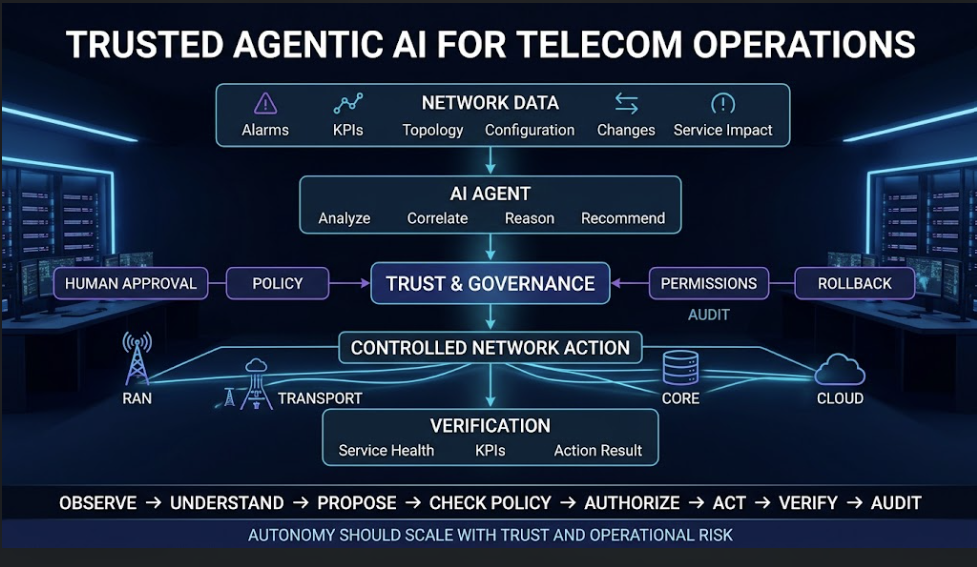
    The Trusted Decision Flow

    OBSERVE → UNDERSTAND → PROPOSE → CHECK POLICY → AUTHORIZE → ACT → VERIFY → AUDIT

    Paragraph:

    The critical difference from basic AI automation is that the agent does not move directly from decision to action. A trust layer sits between them.

    For example, an agent may be allowed to restart a low-risk application process automatically, while a routing change affecting thousands of customers may require engineer approval.

    The level of autonomy should increase or decrease according to the risk of the action—not simply according to the intelligence of the AI agent.
    Should Every AI Agent Have the Same Level of Autonomy?

    Not every telecom network action carries the same operational risk.

    An AI agent summarizing alarms is very different from an AI agent modifying a core-network configuration. Therefore, operators should not give every agent the same level of authority.

    A practical approach is to connect autonomy with operational risk.

    Risk LevelExample Telecom ActionAI AuthorityHuman Control
    LowAlarm correlation, log analysis, incident summaryAnalyze automaticallyReview when needed
    ModerateRecommend parameter optimization or traffic reroutingRecommend actionHuman approval
    HighExecute configuration or routing changeRestricted executionMandatory approval
    CriticalCore, security or large-scale service-impacting changeNo independent executionStrict human authorization

    As an AI agent demonstrates reliability, some actions may gradually move toward greater automation. But this should happen per use case and per action type, not by simply declaring an entire AI platform “autonomous.”

    Autonomy should be earned through evidence, bounded by policy and reduced immediately when operational risk increases.

    How Can Operators Prove an AI Agent Made the Right Decision?

    In traditional network operations, engineers leave evidence behind: alarms, tickets, command logs, approvals and change records.

    Agentic AI should not reduce this visibility. It should make the decision trail even clearer.

    For every significant network action, the operator should be able to reconstruct:

    What happened? — What alarm, KPI or service condition triggered the agent?

    What did the agent know? — Which topology, configuration, change and service data were available?

    Why did it choose this action? — What evidence supported the recommendation?

    Was it authorized? — Which policy and permission allowed the action?

    Who approved it? — Was execution autonomous or human-approved?

    What exactly changed? — Commands, APIs, parameters and affected network elements should be recorded.

    Did it work? — Post-action KPIs and service health should verify the outcome.

    Could it be reversed? — The rollback path and previous state should be available.

    From Network Logs to AI Decision Records

    This suggests that future NOCs may need something beyond traditional command logging: an AI decision record.

    For every important action, the record could connect:

    Trigger → Evidence → Reasoning → Policy Check → Approval → Action → Network Result → Rollback Status

    This creates an auditable chain that engineers, operations management, security teams and governance functions can review.

    If an operator cannot reconstruct why an AI agent changed the network, that action was not truly governed—even if the outcome happened to be correct.

    What Happens When Two AI Agents Want to Take Different Actions?

    A future telecom NOC may not operate with one AI agent.

    Different agents could specialize in RAN, transport, core, service assurance, cybersecurity, energy optimization and change management.

    That creates a new operational challenge: their objectives may conflict.

    Imagine a major event causes congestion in part of the network.

    The Service Assurance Agent wants to reroute traffic immediately to protect customer experience.

    At the same time, the Transport Agent detects that the alternative path is approaching its capacity threshold and recommends keeping the existing routing.

    Meanwhile, an Energy Optimization Agent has already placed some infrastructure into a power-saving state.

    Each recommendation may make sense individually.

    But they cannot all be executed independently.

    From Individual Agents to Coordinated Decisions

    A trusted Agentic AI environment therefore needs coordination above individual agents.

    A coordinating or orchestration layer should evaluate:

    Service priority → Network capacity → Current incidents → Change activity → Security constraints → Business intent → Operational risk

    It can then determine whether to approve one action, combine several recommendations, request additional evidence or escalate the decision to a human operator.

    SPECIALIZED AGENTS → COORDINATED REASONING → POLICY CHECK → HUMAN APPROVAL WHEN REQUIRED → CONTROLLED ACTION

    Multi-agent autonomy without coordination could simply replace operational silos with AI silos.

    Is Trusted Agentic AI Already Becoming Real in Telecom?

    Trusted Agentic AI is no longer only a future architecture discussion. During 2026, major telecom vendors, operators and industry bodies have started demonstrating how AI agents can operate within controlled network environments.

    Nokia: Trust-Based Agentic AI for IP Networks

    In June 2026, Nokia introduced an Agentic AI framework for its Network Services Platform. The framework grounds agents in a real-time network view and is designed to support guided and explainable actions within operator-defined policies and security boundaries. Nokia also describes governance, observability and what it calls “glass box autonomy” as important elements of its broader autonomous-network approach.

    This is important because it reflects the same principle discussed earlier:

    AI Agent → Trusted Network Context → Policy Boundary → Explainable Action

    Ericsson: Human Control Before Network Actuation

    Ericsson has demonstrated an agentic network-intelligence approach where agents analyze subscriber-impacting events, investigate likely root causes and recommend possible remedies.

    Importantly, the proposed remedy can remain under human control. Once the engineer approves the preferred action, an actuation agent can invoke the appropriate automation platform or network interface.

    That creates a practical progression:

    AI Investigates → AI Recommends → Human Validates → Agent Executes

    TM Forum: Trusted Agentic AI With Operators

    At DTW Ignite 2026, TM Forum showcased a Trusted Agentic AI for Access Management Catalyst involving organizations including Deutsche Telekom and Vodafone.

    The project focuses on secure, consistent and auditable network configuration and combines intelligent automation with permission and compliance controls.

    TM Forum’s 2026 Trustworthy AI & Data program also showcased an Agentic NOC, an essential framework for telecom Agentic AI, trusted access management and multi-agent network planning—showing that trust and governance are becoming part of the industry’s Agentic AI discussion rather than an afterthought.

    The industry direction is becoming clearer: telecom operators are not simply asking how to give AI agents more control. They are developing mechanisms to make that control observable, explainable, policy-bound and auditable.

    Trusted autonomy—not unrestricted autonomy—is emerging as the practical path toward Agentic AI in live telecom networks.

    How Should a Telecom NOC Introduce Trusted Agentic AI?

    Operators should not begin by giving an AI agent permission to change a live network.

    Trust should be built progressively, using real operational evidence.

    A practical approach is to move through five stages.

    Stage 1: Observe

    Connect the agent to approved operational data such as alarms, KPIs, topology, tickets and change records.

    The agent can analyze the network, but cannot recommend or execute actions yet.

    Stage 2: Recommend

    Allow the agent to investigate incidents and recommend actions to engineers.

    Compare its recommendations with actual engineering decisions and measure accuracy, context completeness and operational usefulness.

    Stage 3: Shadow

    Let the agent generate the action it would have taken—but do not allow execution.

    Compare:

    AI Proposed Action → Engineer Action → Actual Network Outcome

    This creates evidence about whether the agent can be trusted.

    Stage 4: Human-Approved Execution

    For proven use cases, allow the agent to prepare an action while an authorized engineer approves execution.

    Every action should include:

    Evidence → Risk → Expected Impact → Approval → Rollback Plan

    Stage 5: Bounded Autonomy

    Only well-proven, low-risk actions should eventually be executed without individual human approval.

    Even then, the agent should operate within predefined permissions, thresholds, policies and rollback conditions.

    The objective of the first Agentic AI deployment should not be maximum autonomy. It should be measurable trust.

    What Should Operators Measure?

    Track practical indicators such as recommendation accuracy, false-action rate, human override rate, successful execution rate, rollback rate, service impact avoided and time saved during investigation.

    These metrics provide evidence for deciding whether a specific agent or action is ready for greater autonomy.

    A Practical 90-Day Trusted Agentic AI Pilot for the NOC

    Operators do not need to transform the entire NOC to start testing Agentic AI. A better approach is to select one contained operational use case where decisions can be measured and risk can be controlled.

    A strong starting point could be incident investigation and recommended remediation, because the agent can demonstrate value before receiving direct network control.

    Days 1–30: Build Trusted Context

    Select one use case and connect only the required data sources:

    Alarms → KPIs → Topology → Configuration → Change Records → Tickets → Service Impact

    Define the agent’s identity, access permissions, prohibited actions and escalation rules.

    During this phase, the agent should observe only.

    Days 31–60: Shadow the Engineers

    Allow the agent to investigate real incidents and produce:

    Likely Root Cause → Supporting Evidence → Recommended Action → Risk → Expected Result

    Engineers continue operating normally.

    Compare the agent’s conclusions with actual engineering decisions and network outcomes.

    The goal is to answer:

    Does the agent consistently have enough context to make a reliable recommendation?

    Days 61–90: Introduce Controlled Action

    For actions that performed reliably during the shadow phase, introduce human-approved execution.

    Before execution, the agent should present:

    What it wants to change → Why → Expected impact → Risk → Rollback plan

    After execution, automatically verify service health and relevant KPIs.

    Day 90: Decide Whether to Scale

    Do not ask simply:

    “Did the AI work?”

    Ask:

    Did investigation become faster?
    Were recommendations reliable?
    How often did engineers override the agent?
    Were actions successfully verified?
    Did any action require rollback?
    Did customer/service impact reduce?

    ONE USE CASE → CONTROL THE ACCESS → SHADOW → PROVE TRUST → AUTHORIZE → VERIFY → SCALE

    Autonomy should be the result of proven operational trust—not the starting point of an Agentic AI project.

    What Could a Trusted Agentic NOC Look Like by 2030?

    By 2030, the telecom NOC may operate with multiple specialized AI agents working continuously across different network domains.

    A Service Assurance Agent could monitor customer experience.

    A RAN Agent could investigate radio degradation.

    A Transport Agent could evaluate congestion and path availability.

    A Core Agent could analyze service and signaling abnormalities.

    A Security Agent could identify suspicious behavior.

    A Change Agent could evaluate configuration risk before implementation.

    But these agents should not operate as independent automation engines.

    They could work through a common trust and orchestration layer that understands business intent, operational policy, permissions, service priority and network risk.

    This approach also connects with intent-driven telecom operations, where business objectives and operational policies guide how autonomous systems make network decisions.

    Humans Move From Executing Every Action to Governing Autonomy

    As confidence grows, the role of NOC engineers may increasingly shift from manually gathering information and executing repetitive actions toward:

    Defining operational intent → Setting policy boundaries → Reviewing high-risk decisions → Managing exceptions → Improving automation → Governing AI performance

    This does not remove human accountability.

    It makes human judgment more important at the points where risk, uncertainty and business impact are highest.

    THE FUTURE NOC MAY NOT ASK WHETHER AI OR HUMANS SHOULD OPERATE THE NETWORK. IT MAY ASK WHICH DECISIONS AI CAN SAFELY HANDLE—AND WHICH DECISIONS STILL REQUIRE HUMAN JUDGMENT.

    The destination is not a network with no humans. It is a network where autonomy operates within clearly defined trust boundaries.

    Conclusion: Autonomy Must Be Earned Through Trust

    Agentic AI could fundamentally change telecom network operations by allowing AI systems to investigate incidents, coordinate across domains, recommend actions and eventually execute selected network changes.

    But greater intelligence does not automatically create greater trust.

    Before an AI agent is allowed to influence a live network, operators need to know what the agent can access, what it is allowed to do, what evidence supports its decision, how the action will be verified and how quickly it can be reversed if something goes wrong.

    That means the path toward Agentic AI should not be:

    AI Capability → Full Autonomy

    It should be:

    AI Capability → Operational Evidence → Governance → Controlled Authority → Verification → Trusted Autonomy

    The most successful Agentic AI networks may not be those that give AI the most control. They may be those that can prove exactly when, where and why that control can be trusted.

    How Ready Is Your NOC for AI-Driven Operations?

    Trusted Agentic AI depends on capabilities that must already exist across observability, automation, predictive operations, AIOps, decision intelligence, closed-loop operations and governance.

    Use the free TelcoMind AI NOC Maturity Assessment to evaluate your current operations across 8 critical dimensions and identify where your NOC stands on the journey:

    Reactive → Automated → Predictive → Intelligent → Autonomous
    Take the Free NOC AI Maturity Assessment →

  • Trusted Agentic AI in Telecom: How Operators Can Prove AI Decisions Are Safe

    Trusted Agentic AI in Telecom: How Operators Can Prove AI Decisions Are Safe

    When an AI Agent Makes a Network Decision, Who Trusts the Decision?

    Imagine an AI agent in a telecom NOC detects abnormal congestion in the mobile core.

    It correlates alarms, KPIs, recent configuration changes and service-impact information. Within seconds, it concludes that traffic should be rerouted to protect customer services.

    Technically, the recommendation may be correct.

    But before allowing the agent to execute the change, the operator needs answers to several questions.

    Can we verify why the AI made this decision?

    Does the agent have permission to perform this action?

    What could happen if its reasoning is wrong?

    Can the action be reversed immediately?

    And who remains accountable for the outcome?

    These questions become increasingly important as telecom AI moves from providing recommendations toward taking actions across RAN, transport, core, cloud and service-assurance environments.

    This evolution is already visible in practical Agentic AI use cases in telecom, where AI agents can investigate incidents, coordinate decisions and support controlled network actions.

    The challenge is therefore no longer simply:

    “Can Agentic AI operate the network?”

    “Can operators prove that an AI agent is acting safely, within policy and for the right reason?”

    That is where Trusted Agentic AI becomes critical.

    For telecom operators, trust cannot simply mean believing that an AI model is accurate. Trust must be demonstrated through identity, permissions, explainability, policy controls, verification, audit trails and rollback mechanisms.

    The journey toward autonomous networks therefore requires two capabilities to mature together: AI autonomy and AI governance.

    H2 — What Does Trusted Agentic AI Actually Mean in Telecom?

    Trusted Agentic AI does not mean that an AI agent never makes a mistake.

    It means the operator has enough visibility, control and evidence to understand what the agent is doing, why it is doing it and whether it is operating within approved boundaries.

    Consider an AI agent investigating degradation in a 5G service.

    The agent may collect information from alarms, performance counters, topology, configuration changes, trouble tickets and service-impact data. It may then recommend—or eventually execute—a corrective action.

    Before that action can be trusted, several controls should exist.

    Identity — The network must know which AI agent is requesting an action.

    Permission — The agent should access only the systems and commands required for its assigned role.

    Context — Its decision should use reliable and sufficiently current network information.

    Policy — Actions must remain within predefined operational and business rules.

    Explainability — Engineers should be able to understand the evidence behind important decisions.

    Verification — The system must confirm whether the action produced the intended result.

    Auditability — Every important decision and action should leave a trace that can be reviewed later.

    Rollback — If the outcome is wrong, the network needs a safe path back to the previous state.

    Trust is not created by giving an AI agent more autonomy. Trust is created by proving that its autonomy remains controlled, observable and reversible.

    In telecom, Trusted Agentic AI should therefore be treated as an operational control architecture—not simply an AI-model feature.

    H2 — When the AI Makes the Right Decision Using the Wrong Context

    Imagine a telecom AI agent detects rising packet loss on a transport path carrying traffic from several mobile sites.

    The agent checks performance data and concludes that the best action is to reroute traffic through an alternative path.

    From the data available to the agent, the decision looks correct.

    But there is a problem.

    A planned maintenance activity is already underway on the alternative path. The information exists in the change-management system, but the AI agent does not have access to it.

    If the agent automatically reroutes the traffic, a localized degradation could become a much larger service incident.

    The AI reasoning was not necessarily wrong.

    The context was incomplete.

    What Should a Trusted AI Agent Do?

    Before executing the reroute, the agent should verify:

    Network health → Active alarms → Topology → Current changes → Maintenance windows → Service impact → Policy restrictions

    If critical information is missing or conflicting, the agent should stop autonomous execution and escalate the decision to an engineer.

    This creates an important principle for telecom operations:

    An AI agent should not only calculate confidence in its answer. It should also understand the completeness and reliability of the context behind that answer.

    Trusted Agentic AI needs a mechanism to know when it has enough evidence to act—and when it should ask a human.

    What Does a Trusted Agentic AI Architecture Look Like?

    Trust should not depend on a single AI model. It should be built around the agent through multiple layers of operational control.

    A practical telecom architecture can be viewed as five layers:

    1. Network Context Layer
    Provides the agent with alarms, KPIs, topology, configuration, service impact, change records and historical incidents.

    2. Agent Intelligence Layer
    The AI agent analyzes the situation, correlates evidence, develops possible actions and estimates confidence and risk.

    3. Trust & Governance Layer
    Checks identity, permissions, policies, action boundaries and whether human approval is required.

    4. Controlled Execution Layer
    Approved actions are executed through controlled automation, APIs or orchestration platforms rather than unrestricted network access.

    5. Verification & Audit Layer
    The network is monitored after the action. Results are verified, decisions are logged and rollback is triggered when necessary.

    The Trusted Decision Flow

    OBSERVE → UNDERSTAND → PROPOSE → CHECK POLICY → AUTHORIZE → ACT → VERIFY → AUDIT

    Paragraph:

    The critical difference from basic AI automation is that the agent does not move directly from decision to action. A trust layer sits between them.

    For example, an agent may be allowed to restart a low-risk application process automatically, while a routing change affecting thousands of customers may require engineer approval.

    The level of autonomy should increase or decrease according to the risk of the action—not simply according to the intelligence of the AI agent.

    Should Every AI Agent Have the Same Level of Autonomy?

    Not every telecom network action carries the same operational risk.

    An AI agent summarizing alarms is very different from an AI agent modifying a core-network configuration. Therefore, operators should not give every agent the same level of authority.

    A practical approach is to connect autonomy with operational risk.

    Risk LevelExample Telecom ActionAI AuthorityHuman Control
    LowAlarm correlation, log analysis, incident summaryAnalyze automaticallyReview when needed
    ModerateRecommend parameter optimization or traffic reroutingRecommend actionHuman approval
    HighExecute configuration or routing changeRestricted executionMandatory approval
    CriticalCore, security or large-scale service-impacting changeNo independent executionStrict human authorization

    As an AI agent demonstrates reliability, some actions may gradually move toward greater automation. But this should happen per use case and per action type, not by simply declaring an entire AI platform “autonomous.”

    Autonomy should be earned through evidence, bounded by policy and reduced immediately when operational risk increases.

    How Can Operators Prove an AI Agent Made the Right Decision?

    In traditional network operations, engineers leave evidence behind: alarms, tickets, command logs, approvals and change records.

    Agentic AI should not reduce this visibility. It should make the decision trail even clearer.

    For every significant network action, the operator should be able to reconstruct:

    What happened? — What alarm, KPI or service condition triggered the agent?

    What did the agent know? — Which topology, configuration, change and service data were available?

    Why did it choose this action? — What evidence supported the recommendation?

    Was it authorized? — Which policy and permission allowed the action?

    Who approved it? — Was execution autonomous or human-approved?

    What exactly changed? — Commands, APIs, parameters and affected network elements should be recorded.

    Did it work? — Post-action KPIs and service health should verify the outcome.

    Could it be reversed? — The rollback path and previous state should be available.

    From Network Logs to AI Decision Records

    This suggests that future NOCs may need something beyond traditional command logging: an AI decision record.

    For every important action, the record could connect:

    Trigger → Evidence → Reasoning → Policy Check → Approval → Action → Network Result → Rollback Status

    This creates an auditable chain that engineers, operations management, security teams and governance functions can review.

    If an operator cannot reconstruct why an AI agent changed the network, that action was not truly governed—even if the outcome happened to be correct.

    What Happens When Two AI Agents Want to Take Different Actions?

    A future telecom NOC may not operate with one AI agent.

    Different agents could specialize in RAN, transport, core, service assurance, cybersecurity, energy optimization and change management.

    That creates a new operational challenge: their objectives may conflict.

    Imagine a major event causes congestion in part of the network.

    The Service Assurance Agent wants to reroute traffic immediately to protect customer experience.

    At the same time, the Transport Agent detects that the alternative path is approaching its capacity threshold and recommends keeping the existing routing.

    Meanwhile, an Energy Optimization Agent has already placed some infrastructure into a power-saving state.

    Each recommendation may make sense individually.

    But they cannot all be executed independently.

    From Individual Agents to Coordinated Decisions

    A trusted Agentic AI environment therefore needs coordination above individual agents.

    A coordinating or orchestration layer should evaluate:

    Service priority → Network capacity → Current incidents → Change activity → Security constraints → Business intent → Operational risk

    It can then determine whether to approve one action, combine several recommendations, request additional evidence or escalate the decision to a human operator.

    SPECIALIZED AGENTS → COORDINATED REASONING → POLICY CHECK → HUMAN APPROVAL WHEN REQUIRED → CONTROLLED ACTION

    Multi-agent autonomy without coordination could simply replace operational silos with AI silos.

    Is Trusted Agentic AI Already Becoming Real in Telecom?

    Trusted Agentic AI is no longer only a future architecture discussion. During 2026, major telecom vendors, operators and industry bodies have started demonstrating how AI agents can operate within controlled network environments.

    Nokia: Trust-Based Agentic AI for IP Networks

    In June 2026, Nokia introduced an Agentic AI framework for its Network Services Platform. The framework grounds agents in a real-time network view and is designed to support guided and explainable actions within operator-defined policies and security boundaries. Nokia also describes governance, observability and what it calls “glass box autonomy” as important elements of its broader autonomous-network approach.

    This is important because it reflects the same principle discussed earlier:

    AI Agent → Trusted Network Context → Policy Boundary → Explainable Action

    Ericsson: Human Control Before Network Actuation

    Ericsson has demonstrated an agentic network-intelligence approach where agents analyze subscriber-impacting events, investigate likely root causes and recommend possible remedies.

    Importantly, the proposed remedy can remain under human control. Once the engineer approves the preferred action, an actuation agent can invoke the appropriate automation platform or network interface.

    That creates a practical progression:

    AI Investigates → AI Recommends → Human Validates → Agent Executes

    TM Forum: Trusted Agentic AI With Operators

    At DTW Ignite 2026, TM Forum showcased a Trusted Agentic AI for Access Management Catalyst involving organizations including Deutsche Telekom and Vodafone.

    The project focuses on secure, consistent and auditable network configuration and combines intelligent automation with permission and compliance controls.

    TM Forum’s 2026 Trustworthy AI & Data program also showcased an Agentic NOC, an essential framework for telecom Agentic AI, trusted access management and multi-agent network planning—showing that trust and governance are becoming part of the industry’s Agentic AI discussion rather than an afterthought.

    The industry direction is becoming clearer: telecom operators are not simply asking how to give AI agents more control. They are developing mechanisms to make that control observable, explainable, policy-bound and auditable.

    Trusted autonomy—not unrestricted autonomy—is emerging as the practical path toward Agentic AI in live telecom networks.

    How Should a Telecom NOC Introduce Trusted Agentic AI?

    Operators should not begin by giving an AI agent permission to change a live network.

    Trust should be built progressively, using real operational evidence.

    A practical approach is to move through five stages.

    Stage 1: Observe

    Connect the agent to approved operational data such as alarms, KPIs, topology, tickets and change records.

    The agent can analyze the network, but cannot recommend or execute actions yet.

    Stage 2: Recommend

    Allow the agent to investigate incidents and recommend actions to engineers.

    Compare its recommendations with actual engineering decisions and measure accuracy, context completeness and operational usefulness.

    Stage 3: Shadow

    Let the agent generate the action it would have taken—but do not allow execution.

    Compare:

    AI Proposed Action → Engineer Action → Actual Network Outcome

    This creates evidence about whether the agent can be trusted.

    Stage 4: Human-Approved Execution

    For proven use cases, allow the agent to prepare an action while an authorized engineer approves execution.

    Every action should include:

    Evidence → Risk → Expected Impact → Approval → Rollback Plan

    Stage 5: Bounded Autonomy

    Only well-proven, low-risk actions should eventually be executed without individual human approval.

    Even then, the agent should operate within predefined permissions, thresholds, policies and rollback conditions.

    The objective of the first Agentic AI deployment should not be maximum autonomy. It should be measurable trust.

    What Should Operators Measure?

    Track practical indicators such as recommendation accuracy, false-action rate, human override rate, successful execution rate, rollback rate, service impact avoided and time saved during investigation.

    These metrics provide evidence for deciding whether a specific agent or action is ready for greater autonomy.

    A Practical 90-Day Trusted Agentic AI Pilot for the NOC

    Operators do not need to transform the entire NOC to start testing Agentic AI. A better approach is to select one contained operational use case where decisions can be measured and risk can be controlled.

    A strong starting point could be incident investigation and recommended remediation, because the agent can demonstrate value before receiving direct network control.

    Days 1–30: Build Trusted Context

    Select one use case and connect only the required data sources:

    Alarms → KPIs → Topology → Configuration → Change Records → Tickets → Service Impact

    Define the agent’s identity, access permissions, prohibited actions and escalation rules.

    During this phase, the agent should observe only.

    Days 31–60: Shadow the Engineers

    Allow the agent to investigate real incidents and produce:

    Likely Root Cause → Supporting Evidence → Recommended Action → Risk → Expected Result

    Engineers continue operating normally.

    Compare the agent’s conclusions with actual engineering decisions and network outcomes.

    The goal is to answer:

    Does the agent consistently have enough context to make a reliable recommendation?

    Days 61–90: Introduce Controlled Action

    For actions that performed reliably during the shadow phase, introduce human-approved execution.

    Before execution, the agent should present:

    What it wants to change → Why → Expected impact → Risk → Rollback plan

    After execution, automatically verify service health and relevant KPIs.

    Day 90: Decide Whether to Scale

    Do not ask simply:

    “Did the AI work?”

    Ask:

    Did investigation become faster?
    Were recommendations reliable?
    How often did engineers override the agent?
    Were actions successfully verified?
    Did any action require rollback?
    Did customer/service impact reduce?

    ONE USE CASE → CONTROL THE ACCESS → SHADOW → PROVE TRUST → AUTHORIZE → VERIFY → SCALE

    Autonomy should be the result of proven operational trust—not the starting point of an Agentic AI project.

    What Could a Trusted Agentic NOC Look Like by 2030?

    By 2030, the telecom NOC may operate with multiple specialized AI agents working continuously across different network domains.

    A Service Assurance Agent could monitor customer experience.

    A RAN Agent could investigate radio degradation.

    A Transport Agent could evaluate congestion and path availability.

    A Core Agent could analyze service and signaling abnormalities.

    A Security Agent could identify suspicious behavior.

    A Change Agent could evaluate configuration risk before implementation.

    But these agents should not operate as independent automation engines.

    They could work through a common trust and orchestration layer that understands business intent, operational policy, permissions, service priority and network risk.

    This approach also connects with intent-driven telecom operations, where business objectives and operational policies guide how autonomous systems make network decisions.

    Humans Move From Executing Every Action to Governing Autonomy

    As confidence grows, the role of NOC engineers may increasingly shift from manually gathering information and executing repetitive actions toward:

    Defining operational intent → Setting policy boundaries → Reviewing high-risk decisions → Managing exceptions → Improving automation → Governing AI performance

    This does not remove human accountability.

    It makes human judgment more important at the points where risk, uncertainty and business impact are highest.

    THE FUTURE NOC MAY NOT ASK WHETHER AI OR HUMANS SHOULD OPERATE THE NETWORK. IT MAY ASK WHICH DECISIONS AI CAN SAFELY HANDLE—AND WHICH DECISIONS STILL REQUIRE HUMAN JUDGMENT.

    The destination is not a network with no humans. It is a network where autonomy operates within clearly defined trust boundaries.

    Conclusion: Autonomy Must Be Earned Through Trust

    Agentic AI could fundamentally change telecom network operations by allowing AI systems to investigate incidents, coordinate across domains, recommend actions and eventually execute selected network changes.

    But greater intelligence does not automatically create greater trust.

    Before an AI agent is allowed to influence a live network, operators need to know what the agent can access, what it is allowed to do, what evidence supports its decision, how the action will be verified and how quickly it can be reversed if something goes wrong.

    That means the path toward Agentic AI should not be:

    AI Capability → Full Autonomy

    It should be:

    AI Capability → Operational Evidence → Governance → Controlled Authority → Verification → Trusted Autonomy

    The most successful Agentic AI networks may not be those that give AI the most control. They may be those that can prove exactly when, where and why that control can be trusted.

    How Ready Is Your NOC for AI-Driven Operations?

    Trusted Agentic AI depends on capabilities that must already exist across observability, automation, predictive operations, AIOps, decision intelligence, closed-loop operations and governance.

    Use the free TelcoMind AI NOC Maturity Assessment to evaluate your current operations across 8 critical dimensions and identify where your NOC stands on the journey:

    Reactive → Automated → Predictive → Intelligent → Autonomous
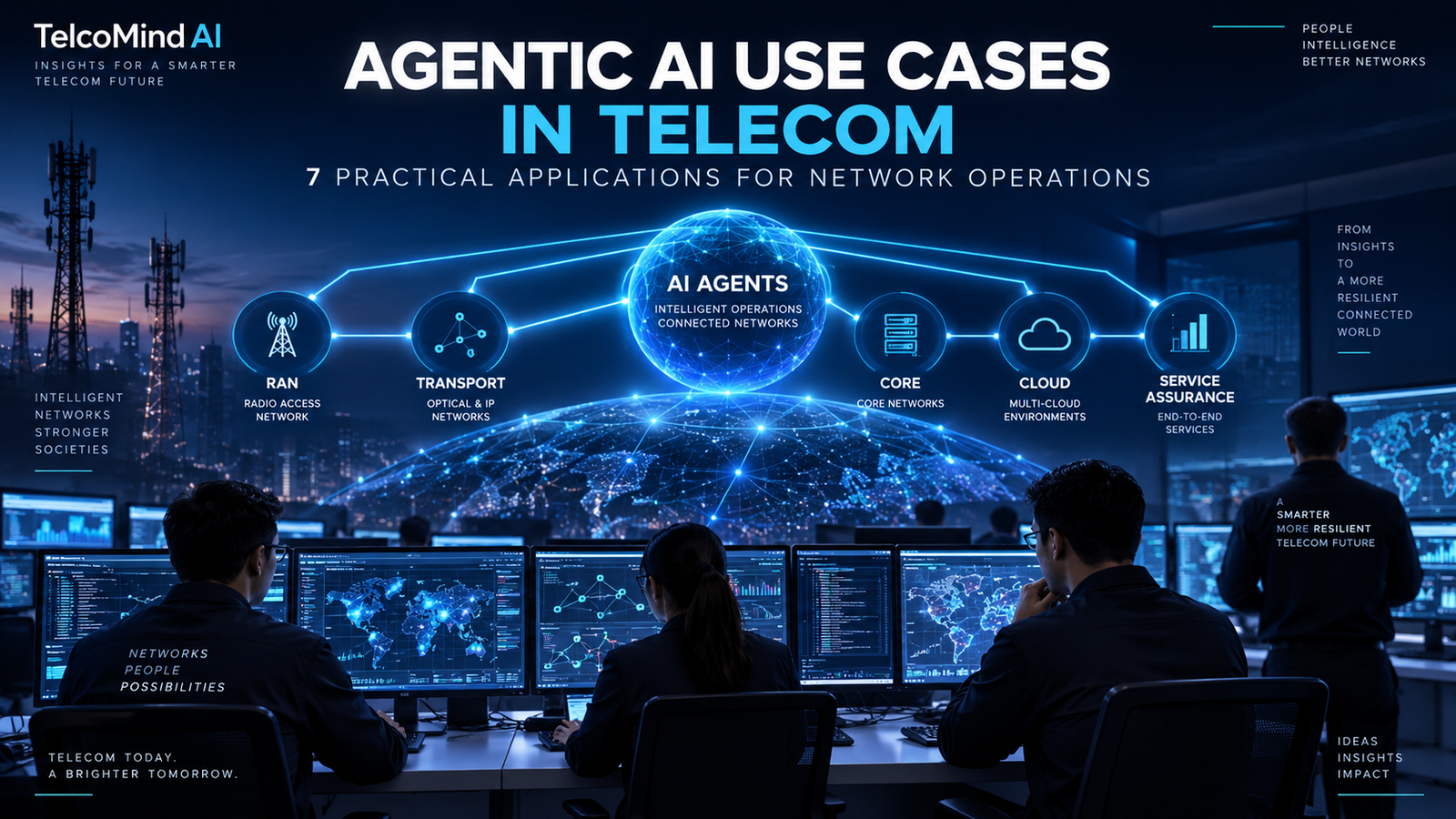
    Take the Free NOC AI Maturity Assessment →

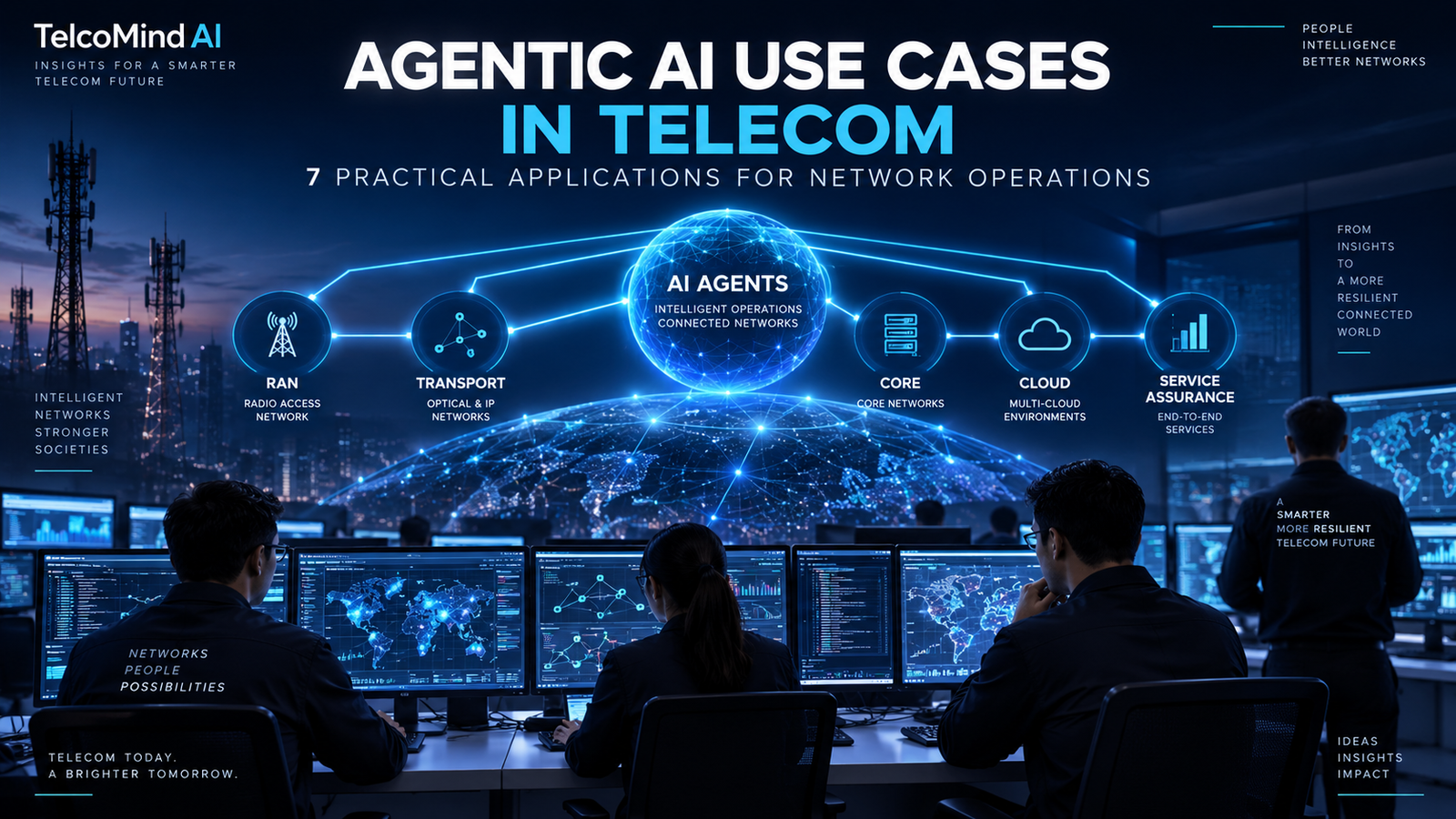
  • Agentic AI Use Cases in Telecom: 7 Practical Applications for Network Operations

    Agentic AI Use Cases in Telecom: 7 Practical Applications for Network Operations

    Where Can Agentic AI Actually Be Used in a Telecom Network?

    Agentic AI is becoming one of the most discussed ideas in telecom AI.

    But for network operators, the important question is no longer simply:

    “What is Agentic AI?”

    The more useful question is:

    “What operational problem can an AI agent actually solve?”

    Imagine a major service degradation.

    Today, an engineer may need to move between alarm systems, performance dashboards, configuration records, change-management tools and network logs before understanding what happened.

    An Agentic AI system could approach the same problem differently.

    It could gather evidence from multiple systems, investigate possible causes, coordinate with specialized AI agents, evaluate possible actions and present the engineer with a recommended response.

    For approved low-risk situations, it could eventually execute a controlled action and verify whether the service recovered.

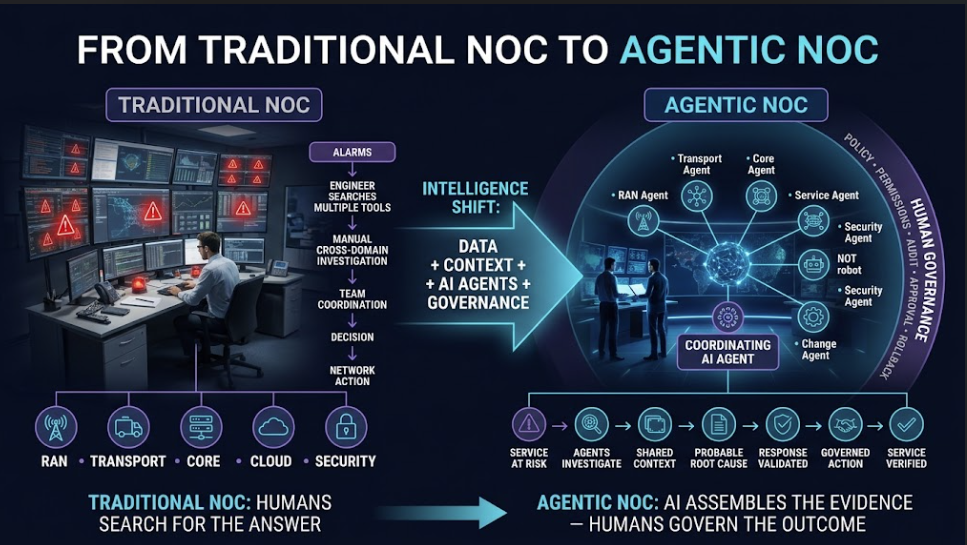
    That changes the operational flow from:

    ALARM → ENGINEER SEARCHES → INVESTIGATES → DECIDES → ACTS

    toward:

    ALARM → AI INVESTIGATES → CORRELATES → REASONS → RECOMMENDS → GOVERNED ACTION → VERIFIES

    But not every telecom problem needs an AI agent.

    The real value appears when a task requires multiple steps, multiple systems, contextual reasoning and coordinated decisions.

    This article explores seven practical Agentic AI use cases in telecom network operations—and, importantly, where operators should and should not give AI operational authority.

    The value of Agentic AI is not that it can talk about the network. It is whether it can help move an operational problem safely toward resolution.

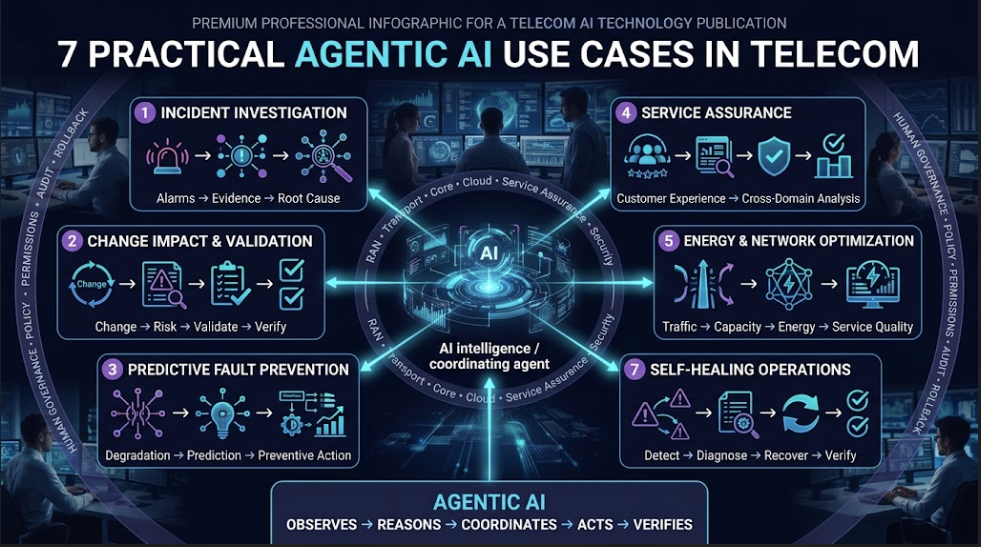
    Use Case 1: Autonomous Incident Investigation

    Incident investigation is one of the strongest potential applications for Agentic AI because the information required to understand a network problem is often distributed across multiple systems.

    Consider a sudden degradation affecting thousands of mobile customers.

    The NOC sees several symptoms:

    RAN alarms → Transport packet loss → Core KPI degradation → Customer complaints

    The difficult question is:

    Are these four different problems—or four symptoms of the same problem?

    An Agentic AI system could assign different tasks to specialized agents.

    A RAN Agent checks cell alarms and performance changes.

    A Transport Agent investigates congestion, interface errors and path changes.

    A Core Agent examines session failures and service KPIs.

    A Change Agent checks whether any recent configuration or software change matches the incident timeline.

    A coordinating agent could then combine the evidence and build a probable incident story:

    Recent transport change → Packet loss increases → RAN service degradation → Core sessions affected → Customer experience deteriorates

    Instead of engineers manually searching several platforms, the system could present:

    Probable Root Cause → Supporting Evidence → Affected Services → Recommended Action → Confidence Level

    The engineer can then validate the evidence and decide whether the recommended action is safe.

    MULTIPLE ALARMS → MULTIPLE AGENTS → SHARED CONTEXT → PROBABLE ROOT CAUSE → GOVERNED RESPONSE

    Agentic AI becomes valuable when it can turn fragmented network evidence into an investigation engineers can verify and act upon.

    Use Case 2: Change Impact Analysis and Validation

    Many network incidents do not begin with hardware failure or an external attack.

    They begin with a planned change.

    A routing update, software upgrade, parameter modification or cloud configuration may complete successfully from a technical perspective—but still create unexpected service impact somewhere else.

    Imagine a routing change is planned in the transport network.

    Before execution, an Agentic AI system could coordinate several checks:

    Change Agent → Understands the proposed configuration.

    Topology Agent → Identifies affected network paths and dependencies.

    Capacity Agent → Checks whether alternative routes have sufficient capacity.

    Service Agent → Identifies enterprise, voice, 5G or other critical services using those paths.

    Risk Agent → Reviews similar historical changes and previous incidents.

    The system could then produce:

    CHANGE → DEPENDENCIES → POSSIBLE IMPACT → RISK LEVEL → RECOMMENDATION

    For a higher-risk change, the proposed action could also be tested through a Network Digital Twin before touching the live network.

    But Agentic AI should not stop working once the change is executed.

    It could compare network conditions before and after the change, checking latency, packet loss, alarms, traffic distribution and service KPIs.

    If unexpected degradation appears, it could recommend a rollback—or execute an already approved rollback policy where appropriate.

    BEFORE THE CHANGE: UNDERSTAND THE RISK

    AFTER THE CHANGE: VERIFY THE OUTCOME

    A successful change should not mean only that the command executed correctly. It should mean that the network remained healthy after it was executed.

    Use Case 3: Predictive Fault Prevention Before the Outage

    Some of the most valuable network incidents are the ones that never happen.

    Telecom equipment often shows warning signs before a major failure: rising temperature, increasing optical errors, unstable power, repeated interface flaps, abnormal CPU utilization or gradually deteriorating performance.

    The problem is that these signals may appear in different monitoring systems and at different times.

    Imagine an optical transmission link begins showing increasing errors.

    A traditional system may generate threshold alarms once conditions become serious.

    An Agentic AI workflow could investigate earlier.

    Performance Agent → Detects unusual degradation compared with historical behavior.

    Transmission Agent → Checks optical power, errors and link performance.

    Topology Agent → Identifies services and network elements dependent on the link.

    Maintenance Agent → Reviews previous faults and maintenance history.

    Capacity Agent → Determines whether traffic could safely use an alternative path.

    The agents could combine their findings:

    DEGRADING SIGNAL → FAILURE PROBABILITY → SERVICE EXPOSURE → AVAILABLE PROTECTION → RECOMMENDED ACTION

    Instead of waiting for the equipment to fail, the operator might proactively reroute traffic, schedule maintenance or replace a deteriorating component during a controlled window.

    The important distinction is that Agentic AI would not merely predict a failure.

    It could help coordinate what should happen because a failure is predicted.

    PREDICTION TELLS US WHAT MAY FAIL. AGENTIC AI CAN HELP DETERMINE WHAT WE SHOULD DO ABOUT IT.

    The operational value of prediction appears when insight is converted into a safe action before customers are affected.

    Use Case 4: Service Assurance Before Customers Complain

    A network can look healthy while customers are already experiencing a poor service.

    Traditional monitoring often looks at individual network domains. But a customer experiences the complete service journey.

    Imagine enterprise customers in one area begin experiencing intermittent video and voice degradation.

    There is no major outage.

    RAN availability remains high.

    Core systems appear healthy.

    Transport utilization is within normal thresholds.

    Yet customer experience is deteriorating.

    An Agentic AI system could investigate the service across domains.

    Customer Experience Agent → Detects unusual degradation in service-quality indicators.

    RAN Agent → Checks radio quality, congestion and mobility behavior.

    Transport Agent → Examines latency, packet loss and path performance.

    Core Agent → Reviews sessions, signaling and service KPIs.

    Change Agent → Searches for recent changes matching the degradation timeline.

    The coordinating agent could discover that no single domain has crossed a major alarm threshold—but several small degradations are combining to affect the customer.

    It could produce:

    CUSTOMER IMPACT → CROSS-DOMAIN EVIDENCE → PROBABLE CAUSE → AFFECTED SERVICES → RECOMMENDED ACTION

    This changes service assurance from waiting for:

    CUSTOMER COMPLAINT → TICKET → INVESTIGATION

    toward:

    EXPERIENCE DEGRADATION → AI INVESTIGATION → EARLY ACTION → SERVICE PROTECTED

    Agentic AI could help telecom operations investigate the service from the customer’s perspective—not only from the perspective of individual network elements.

    Use Case 5: Intelligent Energy and Network Optimization

    Reducing network energy consumption sounds simple until service quality, coverage and capacity are added to the equation.

    Imagine traffic falls significantly across part of the mobile network during the night.

    Some radio resources could potentially operate in a lower-energy state.

    But switching resources off based only on traffic volume could create another problem if demand suddenly increases or neighboring sites cannot absorb the load.

    Agentic AI could coordinate several perspectives before making a recommendation.

    Traffic Agent → Predicts demand for the next period.

    RAN Agent → Identifies resources that could potentially enter energy-saving mode.

    Capacity Agent → Checks whether neighboring resources can handle additional traffic.

    Service Agent → Protects critical services and customer-experience requirements.

    Energy Agent → Calculates the potential energy benefit.

    The coordinating agent could then evaluate:

    ENERGY SAVING vs CAPACITY vs COVERAGE vs SERVICE QUALITY

    For example, instead of simply deciding:

    “Switch this resource off.”

    the system could reason:

    Traffic is low → Neighboring capacity is sufficient → No critical service risk detected → Energy-saving action is permitted → Monitor KPIs → Restore capacity automatically if demand changes

    This is important because optimization rarely has only one objective.

    The network may simultaneously need to reduce energy, maintain SLA performance, protect coverage and preserve resilience.

    THE BEST OPTIMIZATION IS NOT THE ONE THAT SAVES THE MOST ENERGY. IT IS THE ONE THAT SAVES ENERGY WITHOUT COMPROMISING THE REQUIRED SERVICE OUTCOME.

    Agentic AI becomes especially useful when the network must balance several competing objectives rather than optimize one KPI in isolation.

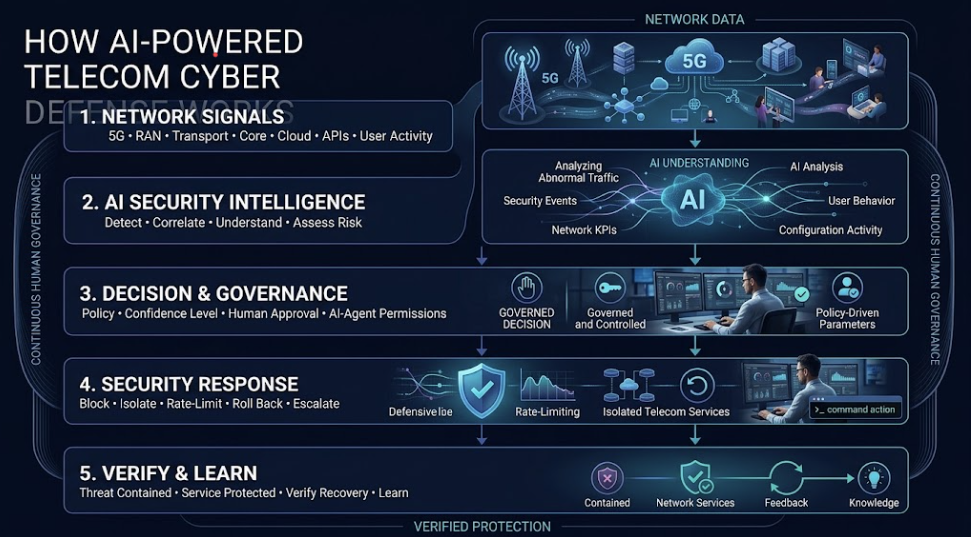
    Use Case 6: AI-Powered Cyber Defense and Threat Response

    Cybersecurity becomes more complex when a threat moves across several parts of the telecom environment.

    Imagine abnormal traffic begins hitting an important service.

    At the same time, unusual login activity appears, an API starts receiving unexpected requests and service latency begins increasing.

    Individually, these events may generate separate alerts.

    Agentic AI could investigate whether they are actually part of one coordinated security incident.

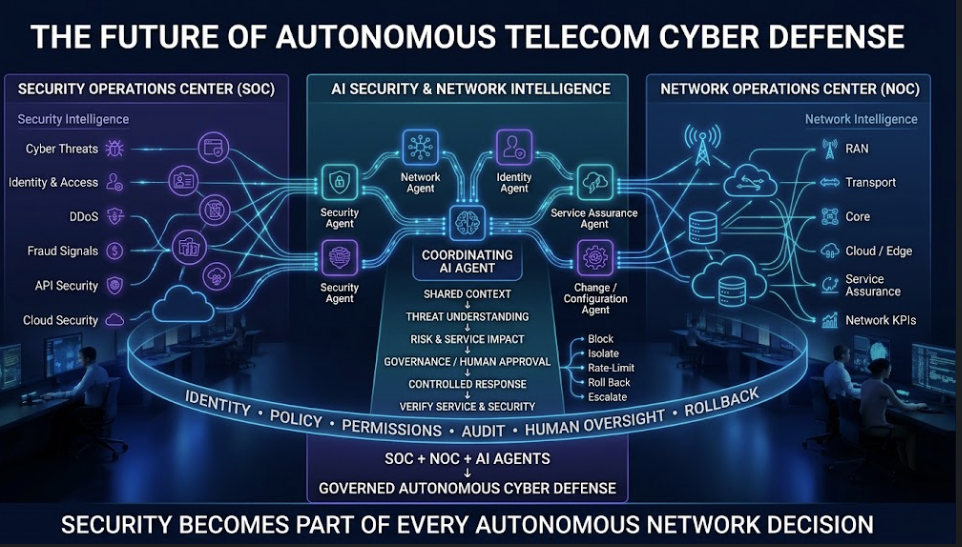
    Security Agent → Analyzes threat indicators and abnormal traffic.

    Identity Agent → Investigates suspicious accounts and access behavior.

    Network Agent → Checks affected infrastructure and traffic patterns.

    Service Assurance Agent → Determines whether customers or critical services are being impacted.

    Change Agent → Checks whether suspicious configuration activity occurred during the same period.

    A coordinating agent could combine the evidence:

    ABNORMAL BEHAVIOR → CROSS-DOMAIN CORRELATION → THREAT ASSESSMENT → SERVICE RISK → RESPONSE OPTIONS

    For a high-confidence, predefined scenario, controlled actions might include rate-limiting suspicious traffic, isolating a compromised component, blocking unauthorized access or rolling back an unsafe change.

    But cybersecurity also demonstrates why Agentic AI needs strict governance.

    An AI agent capable of protecting the network can itself become a risk if its identity, permissions, data sources and operational authority are not properly controlled.

    THE MORE AUTHORITY WE GIVE AN AI AGENT TO DEFEND THE NETWORK, THE MORE CAREFULLY WE MUST SECURE THE AGENT ITSELF.

    For a deeper explanation of this challenge, see our article on AI-powered cybersecurity in telecom.

    Agentic cyber defense is not only about responding at machine speed. It is about responding at machine speed within boundaries the operator can trust.

    Use Case 7: Self-Healing Network Operations

    Self-healing is where many of the capabilities discussed in the previous use cases begin to come together.

    Imagine a critical network service suddenly degrades.

    The system must do more than detect an alarm.

    It needs to understand:

    What failed?

    What services are affected?

    What caused the failure?

    What recovery options are available?

    Which action is safest?

    Did the action actually restore the service?

    Agentic AI could coordinate specialized agents to answer these questions.

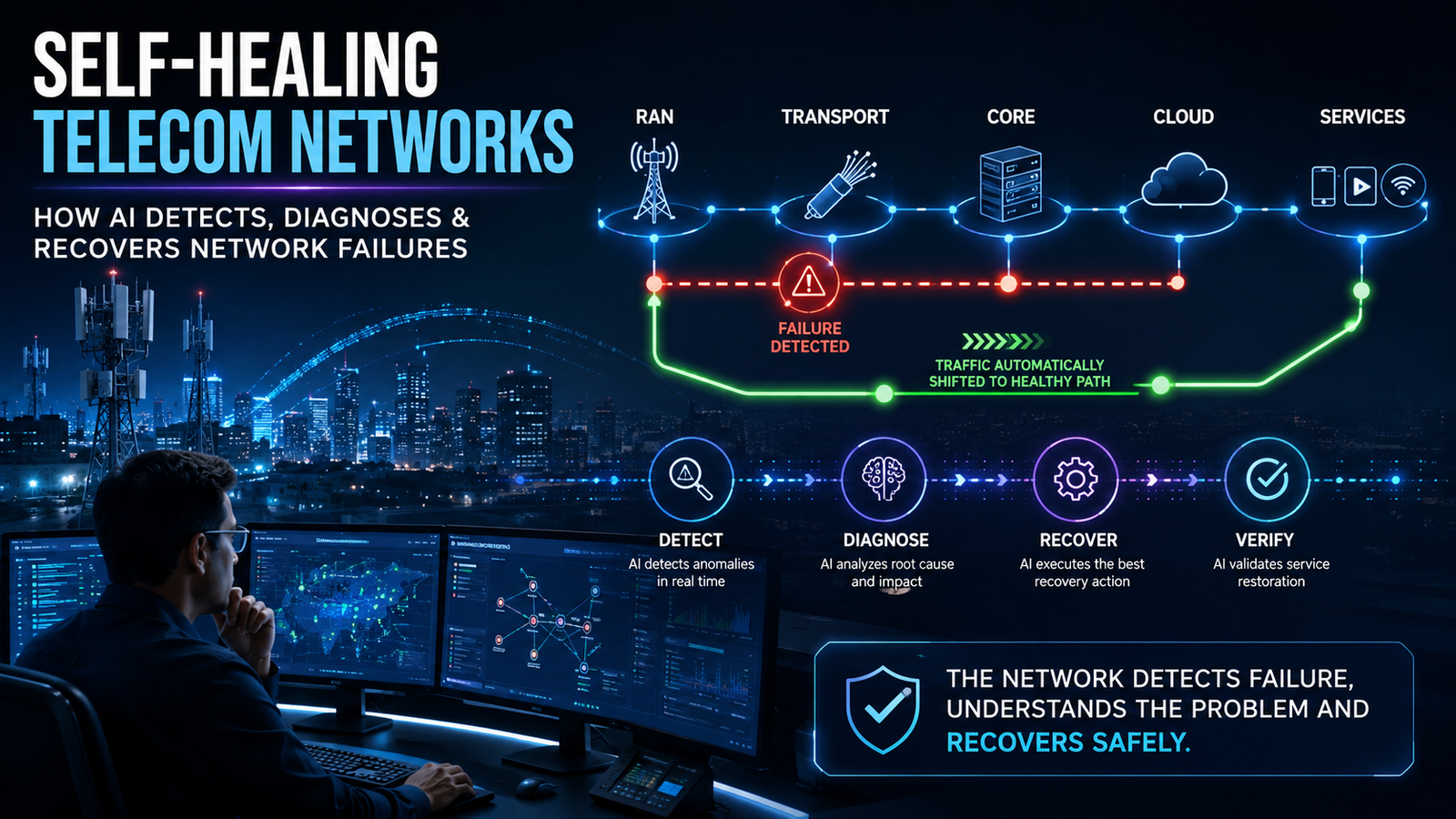
    Detection Agent → Identifies abnormal network behavior.

    Diagnosis Agent → Correlates alarms, KPIs, topology and recent changes.

    Service Agent → Determines customer and business impact.

    Recovery Agent → Identifies possible remediation actions.

    Risk Agent → Checks dependencies, policies and potential side effects.

    The coordinating agent could then build a controlled recovery path:

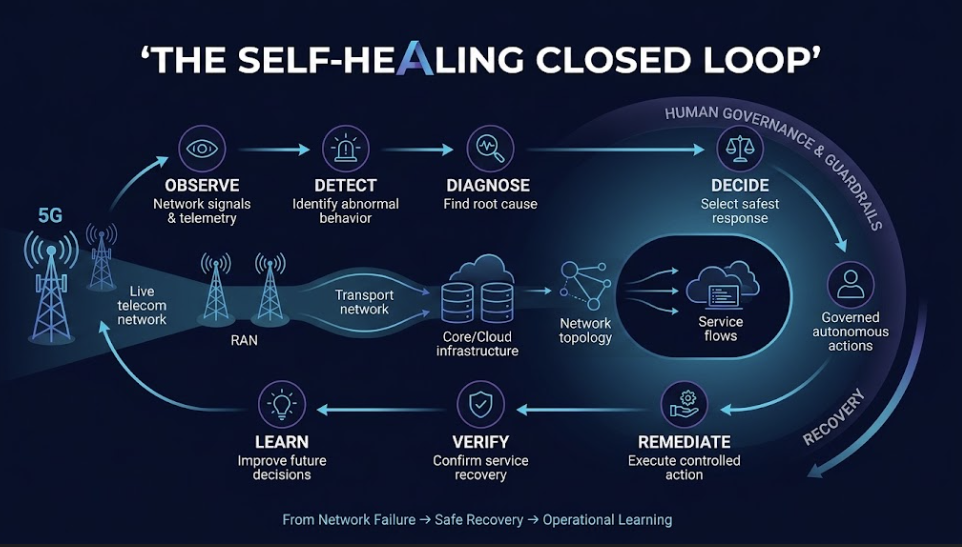
    DETECT → DIAGNOSE → UNDERSTAND IMPACT → SELECT RESPONSE → VALIDATE → ACT → VERIFY

    For a known, low-risk failure, an approved recovery action could execute automatically.

    For an uncertain or high-impact situation, the system should provide the evidence and recommendation to an engineer for approval.

    And there is one critical final step:

    Verification.

    Restarting a process, rerouting traffic or rolling back a configuration does not mean the incident is resolved.

    The system must confirm that network KPIs recovered, alarms cleared and the affected service returned to the required level.

    SELF-HEALING IS NOT “AI FIXED SOMETHING.” IT IS “THE NETWORK UNDERSTOOD THE FAILURE, RECOVERED SAFELY AND VERIFIED THE OUTCOME.”

    For a deeper technical explanation, see self-healing telecom networks.

    The closed loop is not complete when the action is executed. It is complete when the service outcome is verified.

    Which Agentic AI Use Case Should Telecom Operators Implement First?

    Not every use case should move to Agentic AI at the same time.

    The best starting point is usually not the most futuristic use case. It is the operational problem where the operator already has good data, repetitive investigation work, measurable business impact and relatively safe actions.

    For many NOCs, incident investigation could be a strong starting point.

    Why?

    The AI agent can initially work in observation and recommendation mode. It can gather alarms, KPIs, topology, logs and change information without being given authority to modify the live network.

    Once its recommendations become reliable, operators can gradually progress toward more operational responsibility.

    Use CasePotential ValueImplementation ComplexityAutomation RiskGood Starting Point?
    Incident InvestigationHighMediumLowYes
    Change Impact & ValidationHighMediumMediumYes
    Predictive Fault PreventionHighMediumLow–MediumYes
    Service AssuranceHighMediumLowYes
    Energy OptimizationMedium–HighHighMediumLater
    Cyber DefenseVery HighHighHighControlled Pilot
    Self-Healing OperationsVery HighVery HighHighAdvanced Stage

    This is not a universal ranking. An operator’s starting point should depend on its network architecture, available data, operational pain points, automation maturity and governance capability.

    START WHERE THE BUSINESS VALUE IS CLEAR AND THE OPERATIONAL RISK CAN BE CONTROLLED.

    How Do You Implement Agentic AI Without Giving It Control Too Early?

    Give the AI agent access to approved operational data such as:

    Alarms → KPIs → Logs → Topology → Change Records → Service Information

    The agent observes and builds context, but takes no operational action.

    Stage 2 — Investigate

    Allow the agent to correlate information, investigate possible causes and generate a probable root cause with supporting evidence.

    Engineers compare its findings with their own investigation.

    Stage 3 — Recommend

    The agent begins recommending actions.

    For example:

    Probable transport congestion → Identify affected services → Evaluate alternate path → Recommend rerouting

    The engineer still makes the decision.

    Stage 4 — Human-Approved Execution

    Once recommendations have been repeatedly proven, the agent may prepare or initiate an action—but execution requires engineer approval.

    Every action should have clear permissions, audit records and rollback conditions.

    Stage 5 — Controlled Autonomy

    Only proven, low-risk and well-defined scenarios move toward autonomous execution.

    The AI agent acts within predefined boundaries and immediately verifies the outcome.

    If confidence is low, conditions change or verification fails:

    STOP → ROLLBACK → ESCALATE TO HUMAN

    OBSERVE → INVESTIGATE → RECOMMEND → HUMAN APPROVES → CONTROLLED AUTONOMY

    Do not measure Agentic AI maturity by how much control the AI has. Measure it by how much operational responsibility it can handle safely and reliably.

    Is Agentic AI in Telecom Still a Concept—or Is It Becoming Real?

    Agentic AI in telecom is no longer limited to research discussions. During 2026, vendors, operators and industry bodies have increasingly moved toward real operational frameworks, products and trials.

    For example, Ericsson describes an agentic network-intelligence approach where specialized agents can support root-cause analysis and impact analysis, using subscriber events, network data, historical tickets, topology and operational knowledge to help teams identify problems earlier and understand their likely impact.

    Nokia has also introduced agentic AI capabilities for network operations. Its IP-network framework includes an AI-driven troubleshooting agent designed to accelerate root-cause analysis and provide guided, explainable actions within operator-defined policy and security boundaries.

    The movement is also reaching autonomous-network architecture. TM Forum’s 2026 Autonomous Operations Target Operating Model positions AI agents as a bridge between business intent and technical execution, while providing a framework for trusted decision-making and orchestration across network, OSS/BSS and operational systems.

    There are operator-level signals too. At DTW Ignite 2026, Vodafone and Google Cloud presented production-scale Agentic AI workflows spanning the network lifecycle, while TM Forum showcased projects involving Agentic NOCs, trusted AI agents, multi-agent network planning and autonomous operations.

    This does not mean telecom networks have suddenly become fully autonomous.

    It means the industry is moving from:

    AGENTIC AI CONCEPT → OPERATIONAL USE CASE → CONTROLLED DEPLOYMENT → MULTI-AGENT OPERATIONS → INCREASING AUTONOMY

    The question is gradually changing from “Can Agentic AI work in telecom?” to “Where can it create measurable value without introducing unacceptable operational risk?”

    What Happens When an AI Agent Makes the Wrong Decision?

    Agentic AI can accelerate network operations, but speed becomes dangerous when the underlying decision is wrong.

    Imagine an AI agent detects congestion and decides that traffic should be rerouted.

    The action looks reasonable.

    But the agent does not know that the alternative path is carrying a critical enterprise service and has limited spare capacity.

    The rerouting solves one problem—and creates another.

    The failure was not necessarily the AI model itself.

    The agent was missing network context.

    Similar problems can occur when agents operate with:

    Incomplete topology information

    Poor-quality or delayed data

    Incorrect service dependencies

    Excessive permissions

    Conflicting objectives

    Outdated operational procedures

    No validation or rollback mechanism

    This is why giving an AI agent access to more tools does not automatically make it more intelligent.

    An operational agent needs to understand not only:

    “Can I execute this action?”

    but also:

    “Should I execute it, what else could it affect, and can I safely reverse it?”

    For high-impact actions, operators may also use simulation or a Network Digital Twin to test the proposed change before touching the live network.

    AGENTIC AI WITHOUT CONTEXT + GOVERNANCE + VERIFICATION CAN TURN AUTOMATION SPEED INTO OPERATIONAL RISK.

    The safest AI agent is not the one capable of taking the most actions. It is the one that understands when it should not act.

    Where Is the Business Value of Agentic AI?

    Agentic AI should not be justified simply because it is a new technology.

    For telecom operators, the business case must come from measurable operational improvement.

    Consider incident investigation.

    If engineers currently spend significant time collecting alarms, checking dashboards, reviewing changes and coordinating across RAN, transport and core teams, an AI agent that shortens this investigation can create measurable value.

    Operators can track:

    Mean Time to Identify (MTTI) — How quickly is the probable problem identified?

    Mean Time to Repair (MTTR) — Does faster investigation lead to faster recovery?

    Engineering hours — How much repetitive investigation effort is reduced?

    Service-impact minutes — Are customer-affecting incidents resolved earlier?

    Change failures — Can Agentic AI identify risky changes before implementation?

    Prevented incidents — Can predictive agents help teams act before failures occur?

    The financial model can then use the operator’s own historical data.

    Annual Benefit = Reduced Engineering Cost + Avoided Service Impact + Reduced Incident/Escalation Cost + Prevented Operational Loss

    ROI (%) = (Annual Benefit − Annual Agentic AI Cost) ÷ Annual Agentic AI Cost × 100

    But there is another important measure:

    How much operational responsibility can AI safely absorb?

    An agent saving ten minutes but creating additional operational risk may provide little real value.

    An agent that reliably reduces investigation time while keeping engineers in control can be much more valuable.

    The business case for Agentic AI is not the number of agents deployed. It is the operational outcome those agents improve.

    What Could the Agentic NOC Look Like by 2030?

    Today’s NOC is largely organized around network domains, monitoring platforms and operational teams.

    The future NOC may increasingly organize intelligence around problems, services and business outcomes.

    Imagine a major enterprise service begins degrading.

    Instead of one engineer manually coordinating several teams, specialized agents could begin working simultaneously:

    Service Agent → Understands customer and SLA impact.

    RAN Agent → Investigates radio conditions.

    Transport Agent → Checks paths, congestion and failures.

    Core Agent → Analyzes sessions and signaling.

    Security Agent → Determines whether abnormal behavior has a cyber dimension.

    Change Agent → Checks recent network modifications.

    A coordinating agent could combine their findings and maintain a shared operational picture.

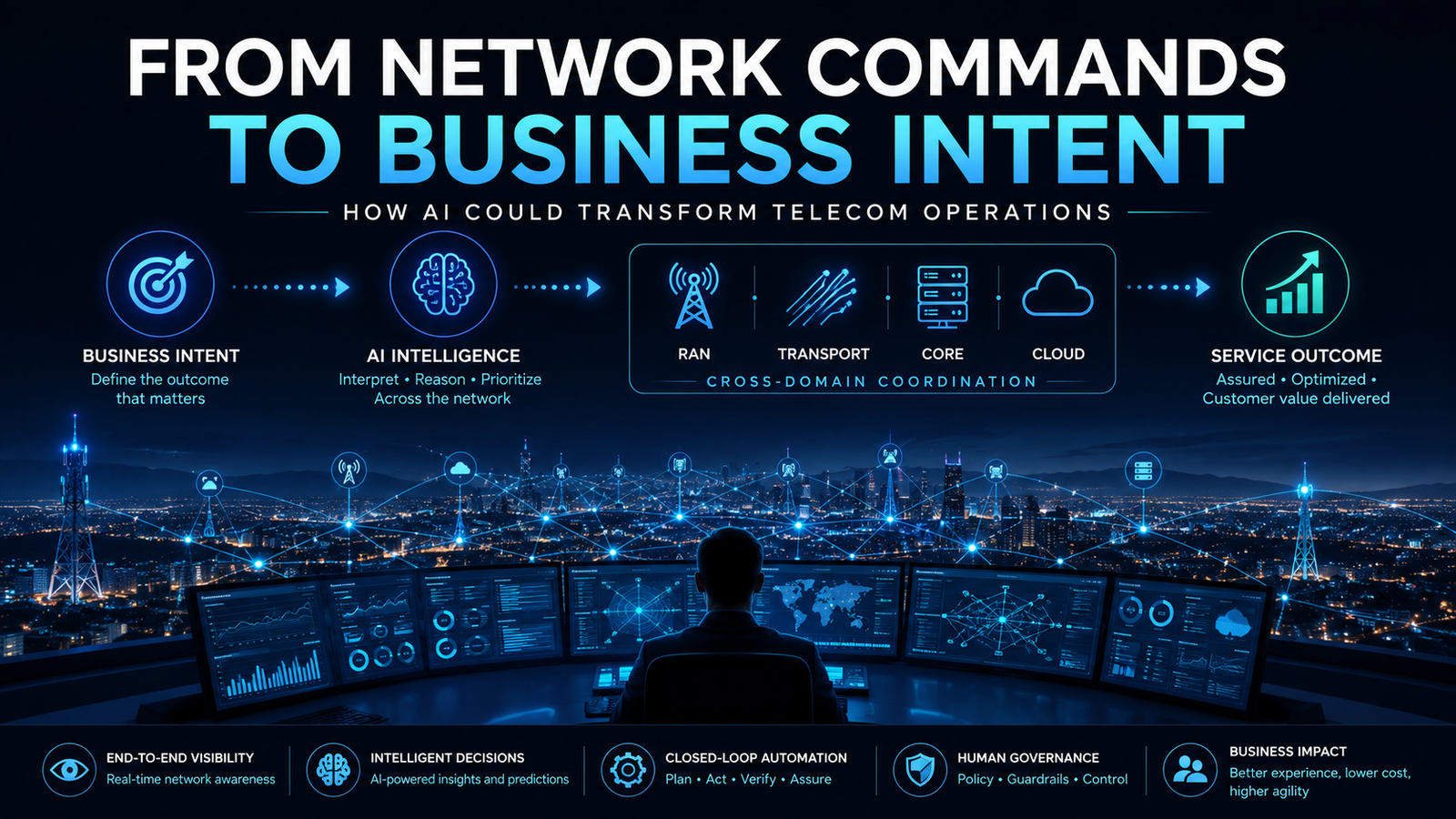
    The next evolution could connect this directly with intent-driven operations.

    Instead of simply asking:

    “What is wrong with the network?”

    the system could continuously work toward an operator-defined objective such as:

    “Maintain premium enterprise service within the agreed SLA while protecting network resilience.”

    AI agents could investigate threats to that intent, coordinate possible responses and recommend—or eventually execute—approved actions.

    The NOC engineer’s interface could therefore evolve from thousands of individual alarms toward something more outcome-oriented:

    SERVICE AT RISK → AI AGENTS INVESTIGATING → PROBABLE CAUSE IDENTIFIED → RESPONSE VALIDATED → ACTION APPROVED → SERVICE VERIFIED

    But humans remain essential for defining objectives, policies, risk boundaries and accountability.

    THE FUTURE NOC MAY NOT BE MANAGED BY ONE AI AGENT. IT MAY BE ORCHESTRATED THROUGH MANY SPECIALIZED AGENTS WORKING WITH HUMAN EXPERTS TOWARD SHARED NETWORK OUTCOMES.

    Agentic AI could change the NOC from a place where engineers search for answers into an environment where intelligence continuously assembles the evidence needed for better decisions.

    A Practical 90-Day Agentic AI Pilot for the Telecom NOC

    Operators do not need to build a fully Agentic NOC to start.

    Choose one measurable use case. For example:

    Autonomous Incident Investigation

    Days 1–30: Build the Operational Context

    Connect the minimum information the agent needs:

    Alarms + KPIs + Logs + Topology + Change Records + Service Context

    Measure today’s baseline:

    Investigation time • MTTR • Engineering effort • Escalations • Service-impact minutes

    At this stage:

    AI OBSERVES — ENGINEERS INVESTIGATE

    Days 31–60: Shadow the Engineers

    Allow the agent to investigate incidents independently.

    For every incident compare:

    AI Root Cause vs Engineer Root Cause

    AI Evidence vs Engineer Evidence

    AI Recommendation vs Actual Action

    The objective is to prove whether the agent can produce reliable and explainable operational conclusions.

    At this stage:

    AI INVESTIGATES + RECOMMENDS — ENGINEERS DECIDE

    Days 61–90: Introduce Controlled Action

    Select only well-understood, low-risk scenarios.

    Allow the agent to prepare or execute approved actions within strict policies.

    Every action should include:

    Authorization → Audit Trail → Rollback → Verification

    If confidence is low or the situation falls outside policy:

    STOP → ESCALATE TO ENGINEER

    Day 90: Decide Whether to Scale

    Ask:

    Did investigation become faster?

    Was root-cause accuracy acceptable?

    Did MTTR improve?

    Was engineering effort reduced?

    Were recommendations explainable?

    Did any AI action introduce additional operational risk?

    Only then should the operator expand to another use case or increase autonomy.

    ONE USE CASE → OBSERVE → SHADOW → PROVE → CONTROL → MEASURE → SCALE

    The first Agentic AI project should prove trust—not autonomy.

    From AI Assistance to Agentic Network Operations

    Agentic AI could represent an important next step in telecom network operations—but its value will not come from simply adding AI agents to the NOC.

    The real opportunity is connecting network data, operational context, specialized intelligence and controlled actions around problems that engineers deal with every day.

    The seven use cases in this article show where that could happen:

    Incident investigation. Change validation. Predictive fault prevention. Service assurance. Energy optimization. Cyber defense. Self-healing operations.

    Some can begin today as AI-assisted workflows.

    Others will require stronger automation, better data, clearer policies and much higher levels of operational trust before greater autonomy is appropriate.

    The journey should therefore be gradual.

    Start with a real operational problem.

    Give the agent enough context to understand it.

    Measure its decisions against experienced engineers.

    Prove the value.

    Then increase responsibility only when the evidence supports it.

    Agentic AI should ultimately help telecom teams move from searching across fragmented systems toward making faster, better-informed and more coordinated network decisions.

    The future of Agentic AI in telecom will not be decided by how many AI agents operators deploy. It will be decided by how reliably those agents improve real network outcomes.

    START WITH THE PROBLEM → BUILD CONTEXT → PROVE THE DECISION → GOVERN THE ACTION → VERIFY THE OUTCOME → SCALE

    How Ready Is Your NOC for Agentic AI?

    Before deploying AI agents, operators need to understand whether their NOC has the required foundations.

    That includes data and observability, automation, AIOps, decision intelligence, closed-loop operations and governance.

    TelcoMind AI has created a free NOC AI Maturity Assessment to help telecom teams evaluate their current position and identify the capabilities they need to strengthen before moving toward more autonomous operations.

    → Take the Free NOC AI Maturity Assessment

    Related TelcoMind AI Insights

    1. Agentic AI in Telecom Operations: From AI Assistance to Autonomous Action

    2. AI-Powered Cybersecurity in Telecom: Can Networks Detect and Stop Attacks Before Service Is Impacted?

    3. Self-Healing Telecom Networks: How AI Detects, Diagnoses and Recovers Network Failures

  • Agentic AI Use Cases in Telecom: 7 Practical Applications for Network Operations

    Agentic AI Use Cases in Telecom: 7 Practical Applications for Network Operations

    Where Can Agentic AI Actually Be Used in a Telecom Network?

    Agentic AI is becoming one of the most discussed ideas in telecom AI.

    But for network operators, the important question is no longer simply:

    “What is Agentic AI?”

    The more useful question is:

    “What operational problem can an AI agent actually solve?”

    Imagine a major service degradation.

    Today, an engineer may need to move between alarm systems, performance dashboards, configuration records, change-management tools and network logs before understanding what happened.

    An Agentic AI system could approach the same problem differently.

    It could gather evidence from multiple systems, investigate possible causes, coordinate with specialized AI agents, evaluate possible actions and present the engineer with a recommended response.

    For approved low-risk situations, it could eventually execute a controlled action and verify whether the service recovered.

    That changes the operational flow from:

    ALARM → ENGINEER SEARCHES → INVESTIGATES → DECIDES → ACTS

    toward:

    ALARM → AI INVESTIGATES → CORRELATES → REASONS → RECOMMENDS → GOVERNED ACTION → VERIFIES

    But not every telecom problem needs an AI agent.

    The real value appears when a task requires multiple steps, multiple systems, contextual reasoning and coordinated decisions.

    This article explores seven practical Agentic AI use cases in telecom network operations—and, importantly, where operators should and should not give AI operational authority.

    The value of Agentic AI is not that it can talk about the network. It is whether it can help move an operational problem safely toward resolution.

    Use Case 1: Autonomous Incident Investigation

    Incident investigation is one of the strongest potential applications for Agentic AI because the information required to understand a network problem is often distributed across multiple systems.

    Consider a sudden degradation affecting thousands of mobile customers.

    The NOC sees several symptoms:

    RAN alarms → Transport packet loss → Core KPI degradation → Customer complaints

    The difficult question is:

    Are these four different problems—or four symptoms of the same problem?

    An Agentic AI system could assign different tasks to specialized agents.

    A RAN Agent checks cell alarms and performance changes.

    A Transport Agent investigates congestion, interface errors and path changes.

    A Core Agent examines session failures and service KPIs.

    A Change Agent checks whether any recent configuration or software change matches the incident timeline.

    A coordinating agent could then combine the evidence and build a probable incident story:

    Recent transport change → Packet loss increases → RAN service degradation → Core sessions affected → Customer experience deteriorates

    Instead of engineers manually searching several platforms, the system could present:

    Probable Root Cause → Supporting Evidence → Affected Services → Recommended Action → Confidence Level

    The engineer can then validate the evidence and decide whether the recommended action is safe.

    MULTIPLE ALARMS → MULTIPLE AGENTS → SHARED CONTEXT → PROBABLE ROOT CAUSE → GOVERNED RESPONSE

    Agentic AI becomes valuable when it can turn fragmented network evidence into an investigation engineers can verify and act upon.

    Use Case 2: Change Impact Analysis and Validation

    Many network incidents do not begin with hardware failure or an external attack.

    They begin with a planned change.

    A routing update, software upgrade, parameter modification or cloud configuration may complete successfully from a technical perspective—but still create unexpected service impact somewhere else.

    Imagine a routing change is planned in the transport network.

    Before execution, an Agentic AI system could coordinate several checks:

    Change Agent → Understands the proposed configuration.

    Topology Agent → Identifies affected network paths and dependencies.

    Capacity Agent → Checks whether alternative routes have sufficient capacity.

    Service Agent → Identifies enterprise, voice, 5G or other critical services using those paths.

    Risk Agent → Reviews similar historical changes and previous incidents.

    The system could then produce:

    CHANGE → DEPENDENCIES → POSSIBLE IMPACT → RISK LEVEL → RECOMMENDATION

    For a higher-risk change, the proposed action could also be tested through a Network Digital Twin before touching the live network.

    But Agentic AI should not stop working once the change is executed.

    It could compare network conditions before and after the change, checking latency, packet loss, alarms, traffic distribution and service KPIs.

    If unexpected degradation appears, it could recommend a rollback—or execute an already approved rollback policy where appropriate.

    BEFORE THE CHANGE: UNDERSTAND THE RISK

    AFTER THE CHANGE: VERIFY THE OUTCOME

    A successful change should not mean only that the command executed correctly. It should mean that the network remained healthy after it was executed.

    Use Case 3: Predictive Fault Prevention Before the Outage

    Some of the most valuable network incidents are the ones that never happen.

    Telecom equipment often shows warning signs before a major failure: rising temperature, increasing optical errors, unstable power, repeated interface flaps, abnormal CPU utilization or gradually deteriorating performance.

    The problem is that these signals may appear in different monitoring systems and at different times.

    Imagine an optical transmission link begins showing increasing errors.

    A traditional system may generate threshold alarms once conditions become serious.

    An Agentic AI workflow could investigate earlier.

    Performance Agent → Detects unusual degradation compared with historical behavior.

    Transmission Agent → Checks optical power, errors and link performance.

    Topology Agent → Identifies services and network elements dependent on the link.

    Maintenance Agent → Reviews previous faults and maintenance history.

    Capacity Agent → Determines whether traffic could safely use an alternative path.

    The agents could combine their findings:

    DEGRADING SIGNAL → FAILURE PROBABILITY → SERVICE EXPOSURE → AVAILABLE PROTECTION → RECOMMENDED ACTION

    Instead of waiting for the equipment to fail, the operator might proactively reroute traffic, schedule maintenance or replace a deteriorating component during a controlled window.

    The important distinction is that Agentic AI would not merely predict a failure.

    It could help coordinate what should happen because a failure is predicted.

    PREDICTION TELLS US WHAT MAY FAIL. AGENTIC AI CAN HELP DETERMINE WHAT WE SHOULD DO ABOUT IT.

    The operational value of prediction appears when insight is converted into a safe action before customers are affected.

    Use Case 4: Service Assurance Before Customers Complain

    A network can look healthy while customers are already experiencing a poor service.

    Traditional monitoring often looks at individual network domains. But a customer experiences the complete service journey.

    Imagine enterprise customers in one area begin experiencing intermittent video and voice degradation.

    There is no major outage.

    RAN availability remains high.

    Core systems appear healthy.

    Transport utilization is within normal thresholds.

    Yet customer experience is deteriorating.

    An Agentic AI system could investigate the service across domains.

    Customer Experience Agent → Detects unusual degradation in service-quality indicators.

    RAN Agent → Checks radio quality, congestion and mobility behavior.

    Transport Agent → Examines latency, packet loss and path performance.

    Core Agent → Reviews sessions, signaling and service KPIs.

    Change Agent → Searches for recent changes matching the degradation timeline.

    The coordinating agent could discover that no single domain has crossed a major alarm threshold—but several small degradations are combining to affect the customer.

    It could produce:

    CUSTOMER IMPACT → CROSS-DOMAIN EVIDENCE → PROBABLE CAUSE → AFFECTED SERVICES → RECOMMENDED ACTION

    This changes service assurance from waiting for:

    CUSTOMER COMPLAINT → TICKET → INVESTIGATION

    toward:

    EXPERIENCE DEGRADATION → AI INVESTIGATION → EARLY ACTION → SERVICE PROTECTED

    Agentic AI could help telecom operations investigate the service from the customer’s perspective—not only from the perspective of individual network elements.

    Use Case 5: Intelligent Energy and Network Optimization

    Reducing network energy consumption sounds simple until service quality, coverage and capacity are added to the equation.

    Imagine traffic falls significantly across part of the mobile network during the night.

    Some radio resources could potentially operate in a lower-energy state.

    But switching resources off based only on traffic volume could create another problem if demand suddenly increases or neighboring sites cannot absorb the load.

    Agentic AI could coordinate several perspectives before making a recommendation.

    Traffic Agent → Predicts demand for the next period.

    RAN Agent → Identifies resources that could potentially enter energy-saving mode.

    Capacity Agent → Checks whether neighboring resources can handle additional traffic.

    Service Agent → Protects critical services and customer-experience requirements.

    Energy Agent → Calculates the potential energy benefit.

    The coordinating agent could then evaluate:

    ENERGY SAVING vs CAPACITY vs COVERAGE vs SERVICE QUALITY

    For example, instead of simply deciding:

    “Switch this resource off.”

    the system could reason:

    Traffic is low → Neighboring capacity is sufficient → No critical service risk detected → Energy-saving action is permitted → Monitor KPIs → Restore capacity automatically if demand changes

    This is important because optimization rarely has only one objective.

    The network may simultaneously need to reduce energy, maintain SLA performance, protect coverage and preserve resilience.

    THE BEST OPTIMIZATION IS NOT THE ONE THAT SAVES THE MOST ENERGY. IT IS THE ONE THAT SAVES ENERGY WITHOUT COMPROMISING THE REQUIRED SERVICE OUTCOME.

    Agentic AI becomes especially useful when the network must balance several competing objectives rather than optimize one KPI in isolation.

    Use Case 6: AI-Powered Cyber Defense and Threat Response

    Cybersecurity becomes more complex when a threat moves across several parts of the telecom environment.

    Imagine abnormal traffic begins hitting an important service.

    At the same time, unusual login activity appears, an API starts receiving unexpected requests and service latency begins increasing.

    Individually, these events may generate separate alerts.

    Agentic AI could investigate whether they are actually part of one coordinated security incident.

    Security Agent → Analyzes threat indicators and abnormal traffic.

    Identity Agent → Investigates suspicious accounts and access behavior.

    Network Agent → Checks affected infrastructure and traffic patterns.

    Service Assurance Agent → Determines whether customers or critical services are being impacted.

    Change Agent → Checks whether suspicious configuration activity occurred during the same period.

    A coordinating agent could combine the evidence:

    ABNORMAL BEHAVIOR → CROSS-DOMAIN CORRELATION → THREAT ASSESSMENT → SERVICE RISK → RESPONSE OPTIONS

    For a high-confidence, predefined scenario, controlled actions might include rate-limiting suspicious traffic, isolating a compromised component, blocking unauthorized access or rolling back an unsafe change.

    But cybersecurity also demonstrates why Agentic AI needs strict governance.

    An AI agent capable of protecting the network can itself become a risk if its identity, permissions, data sources and operational authority are not properly controlled.

    THE MORE AUTHORITY WE GIVE AN AI AGENT TO DEFEND THE NETWORK, THE MORE CAREFULLY WE MUST SECURE THE AGENT ITSELF.

    For a deeper explanation of this challenge, see our article on AI-powered cybersecurity in telecom.

    Agentic cyber defense is not only about responding at machine speed. It is about responding at machine speed within boundaries the operator can trust.

    Use Case 7: Self-Healing Network Operations

    Self-healing is where many of the capabilities discussed in the previous use cases begin to come together.

    Imagine a critical network service suddenly degrades.

    The system must do more than detect an alarm.

    It needs to understand:

    What failed?

    What services are affected?

    What caused the failure?

    What recovery options are available?

    Which action is safest?

    Did the action actually restore the service?

    Agentic AI could coordinate specialized agents to answer these questions.

    Detection Agent → Identifies abnormal network behavior.

    Diagnosis Agent → Correlates alarms, KPIs, topology and recent changes.

    Service Agent → Determines customer and business impact.

    Recovery Agent → Identifies possible remediation actions.

    Risk Agent → Checks dependencies, policies and potential side effects.

    The coordinating agent could then build a controlled recovery path:

    DETECT → DIAGNOSE → UNDERSTAND IMPACT → SELECT RESPONSE → VALIDATE → ACT → VERIFY

    For a known, low-risk failure, an approved recovery action could execute automatically.

    For an uncertain or high-impact situation, the system should provide the evidence and recommendation to an engineer for approval.

    And there is one critical final step:

    Verification.

    Restarting a process, rerouting traffic or rolling back a configuration does not mean the incident is resolved.

    The system must confirm that network KPIs recovered, alarms cleared and the affected service returned to the required level.

    SELF-HEALING IS NOT “AI FIXED SOMETHING.” IT IS “THE NETWORK UNDERSTOOD THE FAILURE, RECOVERED SAFELY AND VERIFIED THE OUTCOME.”

    For a deeper technical explanation, see self-healing telecom networks.

    The closed loop is not complete when the action is executed. It is complete when the service outcome is verified.

    Which Agentic AI Use Case Should Telecom Operators Implement First?

    Not every use case should move to Agentic AI at the same time.

    The best starting point is usually not the most futuristic use case. It is the operational problem where the operator already has good data, repetitive investigation work, measurable business impact and relatively safe actions.

    For many NOCs, incident investigation could be a strong starting point.

    Why?

    The AI agent can initially work in observation and recommendation mode. It can gather alarms, KPIs, topology, logs and change information without being given authority to modify the live network.

    Once its recommendations become reliable, operators can gradually progress toward more operational responsibility.

    Use CasePotential ValueImplementation ComplexityAutomation RiskGood Starting Point?
    Incident InvestigationHighMediumLowYes
    Change Impact & ValidationHighMediumMediumYes
    Predictive Fault PreventionHighMediumLow–MediumYes
    Service AssuranceHighMediumLowYes
    Energy OptimizationMedium–HighHighMediumLater
    Cyber DefenseVery HighHighHighControlled Pilot
    Self-Healing OperationsVery HighVery HighHighAdvanced Stage

    This is not a universal ranking. An operator’s starting point should depend on its network architecture, available data, operational pain points, automation maturity and governance capability.

    START WHERE THE BUSINESS VALUE IS CLEAR AND THE OPERATIONAL RISK CAN BE CONTROLLED.

    How Do You Implement Agentic AI Without Giving It Control Too Early?

    Give the AI agent access to approved operational data such as:

    Alarms → KPIs → Logs → Topology → Change Records → Service Information

    The agent observes and builds context, but takes no operational action.

    Stage 2 — Investigate

    Allow the agent to correlate information, investigate possible causes and generate a probable root cause with supporting evidence.

    Engineers compare its findings with their own investigation.

    Stage 3 — Recommend

    The agent begins recommending actions.

    For example:

    Probable transport congestion → Identify affected services → Evaluate alternate path → Recommend rerouting

    The engineer still makes the decision.

    Stage 4 — Human-Approved Execution

    Once recommendations have been repeatedly proven, the agent may prepare or initiate an action—but execution requires engineer approval.

    Every action should have clear permissions, audit records and rollback conditions.

    Stage 5 — Controlled Autonomy

    Only proven, low-risk and well-defined scenarios move toward autonomous execution.

    The AI agent acts within predefined boundaries and immediately verifies the outcome.

    If confidence is low, conditions change or verification fails:

    STOP → ROLLBACK → ESCALATE TO HUMAN

    OBSERVE → INVESTIGATE → RECOMMEND → HUMAN APPROVES → CONTROLLED AUTONOMY

    Do not measure Agentic AI maturity by how much control the AI has. Measure it by how much operational responsibility it can handle safely and reliably.

    Is Agentic AI in Telecom Still a Concept—or Is It Becoming Real?

    Agentic AI in telecom is no longer limited to research discussions. During 2026, vendors, operators and industry bodies have increasingly moved toward real operational frameworks, products and trials.

    For example, Ericsson describes an agentic network-intelligence approach where specialized agents can support root-cause analysis and impact analysis, using subscriber events, network data, historical tickets, topology and operational knowledge to help teams identify problems earlier and understand their likely impact.

    Nokia has also introduced agentic AI capabilities for network operations. Its IP-network framework includes an AI-driven troubleshooting agent designed to accelerate root-cause analysis and provide guided, explainable actions within operator-defined policy and security boundaries.

    The movement is also reaching autonomous-network architecture. TM Forum’s 2026 Autonomous Operations Target Operating Model positions AI agents as a bridge between business intent and technical execution, while providing a framework for trusted decision-making and orchestration across network, OSS/BSS and operational systems.

    There are operator-level signals too. At DTW Ignite 2026, Vodafone and Google Cloud presented production-scale Agentic AI workflows spanning the network lifecycle, while TM Forum showcased projects involving Agentic NOCs, trusted AI agents, multi-agent network planning and autonomous operations.

    This does not mean telecom networks have suddenly become fully autonomous.

    It means the industry is moving from:

    AGENTIC AI CONCEPT → OPERATIONAL USE CASE → CONTROLLED DEPLOYMENT → MULTI-AGENT OPERATIONS → INCREASING AUTONOMY

    The question is gradually changing from “Can Agentic AI work in telecom?” to “Where can it create measurable value without introducing unacceptable operational risk?”

    What Happens When an AI Agent Makes the Wrong Decision?

    Agentic AI can accelerate network operations, but speed becomes dangerous when the underlying decision is wrong.

    Imagine an AI agent detects congestion and decides that traffic should be rerouted.

    The action looks reasonable.

    But the agent does not know that the alternative path is carrying a critical enterprise service and has limited spare capacity.

    The rerouting solves one problem—and creates another.

    The failure was not necessarily the AI model itself.

    The agent was missing network context.

    Similar problems can occur when agents operate with:

    Incomplete topology information

    Poor-quality or delayed data

    Incorrect service dependencies

    Excessive permissions

    Conflicting objectives

    Outdated operational procedures

    No validation or rollback mechanism

    This is why giving an AI agent access to more tools does not automatically make it more intelligent.

    An operational agent needs to understand not only:

    “Can I execute this action?”

    but also:

    “Should I execute it, what else could it affect, and can I safely reverse it?”

    For high-impact actions, operators may also use simulation or a Network Digital Twin to test the proposed change before touching the live network.

    AGENTIC AI WITHOUT CONTEXT + GOVERNANCE + VERIFICATION CAN TURN AUTOMATION SPEED INTO OPERATIONAL RISK.

    The safest AI agent is not the one capable of taking the most actions. It is the one that understands when it should not act.

    Where Is the Business Value of Agentic AI?

    Agentic AI should not be justified simply because it is a new technology.

    For telecom operators, the business case must come from measurable operational improvement.

    Consider incident investigation.

    If engineers currently spend significant time collecting alarms, checking dashboards, reviewing changes and coordinating across RAN, transport and core teams, an AI agent that shortens this investigation can create measurable value.

    Operators can track:

    Mean Time to Identify (MTTI) — How quickly is the probable problem identified?

    Mean Time to Repair (MTTR) — Does faster investigation lead to faster recovery?

    Engineering hours — How much repetitive investigation effort is reduced?

    Service-impact minutes — Are customer-affecting incidents resolved earlier?

    Change failures — Can Agentic AI identify risky changes before implementation?

    Prevented incidents — Can predictive agents help teams act before failures occur?

    The financial model can then use the operator’s own historical data.

    Annual Benefit = Reduced Engineering Cost + Avoided Service Impact + Reduced Incident/Escalation Cost + Prevented Operational Loss

    ROI (%) = (Annual Benefit − Annual Agentic AI Cost) ÷ Annual Agentic AI Cost × 100

    But there is another important measure:

    How much operational responsibility can AI safely absorb?

    An agent saving ten minutes but creating additional operational risk may provide little real value.

    An agent that reliably reduces investigation time while keeping engineers in control can be much more valuable.

    The business case for Agentic AI is not the number of agents deployed. It is the operational outcome those agents improve.

    What Could the Agentic NOC Look Like by 2030?

    Today’s NOC is largely organized around network domains, monitoring platforms and operational teams.

    The future NOC may increasingly organize intelligence around problems, services and business outcomes.

    Imagine a major enterprise service begins degrading.

    Instead of one engineer manually coordinating several teams, specialized agents could begin working simultaneously:

    Service Agent → Understands customer and SLA impact.

    RAN Agent → Investigates radio conditions.

    Transport Agent → Checks paths, congestion and failures.

    Core Agent → Analyzes sessions and signaling.

    Security Agent → Determines whether abnormal behavior has a cyber dimension.

    Change Agent → Checks recent network modifications.

    A coordinating agent could combine their findings and maintain a shared operational picture.

    The next evolution could connect this directly with intent-driven operations.

    Instead of simply asking:

    “What is wrong with the network?”

    the system could continuously work toward an operator-defined objective such as:

    “Maintain premium enterprise service within the agreed SLA while protecting network resilience.”

    AI agents could investigate threats to that intent, coordinate possible responses and recommend—or eventually execute—approved actions.

    The NOC engineer’s interface could therefore evolve from thousands of individual alarms toward something more outcome-oriented:

    SERVICE AT RISK → AI AGENTS INVESTIGATING → PROBABLE CAUSE IDENTIFIED → RESPONSE VALIDATED → ACTION APPROVED → SERVICE VERIFIED

    But humans remain essential for defining objectives, policies, risk boundaries and accountability.

    THE FUTURE NOC MAY NOT BE MANAGED BY ONE AI AGENT. IT MAY BE ORCHESTRATED THROUGH MANY SPECIALIZED AGENTS WORKING WITH HUMAN EXPERTS TOWARD SHARED NETWORK OUTCOMES.

    Agentic AI could change the NOC from a place where engineers search for answers into an environment where intelligence continuously assembles the evidence needed for better decisions.

    A Practical 90-Day Agentic AI Pilot for the Telecom NOC

    Operators do not need to build a fully Agentic NOC to start.

    Choose one measurable use case. For example:

    Autonomous Incident Investigation

    Days 1–30: Build the Operational Context

    Connect the minimum information the agent needs:

    Alarms + KPIs + Logs + Topology + Change Records + Service Context

    Measure today’s baseline:

    Investigation time • MTTR • Engineering effort • Escalations • Service-impact minutes

    At this stage:

    AI OBSERVES — ENGINEERS INVESTIGATE

    Days 31–60: Shadow the Engineers

    Allow the agent to investigate incidents independently.

    For every incident compare:

    AI Root Cause vs Engineer Root Cause

    AI Evidence vs Engineer Evidence

    AI Recommendation vs Actual Action

    The objective is to prove whether the agent can produce reliable and explainable operational conclusions.

    At this stage:

    AI INVESTIGATES + RECOMMENDS — ENGINEERS DECIDE

    Days 61–90: Introduce Controlled Action

    Select only well-understood, low-risk scenarios.

    Allow the agent to prepare or execute approved actions within strict policies.

    Every action should include:

    Authorization → Audit Trail → Rollback → Verification

    If confidence is low or the situation falls outside policy:

    STOP → ESCALATE TO ENGINEER

    Day 90: Decide Whether to Scale

    Ask:

    Did investigation become faster?

    Was root-cause accuracy acceptable?

    Did MTTR improve?

    Was engineering effort reduced?

    Were recommendations explainable?

    Did any AI action introduce additional operational risk?

    Only then should the operator expand to another use case or increase autonomy.

    ONE USE CASE → OBSERVE → SHADOW → PROVE → CONTROL → MEASURE → SCALE

    The first Agentic AI project should prove trust—not autonomy.

    From AI Assistance to Agentic Network Operations

    Agentic AI could represent an important next step in telecom network operations—but its value will not come from simply adding AI agents to the NOC.

    The real opportunity is connecting network data, operational context, specialized intelligence and controlled actions around problems that engineers deal with every day.

    The seven use cases in this article show where that could happen:

    Incident investigation. Change validation. Predictive fault prevention. Service assurance. Energy optimization. Cyber defense. Self-healing operations.

    Some can begin today as AI-assisted workflows.

    Others will require stronger automation, better data, clearer policies and much higher levels of operational trust before greater autonomy is appropriate.

    The journey should therefore be gradual.

    Start with a real operational problem.

    Give the agent enough context to understand it.

    Measure its decisions against experienced engineers.

    Prove the value.

    Then increase responsibility only when the evidence supports it.

    Agentic AI should ultimately help telecom teams move from searching across fragmented systems toward making faster, better-informed and more coordinated network decisions.

    The future of Agentic AI in telecom will not be decided by how many AI agents operators deploy. It will be decided by how reliably those agents improve real network outcomes.

    START WITH THE PROBLEM → BUILD CONTEXT → PROVE THE DECISION → GOVERN THE ACTION → VERIFY THE OUTCOME → SCALE

    How Ready Is Your NOC for Agentic AI?

    Before deploying AI agents, operators need to understand whether their NOC has the required foundations.

    That includes data and observability, automation, AIOps, decision intelligence, closed-loop operations and governance.

    TelcoMind AI has created a free NOC AI Maturity Assessment to help telecom teams evaluate their current position and identify the capabilities they need to strengthen before moving toward more autonomous operations.

    → Take the Free NOC AI Maturity Assessment

    Related TelcoMind AI Insights

    1. Agentic AI in Telecom Operations: From AI Assistance to Autonomous Action

    2. AI-Powered Cybersecurity in Telecom: Can Networks Detect and Stop Attacks Before Service Is Impacted?

    3. Self-Healing Telecom Networks: How AI Detects, Diagnoses and Recovers Network Failures

  • AI-Powered Cybersecurity in Telecom: Can Networks Detect and Stop Attacks Before Service Is Impacted?

    AI-Powered Cybersecurity in Telecom: Can Networks Detect and Stop Attacks Before Service Is Impacted?

    What If the Network Detects the Attack Before the Security Team Sees the Alarm?

    Telecom networks are becoming more intelligent, automated and software-driven. But the same transformation that makes networks faster and more flexible is also changing the cybersecurity challenge.

    A modern attack may not begin with an obvious network outage.

    It could start with an unusual API request, a compromised account, abnormal signaling traffic, a suspicious configuration change or thousands of devices suddenly behaving differently.

    Individually, these signals may look harmless.

    Together, they may tell a completely different story.

    Traditional security operations often depend on a familiar sequence:

    DETECT → ALERT → INVESTIGATE → DECIDE → RESPOND

    But what happens when an attack develops faster than this operational cycle?

    This is where AI could fundamentally change telecom cybersecurity—not simply by generating more alerts, but by helping the network understand abnormal behavior, connect evidence across multiple domains and respond before a security event becomes a customer-impacting incident.

    The future of telecom cybersecurity may not be about detecting attacks faster. It may be about stopping them before customers realize an attack has started.

    Why Is the Telecom Attack Surface Becoming Bigger?

    A telecom network is no longer only a collection of radio sites, routers and core network elements.

    Modern telecom infrastructure increasingly combines 5G, cloud-native network functions, APIs, edge computing, virtualization, IoT, automation platforms and AI-driven operations.

    Each capability creates business value—but it can also create another path that must be protected.

    Consider a 5G service. A security problem may originate in one area but quickly affect several others:

    Device → RAN → Transport → 5G Core → Cloud / Edge → API → Application

    The challenge becomes even greater as networks become more automated. An attacker may not need to directly take down a network element. Compromising an account, API, automation workflow or privileged system could potentially allow legitimate network capabilities to be used in the wrong way.

    This changes the security question from:

    “Has someone attacked my firewall?”

    to:

    “Is something happening anywhere across the service chain that does not match normal, authorized network behavior?”

    That is a much harder question—and one where AI becomes particularly interesting.

    MORE CONNECTIVITY + MORE SOFTWARE + MORE APIs + MORE AUTOMATION = MORE BEHAVIOR TO UNDERSTAND AND PROTECT

    As telecom networks become more intelligent, cybersecurity must understand not only individual threats, but how abnormal behavior moves across the entire network.

    Imagine traffic toward an important telecom service begins increasing rapidly.

    At first, there is no outage.

    Customers are still connected. Network availability looks normal. The NOC may only see increasing traffic, while the security platform generates several separate alerts.

    But underneath those alarms, something unusual is developing.

    An AI-driven security system could correlate:

    Traffic volume increasing abnormally

    Thousands of sources showing similar behavior

    Unexpected geographic or device patterns

    Firewall and gateway anomalies

    Changes in latency, packet loss or service performance

    Historical behavior from previous attacks

    Instead of treating each signal separately, AI could identify that these events together resemble an emerging DDoS attack.

    The important difference is what happens next.

    A traditional workflow may be:

    ALARM → TICKET → INVESTIGATION → SECURITY TEAM → NETWORK TEAM → MITIGATION

    An AI-assisted workflow could become:

    ANOMALY → CORRELATION → ATTACK PROBABILITY → IMPACT ANALYSIS → RECOMMENDED RESPONSE → CONTROLLED MITIGATION → VERIFICATION

    Depending on operator policy and confidence level, low-risk defensive actions could be automated, while higher-risk actions remain subject to engineer or security-team approval.

    The objective is not simply to detect the DDoS attack. It is to protect the service before abnormal traffic becomes customer impact.

    In cybersecurity, the minutes saved before service degradation can be more valuable than the minutes saved after the outage begins.

    What If the Attacker Uses a Valid Account?

    Not every cyberattack looks like an attack.

    Imagine an engineer’s privileged account successfully logs into a network management platform.

    The username is valid.

    The password is correct.

    The authentication succeeds.

    But something is different.

    The account suddenly connects at an unusual time, accesses network elements it rarely touches and begins attempting configuration changes outside its normal operational pattern.

    A traditional security control may see an authorized user.

    AI-based behavioral analysis could see an authorized account behaving abnormally.

    It could correlate:

    Login context → User behavior → Network access → Configuration activity → Change history → Service risk

    For example, the system might determine:

    Valid credentials + unusual behavior + sensitive network access + unexpected change = HIGH-RISK EVENT

    Instead of immediately blocking every unusual action, the response could depend on risk.

    A suspicious low-impact activity might trigger additional authentication.

    A high-risk configuration attempt could be temporarily stopped and sent for approval.

    An extremely abnormal privileged action affecting critical infrastructure could trigger immediate containment according to predefined security policy.

    IDENTITY TELLS US WHO LOGGED IN. BEHAVIOR HELPS US UNDERSTAND WHETHER WHAT THEY ARE DOING MAKES SENSE.

    The most dangerous network action may not come from an unknown attacker. It may come through credentials the network already trusts.

    What Happens When an AI Agent Has Permission to Change the Network?

    This may become one of the most important telecom cybersecurity questions of the autonomous-network era.

    Imagine an AI agent inside the NOC is authorized to investigate incidents and perform selected operational actions.

    It can collect alarms, analyze KPIs, query network systems and recommend—or eventually execute—changes.

    Now imagine the agent receives manipulated information, a malicious instruction or compromised data that causes it to recommend the wrong action.

    The attacker may no longer need to attack the network element directly.

    The attacker could try to influence the intelligence controlling the network.

    For example:

    Manipulated Input → AI Agent Misinterprets Situation → Wrong Decision → Automated Network Action → Service Impact

    This creates a new security requirement.

    Operators must protect not only network elements and user accounts, but also:

    AI agents, their identities, permissions, data sources, tools, actions and communication with other agents.

    An AI agent responsible for alarm analysis should not automatically have unlimited authority to modify routing, security policies or critical core-network configurations.

    The principle should be simple:

    AN AI AGENT SHOULD HAVE ONLY THE ACCESS AND AUTHORITY REQUIRED FOR ITS SPECIFIC ROLE.

    Every important autonomous action should also be traceable, policy-controlled and reversible.

    As AI gains the ability to operate the network, securing the intelligence becomes part of securing the network itself.

    Traditional Cybersecurity vs AI-Powered Cyber Defense

    The biggest change is not that AI creates another security tool. The change is that security can become more contextual, predictive and coordinated with live network operations.

    Traditional ApproachAI-Powered Approach
    Detect individual alertsCorrelate signals across multiple systems
    Depend heavily on predefined rulesDetect unusual behavior and emerging patterns
    Investigate after an alertAssess potential impact while the event develops
    Security and network data may remain separatedConnect security events with network and service context
    Manual response can increase reaction timeRecommend or automate approved defensive actions
    Focus on detecting the threatFocus on protecting the service outcome
    Review incidents afterwardVerify response and continuously improve detection

    The real opportunity is not AI replacing traditional security controls. It is AI helping those controls understand what is happening across the network as one connected security event.

    Is AI-Powered Telecom Cybersecurity Already Happening?

    Yes—but the industry is still at different stages of maturity.

    Telecom operators are already using machine learning, behavioral analytics, automation and real-time network intelligence for areas such as anomaly detection, fraud prevention, DDoS protection and security monitoring.

    The bigger shift now is toward connecting these capabilities with 5G, network APIs, cloud-native infrastructure and increasingly autonomous operations.

    This matters because the industry itself is preparing for the security implications of AI-driven networks. GSMA’s 2026 security work highlights Generative AI and Agentic AI among emerging security considerations, while TM Forum is developing security and governance approaches for agentic interactions as telecom operations become increasingly AI-native.

    The direction is therefore moving from:

    AI HELPS DETECT THE THREAT

    toward:

    AI DETECTS → CORRELATES → ASSESSES RISK → RECOMMENDS RESPONSE → GOVERNED AUTOMATION ACTS → SERVICE IS VERIFIED

    But this does not mean every operator is already running fully autonomous cyber defense.

    Most importantly, the maturity of data, identity management, security policies, automation controls and governance will determine how much decision-making can safely be automated.

    The technology is moving toward autonomous cyber defense, but trust, governance and operational maturity will determine how quickly telecom operators can follow.

    Real-World Signals: Telecom Cyber Defense Is Already Evolving

    This transition is no longer limited to research papers and security labs. Several developments in 2026 show telecom cybersecurity moving toward real-time intelligence, network-level fraud prevention and governed AI automation.

    Example 1 — Telecom Network Intelligence for Fraud Prevention

    In August 2026, BlackDice joined the GSMA Open Gateway ecosystem to bring AI-powered behavioral intelligence and cyber-defense capabilities into standardized telecom network APIs. The objective includes fraud prevention and subscriber protection using network-level intelligence.

    This demonstrates an important change:

    The telecom network itself can become a source of security intelligence—not simply the infrastructure carrying the transaction.

    Example 2 — Operators Using Network APIs Against SIM-Swap and Identity Fraud

    Operators are also exposing trusted network signals such as Number Verification and SIM Swap information for fraud prevention.

    In Poland, T-Mobile, Orange, Plus and Play announced cooperation around GSMA Open Gateway network APIs for digital security and fraud prevention. Similar initiatives have appeared in Greece and Taiwan.

    Imagine a bank receiving a high-value transaction request immediately after an unexpected SIM change.

    Instead of relying only on a password or OTP, telecom intelligence could contribute another risk signal:

    Transaction Request + Recent SIM Swap + Identity Context → Higher Fraud Risk

    Example 3 — Securing the Agentic Telecom Era

    TM Forum launched Agentic Interactions Security in March 2026 as one of the first projects within its AI-Native Blueprint. The objective is to help create the governance and security foundations needed as telecom companies move AI from isolated experiments toward production-scale operations.

    More recently, TM Forum demonstrated frameworks where AI agents can perform operational tasks while consequential write actions remain protected through policy controls, auditability and human oversight.

    This brings cybersecurity directly into the autonomous-network discussion.

    What These Examples Tell Us

    The direction is becoming clearer:

    NETWORK SECURITY → NETWORK INTELLIGENCE → AI-ASSISTED DEFENSE → GOVERNED AUTONOMOUS DEFENSE

    Telecom cybersecurity is gradually moving from protecting individual systems toward understanding identity, behavior, network context and service risk together.

    The next generation of telecom security may not live only at the network perimeter. Intelligence will increasingly need to exist throughout the network itself.

    What Is the Cost of Waiting?

    The risk is not simply that telecom operators will experience more cybersecurity alarms.

    The bigger problem is that attacks are becoming faster while networks are becoming more interconnected and automated.

    A security event that begins with one compromised identity, API or cloud workload could potentially move across several systems before traditional operational teams fully understand what is happening.

    The consequences can extend far beyond the security department:

    Service disruption — attacks can affect network availability and customer experience.

    Revenue impact — outages, fraud and service degradation can directly affect business.

    Customer trust — subscribers expect operators to protect both connectivity and identity.

    Operational pressure — security, NOC, cloud and network teams may spend hours correlating information manually during a fast-moving incident.

    Regulatory exposure — inadequate controls around sensitive data, critical infrastructure and automated decisions can create additional compliance risk.

    And there is a newer danger.

    As telecom networks move toward Agentic AI, closed-loop automation and autonomous operations, weak cybersecurity could allow a compromised system to influence increasingly powerful operational capabilities.

    The same automation that can restore a service quickly could create greater impact if it is manipulated or given excessive authority.

    THE MORE AUTONOMOUS THE NETWORK BECOMES, THE MORE IMPORTANT SECURITY, IDENTITY AND GOVERNANCE BECOME.

    Autonomy can increase the speed of recovery—but without the right controls, it can also increase the speed of a bad decision.

    How Can a Telecom Operator Start AI-Powered Cyber Defense?

    The starting point should not be “deploy AI across the entire security operation.”

    A better approach is to choose one security problem where the operator already has data, measurable business impact and a clear response process.

    For example, an operator could start with:

    DDoS detection and mitigation

    Instead of immediately allowing AI to control defensive actions, the operator can gradually increase intelligence and automation.

    1. Establish the Security Baseline

    First understand normal behavior.

    Measure typical traffic patterns, attack frequency, false alarms, detection time, investigation time, mitigation time and service impact.

    Without a baseline, it becomes difficult to prove whether AI actually improves security.

    2. Connect Security and Network Context

    Bring together relevant signals from:

    Network traffic + Firewalls + DDoS platforms + Network KPIs + Logs + Identity + Configuration changes + Service assurance

    The objective is not simply collecting more data.

    It is giving AI enough context to understand what is happening to the service.

    3. Start in Observation Mode

    Let AI detect anomalies, correlate events and recommend possible responses—but initially allow engineers and security teams to make the final decision.

    Compare:

    What AI detected → What engineers concluded → What action worked

    This helps build confidence before increasing automation.

    4. Automate Only Proven, Low-Risk Responses

    Once accuracy is demonstrated, selected actions can gradually become automated within predefined boundaries.

    For example:

    High-confidence DDoS pattern → Approved mitigation policy → Rate-limit or redirect malicious traffic → Verify legitimate service

    Critical or uncertain actions should still escalate for approval.

    OBSERVE → CORRELATE → RECOMMEND → PROVE → CONTROL → AUTOMATE → VERIFY

    Do not begin by asking how much cybersecurity AI can automate. Begin by proving which decisions it can make safely.

    Can AI-Powered Cyber Defense Deliver Measurable ROI?

    Cybersecurity ROI should not be measured simply by counting how many alerts AI processes.

    The stronger business case is the operational and financial impact that better detection and faster response can prevent.

    For a telecom operator, useful measurements can include:

    Mean Time to Detect (MTTD) — How quickly is suspicious activity identified?

    Mean Time to Respond (MTTR) — How long does containment or mitigation take?

    Service-impact minutes — How much customer-facing degradation was avoided?

    Engineering effort — How many security and network-operation hours were required?

    Fraud losses — Did improved detection prevent measurable fraudulent activity?

    Incident cost — What was previously spent on escalation, recovery, penalties or service credits?

    Then calculate value using the operator’s own historical incidents, rather than assuming a generic AI saving.

    Annual Benefit = Avoided Service Impact + Reduced Incident Effort + Avoided Fraud Loss + Avoided Recovery / Escalation Cost

    ROI (%) = (Annual Benefit − Annual AI Security Cost) ÷ Annual AI Security Cost × 100

    The important point is that the business case should begin with real incidents the operator already experiences.

    If a particular attack type repeatedly consumes engineering hours, causes service degradation or creates financial losses, it becomes a strong candidate for an AI-security pilot.

    The value of AI cybersecurity is not how many threats it analyzes. It is how much business impact it helps prevent.

    What Could Telecom Cybersecurity Look Like by 2030?

    The next phase of telecom cybersecurity may be very different from today’s model of security tools generating alerts for humans to investigate.

    As networks move toward 5G-Advanced, cloud-native infrastructure, network APIs, edge services, autonomous networks and eventually 6G, the number and speed of operational decisions will continue to increase.

    Cyber defense will need to evolve with them.

    One possible direction is AI-versus-AI security.

    Attackers may increasingly use AI to discover vulnerabilities, automate reconnaissance, create convincing social-engineering attacks or adapt their behavior to defensive controls.

    Defenders will increasingly use AI to identify those changing patterns, correlate evidence and coordinate responses at machine speed.

    Another major development could be closer cooperation between the SOC and NOC.

    Instead of:

    SOC detects security problem → NOC investigates network impact

    the future workflow could become:

    SECURITY AI + NETWORK AI → SHARED CONTEXT → COORDINATED DECISION → GOVERNED RESPONSE → SERVICE VERIFICATION

    Agentic AI could push this further.

    Specialized agents might investigate identity, traffic, cloud infrastructure, network performance and service impact simultaneously—while a coordinating layer determines whether the evidence represents one connected attack.

    But increasing intelligence also creates a new responsibility:

    Who secures the AI that is securing the network?

    Operators will need strong controls around AI-agent identity, permissions, trusted data, model behavior, audit trails, human authorization and rollback.

    THE FUTURE MAY NOT BE AN AUTONOMOUS NETWORK WITH A SEPARATE SECURITY SYSTEM. IT MAY BE A NETWORK WHERE SECURITY IS BUILT INTO EVERY AUTONOMOUS DECISION.

    The closer telecom moves toward autonomous operations, the closer cybersecurity must move toward autonomous—but governed—defense.

    Why Most Operators Cannot Jump Straight to Autonomous Cyber Defense

    The vision is attractive, but there is an important reality.

    A telecom operator cannot safely introduce autonomous cyber defense simply by adding an AI platform.

    AI depends on the quality of the operational environment around it.

    If security data is fragmented, identities are poorly controlled, network topology is incomplete or automation permissions are unclear, AI may make decisions using only part of the picture.

    For many operators, the biggest barriers may therefore be less about the AI model itself and more about:

    Data quality and visibility

    SOC and NOC working in separate operational silos

    Legacy network platforms

    Incomplete service and topology context

    Weak identity and privileged-access controls

    Unclear automation permissions

    Limited explainability and auditability

    No reliable rollback mechanism

    This creates an important maturity principle:

    AI SHOULD NOT RECEIVE MORE OPERATIONAL AUTHORITY THAN THE ORGANIZATION CAN SAFELY GOVERN.

    An operator with fragmented data might begin with AI-assisted detection.

    An operator with stronger correlation and operational context could progress toward AI-recommended responses.

    Only after decisions have been repeatedly proven should selected security actions move toward controlled autonomous execution.

    Autonomous cyber defense is not primarily a race toward more automation. It is a progression toward automation that can be trusted.

    A Practical 90-Day AI Cyber Defense Pilot

    Operators do not need to transform the entire SOC and NOC to prove the value of AI-powered cyber defense.

    Choose one measurable security problem—for example, DDoS detection and response—and run a controlled 90-day pilot.

    Days 1–30: Understand and Baseline

    Select the use case and measure today’s performance.

    Capture attack frequency, detection time, investigation time, response time, false positives, engineering effort and service impact.

    Connect the minimum security and network data required to understand the event end to end.

    At this stage:

    AI OBSERVES — HUMANS DECIDE

    Days 31–60: AI-Assisted Investigation

    Allow AI to detect anomalies, correlate events and recommend responses.

    But keep execution under human control.

    Compare AI recommendations against actual SOC and NOC decisions.

    Measure whether AI improves detection accuracy, investigation speed and understanding of service impact.

    At this stage:

    AI DETECTS + RECOMMENDS — HUMANS APPROVE + ACT

    Days 61–90: Controlled Automation

    Automate only high-confidence, low-risk and previously proven defensive actions.

    Keep strict policies, permissions, audit trails and rollback mechanisms.

    After every action, verify both:

    Was the threat contained?

    and

    Was the legitimate service protected?

    At this stage:

    AI DETECTS → RECOMMENDS → APPROVED AUTOMATION ACTS → SYSTEM VERIFIES

    Day 90: Make the Scale Decision

    Do not ask:

    “Did we deploy AI?”

    Ask:

    Did we detect threats earlier? Did response time improve? Did false positives decrease? Did we protect more service-impact minutes? Did we reduce operational effort without increasing risk?

    If the evidence is positive, expand gradually to another security use case.

    Start with one threat, prove one closed loop, measure the outcome—and only then increase autonomy.

    From Cybersecurity Alerts to Cyber Resilience

    Telecom cybersecurity is entering a different era.

    The challenge is no longer simply detecting more threats. It is understanding which threats matter, how they could affect the network and what action can be taken before customers experience the impact.

    AI can help connect signals that traditional tools may examine separately.

    It can correlate security events, network behavior, identity, configuration activity and service performance to create a more complete picture of an emerging threat.

    But faster intelligence must come with stronger control.

    As telecom networks move toward Agentic AI, intent-driven operations, self-healing and higher levels of autonomy, cybersecurity cannot remain a separate layer added afterward.

    It must become part of the network’s decision-making architecture.

    The strongest future model may therefore combine:

    AI SPEED + NETWORK CONTEXT + SECURITY INTELLIGENCE + AUTOMATION + HUMAN GOVERNANCE

    The objective is not a network that never experiences a cyberattack.

    The objective is a network that can detect abnormal behavior early, understand the risk, respond safely and protect the service before the threat becomes a major incident.

    The autonomous telecom network will only be as trustworthy as the security protecting every decision it is allowed to make.

    How Ready Is Your NOC for AI-Driven Operations?

    AI-powered cyber defense becomes much more effective when the underlying network operation already has strong data visibility, automation, decision intelligence, closed-loop capabilities and governance.

    Before moving toward more autonomous security and network operations, it helps to understand where your NOC stands today.

    TelcoMind AI has created a free NOC AI Maturity Assessment to help telecom teams evaluate their current maturity and identify where improvement is needed.

    → Take the Free NOC AI Maturity Assessment

    Related TelcoMind AI Insights

    1. Agentic AI in Telecom Operations: From AI Assistance to Autonomous Action

    2. From Level 0 to Level 5: How Close Are We to Truly Autonomous Telecom Networks?

    3. From Network Commands to Business Intent: How AI Could Transform Telecom Operations

  • From Network Commands to Business Intent: How AI Could Transform Telecom Operations

    From Network Commands to Business Intent: How AI Could Transform Telecom Operations

    For Decades, We Have Told Networks Exactly What to Do

    Telecom engineers are used to speaking to networks in instructions.

    Configure this route.
    Change this parameter.
    Increase this capacity.
    Apply this QoS policy.
    Move this traffic to another path.

    Even when these actions are automated, someone usually has to define how the network should achieve the required result.

    But imagine changing the conversation.

    Instead of telling the network:

    “Increase capacity on this interface and modify the QoS policy for this traffic.”

    we tell it:

    “Maintain premium video service quality during tonight’s major event.”

    Now we have described the outcome, not the commands.

    The network must determine what that outcome means, understand its current condition, decide what needs to change, execute within approved boundaries and continuously check whether the required service level is being maintained.

    That desired outcome is the intent.

    So What Does “Intent” Actually Mean in a Telecom Network?

    Intent is simply a way of expressing what outcome we want from the network, without manually specifying every technical step required to achieve it.

    Consider a high-value enterprise customer.

    The traditional operational approach might require engineers or automation systems to define several actions across the network:

    Increase bandwidth → Adjust QoS → Check transport capacity → Optimize radio resources → Monitor service KPIs

    An intent-driven approach starts differently:

    Business Intent: “Maintain the agreed service experience for this enterprise customer.”

    The network then has to translate that outcome into technical objectives, determine which domains are involved and decide what actions are required.

    This creates an important separation:

    Humans define the desired outcome.

    Network intelligence determines how that outcome can be achieved within approved policies and operational boundaries.

    Intent changes the conversation from “What commands should I execute?” to “What outcome must the network achieve?”

    From Commands to Outcomes: How Network Operations Are Evolving

    The easiest way to understand intent-driven operations is to look at how network decision-making has evolved.

    Manual Operations
    The engineer identifies the problem, decides what needs to change and executes the commands.

    Rule-Based Automation
    The engineer defines the condition and the response in advance:

    IF X happens → Execute Y

    Self-Healing Operations
    The network can detect a problem, diagnose its probable cause, select an approved recovery action and verify whether the service recovered.

    Intent-Driven Operations
    The starting point moves even higher:

    “This is the outcome the service must maintain.”

    The network continuously observes whether that intent is being satisfied and determines what actions may be required when reality begins moving away from the desired outcome.

    So the evolution is not simply about executing commands faster.

    It is about gradually moving intelligence from execution toward decision-making.

    COMMAND → AUTOMATE → UNDERSTAND → DECIDE → MAINTAIN THE INTENT

    The more autonomous the network becomes, the less we should need to describe every individual action—and the more clearly we need to define the desired outcome.

    How Does Business Intent Become a Network Action?

    This is where intent-driven operations become challenging.

    A statement such as:

    “Maintain premium video service quality during tonight’s major event.”

    cannot be sent directly to a router, base station or core network function.

    The network first needs to translate that business intent into measurable technical objectives.

    For example, the intent may translate into requirements such as:

    Service latency must remain within the agreed target.

    Packet loss must remain below the defined service threshold.

    Sufficient RAN and transport capacity must remain available.

    Critical traffic must receive the required QoS treatment.

    Service availability must remain within the agreed SLA.

    Now the intent has moved from a human-readable business objective toward something the network can actually observe and measure.

    But measurement alone is not enough.

    The next question is much harder:

    What should the network do when one of those objectives is at risk?

    Intent is useful only when the network can translate an outcome into measurable objectives—and measurable objectives into safe operational decisions.

    One Service Intent Can Trigger Decisions Across the Entire Network

    Suppose the system detects that premium video experience is beginning to move away from the required intent.

    There may be no single network element responsible.

    The RAN may be approaching congestion in the event area.

    The transport network may need to provide additional capacity or prioritize critical traffic.

    The core network may need to maintain sufficient session and user-plane performance.

    The cloud infrastructure may need to scale the application or network-function resources supporting the service.

    Service assurance must then continuously determine whether the combined actions are actually maintaining the required customer experience.

    This means the network cannot simply optimize each domain independently.

    A RAN decision that improves radio performance could create additional traffic pressure on transport. A transport change could affect another service. Scaling cloud resources may achieve little if the real bottleneck remains in the access network.

    The intent therefore needs to be understood end to end.

    ONE INTENT → MULTIPLE DOMAINS → COORDINATED DECISIONS → ONE SERVICE OUTCOME

    Customers experience a service—not a RAN, transport, core or cloud domain. Intent-driven operations must think the same way.

    The Intent Closed Loop: From Business Goal to Continuous Assurance

    Defining an intent is only the beginning.

    The network must continuously compare what the business wants with what the network is actually delivering.

    Using our event example, the loop could work like this:

    UNDERSTAND — Interpret the requested outcome: maintain premium video experience.

    TRANSLATE — Convert that outcome into measurable service and network objectives.

    PLAN — Determine which RAN, transport, core or cloud actions could maintain those objectives.

    VALIDATE — Check capacity, dependencies, policies and operational risk before making changes.

    ACT — Execute only the actions permitted within defined governance boundaries.

    ASSURE — Measure whether the service is actually meeting the original intent.

    ADAPT — If conditions change, reassess the situation and adjust the plan.

    This creates a continuous relationship between the desired business outcome and the real network state.

    INTENT → UNDERSTAND → TRANSLATE → PLAN → VALIDATE → ACT → ASSURE → ADAPT

    Intent-driven operations are not about executing one intelligent command. They are about continuously keeping the network aligned with the required outcome.

    What Happens When Two Business Intents Conflict?

    Real telecom networks rarely operate around a single objective.

    Imagine the network is simultaneously given two valid intents:

    Intent A: Maintain premium video experience during a major event.

    Intent B: Keep network energy consumption within an efficiency target.

    Under normal conditions, both may be achievable.

    But during peak traffic, maintaining premium service quality may require activating additional capacity or cloud resources—exactly the opposite of what the energy-efficiency intent is trying to achieve.

    Now the network faces something that a simple automation rule cannot easily solve:

    Which intent has priority?

    The answer should not be left to AI to invent.

    Operators need policies that define business priority, service criticality, SLA commitments, risk limits and acceptable trade-offs.

    For example:

    Critical Service SLA → Higher Priority

    Energy Optimization → Apply only when service objectives remain protected

    This introduces an important principle:

    AI can optimize the decision. The operator must define the boundaries of that decision.

    Intent-driven autonomy requires more than intelligence. It requires clear rules for what matters most when business objectives compete.

    Who Remains Accountable When the Network Makes the Decision?

    Intent-driven operations introduce a different kind of operational responsibility.

    Today, when an engineer changes a routing policy or modifies a network parameter, there is usually a clear chain:

    Who requested the change → Who approved it → What was changed → When it was executed

    An autonomous system needs the same level of accountability—possibly even more.

    If AI translates a business intent into several cross-domain actions, the operator should still be able to answer:

    Why was this action selected?

    Which intent triggered it?

    What evidence supported the decision?

    Which policy allowed the action?

    What changed in the network?

    Did the action achieve the intended outcome?

    This means governance cannot sit outside the intent-driven architecture.

    It must be part of the decision loop itself.

    For high-risk actions, the system may prepare the complete recommendation while requiring engineer approval.

    For proven low-risk actions, execution may happen automatically—but with policy controls, audit trails, rollback mechanisms and post-action verification.

    INTENT → DECISION → AUTHORIZATION → ACTION → EVIDENCE

    Autonomy should not make network decisions less visible. It should make every decision more explainable, traceable and governable.

    Is Intent-Driven Networking Already Becoming Real?

    Yes—but the industry is still on the journey toward full intent-driven autonomy.

    Intent-driven operations are now appearing in formal telecom frameworks and autonomous-network strategies rather than remaining only a research concept.

    The ITU-T M.3043 framework addresses intent-driven telecom operations and management, providing a structured foundation for moving from operational goals toward intelligent network management.

    At the same time, operators and vendors are increasingly connecting intent, AI, closed-loop automation and autonomous networks.

    For example, e& and TM Forum announced a strategic autonomous-network blueprint in 2026 focused on AI-native, intent-driven and closed-loop operations as part of the journey toward higher levels of network autonomy.

    This is important because it shows where the industry direction is heading:

    Intent defines the desired outcome.
    AI helps understand and reason about the network state.
    Automation executes permitted actions.
    Closed loops continuously verify whether the intent is being achieved.

    Intent is becoming the bridge between what the business wants and what an autonomous network needs to do.

    If Intent Is So Powerful, What Is Holding Telecom Networks Back?

    The difficult part is making sure the network understands exactly what that statement means—and can safely translate it into the correct technical actions.

    Several gaps appear immediately.

    The network needs accurate end-to-end topology and service context.

    Data from RAN, transport, core, cloud and service assurance must be connected rather than isolated.

    The system must understand which actions are available, which policies restrict them and what dependencies could be affected.

    It must also distinguish between:

    What is technically possible

    and

    What is operationally safe.

    Then comes an even harder problem.

    Business language can be ambiguous.

    “Provide the best customer experience” sounds reasonable to a person, but it is not precise enough for an autonomous network. What does best mean? Lowest latency? Highest throughput? Maximum availability? And at what cost?

    Intent therefore needs a translation layer between human objectives and measurable network outcomes.

    The real challenge is not expressing intent. It is translating intent into safe, measurable and conflict-free network behavior.

    Before networks can act on human intent, they must learn how to remove ambiguity from it.

    This is where the convergence becomes particularly interesting.

    An intent tells the network what outcome is required.

    But something still needs to determine:

    What is happening now?

    Why is the intent at risk?

    Which network domains are involved?

    What actions are available?

    Which action is safest?

    Did the action actually restore the required outcome?

    Agentic AI could provide part of this reasoning layer.

    Imagine our premium video intent begins moving outside its required performance target.

    A Service Assurance Agent identifies the experience degradation.

    A RAN Agent checks congestion and radio conditions.

    A Transport Agent evaluates capacity and path health.

    A Core Agent checks session and user-plane performance.

    A Change Agent determines whether a recent network change contributed to the problem.

    A coordinating agent could combine these findings and propose the best cross-domain response—while governance policies determine what can be executed automatically and what requires approval.

    The architecture starts to look like:

    BUSINESS INTENT → AI AGENTS → CROSS-DOMAIN DECISION → GOVERNED ACTION → CONTINUOUS ASSURANCE

    This connects several technologies that are often discussed separately:

    Intent defines the outcome.
    Agentic AI provides reasoning and coordination.
    Digital Twin can help validate risky actions.
    Automation executes approved changes.
    Self-healing closes the recovery loop.

    Intent may tell the autonomous network where it needs to go. Agentic AI could help it reason about how to get there.

    How Do You Start Intent-Driven Operations Without Transforming the Entire Network?

    The wrong starting point would be:

    “Let us make the network intent-driven.”

    That ambition is too broad.

    A better starting point is to select one service outcome that the business already understands and the network can already measure.

    For example:

    “Maintain enterprise customer latency within the agreed SLA.”

    Now the operator has something concrete to work with.

    The team can identify:

    Which KPI proves the intent is being achieved?

    Which RAN, transport, core or cloud resources influence that KPI?

    Which network conditions could put the intent at risk?

    Which corrective actions are already known and operationally proven?

    Which actions can be automated safely?

    Which decisions still require engineer approval?

    This turns an abstract concept such as intent-driven networking into a specific operational use case that can be tested.

    ONE SERVICE → ONE INTENT → MEASURABLE KPIs → CONTROLLED ACTIONS → PROVE THE OUTCOME

    Do not start by making the network autonomous. Start by proving that one business intent can be translated, protected and continuously assured.

    1. Translate the Business Intent Into Something the Network Can Measure

    Start with the business statement:

    “Maintain enterprise customer latency within the agreed SLA.”

    That statement needs to become technically precise.

    The operator must define:

    Target: What latency level must be maintained?

    Scope: Which customer, service, sites or geographic area does the intent cover?

    Time: Is the requirement permanent or only during specific business hours?

    Priority: How important is this intent compared with other network objectives?

    Tolerance: How much deviation is acceptable before action is required?

    Now the network has something it can continuously evaluate.

    For example:

    Business Intent
    Maintain enterprise service performance within SLA.

    Measurable Objective
    Latency ≤ agreed threshold for the defined service and scope.

    Trigger
    Performance begins approaching or exceeding the allowed boundary.

    This translation is critical because AI should not be expected to make autonomous decisions from vague business language.

    Before the network can protect an intent, the intent must become measurable.

    2. Identify What Can Influence the Intent

    Once the intent is measurable, the next question is:

    What parts of the network can actually cause that objective to succeed or fail?

    For our enterprise latency example, the answer may cross several domains.

    RAN — radio congestion, coverage conditions and scheduler performance.

    Transport — path latency, packet loss, utilization and congestion.

    Core — session handling, user-plane performance and network-function health.

    Cloud / Edge — workload location, resource utilization and processing delay.

    Service Assurance — the end-to-end experience actually being delivered to the customer.

    This creates an intent dependency map.

    Instead of monitoring hundreds of unrelated KPIs, the system begins understanding which network conditions are directly relevant to the business outcome.

    For example:

    Enterprise Latency Intent

    RAN + Transport + Core + Edge

    Relevant KPIs + Topology + Service Dependencies

    Possible Corrective Actions

    This is where intent-driven operations become much more powerful than traditional threshold monitoring.

    The network should not only know that an intent is at risk. It needs to know which dependencies can change the outcome.

    3. Define the Action Boundaries Before Giving the Network Control

    Knowing that an intent is at risk does not automatically mean the network should be allowed to change itself.

    Suppose enterprise latency begins approaching the agreed limit.

    Several actions might improve the situation:

    Optimize traffic routing

    Adjust QoS treatment

    Move traffic to a healthier path

    Scale cloud or edge resources

    Modify selected network parameters

    But these actions do not carry the same operational risk.

    The operator therefore needs to define boundaries before automation begins:

    Low-risk + proven action → Automatic execution

    Medium-risk action → Execute only within approved conditions

    High-risk or uncertain action → Engineer approval required

    The system should also know when not to act.

    If confidence is low, data is incomplete, another critical change is underway or two intents are conflicting, escalation may be safer than autonomous execution.

    INTENT AT RISK → OPTIONS → RISK CHECK → AUTHORIZATION → ACTION

    Intent tells the network what outcome matters. Governance determines how far the network may go to protect it.

    4. Test the Decision Before Executing High-Risk Actions

    Suppose the system concludes that changing the transport path could protect the enterprise latency intent.

    The action may look correct—but one question remains:

    What else could this change affect?

    Moving traffic to another path could create congestion there. A QoS adjustment could affect another service. Scaling one resource may shift the bottleneck somewhere else.

    For higher-risk decisions, the operator needs a validation layer before execution.

    This is where a Network Digital Twin can become particularly valuable.

    The proposed action could first be evaluated against a digital representation of the network to understand:

    Will the alternative path have enough capacity?

    Could another SLA be affected?

    Does the action conflict with another active intent?

    What happens if traffic increases further?

    Can the change be safely reversed?

    The Digital Twin does not need to make the final decision. Its role is to provide additional evidence before the live network is changed.

    The more autonomous the decision, the more important it becomes to understand its consequences before execution.

    5. Verify That the Business Intent Was Actually Achieved

    The network action has been executed.

    But intent-driven operations cannot stop there.

    The system must return to the original question:

    “Are we now delivering the outcome the business requested?”

    For our enterprise service example, it should verify whether latency has returned within the agreed SLA—and whether the corrective action created any unintended impact elsewhere.

    If the intent is satisfied:

    Continue monitoring.

    If the intent remains at risk:

    Reassess → Generate another option → Validate → Act again

    If the system cannot find a safe solution:

    Escalate to the engineer with the evidence already collected.

    This creates the real closed loop:

    DEFINE INTENT → MEASURE → UNDERSTAND → DECIDE → VALIDATE → ACT → ASSURE → ADAPT ↻

    The important difference is that success is no longer measured by whether a command executed successfully.

    Success is measured by whether the business outcome was restored and maintained.

    The network action is not the objective. The business outcome is.

    Where Is the Business Value?

    The value of intent-driven operations is not that engineers need to type fewer commands.

    The bigger opportunity is reducing the operational distance between a business requirement and the network response needed to protect it.

    Consider an enterprise SLA.

    Today, protecting that SLA may require monitoring across several tools, identifying which domain is creating the degradation, coordinating multiple teams, deciding on corrective actions and then confirming whether service performance has recovered.

    Intent-driven operations could compress that cycle.

    Faster response — detect when a business outcome is moving toward risk before a major SLA breach occurs.

    Cross-domain coordination — connect RAN, transport, core, cloud and service assurance around the same service objective.

    Lower operational effort — reduce repetitive investigation and coordination for well-understood scenarios.

    Better SLA protection — make network decisions based on service outcomes rather than isolated domain KPIs.

    More scalable operations — manage increasing network complexity without requiring the same increase in manual coordination.

    The ROI should therefore not be measured simply as:

    “How many network changes did AI automate?”

    A better question is:

    “How much business impact did the network prevent by continuously protecting the required outcome?”

    The strongest business case for intent-driven operations may be the value of protecting outcomes—not the number of tasks automated.

    A Practical Way to Measure the Value

    Take one enterprise service with a contractual SLA.

    Instead of trying to calculate the value of the entire intent-driven platform, measure what happens around that one business outcome.

    For example, track:

    SLA breaches per year

    Average duration of service degradation

    Engineering hours required per incident

    Escalation and customer-care effort

    SLA penalties or service credits

    Estimated revenue or customer-retention risk

    Then compare today’s operating model with the intent-driven model.

    Annual Benefit = Avoided SLA Impact + Reduced Engineering Effort + Reduced Escalation Cost + Avoided Service-Impact Cost

    Then:

    ROI (%) = (Annual Benefit − Annual Implementation Cost) ÷ Annual Implementation Cost × 100

    But there is an important discipline here:

    Do not build the business case around assumed AI savings.

    Use actual historical incidents and ask:

    “If this intent-driven closed loop had existed last year, which incidents could realistically have been detected earlier, prevented or resolved faster?”

    That creates a much more credible investment case.

    Start the ROI calculation with business impact already visible in your operational data—not with an AI savings assumption.

    For decades, telecom operations have been organized largely around technology domains.

    RAN teams manage radio.

    Transport teams manage connectivity.

    Core teams manage network functions and services.

    Cloud teams manage infrastructure and workloads.

    That structure will not disappear overnight.

    But intent-driven operations introduce another operational view:

    What business or service outcome are all these domains collectively trying to protect?

    A future NOC dashboard may therefore show more than alarms and element health.

    It could show:

    Enterprise SLA Intent — Satisfied

    Premium Video Experience — At Risk

    Emergency Service Availability — Protected

    Energy Efficiency Intent — Temporarily Relaxed

    Engineers could then move from manually connecting hundreds of technical symptoms toward supervising how network intelligence is maintaining business and service outcomes across domains.

    The skill set also evolves.

    Understanding network architecture, service dependencies, automation policies, AI decisions, risk and business impact becomes increasingly important.

    The future NOC may still monitor the network—but increasingly through the lens of the outcomes the network exists to deliver.

    The Journey Should Be Gradual, Not a Jump to Full Autonomy

    Intent-driven operations should not begin by giving AI unrestricted authority across the network.

    The safer journey is progressive.

    Start with intent visibility—define the business outcome and measure whether the network is achieving it.

    Then move toward intent assurance—use AI to identify why an outcome is at risk and recommend corrective actions.

    Next comes human-approved intent execution—the system proposes cross-domain actions, but engineers approve significant changes.

    Only after repeated operational evidence should selected low-risk scenarios move toward governed autonomous execution.

    The progression could look like:

    Define Intent → Measure → Recommend → Human Approves → Controlled Automation → Governed Autonomy

    Different services may deliberately stop at different stages.

    A low-risk optimization use case may eventually operate autonomously, while a critical core-network or emergency-service intent may continue requiring human authorization.

    The goal is not to give the network maximum autonomy. It is to give it the right autonomy for each business outcome.

    From Managing the Network to Managing the Outcome

    Telecom networks have spent decades becoming more programmable, automated and intelligent.

    Intent-driven operations represent another important shift.

    Instead of defining every command required to operate the network, we begin by defining what the network needs to achieve.

    AI can help interpret the network state.

    Agentic AI can help reason and coordinate across domains.

    Digital Twins can help validate complex decisions.

    Automation can execute approved actions.

    Self-healing can restore services when conditions move away from the desired outcome.

    But one principle remains essential:

    The operator defines the objective, the priorities and the boundaries.

    The technology determines how those objectives can be maintained safely and efficiently.

    The evolution therefore looks less like:

    Human → Command → Network

    and increasingly like:

    Human Defines Intent → AI Reasons → Network Acts → Service Is Assured → Human Governs

    The autonomous network of the future may not wait for us to tell it every action to take. But we must become much better at telling it what outcomes truly matter.

    DEFINE THE OUTCOME → TRANSLATE → REASON → VALIDATE → ACT → ASSURE → ADAPT

    How Ready Is Your NOC for Intent-Driven Operations?

    Moving toward intent-driven operations requires more than AI.

    It depends on capabilities such as data and observability, automation, AIOps, decision intelligence, closed-loop operations and governance.

    Before deciding where to introduce more autonomy, operators need to understand where their NOC stands today.

    TelcoMind AI has created a free NOC AI Maturity Assessment to help telecom teams evaluate their current maturity and identify the capabilities they need to strengthen next.

    → Take the Free NOC AI Maturity Assessment

    Related TelcoMind AI Insights

    1. Self-Healing Telecom Networks: How AI Detects, Diagnoses and Recovers Network Failures

    2. Agentic AI in Telecom Operations: From AI Assistance to Autonomous Action

    3. From Level 0 to Level 5: How Close Are We to Truly Autonomous Telecom Networks?

  • From Network Commands to Business Intent: How AI Could Transform Telecom Operations

    From Network Commands to Business Intent: How AI Could Transform Telecom Operations

    For Decades, We Have Told Networks Exactly What to Do

    Telecom engineers are used to speaking to networks in instructions.

    Configure this route.
    Change this parameter.
    Increase this capacity.
    Apply this QoS policy.
    Move this traffic to another path.

    Even when these actions are automated, someone usually has to define how the network should achieve the required result.

    But imagine changing the conversation.

    Instead of telling the network:

    “Increase capacity on this interface and modify the QoS policy for this traffic.”

    we tell it:

    “Maintain premium video service quality during tonight’s major event.”

    Now we have described the outcome, not the commands.

    The network must determine what that outcome means, understand its current condition, decide what needs to change, execute within approved boundaries and continuously check whether the required service level is being maintained.

    That desired outcome is the intent.

    So What Does “Intent” Actually Mean in a Telecom Network?

    Intent is simply a way of expressing what outcome we want from the network, without manually specifying every technical step required to achieve it.

    Consider a high-value enterprise customer.

    The traditional operational approach might require engineers or automation systems to define several actions across the network:

    Increase bandwidth → Adjust QoS → Check transport capacity → Optimize radio resources → Monitor service KPIs

    An intent-driven approach starts differently:

    Business Intent: “Maintain the agreed service experience for this enterprise customer.”

    The network then has to translate that outcome into technical objectives, determine which domains are involved and decide what actions are required.

    This creates an important separation:

    Humans define the desired outcome.

    Network intelligence determines how that outcome can be achieved within approved policies and operational boundaries.

    Intent changes the conversation from “What commands should I execute?” to “What outcome must the network achieve?”

    From Commands to Outcomes: How Network Operations Are Evolving

    The easiest way to understand intent-driven operations is to look at how network decision-making has evolved.

    Manual Operations
    The engineer identifies the problem, decides what needs to change and executes the commands.

    Rule-Based Automation
    The engineer defines the condition and the response in advance:

    IF X happens → Execute Y

    Self-Healing Operations
    The network can detect a problem, diagnose its probable cause, select an approved recovery action and verify whether the service recovered.

    Intent-Driven Operations
    The starting point moves even higher:

    “This is the outcome the service must maintain.”

    The network continuously observes whether that intent is being satisfied and determines what actions may be required when reality begins moving away from the desired outcome.

    So the evolution is not simply about executing commands faster.

    It is about gradually moving intelligence from execution toward decision-making.

    COMMAND → AUTOMATE → UNDERSTAND → DECIDE → MAINTAIN THE INTENT

    The more autonomous the network becomes, the less we should need to describe every individual action—and the more clearly we need to define the desired outcome.

    How Does Business Intent Become a Network Action?

    This is where intent-driven operations become challenging.

    A statement such as:

    “Maintain premium video service quality during tonight’s major event.”

    cannot be sent directly to a router, base station or core network function.

    The network first needs to translate that business intent into measurable technical objectives.

    For example, the intent may translate into requirements such as:

    Service latency must remain within the agreed target.

    Packet loss must remain below the defined service threshold.

    Sufficient RAN and transport capacity must remain available.

    Critical traffic must receive the required QoS treatment.

    Service availability must remain within the agreed SLA.

    Now the intent has moved from a human-readable business objective toward something the network can actually observe and measure.

    But measurement alone is not enough.

    The next question is much harder:

    What should the network do when one of those objectives is at risk?

    Intent is useful only when the network can translate an outcome into measurable objectives—and measurable objectives into safe operational decisions.

    One Service Intent Can Trigger Decisions Across the Entire Network

    Suppose the system detects that premium video experience is beginning to move away from the required intent.

    There may be no single network element responsible.

    The RAN may be approaching congestion in the event area.

    The transport network may need to provide additional capacity or prioritize critical traffic.

    The core network may need to maintain sufficient session and user-plane performance.

    The cloud infrastructure may need to scale the application or network-function resources supporting the service.

    Service assurance must then continuously determine whether the combined actions are actually maintaining the required customer experience.

    This means the network cannot simply optimize each domain independently.

    A RAN decision that improves radio performance could create additional traffic pressure on transport. A transport change could affect another service. Scaling cloud resources may achieve little if the real bottleneck remains in the access network.

    The intent therefore needs to be understood end to end.

    ONE INTENT → MULTIPLE DOMAINS → COORDINATED DECISIONS → ONE SERVICE OUTCOME

    Customers experience a service—not a RAN, transport, core or cloud domain. Intent-driven operations must think the same way.

    The Intent Closed Loop: From Business Goal to Continuous Assurance

    Defining an intent is only the beginning.

    The network must continuously compare what the business wants with what the network is actually delivering.

    Using our event example, the loop could work like this:

    UNDERSTAND — Interpret the requested outcome: maintain premium video experience.

    TRANSLATE — Convert that outcome into measurable service and network objectives.

    PLAN — Determine which RAN, transport, core or cloud actions could maintain those objectives.

    VALIDATE — Check capacity, dependencies, policies and operational risk before making changes.

    ACT — Execute only the actions permitted within defined governance boundaries.

    ASSURE — Measure whether the service is actually meeting the original intent.

    ADAPT — If conditions change, reassess the situation and adjust the plan.

    This creates a continuous relationship between the desired business outcome and the real network state.

    INTENT → UNDERSTAND → TRANSLATE → PLAN → VALIDATE → ACT → ASSURE → ADAPT

    Intent-driven operations are not about executing one intelligent command. They are about continuously keeping the network aligned with the required outcome.

    What Happens When Two Business Intents Conflict?

    Real telecom networks rarely operate around a single objective.

    Imagine the network is simultaneously given two valid intents:

    Intent A: Maintain premium video experience during a major event.

    Intent B: Keep network energy consumption within an efficiency target.

    Under normal conditions, both may be achievable.

    But during peak traffic, maintaining premium service quality may require activating additional capacity or cloud resources—exactly the opposite of what the energy-efficiency intent is trying to achieve.

    Now the network faces something that a simple automation rule cannot easily solve:

    Which intent has priority?

    The answer should not be left to AI to invent.

    Operators need policies that define business priority, service criticality, SLA commitments, risk limits and acceptable trade-offs.

    For example:

    Critical Service SLA → Higher Priority

    Energy Optimization → Apply only when service objectives remain protected

    This introduces an important principle:

    AI can optimize the decision. The operator must define the boundaries of that decision.

    Intent-driven autonomy requires more than intelligence. It requires clear rules for what matters most when business objectives compete.

    Who Remains Accountable When the Network Makes the Decision?

    Intent-driven operations introduce a different kind of operational responsibility.

    Today, when an engineer changes a routing policy or modifies a network parameter, there is usually a clear chain:

    Who requested the change → Who approved it → What was changed → When it was executed

    An autonomous system needs the same level of accountability—possibly even more.

    If AI translates a business intent into several cross-domain actions, the operator should still be able to answer:

    Why was this action selected?

    Which intent triggered it?

    What evidence supported the decision?

    Which policy allowed the action?

    What changed in the network?

    Did the action achieve the intended outcome?

    This means governance cannot sit outside the intent-driven architecture.

    It must be part of the decision loop itself.

    For high-risk actions, the system may prepare the complete recommendation while requiring engineer approval.

    For proven low-risk actions, execution may happen automatically—but with policy controls, audit trails, rollback mechanisms and post-action verification.

    INTENT → DECISION → AUTHORIZATION → ACTION → EVIDENCE

    Autonomy should not make network decisions less visible. It should make every decision more explainable, traceable and governable.

    Is Intent-Driven Networking Already Becoming Real?

    Yes—but the industry is still on the journey toward full intent-driven autonomy.

    Intent-driven operations are now appearing in formal telecom frameworks and autonomous-network strategies rather than remaining only a research concept.

    The ITU-T M.3043 framework addresses intent-driven telecom operations and management, providing a structured foundation for moving from operational goals toward intelligent network management.

    At the same time, operators and vendors are increasingly connecting intent, AI, closed-loop automation and autonomous networks.

    For example, e& and TM Forum announced a strategic autonomous-network blueprint in 2026 focused on AI-native, intent-driven and closed-loop operations as part of the journey toward higher levels of network autonomy.

    This is important because it shows where the industry direction is heading:

    Intent defines the desired outcome.
    AI helps understand and reason about the network state.
    Automation executes permitted actions.
    Closed loops continuously verify whether the intent is being achieved.

    Intent is becoming the bridge between what the business wants and what an autonomous network needs to do.

    If Intent Is So Powerful, What Is Holding Telecom Networks Back?

    The difficult part is making sure the network understands exactly what that statement means—and can safely translate it into the correct technical actions.

    Several gaps appear immediately.

    The network needs accurate end-to-end topology and service context.

    Data from RAN, transport, core, cloud and service assurance must be connected rather than isolated.

    The system must understand which actions are available, which policies restrict them and what dependencies could be affected.

    It must also distinguish between:

    What is technically possible

    and

    What is operationally safe.

    Then comes an even harder problem.

    Business language can be ambiguous.

    “Provide the best customer experience” sounds reasonable to a person, but it is not precise enough for an autonomous network. What does best mean? Lowest latency? Highest throughput? Maximum availability? And at what cost?

    Intent therefore needs a translation layer between human objectives and measurable network outcomes.

    The real challenge is not expressing intent. It is translating intent into safe, measurable and conflict-free network behavior.

    Before networks can act on human intent, they must learn how to remove ambiguity from it.

    This is where the convergence becomes particularly interesting.

    An intent tells the network what outcome is required.

    But something still needs to determine:

    What is happening now?

    Why is the intent at risk?

    Which network domains are involved?

    What actions are available?

    Which action is safest?

    Did the action actually restore the required outcome?

    Agentic AI could provide part of this reasoning layer.

    Imagine our premium video intent begins moving outside its required performance target.

    A Service Assurance Agent identifies the experience degradation.

    A RAN Agent checks congestion and radio conditions.

    A Transport Agent evaluates capacity and path health.

    A Core Agent checks session and user-plane performance.

    A Change Agent determines whether a recent network change contributed to the problem.

    A coordinating agent could combine these findings and propose the best cross-domain response—while governance policies determine what can be executed automatically and what requires approval.

    The architecture starts to look like:

    BUSINESS INTENT → AI AGENTS → CROSS-DOMAIN DECISION → GOVERNED ACTION → CONTINUOUS ASSURANCE

    This connects several technologies that are often discussed separately:

    Intent defines the outcome.
    Agentic AI provides reasoning and coordination.
    Digital Twin can help validate risky actions.
    Automation executes approved changes.
    Self-healing closes the recovery loop.

    Intent may tell the autonomous network where it needs to go. Agentic AI could help it reason about how to get there.

    How Do You Start Intent-Driven Operations Without Transforming the Entire Network?

    The wrong starting point would be:

    “Let us make the network intent-driven.”

    That ambition is too broad.

    A better starting point is to select one service outcome that the business already understands and the network can already measure.

    For example:

    “Maintain enterprise customer latency within the agreed SLA.”

    Now the operator has something concrete to work with.

    The team can identify:

    Which KPI proves the intent is being achieved?

    Which RAN, transport, core or cloud resources influence that KPI?

    Which network conditions could put the intent at risk?

    Which corrective actions are already known and operationally proven?

    Which actions can be automated safely?

    Which decisions still require engineer approval?

    This turns an abstract concept such as intent-driven networking into a specific operational use case that can be tested.

    ONE SERVICE → ONE INTENT → MEASURABLE KPIs → CONTROLLED ACTIONS → PROVE THE OUTCOME

    Do not start by making the network autonomous. Start by proving that one business intent can be translated, protected and continuously assured.

    1. Translate the Business Intent Into Something the Network Can Measure

    Start with the business statement:

    “Maintain enterprise customer latency within the agreed SLA.”

    That statement needs to become technically precise.

    The operator must define:

    Target: What latency level must be maintained?

    Scope: Which customer, service, sites or geographic area does the intent cover?

    Time: Is the requirement permanent or only during specific business hours?

    Priority: How important is this intent compared with other network objectives?

    Tolerance: How much deviation is acceptable before action is required?

    Now the network has something it can continuously evaluate.

    For example:

    Business Intent
    Maintain enterprise service performance within SLA.

    Measurable Objective
    Latency ≤ agreed threshold for the defined service and scope.

    Trigger
    Performance begins approaching or exceeding the allowed boundary.

    This translation is critical because AI should not be expected to make autonomous decisions from vague business language.

    Before the network can protect an intent, the intent must become measurable.

    2. Identify What Can Influence the Intent

    Once the intent is measurable, the next question is:

    What parts of the network can actually cause that objective to succeed or fail?

    For our enterprise latency example, the answer may cross several domains.

    RAN — radio congestion, coverage conditions and scheduler performance.

    Transport — path latency, packet loss, utilization and congestion.

    Core — session handling, user-plane performance and network-function health.

    Cloud / Edge — workload location, resource utilization and processing delay.

    Service Assurance — the end-to-end experience actually being delivered to the customer.

    This creates an intent dependency map.

    Instead of monitoring hundreds of unrelated KPIs, the system begins understanding which network conditions are directly relevant to the business outcome.

    For example:

    Enterprise Latency Intent

    RAN + Transport + Core + Edge

    Relevant KPIs + Topology + Service Dependencies

    Possible Corrective Actions

    This is where intent-driven operations become much more powerful than traditional threshold monitoring.

    The network should not only know that an intent is at risk. It needs to know which dependencies can change the outcome.

    3. Define the Action Boundaries Before Giving the Network Control

    Knowing that an intent is at risk does not automatically mean the network should be allowed to change itself.

    Suppose enterprise latency begins approaching the agreed limit.

    Several actions might improve the situation:

    Optimize traffic routing

    Adjust QoS treatment

    Move traffic to a healthier path

    Scale cloud or edge resources

    Modify selected network parameters

    But these actions do not carry the same operational risk.

    The operator therefore needs to define boundaries before automation begins:

    Low-risk + proven action → Automatic execution

    Medium-risk action → Execute only within approved conditions

    High-risk or uncertain action → Engineer approval required

    The system should also know when not to act.

    If confidence is low, data is incomplete, another critical change is underway or two intents are conflicting, escalation may be safer than autonomous execution.

    INTENT AT RISK → OPTIONS → RISK CHECK → AUTHORIZATION → ACTION

    Intent tells the network what outcome matters. Governance determines how far the network may go to protect it.

    4. Test the Decision Before Executing High-Risk Actions

    Suppose the system concludes that changing the transport path could protect the enterprise latency intent.

    The action may look correct—but one question remains:

    What else could this change affect?

    Moving traffic to another path could create congestion there. A QoS adjustment could affect another service. Scaling one resource may shift the bottleneck somewhere else.

    For higher-risk decisions, the operator needs a validation layer before execution.

    This is where a Network Digital Twin can become particularly valuable.

    The proposed action could first be evaluated against a digital representation of the network to understand:

    Will the alternative path have enough capacity?

    Could another SLA be affected?

    Does the action conflict with another active intent?

    What happens if traffic increases further?

    Can the change be safely reversed?

    The Digital Twin does not need to make the final decision. Its role is to provide additional evidence before the live network is changed.

    The more autonomous the decision, the more important it becomes to understand its consequences before execution.

    5. Verify That the Business Intent Was Actually Achieved

    The network action has been executed.

    But intent-driven operations cannot stop there.

    The system must return to the original question:

    “Are we now delivering the outcome the business requested?”

    For our enterprise service example, it should verify whether latency has returned within the agreed SLA—and whether the corrective action created any unintended impact elsewhere.

    If the intent is satisfied:

    Continue monitoring.

    If the intent remains at risk:

    Reassess → Generate another option → Validate → Act again

    If the system cannot find a safe solution:

    Escalate to the engineer with the evidence already collected.

    This creates the real closed loop:

    DEFINE INTENT → MEASURE → UNDERSTAND → DECIDE → VALIDATE → ACT → ASSURE → ADAPT ↻

    The important difference is that success is no longer measured by whether a command executed successfully.

    Success is measured by whether the business outcome was restored and maintained.

    The network action is not the objective. The business outcome is.

    Where Is the Business Value?

    The value of intent-driven operations is not that engineers need to type fewer commands.

    The bigger opportunity is reducing the operational distance between a business requirement and the network response needed to protect it.

    Consider an enterprise SLA.

    Today, protecting that SLA may require monitoring across several tools, identifying which domain is creating the degradation, coordinating multiple teams, deciding on corrective actions and then confirming whether service performance has recovered.

    Intent-driven operations could compress that cycle.

    Faster response — detect when a business outcome is moving toward risk before a major SLA breach occurs.

    Cross-domain coordination — connect RAN, transport, core, cloud and service assurance around the same service objective.

    Lower operational effort — reduce repetitive investigation and coordination for well-understood scenarios.

    Better SLA protection — make network decisions based on service outcomes rather than isolated domain KPIs.

    More scalable operations — manage increasing network complexity without requiring the same increase in manual coordination.

    The ROI should therefore not be measured simply as:

    “How many network changes did AI automate?”

    A better question is:

    “How much business impact did the network prevent by continuously protecting the required outcome?”

    The strongest business case for intent-driven operations may be the value of protecting outcomes—not the number of tasks automated.

    A Practical Way to Measure the Value

    Take one enterprise service with a contractual SLA.

    Instead of trying to calculate the value of the entire intent-driven platform, measure what happens around that one business outcome.

    For example, track:

    SLA breaches per year

    Average duration of service degradation

    Engineering hours required per incident

    Escalation and customer-care effort

    SLA penalties or service credits

    Estimated revenue or customer-retention risk

    Then compare today’s operating model with the intent-driven model.

    Annual Benefit = Avoided SLA Impact + Reduced Engineering Effort + Reduced Escalation Cost + Avoided Service-Impact Cost

    Then:

    ROI (%) = (Annual Benefit − Annual Implementation Cost) ÷ Annual Implementation Cost × 100

    But there is an important discipline here:

    Do not build the business case around assumed AI savings.

    Use actual historical incidents and ask:

    “If this intent-driven closed loop had existed last year, which incidents could realistically have been detected earlier, prevented or resolved faster?”

    That creates a much more credible investment case.

    Start the ROI calculation with business impact already visible in your operational data—not with an AI savings assumption.

    For decades, telecom operations have been organized largely around technology domains.

    RAN teams manage radio.

    Transport teams manage connectivity.

    Core teams manage network functions and services.

    Cloud teams manage infrastructure and workloads.

    That structure will not disappear overnight.

    But intent-driven operations introduce another operational view:

    What business or service outcome are all these domains collectively trying to protect?

    A future NOC dashboard may therefore show more than alarms and element health.

    It could show:

    Enterprise SLA Intent — Satisfied

    Premium Video Experience — At Risk

    Emergency Service Availability — Protected

    Energy Efficiency Intent — Temporarily Relaxed

    Engineers could then move from manually connecting hundreds of technical symptoms toward supervising how network intelligence is maintaining business and service outcomes across domains.

    The skill set also evolves.

    Understanding network architecture, service dependencies, automation policies, AI decisions, risk and business impact becomes increasingly important.

    The future NOC may still monitor the network—but increasingly through the lens of the outcomes the network exists to deliver.

    The Journey Should Be Gradual, Not a Jump to Full Autonomy

    Intent-driven operations should not begin by giving AI unrestricted authority across the network.

    The safer journey is progressive.

    Start with intent visibility—define the business outcome and measure whether the network is achieving it.

    Then move toward intent assurance—use AI to identify why an outcome is at risk and recommend corrective actions.

    Next comes human-approved intent execution—the system proposes cross-domain actions, but engineers approve significant changes.

    Only after repeated operational evidence should selected low-risk scenarios move toward governed autonomous execution.

    The progression could look like:

    Define Intent → Measure → Recommend → Human Approves → Controlled Automation → Governed Autonomy

    Different services may deliberately stop at different stages.

    A low-risk optimization use case may eventually operate autonomously, while a critical core-network or emergency-service intent may continue requiring human authorization.

    The goal is not to give the network maximum autonomy. It is to give it the right autonomy for each business outcome.

    From Managing the Network to Managing the Outcome

    Telecom networks have spent decades becoming more programmable, automated and intelligent.

    Intent-driven operations represent another important shift.

    Instead of defining every command required to operate the network, we begin by defining what the network needs to achieve.

    AI can help interpret the network state.

    Agentic AI can help reason and coordinate across domains.

    Digital Twins can help validate complex decisions.

    Automation can execute approved actions.

    Self-healing can restore services when conditions move away from the desired outcome.

    But one principle remains essential:

    The operator defines the objective, the priorities and the boundaries.

    The technology determines how those objectives can be maintained safely and efficiently.

    The evolution therefore looks less like:

    Human → Command → Network

    and increasingly like:

    Human Defines Intent → AI Reasons → Network Acts → Service Is Assured → Human Governs

    The autonomous network of the future may not wait for us to tell it every action to take. But we must become much better at telling it what outcomes truly matter.

    DEFINE THE OUTCOME → TRANSLATE → REASON → VALIDATE → ACT → ASSURE → ADAPT

    How Ready Is Your NOC for Intent-Driven Operations?

    Moving toward intent-driven operations requires more than AI.

    It depends on capabilities such as data and observability, automation, AIOps, decision intelligence, closed-loop operations and governance.

    Before deciding where to introduce more autonomy, operators need to understand where their NOC stands today.

    TelcoMind AI has created a free NOC AI Maturity Assessment to help telecom teams evaluate their current maturity and identify the capabilities they need to strengthen next.

    → Take the Free NOC AI Maturity Assessment

    Related TelcoMind AI Insights

    1. Self-Healing Telecom Networks: How AI Detects, Diagnoses and Recovers Network Failures

    2. Agentic AI in Telecom Operations: From AI Assistance to Autonomous Action

    3. From Level 0 to Level 5: How Close Are We to Truly Autonomous Telecom Networks?

  • Self-Healing Telecom Networks: How AI Detects, Diagnoses and Recovers Network Failures

    Self-Healing Telecom Networks: How AI Detects, Diagnoses and Recovers Network Failures

    The Network Recovered Before Anyone Opened a Ticket

    What if the most successful network incident is the one the NOC never has to manage?

    Not because the failure never occurred.

    But because the network detected the conditions leading to service degradation, understood what was happening, selected a safe recovery action and verified that the service had recovered—before the situation developed into a major incident.

    That sounds simple when written as one sentence.

    In a live telecom network, it is anything but simple.

    A single recovery decision may require information from RAN, Transport, Core, Cloud, topology, service assurance, configuration history and customer experience. The network must distinguish a symptom from a cause, understand dependencies, evaluate the risk of taking action and make sure that fixing one problem does not create another.

    This is where the idea of a self-healing telecom network becomes much more interesting than ordinary automation.

    Self-healing is not about automatically fixing alarms. It is about understanding enough of the network to recover safely.

    If a Script Restarts a Failed Process, Is That Self-Healing?

    A network function becomes unresponsive.

    A monitoring system detects the failure and automatically executes a predefined script:

    Process Down → Restart Process

    The service recovers.

    Was that self-healing?

    At first glance, it may look like it. The problem was detected and corrected without an engineer manually executing the restart.

    But consider a second possibility.

    The process became unresponsive because the underlying server was experiencing resource exhaustion. Restarting it restores the service temporarily—but twenty minutes later, the same failure happens again.

    The automation fixed the symptom.

    It never understood the cause.

    Automation asks: “What action should I execute?”
    Self-healing must also ask: “Why did this happen, and will this action actually solve it?”

    Now imagine the same failure in a more intelligent operating model.

    The system does not immediately restart the process.

    First, it checks whether this is an isolated failure or part of a wider pattern.

    It correlates CPU and memory utilization, application logs, recent configuration changes, infrastructure health, service dependencies and previous incidents.

    The evidence shows that memory consumption has been increasing abnormally for several hours.

    Now the problem looks different.

    The failed process is no longer the root cause. It is evidence of a deeper problem.

    Instead of repeatedly restarting the same process, the system could evaluate several recovery options:

    Restart the process — fastest recovery, but the problem may return.
    Move the workload — potentially restore service on healthy infrastructure.
    Scale resources — appropriate if capacity exhaustion is the cause.
    Trigger failover — useful where resilient architecture permits it.
    Escalate to an engineer — necessary when confidence is low or the action carries significant risk.

    The important change is that the network is no longer following a single predefined reaction.

    It is using context to decide which recovery action makes sense.

    Detecting a failure is monitoring. Executing a predefined response is automation. Understanding the cause, selecting a safe response and verifying recovery moves us toward self-healing.

    The Self-Healing Closed Loop: From Detection to Learning

    Consider a group of mobile sites experiencing intermittent service degradation.

    No major element has completely failed. Instead, accessibility begins fluctuating, packet loss appears intermittently, and customer-experience indicators start moving away from their normal baseline.

    A self-healing system should not jump immediately to a recovery action.

    It first needs to build an understanding of what is happening.

    1. OBSERVE — Build the Network Picture

    he system continuously collects signals from the operational environment:

    Alarms • KPIs • Logs • Topology • Traffic • Configuration • Service Experience

    The objective at this stage is not to make a decision.

    It is to create enough situational awareness to recognize what normal network behavior looks like—and when that behavior begins to change.

    A network cannot heal what it cannot observe.

    2. DETECT — Recognize What Has Changed

    Observation gives the system data. Detection gives that data meaning.

    Instead of waiting for a fixed threshold to generate a critical alarm, the system compares current network behavior with historical patterns, expected baselines and related network conditions.

    In our example, it notices something important:

    Packet loss is appearing across several sites—but the sites themselves do not share the same RAN equipment.

    What they do share is part of the same transport path.

    That relationship changes the investigation.

    What initially looked like several independent site problems may actually be one developing network issue affecting multiple services.

    The value of intelligent detection is not generating more alarms. It is recognizing when separate symptoms belong to the same problem.

    3. DIAGNOSE — Find the Common Cause

    The system now follows the dependency chain across the network.

    It discovers that the affected sites share a common aggregation path. Interface statistics show intermittent errors, while historical data confirms that this behavior is unusual. Configuration records show no recent planned change on the affected sites themselves.

    The evidence begins pointing away from the RAN and toward the transport layer.

    This is an important capability.

    Without cross-domain context, an AI system may simply become a faster alarm analyzer. With topology, dependency and historical context, it can begin reasoning about cause and effect across network domains.

    Self-healing becomes powerful when the network can move from “Where is the alarm?” to “Where does the problem actually originate?”

    4. DECIDE — Choose the Safest Recovery Action

    Finding the probable root cause does not automatically mean the network should act.

    Suppose the system identifies degradation on the common transport path. Several recovery options may be available:

    Reroute traffic through an alternative path.
    Adjust routing parameters to reduce the load.
    Isolate the degraded link from service traffic.
    Keep monitoring if the degradation remains within a safe limit.
    Escalate to an engineer if the diagnosis or recovery risk is uncertain.

    The challenge is no longer simply:

    “What can the network do?”

    It becomes:

    “Which action provides the safest recovery with the lowest risk to customers and the rest of the network?”

    A mature self-healing system therefore needs more than automation rules. It needs operational context, confidence thresholds, policy constraints and clearly defined guardrails before selecting an action.

    Autonomy should increase only when confidence is high and operational risk is controlled.

    5. REMEDIATE — Act Within Defined Guardrails

    Now the network is ready to act.

    In our example, the system determines that an alternative transport path has sufficient capacity and is operating normally. Based on predefined operational policies, traffic can be moved away from the degraded path.

    But self-healing should not mean giving AI unlimited permission to change the network.

    The action depends on its risk level and confidence.

    A low-risk, well-tested action may be executed automatically.

    A higher-risk action—such as changing routing across a critical service path—may require engineer approval before execution.

    This creates an important principle for self-healing operations:

    Low Risk + High Confidence → Automated Action

    Higher Risk or Lower Confidence → Human Approval

    The objective is not to remove the engineer from operations.

    It is to remove unnecessary manual intervention where the network already has enough evidence to recover safely.

    The goal of self-healing is controlled autonomy—not uncontrolled automation.

    6. VERIFY — Prove That the Service Has Recovered

    The recovery action has been executed.

    But the closed loop is not complete yet.

    The system now checks what happened after traffic was moved to the healthy path.

    Did packet loss return to normal?

    Did latency improve?

    Did the affected sites recover their expected accessibility?

    Did customer-experience indicators improve?

    And importantly:

    Did the recovery action create a new problem somewhere else?

    This last question matters because a technically successful network action can still create unintended consequences—for example, shifting too much traffic onto another path and causing congestion there.

    A self-healing system therefore needs to compare before-and-after network and service conditions, rather than assuming that a successfully executed command equals a successfully resolved incident.

    Execution tells us that an action happened. Verification tells us whether it actually worked.

    7. LEARN — Turn Every Recovery Into Operational Knowledge

    The service has recovered, but one final opportunity remains.

    The system records what happened:

    What symptoms appeared first?

    Which signals were most useful in identifying the root cause?

    Which recovery action was selected?

    How quickly did the service recover?

    Was engineer intervention required?

    Did the same problem return?

    Over time, these outcomes can improve future diagnosis and recovery decisions.

    For example, if similar transport degradation occurs again, the system does not need to treat it as an entirely new problem. Previous incidents, successful actions and engineer feedback can become part of its operational knowledge.

    But learning should also be governed. A network should not automatically turn every past action into a future rule simply because it worked once.

    The lesson must be validated against context, risk and repeatability.

    A truly intelligent closed loop should not only recover the network. It should make the next recovery better informed.

    OBSERVE → DETECT → DIAGNOSE → DECIDE → REMEDIATE → VERIFY → LEARN

    Self-Healing Is Moving From Concept to Live Telecom Networks

    From Lab Experiment to Live Network: Deutsche Telekom

    One of the strongest signs that self-healing is moving beyond research is the shift from isolated AI experiments toward AI operating inside live network environments.

    At MWC 2026, Deutsche Telekom and Google Cloud presented work around autonomous and self-healing network operations. One example, RAN Guardian, progressed from concept to live deployment in approximately nine months.

    The direction is particularly important.

    The ambition is no longer limited to detecting an anomaly inside one network domain. Deutsche Telekom’s broader MINDR approach is aimed at combining service-level intelligence with cross-domain network information so that AI can reason about problems across operational boundaries.

    That is much closer to the challenge we described earlier.

    A customer-facing service problem may begin in the RAN, transport, core or cloud—but the recovery process needs to understand the service end to end, rather than treating every domain as a separate island.

    The important shift is from “AI optimizing a network element” to “AI understanding and protecting a service.”

    Deutsche Telekom is not an isolated example. Across the industry, operators are increasingly connecting AI, autonomous-network architectures and closed-loop operations.

    e& UAE — Building toward higher autonomy
    e& and TM Forum announced a strategic blueprint in 2026 focused on AI-native, intent-driven and closed-loop autonomous networks, with a roadmap toward higher levels of network autonomy.

    Mobily — Exploring self-healing across multiple domains
    Mobily and Ericsson announced work around autonomous-network capabilities including self-healing, process automation, network optimization and energy management across a multi-vendor environment.

    China Mobile — Showing measurable operational impact
    China Mobile and ZTE have reported trials using coordinated AI agents for network operations. In the reported scenarios, AI agents combined information from alarms, logs, performance data and customer complaints to support root-cause analysis and operational actions, with improvements reported in diagnosis time and MTTR.

    The industry direction is becoming clear: self-healing is moving from isolated automation toward cross-domain, AI-assisted closed loops.

    How Do You Actually Build a Self-Healing Network?

    The biggest mistake is to start with the ambition:

    “We want a self-healing network.”

    That is too broad to implement.

    A practical transformation starts with something much smaller: one recurring failure scenario where detection, diagnosis and recovery can be clearly defined and measured.

    For example, instead of trying to automate the entire transport network, an operator might begin with:

    “When degradation develops on a redundant transport path, can the system identify the probable cause, determine whether a healthy alternative path exists and safely recommend—or execute—traffic rerouting?”

    That single use case can become the laboratory for building the capabilities needed for wider self-healing operations.

    Do not start by automating the network. Start by proving one recovery loop.

    1. Define the Failure Scenario and Recovery Objective

    Before selecting an AI model, automation platform or agent, define exactly what operational problem the closed loop is expected to solve.

    For our transport example, the operator could define:

    Failure Scenario: Progressive degradation on a redundant transport path.

    Observable Symptoms: Packet loss, interface errors, increasing latency and service KPI degradation.

    Recovery Objective: Protect customer traffic before the degraded path develops into a major service outage.

    Possible Action: Move traffic to a verified healthy path.

    Success Condition: Service KPIs recover without creating congestion or degradation elsewhere.

    This sounds simple, but it changes the entire implementation approach.

    The team is no longer starting with:

    “Where can we use AI?”

    It is starting with:

    “What operational decision do we want the system to make better?”

    A good self-healing use case begins with a clearly defined operational decision—not with an AI technology.

    2. Connect the Signals That Explain the Failure

    A self-healing system cannot make a reliable recovery decision from alarms alone.

    For the transport degradation example, it may need to combine:

    Performance data — packet loss, latency, utilization and interface errors.

    Topology — which sites, links and services depend on the affected path.

    Configuration — how routing, protection and redundancy are currently designed.

    Change history — whether a recent configuration or software change could explain the behavior.

    Service context — which customer services are affected and how critical they are.

    Historical incidents — whether similar symptoms have occurred before and what resolved them.

    The real challenge is not collecting more data.

    It is connecting these signals so the system can understand their relationship.

    For example:

    High packet loss alone tells us something is wrong.

    But:

    High packet loss + interface errors + common topology dependency + no recent RAN change + healthy alternate path

    creates enough context to support a much stronger operational decision.

    Data tells the system what is happening. Context helps it understand why—and what it can safely do about it.

    3. Build the Diagnosis Before Automating the Recovery

    At this stage, resist the temptation to close the loop immediately.

    Let the system investigate the incident while the engineer remains responsible for the final decision.

    For the transport example, the system should be able to produce something like:

    Observed: Packet loss and interface errors are increasing.

    Affected: 14 sites and two customer-facing services share the degraded path.

    Probable Cause: Degradation on the common aggregation link.

    Confidence: High, based on correlated performance, topology and historical behavior.

    Recommended Action: Reroute affected traffic through the redundant path.

    Risk Check: Alternate path has sufficient available capacity and no active degradation.

    The NOC engineer then reviews the evidence and either approves or rejects the recommendation.

    This stage is extremely valuable because it tests the intelligence without yet giving the system authority to change the live network.

    Observe → Diagnose → Recommend → Engineer Decides

    Before asking AI to operate the network, prove that it can consistently understand the network.

    4. Run the Self-Healing Logic in Shadow Mode

    Before allowing the system to execute recovery actions, let it operate silently beside the NOC team.

    During shadow mode, the system detects the problem, performs its diagnosis and recommends what it would do—but does not change the live network.

    The engineer handles the incident normally.

    Afterward, compare the two decisions:

    What did the AI diagnose?

    What did the engineer diagnose?

    Did they identify the same root cause?

    Would the AI have selected the correct recovery action?

    Did it miss any operational risk that the engineer noticed?

    Repeated across real incidents, this creates something extremely important:

    Evidence that the closed loop can be trusted before it is closed.

    Shadow mode also exposes weaknesses that laboratory testing may miss—unusual topology conditions, incomplete data, unexpected dependencies and operational exceptions.

    The safest path to autonomy is to let the system prove its decisions before giving it permission to execute them.

    5. Define What the Network Is Allowed to Heal Automatically

    Once shadow-mode results show that the system can diagnose incidents reliably, the next step is not full autonomy.

    It is controlled autonomy.

    Different recovery actions carry very different levels of operational risk.

    For example, restarting a non-critical application process may be relatively low risk. Rerouting major traffic, modifying routing policy or triggering a core-network failover may have much wider consequences.

    So every self-healing action should have a defined autonomy boundary.

    A practical policy could be:

    High Confidence + Low Risk → Execute Automatically

    High Confidence + Medium Risk → Execute Within Approved Guardrails

    Low Confidence or High Risk → Recommend and Request Engineer Approval

    This allows automation to grow based on demonstrated reliability rather than ambition.

    As successful recoveries accumulate, specific actions can gradually move from:

    Recommend → Approve → Auto-Execute

    But critical actions may deliberately remain under human approval even when the technology is capable of executing them.

    The maturity of a self-healing network should be measured by how safely it can act—not by how many decisions humans are removed from.

    6. Measure Recovery, Not Just Automation

    A self-healing project should not be considered successful simply because the network executed an action automatically.

    The real question is:

    Did operations actually improve?

    For the pilot use case, track a small set of operational outcomes:

    MTTD — Did the system detect degradation earlier?

    Diagnosis Time — Did it identify the probable root cause faster?

    MTTR — Did the service recover faster?

    Successful Remediation Rate — How often did the recommended or automated action actually resolve the problem?

    Engineer Intervention — How often was manual investigation still required?

    Repeat Incidents — Did the same failure return after recovery?

    Customer Impact — Was degradation prevented or reduced before customers experienced it?

    This changes the success conversation from:

    “We automated 200 actions this month.”

    to:

    “We prevented service impact, reduced recovery time and required fewer manual interventions.”

    That is a much more meaningful measure of self-healing maturity.

    Automation volume measures activity. Recovery outcomes measure value.

    What Should a Self-Healing Network Be Allowed to Do?

    Not every network problem deserves the same level of autonomy. The right question is not whether AI can execute an action, but whether it can execute that action safely, predictably and within an acceptable operational risk.

    Not every network problem deserves the same level of autonomy. The right question is not whether AI can execute an action, but whether it can execute that action safely, predictably and within an acceptable operational risk.

    Network ScenarioAI DetectAI DiagnoseAI RecommendAuto-Heal?
    Non-critical process failureYes — within guardrails
    Degraded redundant transport pathConditional
    Capacity congestionConditional
    RAN performance degradationConditional
    Major routing changeHuman approval
    Core network failoverHuman approval
    Unknown / low-confidence incidentNo — escalate

    The objective is not maximum autonomy. It is the right autonomy for the right operational risk.

    If the Technology Exists, Why Aren’t Telecom Networks Already Self-Healing?

    Telecom operators are not short of automation.

    Most mature networks already contain scripts, orchestration platforms, assurance tools, optimization systems, AI models and domain-specific automation.

    Yet connecting all of these capabilities into a trusted end-to-end recovery loop remains difficult.

    The problem is often not:

    “Can we automate this action?”

    The harder questions are:

    Does the system understand the full service impact?

    Can it identify the real root cause across multiple domains?

    Does it know whether another automation is already acting on the same problem?

    Can it predict the consequences of its recovery decision?

    Can it verify that the action actually restored the service?

    And who remains accountable when an autonomous decision goes wrong?

    This creates the current gap between isolated automation and genuine self-healing operations.

    A RAN optimizer may understand the radio network.

    A transport controller may understand paths and capacity.

    A cloud platform may automatically restart workloads.

    A service-assurance platform may understand customer impact.

    But the customer service often depends on all of them at the same time.

    The self-healing challenge is increasingly becoming an automation coordination problem—not simply an automation availability problem.

    The Next Shift: Self-Healing Networks Meet Agentic AI

    Traditional self-healing has largely been built around a familiar model:

    Detect a known condition → Trigger a predefined automation → Verify the result

    That works well when the failure pattern is understood and the recovery action is predictable.

    But telecom incidents are not always that clean.

    A service problem may involve several domains, incomplete evidence, multiple possible causes and recovery options that change depending on the network context.

    This is where Agentic AI could change the self-healing model.

    Instead of relying only on a fixed rule, specialized AI agents could collaborate across operational domains:

    RAN Agent investigates radio conditions.

    Transport Agent checks paths, congestion and link health.

    Core Agent evaluates sessions and network functions.

    Service Assurance Agent determines customer impact.

    Change Agent checks whether a recent change could explain the degradation.

    A coordinating agent could then combine their findings, evaluate possible recovery actions and present—or, within approved guardrails, execute—the safest response.

    The model begins to change from:

    ML Detects → Script Fixes

    to:

    AI Observes → Reasons → Collaborates → Acts → Verifies

    The next generation of self-healing networks may not be built only around automation rules. It may increasingly be built around AI agents operating inside governed closed loops.

    Does Self-Healing Actually Deliver ROI?

    A self-healing use case should not be justified simply because it uses advanced AI.

    It should solve an operational problem that is frequent enough, costly enough or service-critical enough to justify the investment.

    Consider a recurring network failure that happens several times each month.

    Today, every occurrence may consume NOC investigation time, domain-engineer effort, escalation effort and service-restoration time. If customers are affected, the real cost can extend further into SLA exposure, customer-care contacts and potentially lost revenue.

    Self-healing changes the economics when it can detect the problem earlier, shorten diagnosis, reduce manual effort and restore service faster.

    A simple business case can start with:

    Annual Benefit = Avoided Incident Cost + Engineering Productivity Gain + Reduced Service-Impact Cost + Avoided Escalation Cost

    Then:

    ROI (%) = (Annual Benefit − Annual Self-Healing Cost) ÷ Annual Self-Healing Cost × 100

    The important point is not to manufacture an impressive ROI percentage.

    Use the operator’s actual incident volumes, MTTR, engineering effort and service-impact data.

    The strongest self-healing use case is not necessarily the most technically impressive one. It is the one where faster, safer recovery creates measurable operational value.

    A Simple Self-Healing Business Case

    Imagine an operator has a recurring network issue that causes 10 incidents per month.

    Each incident currently requires an average of 3 engineering hours across NOC and domain teams, while service degradation lasts approximately 45 minutes before full recovery.

    Assume, purely for illustration:

    Engineering cost per incident: $150
    Estimated service-impact and escalation cost per incident: $500

    The current annual incident cost would be:

    10 incidents × 12 months × ($150 + $500) = $78,000 per year

    Now suppose a self-healing solution reduces the average operational impact by 60% through earlier detection, faster diagnosis and controlled recovery.

    The potential annual benefit becomes:

    $78,000 × 60% = $46,800

    If implementing and operating that specific closed-loop use case costs $25,000 per year, then:

    ROI = ($46,800 − $25,000) ÷ $25,000 × 100

    Illustrative ROI = 87.2%

    This is an illustrative model, not an industry benchmark. Operators should replace these assumptions with their own incident, engineering, service-impact and implementation costs.

    Start with the incidents already costing the business money. That is where the self-healing business case becomes easier to prove.

    What Is the Industry Seeing?

    The potential value is not only theoretical.

    Industry studies and operator trials are beginning to report measurable improvements from AI-driven and increasingly autonomous network operations.

    For example, McKinsey has reported that scaled AI-driven network operations can contribute to 30–40% faster MTTR in some implementations, alongside reductions in troubleshooting workload and NOC operating costs.

    China Mobile and ZTE have also reported results from coordinated AI-agent trials where root-cause diagnosis time was reduced from approximately 15 minutes to 3 minutes in tested scenarios, with MTTR improving by up to 11%.

    These figures should not be treated as guaranteed outcomes for every operator.

    Network architecture, automation maturity, data quality, incident mix and implementation scope can produce very different results.

    The business case for self-healing should be proven in the operator’s own network—not borrowed from someone else’s benchmark.

    Why Future Telecom Networks Will Need Self-Healing

    Telecom networks are becoming more programmable—but also more interconnected.

    5G-Advanced, cloud-native network functions, network slicing, edge computing, APIs and eventually 6G will create more dynamic relationships between infrastructure, software and services.

    That creates an operational challenge.

    A customer-experience problem may no longer have one obvious network cause. It could emerge from the interaction between radio conditions, transport capacity, cloud resources, network functions, policies and service configuration.

    Adding more dashboards will not solve that complexity.

    Adding more independent automation may not solve it either.

    The network increasingly needs the ability to observe across domains, understand dependencies, coordinate decisions and recover services at machine speed—while keeping critical actions governed.

    This changes the role of self-healing.

    It is no longer simply:

    “Can we automatically recover from a known failure?”

    The bigger question becomes:

    “Can the network maintain service resilience as operational complexity grows beyond what humans can continuously coordinate manually?”

    The future need for self-healing will be driven less by reducing headcount and more by managing network complexity at a speed humans alone cannot sustain.

    A Practical 90-Day Self-Healing Pilot

    An operator does not need to wait for a fully autonomous network architecture to begin.

    Choose one recurring, measurable and relatively controlled failure scenario and use the next 90 days to prove whether a closed-loop approach can improve recovery.

    Days 1–30: Observe and Build the Baseline

    For the first month, do not automate the recovery.

    Study the selected incident and establish how it behaves today.

    Capture:

    How often does it occur?

    Which alarms, KPIs and logs appear first?

    How long does diagnosis normally take?

    What is the current MTTR?

    Which teams become involved?

    What recovery action normally works?

    What customer or service impact occurs?

    The objective is to create a measurable before-self-healing baseline.

    At the end of 30 days, the team should be able to answer one important question:

    “Do we understand this failure well enough to teach a system how to recognize and investigate it?”

    You cannot prove improvement without first understanding the operational baseline.

    Days 31–60: Let the System Decide—But Not Act

    Now introduce the self-healing intelligence alongside the existing NOC process.

    For every occurrence of the selected failure, let the system independently:

    Detect the abnormal behavior

    Correlate the relevant network signals

    Identify the probable root cause

    Recommend a recovery action

    Estimate confidence and operational risk

    But keep one restriction:

    The system cannot execute the action.

    Engineers continue handling the live incident normally.

    After each incident, compare the system’s conclusion with what actually happened.

    Did it detect the problem earlier?

    Did it identify the same root cause as the engineer?

    Was its recommended action correct?

    Would that action have been safe?

    Did the system miss any dependency that an experienced engineer noticed?

    By the end of Day 60, the operator should have evidence showing where the system can be trusted—and where it still needs improvement.

    The goal of shadow mode is not to prove that AI is perfect. It is to discover exactly where autonomy is safe.

    Days 61–90: Allow Controlled Recovery

    By this stage, the operator has observed the failure, established a baseline and tested the system’s decisions in shadow mode.

    Now selected recovery actions can move from recommendation to controlled execution.

    Start with actions that have:

    High diagnostic confidence

    Low operational risk

    A proven recovery procedure

    Clear rollback capability

    Reliable post-action verification

    For example, the system may be permitted to reroute traffic only when the alternative path is healthy, sufficient spare capacity exists and no conflicting network activity is detected.

    Anything outside those conditions should automatically return to:

    Recommend → Engineer Approval

    After every automated recovery, the system must verify that service KPIs have returned to normal and that the action has not created degradation elsewhere.

    If verification fails:

    Stop → Roll Back → Escalate

    By Day 90, the objective is not to claim that the network has become autonomous.

    It is to demonstrate that one complete recovery loop can operate safely, measurably and repeatedly in the live network.

    Do not scale self-healing because one automated action worked. Scale it when the complete recovery loop repeatedly proves that it works.

    Day 90: Should We Scale It?

    At the end of the pilot, management should not ask:

    “How many actions did AI automate?”

    Instead, compare the pilot against the original operational baseline.

    Did MTTD improve?

    Did diagnosis time decrease?

    Did MTTR improve?

    How many recovery recommendations were correct?

    How many automated recoveries succeeded without engineer intervention?

    Were any incorrect or unsafe actions attempted?

    Did repeat incidents decrease?

    Was measurable customer or service impact avoided?

    And perhaps most importantly:

    Do the NOC engineers trust the system enough to expand its responsibility?

    If the results are positive, the operator can gradually expand the same closed-loop methodology to additional failure scenarios and network domains.

    If the results are weak, that is also valuable.

    It tells the operator whether the problem lies in data quality, diagnosis accuracy, topology context, automation reliability, governance or the use case itself—before attempting to scale.

    The first 90 days should earn the right to scale—not assume it.

    A Self-Healing Network Is Not a Network That Never Fails

    Failures will not disappear from telecom networks.

    Hardware will fail. Software will behave unexpectedly. Fiber will be cut. Capacity will become constrained. Configuration changes will sometimes produce unintended consequences.

    The real transformation is therefore not the elimination of failure.

    It is changing how the network responds when failure begins.

    Today, much of that journey still depends on engineers moving between alarms, dashboards, logs, topology tools and domain teams to understand what happened and decide what to do next.

    Self-healing introduces a different operating model:

    OBSERVE → DETECT → DIAGNOSE → DECIDE → REMEDIATE → VERIFY → LEARN

    But the journey should not begin with full autonomy.

    It should begin with one well-understood failure, one trusted recovery loop and one measurable operational outcome.

    Then scale what proves safe.

    A self-healing network is not a network that never fails. It is a network that can understand failure, recover safely and learn before the same problem becomes tomorrow’s outage.

    START SMALL → OBSERVE → DIAGNOSE → PROVE → CONTROL → HEAL → VERIFY → SCALE

    How Ready Is Your NOC for Self-Healing Operations?

    Moving toward self-healing does not start with buying another AI platform.

    It starts by understanding where your NOC stands today across observability, automation, predictive operations, AIOps, decision intelligence, closed-loop operations and governance.

    TelcoMind AI has created a free NOC AI Maturity Assessment to help telecom teams identify their current maturity level and the capabilities they need to develop next.

    → Take the Free NOC AI Maturity Assessment

    Related TelcoMind AI Insights

    1. Agentic AI in Telecom Operations: From AI Assistance to Autonomous Action

    2. AI-Powered AIOps in Telecom: From Alarm Management to Autonomous Network Operations

    3. From Level 0 to Level 5: How Close Are We to Truly Autonomous Telecom Networks?

  • Self-Healing Telecom Networks: How AI Detects, Diagnoses and Recovers Network Failures

    Self-Healing Telecom Networks: How AI Detects, Diagnoses and Recovers Network Failures

    The Network Recovered Before Anyone Opened a Ticket

    What if the most successful network incident is the one the NOC never has to manage?

    Not because the failure never occurred.

    But because the network detected the conditions leading to service degradation, understood what was happening, selected a safe recovery action and verified that the service had recovered—before the situation developed into a major incident.

    That sounds simple when written as one sentence.

    In a live telecom network, it is anything but simple.

    A single recovery decision may require information from RAN, Transport, Core, Cloud, topology, service assurance, configuration history and customer experience. The network must distinguish a symptom from a cause, understand dependencies, evaluate the risk of taking action and make sure that fixing one problem does not create another.

    This is where the idea of a self-healing telecom network becomes much more interesting than ordinary automation.

    Self-healing is not about automatically fixing alarms. It is about understanding enough of the network to recover safely.

    If a Script Restarts a Failed Process, Is That Self-Healing?

    A network function becomes unresponsive.

    A monitoring system detects the failure and automatically executes a predefined script:

    Process Down → Restart Process

    The service recovers.

    Was that self-healing?

    At first glance, it may look like it. The problem was detected and corrected without an engineer manually executing the restart.

    But consider a second possibility.

    The process became unresponsive because the underlying server was experiencing resource exhaustion. Restarting it restores the service temporarily—but twenty minutes later, the same failure happens again.

    The automation fixed the symptom.

    It never understood the cause.

    Automation asks: “What action should I execute?”
    Self-healing must also ask: “Why did this happen, and will this action actually solve it?”

    Now imagine the same failure in a more intelligent operating model.

    The system does not immediately restart the process.

    First, it checks whether this is an isolated failure or part of a wider pattern.

    It correlates CPU and memory utilization, application logs, recent configuration changes, infrastructure health, service dependencies and previous incidents.

    The evidence shows that memory consumption has been increasing abnormally for several hours.

    Now the problem looks different.

    The failed process is no longer the root cause. It is evidence of a deeper problem.

    Instead of repeatedly restarting the same process, the system could evaluate several recovery options:

    Restart the process — fastest recovery, but the problem may return.
    Move the workload — potentially restore service on healthy infrastructure.
    Scale resources — appropriate if capacity exhaustion is the cause.
    Trigger failover — useful where resilient architecture permits it.
    Escalate to an engineer — necessary when confidence is low or the action carries significant risk.

    The important change is that the network is no longer following a single predefined reaction.

    It is using context to decide which recovery action makes sense.

    Detecting a failure is monitoring. Executing a predefined response is automation. Understanding the cause, selecting a safe response and verifying recovery moves us toward self-healing.

    The Self-Healing Closed Loop: From Detection to Learning

    Consider a group of mobile sites experiencing intermittent service degradation.

    No major element has completely failed. Instead, accessibility begins fluctuating, packet loss appears intermittently, and customer-experience indicators start moving away from their normal baseline.

    A self-healing system should not jump immediately to a recovery action.

    It first needs to build an understanding of what is happening.

    1. OBSERVE — Build the Network Picture

    he system continuously collects signals from the operational environment:

    Alarms • KPIs • Logs • Topology • Traffic • Configuration • Service Experience

    The objective at this stage is not to make a decision.

    It is to create enough situational awareness to recognize what normal network behavior looks like—and when that behavior begins to change.

    A network cannot heal what it cannot observe.

    2. DETECT — Recognize What Has Changed

    Observation gives the system data. Detection gives that data meaning.

    Instead of waiting for a fixed threshold to generate a critical alarm, the system compares current network behavior with historical patterns, expected baselines and related network conditions.

    In our example, it notices something important:

    Packet loss is appearing across several sites—but the sites themselves do not share the same RAN equipment.

    What they do share is part of the same transport path.

    That relationship changes the investigation.

    What initially looked like several independent site problems may actually be one developing network issue affecting multiple services.

    The value of intelligent detection is not generating more alarms. It is recognizing when separate symptoms belong to the same problem.

    3. DIAGNOSE — Find the Common Cause

    The system now follows the dependency chain across the network.

    It discovers that the affected sites share a common aggregation path. Interface statistics show intermittent errors, while historical data confirms that this behavior is unusual. Configuration records show no recent planned change on the affected sites themselves.

    The evidence begins pointing away from the RAN and toward the transport layer.

    This is an important capability.

    Without cross-domain context, an AI system may simply become a faster alarm analyzer. With topology, dependency and historical context, it can begin reasoning about cause and effect across network domains.

    Self-healing becomes powerful when the network can move from “Where is the alarm?” to “Where does the problem actually originate?”

    4. DECIDE — Choose the Safest Recovery Action

    Finding the probable root cause does not automatically mean the network should act.

    Suppose the system identifies degradation on the common transport path. Several recovery options may be available:

    Reroute traffic through an alternative path.
    Adjust routing parameters to reduce the load.
    Isolate the degraded link from service traffic.
    Keep monitoring if the degradation remains within a safe limit.
    Escalate to an engineer if the diagnosis or recovery risk is uncertain.

    The challenge is no longer simply:

    “What can the network do?”

    It becomes:

    “Which action provides the safest recovery with the lowest risk to customers and the rest of the network?”

    A mature self-healing system therefore needs more than automation rules. It needs operational context, confidence thresholds, policy constraints and clearly defined guardrails before selecting an action.

    Autonomy should increase only when confidence is high and operational risk is controlled.

    5. REMEDIATE — Act Within Defined Guardrails

    Now the network is ready to act.

    In our example, the system determines that an alternative transport path has sufficient capacity and is operating normally. Based on predefined operational policies, traffic can be moved away from the degraded path.

    But self-healing should not mean giving AI unlimited permission to change the network.

    The action depends on its risk level and confidence.

    A low-risk, well-tested action may be executed automatically.

    A higher-risk action—such as changing routing across a critical service path—may require engineer approval before execution.

    This creates an important principle for self-healing operations:

    Low Risk + High Confidence → Automated Action

    Higher Risk or Lower Confidence → Human Approval

    The objective is not to remove the engineer from operations.

    It is to remove unnecessary manual intervention where the network already has enough evidence to recover safely.

    The goal of self-healing is controlled autonomy—not uncontrolled automation.

    6. VERIFY — Prove That the Service Has Recovered

    The recovery action has been executed.

    But the closed loop is not complete yet.

    The system now checks what happened after traffic was moved to the healthy path.

    Did packet loss return to normal?

    Did latency improve?

    Did the affected sites recover their expected accessibility?

    Did customer-experience indicators improve?

    And importantly:

    Did the recovery action create a new problem somewhere else?

    This last question matters because a technically successful network action can still create unintended consequences—for example, shifting too much traffic onto another path and causing congestion there.

    A self-healing system therefore needs to compare before-and-after network and service conditions, rather than assuming that a successfully executed command equals a successfully resolved incident.

    Execution tells us that an action happened. Verification tells us whether it actually worked.

    7. LEARN — Turn Every Recovery Into Operational Knowledge

    The service has recovered, but one final opportunity remains.

    The system records what happened:

    What symptoms appeared first?

    Which signals were most useful in identifying the root cause?

    Which recovery action was selected?

    How quickly did the service recover?

    Was engineer intervention required?

    Did the same problem return?

    Over time, these outcomes can improve future diagnosis and recovery decisions.

    For example, if similar transport degradation occurs again, the system does not need to treat it as an entirely new problem. Previous incidents, successful actions and engineer feedback can become part of its operational knowledge.

    But learning should also be governed. A network should not automatically turn every past action into a future rule simply because it worked once.

    The lesson must be validated against context, risk and repeatability.

    A truly intelligent closed loop should not only recover the network. It should make the next recovery better informed.

    OBSERVE → DETECT → DIAGNOSE → DECIDE → REMEDIATE → VERIFY → LEARN

    Self-Healing Is Moving From Concept to Live Telecom Networks

    From Lab Experiment to Live Network: Deutsche Telekom

    One of the strongest signs that self-healing is moving beyond research is the shift from isolated AI experiments toward AI operating inside live network environments.

    At MWC 2026, Deutsche Telekom and Google Cloud presented work around autonomous and self-healing network operations. One example, RAN Guardian, progressed from concept to live deployment in approximately nine months.

    The direction is particularly important.

    The ambition is no longer limited to detecting an anomaly inside one network domain. Deutsche Telekom’s broader MINDR approach is aimed at combining service-level intelligence with cross-domain network information so that AI can reason about problems across operational boundaries.

    That is much closer to the challenge we described earlier.

    A customer-facing service problem may begin in the RAN, transport, core or cloud—but the recovery process needs to understand the service end to end, rather than treating every domain as a separate island.

    The important shift is from “AI optimizing a network element” to “AI understanding and protecting a service.”

    Deutsche Telekom is not an isolated example. Across the industry, operators are increasingly connecting AI, autonomous-network architectures and closed-loop operations.

    e& UAE — Building toward higher autonomy
    e& and TM Forum announced a strategic blueprint in 2026 focused on AI-native, intent-driven and closed-loop autonomous networks, with a roadmap toward higher levels of network autonomy.

    Mobily — Exploring self-healing across multiple domains
    Mobily and Ericsson announced work around autonomous-network capabilities including self-healing, process automation, network optimization and energy management across a multi-vendor environment.

    China Mobile — Showing measurable operational impact
    China Mobile and ZTE have reported trials using coordinated AI agents for network operations. In the reported scenarios, AI agents combined information from alarms, logs, performance data and customer complaints to support root-cause analysis and operational actions, with improvements reported in diagnosis time and MTTR.

    The industry direction is becoming clear: self-healing is moving from isolated automation toward cross-domain, AI-assisted closed loops.

    How Do You Actually Build a Self-Healing Network?

    The biggest mistake is to start with the ambition:

    “We want a self-healing network.”

    That is too broad to implement.

    A practical transformation starts with something much smaller: one recurring failure scenario where detection, diagnosis and recovery can be clearly defined and measured.

    For example, instead of trying to automate the entire transport network, an operator might begin with:

    “When degradation develops on a redundant transport path, can the system identify the probable cause, determine whether a healthy alternative path exists and safely recommend—or execute—traffic rerouting?”

    That single use case can become the laboratory for building the capabilities needed for wider self-healing operations.

    Do not start by automating the network. Start by proving one recovery loop.

    1. Define the Failure Scenario and Recovery Objective

    Before selecting an AI model, automation platform or agent, define exactly what operational problem the closed loop is expected to solve.

    For our transport example, the operator could define:

    Failure Scenario: Progressive degradation on a redundant transport path.

    Observable Symptoms: Packet loss, interface errors, increasing latency and service KPI degradation.

    Recovery Objective: Protect customer traffic before the degraded path develops into a major service outage.

    Possible Action: Move traffic to a verified healthy path.

    Success Condition: Service KPIs recover without creating congestion or degradation elsewhere.

    This sounds simple, but it changes the entire implementation approach.

    The team is no longer starting with:

    “Where can we use AI?”

    It is starting with:

    “What operational decision do we want the system to make better?”

    A good self-healing use case begins with a clearly defined operational decision—not with an AI technology.

    2. Connect the Signals That Explain the Failure

    A self-healing system cannot make a reliable recovery decision from alarms alone.

    For the transport degradation example, it may need to combine:

    Performance data — packet loss, latency, utilization and interface errors.

    Topology — which sites, links and services depend on the affected path.

    Configuration — how routing, protection and redundancy are currently designed.

    Change history — whether a recent configuration or software change could explain the behavior.

    Service context — which customer services are affected and how critical they are.

    Historical incidents — whether similar symptoms have occurred before and what resolved them.

    The real challenge is not collecting more data.

    It is connecting these signals so the system can understand their relationship.

    For example:

    High packet loss alone tells us something is wrong.

    But:

    High packet loss + interface errors + common topology dependency + no recent RAN change + healthy alternate path

    creates enough context to support a much stronger operational decision.

    Data tells the system what is happening. Context helps it understand why—and what it can safely do about it.

    3. Build the Diagnosis Before Automating the Recovery

    At this stage, resist the temptation to close the loop immediately.

    Let the system investigate the incident while the engineer remains responsible for the final decision.

    For the transport example, the system should be able to produce something like:

    Observed: Packet loss and interface errors are increasing.

    Affected: 14 sites and two customer-facing services share the degraded path.

    Probable Cause: Degradation on the common aggregation link.

    Confidence: High, based on correlated performance, topology and historical behavior.

    Recommended Action: Reroute affected traffic through the redundant path.

    Risk Check: Alternate path has sufficient available capacity and no active degradation.

    The NOC engineer then reviews the evidence and either approves or rejects the recommendation.

    This stage is extremely valuable because it tests the intelligence without yet giving the system authority to change the live network.

    Observe → Diagnose → Recommend → Engineer Decides

    Before asking AI to operate the network, prove that it can consistently understand the network.

    4. Run the Self-Healing Logic in Shadow Mode

    Before allowing the system to execute recovery actions, let it operate silently beside the NOC team.

    During shadow mode, the system detects the problem, performs its diagnosis and recommends what it would do—but does not change the live network.

    The engineer handles the incident normally.

    Afterward, compare the two decisions:

    What did the AI diagnose?

    What did the engineer diagnose?

    Did they identify the same root cause?

    Would the AI have selected the correct recovery action?

    Did it miss any operational risk that the engineer noticed?

    Repeated across real incidents, this creates something extremely important:

    Evidence that the closed loop can be trusted before it is closed.

    Shadow mode also exposes weaknesses that laboratory testing may miss—unusual topology conditions, incomplete data, unexpected dependencies and operational exceptions.

    The safest path to autonomy is to let the system prove its decisions before giving it permission to execute them.

    5. Define What the Network Is Allowed to Heal Automatically

    Once shadow-mode results show that the system can diagnose incidents reliably, the next step is not full autonomy.

    It is controlled autonomy.

    Different recovery actions carry very different levels of operational risk.

    For example, restarting a non-critical application process may be relatively low risk. Rerouting major traffic, modifying routing policy or triggering a core-network failover may have much wider consequences.

    So every self-healing action should have a defined autonomy boundary.

    A practical policy could be:

    High Confidence + Low Risk → Execute Automatically

    High Confidence + Medium Risk → Execute Within Approved Guardrails

    Low Confidence or High Risk → Recommend and Request Engineer Approval

    This allows automation to grow based on demonstrated reliability rather than ambition.

    As successful recoveries accumulate, specific actions can gradually move from:

    Recommend → Approve → Auto-Execute

    But critical actions may deliberately remain under human approval even when the technology is capable of executing them.

    The maturity of a self-healing network should be measured by how safely it can act—not by how many decisions humans are removed from.

    6. Measure Recovery, Not Just Automation

    A self-healing project should not be considered successful simply because the network executed an action automatically.

    The real question is:

    Did operations actually improve?

    For the pilot use case, track a small set of operational outcomes:

    MTTD — Did the system detect degradation earlier?

    Diagnosis Time — Did it identify the probable root cause faster?

    MTTR — Did the service recover faster?

    Successful Remediation Rate — How often did the recommended or automated action actually resolve the problem?

    Engineer Intervention — How often was manual investigation still required?

    Repeat Incidents — Did the same failure return after recovery?

    Customer Impact — Was degradation prevented or reduced before customers experienced it?

    This changes the success conversation from:

    “We automated 200 actions this month.”

    to:

    “We prevented service impact, reduced recovery time and required fewer manual interventions.”

    That is a much more meaningful measure of self-healing maturity.

    Automation volume measures activity. Recovery outcomes measure value.

    What Should a Self-Healing Network Be Allowed to Do?

    Not every network problem deserves the same level of autonomy. The right question is not whether AI can execute an action, but whether it can execute that action safely, predictably and within an acceptable operational risk.

    Not every network problem deserves the same level of autonomy. The right question is not whether AI can execute an action, but whether it can execute that action safely, predictably and within an acceptable operational risk.

    Network ScenarioAI DetectAI DiagnoseAI RecommendAuto-Heal?
    Non-critical process failureYes — within guardrails
    Degraded redundant transport pathConditional
    Capacity congestionConditional
    RAN performance degradationConditional
    Major routing changeHuman approval
    Core network failoverHuman approval
    Unknown / low-confidence incidentNo — escalate

    The objective is not maximum autonomy. It is the right autonomy for the right operational risk.

    If the Technology Exists, Why Aren’t Telecom Networks Already Self-Healing?

    Telecom operators are not short of automation.

    Most mature networks already contain scripts, orchestration platforms, assurance tools, optimization systems, AI models and domain-specific automation.

    Yet connecting all of these capabilities into a trusted end-to-end recovery loop remains difficult.

    The problem is often not:

    “Can we automate this action?”

    The harder questions are:

    Does the system understand the full service impact?

    Can it identify the real root cause across multiple domains?

    Does it know whether another automation is already acting on the same problem?

    Can it predict the consequences of its recovery decision?

    Can it verify that the action actually restored the service?

    And who remains accountable when an autonomous decision goes wrong?

    This creates the current gap between isolated automation and genuine self-healing operations.

    A RAN optimizer may understand the radio network.

    A transport controller may understand paths and capacity.

    A cloud platform may automatically restart workloads.

    A service-assurance platform may understand customer impact.

    But the customer service often depends on all of them at the same time.

    The self-healing challenge is increasingly becoming an automation coordination problem—not simply an automation availability problem.

    The Next Shift: Self-Healing Networks Meet Agentic AI

    Traditional self-healing has largely been built around a familiar model:

    Detect a known condition → Trigger a predefined automation → Verify the result

    That works well when the failure pattern is understood and the recovery action is predictable.

    But telecom incidents are not always that clean.

    A service problem may involve several domains, incomplete evidence, multiple possible causes and recovery options that change depending on the network context.

    This is where Agentic AI could change the self-healing model.

    Instead of relying only on a fixed rule, specialized AI agents could collaborate across operational domains:

    RAN Agent investigates radio conditions.

    Transport Agent checks paths, congestion and link health.

    Core Agent evaluates sessions and network functions.

    Service Assurance Agent determines customer impact.

    Change Agent checks whether a recent change could explain the degradation.

    A coordinating agent could then combine their findings, evaluate possible recovery actions and present—or, within approved guardrails, execute—the safest response.

    The model begins to change from:

    ML Detects → Script Fixes

    to:

    AI Observes → Reasons → Collaborates → Acts → Verifies

    The next generation of self-healing networks may not be built only around automation rules. It may increasingly be built around AI agents operating inside governed closed loops.

    Does Self-Healing Actually Deliver ROI?

    A self-healing use case should not be justified simply because it uses advanced AI.

    It should solve an operational problem that is frequent enough, costly enough or service-critical enough to justify the investment.

    Consider a recurring network failure that happens several times each month.

    Today, every occurrence may consume NOC investigation time, domain-engineer effort, escalation effort and service-restoration time. If customers are affected, the real cost can extend further into SLA exposure, customer-care contacts and potentially lost revenue.

    Self-healing changes the economics when it can detect the problem earlier, shorten diagnosis, reduce manual effort and restore service faster.

    A simple business case can start with:

    Annual Benefit = Avoided Incident Cost + Engineering Productivity Gain + Reduced Service-Impact Cost + Avoided Escalation Cost

    Then:

    ROI (%) = (Annual Benefit − Annual Self-Healing Cost) ÷ Annual Self-Healing Cost × 100

    The important point is not to manufacture an impressive ROI percentage.

    Use the operator’s actual incident volumes, MTTR, engineering effort and service-impact data.

    The strongest self-healing use case is not necessarily the most technically impressive one. It is the one where faster, safer recovery creates measurable operational value.

    A Simple Self-Healing Business Case

    Imagine an operator has a recurring network issue that causes 10 incidents per month.

    Each incident currently requires an average of 3 engineering hours across NOC and domain teams, while service degradation lasts approximately 45 minutes before full recovery.

    Assume, purely for illustration:

    Engineering cost per incident: $150
    Estimated service-impact and escalation cost per incident: $500

    The current annual incident cost would be:

    10 incidents × 12 months × ($150 + $500) = $78,000 per year

    Now suppose a self-healing solution reduces the average operational impact by 60% through earlier detection, faster diagnosis and controlled recovery.

    The potential annual benefit becomes:

    $78,000 × 60% = $46,800

    If implementing and operating that specific closed-loop use case costs $25,000 per year, then:

    ROI = ($46,800 − $25,000) ÷ $25,000 × 100

    Illustrative ROI = 87.2%

    This is an illustrative model, not an industry benchmark. Operators should replace these assumptions with their own incident, engineering, service-impact and implementation costs.

    Start with the incidents already costing the business money. That is where the self-healing business case becomes easier to prove.

    What Is the Industry Seeing?

    The potential value is not only theoretical.

    Industry studies and operator trials are beginning to report measurable improvements from AI-driven and increasingly autonomous network operations.

    For example, McKinsey has reported that scaled AI-driven network operations can contribute to 30–40% faster MTTR in some implementations, alongside reductions in troubleshooting workload and NOC operating costs.

    China Mobile and ZTE have also reported results from coordinated AI-agent trials where root-cause diagnosis time was reduced from approximately 15 minutes to 3 minutes in tested scenarios, with MTTR improving by up to 11%.

    These figures should not be treated as guaranteed outcomes for every operator.

    Network architecture, automation maturity, data quality, incident mix and implementation scope can produce very different results.

    The business case for self-healing should be proven in the operator’s own network—not borrowed from someone else’s benchmark.

    Why Future Telecom Networks Will Need Self-Healing

    Telecom networks are becoming more programmable—but also more interconnected.

    5G-Advanced, cloud-native network functions, network slicing, edge computing, APIs and eventually 6G will create more dynamic relationships between infrastructure, software and services.

    That creates an operational challenge.

    A customer-experience problem may no longer have one obvious network cause. It could emerge from the interaction between radio conditions, transport capacity, cloud resources, network functions, policies and service configuration.

    Adding more dashboards will not solve that complexity.

    Adding more independent automation may not solve it either.

    The network increasingly needs the ability to observe across domains, understand dependencies, coordinate decisions and recover services at machine speed—while keeping critical actions governed.

    This changes the role of self-healing.

    It is no longer simply:

    “Can we automatically recover from a known failure?”

    The bigger question becomes:

    “Can the network maintain service resilience as operational complexity grows beyond what humans can continuously coordinate manually?”

    The future need for self-healing will be driven less by reducing headcount and more by managing network complexity at a speed humans alone cannot sustain.

    A Practical 90-Day Self-Healing Pilot

    An operator does not need to wait for a fully autonomous network architecture to begin.

    Choose one recurring, measurable and relatively controlled failure scenario and use the next 90 days to prove whether a closed-loop approach can improve recovery.

    Days 1–30: Observe and Build the Baseline

    For the first month, do not automate the recovery.

    Study the selected incident and establish how it behaves today.

    Capture:

    How often does it occur?

    Which alarms, KPIs and logs appear first?

    How long does diagnosis normally take?

    What is the current MTTR?

    Which teams become involved?

    What recovery action normally works?

    What customer or service impact occurs?

    The objective is to create a measurable before-self-healing baseline.

    At the end of 30 days, the team should be able to answer one important question:

    “Do we understand this failure well enough to teach a system how to recognize and investigate it?”

    You cannot prove improvement without first understanding the operational baseline.

    Days 31–60: Let the System Decide—But Not Act

    Now introduce the self-healing intelligence alongside the existing NOC process.

    For every occurrence of the selected failure, let the system independently:

    Detect the abnormal behavior

    Correlate the relevant network signals

    Identify the probable root cause

    Recommend a recovery action

    Estimate confidence and operational risk

    But keep one restriction:

    The system cannot execute the action.

    Engineers continue handling the live incident normally.

    After each incident, compare the system’s conclusion with what actually happened.

    Did it detect the problem earlier?

    Did it identify the same root cause as the engineer?

    Was its recommended action correct?

    Would that action have been safe?

    Did the system miss any dependency that an experienced engineer noticed?

    By the end of Day 60, the operator should have evidence showing where the system can be trusted—and where it still needs improvement.

    The goal of shadow mode is not to prove that AI is perfect. It is to discover exactly where autonomy is safe.

    Days 61–90: Allow Controlled Recovery

    By this stage, the operator has observed the failure, established a baseline and tested the system’s decisions in shadow mode.

    Now selected recovery actions can move from recommendation to controlled execution.

    Start with actions that have:

    High diagnostic confidence

    Low operational risk

    A proven recovery procedure

    Clear rollback capability

    Reliable post-action verification

    For example, the system may be permitted to reroute traffic only when the alternative path is healthy, sufficient spare capacity exists and no conflicting network activity is detected.

    Anything outside those conditions should automatically return to:

    Recommend → Engineer Approval

    After every automated recovery, the system must verify that service KPIs have returned to normal and that the action has not created degradation elsewhere.

    If verification fails:

    Stop → Roll Back → Escalate

    By Day 90, the objective is not to claim that the network has become autonomous.

    It is to demonstrate that one complete recovery loop can operate safely, measurably and repeatedly in the live network.

    Do not scale self-healing because one automated action worked. Scale it when the complete recovery loop repeatedly proves that it works.

    Day 90: Should We Scale It?

    At the end of the pilot, management should not ask:

    “How many actions did AI automate?”

    Instead, compare the pilot against the original operational baseline.

    Did MTTD improve?

    Did diagnosis time decrease?

    Did MTTR improve?

    How many recovery recommendations were correct?

    How many automated recoveries succeeded without engineer intervention?

    Were any incorrect or unsafe actions attempted?

    Did repeat incidents decrease?

    Was measurable customer or service impact avoided?

    And perhaps most importantly:

    Do the NOC engineers trust the system enough to expand its responsibility?

    If the results are positive, the operator can gradually expand the same closed-loop methodology to additional failure scenarios and network domains.

    If the results are weak, that is also valuable.

    It tells the operator whether the problem lies in data quality, diagnosis accuracy, topology context, automation reliability, governance or the use case itself—before attempting to scale.

    The first 90 days should earn the right to scale—not assume it.

    A Self-Healing Network Is Not a Network That Never Fails

    Failures will not disappear from telecom networks.

    Hardware will fail. Software will behave unexpectedly. Fiber will be cut. Capacity will become constrained. Configuration changes will sometimes produce unintended consequences.

    The real transformation is therefore not the elimination of failure.

    It is changing how the network responds when failure begins.

    Today, much of that journey still depends on engineers moving between alarms, dashboards, logs, topology tools and domain teams to understand what happened and decide what to do next.

    Self-healing introduces a different operating model:

    OBSERVE → DETECT → DIAGNOSE → DECIDE → REMEDIATE → VERIFY → LEARN

    But the journey should not begin with full autonomy.

    It should begin with one well-understood failure, one trusted recovery loop and one measurable operational outcome.

    Then scale what proves safe.

    A self-healing network is not a network that never fails. It is a network that can understand failure, recover safely and learn before the same problem becomes tomorrow’s outage.

    START SMALL → OBSERVE → DIAGNOSE → PROVE → CONTROL → HEAL → VERIFY → SCALE

    How Ready Is Your NOC for Self-Healing Operations?

    Moving toward self-healing does not start with buying another AI platform.

    It starts by understanding where your NOC stands today across observability, automation, predictive operations, AIOps, decision intelligence, closed-loop operations and governance.

    TelcoMind AI has created a free NOC AI Maturity Assessment to help telecom teams identify their current maturity level and the capabilities they need to develop next.

    → Take the Free NOC AI Maturity Assessment

    Related TelcoMind AI Insights

    1. Agentic AI in Telecom Operations: From AI Assistance to Autonomous Action

    2. AI-Powered AIOps in Telecom: From Alarm Management to Autonomous Network Operations

    3. From Level 0 to Level 5: How Close Are We to Truly Autonomous Telecom Networks?

  • Self-Healing Telecom Networks: How AI Detects, Diagnoses and Recovers Network Failures

    Self-Healing Telecom Networks: How AI Detects, Diagnoses and Recovers Network Failures

    The Network Recovered Before Anyone Opened a Ticket

    What if the most successful network incident is the one the NOC never has to manage?

    Not because the failure never occurred.

    But because the network detected the conditions leading to service degradation, understood what was happening, selected a safe recovery action and verified that the service had recovered—before the situation developed into a major incident.

    That sounds simple when written as one sentence.

    In a live telecom network, it is anything but simple.

    A single recovery decision may require information from RAN, Transport, Core, Cloud, topology, service assurance, configuration history and customer experience. The network must distinguish a symptom from a cause, understand dependencies, evaluate the risk of taking action and make sure that fixing one problem does not create another.

    This is where the idea of a self-healing telecom network becomes much more interesting than ordinary automation.

    Self-healing is not about automatically fixing alarms. It is about understanding enough of the network to recover safely.

    If a Script Restarts a Failed Process, Is That Self-Healing?

    A network function becomes unresponsive.

    A monitoring system detects the failure and automatically executes a predefined script:

    Process Down → Restart Process

    The service recovers.

    Was that self-healing?

    At first glance, it may look like it. The problem was detected and corrected without an engineer manually executing the restart.

    But consider a second possibility.

    The process became unresponsive because the underlying server was experiencing resource exhaustion. Restarting it restores the service temporarily—but twenty minutes later, the same failure happens again.

    The automation fixed the symptom.

    It never understood the cause.

    Automation asks: “What action should I execute?”
    Self-healing must also ask: “Why did this happen, and will this action actually solve it?”

    Now imagine the same failure in a more intelligent operating model.

    The system does not immediately restart the process.

    First, it checks whether this is an isolated failure or part of a wider pattern.

    It correlates CPU and memory utilization, application logs, recent configuration changes, infrastructure health, service dependencies and previous incidents.

    The evidence shows that memory consumption has been increasing abnormally for several hours.

    Now the problem looks different.

    The failed process is no longer the root cause. It is evidence of a deeper problem.

    Instead of repeatedly restarting the same process, the system could evaluate several recovery options:

    Restart the process — fastest recovery, but the problem may return.
    Move the workload — potentially restore service on healthy infrastructure.
    Scale resources — appropriate if capacity exhaustion is the cause.
    Trigger failover — useful where resilient architecture permits it.
    Escalate to an engineer — necessary when confidence is low or the action carries significant risk.

    The important change is that the network is no longer following a single predefined reaction.

    It is using context to decide which recovery action makes sense.

    Detecting a failure is monitoring. Executing a predefined response is automation. Understanding the cause, selecting a safe response and verifying recovery moves us toward self-healing.

    The Self-Healing Closed Loop: From Detection to Learning

    Consider a group of mobile sites experiencing intermittent service degradation.

    No major element has completely failed. Instead, accessibility begins fluctuating, packet loss appears intermittently, and customer-experience indicators start moving away from their normal baseline.

    A self-healing system should not jump immediately to a recovery action.

    It first needs to build an understanding of what is happening.

    1. OBSERVE — Build the Network Picture

    he system continuously collects signals from the operational environment:

    Alarms • KPIs • Logs • Topology • Traffic • Configuration • Service Experience

    The objective at this stage is not to make a decision.

    It is to create enough situational awareness to recognize what normal network behavior looks like—and when that behavior begins to change.

    A network cannot heal what it cannot observe.

    2. DETECT — Recognize What Has Changed

    Observation gives the system data. Detection gives that data meaning.

    Instead of waiting for a fixed threshold to generate a critical alarm, the system compares current network behavior with historical patterns, expected baselines and related network conditions.

    In our example, it notices something important:

    Packet loss is appearing across several sites—but the sites themselves do not share the same RAN equipment.

    What they do share is part of the same transport path.

    That relationship changes the investigation.

    What initially looked like several independent site problems may actually be one developing network issue affecting multiple services.

    The value of intelligent detection is not generating more alarms. It is recognizing when separate symptoms belong to the same problem.

    3. DIAGNOSE — Find the Common Cause

    The system now follows the dependency chain across the network.

    It discovers that the affected sites share a common aggregation path. Interface statistics show intermittent errors, while historical data confirms that this behavior is unusual. Configuration records show no recent planned change on the affected sites themselves.

    The evidence begins pointing away from the RAN and toward the transport layer.

    This is an important capability.

    Without cross-domain context, an AI system may simply become a faster alarm analyzer. With topology, dependency and historical context, it can begin reasoning about cause and effect across network domains.

    Self-healing becomes powerful when the network can move from “Where is the alarm?” to “Where does the problem actually originate?”

    4. DECIDE — Choose the Safest Recovery Action

    Finding the probable root cause does not automatically mean the network should act.

    Suppose the system identifies degradation on the common transport path. Several recovery options may be available:

    Reroute traffic through an alternative path.
    Adjust routing parameters to reduce the load.
    Isolate the degraded link from service traffic.
    Keep monitoring if the degradation remains within a safe limit.
    Escalate to an engineer if the diagnosis or recovery risk is uncertain.

    The challenge is no longer simply:

    “What can the network do?”

    It becomes:

    “Which action provides the safest recovery with the lowest risk to customers and the rest of the network?”

    A mature self-healing system therefore needs more than automation rules. It needs operational context, confidence thresholds, policy constraints and clearly defined guardrails before selecting an action.

    Autonomy should increase only when confidence is high and operational risk is controlled.

    5. REMEDIATE — Act Within Defined Guardrails

    Now the network is ready to act.

    In our example, the system determines that an alternative transport path has sufficient capacity and is operating normally. Based on predefined operational policies, traffic can be moved away from the degraded path.

    But self-healing should not mean giving AI unlimited permission to change the network.

    The action depends on its risk level and confidence.

    A low-risk, well-tested action may be executed automatically.

    A higher-risk action—such as changing routing across a critical service path—may require engineer approval before execution.

    This creates an important principle for self-healing operations:

    Low Risk + High Confidence → Automated Action

    Higher Risk or Lower Confidence → Human Approval

    The objective is not to remove the engineer from operations.

    It is to remove unnecessary manual intervention where the network already has enough evidence to recover safely.

    The goal of self-healing is controlled autonomy—not uncontrolled automation.

    6. VERIFY — Prove That the Service Has Recovered

    The recovery action has been executed.

    But the closed loop is not complete yet.

    The system now checks what happened after traffic was moved to the healthy path.

    Did packet loss return to normal?

    Did latency improve?

    Did the affected sites recover their expected accessibility?

    Did customer-experience indicators improve?

    And importantly:

    Did the recovery action create a new problem somewhere else?

    This last question matters because a technically successful network action can still create unintended consequences—for example, shifting too much traffic onto another path and causing congestion there.

    A self-healing system therefore needs to compare before-and-after network and service conditions, rather than assuming that a successfully executed command equals a successfully resolved incident.

    Execution tells us that an action happened. Verification tells us whether it actually worked.

    7. LEARN — Turn Every Recovery Into Operational Knowledge

    The service has recovered, but one final opportunity remains.

    The system records what happened:

    What symptoms appeared first?

    Which signals were most useful in identifying the root cause?

    Which recovery action was selected?

    How quickly did the service recover?

    Was engineer intervention required?

    Did the same problem return?

    Over time, these outcomes can improve future diagnosis and recovery decisions.

    For example, if similar transport degradation occurs again, the system does not need to treat it as an entirely new problem. Previous incidents, successful actions and engineer feedback can become part of its operational knowledge.

    But learning should also be governed. A network should not automatically turn every past action into a future rule simply because it worked once.

    The lesson must be validated against context, risk and repeatability.

    A truly intelligent closed loop should not only recover the network. It should make the next recovery better informed.

    OBSERVE → DETECT → DIAGNOSE → DECIDE → REMEDIATE → VERIFY → LEARN

    Self-Healing Is Moving From Concept to Live Telecom Networks

    From Lab Experiment to Live Network: Deutsche Telekom

    One of the strongest signs that self-healing is moving beyond research is the shift from isolated AI experiments toward AI operating inside live network environments.

    At MWC 2026, Deutsche Telekom and Google Cloud presented work around autonomous and self-healing network operations. One example, RAN Guardian, progressed from concept to live deployment in approximately nine months.

    The direction is particularly important.

    The ambition is no longer limited to detecting an anomaly inside one network domain. Deutsche Telekom’s broader MINDR approach is aimed at combining service-level intelligence with cross-domain network information so that AI can reason about problems across operational boundaries.

    That is much closer to the challenge we described earlier.

    A customer-facing service problem may begin in the RAN, transport, core or cloud—but the recovery process needs to understand the service end to end, rather than treating every domain as a separate island.

    The important shift is from “AI optimizing a network element” to “AI understanding and protecting a service.”

    Deutsche Telekom is not an isolated example. Across the industry, operators are increasingly connecting AI, autonomous-network architectures and closed-loop operations.

    e& UAE — Building toward higher autonomy
    e& and TM Forum announced a strategic blueprint in 2026 focused on AI-native, intent-driven and closed-loop autonomous networks, with a roadmap toward higher levels of network autonomy.

    Mobily — Exploring self-healing across multiple domains
    Mobily and Ericsson announced work around autonomous-network capabilities including self-healing, process automation, network optimization and energy management across a multi-vendor environment.

    China Mobile — Showing measurable operational impact
    China Mobile and ZTE have reported trials using coordinated AI agents for network operations. In the reported scenarios, AI agents combined information from alarms, logs, performance data and customer complaints to support root-cause analysis and operational actions, with improvements reported in diagnosis time and MTTR.

    The industry direction is becoming clear: self-healing is moving from isolated automation toward cross-domain, AI-assisted closed loops.

    How Do You Actually Build a Self-Healing Network?

    The biggest mistake is to start with the ambition:

    “We want a self-healing network.”

    That is too broad to implement.

    A practical transformation starts with something much smaller: one recurring failure scenario where detection, diagnosis and recovery can be clearly defined and measured.

    For example, instead of trying to automate the entire transport network, an operator might begin with:

    “When degradation develops on a redundant transport path, can the system identify the probable cause, determine whether a healthy alternative path exists and safely recommend—or execute—traffic rerouting?”

    That single use case can become the laboratory for building the capabilities needed for wider self-healing operations.

    Do not start by automating the network. Start by proving one recovery loop.

    1. Define the Failure Scenario and Recovery Objective

    Before selecting an AI model, automation platform or agent, define exactly what operational problem the closed loop is expected to solve.

    For our transport example, the operator could define:

    Failure Scenario: Progressive degradation on a redundant transport path.

    Observable Symptoms: Packet loss, interface errors, increasing latency and service KPI degradation.

    Recovery Objective: Protect customer traffic before the degraded path develops into a major service outage.

    Possible Action: Move traffic to a verified healthy path.

    Success Condition: Service KPIs recover without creating congestion or degradation elsewhere.

    This sounds simple, but it changes the entire implementation approach.

    The team is no longer starting with:

    “Where can we use AI?”

    It is starting with:

    “What operational decision do we want the system to make better?”

    A good self-healing use case begins with a clearly defined operational decision—not with an AI technology.

    2. Connect the Signals That Explain the Failure

    A self-healing system cannot make a reliable recovery decision from alarms alone.

    For the transport degradation example, it may need to combine:

    Performance data — packet loss, latency, utilization and interface errors.

    Topology — which sites, links and services depend on the affected path.

    Configuration — how routing, protection and redundancy are currently designed.

    Change history — whether a recent configuration or software change could explain the behavior.

    Service context — which customer services are affected and how critical they are.

    Historical incidents — whether similar symptoms have occurred before and what resolved them.

    The real challenge is not collecting more data.

    It is connecting these signals so the system can understand their relationship.

    For example:

    High packet loss alone tells us something is wrong.

    But:

    High packet loss + interface errors + common topology dependency + no recent RAN change + healthy alternate path

    creates enough context to support a much stronger operational decision.

    Data tells the system what is happening. Context helps it understand why—and what it can safely do about it.

    3. Build the Diagnosis Before Automating the Recovery

    At this stage, resist the temptation to close the loop immediately.

    Let the system investigate the incident while the engineer remains responsible for the final decision.

    For the transport example, the system should be able to produce something like:

    Observed: Packet loss and interface errors are increasing.

    Affected: 14 sites and two customer-facing services share the degraded path.

    Probable Cause: Degradation on the common aggregation link.

    Confidence: High, based on correlated performance, topology and historical behavior.

    Recommended Action: Reroute affected traffic through the redundant path.

    Risk Check: Alternate path has sufficient available capacity and no active degradation.

    The NOC engineer then reviews the evidence and either approves or rejects the recommendation.

    This stage is extremely valuable because it tests the intelligence without yet giving the system authority to change the live network.

    Observe → Diagnose → Recommend → Engineer Decides

    Before asking AI to operate the network, prove that it can consistently understand the network.

    4. Run the Self-Healing Logic in Shadow Mode

    Before allowing the system to execute recovery actions, let it operate silently beside the NOC team.

    During shadow mode, the system detects the problem, performs its diagnosis and recommends what it would do—but does not change the live network.

    The engineer handles the incident normally.

    Afterward, compare the two decisions:

    What did the AI diagnose?

    What did the engineer diagnose?

    Did they identify the same root cause?

    Would the AI have selected the correct recovery action?

    Did it miss any operational risk that the engineer noticed?

    Repeated across real incidents, this creates something extremely important:

    Evidence that the closed loop can be trusted before it is closed.

    Shadow mode also exposes weaknesses that laboratory testing may miss—unusual topology conditions, incomplete data, unexpected dependencies and operational exceptions.

    The safest path to autonomy is to let the system prove its decisions before giving it permission to execute them.

    5. Define What the Network Is Allowed to Heal Automatically

    Once shadow-mode results show that the system can diagnose incidents reliably, the next step is not full autonomy.

    It is controlled autonomy.

    Different recovery actions carry very different levels of operational risk.

    For example, restarting a non-critical application process may be relatively low risk. Rerouting major traffic, modifying routing policy or triggering a core-network failover may have much wider consequences.

    So every self-healing action should have a defined autonomy boundary.

    A practical policy could be:

    High Confidence + Low Risk → Execute Automatically

    High Confidence + Medium Risk → Execute Within Approved Guardrails

    Low Confidence or High Risk → Recommend and Request Engineer Approval

    This allows automation to grow based on demonstrated reliability rather than ambition.

    As successful recoveries accumulate, specific actions can gradually move from:

    Recommend → Approve → Auto-Execute

    But critical actions may deliberately remain under human approval even when the technology is capable of executing them.

    The maturity of a self-healing network should be measured by how safely it can act—not by how many decisions humans are removed from.

    6. Measure Recovery, Not Just Automation

    A self-healing project should not be considered successful simply because the network executed an action automatically.

    The real question is:

    Did operations actually improve?

    For the pilot use case, track a small set of operational outcomes:

    MTTD — Did the system detect degradation earlier?

    Diagnosis Time — Did it identify the probable root cause faster?

    MTTR — Did the service recover faster?

    Successful Remediation Rate — How often did the recommended or automated action actually resolve the problem?

    Engineer Intervention — How often was manual investigation still required?

    Repeat Incidents — Did the same failure return after recovery?

    Customer Impact — Was degradation prevented or reduced before customers experienced it?

    This changes the success conversation from:

    “We automated 200 actions this month.”

    to:

    “We prevented service impact, reduced recovery time and required fewer manual interventions.”

    That is a much more meaningful measure of self-healing maturity.

    Automation volume measures activity. Recovery outcomes measure value.

    What Should a Self-Healing Network Be Allowed to Do?

    Not every network problem deserves the same level of autonomy. The right question is not whether AI can execute an action, but whether it can execute that action safely, predictably and within an acceptable operational risk.

    Not every network problem deserves the same level of autonomy. The right question is not whether AI can execute an action, but whether it can execute that action safely, predictably and within an acceptable operational risk.

    Network ScenarioAI DetectAI DiagnoseAI RecommendAuto-Heal?
    Non-critical process failureYes — within guardrails
    Degraded redundant transport pathConditional
    Capacity congestionConditional
    RAN performance degradationConditional
    Major routing changeHuman approval
    Core network failoverHuman approval
    Unknown / low-confidence incidentNo — escalate

    The objective is not maximum autonomy. It is the right autonomy for the right operational risk.

    If the Technology Exists, Why Aren’t Telecom Networks Already Self-Healing?

    Telecom operators are not short of automation.

    Most mature networks already contain scripts, orchestration platforms, assurance tools, optimization systems, AI models and domain-specific automation.

    Yet connecting all of these capabilities into a trusted end-to-end recovery loop remains difficult.

    The problem is often not:

    “Can we automate this action?”

    The harder questions are:

    Does the system understand the full service impact?

    Can it identify the real root cause across multiple domains?

    Does it know whether another automation is already acting on the same problem?

    Can it predict the consequences of its recovery decision?

    Can it verify that the action actually restored the service?

    And who remains accountable when an autonomous decision goes wrong?

    This creates the current gap between isolated automation and genuine self-healing operations.

    A RAN optimizer may understand the radio network.

    A transport controller may understand paths and capacity.

    A cloud platform may automatically restart workloads.

    A service-assurance platform may understand customer impact.

    But the customer service often depends on all of them at the same time.

    The self-healing challenge is increasingly becoming an automation coordination problem—not simply an automation availability problem.

    The Next Shift: Self-Healing Networks Meet Agentic AI

    Traditional self-healing has largely been built around a familiar model:

    Detect a known condition → Trigger a predefined automation → Verify the result

    That works well when the failure pattern is understood and the recovery action is predictable.

    But telecom incidents are not always that clean.

    A service problem may involve several domains, incomplete evidence, multiple possible causes and recovery options that change depending on the network context.

    This is where Agentic AI could change the self-healing model.

    Instead of relying only on a fixed rule, specialized AI agents could collaborate across operational domains:

    RAN Agent investigates radio conditions.

    Transport Agent checks paths, congestion and link health.

    Core Agent evaluates sessions and network functions.

    Service Assurance Agent determines customer impact.

    Change Agent checks whether a recent change could explain the degradation.

    A coordinating agent could then combine their findings, evaluate possible recovery actions and present—or, within approved guardrails, execute—the safest response.

    The model begins to change from:

    ML Detects → Script Fixes

    to:

    AI Observes → Reasons → Collaborates → Acts → Verifies

    The next generation of self-healing networks may not be built only around automation rules. It may increasingly be built around AI agents operating inside governed closed loops.

    Does Self-Healing Actually Deliver ROI?

    A self-healing use case should not be justified simply because it uses advanced AI.

    It should solve an operational problem that is frequent enough, costly enough or service-critical enough to justify the investment.

    Consider a recurring network failure that happens several times each month.

    Today, every occurrence may consume NOC investigation time, domain-engineer effort, escalation effort and service-restoration time. If customers are affected, the real cost can extend further into SLA exposure, customer-care contacts and potentially lost revenue.

    Self-healing changes the economics when it can detect the problem earlier, shorten diagnosis, reduce manual effort and restore service faster.

    A simple business case can start with:

    Annual Benefit = Avoided Incident Cost + Engineering Productivity Gain + Reduced Service-Impact Cost + Avoided Escalation Cost

    Then:

    ROI (%) = (Annual Benefit − Annual Self-Healing Cost) ÷ Annual Self-Healing Cost × 100

    The important point is not to manufacture an impressive ROI percentage.

    Use the operator’s actual incident volumes, MTTR, engineering effort and service-impact data.

    The strongest self-healing use case is not necessarily the most technically impressive one. It is the one where faster, safer recovery creates measurable operational value.

    A Simple Self-Healing Business Case

    Imagine an operator has a recurring network issue that causes 10 incidents per month.

    Each incident currently requires an average of 3 engineering hours across NOC and domain teams, while service degradation lasts approximately 45 minutes before full recovery.

    Assume, purely for illustration:

    Engineering cost per incident: $150
    Estimated service-impact and escalation cost per incident: $500

    The current annual incident cost would be:

    10 incidents × 12 months × ($150 + $500) = $78,000 per year

    Now suppose a self-healing solution reduces the average operational impact by 60% through earlier detection, faster diagnosis and controlled recovery.

    The potential annual benefit becomes:

    $78,000 × 60% = $46,800

    If implementing and operating that specific closed-loop use case costs $25,000 per year, then:

    ROI = ($46,800 − $25,000) ÷ $25,000 × 100

    Illustrative ROI = 87.2%

    This is an illustrative model, not an industry benchmark. Operators should replace these assumptions with their own incident, engineering, service-impact and implementation costs.

    Start with the incidents already costing the business money. That is where the self-healing business case becomes easier to prove.

    What Is the Industry Seeing?

    The potential value is not only theoretical.

    Industry studies and operator trials are beginning to report measurable improvements from AI-driven and increasingly autonomous network operations.

    For example, McKinsey has reported that scaled AI-driven network operations can contribute to 30–40% faster MTTR in some implementations, alongside reductions in troubleshooting workload and NOC operating costs.

    China Mobile and ZTE have also reported results from coordinated AI-agent trials where root-cause diagnosis time was reduced from approximately 15 minutes to 3 minutes in tested scenarios, with MTTR improving by up to 11%.

    These figures should not be treated as guaranteed outcomes for every operator.

    Network architecture, automation maturity, data quality, incident mix and implementation scope can produce very different results.

    The business case for self-healing should be proven in the operator’s own network—not borrowed from someone else’s benchmark.

    Why Future Telecom Networks Will Need Self-Healing

    Telecom networks are becoming more programmable—but also more interconnected.

    5G-Advanced, cloud-native network functions, network slicing, edge computing, APIs and eventually 6G will create more dynamic relationships between infrastructure, software and services.

    That creates an operational challenge.

    A customer-experience problem may no longer have one obvious network cause. It could emerge from the interaction between radio conditions, transport capacity, cloud resources, network functions, policies and service configuration.

    Adding more dashboards will not solve that complexity.

    Adding more independent automation may not solve it either.

    The network increasingly needs the ability to observe across domains, understand dependencies, coordinate decisions and recover services at machine speed—while keeping critical actions governed.

    This changes the role of self-healing.

    It is no longer simply:

    “Can we automatically recover from a known failure?”

    The bigger question becomes:

    “Can the network maintain service resilience as operational complexity grows beyond what humans can continuously coordinate manually?”

    The future need for self-healing will be driven less by reducing headcount and more by managing network complexity at a speed humans alone cannot sustain.

    A Practical 90-Day Self-Healing Pilot

    An operator does not need to wait for a fully autonomous network architecture to begin.

    Choose one recurring, measurable and relatively controlled failure scenario and use the next 90 days to prove whether a closed-loop approach can improve recovery.

    Days 1–30: Observe and Build the Baseline

    For the first month, do not automate the recovery.

    Study the selected incident and establish how it behaves today.

    Capture:

    How often does it occur?

    Which alarms, KPIs and logs appear first?

    How long does diagnosis normally take?

    What is the current MTTR?

    Which teams become involved?

    What recovery action normally works?

    What customer or service impact occurs?

    The objective is to create a measurable before-self-healing baseline.

    At the end of 30 days, the team should be able to answer one important question:

    “Do we understand this failure well enough to teach a system how to recognize and investigate it?”

    You cannot prove improvement without first understanding the operational baseline.

    Days 31–60: Let the System Decide—But Not Act

    Now introduce the self-healing intelligence alongside the existing NOC process.

    For every occurrence of the selected failure, let the system independently:

    Detect the abnormal behavior

    Correlate the relevant network signals

    Identify the probable root cause

    Recommend a recovery action

    Estimate confidence and operational risk

    But keep one restriction:

    The system cannot execute the action.

    Engineers continue handling the live incident normally.

    After each incident, compare the system’s conclusion with what actually happened.

    Did it detect the problem earlier?

    Did it identify the same root cause as the engineer?

    Was its recommended action correct?

    Would that action have been safe?

    Did the system miss any dependency that an experienced engineer noticed?

    By the end of Day 60, the operator should have evidence showing where the system can be trusted—and where it still needs improvement.

    The goal of shadow mode is not to prove that AI is perfect. It is to discover exactly where autonomy is safe.

    Days 61–90: Allow Controlled Recovery

    By this stage, the operator has observed the failure, established a baseline and tested the system’s decisions in shadow mode.

    Now selected recovery actions can move from recommendation to controlled execution.

    Start with actions that have:

    High diagnostic confidence

    Low operational risk

    A proven recovery procedure

    Clear rollback capability

    Reliable post-action verification

    For example, the system may be permitted to reroute traffic only when the alternative path is healthy, sufficient spare capacity exists and no conflicting network activity is detected.

    Anything outside those conditions should automatically return to:

    Recommend → Engineer Approval

    After every automated recovery, the system must verify that service KPIs have returned to normal and that the action has not created degradation elsewhere.

    If verification fails:

    Stop → Roll Back → Escalate

    By Day 90, the objective is not to claim that the network has become autonomous.

    It is to demonstrate that one complete recovery loop can operate safely, measurably and repeatedly in the live network.

    Do not scale self-healing because one automated action worked. Scale it when the complete recovery loop repeatedly proves that it works.

    Day 90: Should We Scale It?

    At the end of the pilot, management should not ask:

    “How many actions did AI automate?”

    Instead, compare the pilot against the original operational baseline.

    Did MTTD improve?

    Did diagnosis time decrease?

    Did MTTR improve?

    How many recovery recommendations were correct?

    How many automated recoveries succeeded without engineer intervention?

    Were any incorrect or unsafe actions attempted?

    Did repeat incidents decrease?

    Was measurable customer or service impact avoided?

    And perhaps most importantly:

    Do the NOC engineers trust the system enough to expand its responsibility?

    If the results are positive, the operator can gradually expand the same closed-loop methodology to additional failure scenarios and network domains.

    If the results are weak, that is also valuable.

    It tells the operator whether the problem lies in data quality, diagnosis accuracy, topology context, automation reliability, governance or the use case itself—before attempting to scale.

    The first 90 days should earn the right to scale—not assume it.

    A Self-Healing Network Is Not a Network That Never Fails

    Failures will not disappear from telecom networks.

    Hardware will fail. Software will behave unexpectedly. Fiber will be cut. Capacity will become constrained. Configuration changes will sometimes produce unintended consequences.

    The real transformation is therefore not the elimination of failure.

    It is changing how the network responds when failure begins.

    Today, much of that journey still depends on engineers moving between alarms, dashboards, logs, topology tools and domain teams to understand what happened and decide what to do next.

    Self-healing introduces a different operating model:

    OBSERVE → DETECT → DIAGNOSE → DECIDE → REMEDIATE → VERIFY → LEARN

    But the journey should not begin with full autonomy.

    It should begin with one well-understood failure, one trusted recovery loop and one measurable operational outcome.

    Then scale what proves safe.

    A self-healing network is not a network that never fails. It is a network that can understand failure, recover safely and learn before the same problem becomes tomorrow’s outage.

    START SMALL → OBSERVE → DIAGNOSE → PROVE → CONTROL → HEAL → VERIFY → SCALE

    How Ready Is Your NOC for Self-Healing Operations?

    Moving toward self-healing does not start with buying another AI platform.

    It starts by understanding where your NOC stands today across observability, automation, predictive operations, AIOps, decision intelligence, closed-loop operations and governance.

    TelcoMind AI has created a free NOC AI Maturity Assessment to help telecom teams identify their current maturity level and the capabilities they need to develop next.

    → Take the Free NOC AI Maturity Assessment

    Related TelcoMind AI Insights

    1. Agentic AI in Telecom Operations: From AI Assistance to Autonomous Action

    2. AI-Powered AIOps in Telecom: From Alarm Management to Autonomous Network Operations

    3. From Level 0 to Level 5: How Close Are We to Truly Autonomous Telecom Networks?