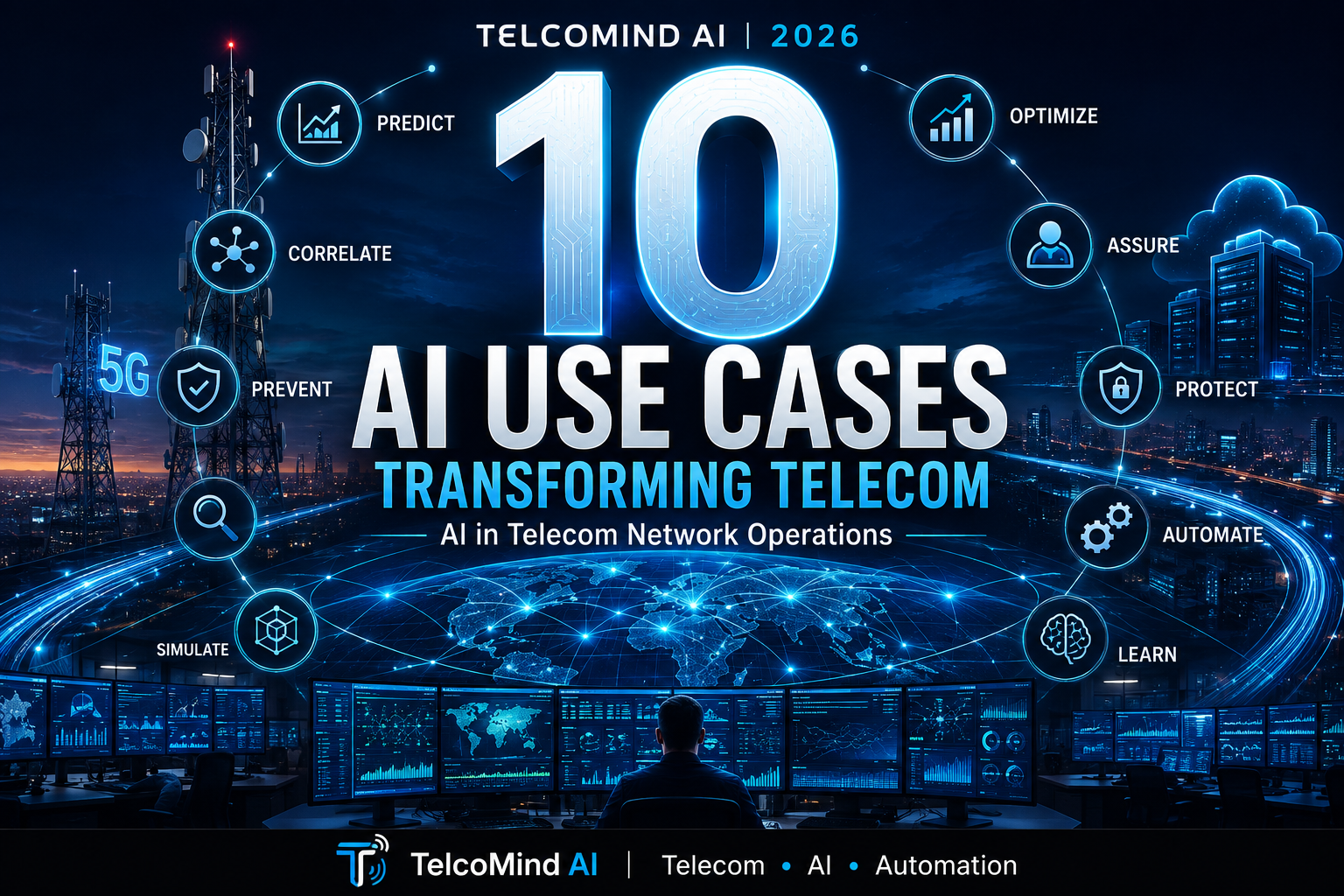
AI use cases in telecom are moving beyond isolated automation toward intelligent network operations. Across the NOC, AI can help correlate alarms, predict failures, investigate root causes, optimize network performance and support increasingly autonomous operational decisions.
2:17 AM in the NOC
2:17 AM.
The NOC is relatively quiet.
Then the screens begin to change.
A cluster of alarms appears from the transport network.
Within seconds, additional alarms arrive from the RAN.
Traffic begins shifting.
A service-quality indicator starts deteriorating.
The traditional response is familiar.
Engineers open multiple monitoring systems, correlate alarms, check topology, review recent changes and begin tracing the problem across network domains.
But imagine the same incident inside an AI-enabled telecom operation.
Before the alarm flood overwhelms the screen, AI correlates hundreds of events into one probable incident.
It identifies the most likely originating fault.
It checks historical behaviour and predicts which services could be affected next.
An AI agent begins gathering evidence across systems.
A Digital Twin evaluates a proposed recovery action.
And before any automated change reaches the production network, operational policies determine whether the action can proceed automatically or requires engineer approval.
One incident.
Several forms of intelligence.
And this is where the conversation about AI in telecom becomes much more interesting than simply asking whether operators are “using AI.”
The real question is no longer whether AI will enter telecom operations. It is where intelligence can create measurable operational value.
AI in Telecom Is Moving Beyond a Single Use Case
AI in telecom is not one technology solving one problem.
It is increasingly appearing across different stages of the operational lifecycle—from detecting anomalies and predicting failures to investigating incidents, optimizing resources, testing network decisions and supporting controlled automation.
Some of these capabilities are already deployed in operational environments. Others are still evolving toward broader scale and greater autonomy.
For telecom operators, the opportunity is therefore not simply to “implement AI.”
The more important question is:
Where should AI be applied first, and what operational problem should it actually solve?
AI in telecom is increasingly being applied across network operations to predict failures, correlate alarms, automate root-cause analysis, optimize 5G networks, reduce energy consumption, improve customer experience and enable increasingly autonomous operations. This article explores 10 practical AI use cases in telecom network operations and how they are changing the way modern networks are managed.
The following ten use cases provide a practical view of where AI can create value across modern telecom network operations.
10 AI Use Cases Transforming Telecom Network Operations
1. Predictive Network Operations — See the Problem Before the Alarm
raditional network operations often begin when something has already happened.
A link goes down.
A KPI crosses a threshold.
Customers begin experiencing degradation.
An alarm reaches the NOC.
AI introduces a different possibility:
What if the network could recognize the pattern before the failure becomes obvious?
Imagine a transmission link that normally operates within stable performance boundaries.
Nothing is down.
No critical alarm exists.
But over several days, AI detects a combination of small changes: increasing errors, unusual latency behaviour and a gradual shift from the link’s normal performance pattern.
Individually, none of these signals may justify an incident.
Together, they may tell a different story.
AI can compare current behaviour with historical patterns and identify that the link is moving toward an abnormal condition.
The NOC therefore receives something much more valuable than another alarm:
An early warning—and time to act.
This changes the operating model from:
Failure → Alarm → Investigation → Recovery
toward:
Weak Signal → Prediction → Investigation → Preventive Action
The objective is not to predict every network failure perfectly.
It is to identify enough developing risks early enough that operations teams have more options before customers are affected.
Deep Dive: We explored this transition in this article
From Reactive NOC to Predictive Operations
2. Intelligent Alarm Correlation & Root Cause Analysis — From Alarm Flood to One Story
When a major network element fails, the first alarm is rarely the last.
One fault can trigger alarms across transmission, RAN, core platforms and dependent services.
The NOC may suddenly see hundreds of events even though the network has only one underlying problem.
This is where AIOps can create immediate operational value.
Instead of treating every alarm as an independent event, AI can correlate information using time, topology, dependency, historical patterns and network behaviour.
Hundreds of alarms can potentially become:
One incident. One probable root cause. One affected service picture.
Imagine 300 sites becoming unreachable.
Traditional monitoring may show hundreds of site alarms.
But topology-aware correlation may identify that those sites share the same upstream transmission dependency.
The question changes from:
“Why are 300 sites down?”
to:
“What happened to the common dependency serving these 300 sites?”
That is a very different investigation.
AI does not create value simply by reducing the number of alarms on a screen.
Its real value comes when it converts network noise into operational context.
Deep Dive: Read Article
AIOps — Autonomous Telecom Operations
3. AI-Powered Preventive Maintenance — Fix It Before It Fails
Prediction becomes much more valuable when it leads to action.
Imagine a critical network element that has not failed yet.
Its alarms are normal.
Traffic is flowing.
Customers are unaffected.
But AI notices something different.
Temperature behaviour is gradually changing.
Error patterns are appearing more frequently.
Performance after peak traffic is taking longer to return to normal.
Historical data shows that similar behaviour has previously appeared before equipment degradation.
The question is no longer:
“Is this equipment down?”
It becomes:
“How long should we wait before this becomes a service-affecting problem?”
This is where AI-powered preventive maintenance can change network operations.
Instead of maintaining equipment only according to a fixed schedule—or waiting for failure—AI can help identify assets showing unusual behaviour and prioritize where technical attention is actually required.
But identifying the risk is only half of the story.
Operations still need to understand:
Can maintenance be performed safely?
Is redundancy available?
What services depend on this asset?
When is the lowest-risk maintenance window?
What happens if we do nothing?
Preventive maintenance therefore becomes more powerful when prediction is connected with network context, operational workflows and controlled action.
The goal is simple:
Move maintenance closer to the developing problem—and further away from the customer-impacting failure.
Deep Dive: Read Article
Preventive Maintenance Automation in Telecom4. Agentic AI — From Finding the Problem to Investigating It
So far, AI has detected patterns, predicted risks and correlated alarms.
But what happens when AI begins participating in the investigation itself?
Consider a service degradation crossing several network domains.
Instead of waiting for an engineer to manually open multiple tools, an AI agent could begin gathering the relevant evidence.
It checks the alarms.
It reviews performance trends.
It examines topology.
It looks at recent configuration changes.
It checks whether similar incidents have occurred before.
It identifies affected services.
Then it brings those pieces together into a working hypothesis:
“This is the probable cause, these services are at risk, and this is the recommended next action.”
That is fundamentally different from a chatbot simply answering a question.
Agentic AI introduces the idea of AI that can pursue an operational objective across multiple steps, using tools and information available within defined boundaries.
For a telecom NOC, that could mean moving from:
Engineer asks → AI answers
toward:
Network event → AI investigates → AI correlates → AI recommends → Engineer/policy validates → Action
The important point is not removing the telecom professional from operations.
It is reducing the amount of repetitive investigation required before expertise can be applied to the decision that actually matters.
The value of an AI agent is not that it can replace the NOC. It is that it can help the NOC move faster from symptoms to understanding.
Deep Dive: Read Article
Agentic AI in Telecom Operations: From AI Assistance to Autonomous ActionBut Agentic AI creates a new challenge.
If an AI agent recommends a network action, how do we know what that action will do before it reaches production?
That takes us directly to our fifth use case.
5. Network Digital Twins — Test the Decision Before Touching the Network
An AI agent has investigated the problem.
It understands the likely cause.
And it recommends:
“Move the affected traffic to the protection path.”
Technically, the recommendation looks correct.
But there is another question:
What happens after the traffic moves?
Could another interface become congested?
Could an enterprise service sharing that route experience higher latency?
Could solving one network problem quietly create another?
This is where a Network Digital Twin introduces an interesting possibility.
Instead of moving directly from:
AI Recommendation → Live Execution
the proposed action can first be evaluated against a digital representation of the network.
AI Recommendation → Digital Twin → What-If Simulation → Risk Evaluation → Controlled Execution
The purpose is not to predict the future perfectly.
It is to discover more of the possible consequences before the production network discovers them for us.
As telecom networks move toward greater autonomy, this capability could become increasingly important.
AI may become better at deciding what should be done.
Digital Twins could help answer:
“What might happen if we do it?”
Explore deeper: See how a Network Digital Twin can simulate network changes, predict potential impact and reduce operational risk before implementation.
6. AI-RAN & 5G Optimization — When the Radio Network Starts Learning
The RAN has always been one of the most dynamic parts of a mobile network.
Traffic changes by location and time.
Users move continuously between cells.
Interference conditions change.
Capacity demand shifts.
Events can transform the traffic profile of an entire area within minutes.
Traditional optimization therefore relies heavily on rules, thresholds, parameters and engineering expertise.
AI introduces another layer.
Instead of applying the same optimization logic repeatedly, machine-learning models can analyze network conditions and identify patterns across large numbers of cells.
Imagine a busy 5G cluster during evening peak hours.
One group of cells is becoming congested.
Another has spare capacity.
Cell-edge users are experiencing lower throughput.
AI can analyze traffic distribution, radio conditions and historical behaviour and recommend how network resources could be optimized.
The objective is not simply:
“Increase capacity.”
It is:
“Use the available radio resources more intelligently as network conditions change.”
This is already moving beyond laboratory discussion.
Recent operator/vendor work is demonstrating AI-driven optimization directly in commercial mobile networks.
For example, T-Mobile and Ericsson reported in 2026 that AI-powered RAN optimization trials on T-Mobile’s live 5G Advanced network achieved up to 15% higher downlink throughput and close to 10% improvement in spectral efficiency compared with legacy rule-based approaches.
In another live-network example, KDDI and Ericsson reported an AI-driven uplink optimization field trial covering approximately 1,500 5G cells and 1,300 4G cells, with a reported 27% improvement in 5G uplink SINR.
These examples matter because AI-RAN is beginning to demonstrate something measurable:
AI is not only analyzing the radio network—it is increasingly influencing how radio resources are optimized.
And this is where AI-RAN connects naturally with our previous use case.
If AI proposes an optimization across hundreds or thousands of cells, a Digital Twin could potentially provide an environment to evaluate the wider consequences before selected changes reach production.
AI-RAN asks: “How can we optimize this network?”
The Digital Twin asks: “What else changes if we do?”
Together, those capabilities point toward a much more adaptive 5G operating model.
     5G NETWORK STATE
            ↓
     AI / ML ANALYSIS
            ↓
 Traffic • SINR • Load
 Mobility • Interference
            ↓
    OPTIMIZATION MODEL
            ↓
   Proposed RAN Action
            ↓
    DIGITAL TWIN
       “What if?”
            ↓
    Controlled Change
            ↓
     Measure Result
The future RAN may not simply be configured. It may continuously learn how to perform better.
7. AI-Powered Energy Optimization — When the Network Learns When to Save
A mobile network cannot simply switch itself off when traffic becomes quiet.
Coverage must remain available.
Critical services must continue.
Customer experience cannot be sacrificed just to reduce the electricity bill.
But network demand is far from constant.
A cell carrying heavy traffic during the evening may be lightly loaded several hours later.
Another site may experience completely different traffic behaviour.
Yet network resources have traditionally been operated using relatively fixed configurations and predefined energy-saving rules.
AI creates an opportunity to make this behaviour more adaptive.
By learning traffic patterns, utilization behaviour and historical demand, AI can help determine where network resources are required—and where energy consumption may potentially be reduced without compromising service.
Imagine a group of 5G sites after midnight.
Traffic has fallen significantly.
AI predicts that demand will remain low for the next several hours.
Instead of keeping every available radio resource operating at the same level, selected resources can potentially enter energy-saving states while the remaining network continues serving the expected demand.
But then traffic begins increasing earlier than usual.
The model detects the change.
Resources are restored before congestion develops.
The objective is therefore not simply:
“Use less energy.”
It is:
“Use energy when and where the network actually needs it.”
This has direct business significance.
Energy is a major operating cost for mobile networks, and AI-driven energy optimization can connect network intelligence with OPEX reduction and sustainability objectives.
The value becomes measurable not only through network KPIs, but through energy saved, operating cost reduced and emissions avoided.
That makes energy optimization one of the clearest examples of AI moving from a technology initiative toward a business outcome.
A smarter network should not only know how to carry more traffic. It should also know when it does not need to consume the same resources.
8. Customer Experience & Service Assurance — From “The Network Is Green” to “Is the Customer Okay?”
Every NOC engineer has seen some version of this situation.
The dashboard looks healthy.
Major network elements are green.
No critical outage is visible.
Yet customers are complaining.
A video call is freezing.
Gaming latency has increased.
An enterprise application feels slow.
A group of 5G users is experiencing poor throughput.
From an infrastructure perspective, the network may appear available.
From the customer’s perspective, something is clearly wrong.
This exposes one of the limitations of traditional network assurance:
Network availability and customer experience are not always the same thing.
AI can help connect information that traditionally lives in different operational environments.
Network KPIs.
Service performance.
Device behaviour.
Location.
Traffic patterns.
Customer complaints.
Historical incidents.
Service dependencies.
Instead of asking only:
“Which network element has an alarm?”
an AI-enabled assurance system can increasingly ask:
“Which customers and services are experiencing degradation—and what network condition is most likely responsible?”
The Customer May Become the Alarm
Imagine that no critical network alarm exists.
But AI detects a sudden deterioration in video-session quality across users connected to a particular geographic area.
At the same time, latency has begun increasing along a shared service path.
Individually, neither condition may cross a traditional critical threshold.
Together, they indicate that customer experience is deteriorating.
The NOC can therefore begin investigating before complaint volumes become the primary indication of the problem.
This changes service assurance from infrastructure-centric monitoring toward experience-aware operations.
And commercially, this matters enormously.
Customers do not buy a green network dashboard.
They buy connectivity, applications, voice, video, gaming, enterprise services and digital experiences.
The closer AI can bring network operations to understanding those experiences, the closer network intelligence moves toward actual business value.
The ultimate network KPI may not be whether every element is green—but whether the customer experience is healthy.
So far, AI has helped us predict failures, understand incidents, optimize resources, reduce energy consumption and protect customer experience.
But increasingly intelligent networks also create another requirement:
They must become better at recognizing threats.
9. AI-Powered Network Security — Finding the Behaviour That Doesn’t Belong
Telecom networks generate enormous volumes of traffic and operational data every second.
Somewhere inside that normal activity, a security threat may begin with something very small.
An unusual traffic pattern.
An unexpected increase in requests.
Abnormal signalling behaviour.
A device communicating differently from its historical pattern.
Or traffic suddenly appearing from an unexpected source.
Traditional security controls remain essential, but many depend on known signatures, predefined rules and thresholds.
AI introduces another capability:
Learning what normal behaviour looks like—and identifying when something begins to move away from it.
Imagine signalling traffic suddenly increasing across part of the network.
No single event appears catastrophic.
But AI detects that the volume, timing and distribution are significantly different from the normal pattern.
It correlates the anomaly with other network and security information and raises the event for investigation before the condition develops further.
This does not mean AI independently decides that every anomaly is an attack.
Networks naturally produce unusual behaviour during major events, software changes, failures and sudden traffic shifts.
Context therefore matters.
The value comes from helping security and operations teams move faster from:
Millions of events → Unusual behaviour → Correlated evidence → Prioritized investigation
As telecom networks become increasingly software-defined, cloud-native and API-driven, the ability to detect abnormal behaviour quickly will become even more important.
The same intelligence helping us understand network performance can also help us recognize when the network is behaving in a way it should not.
10. Autonomous Network Operations — When the Pieces Begin Working Together
Now bring the previous nine use cases together.
A network condition begins changing.
Predictive analytics detects the weak signal.
AIOps correlates the resulting events.
Agentic AI investigates the probable cause.
Service assurance identifies the customers and services at risk.
An AI agent develops a recommended action.
The Network Digital Twin evaluates what may happen if that action is executed.
Operational policies determine whether the action requires approval or can proceed automatically.
Automation executes the approved change.
The live network is monitored again.
Performance improves.
Customer experience recovers.
And the difference between the expected and actual result becomes new information for the next decision.
This is where the individual AI use cases begin to look less like separate tools and more like parts of a future operating model.
The journey can be represented simply:
Observe → Predict → Understand → Decide → Simulate → Execute → Validate → Learn
This is the direction behind the industry’s movement toward increasingly autonomous networks.
But autonomy should not be confused with removing all human involvement.
Different network actions carry very different levels of risk.
Automatically adjusting a low-risk optimization parameter is not the same as changing a critical core-network configuration.
The practical journey toward autonomy will therefore require policy boundaries, governance, confidence levels, rollback mechanisms and appropriate human authorization based on the risk of the action.
The most mature autonomous network may therefore not be the one that performs the greatest number of actions without people.
It may be the one that understands:
what it can do automatically,
what it should test first,
what requires expert approval,
and
how to verify that the action actually worked.
That is a much more meaningful form of network autonomy.
          AI IN TELECOM OPERATIONS

                   NETWORK
                      │
                      ▼
              1. PREDICT
                      │
              2. CORRELATE
                      │
              3. PREVENT
                      │
              4. INVESTIGATE
                      │
              5. SIMULATE
                      │
              6. OPTIMIZE RAN
                      │
              7. OPTIMIZE ENERGY
                      │
              8. PROTECT EXPERIENCE
                      │
              9. DETECT THREATS
                      │
                     10.
              AUTONOMOUS ACTION
                      │
                      ▼
                 VALIDATE
                      │
                      ▼
                   LEARN
AI in telecom is not one use case. Its real potential appears when intelligence begins connecting decisions across the operational lifecycle.
10 AI Use Cases in Telecom at a Glance
| AI Use Case | Operational Problem | What AI Brings | Potential Business Value |
|---|---|---|---|
| 1. Predictive Operations | Problems discovered after degradation | Early anomaly and risk detection | Fewer service-impacting incidents |
| 2. Alarm Correlation & RCA | Alarm floods and slow troubleshooting | Event correlation and probable root cause | Lower MTTR and faster response |
| 3. Preventive Maintenance | Reactive/fixed maintenance | Failure-risk prediction and prioritization | Better availability and maintenance efficiency |
| 4. Agentic AI | Manual multi-tool investigation | Multi-step investigation and recommendations | Faster operational decisions |
| 5. Network Digital Twin | Risk of changes affecting production | What-if simulation before execution | Safer network changes |
| 6. AI-RAN & 5G Optimization | Dynamic traffic and radio conditions | Adaptive resource optimization | Better capacity and network performance |
| 7. Energy Optimization | High network energy consumption | Demand-aware resource management | Lower OPEX and energy consumption |
| 8. Customer Experience Assurance | Healthy KPIs but poor user experience | Network-to-service correlation | Better customer experience |
| 9. AI-Powered Security | Massive volumes of security/network events | Behavioural anomaly detection | Earlier threat identification |
| 10. Autonomous Operations | Manual operational loops | Decision, execution and validation loops | Greater operational efficiency and scalability |
The important point is that these use cases should not be viewed as ten isolated AI projects.
Their greater value may emerge when they begin sharing network context, operational data and decision workflows.
Predictive analytics identifies the risk.
AIOps provides context.
Agentic AI investigates.
A Digital Twin tests the proposed response.
Automation executes within defined boundaries.
Service assurance verifies the outcome.
That is when AI begins moving from individual tools toward an intelligent operating model.
Frequently Asked Questions About AI in Telecom
How is AI used in telecom network operations?
AI is used across telecom operations for anomaly detection, predictive maintenance, alarm correlation, root-cause analysis, RAN optimization, capacity forecasting, energy optimization, customer-experience assurance, security analytics and network automation. Increasingly, AI agents are also being explored for multi-step operational investigation and decision support.
What is AIOps in telecom?
AIOps combines AI, machine learning and operational data to help telecom teams understand large volumes of network events. In a NOC environment, it can support alarm correlation, anomaly detection, probable root-cause identification, incident prioritization and automated operational workflows.
What is Agentic AI in telecom?
Agentic AI goes beyond generating answers. An AI agent can potentially pursue an operational objective across multiple steps—for example, gathering alarms, checking topology, reviewing performance, examining recent changes and developing a recommended response within defined operational boundaries.
How can AI improve 5G networks?
AI can analyze changing traffic, radio conditions, interference, mobility and utilization to support more adaptive 5G optimization. Current industry trials are already demonstrating measurable improvements from AI-driven RAN optimization.
What is a Network Digital Twin?
A Network Digital Twin is a dynamic digital representation of a telecom network that can help operators understand network conditions and evaluate what-if scenarios. One emerging application is testing a proposed AI or automation action before applying it to the production network.
Will AI replace telecom NOC engineers?
The more realistic transformation is a change in how operational work is divided. AI can increasingly handle repetitive correlation, data gathering, pattern detection and workflow execution, while telecom professionals remain critical for complex engineering judgment, governance, architecture, risk management and high-impact decisions.
Can telecom networks become fully autonomous?
Increasing levels of autonomy are technically possible, but telecom networks contain actions with very different risk levels. The journey will therefore likely be progressive, combining AI, automation, Digital Twins, policies, rollback mechanisms and human authorization according to the operational risk involved.
Where Does Telecom Go From Here?
The telecom industry has spent decades making networks faster, larger and more connected.
The next challenge may be making them more intelligent.
Not intelligence for its own sake.
Intelligence that can recognize a developing problem.
Understand what is happening.
Predict what may happen next.
Recommend an appropriate response.
Test the consequence.
Act within defined boundaries.
And verify whether the customer actually benefited.
The ten use cases in this article represent different stages of that journey.
Some are already delivering value in live networks.
Others are still developing.
But together they point toward a telecom operating model where AI increasingly becomes part of how networks are observed, optimized, protected and operated.
And perhaps the biggest transformation will not be a single AI technology.
It will be what happens when all these forms of intelligence begin working together.
The future telecom network will not simply carry intelligence. Increasingly, intelligence will help operate the network itself.
TelcoMind AI | Telecom • AI • Automation
Where Does Your NOC Stand Today?
Understanding AI use cases is the first step. The next is knowing which capabilities your NOC already has—and where the biggest gaps remain.
Use the free TelcoMind AI NOC Maturity Assessment to evaluate your operations across 8 critical dimensions and identify where your NOC stands on the journey from Reactive → Automated → Predictive → Intelligent → Autonomous.
Leave a Reply