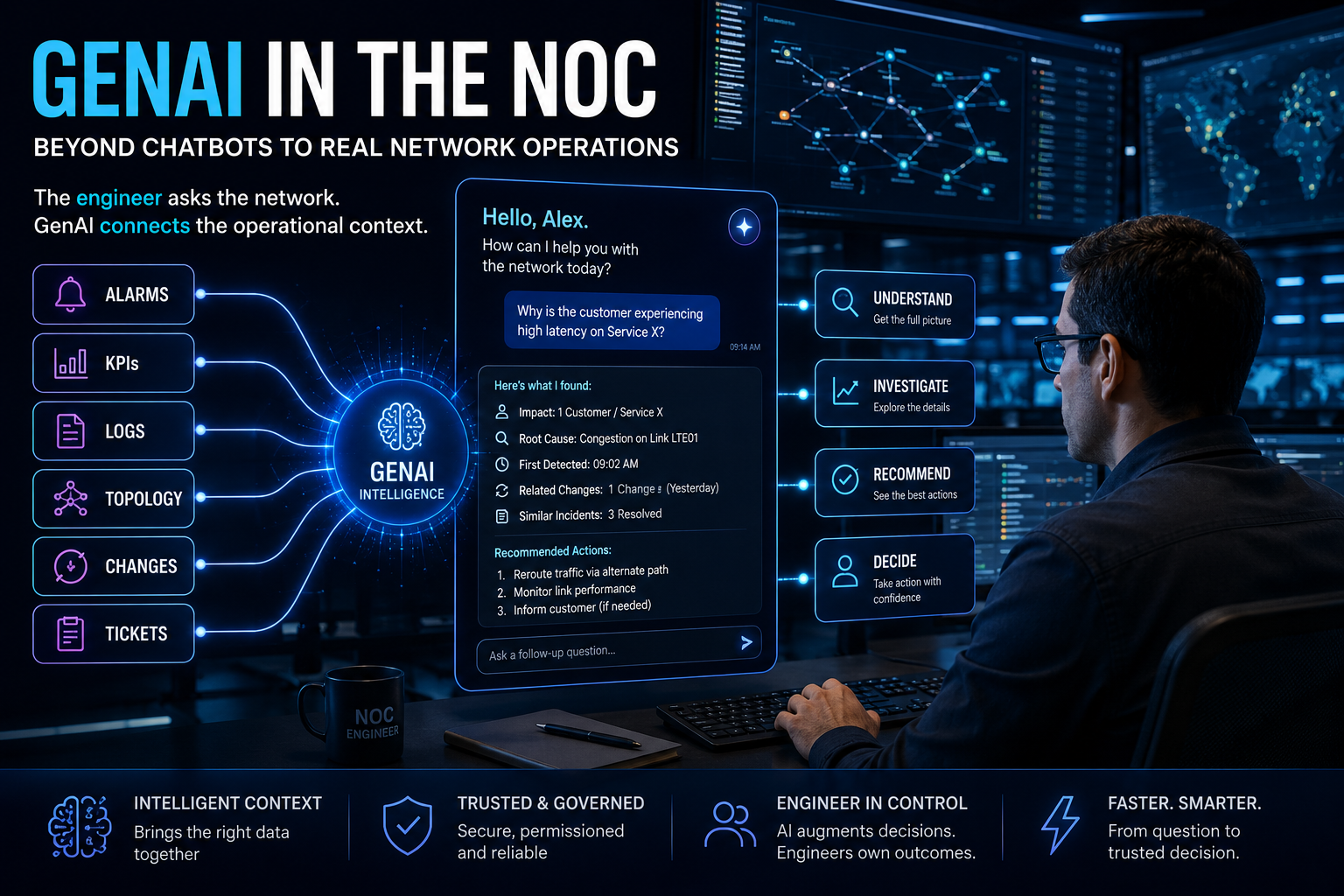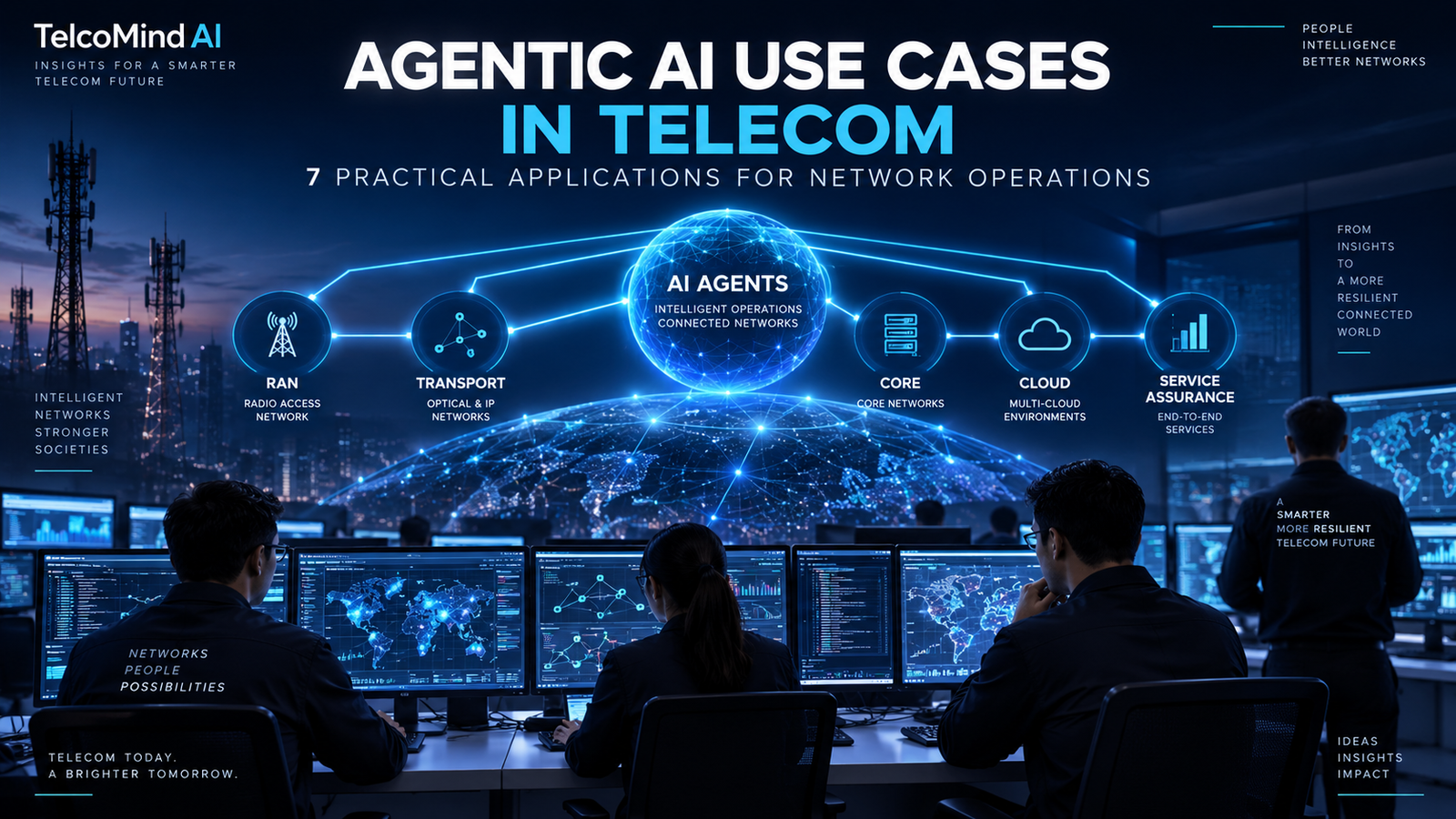
Tag: AIOps

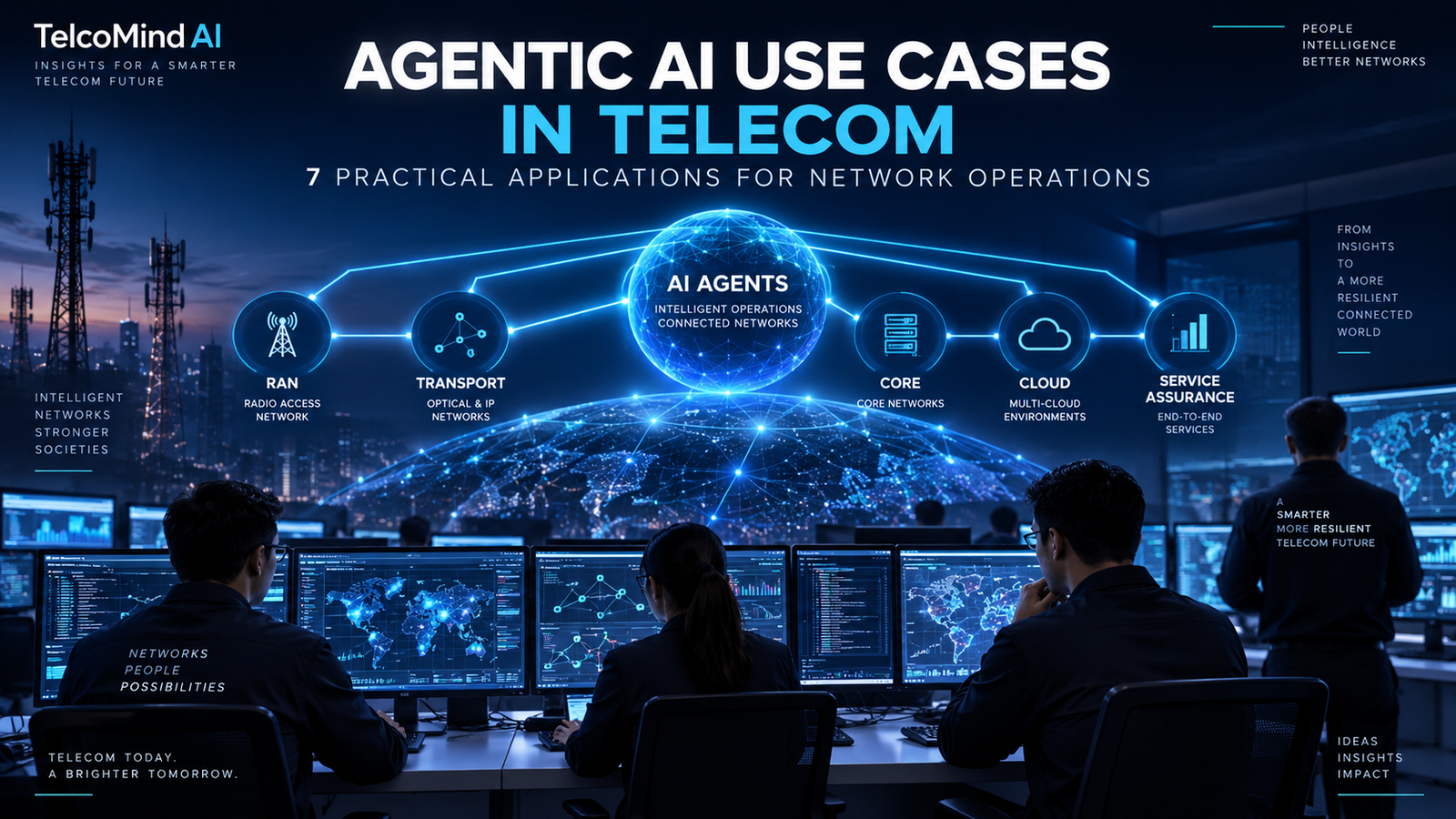
  • Agentic AI Use Cases in Telecom: 7 Practical Applications for Network Operations

    Agentic AI Use Cases in Telecom: 7 Practical Applications for Network Operations

    Where Can Agentic AI Actually Be Used in a Telecom Network?

    Agentic AI is becoming one of the most discussed ideas in telecom AI.

    But for network operators, the important question is no longer simply:

    “What is Agentic AI?”

    The more useful question is:

    “What operational problem can an AI agent actually solve?”

    Imagine a major service degradation.

    Today, an engineer may need to move between alarm systems, performance dashboards, configuration records, change-management tools and network logs before understanding what happened.

    An Agentic AI system could approach the same problem differently.

    It could gather evidence from multiple systems, investigate possible causes, coordinate with specialized AI agents, evaluate possible actions and present the engineer with a recommended response.

    For approved low-risk situations, it could eventually execute a controlled action and verify whether the service recovered.

    That changes the operational flow from:

    ALARM → ENGINEER SEARCHES → INVESTIGATES → DECIDES → ACTS

    toward:

    ALARM → AI INVESTIGATES → CORRELATES → REASONS → RECOMMENDS → GOVERNED ACTION → VERIFIES

    But not every telecom problem needs an AI agent.

    The real value appears when a task requires multiple steps, multiple systems, contextual reasoning and coordinated decisions.

    This article explores seven practical Agentic AI use cases in telecom network operations—and, importantly, where operators should and should not give AI operational authority.

    The value of Agentic AI is not that it can talk about the network. It is whether it can help move an operational problem safely toward resolution.

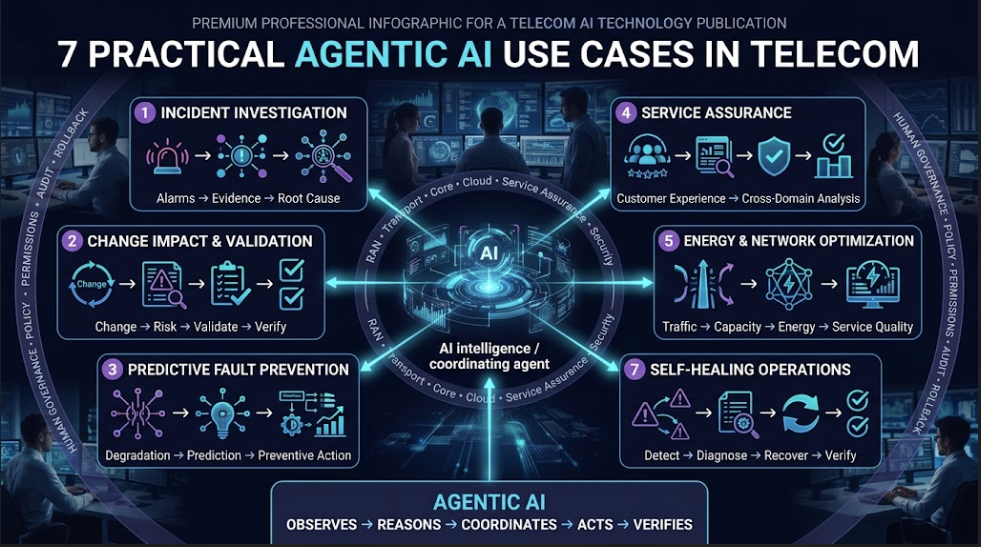
    Use Case 1: Autonomous Incident Investigation

    Incident investigation is one of the strongest potential applications for Agentic AI because the information required to understand a network problem is often distributed across multiple systems.

    Consider a sudden degradation affecting thousands of mobile customers.

    The NOC sees several symptoms:

    RAN alarms → Transport packet loss → Core KPI degradation → Customer complaints

    The difficult question is:

    Are these four different problems—or four symptoms of the same problem?

    An Agentic AI system could assign different tasks to specialized agents.

    A RAN Agent checks cell alarms and performance changes.

    A Transport Agent investigates congestion, interface errors and path changes.

    A Core Agent examines session failures and service KPIs.

    A Change Agent checks whether any recent configuration or software change matches the incident timeline.

    A coordinating agent could then combine the evidence and build a probable incident story:

    Recent transport change → Packet loss increases → RAN service degradation → Core sessions affected → Customer experience deteriorates

    Instead of engineers manually searching several platforms, the system could present:

    Probable Root Cause → Supporting Evidence → Affected Services → Recommended Action → Confidence Level

    The engineer can then validate the evidence and decide whether the recommended action is safe.

    MULTIPLE ALARMS → MULTIPLE AGENTS → SHARED CONTEXT → PROBABLE ROOT CAUSE → GOVERNED RESPONSE

    Agentic AI becomes valuable when it can turn fragmented network evidence into an investigation engineers can verify and act upon.

    Use Case 2: Change Impact Analysis and Validation

    Many network incidents do not begin with hardware failure or an external attack.

    They begin with a planned change.

    A routing update, software upgrade, parameter modification or cloud configuration may complete successfully from a technical perspective—but still create unexpected service impact somewhere else.

    Imagine a routing change is planned in the transport network.

    Before execution, an Agentic AI system could coordinate several checks:

    Change Agent → Understands the proposed configuration.

    Topology Agent → Identifies affected network paths and dependencies.

    Capacity Agent → Checks whether alternative routes have sufficient capacity.

    Service Agent → Identifies enterprise, voice, 5G or other critical services using those paths.

    Risk Agent → Reviews similar historical changes and previous incidents.

    The system could then produce:

    CHANGE → DEPENDENCIES → POSSIBLE IMPACT → RISK LEVEL → RECOMMENDATION

    For a higher-risk change, the proposed action could also be tested through a Network Digital Twin before touching the live network.

    But Agentic AI should not stop working once the change is executed.

    It could compare network conditions before and after the change, checking latency, packet loss, alarms, traffic distribution and service KPIs.

    If unexpected degradation appears, it could recommend a rollback—or execute an already approved rollback policy where appropriate.

    BEFORE THE CHANGE: UNDERSTAND THE RISK

    AFTER THE CHANGE: VERIFY THE OUTCOME

    A successful change should not mean only that the command executed correctly. It should mean that the network remained healthy after it was executed.

    Use Case 3: Predictive Fault Prevention Before the Outage

    Some of the most valuable network incidents are the ones that never happen.

    Telecom equipment often shows warning signs before a major failure: rising temperature, increasing optical errors, unstable power, repeated interface flaps, abnormal CPU utilization or gradually deteriorating performance.

    The problem is that these signals may appear in different monitoring systems and at different times.

    Imagine an optical transmission link begins showing increasing errors.

    A traditional system may generate threshold alarms once conditions become serious.

    An Agentic AI workflow could investigate earlier.

    Performance Agent → Detects unusual degradation compared with historical behavior.

    Transmission Agent → Checks optical power, errors and link performance.

    Topology Agent → Identifies services and network elements dependent on the link.

    Maintenance Agent → Reviews previous faults and maintenance history.

    Capacity Agent → Determines whether traffic could safely use an alternative path.

    The agents could combine their findings:

    DEGRADING SIGNAL → FAILURE PROBABILITY → SERVICE EXPOSURE → AVAILABLE PROTECTION → RECOMMENDED ACTION

    Instead of waiting for the equipment to fail, the operator might proactively reroute traffic, schedule maintenance or replace a deteriorating component during a controlled window.

    The important distinction is that Agentic AI would not merely predict a failure.

    It could help coordinate what should happen because a failure is predicted.

    PREDICTION TELLS US WHAT MAY FAIL. AGENTIC AI CAN HELP DETERMINE WHAT WE SHOULD DO ABOUT IT.

    The operational value of prediction appears when insight is converted into a safe action before customers are affected.

    Use Case 4: Service Assurance Before Customers Complain

    A network can look healthy while customers are already experiencing a poor service.

    Traditional monitoring often looks at individual network domains. But a customer experiences the complete service journey.

    Imagine enterprise customers in one area begin experiencing intermittent video and voice degradation.

    There is no major outage.

    RAN availability remains high.

    Core systems appear healthy.

    Transport utilization is within normal thresholds.

    Yet customer experience is deteriorating.

    An Agentic AI system could investigate the service across domains.

    Customer Experience Agent → Detects unusual degradation in service-quality indicators.

    RAN Agent → Checks radio quality, congestion and mobility behavior.

    Transport Agent → Examines latency, packet loss and path performance.

    Core Agent → Reviews sessions, signaling and service KPIs.

    Change Agent → Searches for recent changes matching the degradation timeline.

    The coordinating agent could discover that no single domain has crossed a major alarm threshold—but several small degradations are combining to affect the customer.

    It could produce:

    CUSTOMER IMPACT → CROSS-DOMAIN EVIDENCE → PROBABLE CAUSE → AFFECTED SERVICES → RECOMMENDED ACTION

    This changes service assurance from waiting for:

    CUSTOMER COMPLAINT → TICKET → INVESTIGATION

    toward:

    EXPERIENCE DEGRADATION → AI INVESTIGATION → EARLY ACTION → SERVICE PROTECTED

    Agentic AI could help telecom operations investigate the service from the customer’s perspective—not only from the perspective of individual network elements.

    Use Case 5: Intelligent Energy and Network Optimization

    Reducing network energy consumption sounds simple until service quality, coverage and capacity are added to the equation.

    Imagine traffic falls significantly across part of the mobile network during the night.

    Some radio resources could potentially operate in a lower-energy state.

    But switching resources off based only on traffic volume could create another problem if demand suddenly increases or neighboring sites cannot absorb the load.

    Agentic AI could coordinate several perspectives before making a recommendation.

    Traffic Agent → Predicts demand for the next period.

    RAN Agent → Identifies resources that could potentially enter energy-saving mode.

    Capacity Agent → Checks whether neighboring resources can handle additional traffic.

    Service Agent → Protects critical services and customer-experience requirements.

    Energy Agent → Calculates the potential energy benefit.

    The coordinating agent could then evaluate:

    ENERGY SAVING vs CAPACITY vs COVERAGE vs SERVICE QUALITY

    For example, instead of simply deciding:

    “Switch this resource off.”

    the system could reason:

    Traffic is low → Neighboring capacity is sufficient → No critical service risk detected → Energy-saving action is permitted → Monitor KPIs → Restore capacity automatically if demand changes

    This is important because optimization rarely has only one objective.

    The network may simultaneously need to reduce energy, maintain SLA performance, protect coverage and preserve resilience.

    THE BEST OPTIMIZATION IS NOT THE ONE THAT SAVES THE MOST ENERGY. IT IS THE ONE THAT SAVES ENERGY WITHOUT COMPROMISING THE REQUIRED SERVICE OUTCOME.

    Agentic AI becomes especially useful when the network must balance several competing objectives rather than optimize one KPI in isolation.

    Use Case 6: AI-Powered Cyber Defense and Threat Response

    Cybersecurity becomes more complex when a threat moves across several parts of the telecom environment.

    Imagine abnormal traffic begins hitting an important service.

    At the same time, unusual login activity appears, an API starts receiving unexpected requests and service latency begins increasing.

    Individually, these events may generate separate alerts.

    Agentic AI could investigate whether they are actually part of one coordinated security incident.

    Security Agent → Analyzes threat indicators and abnormal traffic.

    Identity Agent → Investigates suspicious accounts and access behavior.

    Network Agent → Checks affected infrastructure and traffic patterns.

    Service Assurance Agent → Determines whether customers or critical services are being impacted.

    Change Agent → Checks whether suspicious configuration activity occurred during the same period.

    A coordinating agent could combine the evidence:

    ABNORMAL BEHAVIOR → CROSS-DOMAIN CORRELATION → THREAT ASSESSMENT → SERVICE RISK → RESPONSE OPTIONS

    For a high-confidence, predefined scenario, controlled actions might include rate-limiting suspicious traffic, isolating a compromised component, blocking unauthorized access or rolling back an unsafe change.

    But cybersecurity also demonstrates why Agentic AI needs strict governance.

    An AI agent capable of protecting the network can itself become a risk if its identity, permissions, data sources and operational authority are not properly controlled.

    THE MORE AUTHORITY WE GIVE AN AI AGENT TO DEFEND THE NETWORK, THE MORE CAREFULLY WE MUST SECURE THE AGENT ITSELF.

    For a deeper explanation of this challenge, see our article on AI-powered cybersecurity in telecom.

    Agentic cyber defense is not only about responding at machine speed. It is about responding at machine speed within boundaries the operator can trust.

    Use Case 7: Self-Healing Network Operations

    Self-healing is where many of the capabilities discussed in the previous use cases begin to come together.

    Imagine a critical network service suddenly degrades.

    The system must do more than detect an alarm.

    It needs to understand:

    What failed?

    What services are affected?

    What caused the failure?

    What recovery options are available?

    Which action is safest?

    Did the action actually restore the service?

    Agentic AI could coordinate specialized agents to answer these questions.

    Detection Agent → Identifies abnormal network behavior.

    Diagnosis Agent → Correlates alarms, KPIs, topology and recent changes.

    Service Agent → Determines customer and business impact.

    Recovery Agent → Identifies possible remediation actions.

    Risk Agent → Checks dependencies, policies and potential side effects.

    The coordinating agent could then build a controlled recovery path:

    DETECT → DIAGNOSE → UNDERSTAND IMPACT → SELECT RESPONSE → VALIDATE → ACT → VERIFY

    For a known, low-risk failure, an approved recovery action could execute automatically.

    For an uncertain or high-impact situation, the system should provide the evidence and recommendation to an engineer for approval.

    And there is one critical final step:

    Verification.

    Restarting a process, rerouting traffic or rolling back a configuration does not mean the incident is resolved.

    The system must confirm that network KPIs recovered, alarms cleared and the affected service returned to the required level.

    SELF-HEALING IS NOT “AI FIXED SOMETHING.” IT IS “THE NETWORK UNDERSTOOD THE FAILURE, RECOVERED SAFELY AND VERIFIED THE OUTCOME.”

    For a deeper technical explanation, see self-healing telecom networks.

    The closed loop is not complete when the action is executed. It is complete when the service outcome is verified.
    Which Agentic AI Use Case Should Telecom Operators Implement First?

    Not every use case should move to Agentic AI at the same time.

    The best starting point is usually not the most futuristic use case. It is the operational problem where the operator already has good data, repetitive investigation work, measurable business impact and relatively safe actions.

    For many NOCs, incident investigation could be a strong starting point.

    Why?

    The AI agent can initially work in observation and recommendation mode. It can gather alarms, KPIs, topology, logs and change information without being given authority to modify the live network.

    Once its recommendations become reliable, operators can gradually progress toward more operational responsibility.

    Use CasePotential ValueImplementation ComplexityAutomation RiskGood Starting Point?
    Incident InvestigationHighMediumLowYes
    Change Impact & ValidationHighMediumMediumYes
    Predictive Fault PreventionHighMediumLow–MediumYes
    Service AssuranceHighMediumLowYes
    Energy OptimizationMedium–HighHighMediumLater
    Cyber DefenseVery HighHighHighControlled Pilot
    Self-Healing OperationsVery HighVery HighHighAdvanced Stage

    This is not a universal ranking. An operator’s starting point should depend on its network architecture, available data, operational pain points, automation maturity and governance capability.

    START WHERE THE BUSINESS VALUE IS CLEAR AND THE OPERATIONAL RISK CAN BE CONTROLLED.

    How Do You Implement Agentic AI Without Giving It Control Too Early?

    Give the AI agent access to approved operational data such as:

    Alarms → KPIs → Logs → Topology → Change Records → Service Information

    The agent observes and builds context, but takes no operational action.

    Stage 2 — Investigate

    Allow the agent to correlate information, investigate possible causes and generate a probable root cause with supporting evidence.

    Engineers compare its findings with their own investigation.

    Stage 3 — Recommend

    The agent begins recommending actions.

    For example:

    Probable transport congestion → Identify affected services → Evaluate alternate path → Recommend rerouting

    The engineer still makes the decision.

    Stage 4 — Human-Approved Execution

    Once recommendations have been repeatedly proven, the agent may prepare or initiate an action—but execution requires engineer approval.

    Every action should have clear permissions, audit records and rollback conditions.

    Stage 5 — Controlled Autonomy

    Only proven, low-risk and well-defined scenarios move toward autonomous execution.

    The AI agent acts within predefined boundaries and immediately verifies the outcome.

    If confidence is low, conditions change or verification fails:

    STOP → ROLLBACK → ESCALATE TO HUMAN

    OBSERVE → INVESTIGATE → RECOMMEND → HUMAN APPROVES → CONTROLLED AUTONOMY

    Do not measure Agentic AI maturity by how much control the AI has. Measure it by how much operational responsibility it can handle safely and reliably.

    Is Agentic AI in Telecom Still a Concept—or Is It Becoming Real?

    Agentic AI in telecom is no longer limited to research discussions. During 2026, vendors, operators and industry bodies have increasingly moved toward real operational frameworks, products and trials.

    For example, Ericsson describes an agentic network-intelligence approach where specialized agents can support root-cause analysis and impact analysis, using subscriber events, network data, historical tickets, topology and operational knowledge to help teams identify problems earlier and understand their likely impact.

    Nokia has also introduced agentic AI capabilities for network operations. Its IP-network framework includes an AI-driven troubleshooting agent designed to accelerate root-cause analysis and provide guided, explainable actions within operator-defined policy and security boundaries.

    The movement is also reaching autonomous-network architecture. TM Forum’s 2026 Autonomous Operations Target Operating Model positions AI agents as a bridge between business intent and technical execution, while providing a framework for trusted decision-making and orchestration across network, OSS/BSS and operational systems.

    There are operator-level signals too. At DTW Ignite 2026, Vodafone and Google Cloud presented production-scale Agentic AI workflows spanning the network lifecycle, while TM Forum showcased projects involving Agentic NOCs, trusted AI agents, multi-agent network planning and autonomous operations.

    This does not mean telecom networks have suddenly become fully autonomous.

    It means the industry is moving from:

    AGENTIC AI CONCEPT → OPERATIONAL USE CASE → CONTROLLED DEPLOYMENT → MULTI-AGENT OPERATIONS → INCREASING AUTONOMY

    The question is gradually changing from “Can Agentic AI work in telecom?” to “Where can it create measurable value without introducing unacceptable operational risk?”

    What Happens When an AI Agent Makes the Wrong Decision?

    Agentic AI can accelerate network operations, but speed becomes dangerous when the underlying decision is wrong.

    Imagine an AI agent detects congestion and decides that traffic should be rerouted.

    The action looks reasonable.

    But the agent does not know that the alternative path is carrying a critical enterprise service and has limited spare capacity.

    The rerouting solves one problem—and creates another.

    The failure was not necessarily the AI model itself.

    The agent was missing network context.

    Similar problems can occur when agents operate with:

    Incomplete topology information

    Poor-quality or delayed data

    Incorrect service dependencies

    Excessive permissions

    Conflicting objectives

    Outdated operational procedures

    No validation or rollback mechanism

    This is why giving an AI agent access to more tools does not automatically make it more intelligent.

    An operational agent needs to understand not only:

    “Can I execute this action?”

    but also:

    “Should I execute it, what else could it affect, and can I safely reverse it?”

    For high-impact actions, operators may also use simulation or a Network Digital Twin to test the proposed change before touching the live network.

    AGENTIC AI WITHOUT CONTEXT + GOVERNANCE + VERIFICATION CAN TURN AUTOMATION SPEED INTO OPERATIONAL RISK.

    The safest AI agent is not the one capable of taking the most actions. It is the one that understands when it should not act.

    Where Is the Business Value of Agentic AI?

    Agentic AI should not be justified simply because it is a new technology.

    For telecom operators, the business case must come from measurable operational improvement.

    Consider incident investigation.

    If engineers currently spend significant time collecting alarms, checking dashboards, reviewing changes and coordinating across RAN, transport and core teams, an AI agent that shortens this investigation can create measurable value.

    Operators can track:

    Mean Time to Identify (MTTI) — How quickly is the probable problem identified?

    Mean Time to Repair (MTTR) — Does faster investigation lead to faster recovery?

    Engineering hours — How much repetitive investigation effort is reduced?

    Service-impact minutes — Are customer-affecting incidents resolved earlier?

    Change failures — Can Agentic AI identify risky changes before implementation?

    Prevented incidents — Can predictive agents help teams act before failures occur?

    The financial model can then use the operator’s own historical data.

    Annual Benefit = Reduced Engineering Cost + Avoided Service Impact + Reduced Incident/Escalation Cost + Prevented Operational Loss

    ROI (%) = (Annual Benefit − Annual Agentic AI Cost) ÷ Annual Agentic AI Cost × 100

    But there is another important measure:

    How much operational responsibility can AI safely absorb?

    An agent saving ten minutes but creating additional operational risk may provide little real value.

    An agent that reliably reduces investigation time while keeping engineers in control can be much more valuable.

    The business case for Agentic AI is not the number of agents deployed. It is the operational outcome those agents improve.

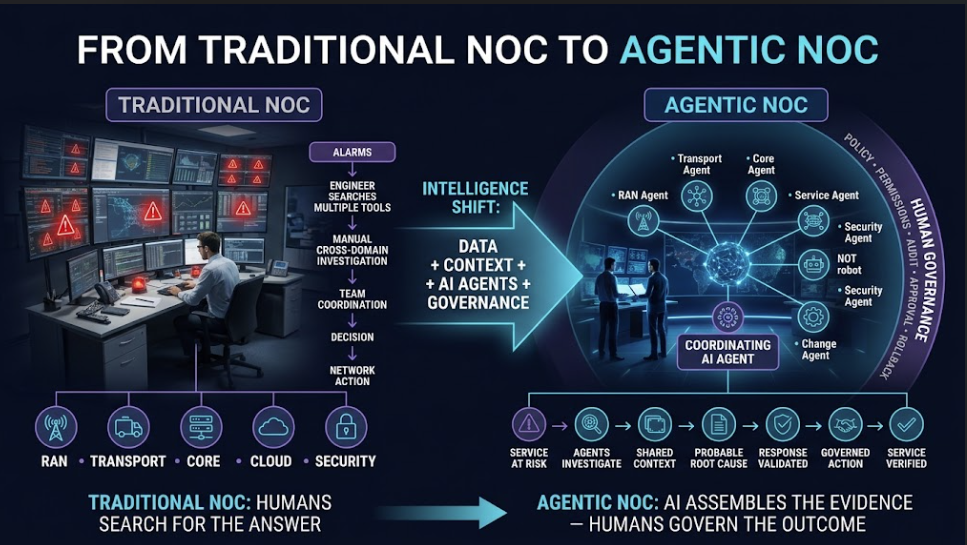
    What Could the Agentic NOC Look Like by 2030?

    Today’s NOC is largely organized around network domains, monitoring platforms and operational teams.

    The future NOC may increasingly organize intelligence around problems, services and business outcomes.

    Imagine a major enterprise service begins degrading.

    Instead of one engineer manually coordinating several teams, specialized agents could begin working simultaneously:

    Service Agent → Understands customer and SLA impact.

    RAN Agent → Investigates radio conditions.

    Transport Agent → Checks paths, congestion and failures.

    Core Agent → Analyzes sessions and signaling.

    Security Agent → Determines whether abnormal behavior has a cyber dimension.

    Change Agent → Checks recent network modifications.

    A coordinating agent could combine their findings and maintain a shared operational picture.

    The next evolution could connect this directly with intent-driven operations.

    Instead of simply asking:

    “What is wrong with the network?”

    the system could continuously work toward an operator-defined objective such as:

    “Maintain premium enterprise service within the agreed SLA while protecting network resilience.”

    AI agents could investigate threats to that intent, coordinate possible responses and recommend—or eventually execute—approved actions.

    The NOC engineer’s interface could therefore evolve from thousands of individual alarms toward something more outcome-oriented:

    SERVICE AT RISK → AI AGENTS INVESTIGATING → PROBABLE CAUSE IDENTIFIED → RESPONSE VALIDATED → ACTION APPROVED → SERVICE VERIFIED

    But humans remain essential for defining objectives, policies, risk boundaries and accountability.

    THE FUTURE NOC MAY NOT BE MANAGED BY ONE AI AGENT. IT MAY BE ORCHESTRATED THROUGH MANY SPECIALIZED AGENTS WORKING WITH HUMAN EXPERTS TOWARD SHARED NETWORK OUTCOMES.

    Agentic AI could change the NOC from a place where engineers search for answers into an environment where intelligence continuously assembles the evidence needed for better decisions.
    A Practical 90-Day Agentic AI Pilot for the Telecom NOC

    Operators do not need to build a fully Agentic NOC to start.

    Choose one measurable use case. For example:

    Autonomous Incident Investigation

    Days 1–30: Build the Operational Context

    Connect the minimum information the agent needs:

    Alarms + KPIs + Logs + Topology + Change Records + Service Context

    Measure today’s baseline:

    Investigation time • MTTR • Engineering effort • Escalations • Service-impact minutes

    At this stage:

    AI OBSERVES — ENGINEERS INVESTIGATE

    Days 31–60: Shadow the Engineers

    Allow the agent to investigate incidents independently.

    For every incident compare:

    AI Root Cause vs Engineer Root Cause

    AI Evidence vs Engineer Evidence

    AI Recommendation vs Actual Action

    The objective is to prove whether the agent can produce reliable and explainable operational conclusions.

    At this stage:

    AI INVESTIGATES + RECOMMENDS — ENGINEERS DECIDE

    Days 61–90: Introduce Controlled Action

    Select only well-understood, low-risk scenarios.

    Allow the agent to prepare or execute approved actions within strict policies.

    Every action should include:

    Authorization → Audit Trail → Rollback → Verification

    If confidence is low or the situation falls outside policy:

    STOP → ESCALATE TO ENGINEER

    Day 90: Decide Whether to Scale

    Ask:

    Did investigation become faster?

    Was root-cause accuracy acceptable?

    Did MTTR improve?

    Was engineering effort reduced?

    Were recommendations explainable?

    Did any AI action introduce additional operational risk?

    Only then should the operator expand to another use case or increase autonomy.

    ONE USE CASE → OBSERVE → SHADOW → PROVE → CONTROL → MEASURE → SCALE

    The first Agentic AI project should prove trust—not autonomy.

    From AI Assistance to Agentic Network Operations

    Agentic AI could represent an important next step in telecom network operations—but its value will not come from simply adding AI agents to the NOC.

    The real opportunity is connecting network data, operational context, specialized intelligence and controlled actions around problems that engineers deal with every day.

    The seven use cases in this article show where that could happen:

    Incident investigation. Change validation. Predictive fault prevention. Service assurance. Energy optimization. Cyber defense. Self-healing operations.

    Some can begin today as AI-assisted workflows.

    Others will require stronger automation, better data, clearer policies and much higher levels of operational trust before greater autonomy is appropriate.

    The journey should therefore be gradual.

    Start with a real operational problem.

    Give the agent enough context to understand it.

    Measure its decisions against experienced engineers.

    Prove the value.

    Then increase responsibility only when the evidence supports it.

    Agentic AI should ultimately help telecom teams move from searching across fragmented systems toward making faster, better-informed and more coordinated network decisions.

    The future of Agentic AI in telecom will not be decided by how many AI agents operators deploy. It will be decided by how reliably those agents improve real network outcomes.

    START WITH THE PROBLEM → BUILD CONTEXT → PROVE THE DECISION → GOVERN THE ACTION → VERIFY THE OUTCOME → SCALE

    How Ready Is Your NOC for Agentic AI?

    Before deploying AI agents, operators need to understand whether their NOC has the required foundations.

    That includes data and observability, automation, AIOps, decision intelligence, closed-loop operations and governance.

    TelcoMind AI has created a free NOC AI Maturity Assessment to help telecom teams evaluate their current position and identify the capabilities they need to strengthen before moving toward more autonomous operations.

    → Take the Free NOC AI Maturity Assessment

    Related TelcoMind AI Insights

    1. Agentic AI in Telecom Operations: From AI Assistance to Autonomous Action

    2. AI-Powered Cybersecurity in Telecom: Can Networks Detect and Stop Attacks Before Service Is Impacted?

    3. Self-Healing Telecom Networks: How AI Detects, Diagnoses and Recovers Network Failures
  • Agentic AI Use Cases in Telecom: 7 Practical Applications for Network Operations

    Agentic AI Use Cases in Telecom: 7 Practical Applications for Network Operations

    Where Can Agentic AI Actually Be Used in a Telecom Network?

    Agentic AI is becoming one of the most discussed ideas in telecom AI.

    But for network operators, the important question is no longer simply:

    “What is Agentic AI?”

    The more useful question is:

    “What operational problem can an AI agent actually solve?”

    Imagine a major service degradation.

    Today, an engineer may need to move between alarm systems, performance dashboards, configuration records, change-management tools and network logs before understanding what happened.

    An Agentic AI system could approach the same problem differently.

    It could gather evidence from multiple systems, investigate possible causes, coordinate with specialized AI agents, evaluate possible actions and present the engineer with a recommended response.

    For approved low-risk situations, it could eventually execute a controlled action and verify whether the service recovered.

    That changes the operational flow from:

    ALARM → ENGINEER SEARCHES → INVESTIGATES → DECIDES → ACTS

    toward:

    ALARM → AI INVESTIGATES → CORRELATES → REASONS → RECOMMENDS → GOVERNED ACTION → VERIFIES

    But not every telecom problem needs an AI agent.

    The real value appears when a task requires multiple steps, multiple systems, contextual reasoning and coordinated decisions.

    This article explores seven practical Agentic AI use cases in telecom network operations—and, importantly, where operators should and should not give AI operational authority.

    The value of Agentic AI is not that it can talk about the network. It is whether it can help move an operational problem safely toward resolution.

    Use Case 1: Autonomous Incident Investigation

    Incident investigation is one of the strongest potential applications for Agentic AI because the information required to understand a network problem is often distributed across multiple systems.

    Consider a sudden degradation affecting thousands of mobile customers.

    The NOC sees several symptoms:

    RAN alarms → Transport packet loss → Core KPI degradation → Customer complaints

    The difficult question is:

    Are these four different problems—or four symptoms of the same problem?

    An Agentic AI system could assign different tasks to specialized agents.

    A RAN Agent checks cell alarms and performance changes.

    A Transport Agent investigates congestion, interface errors and path changes.

    A Core Agent examines session failures and service KPIs.

    A Change Agent checks whether any recent configuration or software change matches the incident timeline.

    A coordinating agent could then combine the evidence and build a probable incident story:

    Recent transport change → Packet loss increases → RAN service degradation → Core sessions affected → Customer experience deteriorates

    Instead of engineers manually searching several platforms, the system could present:

    Probable Root Cause → Supporting Evidence → Affected Services → Recommended Action → Confidence Level

    The engineer can then validate the evidence and decide whether the recommended action is safe.

    MULTIPLE ALARMS → MULTIPLE AGENTS → SHARED CONTEXT → PROBABLE ROOT CAUSE → GOVERNED RESPONSE

    Agentic AI becomes valuable when it can turn fragmented network evidence into an investigation engineers can verify and act upon.

    Use Case 2: Change Impact Analysis and Validation

    Many network incidents do not begin with hardware failure or an external attack.

    They begin with a planned change.

    A routing update, software upgrade, parameter modification or cloud configuration may complete successfully from a technical perspective—but still create unexpected service impact somewhere else.

    Imagine a routing change is planned in the transport network.

    Before execution, an Agentic AI system could coordinate several checks:

    Change Agent → Understands the proposed configuration.

    Topology Agent → Identifies affected network paths and dependencies.

    Capacity Agent → Checks whether alternative routes have sufficient capacity.

    Service Agent → Identifies enterprise, voice, 5G or other critical services using those paths.

    Risk Agent → Reviews similar historical changes and previous incidents.

    The system could then produce:

    CHANGE → DEPENDENCIES → POSSIBLE IMPACT → RISK LEVEL → RECOMMENDATION

    For a higher-risk change, the proposed action could also be tested through a Network Digital Twin before touching the live network.

    But Agentic AI should not stop working once the change is executed.

    It could compare network conditions before and after the change, checking latency, packet loss, alarms, traffic distribution and service KPIs.

    If unexpected degradation appears, it could recommend a rollback—or execute an already approved rollback policy where appropriate.

    BEFORE THE CHANGE: UNDERSTAND THE RISK

    AFTER THE CHANGE: VERIFY THE OUTCOME

    A successful change should not mean only that the command executed correctly. It should mean that the network remained healthy after it was executed.

    Use Case 3: Predictive Fault Prevention Before the Outage

    Some of the most valuable network incidents are the ones that never happen.

    Telecom equipment often shows warning signs before a major failure: rising temperature, increasing optical errors, unstable power, repeated interface flaps, abnormal CPU utilization or gradually deteriorating performance.

    The problem is that these signals may appear in different monitoring systems and at different times.

    Imagine an optical transmission link begins showing increasing errors.

    A traditional system may generate threshold alarms once conditions become serious.

    An Agentic AI workflow could investigate earlier.

    Performance Agent → Detects unusual degradation compared with historical behavior.

    Transmission Agent → Checks optical power, errors and link performance.

    Topology Agent → Identifies services and network elements dependent on the link.

    Maintenance Agent → Reviews previous faults and maintenance history.

    Capacity Agent → Determines whether traffic could safely use an alternative path.

    The agents could combine their findings:

    DEGRADING SIGNAL → FAILURE PROBABILITY → SERVICE EXPOSURE → AVAILABLE PROTECTION → RECOMMENDED ACTION

    Instead of waiting for the equipment to fail, the operator might proactively reroute traffic, schedule maintenance or replace a deteriorating component during a controlled window.

    The important distinction is that Agentic AI would not merely predict a failure.

    It could help coordinate what should happen because a failure is predicted.

    PREDICTION TELLS US WHAT MAY FAIL. AGENTIC AI CAN HELP DETERMINE WHAT WE SHOULD DO ABOUT IT.

    The operational value of prediction appears when insight is converted into a safe action before customers are affected.

    Use Case 4: Service Assurance Before Customers Complain

    A network can look healthy while customers are already experiencing a poor service.

    Traditional monitoring often looks at individual network domains. But a customer experiences the complete service journey.

    Imagine enterprise customers in one area begin experiencing intermittent video and voice degradation.

    There is no major outage.

    RAN availability remains high.

    Core systems appear healthy.

    Transport utilization is within normal thresholds.

    Yet customer experience is deteriorating.

    An Agentic AI system could investigate the service across domains.

    Customer Experience Agent → Detects unusual degradation in service-quality indicators.

    RAN Agent → Checks radio quality, congestion and mobility behavior.

    Transport Agent → Examines latency, packet loss and path performance.

    Core Agent → Reviews sessions, signaling and service KPIs.

    Change Agent → Searches for recent changes matching the degradation timeline.

    The coordinating agent could discover that no single domain has crossed a major alarm threshold—but several small degradations are combining to affect the customer.

    It could produce:

    CUSTOMER IMPACT → CROSS-DOMAIN EVIDENCE → PROBABLE CAUSE → AFFECTED SERVICES → RECOMMENDED ACTION

    This changes service assurance from waiting for:

    CUSTOMER COMPLAINT → TICKET → INVESTIGATION

    toward:

    EXPERIENCE DEGRADATION → AI INVESTIGATION → EARLY ACTION → SERVICE PROTECTED

    Agentic AI could help telecom operations investigate the service from the customer’s perspective—not only from the perspective of individual network elements.

    Use Case 5: Intelligent Energy and Network Optimization

    Reducing network energy consumption sounds simple until service quality, coverage and capacity are added to the equation.

    Imagine traffic falls significantly across part of the mobile network during the night.

    Some radio resources could potentially operate in a lower-energy state.

    But switching resources off based only on traffic volume could create another problem if demand suddenly increases or neighboring sites cannot absorb the load.

    Agentic AI could coordinate several perspectives before making a recommendation.

    Traffic Agent → Predicts demand for the next period.

    RAN Agent → Identifies resources that could potentially enter energy-saving mode.

    Capacity Agent → Checks whether neighboring resources can handle additional traffic.

    Service Agent → Protects critical services and customer-experience requirements.

    Energy Agent → Calculates the potential energy benefit.

    The coordinating agent could then evaluate:

    ENERGY SAVING vs CAPACITY vs COVERAGE vs SERVICE QUALITY

    For example, instead of simply deciding:

    “Switch this resource off.”

    the system could reason:

    Traffic is low → Neighboring capacity is sufficient → No critical service risk detected → Energy-saving action is permitted → Monitor KPIs → Restore capacity automatically if demand changes

    This is important because optimization rarely has only one objective.

    The network may simultaneously need to reduce energy, maintain SLA performance, protect coverage and preserve resilience.

    THE BEST OPTIMIZATION IS NOT THE ONE THAT SAVES THE MOST ENERGY. IT IS THE ONE THAT SAVES ENERGY WITHOUT COMPROMISING THE REQUIRED SERVICE OUTCOME.

    Agentic AI becomes especially useful when the network must balance several competing objectives rather than optimize one KPI in isolation.

    Use Case 6: AI-Powered Cyber Defense and Threat Response

    Cybersecurity becomes more complex when a threat moves across several parts of the telecom environment.

    Imagine abnormal traffic begins hitting an important service.

    At the same time, unusual login activity appears, an API starts receiving unexpected requests and service latency begins increasing.

    Individually, these events may generate separate alerts.

    Agentic AI could investigate whether they are actually part of one coordinated security incident.

    Security Agent → Analyzes threat indicators and abnormal traffic.

    Identity Agent → Investigates suspicious accounts and access behavior.

    Network Agent → Checks affected infrastructure and traffic patterns.

    Service Assurance Agent → Determines whether customers or critical services are being impacted.

    Change Agent → Checks whether suspicious configuration activity occurred during the same period.

    A coordinating agent could combine the evidence:

    ABNORMAL BEHAVIOR → CROSS-DOMAIN CORRELATION → THREAT ASSESSMENT → SERVICE RISK → RESPONSE OPTIONS

    For a high-confidence, predefined scenario, controlled actions might include rate-limiting suspicious traffic, isolating a compromised component, blocking unauthorized access or rolling back an unsafe change.

    But cybersecurity also demonstrates why Agentic AI needs strict governance.

    An AI agent capable of protecting the network can itself become a risk if its identity, permissions, data sources and operational authority are not properly controlled.

    THE MORE AUTHORITY WE GIVE AN AI AGENT TO DEFEND THE NETWORK, THE MORE CAREFULLY WE MUST SECURE THE AGENT ITSELF.

    For a deeper explanation of this challenge, see our article on AI-powered cybersecurity in telecom.

    Agentic cyber defense is not only about responding at machine speed. It is about responding at machine speed within boundaries the operator can trust.

    Use Case 7: Self-Healing Network Operations

    Self-healing is where many of the capabilities discussed in the previous use cases begin to come together.

    Imagine a critical network service suddenly degrades.

    The system must do more than detect an alarm.

    It needs to understand:

    What failed?

    What services are affected?

    What caused the failure?

    What recovery options are available?

    Which action is safest?

    Did the action actually restore the service?

    Agentic AI could coordinate specialized agents to answer these questions.

    Detection Agent → Identifies abnormal network behavior.

    Diagnosis Agent → Correlates alarms, KPIs, topology and recent changes.

    Service Agent → Determines customer and business impact.

    Recovery Agent → Identifies possible remediation actions.

    Risk Agent → Checks dependencies, policies and potential side effects.

    The coordinating agent could then build a controlled recovery path:

    DETECT → DIAGNOSE → UNDERSTAND IMPACT → SELECT RESPONSE → VALIDATE → ACT → VERIFY

    For a known, low-risk failure, an approved recovery action could execute automatically.

    For an uncertain or high-impact situation, the system should provide the evidence and recommendation to an engineer for approval.

    And there is one critical final step:

    Verification.

    Restarting a process, rerouting traffic or rolling back a configuration does not mean the incident is resolved.

    The system must confirm that network KPIs recovered, alarms cleared and the affected service returned to the required level.

    SELF-HEALING IS NOT “AI FIXED SOMETHING.” IT IS “THE NETWORK UNDERSTOOD THE FAILURE, RECOVERED SAFELY AND VERIFIED THE OUTCOME.”

    For a deeper technical explanation, see self-healing telecom networks.

    The closed loop is not complete when the action is executed. It is complete when the service outcome is verified.

    Which Agentic AI Use Case Should Telecom Operators Implement First?

    Not every use case should move to Agentic AI at the same time.

    The best starting point is usually not the most futuristic use case. It is the operational problem where the operator already has good data, repetitive investigation work, measurable business impact and relatively safe actions.

    For many NOCs, incident investigation could be a strong starting point.

    Why?

    The AI agent can initially work in observation and recommendation mode. It can gather alarms, KPIs, topology, logs and change information without being given authority to modify the live network.

    Once its recommendations become reliable, operators can gradually progress toward more operational responsibility.

    Use CasePotential ValueImplementation ComplexityAutomation RiskGood Starting Point?
    Incident InvestigationHighMediumLowYes
    Change Impact & ValidationHighMediumMediumYes
    Predictive Fault PreventionHighMediumLow–MediumYes
    Service AssuranceHighMediumLowYes
    Energy OptimizationMedium–HighHighMediumLater
    Cyber DefenseVery HighHighHighControlled Pilot
    Self-Healing OperationsVery HighVery HighHighAdvanced Stage

    This is not a universal ranking. An operator’s starting point should depend on its network architecture, available data, operational pain points, automation maturity and governance capability.

    START WHERE THE BUSINESS VALUE IS CLEAR AND THE OPERATIONAL RISK CAN BE CONTROLLED.

    How Do You Implement Agentic AI Without Giving It Control Too Early?

    Give the AI agent access to approved operational data such as:

    Alarms → KPIs → Logs → Topology → Change Records → Service Information

    The agent observes and builds context, but takes no operational action.

    Stage 2 — Investigate

    Allow the agent to correlate information, investigate possible causes and generate a probable root cause with supporting evidence.

    Engineers compare its findings with their own investigation.

    Stage 3 — Recommend

    The agent begins recommending actions.

    For example:

    Probable transport congestion → Identify affected services → Evaluate alternate path → Recommend rerouting

    The engineer still makes the decision.

    Stage 4 — Human-Approved Execution

    Once recommendations have been repeatedly proven, the agent may prepare or initiate an action—but execution requires engineer approval.

    Every action should have clear permissions, audit records and rollback conditions.

    Stage 5 — Controlled Autonomy

    Only proven, low-risk and well-defined scenarios move toward autonomous execution.

    The AI agent acts within predefined boundaries and immediately verifies the outcome.

    If confidence is low, conditions change or verification fails:

    STOP → ROLLBACK → ESCALATE TO HUMAN

    OBSERVE → INVESTIGATE → RECOMMEND → HUMAN APPROVES → CONTROLLED AUTONOMY

    Do not measure Agentic AI maturity by how much control the AI has. Measure it by how much operational responsibility it can handle safely and reliably.

    Is Agentic AI in Telecom Still a Concept—or Is It Becoming Real?

    Agentic AI in telecom is no longer limited to research discussions. During 2026, vendors, operators and industry bodies have increasingly moved toward real operational frameworks, products and trials.

    For example, Ericsson describes an agentic network-intelligence approach where specialized agents can support root-cause analysis and impact analysis, using subscriber events, network data, historical tickets, topology and operational knowledge to help teams identify problems earlier and understand their likely impact.

    Nokia has also introduced agentic AI capabilities for network operations. Its IP-network framework includes an AI-driven troubleshooting agent designed to accelerate root-cause analysis and provide guided, explainable actions within operator-defined policy and security boundaries.

    The movement is also reaching autonomous-network architecture. TM Forum’s 2026 Autonomous Operations Target Operating Model positions AI agents as a bridge between business intent and technical execution, while providing a framework for trusted decision-making and orchestration across network, OSS/BSS and operational systems.

    There are operator-level signals too. At DTW Ignite 2026, Vodafone and Google Cloud presented production-scale Agentic AI workflows spanning the network lifecycle, while TM Forum showcased projects involving Agentic NOCs, trusted AI agents, multi-agent network planning and autonomous operations.

    This does not mean telecom networks have suddenly become fully autonomous.

    It means the industry is moving from:

    AGENTIC AI CONCEPT → OPERATIONAL USE CASE → CONTROLLED DEPLOYMENT → MULTI-AGENT OPERATIONS → INCREASING AUTONOMY

    The question is gradually changing from “Can Agentic AI work in telecom?” to “Where can it create measurable value without introducing unacceptable operational risk?”

    What Happens When an AI Agent Makes the Wrong Decision?

    Agentic AI can accelerate network operations, but speed becomes dangerous when the underlying decision is wrong.

    Imagine an AI agent detects congestion and decides that traffic should be rerouted.

    The action looks reasonable.

    But the agent does not know that the alternative path is carrying a critical enterprise service and has limited spare capacity.

    The rerouting solves one problem—and creates another.

    The failure was not necessarily the AI model itself.

    The agent was missing network context.

    Similar problems can occur when agents operate with:

    Incomplete topology information

    Poor-quality or delayed data

    Incorrect service dependencies

    Excessive permissions

    Conflicting objectives

    Outdated operational procedures

    No validation or rollback mechanism

    This is why giving an AI agent access to more tools does not automatically make it more intelligent.

    An operational agent needs to understand not only:

    “Can I execute this action?”

    but also:

    “Should I execute it, what else could it affect, and can I safely reverse it?”

    For high-impact actions, operators may also use simulation or a Network Digital Twin to test the proposed change before touching the live network.

    AGENTIC AI WITHOUT CONTEXT + GOVERNANCE + VERIFICATION CAN TURN AUTOMATION SPEED INTO OPERATIONAL RISK.

    The safest AI agent is not the one capable of taking the most actions. It is the one that understands when it should not act.

    Where Is the Business Value of Agentic AI?

    Agentic AI should not be justified simply because it is a new technology.

    For telecom operators, the business case must come from measurable operational improvement.

    Consider incident investigation.

    If engineers currently spend significant time collecting alarms, checking dashboards, reviewing changes and coordinating across RAN, transport and core teams, an AI agent that shortens this investigation can create measurable value.

    Operators can track:

    Mean Time to Identify (MTTI) — How quickly is the probable problem identified?

    Mean Time to Repair (MTTR) — Does faster investigation lead to faster recovery?

    Engineering hours — How much repetitive investigation effort is reduced?

    Service-impact minutes — Are customer-affecting incidents resolved earlier?

    Change failures — Can Agentic AI identify risky changes before implementation?

    Prevented incidents — Can predictive agents help teams act before failures occur?

    The financial model can then use the operator’s own historical data.

    Annual Benefit = Reduced Engineering Cost + Avoided Service Impact + Reduced Incident/Escalation Cost + Prevented Operational Loss

    ROI (%) = (Annual Benefit − Annual Agentic AI Cost) ÷ Annual Agentic AI Cost × 100

    But there is another important measure:

    How much operational responsibility can AI safely absorb?

    An agent saving ten minutes but creating additional operational risk may provide little real value.

    An agent that reliably reduces investigation time while keeping engineers in control can be much more valuable.

    The business case for Agentic AI is not the number of agents deployed. It is the operational outcome those agents improve.

    What Could the Agentic NOC Look Like by 2030?

    Today’s NOC is largely organized around network domains, monitoring platforms and operational teams.

    The future NOC may increasingly organize intelligence around problems, services and business outcomes.

    Imagine a major enterprise service begins degrading.

    Instead of one engineer manually coordinating several teams, specialized agents could begin working simultaneously:

    Service Agent → Understands customer and SLA impact.

    RAN Agent → Investigates radio conditions.

    Transport Agent → Checks paths, congestion and failures.

    Core Agent → Analyzes sessions and signaling.

    Security Agent → Determines whether abnormal behavior has a cyber dimension.

    Change Agent → Checks recent network modifications.

    A coordinating agent could combine their findings and maintain a shared operational picture.

    The next evolution could connect this directly with intent-driven operations.

    Instead of simply asking:

    “What is wrong with the network?”

    the system could continuously work toward an operator-defined objective such as:

    “Maintain premium enterprise service within the agreed SLA while protecting network resilience.”

    AI agents could investigate threats to that intent, coordinate possible responses and recommend—or eventually execute—approved actions.

    The NOC engineer’s interface could therefore evolve from thousands of individual alarms toward something more outcome-oriented:

    SERVICE AT RISK → AI AGENTS INVESTIGATING → PROBABLE CAUSE IDENTIFIED → RESPONSE VALIDATED → ACTION APPROVED → SERVICE VERIFIED

    But humans remain essential for defining objectives, policies, risk boundaries and accountability.

    THE FUTURE NOC MAY NOT BE MANAGED BY ONE AI AGENT. IT MAY BE ORCHESTRATED THROUGH MANY SPECIALIZED AGENTS WORKING WITH HUMAN EXPERTS TOWARD SHARED NETWORK OUTCOMES.

    Agentic AI could change the NOC from a place where engineers search for answers into an environment where intelligence continuously assembles the evidence needed for better decisions.

    A Practical 90-Day Agentic AI Pilot for the Telecom NOC

    Operators do not need to build a fully Agentic NOC to start.

    Choose one measurable use case. For example:

    Autonomous Incident Investigation

    Days 1–30: Build the Operational Context

    Connect the minimum information the agent needs:

    Alarms + KPIs + Logs + Topology + Change Records + Service Context

    Measure today’s baseline:

    Investigation time • MTTR • Engineering effort • Escalations • Service-impact minutes

    At this stage:

    AI OBSERVES — ENGINEERS INVESTIGATE

    Days 31–60: Shadow the Engineers

    Allow the agent to investigate incidents independently.

    For every incident compare:

    AI Root Cause vs Engineer Root Cause

    AI Evidence vs Engineer Evidence

    AI Recommendation vs Actual Action

    The objective is to prove whether the agent can produce reliable and explainable operational conclusions.

    At this stage:

    AI INVESTIGATES + RECOMMENDS — ENGINEERS DECIDE

    Days 61–90: Introduce Controlled Action

    Select only well-understood, low-risk scenarios.

    Allow the agent to prepare or execute approved actions within strict policies.

    Every action should include:

    Authorization → Audit Trail → Rollback → Verification

    If confidence is low or the situation falls outside policy:

    STOP → ESCALATE TO ENGINEER

    Day 90: Decide Whether to Scale

    Ask:

    Did investigation become faster?

    Was root-cause accuracy acceptable?

    Did MTTR improve?

    Was engineering effort reduced?

    Were recommendations explainable?

    Did any AI action introduce additional operational risk?

    Only then should the operator expand to another use case or increase autonomy.

    ONE USE CASE → OBSERVE → SHADOW → PROVE → CONTROL → MEASURE → SCALE

    The first Agentic AI project should prove trust—not autonomy.

    From AI Assistance to Agentic Network Operations

    Agentic AI could represent an important next step in telecom network operations—but its value will not come from simply adding AI agents to the NOC.

    The real opportunity is connecting network data, operational context, specialized intelligence and controlled actions around problems that engineers deal with every day.

    The seven use cases in this article show where that could happen:

    Incident investigation. Change validation. Predictive fault prevention. Service assurance. Energy optimization. Cyber defense. Self-healing operations.

    Some can begin today as AI-assisted workflows.

    Others will require stronger automation, better data, clearer policies and much higher levels of operational trust before greater autonomy is appropriate.

    The journey should therefore be gradual.

    Start with a real operational problem.

    Give the agent enough context to understand it.

    Measure its decisions against experienced engineers.

    Prove the value.

    Then increase responsibility only when the evidence supports it.

    Agentic AI should ultimately help telecom teams move from searching across fragmented systems toward making faster, better-informed and more coordinated network decisions.

    The future of Agentic AI in telecom will not be decided by how many AI agents operators deploy. It will be decided by how reliably those agents improve real network outcomes.

    START WITH THE PROBLEM → BUILD CONTEXT → PROVE THE DECISION → GOVERN THE ACTION → VERIFY THE OUTCOME → SCALE

    How Ready Is Your NOC for Agentic AI?

    Before deploying AI agents, operators need to understand whether their NOC has the required foundations.

    That includes data and observability, automation, AIOps, decision intelligence, closed-loop operations and governance.

    TelcoMind AI has created a free NOC AI Maturity Assessment to help telecom teams evaluate their current position and identify the capabilities they need to strengthen before moving toward more autonomous operations.

    → Take the Free NOC AI Maturity Assessment

    Related TelcoMind AI Insights

    1. Agentic AI in Telecom Operations: From AI Assistance to Autonomous Action

    2. AI-Powered Cybersecurity in Telecom: Can Networks Detect and Stop Attacks Before Service Is Impacted?

    3. Self-Healing Telecom Networks: How AI Detects, Diagnoses and Recovers Network Failures
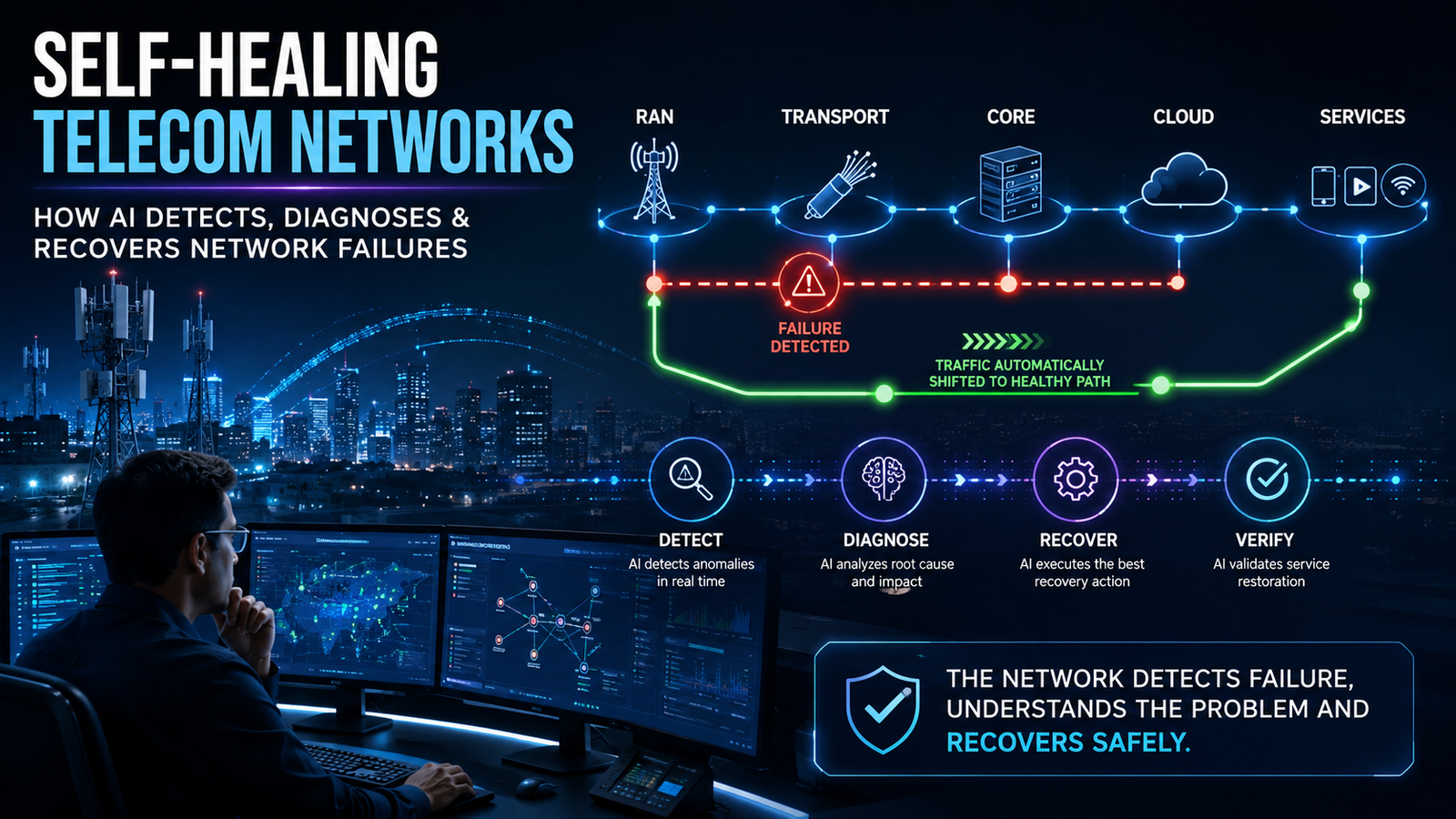
  • Self-Healing Telecom Networks: How AI Detects, Diagnoses and Recovers Network Failures
    Self-Healing Telecom Networks: How AI Detects, Diagnoses and Recovers Network Failures
    The Network Recovered Before Anyone Opened a Ticket

    What if the most successful network incident is the one the NOC never has to manage?

    Not because the failure never occurred.

    But because the network detected the conditions leading to service degradation, understood what was happening, selected a safe recovery action and verified that the service had recovered—before the situation developed into a major incident.

    That sounds simple when written as one sentence.

    In a live telecom network, it is anything but simple.

    A single recovery decision may require information from RAN, Transport, Core, Cloud, topology, service assurance, configuration history and customer experience. The network must distinguish a symptom from a cause, understand dependencies, evaluate the risk of taking action and make sure that fixing one problem does not create another.

    This is where the idea of a self-healing telecom network becomes much more interesting than ordinary automation.

    Self-healing is not about automatically fixing alarms. It is about understanding enough of the network to recover safely.

    If a Script Restarts a Failed Process, Is That Self-Healing?

    A network function becomes unresponsive.

    A monitoring system detects the failure and automatically executes a predefined script:

    Process Down → Restart Process

    The service recovers.

    Was that self-healing?

    At first glance, it may look like it. The problem was detected and corrected without an engineer manually executing the restart.

    But consider a second possibility.

    The process became unresponsive because the underlying server was experiencing resource exhaustion. Restarting it restores the service temporarily—but twenty minutes later, the same failure happens again.

    The automation fixed the symptom.

    It never understood the cause.

    Automation asks: “What action should I execute?”
    Self-healing must also ask: “Why did this happen, and will this action actually solve it?”

    Now imagine the same failure in a more intelligent operating model.

    The system does not immediately restart the process.

    First, it checks whether this is an isolated failure or part of a wider pattern.

    It correlates CPU and memory utilization, application logs, recent configuration changes, infrastructure health, service dependencies and previous incidents.

    The evidence shows that memory consumption has been increasing abnormally for several hours.

    Now the problem looks different.

    The failed process is no longer the root cause. It is evidence of a deeper problem.

    Instead of repeatedly restarting the same process, the system could evaluate several recovery options:

    Restart the process — fastest recovery, but the problem may return.
    Move the workload — potentially restore service on healthy infrastructure.
    Scale resources — appropriate if capacity exhaustion is the cause.
    Trigger failover — useful where resilient architecture permits it.
    Escalate to an engineer — necessary when confidence is low or the action carries significant risk.

    The important change is that the network is no longer following a single predefined reaction.

    It is using context to decide which recovery action makes sense.

    Detecting a failure is monitoring. Executing a predefined response is automation. Understanding the cause, selecting a safe response and verifying recovery moves us toward self-healing.

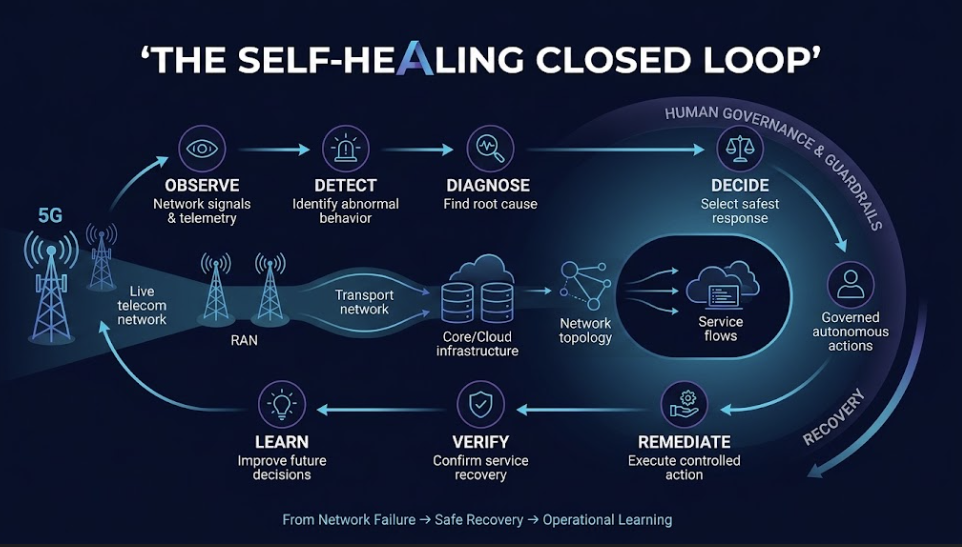
    The Self-Healing Closed Loop: From Detection to Learning

    Consider a group of mobile sites experiencing intermittent service degradation.

    No major element has completely failed. Instead, accessibility begins fluctuating, packet loss appears intermittently, and customer-experience indicators start moving away from their normal baseline.

    A self-healing system should not jump immediately to a recovery action.

    It first needs to build an understanding of what is happening.

    1. OBSERVE — Build the Network Picture

    he system continuously collects signals from the operational environment:

    Alarms • KPIs • Logs • Topology • Traffic • Configuration • Service Experience

    The objective at this stage is not to make a decision.

    It is to create enough situational awareness to recognize what normal network behavior looks like—and when that behavior begins to change.

    A network cannot heal what it cannot observe.

    2. DETECT — Recognize What Has Changed

    Observation gives the system data. Detection gives that data meaning.

    Instead of waiting for a fixed threshold to generate a critical alarm, the system compares current network behavior with historical patterns, expected baselines and related network conditions.

    In our example, it notices something important:

    Packet loss is appearing across several sites—but the sites themselves do not share the same RAN equipment.

    What they do share is part of the same transport path.

    That relationship changes the investigation.

    What initially looked like several independent site problems may actually be one developing network issue affecting multiple services.

    The value of intelligent detection is not generating more alarms. It is recognizing when separate symptoms belong to the same problem.

    3. DIAGNOSE — Find the Common Cause

    The system now follows the dependency chain across the network.

    It discovers that the affected sites share a common aggregation path. Interface statistics show intermittent errors, while historical data confirms that this behavior is unusual. Configuration records show no recent planned change on the affected sites themselves.

    The evidence begins pointing away from the RAN and toward the transport layer.

    This is an important capability.

    Without cross-domain context, an AI system may simply become a faster alarm analyzer. With topology, dependency and historical context, it can begin reasoning about cause and effect across network domains.

    Self-healing becomes powerful when the network can move from “Where is the alarm?” to “Where does the problem actually originate?”

    4. DECIDE — Choose the Safest Recovery Action

    Finding the probable root cause does not automatically mean the network should act.

    Suppose the system identifies degradation on the common transport path. Several recovery options may be available:

    Reroute traffic through an alternative path.
    Adjust routing parameters to reduce the load.
    Isolate the degraded link from service traffic.
    Keep monitoring if the degradation remains within a safe limit.
    Escalate to an engineer if the diagnosis or recovery risk is uncertain.

    The challenge is no longer simply:

    “What can the network do?”

    It becomes:

    “Which action provides the safest recovery with the lowest risk to customers and the rest of the network?”

    A mature self-healing system therefore needs more than automation rules. It needs operational context, confidence thresholds, policy constraints and clearly defined guardrails before selecting an action.

    Autonomy should increase only when confidence is high and operational risk is controlled.

    5. REMEDIATE — Act Within Defined Guardrails

    Now the network is ready to act.

    In our example, the system determines that an alternative transport path has sufficient capacity and is operating normally. Based on predefined operational policies, traffic can be moved away from the degraded path.

    But self-healing should not mean giving AI unlimited permission to change the network.

    The action depends on its risk level and confidence.

    A low-risk, well-tested action may be executed automatically.

    A higher-risk action—such as changing routing across a critical service path—may require engineer approval before execution.

    This creates an important principle for self-healing operations:

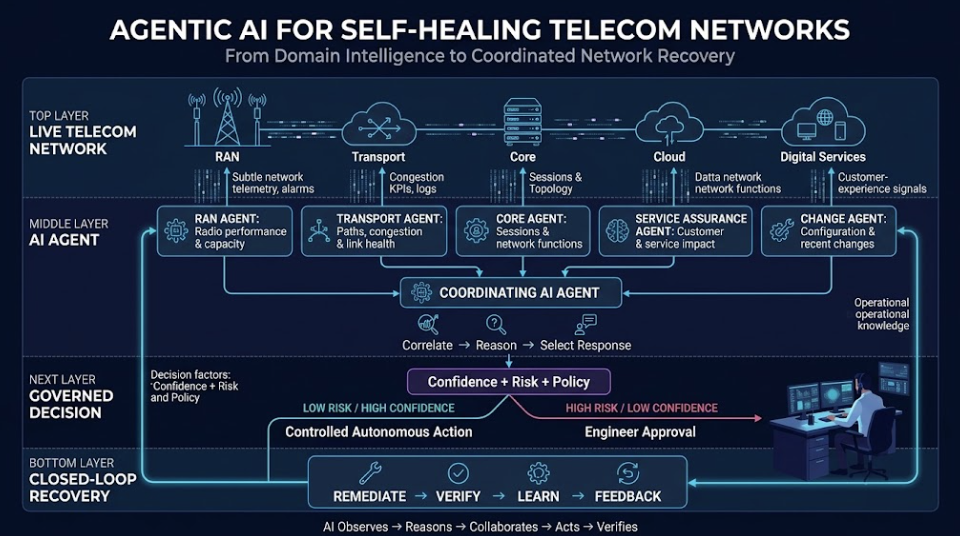
    Low Risk + High Confidence → Automated Action

    Higher Risk or Lower Confidence → Human Approval

    The objective is not to remove the engineer from operations.

    It is to remove unnecessary manual intervention where the network already has enough evidence to recover safely.

    The goal of self-healing is controlled autonomy—not uncontrolled automation.

    6. VERIFY — Prove That the Service Has Recovered

    The recovery action has been executed.

    But the closed loop is not complete yet.

    The system now checks what happened after traffic was moved to the healthy path.

    Did packet loss return to normal?

    Did latency improve?

    Did the affected sites recover their expected accessibility?

    Did customer-experience indicators improve?

    And importantly:

    Did the recovery action create a new problem somewhere else?

    This last question matters because a technically successful network action can still create unintended consequences—for example, shifting too much traffic onto another path and causing congestion there.

    A self-healing system therefore needs to compare before-and-after network and service conditions, rather than assuming that a successfully executed command equals a successfully resolved incident.

    Execution tells us that an action happened. Verification tells us whether it actually worked.

    7. LEARN — Turn Every Recovery Into Operational Knowledge

    The service has recovered, but one final opportunity remains.

    The system records what happened:

    What symptoms appeared first?

    Which signals were most useful in identifying the root cause?

    Which recovery action was selected?

    How quickly did the service recover?

    Was engineer intervention required?

    Did the same problem return?

    Over time, these outcomes can improve future diagnosis and recovery decisions.

    For example, if similar transport degradation occurs again, the system does not need to treat it as an entirely new problem. Previous incidents, successful actions and engineer feedback can become part of its operational knowledge.

    But learning should also be governed. A network should not automatically turn every past action into a future rule simply because it worked once.

    The lesson must be validated against context, risk and repeatability.

    A truly intelligent closed loop should not only recover the network. It should make the next recovery better informed.

    OBSERVE → DETECT → DIAGNOSE → DECIDE → REMEDIATE → VERIFY → LEARN

    Self-Healing Is Moving From Concept to Live Telecom Networks

    From Lab Experiment to Live Network: Deutsche Telekom

    One of the strongest signs that self-healing is moving beyond research is the shift from isolated AI experiments toward AI operating inside live network environments.

    At MWC 2026, Deutsche Telekom and Google Cloud presented work around autonomous and self-healing network operations. One example, RAN Guardian, progressed from concept to live deployment in approximately nine months.

    The direction is particularly important.

    The ambition is no longer limited to detecting an anomaly inside one network domain. Deutsche Telekom’s broader MINDR approach is aimed at combining service-level intelligence with cross-domain network information so that AI can reason about problems across operational boundaries.

    That is much closer to the challenge we described earlier.

    A customer-facing service problem may begin in the RAN, transport, core or cloud—but the recovery process needs to understand the service end to end, rather than treating every domain as a separate island.

    The important shift is from “AI optimizing a network element” to “AI understanding and protecting a service.”

    Deutsche Telekom is not an isolated example. Across the industry, operators are increasingly connecting AI, autonomous-network architectures and closed-loop operations.

    e& UAE — Building toward higher autonomy
    e& and TM Forum announced a strategic blueprint in 2026 focused on AI-native, intent-driven and closed-loop autonomous networks, with a roadmap toward higher levels of network autonomy.

    Mobily — Exploring self-healing across multiple domains
    Mobily and Ericsson announced work around autonomous-network capabilities including self-healing, process automation, network optimization and energy management across a multi-vendor environment.

    China Mobile — Showing measurable operational impact
    China Mobile and ZTE have reported trials using coordinated AI agents for network operations. In the reported scenarios, AI agents combined information from alarms, logs, performance data and customer complaints to support root-cause analysis and operational actions, with improvements reported in diagnosis time and MTTR.

    The industry direction is becoming clear: self-healing is moving from isolated automation toward cross-domain, AI-assisted closed loops.

    How Do You Actually Build a Self-Healing Network?

    The biggest mistake is to start with the ambition:

    “We want a self-healing network.”

    That is too broad to implement.

    A practical transformation starts with something much smaller: one recurring failure scenario where detection, diagnosis and recovery can be clearly defined and measured.

    For example, instead of trying to automate the entire transport network, an operator might begin with:

    “When degradation develops on a redundant transport path, can the system identify the probable cause, determine whether a healthy alternative path exists and safely recommend—or execute—traffic rerouting?”

    That single use case can become the laboratory for building the capabilities needed for wider self-healing operations.

    Do not start by automating the network. Start by proving one recovery loop.

    1. Define the Failure Scenario and Recovery Objective

    Before selecting an AI model, automation platform or agent, define exactly what operational problem the closed loop is expected to solve.

    For our transport example, the operator could define:

    Failure Scenario: Progressive degradation on a redundant transport path.

    Observable Symptoms: Packet loss, interface errors, increasing latency and service KPI degradation.

    Recovery Objective: Protect customer traffic before the degraded path develops into a major service outage.

    Possible Action: Move traffic to a verified healthy path.

    Success Condition: Service KPIs recover without creating congestion or degradation elsewhere.

    This sounds simple, but it changes the entire implementation approach.

    The team is no longer starting with:

    “Where can we use AI?”

    It is starting with:

    “What operational decision do we want the system to make better?”

    A good self-healing use case begins with a clearly defined operational decision—not with an AI technology.

    2. Connect the Signals That Explain the Failure

    A self-healing system cannot make a reliable recovery decision from alarms alone.

    For the transport degradation example, it may need to combine:

    Performance data — packet loss, latency, utilization and interface errors.

    Topology — which sites, links and services depend on the affected path.

    Configuration — how routing, protection and redundancy are currently designed.

    Change history — whether a recent configuration or software change could explain the behavior.

    Service context — which customer services are affected and how critical they are.

    Historical incidents — whether similar symptoms have occurred before and what resolved them.

    The real challenge is not collecting more data.

    It is connecting these signals so the system can understand their relationship.

    For example:

    High packet loss alone tells us something is wrong.

    But:

    High packet loss + interface errors + common topology dependency + no recent RAN change + healthy alternate path

    creates enough context to support a much stronger operational decision.

    Data tells the system what is happening. Context helps it understand why—and what it can safely do about it.

    3. Build the Diagnosis Before Automating the Recovery

    At this stage, resist the temptation to close the loop immediately.

    Let the system investigate the incident while the engineer remains responsible for the final decision.

    For the transport example, the system should be able to produce something like:

    Observed: Packet loss and interface errors are increasing.

    Affected: 14 sites and two customer-facing services share the degraded path.

    Probable Cause: Degradation on the common aggregation link.

    Confidence: High, based on correlated performance, topology and historical behavior.

    Recommended Action: Reroute affected traffic through the redundant path.

    Risk Check: Alternate path has sufficient available capacity and no active degradation.

    The NOC engineer then reviews the evidence and either approves or rejects the recommendation.

    This stage is extremely valuable because it tests the intelligence without yet giving the system authority to change the live network.

    Observe → Diagnose → Recommend → Engineer Decides

    Before asking AI to operate the network, prove that it can consistently understand the network.

    4. Run the Self-Healing Logic in Shadow Mode

    Before allowing the system to execute recovery actions, let it operate silently beside the NOC team.

    During shadow mode, the system detects the problem, performs its diagnosis and recommends what it would do—but does not change the live network.

    The engineer handles the incident normally.

    Afterward, compare the two decisions:

    What did the AI diagnose?

    What did the engineer diagnose?

    Did they identify the same root cause?

    Would the AI have selected the correct recovery action?

    Did it miss any operational risk that the engineer noticed?

    Repeated across real incidents, this creates something extremely important:

    Evidence that the closed loop can be trusted before it is closed.

    Shadow mode also exposes weaknesses that laboratory testing may miss—unusual topology conditions, incomplete data, unexpected dependencies and operational exceptions.

    The safest path to autonomy is to let the system prove its decisions before giving it permission to execute them.

    5. Define What the Network Is Allowed to Heal Automatically

    Once shadow-mode results show that the system can diagnose incidents reliably, the next step is not full autonomy.

    It is controlled autonomy.

    Different recovery actions carry very different levels of operational risk.

    For example, restarting a non-critical application process may be relatively low risk. Rerouting major traffic, modifying routing policy or triggering a core-network failover may have much wider consequences.

    So every self-healing action should have a defined autonomy boundary.

    A practical policy could be:

    High Confidence + Low Risk → Execute Automatically

    High Confidence + Medium Risk → Execute Within Approved Guardrails

    Low Confidence or High Risk → Recommend and Request Engineer Approval

    This allows automation to grow based on demonstrated reliability rather than ambition.

    As successful recoveries accumulate, specific actions can gradually move from:

    Recommend → Approve → Auto-Execute

    But critical actions may deliberately remain under human approval even when the technology is capable of executing them.

    The maturity of a self-healing network should be measured by how safely it can act—not by how many decisions humans are removed from.

    6. Measure Recovery, Not Just Automation

    A self-healing project should not be considered successful simply because the network executed an action automatically.

    The real question is:

    Did operations actually improve?

    For the pilot use case, track a small set of operational outcomes:

    MTTD — Did the system detect degradation earlier?

    Diagnosis Time — Did it identify the probable root cause faster?

    MTTR — Did the service recover faster?

    Successful Remediation Rate — How often did the recommended or automated action actually resolve the problem?

    Engineer Intervention — How often was manual investigation still required?

    Repeat Incidents — Did the same failure return after recovery?

    Customer Impact — Was degradation prevented or reduced before customers experienced it?

    This changes the success conversation from:

    “We automated 200 actions this month.”

    to:

    “We prevented service impact, reduced recovery time and required fewer manual interventions.”

    That is a much more meaningful measure of self-healing maturity.

    Automation volume measures activity. Recovery outcomes measure value.

    What Should a Self-Healing Network Be Allowed to Do?

    Not every network problem deserves the same level of autonomy. The right question is not whether AI can execute an action, but whether it can execute that action safely, predictably and within an acceptable operational risk.

    Not every network problem deserves the same level of autonomy. The right question is not whether AI can execute an action, but whether it can execute that action safely, predictably and within an acceptable operational risk.

    Network ScenarioAI DetectAI DiagnoseAI RecommendAuto-Heal?
    Non-critical process failureYes — within guardrails
    Degraded redundant transport pathConditional
    Capacity congestionConditional
    RAN performance degradationConditional
    Major routing changeHuman approval
    Core network failoverHuman approval
    Unknown / low-confidence incidentNo — escalate

    The objective is not maximum autonomy. It is the right autonomy for the right operational risk.

    If the Technology Exists, Why Aren’t Telecom Networks Already Self-Healing?

    Telecom operators are not short of automation.

    Most mature networks already contain scripts, orchestration platforms, assurance tools, optimization systems, AI models and domain-specific automation.

    Yet connecting all of these capabilities into a trusted end-to-end recovery loop remains difficult.

    The problem is often not:

    “Can we automate this action?”

    The harder questions are:

    Does the system understand the full service impact?

    Can it identify the real root cause across multiple domains?

    Does it know whether another automation is already acting on the same problem?

    Can it predict the consequences of its recovery decision?

    Can it verify that the action actually restored the service?

    And who remains accountable when an autonomous decision goes wrong?

    This creates the current gap between isolated automation and genuine self-healing operations.

    A RAN optimizer may understand the radio network.

    A transport controller may understand paths and capacity.

    A cloud platform may automatically restart workloads.

    A service-assurance platform may understand customer impact.

    But the customer service often depends on all of them at the same time.

    The self-healing challenge is increasingly becoming an automation coordination problem—not simply an automation availability problem.

    The Next Shift: Self-Healing Networks Meet Agentic AI

    Traditional self-healing has largely been built around a familiar model:

    Detect a known condition → Trigger a predefined automation → Verify the result

    That works well when the failure pattern is understood and the recovery action is predictable.

    But telecom incidents are not always that clean.

    A service problem may involve several domains, incomplete evidence, multiple possible causes and recovery options that change depending on the network context.

    This is where Agentic AI could change the self-healing model.

    Instead of relying only on a fixed rule, specialized AI agents could collaborate across operational domains:

    RAN Agent investigates radio conditions.

    Transport Agent checks paths, congestion and link health.

    Core Agent evaluates sessions and network functions.

    Service Assurance Agent determines customer impact.

    Change Agent checks whether a recent change could explain the degradation.

    A coordinating agent could then combine their findings, evaluate possible recovery actions and present—or, within approved guardrails, execute—the safest response.

    The model begins to change from:

    ML Detects → Script Fixes

    to:

    AI Observes → Reasons → Collaborates → Acts → Verifies

    The next generation of self-healing networks may not be built only around automation rules. It may increasingly be built around AI agents operating inside governed closed loops.

    Does Self-Healing Actually Deliver ROI?

    A self-healing use case should not be justified simply because it uses advanced AI.

    It should solve an operational problem that is frequent enough, costly enough or service-critical enough to justify the investment.

    Consider a recurring network failure that happens several times each month.

    Today, every occurrence may consume NOC investigation time, domain-engineer effort, escalation effort and service-restoration time. If customers are affected, the real cost can extend further into SLA exposure, customer-care contacts and potentially lost revenue.

    Self-healing changes the economics when it can detect the problem earlier, shorten diagnosis, reduce manual effort and restore service faster.

    A simple business case can start with:

    Annual Benefit = Avoided Incident Cost + Engineering Productivity Gain + Reduced Service-Impact Cost + Avoided Escalation Cost

    Then:

    ROI (%) = (Annual Benefit − Annual Self-Healing Cost) ÷ Annual Self-Healing Cost × 100

    The important point is not to manufacture an impressive ROI percentage.

    Use the operator’s actual incident volumes, MTTR, engineering effort and service-impact data.

    The strongest self-healing use case is not necessarily the most technically impressive one. It is the one where faster, safer recovery creates measurable operational value.

    A Simple Self-Healing Business Case

    Imagine an operator has a recurring network issue that causes 10 incidents per month.

    Each incident currently requires an average of 3 engineering hours across NOC and domain teams, while service degradation lasts approximately 45 minutes before full recovery.

    Assume, purely for illustration:

    Engineering cost per incident: $150
    Estimated service-impact and escalation cost per incident: $500

    The current annual incident cost would be:

    10 incidents × 12 months × ($150 + $500) = $78,000 per year

    Now suppose a self-healing solution reduces the average operational impact by 60% through earlier detection, faster diagnosis and controlled recovery.

    The potential annual benefit becomes:

    $78,000 × 60% = $46,800

    If implementing and operating that specific closed-loop use case costs $25,000 per year, then:

    ROI = ($46,800 − $25,000) ÷ $25,000 × 100

    Illustrative ROI = 87.2%

    This is an illustrative model, not an industry benchmark. Operators should replace these assumptions with their own incident, engineering, service-impact and implementation costs.

    Start with the incidents already costing the business money. That is where the self-healing business case becomes easier to prove.

    What Is the Industry Seeing?

    The potential value is not only theoretical.

    Industry studies and operator trials are beginning to report measurable improvements from AI-driven and increasingly autonomous network operations.

    For example, McKinsey has reported that scaled AI-driven network operations can contribute to 30–40% faster MTTR in some implementations, alongside reductions in troubleshooting workload and NOC operating costs.

    China Mobile and ZTE have also reported results from coordinated AI-agent trials where root-cause diagnosis time was reduced from approximately 15 minutes to 3 minutes in tested scenarios, with MTTR improving by up to 11%.

    These figures should not be treated as guaranteed outcomes for every operator.

    Network architecture, automation maturity, data quality, incident mix and implementation scope can produce very different results.

    The business case for self-healing should be proven in the operator’s own network—not borrowed from someone else’s benchmark.

    Why Future Telecom Networks Will Need Self-Healing

    Telecom networks are becoming more programmable—but also more interconnected.

    5G-Advanced, cloud-native network functions, network slicing, edge computing, APIs and eventually 6G will create more dynamic relationships between infrastructure, software and services.

    That creates an operational challenge.

    A customer-experience problem may no longer have one obvious network cause. It could emerge from the interaction between radio conditions, transport capacity, cloud resources, network functions, policies and service configuration.

    Adding more dashboards will not solve that complexity.

    Adding more independent automation may not solve it either.

    The network increasingly needs the ability to observe across domains, understand dependencies, coordinate decisions and recover services at machine speed—while keeping critical actions governed.

    This changes the role of self-healing.

    It is no longer simply:

    “Can we automatically recover from a known failure?”

    The bigger question becomes:

    “Can the network maintain service resilience as operational complexity grows beyond what humans can continuously coordinate manually?”

    The future need for self-healing will be driven less by reducing headcount and more by managing network complexity at a speed humans alone cannot sustain.

    A Practical 90-Day Self-Healing Pilot

    An operator does not need to wait for a fully autonomous network architecture to begin.

    Choose one recurring, measurable and relatively controlled failure scenario and use the next 90 days to prove whether a closed-loop approach can improve recovery.

    Days 1–30: Observe and Build the Baseline

    For the first month, do not automate the recovery.

    Study the selected incident and establish how it behaves today.

    Capture:

    How often does it occur?

    Which alarms, KPIs and logs appear first?

    How long does diagnosis normally take?

    What is the current MTTR?

    Which teams become involved?

    What recovery action normally works?

    What customer or service impact occurs?

    The objective is to create a measurable before-self-healing baseline.

    At the end of 30 days, the team should be able to answer one important question:

    “Do we understand this failure well enough to teach a system how to recognize and investigate it?”

    You cannot prove improvement without first understanding the operational baseline.

    Days 31–60: Let the System Decide—But Not Act

    Now introduce the self-healing intelligence alongside the existing NOC process.

    For every occurrence of the selected failure, let the system independently:

    Detect the abnormal behavior

    Correlate the relevant network signals

    Identify the probable root cause

    Recommend a recovery action

    Estimate confidence and operational risk

    But keep one restriction:

    The system cannot execute the action.

    Engineers continue handling the live incident normally.

    After each incident, compare the system’s conclusion with what actually happened.

    Did it detect the problem earlier?

    Did it identify the same root cause as the engineer?

    Was its recommended action correct?

    Would that action have been safe?

    Did the system miss any dependency that an experienced engineer noticed?

    By the end of Day 60, the operator should have evidence showing where the system can be trusted—and where it still needs improvement.

    The goal of shadow mode is not to prove that AI is perfect. It is to discover exactly where autonomy is safe.

    Days 61–90: Allow Controlled Recovery

    By this stage, the operator has observed the failure, established a baseline and tested the system’s decisions in shadow mode.

    Now selected recovery actions can move from recommendation to controlled execution.

    Start with actions that have:

    High diagnostic confidence

    Low operational risk

    A proven recovery procedure

    Clear rollback capability

    Reliable post-action verification

    For example, the system may be permitted to reroute traffic only when the alternative path is healthy, sufficient spare capacity exists and no conflicting network activity is detected.

    Anything outside those conditions should automatically return to:

    Recommend → Engineer Approval

    After every automated recovery, the system must verify that service KPIs have returned to normal and that the action has not created degradation elsewhere.

    If verification fails:

    Stop → Roll Back → Escalate

    By Day 90, the objective is not to claim that the network has become autonomous.

    It is to demonstrate that one complete recovery loop can operate safely, measurably and repeatedly in the live network.

    Do not scale self-healing because one automated action worked. Scale it when the complete recovery loop repeatedly proves that it works.

    Day 90: Should We Scale It?

    At the end of the pilot, management should not ask:

    “How many actions did AI automate?”

    Instead, compare the pilot against the original operational baseline.

    Did MTTD improve?

    Did diagnosis time decrease?

    Did MTTR improve?

    How many recovery recommendations were correct?

    How many automated recoveries succeeded without engineer intervention?

    Were any incorrect or unsafe actions attempted?

    Did repeat incidents decrease?

    Was measurable customer or service impact avoided?

    And perhaps most importantly:

    Do the NOC engineers trust the system enough to expand its responsibility?

    If the results are positive, the operator can gradually expand the same closed-loop methodology to additional failure scenarios and network domains.

    If the results are weak, that is also valuable.

    It tells the operator whether the problem lies in data quality, diagnosis accuracy, topology context, automation reliability, governance or the use case itself—before attempting to scale.

    The first 90 days should earn the right to scale—not assume it.

    A Self-Healing Network Is Not a Network That Never Fails

    Failures will not disappear from telecom networks.

    Hardware will fail. Software will behave unexpectedly. Fiber will be cut. Capacity will become constrained. Configuration changes will sometimes produce unintended consequences.

    The real transformation is therefore not the elimination of failure.

    It is changing how the network responds when failure begins.

    Today, much of that journey still depends on engineers moving between alarms, dashboards, logs, topology tools and domain teams to understand what happened and decide what to do next.

    Self-healing introduces a different operating model:

    OBSERVE → DETECT → DIAGNOSE → DECIDE → REMEDIATE → VERIFY → LEARN

    But the journey should not begin with full autonomy.

    It should begin with one well-understood failure, one trusted recovery loop and one measurable operational outcome.

    Then scale what proves safe.

    A self-healing network is not a network that never fails. It is a network that can understand failure, recover safely and learn before the same problem becomes tomorrow’s outage.

    START SMALL → OBSERVE → DIAGNOSE → PROVE → CONTROL → HEAL → VERIFY → SCALE

    How Ready Is Your NOC for Self-Healing Operations?

    Moving toward self-healing does not start with buying another AI platform.

    It starts by understanding where your NOC stands today across observability, automation, predictive operations, AIOps, decision intelligence, closed-loop operations and governance.

    TelcoMind AI has created a free NOC AI Maturity Assessment to help telecom teams identify their current maturity level and the capabilities they need to develop next.

    → Take the Free NOC AI Maturity Assessment

    Related TelcoMind AI Insights

    1. Agentic AI in Telecom Operations: From AI Assistance to Autonomous Action

    2. AI-Powered AIOps in Telecom: From Alarm Management to Autonomous Network Operations

    3. From Level 0 to Level 5: How Close Are We to Truly Autonomous Telecom Networks?

  • Self-Healing Telecom Networks: How AI Detects, Diagnoses and Recovers Network Failures
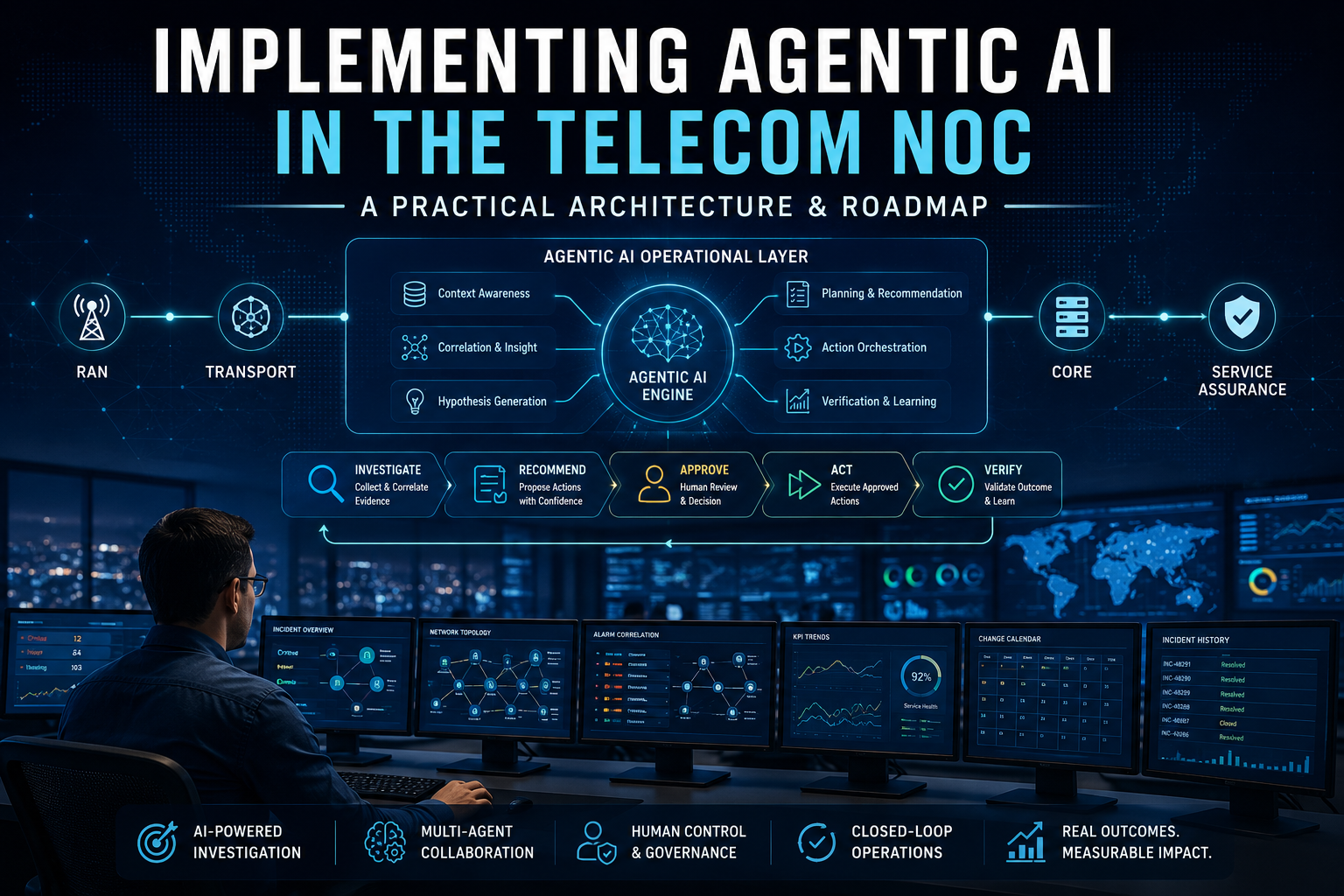
    Self-Healing Telecom Networks: How AI Detects, Diagnoses and Recovers Network Failures

    The Network Recovered Before Anyone Opened a Ticket

    What if the most successful network incident is the one the NOC never has to manage?

    Not because the failure never occurred.

    But because the network detected the conditions leading to service degradation, understood what was happening, selected a safe recovery action and verified that the service had recovered—before the situation developed into a major incident.

    That sounds simple when written as one sentence.

    In a live telecom network, it is anything but simple.

    A single recovery decision may require information from RAN, Transport, Core, Cloud, topology, service assurance, configuration history and customer experience. The network must distinguish a symptom from a cause, understand dependencies, evaluate the risk of taking action and make sure that fixing one problem does not create another.

    This is where the idea of a self-healing telecom network becomes much more interesting than ordinary automation.

    Self-healing is not about automatically fixing alarms. It is about understanding enough of the network to recover safely.

    If a Script Restarts a Failed Process, Is That Self-Healing?

    A network function becomes unresponsive.

    A monitoring system detects the failure and automatically executes a predefined script:

    Process Down → Restart Process

    The service recovers.

    Was that self-healing?

    At first glance, it may look like it. The problem was detected and corrected without an engineer manually executing the restart.

    But consider a second possibility.

    The process became unresponsive because the underlying server was experiencing resource exhaustion. Restarting it restores the service temporarily—but twenty minutes later, the same failure happens again.

    The automation fixed the symptom.

    It never understood the cause.

    Automation asks: “What action should I execute?”
    Self-healing must also ask: “Why did this happen, and will this action actually solve it?”

    Now imagine the same failure in a more intelligent operating model.

    The system does not immediately restart the process.

    First, it checks whether this is an isolated failure or part of a wider pattern.

    It correlates CPU and memory utilization, application logs, recent configuration changes, infrastructure health, service dependencies and previous incidents.

    The evidence shows that memory consumption has been increasing abnormally for several hours.

    Now the problem looks different.

    The failed process is no longer the root cause. It is evidence of a deeper problem.

    Instead of repeatedly restarting the same process, the system could evaluate several recovery options:

    Restart the process — fastest recovery, but the problem may return.
    Move the workload — potentially restore service on healthy infrastructure.
    Scale resources — appropriate if capacity exhaustion is the cause.
    Trigger failover — useful where resilient architecture permits it.
    Escalate to an engineer — necessary when confidence is low or the action carries significant risk.

    The important change is that the network is no longer following a single predefined reaction.

    It is using context to decide which recovery action makes sense.

    Detecting a failure is monitoring. Executing a predefined response is automation. Understanding the cause, selecting a safe response and verifying recovery moves us toward self-healing.

    The Self-Healing Closed Loop: From Detection to Learning

    Consider a group of mobile sites experiencing intermittent service degradation.

    No major element has completely failed. Instead, accessibility begins fluctuating, packet loss appears intermittently, and customer-experience indicators start moving away from their normal baseline.

    A self-healing system should not jump immediately to a recovery action.

    It first needs to build an understanding of what is happening.

    1. OBSERVE — Build the Network Picture

    he system continuously collects signals from the operational environment:

    Alarms • KPIs • Logs • Topology • Traffic • Configuration • Service Experience

    The objective at this stage is not to make a decision.

    It is to create enough situational awareness to recognize what normal network behavior looks like—and when that behavior begins to change.

    A network cannot heal what it cannot observe.

    2. DETECT — Recognize What Has Changed

    Observation gives the system data. Detection gives that data meaning.

    Instead of waiting for a fixed threshold to generate a critical alarm, the system compares current network behavior with historical patterns, expected baselines and related network conditions.

    In our example, it notices something important:

    Packet loss is appearing across several sites—but the sites themselves do not share the same RAN equipment.

    What they do share is part of the same transport path.

    That relationship changes the investigation.

    What initially looked like several independent site problems may actually be one developing network issue affecting multiple services.

    The value of intelligent detection is not generating more alarms. It is recognizing when separate symptoms belong to the same problem.

    3. DIAGNOSE — Find the Common Cause

    The system now follows the dependency chain across the network.

    It discovers that the affected sites share a common aggregation path. Interface statistics show intermittent errors, while historical data confirms that this behavior is unusual. Configuration records show no recent planned change on the affected sites themselves.

    The evidence begins pointing away from the RAN and toward the transport layer.

    This is an important capability.

    Without cross-domain context, an AI system may simply become a faster alarm analyzer. With topology, dependency and historical context, it can begin reasoning about cause and effect across network domains.

    Self-healing becomes powerful when the network can move from “Where is the alarm?” to “Where does the problem actually originate?”

    4. DECIDE — Choose the Safest Recovery Action

    Finding the probable root cause does not automatically mean the network should act.

    Suppose the system identifies degradation on the common transport path. Several recovery options may be available:

    Reroute traffic through an alternative path.
    Adjust routing parameters to reduce the load.
    Isolate the degraded link from service traffic.
    Keep monitoring if the degradation remains within a safe limit.
    Escalate to an engineer if the diagnosis or recovery risk is uncertain.

    The challenge is no longer simply:

    “What can the network do?”

    It becomes:

    “Which action provides the safest recovery with the lowest risk to customers and the rest of the network?”

    A mature self-healing system therefore needs more than automation rules. It needs operational context, confidence thresholds, policy constraints and clearly defined guardrails before selecting an action.

    Autonomy should increase only when confidence is high and operational risk is controlled.

    5. REMEDIATE — Act Within Defined Guardrails

    Now the network is ready to act.

    In our example, the system determines that an alternative transport path has sufficient capacity and is operating normally. Based on predefined operational policies, traffic can be moved away from the degraded path.

    But self-healing should not mean giving AI unlimited permission to change the network.

    The action depends on its risk level and confidence.

    A low-risk, well-tested action may be executed automatically.

    A higher-risk action—such as changing routing across a critical service path—may require engineer approval before execution.

    This creates an important principle for self-healing operations:

    Low Risk + High Confidence → Automated Action

    Higher Risk or Lower Confidence → Human Approval

    The objective is not to remove the engineer from operations.

    It is to remove unnecessary manual intervention where the network already has enough evidence to recover safely.

    The goal of self-healing is controlled autonomy—not uncontrolled automation.

    6. VERIFY — Prove That the Service Has Recovered

    The recovery action has been executed.

    But the closed loop is not complete yet.

    The system now checks what happened after traffic was moved to the healthy path.

    Did packet loss return to normal?

    Did latency improve?

    Did the affected sites recover their expected accessibility?

    Did customer-experience indicators improve?

    And importantly:

    Did the recovery action create a new problem somewhere else?

    This last question matters because a technically successful network action can still create unintended consequences—for example, shifting too much traffic onto another path and causing congestion there.

    A self-healing system therefore needs to compare before-and-after network and service conditions, rather than assuming that a successfully executed command equals a successfully resolved incident.

    Execution tells us that an action happened. Verification tells us whether it actually worked.

    7. LEARN — Turn Every Recovery Into Operational Knowledge

    The service has recovered, but one final opportunity remains.

    The system records what happened:

    What symptoms appeared first?

    Which signals were most useful in identifying the root cause?

    Which recovery action was selected?

    How quickly did the service recover?

    Was engineer intervention required?

    Did the same problem return?

    Over time, these outcomes can improve future diagnosis and recovery decisions.

    For example, if similar transport degradation occurs again, the system does not need to treat it as an entirely new problem. Previous incidents, successful actions and engineer feedback can become part of its operational knowledge.

    But learning should also be governed. A network should not automatically turn every past action into a future rule simply because it worked once.

    The lesson must be validated against context, risk and repeatability.

    A truly intelligent closed loop should not only recover the network. It should make the next recovery better informed.

    OBSERVE → DETECT → DIAGNOSE → DECIDE → REMEDIATE → VERIFY → LEARN

    Self-Healing Is Moving From Concept to Live Telecom Networks

    From Lab Experiment to Live Network: Deutsche Telekom

    One of the strongest signs that self-healing is moving beyond research is the shift from isolated AI experiments toward AI operating inside live network environments.

    At MWC 2026, Deutsche Telekom and Google Cloud presented work around autonomous and self-healing network operations. One example, RAN Guardian, progressed from concept to live deployment in approximately nine months.

    The direction is particularly important.

    The ambition is no longer limited to detecting an anomaly inside one network domain. Deutsche Telekom’s broader MINDR approach is aimed at combining service-level intelligence with cross-domain network information so that AI can reason about problems across operational boundaries.

    That is much closer to the challenge we described earlier.

    A customer-facing service problem may begin in the RAN, transport, core or cloud—but the recovery process needs to understand the service end to end, rather than treating every domain as a separate island.

    The important shift is from “AI optimizing a network element” to “AI understanding and protecting a service.”

    Deutsche Telekom is not an isolated example. Across the industry, operators are increasingly connecting AI, autonomous-network architectures and closed-loop operations.

    e& UAE — Building toward higher autonomy
    e& and TM Forum announced a strategic blueprint in 2026 focused on AI-native, intent-driven and closed-loop autonomous networks, with a roadmap toward higher levels of network autonomy.

    Mobily — Exploring self-healing across multiple domains
    Mobily and Ericsson announced work around autonomous-network capabilities including self-healing, process automation, network optimization and energy management across a multi-vendor environment.

    China Mobile — Showing measurable operational impact
    China Mobile and ZTE have reported trials using coordinated AI agents for network operations. In the reported scenarios, AI agents combined information from alarms, logs, performance data and customer complaints to support root-cause analysis and operational actions, with improvements reported in diagnosis time and MTTR.

    The industry direction is becoming clear: self-healing is moving from isolated automation toward cross-domain, AI-assisted closed loops.

    How Do You Actually Build a Self-Healing Network?

    The biggest mistake is to start with the ambition:

    “We want a self-healing network.”

    That is too broad to implement.

    A practical transformation starts with something much smaller: one recurring failure scenario where detection, diagnosis and recovery can be clearly defined and measured.

    For example, instead of trying to automate the entire transport network, an operator might begin with:

    “When degradation develops on a redundant transport path, can the system identify the probable cause, determine whether a healthy alternative path exists and safely recommend—or execute—traffic rerouting?”

    That single use case can become the laboratory for building the capabilities needed for wider self-healing operations.

    Do not start by automating the network. Start by proving one recovery loop.

    1. Define the Failure Scenario and Recovery Objective

    Before selecting an AI model, automation platform or agent, define exactly what operational problem the closed loop is expected to solve.

    For our transport example, the operator could define:

    Failure Scenario: Progressive degradation on a redundant transport path.

    Observable Symptoms: Packet loss, interface errors, increasing latency and service KPI degradation.

    Recovery Objective: Protect customer traffic before the degraded path develops into a major service outage.

    Possible Action: Move traffic to a verified healthy path.

    Success Condition: Service KPIs recover without creating congestion or degradation elsewhere.

    This sounds simple, but it changes the entire implementation approach.

    The team is no longer starting with:

    “Where can we use AI?”

    It is starting with:

    “What operational decision do we want the system to make better?”

    A good self-healing use case begins with a clearly defined operational decision—not with an AI technology.

    2. Connect the Signals That Explain the Failure

    A self-healing system cannot make a reliable recovery decision from alarms alone.

    For the transport degradation example, it may need to combine:

    Performance data — packet loss, latency, utilization and interface errors.

    Topology — which sites, links and services depend on the affected path.

    Configuration — how routing, protection and redundancy are currently designed.

    Change history — whether a recent configuration or software change could explain the behavior.

    Service context — which customer services are affected and how critical they are.

    Historical incidents — whether similar symptoms have occurred before and what resolved them.

    The real challenge is not collecting more data.

    It is connecting these signals so the system can understand their relationship.

    For example:

    High packet loss alone tells us something is wrong.

    But:

    High packet loss + interface errors + common topology dependency + no recent RAN change + healthy alternate path

    creates enough context to support a much stronger operational decision.

    Data tells the system what is happening. Context helps it understand why—and what it can safely do about it.

    3. Build the Diagnosis Before Automating the Recovery

    At this stage, resist the temptation to close the loop immediately.

    Let the system investigate the incident while the engineer remains responsible for the final decision.

    For the transport example, the system should be able to produce something like:

    Observed: Packet loss and interface errors are increasing.

    Affected: 14 sites and two customer-facing services share the degraded path.

    Probable Cause: Degradation on the common aggregation link.

    Confidence: High, based on correlated performance, topology and historical behavior.

    Recommended Action: Reroute affected traffic through the redundant path.

    Risk Check: Alternate path has sufficient available capacity and no active degradation.

    The NOC engineer then reviews the evidence and either approves or rejects the recommendation.

    This stage is extremely valuable because it tests the intelligence without yet giving the system authority to change the live network.

    Observe → Diagnose → Recommend → Engineer Decides

    Before asking AI to operate the network, prove that it can consistently understand the network.

    4. Run the Self-Healing Logic in Shadow Mode

    Before allowing the system to execute recovery actions, let it operate silently beside the NOC team.

    During shadow mode, the system detects the problem, performs its diagnosis and recommends what it would do—but does not change the live network.

    The engineer handles the incident normally.

    Afterward, compare the two decisions:

    What did the AI diagnose?

    What did the engineer diagnose?

    Did they identify the same root cause?

    Would the AI have selected the correct recovery action?

    Did it miss any operational risk that the engineer noticed?

    Repeated across real incidents, this creates something extremely important:

    Evidence that the closed loop can be trusted before it is closed.

    Shadow mode also exposes weaknesses that laboratory testing may miss—unusual topology conditions, incomplete data, unexpected dependencies and operational exceptions.

    The safest path to autonomy is to let the system prove its decisions before giving it permission to execute them.

    5. Define What the Network Is Allowed to Heal Automatically

    Once shadow-mode results show that the system can diagnose incidents reliably, the next step is not full autonomy.

    It is controlled autonomy.

    Different recovery actions carry very different levels of operational risk.

    For example, restarting a non-critical application process may be relatively low risk. Rerouting major traffic, modifying routing policy or triggering a core-network failover may have much wider consequences.

    So every self-healing action should have a defined autonomy boundary.

    A practical policy could be:

    High Confidence + Low Risk → Execute Automatically

    High Confidence + Medium Risk → Execute Within Approved Guardrails

    Low Confidence or High Risk → Recommend and Request Engineer Approval

    This allows automation to grow based on demonstrated reliability rather than ambition.

    As successful recoveries accumulate, specific actions can gradually move from:

    Recommend → Approve → Auto-Execute

    But critical actions may deliberately remain under human approval even when the technology is capable of executing them.

    The maturity of a self-healing network should be measured by how safely it can act—not by how many decisions humans are removed from.

    6. Measure Recovery, Not Just Automation

    A self-healing project should not be considered successful simply because the network executed an action automatically.

    The real question is:

    Did operations actually improve?

    For the pilot use case, track a small set of operational outcomes:

    MTTD — Did the system detect degradation earlier?

    Diagnosis Time — Did it identify the probable root cause faster?

    MTTR — Did the service recover faster?

    Successful Remediation Rate — How often did the recommended or automated action actually resolve the problem?

    Engineer Intervention — How often was manual investigation still required?

    Repeat Incidents — Did the same failure return after recovery?

    Customer Impact — Was degradation prevented or reduced before customers experienced it?

    This changes the success conversation from:

    “We automated 200 actions this month.”

    to:

    “We prevented service impact, reduced recovery time and required fewer manual interventions.”

    That is a much more meaningful measure of self-healing maturity.

    Automation volume measures activity. Recovery outcomes measure value.

    What Should a Self-Healing Network Be Allowed to Do?

    Not every network problem deserves the same level of autonomy. The right question is not whether AI can execute an action, but whether it can execute that action safely, predictably and within an acceptable operational risk.

    Not every network problem deserves the same level of autonomy. The right question is not whether AI can execute an action, but whether it can execute that action safely, predictably and within an acceptable operational risk.

    Network ScenarioAI DetectAI DiagnoseAI RecommendAuto-Heal?
    Non-critical process failureYes — within guardrails
    Degraded redundant transport pathConditional
    Capacity congestionConditional
    RAN performance degradationConditional
    Major routing changeHuman approval
    Core network failoverHuman approval
    Unknown / low-confidence incidentNo — escalate

    The objective is not maximum autonomy. It is the right autonomy for the right operational risk.

    If the Technology Exists, Why Aren’t Telecom Networks Already Self-Healing?

    Telecom operators are not short of automation.

    Most mature networks already contain scripts, orchestration platforms, assurance tools, optimization systems, AI models and domain-specific automation.

    Yet connecting all of these capabilities into a trusted end-to-end recovery loop remains difficult.

    The problem is often not:

    “Can we automate this action?”

    The harder questions are:

    Does the system understand the full service impact?

    Can it identify the real root cause across multiple domains?

    Does it know whether another automation is already acting on the same problem?

    Can it predict the consequences of its recovery decision?

    Can it verify that the action actually restored the service?

    And who remains accountable when an autonomous decision goes wrong?

    This creates the current gap between isolated automation and genuine self-healing operations.

    A RAN optimizer may understand the radio network.

    A transport controller may understand paths and capacity.

    A cloud platform may automatically restart workloads.

    A service-assurance platform may understand customer impact.

    But the customer service often depends on all of them at the same time.

    The self-healing challenge is increasingly becoming an automation coordination problem—not simply an automation availability problem.

    The Next Shift: Self-Healing Networks Meet Agentic AI

    Traditional self-healing has largely been built around a familiar model:

    Detect a known condition → Trigger a predefined automation → Verify the result

    That works well when the failure pattern is understood and the recovery action is predictable.

    But telecom incidents are not always that clean.

    A service problem may involve several domains, incomplete evidence, multiple possible causes and recovery options that change depending on the network context.

    This is where Agentic AI could change the self-healing model.

    Instead of relying only on a fixed rule, specialized AI agents could collaborate across operational domains:

    RAN Agent investigates radio conditions.

    Transport Agent checks paths, congestion and link health.

    Core Agent evaluates sessions and network functions.

    Service Assurance Agent determines customer impact.

    Change Agent checks whether a recent change could explain the degradation.

    A coordinating agent could then combine their findings, evaluate possible recovery actions and present—or, within approved guardrails, execute—the safest response.

    The model begins to change from:

    ML Detects → Script Fixes

    to:

    AI Observes → Reasons → Collaborates → Acts → Verifies

    The next generation of self-healing networks may not be built only around automation rules. It may increasingly be built around AI agents operating inside governed closed loops.

    Does Self-Healing Actually Deliver ROI?

    A self-healing use case should not be justified simply because it uses advanced AI.

    It should solve an operational problem that is frequent enough, costly enough or service-critical enough to justify the investment.

    Consider a recurring network failure that happens several times each month.

    Today, every occurrence may consume NOC investigation time, domain-engineer effort, escalation effort and service-restoration time. If customers are affected, the real cost can extend further into SLA exposure, customer-care contacts and potentially lost revenue.

    Self-healing changes the economics when it can detect the problem earlier, shorten diagnosis, reduce manual effort and restore service faster.

    A simple business case can start with:

    Annual Benefit = Avoided Incident Cost + Engineering Productivity Gain + Reduced Service-Impact Cost + Avoided Escalation Cost

    Then:

    ROI (%) = (Annual Benefit − Annual Self-Healing Cost) ÷ Annual Self-Healing Cost × 100

    The important point is not to manufacture an impressive ROI percentage.

    Use the operator’s actual incident volumes, MTTR, engineering effort and service-impact data.

    The strongest self-healing use case is not necessarily the most technically impressive one. It is the one where faster, safer recovery creates measurable operational value.

    A Simple Self-Healing Business Case

    Imagine an operator has a recurring network issue that causes 10 incidents per month.

    Each incident currently requires an average of 3 engineering hours across NOC and domain teams, while service degradation lasts approximately 45 minutes before full recovery.

    Assume, purely for illustration:

    Engineering cost per incident: $150
    Estimated service-impact and escalation cost per incident: $500

    The current annual incident cost would be:

    10 incidents × 12 months × ($150 + $500) = $78,000 per year

    Now suppose a self-healing solution reduces the average operational impact by 60% through earlier detection, faster diagnosis and controlled recovery.

    The potential annual benefit becomes:

    $78,000 × 60% = $46,800

    If implementing and operating that specific closed-loop use case costs $25,000 per year, then:

    ROI = ($46,800 − $25,000) ÷ $25,000 × 100

    Illustrative ROI = 87.2%

    This is an illustrative model, not an industry benchmark. Operators should replace these assumptions with their own incident, engineering, service-impact and implementation costs.

    Start with the incidents already costing the business money. That is where the self-healing business case becomes easier to prove.

    What Is the Industry Seeing?

    The potential value is not only theoretical.

    Industry studies and operator trials are beginning to report measurable improvements from AI-driven and increasingly autonomous network operations.

    For example, McKinsey has reported that scaled AI-driven network operations can contribute to 30–40% faster MTTR in some implementations, alongside reductions in troubleshooting workload and NOC operating costs.

    China Mobile and ZTE have also reported results from coordinated AI-agent trials where root-cause diagnosis time was reduced from approximately 15 minutes to 3 minutes in tested scenarios, with MTTR improving by up to 11%.

    These figures should not be treated as guaranteed outcomes for every operator.

    Network architecture, automation maturity, data quality, incident mix and implementation scope can produce very different results.

    The business case for self-healing should be proven in the operator’s own network—not borrowed from someone else’s benchmark.

    Why Future Telecom Networks Will Need Self-Healing

    Telecom networks are becoming more programmable—but also more interconnected.

    5G-Advanced, cloud-native network functions, network slicing, edge computing, APIs and eventually 6G will create more dynamic relationships between infrastructure, software and services.

    That creates an operational challenge.

    A customer-experience problem may no longer have one obvious network cause. It could emerge from the interaction between radio conditions, transport capacity, cloud resources, network functions, policies and service configuration.

    Adding more dashboards will not solve that complexity.

    Adding more independent automation may not solve it either.

    The network increasingly needs the ability to observe across domains, understand dependencies, coordinate decisions and recover services at machine speed—while keeping critical actions governed.

    This changes the role of self-healing.

    It is no longer simply:

    “Can we automatically recover from a known failure?”

    The bigger question becomes:

    “Can the network maintain service resilience as operational complexity grows beyond what humans can continuously coordinate manually?”

    The future need for self-healing will be driven less by reducing headcount and more by managing network complexity at a speed humans alone cannot sustain.

    A Practical 90-Day Self-Healing Pilot

    An operator does not need to wait for a fully autonomous network architecture to begin.

    Choose one recurring, measurable and relatively controlled failure scenario and use the next 90 days to prove whether a closed-loop approach can improve recovery.

    Days 1–30: Observe and Build the Baseline

    For the first month, do not automate the recovery.

    Study the selected incident and establish how it behaves today.

    Capture:

    How often does it occur?

    Which alarms, KPIs and logs appear first?

    How long does diagnosis normally take?

    What is the current MTTR?

    Which teams become involved?

    What recovery action normally works?

    What customer or service impact occurs?

    The objective is to create a measurable before-self-healing baseline.

    At the end of 30 days, the team should be able to answer one important question:

    “Do we understand this failure well enough to teach a system how to recognize and investigate it?”

    You cannot prove improvement without first understanding the operational baseline.

    Days 31–60: Let the System Decide—But Not Act

    Now introduce the self-healing intelligence alongside the existing NOC process.

    For every occurrence of the selected failure, let the system independently:

    Detect the abnormal behavior

    Correlate the relevant network signals

    Identify the probable root cause

    Recommend a recovery action

    Estimate confidence and operational risk

    But keep one restriction:

    The system cannot execute the action.

    Engineers continue handling the live incident normally.

    After each incident, compare the system’s conclusion with what actually happened.

    Did it detect the problem earlier?

    Did it identify the same root cause as the engineer?

    Was its recommended action correct?

    Would that action have been safe?

    Did the system miss any dependency that an experienced engineer noticed?

    By the end of Day 60, the operator should have evidence showing where the system can be trusted—and where it still needs improvement.

    The goal of shadow mode is not to prove that AI is perfect. It is to discover exactly where autonomy is safe.

    Days 61–90: Allow Controlled Recovery

    By this stage, the operator has observed the failure, established a baseline and tested the system’s decisions in shadow mode.

    Now selected recovery actions can move from recommendation to controlled execution.

    Start with actions that have:

    High diagnostic confidence

    Low operational risk

    A proven recovery procedure

    Clear rollback capability

    Reliable post-action verification

    For example, the system may be permitted to reroute traffic only when the alternative path is healthy, sufficient spare capacity exists and no conflicting network activity is detected.

    Anything outside those conditions should automatically return to:

    Recommend → Engineer Approval

    After every automated recovery, the system must verify that service KPIs have returned to normal and that the action has not created degradation elsewhere.

    If verification fails:

    Stop → Roll Back → Escalate

    By Day 90, the objective is not to claim that the network has become autonomous.

    It is to demonstrate that one complete recovery loop can operate safely, measurably and repeatedly in the live network.

    Do not scale self-healing because one automated action worked. Scale it when the complete recovery loop repeatedly proves that it works.

    Day 90: Should We Scale It?

    At the end of the pilot, management should not ask:

    “How many actions did AI automate?”

    Instead, compare the pilot against the original operational baseline.

    Did MTTD improve?

    Did diagnosis time decrease?

    Did MTTR improve?

    How many recovery recommendations were correct?

    How many automated recoveries succeeded without engineer intervention?

    Were any incorrect or unsafe actions attempted?

    Did repeat incidents decrease?

    Was measurable customer or service impact avoided?

    And perhaps most importantly:

    Do the NOC engineers trust the system enough to expand its responsibility?

    If the results are positive, the operator can gradually expand the same closed-loop methodology to additional failure scenarios and network domains.

    If the results are weak, that is also valuable.

    It tells the operator whether the problem lies in data quality, diagnosis accuracy, topology context, automation reliability, governance or the use case itself—before attempting to scale.

    The first 90 days should earn the right to scale—not assume it.

    A Self-Healing Network Is Not a Network That Never Fails

    Failures will not disappear from telecom networks.

    Hardware will fail. Software will behave unexpectedly. Fiber will be cut. Capacity will become constrained. Configuration changes will sometimes produce unintended consequences.

    The real transformation is therefore not the elimination of failure.

    It is changing how the network responds when failure begins.

    Today, much of that journey still depends on engineers moving between alarms, dashboards, logs, topology tools and domain teams to understand what happened and decide what to do next.

    Self-healing introduces a different operating model:

    OBSERVE → DETECT → DIAGNOSE → DECIDE → REMEDIATE → VERIFY → LEARN

    But the journey should not begin with full autonomy.

    It should begin with one well-understood failure, one trusted recovery loop and one measurable operational outcome.

    Then scale what proves safe.

    A self-healing network is not a network that never fails. It is a network that can understand failure, recover safely and learn before the same problem becomes tomorrow’s outage.

    START SMALL → OBSERVE → DIAGNOSE → PROVE → CONTROL → HEAL → VERIFY → SCALE

    How Ready Is Your NOC for Self-Healing Operations?

    Moving toward self-healing does not start with buying another AI platform.

    It starts by understanding where your NOC stands today across observability, automation, predictive operations, AIOps, decision intelligence, closed-loop operations and governance.

    TelcoMind AI has created a free NOC AI Maturity Assessment to help telecom teams identify their current maturity level and the capabilities they need to develop next.

    → Take the Free NOC AI Maturity Assessment

    Related TelcoMind AI Insights

    1. Agentic AI in Telecom Operations: From AI Assistance to Autonomous Action

    2. AI-Powered AIOps in Telecom: From Alarm Management to Autonomous Network Operations

    3. From Level 0 to Level 5: How Close Are We to Truly Autonomous Telecom Networks?

  • Self-Healing Telecom Networks: How AI Detects, Diagnoses and Recovers Network Failures
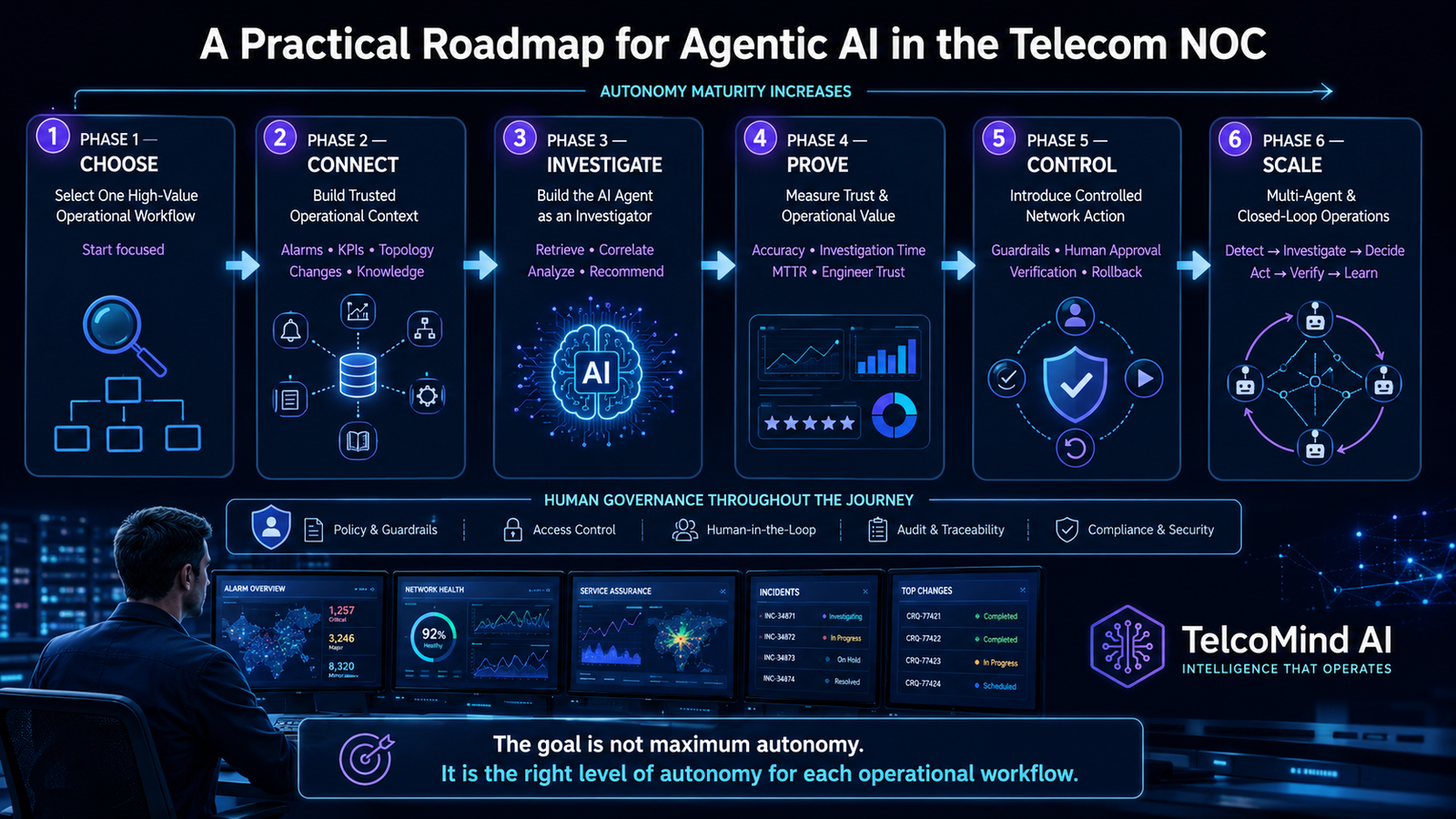
    Self-Healing Telecom Networks: How AI Detects, Diagnoses and Recovers Network Failures
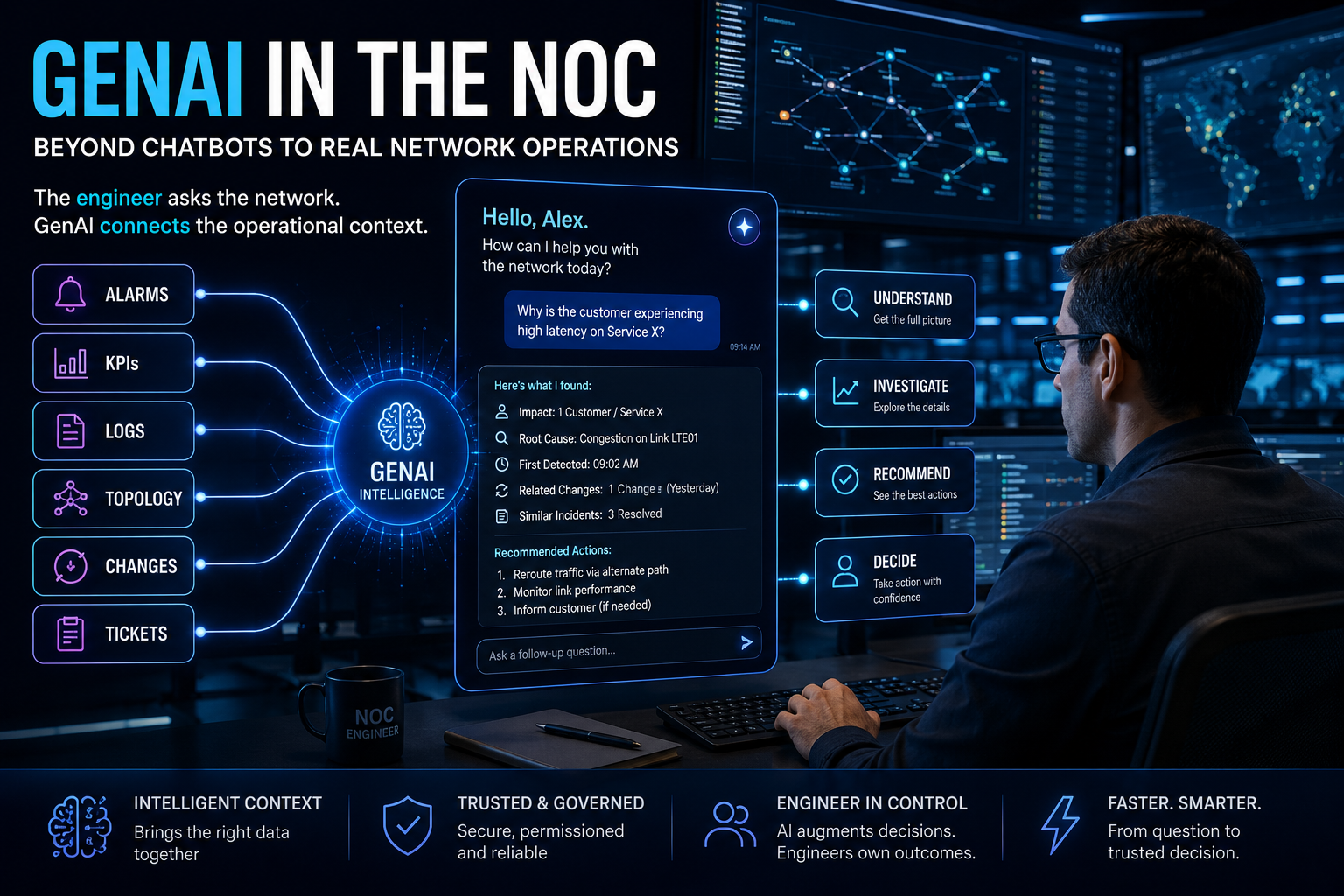
    The Network Recovered Before Anyone Opened a Ticket

    What if the most successful network incident is the one the NOC never has to manage?

    Not because the failure never occurred.

    But because the network detected the conditions leading to service degradation, understood what was happening, selected a safe recovery action and verified that the service had recovered—before the situation developed into a major incident.

    That sounds simple when written as one sentence.

    In a live telecom network, it is anything but simple.

    A single recovery decision may require information from RAN, Transport, Core, Cloud, topology, service assurance, configuration history and customer experience. The network must distinguish a symptom from a cause, understand dependencies, evaluate the risk of taking action and make sure that fixing one problem does not create another.

    This is where the idea of a self-healing telecom network becomes much more interesting than ordinary automation.

    Self-healing is not about automatically fixing alarms. It is about understanding enough of the network to recover safely.

    If a Script Restarts a Failed Process, Is That Self-Healing?

    A network function becomes unresponsive.

    A monitoring system detects the failure and automatically executes a predefined script:

    Process Down → Restart Process

    The service recovers.

    Was that self-healing?

    At first glance, it may look like it. The problem was detected and corrected without an engineer manually executing the restart.

    But consider a second possibility.

    The process became unresponsive because the underlying server was experiencing resource exhaustion. Restarting it restores the service temporarily—but twenty minutes later, the same failure happens again.

    The automation fixed the symptom.

    It never understood the cause.

    Automation asks: “What action should I execute?”
    Self-healing must also ask: “Why did this happen, and will this action actually solve it?”

    Now imagine the same failure in a more intelligent operating model.

    The system does not immediately restart the process.

    First, it checks whether this is an isolated failure or part of a wider pattern.

    It correlates CPU and memory utilization, application logs, recent configuration changes, infrastructure health, service dependencies and previous incidents.

    The evidence shows that memory consumption has been increasing abnormally for several hours.

    Now the problem looks different.

    The failed process is no longer the root cause. It is evidence of a deeper problem.

    Instead of repeatedly restarting the same process, the system could evaluate several recovery options:

    Restart the process — fastest recovery, but the problem may return.
    Move the workload — potentially restore service on healthy infrastructure.
    Scale resources — appropriate if capacity exhaustion is the cause.
    Trigger failover — useful where resilient architecture permits it.
    Escalate to an engineer — necessary when confidence is low or the action carries significant risk.

    The important change is that the network is no longer following a single predefined reaction.

    It is using context to decide which recovery action makes sense.

    Detecting a failure is monitoring. Executing a predefined response is automation. Understanding the cause, selecting a safe response and verifying recovery moves us toward self-healing.

    The Self-Healing Closed Loop: From Detection to Learning

    Consider a group of mobile sites experiencing intermittent service degradation.

    No major element has completely failed. Instead, accessibility begins fluctuating, packet loss appears intermittently, and customer-experience indicators start moving away from their normal baseline.

    A self-healing system should not jump immediately to a recovery action.

    It first needs to build an understanding of what is happening.

    1. OBSERVE — Build the Network Picture

    he system continuously collects signals from the operational environment:

    Alarms • KPIs • Logs • Topology • Traffic • Configuration • Service Experience

    The objective at this stage is not to make a decision.

    It is to create enough situational awareness to recognize what normal network behavior looks like—and when that behavior begins to change.

    A network cannot heal what it cannot observe.

    2. DETECT — Recognize What Has Changed

    Observation gives the system data. Detection gives that data meaning.

    Instead of waiting for a fixed threshold to generate a critical alarm, the system compares current network behavior with historical patterns, expected baselines and related network conditions.

    In our example, it notices something important:

    Packet loss is appearing across several sites—but the sites themselves do not share the same RAN equipment.

    What they do share is part of the same transport path.

    That relationship changes the investigation.

    What initially looked like several independent site problems may actually be one developing network issue affecting multiple services.

    The value of intelligent detection is not generating more alarms. It is recognizing when separate symptoms belong to the same problem.

    3. DIAGNOSE — Find the Common Cause

    The system now follows the dependency chain across the network.

    It discovers that the affected sites share a common aggregation path. Interface statistics show intermittent errors, while historical data confirms that this behavior is unusual. Configuration records show no recent planned change on the affected sites themselves.

    The evidence begins pointing away from the RAN and toward the transport layer.

    This is an important capability.

    Without cross-domain context, an AI system may simply become a faster alarm analyzer. With topology, dependency and historical context, it can begin reasoning about cause and effect across network domains.

    Self-healing becomes powerful when the network can move from “Where is the alarm?” to “Where does the problem actually originate?”

    4. DECIDE — Choose the Safest Recovery Action

    Finding the probable root cause does not automatically mean the network should act.

    Suppose the system identifies degradation on the common transport path. Several recovery options may be available:

    Reroute traffic through an alternative path.
    Adjust routing parameters to reduce the load.
    Isolate the degraded link from service traffic.
    Keep monitoring if the degradation remains within a safe limit.
    Escalate to an engineer if the diagnosis or recovery risk is uncertain.

    The challenge is no longer simply:

    “What can the network do?”

    It becomes:

    “Which action provides the safest recovery with the lowest risk to customers and the rest of the network?”

    A mature self-healing system therefore needs more than automation rules. It needs operational context, confidence thresholds, policy constraints and clearly defined guardrails before selecting an action.

    Autonomy should increase only when confidence is high and operational risk is controlled.

    5. REMEDIATE — Act Within Defined Guardrails

    Now the network is ready to act.

    In our example, the system determines that an alternative transport path has sufficient capacity and is operating normally. Based on predefined operational policies, traffic can be moved away from the degraded path.

    But self-healing should not mean giving AI unlimited permission to change the network.

    The action depends on its risk level and confidence.

    A low-risk, well-tested action may be executed automatically.

    A higher-risk action—such as changing routing across a critical service path—may require engineer approval before execution.

    This creates an important principle for self-healing operations:

    Low Risk + High Confidence → Automated Action

    Higher Risk or Lower Confidence → Human Approval

    The objective is not to remove the engineer from operations.

    It is to remove unnecessary manual intervention where the network already has enough evidence to recover safely.

    The goal of self-healing is controlled autonomy—not uncontrolled automation.

    6. VERIFY — Prove That the Service Has Recovered

    The recovery action has been executed.

    But the closed loop is not complete yet.

    The system now checks what happened after traffic was moved to the healthy path.

    Did packet loss return to normal?

    Did latency improve?

    Did the affected sites recover their expected accessibility?

    Did customer-experience indicators improve?

    And importantly:

    Did the recovery action create a new problem somewhere else?

    This last question matters because a technically successful network action can still create unintended consequences—for example, shifting too much traffic onto another path and causing congestion there.

    A self-healing system therefore needs to compare before-and-after network and service conditions, rather than assuming that a successfully executed command equals a successfully resolved incident.

    Execution tells us that an action happened. Verification tells us whether it actually worked.

    7. LEARN — Turn Every Recovery Into Operational Knowledge

    The service has recovered, but one final opportunity remains.

    The system records what happened:

    What symptoms appeared first?

    Which signals were most useful in identifying the root cause?

    Which recovery action was selected?

    How quickly did the service recover?

    Was engineer intervention required?

    Did the same problem return?

    Over time, these outcomes can improve future diagnosis and recovery decisions.

    For example, if similar transport degradation occurs again, the system does not need to treat it as an entirely new problem. Previous incidents, successful actions and engineer feedback can become part of its operational knowledge.

    But learning should also be governed. A network should not automatically turn every past action into a future rule simply because it worked once.

    The lesson must be validated against context, risk and repeatability.

    A truly intelligent closed loop should not only recover the network. It should make the next recovery better informed.

    OBSERVE → DETECT → DIAGNOSE → DECIDE → REMEDIATE → VERIFY → LEARN

    Self-Healing Is Moving From Concept to Live Telecom Networks

    From Lab Experiment to Live Network: Deutsche Telekom

    One of the strongest signs that self-healing is moving beyond research is the shift from isolated AI experiments toward AI operating inside live network environments.

    At MWC 2026, Deutsche Telekom and Google Cloud presented work around autonomous and self-healing network operations. One example, RAN Guardian, progressed from concept to live deployment in approximately nine months.

    The direction is particularly important.

    The ambition is no longer limited to detecting an anomaly inside one network domain. Deutsche Telekom’s broader MINDR approach is aimed at combining service-level intelligence with cross-domain network information so that AI can reason about problems across operational boundaries.

    That is much closer to the challenge we described earlier.

    A customer-facing service problem may begin in the RAN, transport, core or cloud—but the recovery process needs to understand the service end to end, rather than treating every domain as a separate island.

    The important shift is from “AI optimizing a network element” to “AI understanding and protecting a service.”

    Deutsche Telekom is not an isolated example. Across the industry, operators are increasingly connecting AI, autonomous-network architectures and closed-loop operations.

    e& UAE — Building toward higher autonomy
    e& and TM Forum announced a strategic blueprint in 2026 focused on AI-native, intent-driven and closed-loop autonomous networks, with a roadmap toward higher levels of network autonomy.

    Mobily — Exploring self-healing across multiple domains
    Mobily and Ericsson announced work around autonomous-network capabilities including self-healing, process automation, network optimization and energy management across a multi-vendor environment.

    China Mobile — Showing measurable operational impact
    China Mobile and ZTE have reported trials using coordinated AI agents for network operations. In the reported scenarios, AI agents combined information from alarms, logs, performance data and customer complaints to support root-cause analysis and operational actions, with improvements reported in diagnosis time and MTTR.

    The industry direction is becoming clear: self-healing is moving from isolated automation toward cross-domain, AI-assisted closed loops.

    How Do You Actually Build a Self-Healing Network?

    The biggest mistake is to start with the ambition:

    “We want a self-healing network.”

    That is too broad to implement.

    A practical transformation starts with something much smaller: one recurring failure scenario where detection, diagnosis and recovery can be clearly defined and measured.

    For example, instead of trying to automate the entire transport network, an operator might begin with:

    “When degradation develops on a redundant transport path, can the system identify the probable cause, determine whether a healthy alternative path exists and safely recommend—or execute—traffic rerouting?”

    That single use case can become the laboratory for building the capabilities needed for wider self-healing operations.

    Do not start by automating the network. Start by proving one recovery loop.

    1. Define the Failure Scenario and Recovery Objective

    Before selecting an AI model, automation platform or agent, define exactly what operational problem the closed loop is expected to solve.

    For our transport example, the operator could define:

    Failure Scenario: Progressive degradation on a redundant transport path.

    Observable Symptoms: Packet loss, interface errors, increasing latency and service KPI degradation.

    Recovery Objective: Protect customer traffic before the degraded path develops into a major service outage.

    Possible Action: Move traffic to a verified healthy path.

    Success Condition: Service KPIs recover without creating congestion or degradation elsewhere.

    This sounds simple, but it changes the entire implementation approach.

    The team is no longer starting with:

    “Where can we use AI?”

    It is starting with:

    “What operational decision do we want the system to make better?”

    A good self-healing use case begins with a clearly defined operational decision—not with an AI technology.

    2. Connect the Signals That Explain the Failure

    A self-healing system cannot make a reliable recovery decision from alarms alone.

    For the transport degradation example, it may need to combine:

    Performance data — packet loss, latency, utilization and interface errors.

    Topology — which sites, links and services depend on the affected path.

    Configuration — how routing, protection and redundancy are currently designed.

    Change history — whether a recent configuration or software change could explain the behavior.

    Service context — which customer services are affected and how critical they are.

    Historical incidents — whether similar symptoms have occurred before and what resolved them.

    The real challenge is not collecting more data.

    It is connecting these signals so the system can understand their relationship.

    For example:

    High packet loss alone tells us something is wrong.

    But:

    High packet loss + interface errors + common topology dependency + no recent RAN change + healthy alternate path

    creates enough context to support a much stronger operational decision.

    Data tells the system what is happening. Context helps it understand why—and what it can safely do about it.

    3. Build the Diagnosis Before Automating the Recovery

    At this stage, resist the temptation to close the loop immediately.

    Let the system investigate the incident while the engineer remains responsible for the final decision.

    For the transport example, the system should be able to produce something like:

    Observed: Packet loss and interface errors are increasing.

    Affected: 14 sites and two customer-facing services share the degraded path.

    Probable Cause: Degradation on the common aggregation link.

    Confidence: High, based on correlated performance, topology and historical behavior.

    Recommended Action: Reroute affected traffic through the redundant path.

    Risk Check: Alternate path has sufficient available capacity and no active degradation.

    The NOC engineer then reviews the evidence and either approves or rejects the recommendation.

    This stage is extremely valuable because it tests the intelligence without yet giving the system authority to change the live network.

    Observe → Diagnose → Recommend → Engineer Decides

    Before asking AI to operate the network, prove that it can consistently understand the network.

    4. Run the Self-Healing Logic in Shadow Mode

    Before allowing the system to execute recovery actions, let it operate silently beside the NOC team.

    During shadow mode, the system detects the problem, performs its diagnosis and recommends what it would do—but does not change the live network.

    The engineer handles the incident normally.

    Afterward, compare the two decisions:

    What did the AI diagnose?

    What did the engineer diagnose?

    Did they identify the same root cause?

    Would the AI have selected the correct recovery action?

    Did it miss any operational risk that the engineer noticed?

    Repeated across real incidents, this creates something extremely important:

    Evidence that the closed loop can be trusted before it is closed.

    Shadow mode also exposes weaknesses that laboratory testing may miss—unusual topology conditions, incomplete data, unexpected dependencies and operational exceptions.

    The safest path to autonomy is to let the system prove its decisions before giving it permission to execute them.

    5. Define What the Network Is Allowed to Heal Automatically

    Once shadow-mode results show that the system can diagnose incidents reliably, the next step is not full autonomy.

    It is controlled autonomy.

    Different recovery actions carry very different levels of operational risk.

    For example, restarting a non-critical application process may be relatively low risk. Rerouting major traffic, modifying routing policy or triggering a core-network failover may have much wider consequences.

    So every self-healing action should have a defined autonomy boundary.

    A practical policy could be:

    High Confidence + Low Risk → Execute Automatically

    High Confidence + Medium Risk → Execute Within Approved Guardrails

    Low Confidence or High Risk → Recommend and Request Engineer Approval

    This allows automation to grow based on demonstrated reliability rather than ambition.

    As successful recoveries accumulate, specific actions can gradually move from:

    Recommend → Approve → Auto-Execute

    But critical actions may deliberately remain under human approval even when the technology is capable of executing them.

    The maturity of a self-healing network should be measured by how safely it can act—not by how many decisions humans are removed from.

    6. Measure Recovery, Not Just Automation

    A self-healing project should not be considered successful simply because the network executed an action automatically.

    The real question is:

    Did operations actually improve?

    For the pilot use case, track a small set of operational outcomes:

    MTTD — Did the system detect degradation earlier?

    Diagnosis Time — Did it identify the probable root cause faster?

    MTTR — Did the service recover faster?

    Successful Remediation Rate — How often did the recommended or automated action actually resolve the problem?

    Engineer Intervention — How often was manual investigation still required?

    Repeat Incidents — Did the same failure return after recovery?

    Customer Impact — Was degradation prevented or reduced before customers experienced it?

    This changes the success conversation from:

    “We automated 200 actions this month.”

    to:

    “We prevented service impact, reduced recovery time and required fewer manual interventions.”

    That is a much more meaningful measure of self-healing maturity.

    Automation volume measures activity. Recovery outcomes measure value.

    What Should a Self-Healing Network Be Allowed to Do?

    Not every network problem deserves the same level of autonomy. The right question is not whether AI can execute an action, but whether it can execute that action safely, predictably and within an acceptable operational risk.

    Not every network problem deserves the same level of autonomy. The right question is not whether AI can execute an action, but whether it can execute that action safely, predictably and within an acceptable operational risk.

    Network ScenarioAI DetectAI DiagnoseAI RecommendAuto-Heal?
    Non-critical process failureYes — within guardrails
    Degraded redundant transport pathConditional
    Capacity congestionConditional
    RAN performance degradationConditional
    Major routing changeHuman approval
    Core network failoverHuman approval
    Unknown / low-confidence incidentNo — escalate

    The objective is not maximum autonomy. It is the right autonomy for the right operational risk.

    If the Technology Exists, Why Aren’t Telecom Networks Already Self-Healing?

    Telecom operators are not short of automation.

    Most mature networks already contain scripts, orchestration platforms, assurance tools, optimization systems, AI models and domain-specific automation.

    Yet connecting all of these capabilities into a trusted end-to-end recovery loop remains difficult.

    The problem is often not:

    “Can we automate this action?”

    The harder questions are:

    Does the system understand the full service impact?

    Can it identify the real root cause across multiple domains?

    Does it know whether another automation is already acting on the same problem?

    Can it predict the consequences of its recovery decision?

    Can it verify that the action actually restored the service?

    And who remains accountable when an autonomous decision goes wrong?

    This creates the current gap between isolated automation and genuine self-healing operations.

    A RAN optimizer may understand the radio network.

    A transport controller may understand paths and capacity.

    A cloud platform may automatically restart workloads.

    A service-assurance platform may understand customer impact.

    But the customer service often depends on all of them at the same time.

    The self-healing challenge is increasingly becoming an automation coordination problem—not simply an automation availability problem.

    The Next Shift: Self-Healing Networks Meet Agentic AI

    Traditional self-healing has largely been built around a familiar model:

    Detect a known condition → Trigger a predefined automation → Verify the result

    That works well when the failure pattern is understood and the recovery action is predictable.

    But telecom incidents are not always that clean.

    A service problem may involve several domains, incomplete evidence, multiple possible causes and recovery options that change depending on the network context.

    This is where Agentic AI could change the self-healing model.

    Instead of relying only on a fixed rule, specialized AI agents could collaborate across operational domains:

    RAN Agent investigates radio conditions.

    Transport Agent checks paths, congestion and link health.

    Core Agent evaluates sessions and network functions.

    Service Assurance Agent determines customer impact.

    Change Agent checks whether a recent change could explain the degradation.

    A coordinating agent could then combine their findings, evaluate possible recovery actions and present—or, within approved guardrails, execute—the safest response.

    The model begins to change from:

    ML Detects → Script Fixes

    to:

    AI Observes → Reasons → Collaborates → Acts → Verifies

    The next generation of self-healing networks may not be built only around automation rules. It may increasingly be built around AI agents operating inside governed closed loops.

    Does Self-Healing Actually Deliver ROI?

    A self-healing use case should not be justified simply because it uses advanced AI.

    It should solve an operational problem that is frequent enough, costly enough or service-critical enough to justify the investment.

    Consider a recurring network failure that happens several times each month.

    Today, every occurrence may consume NOC investigation time, domain-engineer effort, escalation effort and service-restoration time. If customers are affected, the real cost can extend further into SLA exposure, customer-care contacts and potentially lost revenue.

    Self-healing changes the economics when it can detect the problem earlier, shorten diagnosis, reduce manual effort and restore service faster.

    A simple business case can start with:

    Annual Benefit = Avoided Incident Cost + Engineering Productivity Gain + Reduced Service-Impact Cost + Avoided Escalation Cost

    Then:

    ROI (%) = (Annual Benefit − Annual Self-Healing Cost) ÷ Annual Self-Healing Cost × 100

    The important point is not to manufacture an impressive ROI percentage.

    Use the operator’s actual incident volumes, MTTR, engineering effort and service-impact data.

    The strongest self-healing use case is not necessarily the most technically impressive one. It is the one where faster, safer recovery creates measurable operational value.

    A Simple Self-Healing Business Case

    Imagine an operator has a recurring network issue that causes 10 incidents per month.

    Each incident currently requires an average of 3 engineering hours across NOC and domain teams, while service degradation lasts approximately 45 minutes before full recovery.

    Assume, purely for illustration:

    Engineering cost per incident: $150
    Estimated service-impact and escalation cost per incident: $500

    The current annual incident cost would be:

    10 incidents × 12 months × ($150 + $500) = $78,000 per year

    Now suppose a self-healing solution reduces the average operational impact by 60% through earlier detection, faster diagnosis and controlled recovery.

    The potential annual benefit becomes:

    $78,000 × 60% = $46,800

    If implementing and operating that specific closed-loop use case costs $25,000 per year, then:

    ROI = ($46,800 − $25,000) ÷ $25,000 × 100

    Illustrative ROI = 87.2%

    This is an illustrative model, not an industry benchmark. Operators should replace these assumptions with their own incident, engineering, service-impact and implementation costs.

    Start with the incidents already costing the business money. That is where the self-healing business case becomes easier to prove.

    What Is the Industry Seeing?

    The potential value is not only theoretical.

    Industry studies and operator trials are beginning to report measurable improvements from AI-driven and increasingly autonomous network operations.

    For example, McKinsey has reported that scaled AI-driven network operations can contribute to 30–40% faster MTTR in some implementations, alongside reductions in troubleshooting workload and NOC operating costs.

    China Mobile and ZTE have also reported results from coordinated AI-agent trials where root-cause diagnosis time was reduced from approximately 15 minutes to 3 minutes in tested scenarios, with MTTR improving by up to 11%.

    These figures should not be treated as guaranteed outcomes for every operator.

    Network architecture, automation maturity, data quality, incident mix and implementation scope can produce very different results.

    The business case for self-healing should be proven in the operator’s own network—not borrowed from someone else’s benchmark.

    Why Future Telecom Networks Will Need Self-Healing

    Telecom networks are becoming more programmable—but also more interconnected.

    5G-Advanced, cloud-native network functions, network slicing, edge computing, APIs and eventually 6G will create more dynamic relationships between infrastructure, software and services.

    That creates an operational challenge.

    A customer-experience problem may no longer have one obvious network cause. It could emerge from the interaction between radio conditions, transport capacity, cloud resources, network functions, policies and service configuration.

    Adding more dashboards will not solve that complexity.

    Adding more independent automation may not solve it either.

    The network increasingly needs the ability to observe across domains, understand dependencies, coordinate decisions and recover services at machine speed—while keeping critical actions governed.

    This changes the role of self-healing.

    It is no longer simply:

    “Can we automatically recover from a known failure?”

    The bigger question becomes:

    “Can the network maintain service resilience as operational complexity grows beyond what humans can continuously coordinate manually?”

    The future need for self-healing will be driven less by reducing headcount and more by managing network complexity at a speed humans alone cannot sustain.

    A Practical 90-Day Self-Healing Pilot

    An operator does not need to wait for a fully autonomous network architecture to begin.

    Choose one recurring, measurable and relatively controlled failure scenario and use the next 90 days to prove whether a closed-loop approach can improve recovery.

    Days 1–30: Observe and Build the Baseline

    For the first month, do not automate the recovery.

    Study the selected incident and establish how it behaves today.

    Capture:

    How often does it occur?

    Which alarms, KPIs and logs appear first?

    How long does diagnosis normally take?

    What is the current MTTR?

    Which teams become involved?

    What recovery action normally works?

    What customer or service impact occurs?

    The objective is to create a measurable before-self-healing baseline.

    At the end of 30 days, the team should be able to answer one important question:

    “Do we understand this failure well enough to teach a system how to recognize and investigate it?”

    You cannot prove improvement without first understanding the operational baseline.

    Days 31–60: Let the System Decide—But Not Act

    Now introduce the self-healing intelligence alongside the existing NOC process.

    For every occurrence of the selected failure, let the system independently:

    Detect the abnormal behavior

    Correlate the relevant network signals

    Identify the probable root cause

    Recommend a recovery action

    Estimate confidence and operational risk

    But keep one restriction:

    The system cannot execute the action.

    Engineers continue handling the live incident normally.

    After each incident, compare the system’s conclusion with what actually happened.

    Did it detect the problem earlier?

    Did it identify the same root cause as the engineer?

    Was its recommended action correct?

    Would that action have been safe?

    Did the system miss any dependency that an experienced engineer noticed?

    By the end of Day 60, the operator should have evidence showing where the system can be trusted—and where it still needs improvement.

    The goal of shadow mode is not to prove that AI is perfect. It is to discover exactly where autonomy is safe.

    Days 61–90: Allow Controlled Recovery

    By this stage, the operator has observed the failure, established a baseline and tested the system’s decisions in shadow mode.

    Now selected recovery actions can move from recommendation to controlled execution.

    Start with actions that have:

    High diagnostic confidence

    Low operational risk

    A proven recovery procedure

    Clear rollback capability

    Reliable post-action verification

    For example, the system may be permitted to reroute traffic only when the alternative path is healthy, sufficient spare capacity exists and no conflicting network activity is detected.

    Anything outside those conditions should automatically return to:

    Recommend → Engineer Approval

    After every automated recovery, the system must verify that service KPIs have returned to normal and that the action has not created degradation elsewhere.

    If verification fails:

    Stop → Roll Back → Escalate

    By Day 90, the objective is not to claim that the network has become autonomous.

    It is to demonstrate that one complete recovery loop can operate safely, measurably and repeatedly in the live network.

    Do not scale self-healing because one automated action worked. Scale it when the complete recovery loop repeatedly proves that it works.

    Day 90: Should We Scale It?

    At the end of the pilot, management should not ask:

    “How many actions did AI automate?”

    Instead, compare the pilot against the original operational baseline.

    Did MTTD improve?

    Did diagnosis time decrease?

    Did MTTR improve?

    How many recovery recommendations were correct?

    How many automated recoveries succeeded without engineer intervention?

    Were any incorrect or unsafe actions attempted?

    Did repeat incidents decrease?

    Was measurable customer or service impact avoided?

    And perhaps most importantly:

    Do the NOC engineers trust the system enough to expand its responsibility?

    If the results are positive, the operator can gradually expand the same closed-loop methodology to additional failure scenarios and network domains.

    If the results are weak, that is also valuable.

    It tells the operator whether the problem lies in data quality, diagnosis accuracy, topology context, automation reliability, governance or the use case itself—before attempting to scale.

    The first 90 days should earn the right to scale—not assume it.

    A Self-Healing Network Is Not a Network That Never Fails

    Failures will not disappear from telecom networks.

    Hardware will fail. Software will behave unexpectedly. Fiber will be cut. Capacity will become constrained. Configuration changes will sometimes produce unintended consequences.

    The real transformation is therefore not the elimination of failure.

    It is changing how the network responds when failure begins.

    Today, much of that journey still depends on engineers moving between alarms, dashboards, logs, topology tools and domain teams to understand what happened and decide what to do next.

    Self-healing introduces a different operating model:

    OBSERVE → DETECT → DIAGNOSE → DECIDE → REMEDIATE → VERIFY → LEARN

    But the journey should not begin with full autonomy.

    It should begin with one well-understood failure, one trusted recovery loop and one measurable operational outcome.

    Then scale what proves safe.

    A self-healing network is not a network that never fails. It is a network that can understand failure, recover safely and learn before the same problem becomes tomorrow’s outage.

    START SMALL → OBSERVE → DIAGNOSE → PROVE → CONTROL → HEAL → VERIFY → SCALE

    How Ready Is Your NOC for Self-Healing Operations?

    Moving toward self-healing does not start with buying another AI platform.

    It starts by understanding where your NOC stands today across observability, automation, predictive operations, AIOps, decision intelligence, closed-loop operations and governance.

    TelcoMind AI has created a free NOC AI Maturity Assessment to help telecom teams identify their current maturity level and the capabilities they need to develop next.

    → Take the Free NOC AI Maturity Assessment

    Related TelcoMind AI Insights

    1. Agentic AI in Telecom Operations: From AI Assistance to Autonomous Action

    2. AI-Powered AIOps in Telecom: From Alarm Management to Autonomous Network Operations

    3. From Level 0 to Level 5: How Close Are We to Truly Autonomous Telecom Networks?

  • How to Implement Agentic AI in a Telecom NOC: A Practical Architecture and Roadmap

    How to Implement Agentic AI in a Telecom NOC: A Practical Architecture and Roadmap

    The Real Question Is No Longer “What Can AI Do?”

    Imagine a regional network begins degrading. Nothing has completely failed yet.

    Customer-experience indicators start moving in the wrong direction. A group of sites shows intermittent accessibility degradation. Packet loss appears on part of the transport network. A few alarms are active, but none individually explains the problem.

    The NOC engineer begins investigating.

    First, the alarm-management system. Then performance monitoring. Then topology. Then transmission. Then IP. Then recent network changes. Then previous incidents. Each system contains part of the answer. But the engineer has to connect everything manually.

    Eventually, the team discovers that the symptoms share an upstream dependency and that a configuration change earlier in the day altered the traffic path.

    The experienced engineer can solve the problem.

    The problem is the time and effort required to assemble the evidence.

    Now imagine a different operating model.

    The engineer asks:

    “Investigate the degradation affecting these sites and identify the most probable cause.”

    An AI agent starts working.

    It retrieves the affected alarms, analyzes the KPI deterioration, checks network topology, identifies common dependencies, reviews recent configuration changes, and searches previous incidents with similar symptoms.

    Instead of giving the engineer another dashboard to investigate, the agent brings the evidence together and presents a probable root cause, affected services, supporting evidence, recommended action, and confidence level.

    The engineer reviews the evidence and decides whether the proposed action should proceed.

    This is the important shift:

    AI is no longer simply answering a question. It is performing an operational investigation.

    From AI Assistant to AI Agent

    Most telecom organizations have already experimented with some form of AI.

    An engineer might ask a GenAI assistant:

    “Explain this alarm.”

    The model explains it.

    Or:

    “Summarize this incident report.”

    The model produces a summary.

    Useful? Absolutely. But the engineer is still performing the operational workflow.

    Agentic AI changes this relationship.

    Instead of asking:

    “What does this alarm mean?”

    the engineer can ask:

    “Investigate why this service is degrading.”

    The AI agent can then determine which operational steps are required to investigate the problem.

    AI Assistant vs Agentic AI comparison

    The Difference in One View

    Traditional GenAI Assistant

    Prompt → Answer

    The engineer decides what to investigate, gathers the information, interprets the evidence and decides the next step.

    Agentic AI

    Goal → Plan → Use Tools → Investigate → Correlate → Recommend → Verify

    The engineer defines the objective and remains responsible for critical decisions, while the AI performs multiple investigation steps across operational systems.

    This shift—from answering questions to executing goal-oriented workflows—is what makes Agentic AI particularly relevant to telecom network operations.

    How Does Agentic AI Actually Work Inside a Telecom NOC?

    The real challenge is not connecting a chatbot to the NOC. The challenge is giving AI enough network context, operational knowledge and controlled access to tools to investigate a problem safely.

    A practical Agentic AI architecture for telecom operations can be organized into six layers, connecting network data, operational knowledge, specialized AI agents, human governance and closed-loop network actions.

    1. Network & Operational Data
    2. Data Normalization & Context
    3. Operational Knowledge
    4. Agentic AI & Specialized Agents
    5. Governance & Human Control
    6. Action, Verification & Learning

    Together, these layers allow an AI agent to move from simply understanding an alarm to investigating its probable root cause and recommending an operational response.

    From Alarm to Action: What an Agentic AI Investigation Could Look Like

    Imagine the same regional degradation begins again. Several cell sites show accessibility deterioration, transport packet loss increases, and customer-experience KPIs start declining. No single alarm identifies the root cause.

    This time, instead of manually moving between multiple operational systems, the NOC engineer gives the Agentic AI system a goal:

    “Investigate the service degradation, identify the probable root cause, determine the customer impact and recommend the safest recovery action.”

    The agent does not immediately produce an answer. It begins an investigation.

    Step 1 — Understand What Is Actually Affected

    The agent first builds the operational context. It identifies the affected sites, services, customers and network domains, then correlates alarms with the degrading KPIs.

    Instead of treating every alarm as a separate event, it asks a more useful question:

    “What do these symptoms have in common?”

    Step 2 — Trace the Common Dependency

    Using topology and service relationships, the agent traces the affected sites through RAN, transport and core dependencies.

    It discovers that several apparently unrelated symptoms share the same upstream transport path.

    Step 3 — Check What Changed

    The agent then reviews recent configuration changes, maintenance activity and network events associated with that path.

    A routing change implemented earlier in the day becomes a strong candidate.

    Step 4 — Test the Hypothesis Before Touching the Network

    Finding a likely cause is not enough. Before recommending a network change, the agent needs to determine whether the evidence actually supports its hypothesis.

    It can compare the current incident with historical cases, analyze the timing of the configuration change against the KPI degradation, and evaluate whether the suspected dependency explains all affected services.

    Where a Network Digital Twin or simulation capability is available, the proposed recovery action could also be tested against a virtual representation of the network before being considered for production.

    “If we reverse or modify this change, what is likely to happen?”

    Step 5 — Recommend an Action, Not Just a Root Cause

    The agent now brings the investigation together:

    Probable cause: Recent routing configuration change
    Affected area: Regional transport path and dependent sites
    Customer impact: Degraded accessibility and data performance
    Recommended action: Restore the previous validated routing configuration
    Supporting evidence: Alarm correlation, KPI timeline, topology dependency and change history
    Confidence: Presented with the evidence used to reach the conclusion

    This is an important distinction.

    A useful Agentic AI system should not simply say what it thinks happened. It should show why it reached that conclusion.

    Step 7 — Execute, Verify and Learn

    Once approved, the action can be executed through the appropriate automation or orchestration platform.

    But the workflow should not end when the configuration changes.

    The agent continues monitoring the affected services and asks:

    Did the alarms clear?
    Did the KPIs recover?
    Did customer experience return to normal?
    Did the action create any unexpected impact elsewhere?

    If the network recovers as expected, the incident outcome becomes part of the operational knowledge available for future investigations.

    The complete loop becomes:

    Detect → Investigate → Correlate → Hypothesize → Test → Recommend → Approve → Act → Verify → Learn

    Agentic AI becomes operationally valuable when it can close the investigation loop—not merely generate an intelligent answer.

    What Happens When Multiple AI Agents Work Together?

    A telecom incident rarely belongs neatly to one domain.

    A customer-experience problem may appear in the RAN, originate in transport, interact with a core-network dependency and finally become visible through service-assurance KPIs.

    This creates an interesting possibility for Agentic AI: instead of building one AI agent that tries to understand everything, operators could use specialized agents, each responsible for a particular operational capability.

    For example:

    RAN Agent — investigates radio KPIs, cell alarms and accessibility degradation.

    Transport Agent — analyzes packet loss, latency, link utilization and path dependencies.

    Core Agent — checks sessions, signaling, network functions and service dependencies.

    Change Agent — reviews recent configuration changes and maintenance activity.

    Service Assurance Agent — evaluates customer and service impact.

    Coordinator Agent — combines the findings, resolves conflicting evidence and builds the overall incident hypothesis.

    The future NOC may not rely on one AI that knows everything. It may rely on multiple specialized agents that know how to work together.

    A multi-agent NOC architecture allows specialized AI agents to investigate different network domains while a coordinating agent brings the evidence together for human-reviewed operational decisions.

    How Much Autonomy Should an AI Agent Actually Have?

    Giving an AI agent access to operational systems does not mean giving it unrestricted authority to change the network.

    A practical Agentic AI implementation should introduce autonomy progressively, based on operational risk, confidence, reversibility and potential customer impact.

    For example, an agent may be allowed to automatically collect evidence, correlate alarms and analyze KPIs with very little operational risk.

    Recommending a configuration change requires greater confidence.

    Executing that change on a live production network requires an entirely different level of governance.

    A useful progression could therefore be:

    Observe → Investigate → Recommend → Approve → Act → Verify

    The further the agent moves toward Act, the stronger the controls should become.

    Agentic AI maturity should not be measured by how many decisions AI can make alone. It should be measured by how safely intelligence can be converted into operational action.

    A Practical Roadmap for Implementing Agentic AI in the NOC

    The biggest mistake would be to start with the question:

    “How do we make the NOC autonomous?”

    A better question is:

    “Which operational workflow is repetitive, data-rich, measurable and safe enough for Agentic AI to improve?”

    The first implementation should not attempt to transform the entire NOC. It should prove that an AI agent can reliably investigate a defined operational problem and create measurable value.

    Phase 1 — Choose One High-Value Operational Workflow

    Start with a workflow where engineers already spend significant time gathering and correlating information.

    Good candidates could include:

    Alarm investigation
    Cross-domain incident correlation
    Recurring degradation analysis
    Change-impact investigation
    Preventive maintenance investigation

    Avoid beginning with autonomous configuration changes.

    The initial objective should be simple:

    Can the AI agent reduce investigation effort while producing evidence that an experienced engineer trusts?

    Phase 2 — Connect the Agent to Trusted Operational Context

    An AI agent cannot investigate a telecom network effectively if it only sees alarms.

    It needs enough operational context to understand what happened, where it happened, what changed and what could be affected.

    Depending on the use case, this context may include:

    Alarms & events — what is happening now?
    Performance KPIs — what is degrading?
    Network topology — how are affected elements connected?
    Configuration & change history — what changed recently?
    Tickets & incident history — has this happened before?
    Service data — which services are affected?
    Operational knowledge — what procedures and engineering rules apply?

    But simply connecting these data sources is not enough.

    The information must be current, normalized, permission-controlled and traceable to its source.

    An AI agent can only be as operationally intelligent as the context it is allowed to understand.

    Phase 3 Build the Agent as an Investigator Before Making It an Operator

    The safest starting point is to give the AI agent permission to investigate, not permission to change the network.

    At this stage, the agent can:

    Retrieve relevant alarms, KPIs and logs.
    Correlate symptoms across network domains.
    Check topology and recent changes.
    Search previous incidents and operational knowledge.
    Develop a probable root-cause hypothesis.
    Recommend the next troubleshooting or recovery action.

    But the final operational decision remains with the engineer.

    This creates an important learning period.

    Engineers can compare the agent’s conclusions with their own investigations, identify where the agent performs well, and discover where additional context or operational rules are required.

    Before trusting an AI agent to operate the network, first prove that you can trust it to investigate the network.

    Phase 4 — Measure Trust and Operational Value

    Before expanding Agentic AI to more workflows, operators should measure whether the first implementation is actually improving NOC operations.

    The evaluation should go beyond asking whether the AI produced the correct answer.

    Measure outcomes such as:

    Investigation time — Did engineers reach the probable cause faster?

    Evidence quality — Did the agent provide enough traceable information to support its conclusion?

    Recommendation accuracy — How often were its recommendations accepted, modified or rejected by engineers?

    Operational impact — Did the workflow help reduce MTTR, repeated investigations or unnecessary escalations?

    Engineer trust — Are experienced engineers becoming comfortable using the agent as part of their normal workflow?

    These measurements create the evidence needed to decide whether the agent is ready for greater responsibility.

    Autonomy should be earned through operational evidence—not granted because the AI appears intelligent.

    Phase 5 — Introduce Controlled Action

    Once the agent has demonstrated reliable investigation and recommendation performance, selected low-risk actions can gradually be introduced.

    This should not mean giving the agent unrestricted access to the production network.

    Instead, every action should operate within clearly defined guardrails.

    For example:

    Low-risk actions may be executed automatically when confidence is high.

    Medium-risk actions may require engineer approval before execution.

    High-risk or customer-impacting actions should remain under explicit human control.

    The agent should also understand:

    What it is allowed to change
    When it must ask for approval
    When it must stop and escalate
    How to verify the result
    How to trigger rollback if the expected outcome does not occur

    This creates a controlled progression:

    Recommend → Approve → Execute → Verify → Roll Back if Required

    The goal is not to give AI control of the network. The goal is to give AI the right level of authority for the right operational situation.

    Phase 6 — Scale Toward Multi-Agent and Closed-Loop Operations

    Once individual agents have demonstrated value in specific workflows, the next step is not simply to deploy more agents.

    The real opportunity is to make them work together across operational domains.

    A RAN agent may detect degradation. A Transport agent may identify a shared dependency. A Change agent may discover a recent configuration modification. A Service Assurance agent may determine which customers and services are affected.

    A coordinating agent can bring these findings together and build a common operational view.

    Over time, selected workflows could then progress toward closed-loop operation, where the system can:

    Detect → Investigate → Decide → Act → Verify → Learn

    But not every workflow needs to reach full autonomy.

    Some may remain AI-assisted.
    Some may become human-approved automation.
    Others may eventually operate autonomously within tightly defined boundaries.

    The destination is not an autonomous NOC at any cost. It is the right level of autonomy for each operational workflow.

    What Usually Stops Agentic AI From Working in a Real NOC?

    The architecture can look impressive on a diagram.

    The real difficulty begins when an operator tries to connect it to a live telecom environment.

    Agentic AI depends on something many NOCs still struggle with: consistent operational context across fragmented systems and network domains.

    An alarm may exist in one platform. Performance data in another. Topology somewhere else. Change records in an ITSM system. Troubleshooting procedures in documents. Historical knowledge may exist mainly in the experience of senior engineers.

    If the AI agent cannot connect these pieces reliably, its reasoning will always be incomplete.

    This means the first major challenge is not necessarily the AI model.

    The hardest part of Agentic AI may be building the operational context the agent needs in order to reason correctly.

    What Should a Telecom Operator Do First?

    Agentic AI should not begin as a large autonomous-network program. It should begin with one operational problem where the value can be demonstrated clearly.

    Choose a workflow that is:

    Repetitive — engineers perform it frequently.
    Data-rich — the required operational information already exists.
    Time-consuming — investigation requires significant manual effort.
    Measurable — improvement can be demonstrated.
    Low-risk — AI can initially investigate without controlling the live network.

    A good starting point could be cross-domain incident investigation, where engineers currently spend time moving between alarms, KPIs, topology, changes and historical incidents.

    Start with AI as an investigator.

    Prove that engineers trust its evidence.

    Measure whether investigation becomes faster and more consistent.

    Then—and only then—consider giving the agent greater operational authority.

    Start with one problem. Prove the value. Build trust. Then expand the autonomy.

    Agentic AI Will Change the NOC — But Not Overnight

    Agentic AI introduces an important change in how AI can support telecom operations.

    The journey starts with AI helping engineers understand the network.

    It progresses toward AI that can investigate, correlate evidence across domains, develop hypotheses and recommend actions.

    Eventually, selected operational workflows may allow AI agents to act and verify outcomes within carefully defined boundaries.

    But the real transformation is not simply:

    Manual NOC → Autonomous NOC

    It is a progressive shift:

    Human Investigation → AI-Assisted Investigation → Agent-Led Investigation → Human-Approved Action → Governed Closed-Loop Operations

    The role of the engineer does not disappear in this journey.

    It evolves from manually collecting operational information toward validating intelligence, governing automation and making higher-risk network decisions.

    The future NOC will not be defined by how much AI it deploys. It will be defined by how intelligently it combines AI agents, automation, network context and human judgment.

    Final Thought

    Agentic AI has the potential to become much more than another interface sitting above telecom operational systems.

    Implemented correctly, it can become an operational intelligence layer connecting network data, engineering knowledge, AI reasoning and automation.

    The operators that make progress will probably not be those attempting to automate everything at once.

    They will be those that start with the right operational problem, build trusted context, prove measurable value and increase autonomy only where it makes operational sense.

    Start small. Prove the intelligence. Control the action. Scale what works.

    How Ready Is Your NOC for Agentic AI?

    Before introducing AI agents into network operations, operators need to understand whether their data, automation, operational processes and governance are ready for the transition.

    TelcoMind AI’s free AI-Ready NOC Maturity Assessment helps you evaluate your current NOC across key capabilities and identify where the biggest gaps exist.

    Assess your NOC → Identify the gaps → Define the next step

    Take the Free NOC AI Maturity Assessment →

    Related TelcoMind AI Insights

    Agentic AI in Telecom Operations: From AI Assistance to Autonomous Action

    AI-Powered AIOps in Telecom: From Alarm Management to Autonomous Network Operations

    From Level 0 to Level 5: How Close Are We to Truly Autonomous Telecom Networks?

  • How to Implement Agentic AI in a Telecom NOC: A Practical Architecture and Roadmap

    How to Implement Agentic AI in a Telecom NOC: A Practical Architecture and Roadmap

    The Real Question Is No Longer “What Can AI Do?”

    Imagine a regional network begins degrading. Nothing has completely failed yet.

    Customer-experience indicators start moving in the wrong direction. A group of sites shows intermittent accessibility degradation. Packet loss appears on part of the transport network. A few alarms are active, but none individually explains the problem.

    The NOC engineer begins investigating.

    First, the alarm-management system. Then performance monitoring. Then topology. Then transmission. Then IP. Then recent network changes. Then previous incidents. Each system contains part of the answer. But the engineer has to connect everything manually.

    Eventually, the team discovers that the symptoms share an upstream dependency and that a configuration change earlier in the day altered the traffic path.

    The experienced engineer can solve the problem.

    The problem is the time and effort required to assemble the evidence.

    Now imagine a different operating model.

    The engineer asks:

    “Investigate the degradation affecting these sites and identify the most probable cause.”

    An AI agent starts working.

    It retrieves the affected alarms, analyzes the KPI deterioration, checks network topology, identifies common dependencies, reviews recent configuration changes, and searches previous incidents with similar symptoms.

    Instead of giving the engineer another dashboard to investigate, the agent brings the evidence together and presents a probable root cause, affected services, supporting evidence, recommended action, and confidence level.

    The engineer reviews the evidence and decides whether the proposed action should proceed.

    This is the important shift:

    AI is no longer simply answering a question. It is performing an operational investigation.

    From AI Assistant to AI Agent

    Most telecom organizations have already experimented with some form of AI.

    An engineer might ask a GenAI assistant:

    “Explain this alarm.”

    The model explains it.

    Or:

    “Summarize this incident report.”

    The model produces a summary.

    Useful? Absolutely. But the engineer is still performing the operational workflow.

    Agentic AI changes this relationship.

    Instead of asking:

    “What does this alarm mean?”

    the engineer can ask:

    “Investigate why this service is degrading.”

    The AI agent can then determine which operational steps are required to investigate the problem.

    AI Assistant vs Agentic AI comparison

    The Difference in One View

    Traditional GenAI Assistant

    Prompt → Answer

    The engineer decides what to investigate, gathers the information, interprets the evidence and decides the next step.

    Agentic AI

    Goal → Plan → Use Tools → Investigate → Correlate → Recommend → Verify

    The engineer defines the objective and remains responsible for critical decisions, while the AI performs multiple investigation steps across operational systems.

    This shift—from answering questions to executing goal-oriented workflows—is what makes Agentic AI particularly relevant to telecom network operations.

    How Does Agentic AI Actually Work Inside a Telecom NOC?

    The real challenge is not connecting a chatbot to the NOC. The challenge is giving AI enough network context, operational knowledge and controlled access to tools to investigate a problem safely.

    A practical Agentic AI architecture for telecom operations can be organized into six layers, connecting network data, operational knowledge, specialized AI agents, human governance and closed-loop network actions.

    1. Network & Operational Data
    2. Data Normalization & Context
    3. Operational Knowledge
    4. Agentic AI & Specialized Agents
    5. Governance & Human Control
    6. Action, Verification & Learning

    Together, these layers allow an AI agent to move from simply understanding an alarm to investigating its probable root cause and recommending an operational response.

    From Alarm to Action: What an Agentic AI Investigation Could Look Like

    Imagine the same regional degradation begins again. Several cell sites show accessibility deterioration, transport packet loss increases, and customer-experience KPIs start declining. No single alarm identifies the root cause.

    This time, instead of manually moving between multiple operational systems, the NOC engineer gives the Agentic AI system a goal:

    “Investigate the service degradation, identify the probable root cause, determine the customer impact and recommend the safest recovery action.”

    The agent does not immediately produce an answer. It begins an investigation.

    Step 1 — Understand What Is Actually Affected

    The agent first builds the operational context. It identifies the affected sites, services, customers and network domains, then correlates alarms with the degrading KPIs.

    Instead of treating every alarm as a separate event, it asks a more useful question:

    “What do these symptoms have in common?”

    Step 2 — Trace the Common Dependency

    Using topology and service relationships, the agent traces the affected sites through RAN, transport and core dependencies.

    It discovers that several apparently unrelated symptoms share the same upstream transport path.

    Step 3 — Check What Changed

    The agent then reviews recent configuration changes, maintenance activity and network events associated with that path.

    A routing change implemented earlier in the day becomes a strong candidate.

    Step 4 — Test the Hypothesis Before Touching the Network

    Finding a likely cause is not enough. Before recommending a network change, the agent needs to determine whether the evidence actually supports its hypothesis.

    It can compare the current incident with historical cases, analyze the timing of the configuration change against the KPI degradation, and evaluate whether the suspected dependency explains all affected services.

    Where a Network Digital Twin or simulation capability is available, the proposed recovery action could also be tested against a virtual representation of the network before being considered for production.

    “If we reverse or modify this change, what is likely to happen?”

    Step 5 — Recommend an Action, Not Just a Root Cause

    The agent now brings the investigation together:

    Probable cause: Recent routing configuration change
    Affected area: Regional transport path and dependent sites
    Customer impact: Degraded accessibility and data performance
    Recommended action: Restore the previous validated routing configuration
    Supporting evidence: Alarm correlation, KPI timeline, topology dependency and change history
    Confidence: Presented with the evidence used to reach the conclusion

    This is an important distinction.

    A useful Agentic AI system should not simply say what it thinks happened. It should show why it reached that conclusion.

    Step 7 — Execute, Verify and Learn

    Once approved, the action can be executed through the appropriate automation or orchestration platform.

    But the workflow should not end when the configuration changes.

    The agent continues monitoring the affected services and asks:

    Did the alarms clear?
    Did the KPIs recover?
    Did customer experience return to normal?
    Did the action create any unexpected impact elsewhere?

    If the network recovers as expected, the incident outcome becomes part of the operational knowledge available for future investigations.

    The complete loop becomes:

    Detect → Investigate → Correlate → Hypothesize → Test → Recommend → Approve → Act → Verify → Learn

    Agentic AI becomes operationally valuable when it can close the investigation loop—not merely generate an intelligent answer.

    What Happens When Multiple AI Agents Work Together?

    A telecom incident rarely belongs neatly to one domain.

    A customer-experience problem may appear in the RAN, originate in transport, interact with a core-network dependency and finally become visible through service-assurance KPIs.

    This creates an interesting possibility for Agentic AI: instead of building one AI agent that tries to understand everything, operators could use specialized agents, each responsible for a particular operational capability.

    For example:

    RAN Agent — investigates radio KPIs, cell alarms and accessibility degradation.

    Transport Agent — analyzes packet loss, latency, link utilization and path dependencies.

    Core Agent — checks sessions, signaling, network functions and service dependencies.

    Change Agent — reviews recent configuration changes and maintenance activity.

    Service Assurance Agent — evaluates customer and service impact.

    Coordinator Agent — combines the findings, resolves conflicting evidence and builds the overall incident hypothesis.

    The future NOC may not rely on one AI that knows everything. It may rely on multiple specialized agents that know how to work together.

    A multi-agent NOC architecture allows specialized AI agents to investigate different network domains while a coordinating agent brings the evidence together for human-reviewed operational decisions.

    How Much Autonomy Should an AI Agent Actually Have?

    Giving an AI agent access to operational systems does not mean giving it unrestricted authority to change the network.

    A practical Agentic AI implementation should introduce autonomy progressively, based on operational risk, confidence, reversibility and potential customer impact.

    For example, an agent may be allowed to automatically collect evidence, correlate alarms and analyze KPIs with very little operational risk.

    Recommending a configuration change requires greater confidence.

    Executing that change on a live production network requires an entirely different level of governance.

    A useful progression could therefore be:

    Observe → Investigate → Recommend → Approve → Act → Verify

    The further the agent moves toward Act, the stronger the controls should become.

    Agentic AI maturity should not be measured by how many decisions AI can make alone. It should be measured by how safely intelligence can be converted into operational action.

    A Practical Roadmap for Implementing Agentic AI in the NOC

    The biggest mistake would be to start with the question:

    “How do we make the NOC autonomous?”

    A better question is:

    “Which operational workflow is repetitive, data-rich, measurable and safe enough for Agentic AI to improve?”

    The first implementation should not attempt to transform the entire NOC. It should prove that an AI agent can reliably investigate a defined operational problem and create measurable value.

    Phase 1 — Choose One High-Value Operational Workflow

    Start with a workflow where engineers already spend significant time gathering and correlating information.

    Good candidates could include:

    Alarm investigation
    Cross-domain incident correlation
    Recurring degradation analysis
    Change-impact investigation
    Preventive maintenance investigation

    Avoid beginning with autonomous configuration changes.

    The initial objective should be simple:

    Can the AI agent reduce investigation effort while producing evidence that an experienced engineer trusts?

    Phase 2 — Connect the Agent to Trusted Operational Context

    An AI agent cannot investigate a telecom network effectively if it only sees alarms.

    It needs enough operational context to understand what happened, where it happened, what changed and what could be affected.

    Depending on the use case, this context may include:

    Alarms & events — what is happening now?
    Performance KPIs — what is degrading?
    Network topology — how are affected elements connected?
    Configuration & change history — what changed recently?
    Tickets & incident history — has this happened before?
    Service data — which services are affected?
    Operational knowledge — what procedures and engineering rules apply?

    But simply connecting these data sources is not enough.

    The information must be current, normalized, permission-controlled and traceable to its source.

    An AI agent can only be as operationally intelligent as the context it is allowed to understand.

    Phase 3 Build the Agent as an Investigator Before Making It an Operator

    The safest starting point is to give the AI agent permission to investigate, not permission to change the network.

    At this stage, the agent can:

    Retrieve relevant alarms, KPIs and logs.
    Correlate symptoms across network domains.
    Check topology and recent changes.
    Search previous incidents and operational knowledge.
    Develop a probable root-cause hypothesis.
    Recommend the next troubleshooting or recovery action.

    But the final operational decision remains with the engineer.

    This creates an important learning period.

    Engineers can compare the agent’s conclusions with their own investigations, identify where the agent performs well, and discover where additional context or operational rules are required.

    Before trusting an AI agent to operate the network, first prove that you can trust it to investigate the network.

    Phase 4 — Measure Trust and Operational Value

    Before expanding Agentic AI to more workflows, operators should measure whether the first implementation is actually improving NOC operations.

    The evaluation should go beyond asking whether the AI produced the correct answer.

    Measure outcomes such as:

    Investigation time — Did engineers reach the probable cause faster?

    Evidence quality — Did the agent provide enough traceable information to support its conclusion?

    Recommendation accuracy — How often were its recommendations accepted, modified or rejected by engineers?

    Operational impact — Did the workflow help reduce MTTR, repeated investigations or unnecessary escalations?

    Engineer trust — Are experienced engineers becoming comfortable using the agent as part of their normal workflow?

    These measurements create the evidence needed to decide whether the agent is ready for greater responsibility.

    Autonomy should be earned through operational evidence—not granted because the AI appears intelligent.

    Phase 5 — Introduce Controlled Action

    Once the agent has demonstrated reliable investigation and recommendation performance, selected low-risk actions can gradually be introduced.

    This should not mean giving the agent unrestricted access to the production network.

    Instead, every action should operate within clearly defined guardrails.

    For example:

    Low-risk actions may be executed automatically when confidence is high.

    Medium-risk actions may require engineer approval before execution.

    High-risk or customer-impacting actions should remain under explicit human control.

    The agent should also understand:

    What it is allowed to change
    When it must ask for approval
    When it must stop and escalate
    How to verify the result
    How to trigger rollback if the expected outcome does not occur

    This creates a controlled progression:

    Recommend → Approve → Execute → Verify → Roll Back if Required

    The goal is not to give AI control of the network. The goal is to give AI the right level of authority for the right operational situation.

    Phase 6 — Scale Toward Multi-Agent and Closed-Loop Operations

    Once individual agents have demonstrated value in specific workflows, the next step is not simply to deploy more agents.

    The real opportunity is to make them work together across operational domains.

    A RAN agent may detect degradation. A Transport agent may identify a shared dependency. A Change agent may discover a recent configuration modification. A Service Assurance agent may determine which customers and services are affected.

    A coordinating agent can bring these findings together and build a common operational view.

    Over time, selected workflows could then progress toward closed-loop operation, where the system can:

    Detect → Investigate → Decide → Act → Verify → Learn

    But not every workflow needs to reach full autonomy.

    Some may remain AI-assisted.
    Some may become human-approved automation.
    Others may eventually operate autonomously within tightly defined boundaries.

    The destination is not an autonomous NOC at any cost. It is the right level of autonomy for each operational workflow.

    What Usually Stops Agentic AI From Working in a Real NOC?

    The architecture can look impressive on a diagram.

    The real difficulty begins when an operator tries to connect it to a live telecom environment.

    Agentic AI depends on something many NOCs still struggle with: consistent operational context across fragmented systems and network domains.

    An alarm may exist in one platform. Performance data in another. Topology somewhere else. Change records in an ITSM system. Troubleshooting procedures in documents. Historical knowledge may exist mainly in the experience of senior engineers.

    If the AI agent cannot connect these pieces reliably, its reasoning will always be incomplete.

    This means the first major challenge is not necessarily the AI model.

    The hardest part of Agentic AI may be building the operational context the agent needs in order to reason correctly.

    What Should a Telecom Operator Do First?

    Agentic AI should not begin as a large autonomous-network program. It should begin with one operational problem where the value can be demonstrated clearly.

    Choose a workflow that is:

    Repetitive — engineers perform it frequently.
    Data-rich — the required operational information already exists.
    Time-consuming — investigation requires significant manual effort.
    Measurable — improvement can be demonstrated.
    Low-risk — AI can initially investigate without controlling the live network.

    A good starting point could be cross-domain incident investigation, where engineers currently spend time moving between alarms, KPIs, topology, changes and historical incidents.

    Start with AI as an investigator.

    Prove that engineers trust its evidence.

    Measure whether investigation becomes faster and more consistent.

    Then—and only then—consider giving the agent greater operational authority.

    Start with one problem. Prove the value. Build trust. Then expand the autonomy.

    Agentic AI Will Change the NOC — But Not Overnight

    Agentic AI introduces an important change in how AI can support telecom operations.

    The journey starts with AI helping engineers understand the network.

    It progresses toward AI that can investigate, correlate evidence across domains, develop hypotheses and recommend actions.

    Eventually, selected operational workflows may allow AI agents to act and verify outcomes within carefully defined boundaries.

    But the real transformation is not simply:

    Manual NOC → Autonomous NOC

    It is a progressive shift:

    Human Investigation → AI-Assisted Investigation → Agent-Led Investigation → Human-Approved Action → Governed Closed-Loop Operations

    The role of the engineer does not disappear in this journey.

    It evolves from manually collecting operational information toward validating intelligence, governing automation and making higher-risk network decisions.

    The future NOC will not be defined by how much AI it deploys. It will be defined by how intelligently it combines AI agents, automation, network context and human judgment.

    Final Thought

    Agentic AI has the potential to become much more than another interface sitting above telecom operational systems.

    Implemented correctly, it can become an operational intelligence layer connecting network data, engineering knowledge, AI reasoning and automation.

    The operators that make progress will probably not be those attempting to automate everything at once.

    They will be those that start with the right operational problem, build trusted context, prove measurable value and increase autonomy only where it makes operational sense.

    Start small. Prove the intelligence. Control the action. Scale what works.

    How Ready Is Your NOC for Agentic AI?

    Before introducing AI agents into network operations, operators need to understand whether their data, automation, operational processes and governance are ready for the transition.

    TelcoMind AI’s free AI-Ready NOC Maturity Assessment helps you evaluate your current NOC across key capabilities and identify where the biggest gaps exist.

    Assess your NOC → Identify the gaps → Define the next step

    Take the Free NOC AI Maturity Assessment →

    Related TelcoMind AI Insights

    Agentic AI in Telecom Operations: From AI Assistance to Autonomous Action

    AI-Powered AIOps in Telecom: From Alarm Management to Autonomous Network Operations

    From Level 0 to Level 5: How Close Are We to Truly Autonomous Telecom Networks?

  • GenAI in the NOC: Beyond Chatbots to Real Network Operations

    GenAI in the NOC: Beyond Chatbots to Real Network Operations

    The Incident Is Open. The Engineer Has 10 Places to Look.

    A critical service alarm appears in the NOC during the evening busy hour.

    Within minutes, the engineer begins the familiar investigation — checking alarms, performance dashboards, recent changes, network logs, topology, trouble tickets and previous incidents.

    The information exists.

    The problem is that it exists everywhere.

    One monitoring system shows the alarm. Another shows the affected network element. Performance data sits on a different dashboard. Configuration changes are recorded somewhere else. Previous incidents may be buried inside ticket history, emails or operational documents.

    The engineer has the tools — but still has to connect the story manually.

    “What changed? What is affected? Have we seen this before? And what should I check first?”

    Now imagine the engineer asking those four questions directly to an AI assistant connected to the operational knowledge and approved network data.

    Instead of opening multiple systems one by one, the engineer receives a structured response:

    Likely affected service identified.
    Relevant network changes found.
    Similar historical incidents retrieved.
    Recommended investigation steps prepared.

    This is where Generative AI in the NOC becomes much more interesting than a chatbot.

    The real opportunity for GenAI is not simply answering questions. It is helping engineers turn fragmented operational information into faster, better-informed decisions.

    A Chatbot Can Answer. A NOC Copilot Must Understand Context.

    Most people first experienced Generative AI through a simple interaction: ask a question and receive an answer.

    That is useful, but a telecom NOC requires something much deeper.

    An engineer investigating an incident does not need a generic explanation of what packet loss, congestion or signaling failure means. The engineer needs GenAI to understand the specific operational context of the network.

    Imagine Asking the NOC This Question

    “Why did customer data performance deteriorate in this region during the last 30 minutes?”

    A useful NOC copilot should not immediately guess the answer. It should bring together the information available from approved operational sources — alarms, KPIs, topology, recent changes, logs, tickets and historical incidents — and help the engineer build the investigation.

    It might respond with something like:

    Service impact: Mobile data degradation detected across the affected area.
    Network evidence: Increased latency and declining throughput observed.
    Recent change: A relevant configuration change was completed before degradation began.
    Historical context: Two similar incidents were found in previous operational records.
    Recommended next step: Validate the suspected path and configuration before taking corrective action.

    The difference is important.A normal chatbot provides information.A properly integrated NOC copilot provides operational context.

    GenAI becomes valuable in network operations when it understands not only the engineer’s question, but also the network context behind that question.

    Where GenAI Can Actually Help the NOC Engineer

    The value of GenAI becomes clearer when we stop treating it as a general-purpose chatbot and place it inside real operational workflows.

    During an incident, engineers spend significant time not only fixing the problem, but also finding information, interpreting technical data and connecting evidence from different systems.

    This creates several practical opportunities.

    1. Investigate Alarms and Incidents Faster

    Instead of manually reviewing dozens of related alarms, the engineer could ask GenAI to summarize what happened, identify the affected network domains and highlight the events most relevant to the investigation.

    2. Interpret Logs and Technical Information

    Large logs, traces and configuration outputs can take time to analyze. GenAI can help summarize important patterns, explain unusual entries and direct the engineer toward areas that deserve deeper investigation.

    3. Search Years of Operational Knowledge

    Previous tickets, troubleshooting guides, vendor documents, known-error databases and incident reports contain valuable knowledge — but finding the right information during an outage can be difficult.

    GenAI can make that knowledge conversational:

    “Show me previous incidents with similar symptoms and how they were resolved.”

    4. Support Change and Troubleshooting Decisions

    Before implementing a corrective action, the engineer could ask GenAI to summarize the proposed change, identify known dependencies, retrieve similar historical changes and highlight potential operational risks.

    5. Automate Operational Documentation

    After an incident, GenAI can help prepare incident summaries, shift handovers, troubleshooting notes and management updates using verified operational information.

    The first major productivity gain from GenAI in the NOC may not come from controlling the network. It may come from reducing the time engineers spend searching, interpreting and documenting information.

    From Engineer Question to Operational Intelligence

    GenAI can connect fragmented operational information and turn it into actionable context for the NOC engineer.

    But What Happens When GenAI Gets It Wrong?

    A wrong answer from a normal chatbot may be inconvenient.

    A wrong recommendation during a live network incident can be much more serious.

    If GenAI incorrectly interprets an alarm, misunderstands a configuration, retrieves an outdated procedure or confidently suggests the wrong corrective action, it could increase rather than reduce operational risk.

    The NOC Cannot Operate on Confidence Alone

    For operational use, GenAI should be grounded in trusted and current network information. Engineers should be able to understand where a recommendation came from and verify the evidence behind it.

    The system should clearly distinguish between what it knows from operational data, what it retrieved from approved knowledge sources, and what it is inferring.

    In the NOC, a confident answer is not enough. The answer must be explainable, traceable and verifiable.

    This becomes even more important as GenAI moves from simply summarizing information toward recommending operational actions.

    The closer AI gets to changing the network, the stronger the requirements for validation, permissions, governance and human oversight become.

    What Could a GenAI-Assisted Incident Look Like?

    Imagine a high-priority service degradation appearing during the evening busy hour.

    Instead of immediately moving between multiple tools, the engineer opens the NOC copilot and asks:

    “Investigate the service degradation. What changed, what is affected, and where should I start?”

    The GenAI system begins bringing together the available operational context.

    1. It summarizes the incident
    Relevant alarms, affected network elements and abnormal KPIs are brought into one view.

    2. It checks recent changes
    The system identifies configuration or software changes that occurred before the degradation started.

    3. It searches previous incidents
    Similar symptoms and their historical resolutions are retrieved from approved operational records.

    4. It connects the service impact
    Network symptoms are related to potentially affected services, locations or customer groups.

    5. It recommends the next investigation steps
    Rather than automatically changing the network, GenAI gives the engineer a prioritized set of checks supported by the evidence it found.

    The engineer can then validate the recommendation, investigate deeper where necessary and decide what action should be taken.

    The engineer remains responsible for the decision. GenAI reduces the time required to reach that decision.

    Should GenAI Be Allowed to Touch the Network?

    There is a major difference between asking GenAI to summarize an incident and allowing it to execute a network change.

    A NOC copilot might confidently recommend:

    “Traffic congestion is the probable cause. I recommend rerouting traffic through the alternate path.”

    But before that recommendation becomes an action, several questions matter.

    Is the diagnosis sufficiently reliable? Is the alternate path healthy? What services could be affected? Has this action been approved for automation? Can the change be rolled back safely if the result is unexpected?

    Autonomy Should Increase With Evidence — Not With AI Confidence

    A sensible progression could begin with GenAI simply explaining and summarizing operational information.

    As trust develops, it can recommend troubleshooting steps.

    For proven and repeatable scenarios, it could then prepare an action for engineer approval.

    Eventually, selected low-risk use cases could allow the system to execute an approved action, verify the result and automatically roll back when predefined conditions are not met.

    UNDERSTAND → RECOMMEND → APPROVE → ACT → VERIFY

    Not every incident needs to reach the final stage. Critical services, unfamiliar conditions and high-impact changes may continue to require direct engineering approval.

    The objective is not to give GenAI unlimited control of the network. It is to give it exactly the level of authority that the operational risk allows.

    A GenAI NOC Copilot Is Only as Good as the Data Behind It

    A powerful language model alone cannot understand a telecom network.

    To provide useful operational guidance, the GenAI layer needs controlled access to the right network data, operational context and engineering knowledge.

    The Intelligence Has to Connect to the Network

    Depending on the use case, that context could come from alarm and event systems, performance management platforms, topology and inventory, configuration records, change-management systems, trouble tickets, service-assurance platforms and approved engineering documentation.

    But connecting more data does not automatically create better intelligence.

    The information must be current, trustworthy, correctly permissioned and relevant to the engineer’s question.

    Without trusted operational context, GenAI is a language model. With the right context, it can become an engineering copilot.

    This also means operators do not need to begin by connecting GenAI to everything.

    A safer approach is to start with a clearly defined operational use case, connect only the required trusted data sources, measure the quality of the recommendations and expand gradually as confidence grows.

    Start with one use case → connect trusted data → validate with engineers → measure results → expand carefully.

    Does GenAI Reduce the Need for NOC Engineers?

    It may reduce some of the repetitive work engineers perform today — searching documentation, collecting incident information, preparing summaries and moving between multiple operational tools.

    But reducing repetitive work is very different from removing engineering responsibility.

    The Engineer’s Role Starts to Shift

    As GenAI becomes part of network operations, engineers may spend less time finding information and more time evaluating what the information means.

    Their role can increasingly move toward validating AI recommendations, understanding service impact, assessing operational risk, approving higher-impact actions and improving the knowledge and rules that AI systems depend on.

    The future NOC engineer may spend less time searching for the answer — and more time deciding whether the answer is right.

    That requires something GenAI cannot simply inherit from network data: operational judgement.

    An experienced engineer understands that two technically similar incidents may require completely different decisions because of customer impact, redundancy conditions, maintenance activity, business priorities or risks elsewhere in the network.

    GenAI can accelerate engineering knowledge. Experience still determines how safely that knowledge is applied.

    What Could the GenAI-Powered NOC Look Like?

    The biggest change may not be another dashboard.

    It may be a completely different way for engineers to interact with network operations.

    Instead of opening multiple systems and manually building the operational picture, an engineer could begin with a simple question:

    “Give me the three most important network risks right now and explain why they matter.”

    The NOC copilot could bring together alarms, performance trends, recent changes, service impact and historical knowledge to create a prioritized operational view.

    The engineer could then continue the investigation conversationally:

    “Which customers and services are potentially affected?”

    “What changed before this started?”

    “Have we experienced this pattern before?”

    “What are the safest recovery options?”

    “Show me the evidence behind your recommendation.”

    This could fundamentally change the NOC interface.

    Rather than engineers adapting themselves to dozens of operational tools, the intelligence layer begins bringing the relevant information to the engineer in the context of the problem being investigated.

    The future NOC may not be defined by how many dashboards engineers can monitor, but by how quickly they can move from a question to a trusted operational decision.

    Beyond Chatbots: GenAI Becomes Part of Network Operations

    The real opportunity for Generative AI in telecom is not putting another chatbot beside the NOC dashboard.

    It is connecting natural-language intelligence with trusted operational data, engineering knowledge and existing network workflows so engineers can understand complex situations faster.

    The journey will likely happen gradually.

    GenAI may begin by searching knowledge and summarizing incidents. It can then support troubleshooting, explain network behavior, identify relevant historical cases and recommend next actions. For carefully controlled use cases, those recommendations may eventually connect with automation.

    But intelligence should not be confused with authority.

    The more closely GenAI becomes connected to live network operations, the more important verification, security, permissions, governance and human oversight becom

    The future of GenAI in the NOC is not AI replacing the engineer. It is the engineer operating with a much more intelligent interface to the network.

    And perhaps that is the biggest transformation.

    Today, engineers often spend valuable time searching through systems to understand what the network is telling them.

    Tomorrow, they may simply ask the network the right question — and receive the evidence needed to make the right decision.

    How Ready Is Your NOC for GenAI-Powered Operations?

    Introducing GenAI into network operations requires more than selecting an AI model.

    The NOC needs the right foundation across data, observability, automation, operational processes, AI capabilities and governance before GenAI can safely become part of critical operational workflows.

    TelcoMind AI has developed a practical AI-Ready NOC Maturity Assessment to help telecom professionals understand where their operations stand today and which capabilities may need further development.

    Assess your NOC across 8 dimensions and 32 operational areas — from Data & Observability to AIOps, Closed-Loop Operations and Governance.

    Take the Free NOC AI Maturity Assessment →

    Continue Exploring Telecom AI

    Agentic AI in Telecom Operations

    AI-Powered AIOps in Telecom: From Alarm Management to Autonomous Network Operations

    From Level 0 to Level 5: How Close Are We to Truly Autonomous Telecom Networks?

  • GenAI in the NOC: Beyond Chatbots to Real Network Operations

    GenAI in the NOC: Beyond Chatbots to Real Network Operations

    The Incident Is Open. The Engineer Has 10 Places to Look.

    A critical service alarm appears in the NOC during the evening busy hour.

    Within minutes, the engineer begins the familiar investigation — checking alarms, performance dashboards, recent changes, network logs, topology, trouble tickets and previous incidents.

    The information exists.

    The problem is that it exists everywhere.

    One monitoring system shows the alarm. Another shows the affected network element. Performance data sits on a different dashboard. Configuration changes are recorded somewhere else. Previous incidents may be buried inside ticket history, emails or operational documents.

    The engineer has the tools — but still has to connect the story manually.

    “What changed? What is affected? Have we seen this before? And what should I check first?”

    Now imagine the engineer asking those four questions directly to an AI assistant connected to the operational knowledge and approved network data.

    Instead of opening multiple systems one by one, the engineer receives a structured response:

    Likely affected service identified.
    Relevant network changes found.
    Similar historical incidents retrieved.
    Recommended investigation steps prepared.

    This is where Generative AI in the NOC becomes much more interesting than a chatbot.

    The real opportunity for GenAI is not simply answering questions. It is helping engineers turn fragmented operational information into faster, better-informed decisions.

    A Chatbot Can Answer. A NOC Copilot Must Understand Context.

    Most people first experienced Generative AI through a simple interaction: ask a question and receive an answer.

    That is useful, but a telecom NOC requires something much deeper.

    An engineer investigating an incident does not need a generic explanation of what packet loss, congestion or signaling failure means. The engineer needs GenAI to understand the specific operational context of the network.

    Imagine Asking the NOC This Question

    “Why did customer data performance deteriorate in this region during the last 30 minutes?”

    A useful NOC copilot should not immediately guess the answer. It should bring together the information available from approved operational sources — alarms, KPIs, topology, recent changes, logs, tickets and historical incidents — and help the engineer build the investigation.

    It might respond with something like:

    Service impact: Mobile data degradation detected across the affected area.
    Network evidence: Increased latency and declining throughput observed.
    Recent change: A relevant configuration change was completed before degradation began.
    Historical context: Two similar incidents were found in previous operational records.
    Recommended next step: Validate the suspected path and configuration before taking corrective action.

    The difference is important.A normal chatbot provides information.A properly integrated NOC copilot provides operational context.

    GenAI becomes valuable in network operations when it understands not only the engineer’s question, but also the network context behind that question.

    Where GenAI Can Actually Help the NOC Engineer

    The value of GenAI becomes clearer when we stop treating it as a general-purpose chatbot and place it inside real operational workflows.

    During an incident, engineers spend significant time not only fixing the problem, but also finding information, interpreting technical data and connecting evidence from different systems.

    This creates several practical opportunities.

    1. Investigate Alarms and Incidents Faster

    Instead of manually reviewing dozens of related alarms, the engineer could ask GenAI to summarize what happened, identify the affected network domains and highlight the events most relevant to the investigation.

    2. Interpret Logs and Technical Information

    Large logs, traces and configuration outputs can take time to analyze. GenAI can help summarize important patterns, explain unusual entries and direct the engineer toward areas that deserve deeper investigation.

    3. Search Years of Operational Knowledge

    Previous tickets, troubleshooting guides, vendor documents, known-error databases and incident reports contain valuable knowledge — but finding the right information during an outage can be difficult.

    GenAI can make that knowledge conversational:

    “Show me previous incidents with similar symptoms and how they were resolved.”

    4. Support Change and Troubleshooting Decisions

    Before implementing a corrective action, the engineer could ask GenAI to summarize the proposed change, identify known dependencies, retrieve similar historical changes and highlight potential operational risks.

    5. Automate Operational Documentation

    After an incident, GenAI can help prepare incident summaries, shift handovers, troubleshooting notes and management updates using verified operational information.

    The first major productivity gain from GenAI in the NOC may not come from controlling the network. It may come from reducing the time engineers spend searching, interpreting and documenting information.

    From Engineer Question to Operational Intelligence

    GenAI can connect fragmented operational information and turn it into actionable context for the NOC engineer.

    But What Happens When GenAI Gets It Wrong?

    A wrong answer from a normal chatbot may be inconvenient.

    A wrong recommendation during a live network incident can be much more serious.

    If GenAI incorrectly interprets an alarm, misunderstands a configuration, retrieves an outdated procedure or confidently suggests the wrong corrective action, it could increase rather than reduce operational risk.

    The NOC Cannot Operate on Confidence Alone

    For operational use, GenAI should be grounded in trusted and current network information. Engineers should be able to understand where a recommendation came from and verify the evidence behind it.

    The system should clearly distinguish between what it knows from operational data, what it retrieved from approved knowledge sources, and what it is inferring.

    In the NOC, a confident answer is not enough. The answer must be explainable, traceable and verifiable.

    This becomes even more important as GenAI moves from simply summarizing information toward recommending operational actions.

    The closer AI gets to changing the network, the stronger the requirements for validation, permissions, governance and human oversight become.

    What Could a GenAI-Assisted Incident Look Like?

    Imagine a high-priority service degradation appearing during the evening busy hour.

    Instead of immediately moving between multiple tools, the engineer opens the NOC copilot and asks:

    “Investigate the service degradation. What changed, what is affected, and where should I start?”

    The GenAI system begins bringing together the available operational context.

    1. It summarizes the incident
    Relevant alarms, affected network elements and abnormal KPIs are brought into one view.

    2. It checks recent changes
    The system identifies configuration or software changes that occurred before the degradation started.

    3. It searches previous incidents
    Similar symptoms and their historical resolutions are retrieved from approved operational records.

    4. It connects the service impact
    Network symptoms are related to potentially affected services, locations or customer groups.

    5. It recommends the next investigation steps
    Rather than automatically changing the network, GenAI gives the engineer a prioritized set of checks supported by the evidence it found.

    The engineer can then validate the recommendation, investigate deeper where necessary and decide what action should be taken.

    The engineer remains responsible for the decision. GenAI reduces the time required to reach that decision.

    Should GenAI Be Allowed to Touch the Network?

    There is a major difference between asking GenAI to summarize an incident and allowing it to execute a network change.

    A NOC copilot might confidently recommend:

    “Traffic congestion is the probable cause. I recommend rerouting traffic through the alternate path.”

    But before that recommendation becomes an action, several questions matter.

    Is the diagnosis sufficiently reliable? Is the alternate path healthy? What services could be affected? Has this action been approved for automation? Can the change be rolled back safely if the result is unexpected?

    Autonomy Should Increase With Evidence — Not With AI Confidence

    A sensible progression could begin with GenAI simply explaining and summarizing operational information.

    As trust develops, it can recommend troubleshooting steps.

    For proven and repeatable scenarios, it could then prepare an action for engineer approval.

    Eventually, selected low-risk use cases could allow the system to execute an approved action, verify the result and automatically roll back when predefined conditions are not met.

    UNDERSTAND → RECOMMEND → APPROVE → ACT → VERIFY

    Not every incident needs to reach the final stage. Critical services, unfamiliar conditions and high-impact changes may continue to require direct engineering approval.

    The objective is not to give GenAI unlimited control of the network. It is to give it exactly the level of authority that the operational risk allows.

    A GenAI NOC Copilot Is Only as Good as the Data Behind It

    A powerful language model alone cannot understand a telecom network.

    To provide useful operational guidance, the GenAI layer needs controlled access to the right network data, operational context and engineering knowledge.

    The Intelligence Has to Connect to the Network

    Depending on the use case, that context could come from alarm and event systems, performance management platforms, topology and inventory, configuration records, change-management systems, trouble tickets, service-assurance platforms and approved engineering documentation.

    But connecting more data does not automatically create better intelligence.

    The information must be current, trustworthy, correctly permissioned and relevant to the engineer’s question.

    Without trusted operational context, GenAI is a language model. With the right context, it can become an engineering copilot.

    This also means operators do not need to begin by connecting GenAI to everything.

    A safer approach is to start with a clearly defined operational use case, connect only the required trusted data sources, measure the quality of the recommendations and expand gradually as confidence grows.

    Start with one use case → connect trusted data → validate with engineers → measure results → expand carefully.

    Does GenAI Reduce the Need for NOC Engineers?

    It may reduce some of the repetitive work engineers perform today — searching documentation, collecting incident information, preparing summaries and moving between multiple operational tools.

    But reducing repetitive work is very different from removing engineering responsibility.

    The Engineer’s Role Starts to Shift

    As GenAI becomes part of network operations, engineers may spend less time finding information and more time evaluating what the information means.

    Their role can increasingly move toward validating AI recommendations, understanding service impact, assessing operational risk, approving higher-impact actions and improving the knowledge and rules that AI systems depend on.

    The future NOC engineer may spend less time searching for the answer — and more time deciding whether the answer is right.

    That requires something GenAI cannot simply inherit from network data: operational judgement.

    An experienced engineer understands that two technically similar incidents may require completely different decisions because of customer impact, redundancy conditions, maintenance activity, business priorities or risks elsewhere in the network.

    GenAI can accelerate engineering knowledge. Experience still determines how safely that knowledge is applied.

    What Could the GenAI-Powered NOC Look Like?

    The biggest change may not be another dashboard.

    It may be a completely different way for engineers to interact with network operations.

    Instead of opening multiple systems and manually building the operational picture, an engineer could begin with a simple question:

    “Give me the three most important network risks right now and explain why they matter.”

    The NOC copilot could bring together alarms, performance trends, recent changes, service impact and historical knowledge to create a prioritized operational view.

    The engineer could then continue the investigation conversationally:

    “Which customers and services are potentially affected?”

    “What changed before this started?”

    “Have we experienced this pattern before?”

    “What are the safest recovery options?”

    “Show me the evidence behind your recommendation.”

    This could fundamentally change the NOC interface.

    Rather than engineers adapting themselves to dozens of operational tools, the intelligence layer begins bringing the relevant information to the engineer in the context of the problem being investigated.

    The future NOC may not be defined by how many dashboards engineers can monitor, but by how quickly they can move from a question to a trusted operational decision.

    Beyond Chatbots: GenAI Becomes Part of Network Operations

    The real opportunity for Generative AI in telecom is not putting another chatbot beside the NOC dashboard.

    It is connecting natural-language intelligence with trusted operational data, engineering knowledge and existing network workflows so engineers can understand complex situations faster.

    The journey will likely happen gradually.

    GenAI may begin by searching knowledge and summarizing incidents. It can then support troubleshooting, explain network behavior, identify relevant historical cases and recommend next actions. For carefully controlled use cases, those recommendations may eventually connect with automation.

    But intelligence should not be confused with authority.

    The more closely GenAI becomes connected to live network operations, the more important verification, security, permissions, governance and human oversight becom

    The future of GenAI in the NOC is not AI replacing the engineer. It is the engineer operating with a much more intelligent interface to the network.

    And perhaps that is the biggest transformation.

    Today, engineers often spend valuable time searching through systems to understand what the network is telling them.

    Tomorrow, they may simply ask the network the right question — and receive the evidence needed to make the right decision.

    How Ready Is Your NOC for GenAI-Powered Operations?

    Introducing GenAI into network operations requires more than selecting an AI model.

    The NOC needs the right foundation across data, observability, automation, operational processes, AI capabilities and governance before GenAI can safely become part of critical operational workflows.

    TelcoMind AI has developed a practical AI-Ready NOC Maturity Assessment to help telecom professionals understand where their operations stand today and which capabilities may need further development.

    Assess your NOC across 8 dimensions and 32 operational areas — from Data & Observability to AIOps, Closed-Loop Operations and Governance.

    Take the Free NOC AI Maturity Assessment →

    Continue Exploring Telecom AI

    Agentic AI in Telecom Operations

    AI-Powered AIOps in Telecom: From Alarm Management to Autonomous Network Operations

    From Level 0 to Level 5: How Close Are We to Truly Autonomous Telecom Networks?

  • GenAI in the NOC: Beyond Chatbots to Real Network Operations

    GenAI in the NOC: Beyond Chatbots to Real Network Operations

    The Incident Is Open. The Engineer Has 10 Places to Look.

    A critical service alarm appears in the NOC during the evening busy hour.

    Within minutes, the engineer begins the familiar investigation — checking alarms, performance dashboards, recent changes, network logs, topology, trouble tickets and previous incidents.

    The information exists.

    The problem is that it exists everywhere.

    One monitoring system shows the alarm. Another shows the affected network element. Performance data sits on a different dashboard. Configuration changes are recorded somewhere else. Previous incidents may be buried inside ticket history, emails or operational documents.

    The engineer has the tools — but still has to connect the story manually.

    “What changed? What is affected? Have we seen this before? And what should I check first?”

    Now imagine the engineer asking those four questions directly to an AI assistant connected to the operational knowledge and approved network data.

    Instead of opening multiple systems one by one, the engineer receives a structured response:

    Likely affected service identified.
    Relevant network changes found.
    Similar historical incidents retrieved.
    Recommended investigation steps prepared.

    This is where Generative AI in the NOC becomes much more interesting than a chatbot.

    The real opportunity for GenAI is not simply answering questions. It is helping engineers turn fragmented operational information into faster, better-informed decisions.

    A Chatbot Can Answer. A NOC Copilot Must Understand Context.

    Most people first experienced Generative AI through a simple interaction: ask a question and receive an answer.

    That is useful, but a telecom NOC requires something much deeper.

    An engineer investigating an incident does not need a generic explanation of what packet loss, congestion or signaling failure means. The engineer needs GenAI to understand the specific operational context of the network.

    Imagine Asking the NOC This Question

    “Why did customer data performance deteriorate in this region during the last 30 minutes?”

    A useful NOC copilot should not immediately guess the answer. It should bring together the information available from approved operational sources — alarms, KPIs, topology, recent changes, logs, tickets and historical incidents — and help the engineer build the investigation.

    It might respond with something like:

    Service impact: Mobile data degradation detected across the affected area.
    Network evidence: Increased latency and declining throughput observed.
    Recent change: A relevant configuration change was completed before degradation began.
    Historical context: Two similar incidents were found in previous operational records.
    Recommended next step: Validate the suspected path and configuration before taking corrective action.

    The difference is important.A normal chatbot provides information.A properly integrated NOC copilot provides operational context.

    GenAI becomes valuable in network operations when it understands not only the engineer’s question, but also the network context behind that question.

    Where GenAI Can Actually Help the NOC Engineer

    The value of GenAI becomes clearer when we stop treating it as a general-purpose chatbot and place it inside real operational workflows.

    During an incident, engineers spend significant time not only fixing the problem, but also finding information, interpreting technical data and connecting evidence from different systems.

    This creates several practical opportunities.

    1. Investigate Alarms and Incidents Faster

    Instead of manually reviewing dozens of related alarms, the engineer could ask GenAI to summarize what happened, identify the affected network domains and highlight the events most relevant to the investigation.

    2. Interpret Logs and Technical Information

    Large logs, traces and configuration outputs can take time to analyze. GenAI can help summarize important patterns, explain unusual entries and direct the engineer toward areas that deserve deeper investigation.

    3. Search Years of Operational Knowledge

    Previous tickets, troubleshooting guides, vendor documents, known-error databases and incident reports contain valuable knowledge — but finding the right information during an outage can be difficult.

    GenAI can make that knowledge conversational:

    “Show me previous incidents with similar symptoms and how they were resolved.”

    4. Support Change and Troubleshooting Decisions

    Before implementing a corrective action, the engineer could ask GenAI to summarize the proposed change, identify known dependencies, retrieve similar historical changes and highlight potential operational risks.

    5. Automate Operational Documentation

    After an incident, GenAI can help prepare incident summaries, shift handovers, troubleshooting notes and management updates using verified operational information.

    The first major productivity gain from GenAI in the NOC may not come from controlling the network. It may come from reducing the time engineers spend searching, interpreting and documenting information.

    From Engineer Question to Operational Intelligence

    GenAI can connect fragmented operational information and turn it into actionable context for the NOC engineer.

    But What Happens When GenAI Gets It Wrong?

    A wrong answer from a normal chatbot may be inconvenient.

    A wrong recommendation during a live network incident can be much more serious.

    If GenAI incorrectly interprets an alarm, misunderstands a configuration, retrieves an outdated procedure or confidently suggests the wrong corrective action, it could increase rather than reduce operational risk.

    The NOC Cannot Operate on Confidence Alone

    For operational use, GenAI should be grounded in trusted and current network information. Engineers should be able to understand where a recommendation came from and verify the evidence behind it.

    The system should clearly distinguish between what it knows from operational data, what it retrieved from approved knowledge sources, and what it is inferring.

    In the NOC, a confident answer is not enough. The answer must be explainable, traceable and verifiable.

    This becomes even more important as GenAI moves from simply summarizing information toward recommending operational actions.

    The closer AI gets to changing the network, the stronger the requirements for validation, permissions, governance and human oversight become.

    What Could a GenAI-Assisted Incident Look Like?

    Imagine a high-priority service degradation appearing during the evening busy hour.

    Instead of immediately moving between multiple tools, the engineer opens the NOC copilot and asks:

    “Investigate the service degradation. What changed, what is affected, and where should I start?”

    The GenAI system begins bringing together the available operational context.

    1. It summarizes the incident
    Relevant alarms, affected network elements and abnormal KPIs are brought into one view.

    2. It checks recent changes
    The system identifies configuration or software changes that occurred before the degradation started.

    3. It searches previous incidents
    Similar symptoms and their historical resolutions are retrieved from approved operational records.

    4. It connects the service impact
    Network symptoms are related to potentially affected services, locations or customer groups.

    5. It recommends the next investigation steps
    Rather than automatically changing the network, GenAI gives the engineer a prioritized set of checks supported by the evidence it found.

    The engineer can then validate the recommendation, investigate deeper where necessary and decide what action should be taken.

    The engineer remains responsible for the decision. GenAI reduces the time required to reach that decision.

    Should GenAI Be Allowed to Touch the Network?

    There is a major difference between asking GenAI to summarize an incident and allowing it to execute a network change.

    A NOC copilot might confidently recommend:

    “Traffic congestion is the probable cause. I recommend rerouting traffic through the alternate path.”

    But before that recommendation becomes an action, several questions matter.

    Is the diagnosis sufficiently reliable? Is the alternate path healthy? What services could be affected? Has this action been approved for automation? Can the change be rolled back safely if the result is unexpected?

    Autonomy Should Increase With Evidence — Not With AI Confidence

    A sensible progression could begin with GenAI simply explaining and summarizing operational information.

    As trust develops, it can recommend troubleshooting steps.

    For proven and repeatable scenarios, it could then prepare an action for engineer approval.

    Eventually, selected low-risk use cases could allow the system to execute an approved action, verify the result and automatically roll back when predefined conditions are not met.

    UNDERSTAND → RECOMMEND → APPROVE → ACT → VERIFY

    Not every incident needs to reach the final stage. Critical services, unfamiliar conditions and high-impact changes may continue to require direct engineering approval.

    The objective is not to give GenAI unlimited control of the network. It is to give it exactly the level of authority that the operational risk allows.

    A GenAI NOC Copilot Is Only as Good as the Data Behind It

    A powerful language model alone cannot understand a telecom network.

    To provide useful operational guidance, the GenAI layer needs controlled access to the right network data, operational context and engineering knowledge.

    The Intelligence Has to Connect to the Network

    Depending on the use case, that context could come from alarm and event systems, performance management platforms, topology and inventory, configuration records, change-management systems, trouble tickets, service-assurance platforms and approved engineering documentation.

    But connecting more data does not automatically create better intelligence.

    The information must be current, trustworthy, correctly permissioned and relevant to the engineer’s question.

    Without trusted operational context, GenAI is a language model. With the right context, it can become an engineering copilot.

    This also means operators do not need to begin by connecting GenAI to everything.

    A safer approach is to start with a clearly defined operational use case, connect only the required trusted data sources, measure the quality of the recommendations and expand gradually as confidence grows.

    Start with one use case → connect trusted data → validate with engineers → measure results → expand carefully.

    Does GenAI Reduce the Need for NOC Engineers?

    It may reduce some of the repetitive work engineers perform today — searching documentation, collecting incident information, preparing summaries and moving between multiple operational tools.

    But reducing repetitive work is very different from removing engineering responsibility.

    The Engineer’s Role Starts to Shift

    As GenAI becomes part of network operations, engineers may spend less time finding information and more time evaluating what the information means.

    Their role can increasingly move toward validating AI recommendations, understanding service impact, assessing operational risk, approving higher-impact actions and improving the knowledge and rules that AI systems depend on.

    The future NOC engineer may spend less time searching for the answer — and more time deciding whether the answer is right.

    That requires something GenAI cannot simply inherit from network data: operational judgement.

    An experienced engineer understands that two technically similar incidents may require completely different decisions because of customer impact, redundancy conditions, maintenance activity, business priorities or risks elsewhere in the network.

    GenAI can accelerate engineering knowledge. Experience still determines how safely that knowledge is applied.

    What Could the GenAI-Powered NOC Look Like?

    The biggest change may not be another dashboard.

    It may be a completely different way for engineers to interact with network operations.

    Instead of opening multiple systems and manually building the operational picture, an engineer could begin with a simple question:

    “Give me the three most important network risks right now and explain why they matter.”

    The NOC copilot could bring together alarms, performance trends, recent changes, service impact and historical knowledge to create a prioritized operational view.

    The engineer could then continue the investigation conversationally:

    “Which customers and services are potentially affected?”

    “What changed before this started?”

    “Have we experienced this pattern before?”

    “What are the safest recovery options?”

    “Show me the evidence behind your recommendation.”

    This could fundamentally change the NOC interface.

    Rather than engineers adapting themselves to dozens of operational tools, the intelligence layer begins bringing the relevant information to the engineer in the context of the problem being investigated.

    The future NOC may not be defined by how many dashboards engineers can monitor, but by how quickly they can move from a question to a trusted operational decision.

    Beyond Chatbots: GenAI Becomes Part of Network Operations

    The real opportunity for Generative AI in telecom is not putting another chatbot beside the NOC dashboard.

    It is connecting natural-language intelligence with trusted operational data, engineering knowledge and existing network workflows so engineers can understand complex situations faster.

    The journey will likely happen gradually.

    GenAI may begin by searching knowledge and summarizing incidents. It can then support troubleshooting, explain network behavior, identify relevant historical cases and recommend next actions. For carefully controlled use cases, those recommendations may eventually connect with automation.

    But intelligence should not be confused with authority.

    The more closely GenAI becomes connected to live network operations, the more important verification, security, permissions, governance and human oversight becom

    The future of GenAI in the NOC is not AI replacing the engineer. It is the engineer operating with a much more intelligent interface to the network.

    And perhaps that is the biggest transformation.

    Today, engineers often spend valuable time searching through systems to understand what the network is telling them.

    Tomorrow, they may simply ask the network the right question — and receive the evidence needed to make the right decision.

    How Ready Is Your NOC for GenAI-Powered Operations?

    Introducing GenAI into network operations requires more than selecting an AI model.

    The NOC needs the right foundation across data, observability, automation, operational processes, AI capabilities and governance before GenAI can safely become part of critical operational workflows.

    TelcoMind AI has developed a practical AI-Ready NOC Maturity Assessment to help telecom professionals understand where their operations stand today and which capabilities may need further development.

    Assess your NOC across 8 dimensions and 32 operational areas — from Data & Observability to AIOps, Closed-Loop Operations and Governance.

    Take the Free NOC AI Maturity Assessment →

    Continue Exploring Telecom AI

    Agentic AI in Telecom Operations

    AI-Powered AIOps in Telecom: From Alarm Management to Autonomous Network Operations

    From Level 0 to Level 5: How Close Are We to Truly Autonomous Telecom Networks?