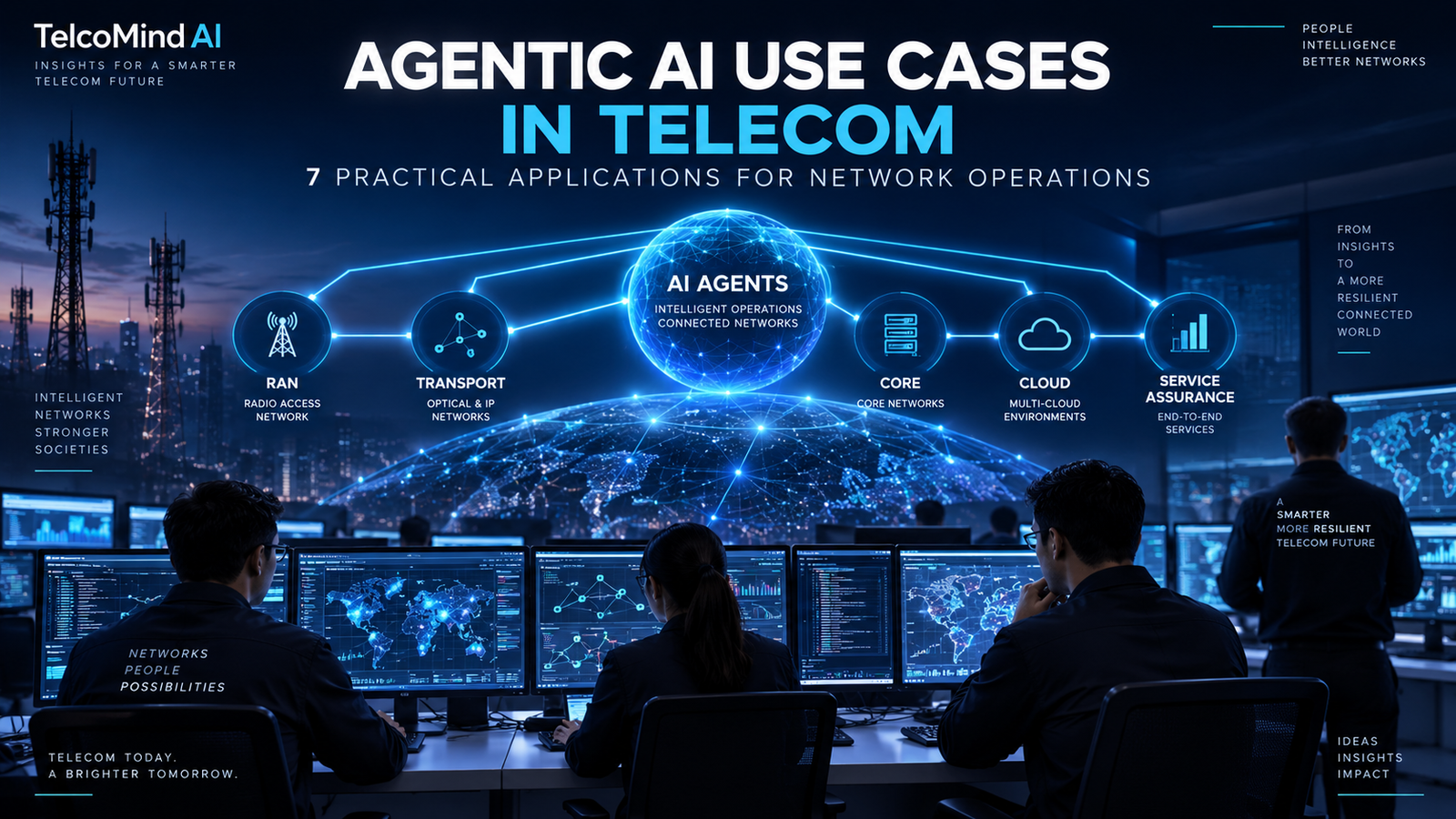
Where Can Agentic AI Actually Be Used in a Telecom Network?
Agentic AI is becoming one of the most discussed ideas in telecom AI.
But for network operators, the important question is no longer simply:
“What is Agentic AI?”
The more useful question is:
“What operational problem can an AI agent actually solve?”
Imagine a major service degradation.
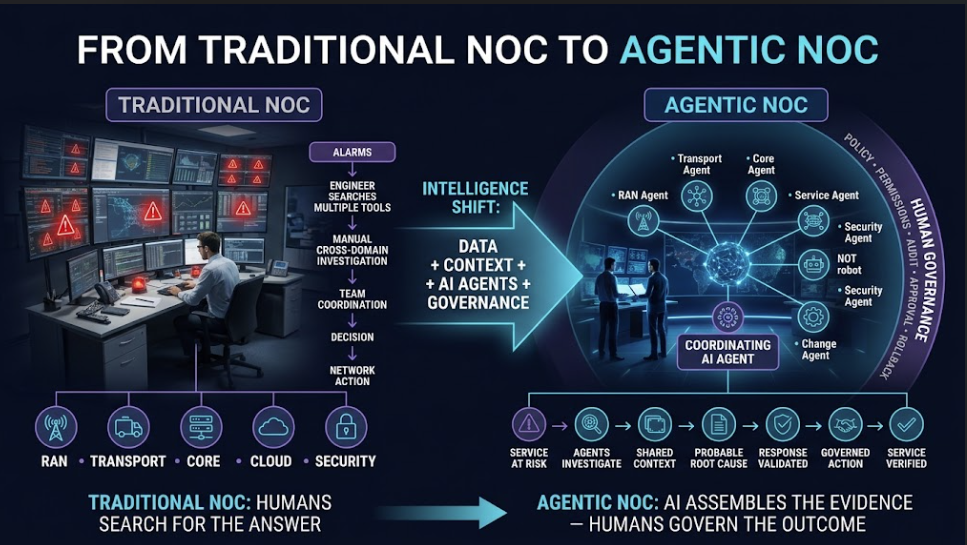
Today, an engineer may need to move between alarm systems, performance dashboards, configuration records, change-management tools and network logs before understanding what happened.
An Agentic AI system could approach the same problem differently.
It could gather evidence from multiple systems, investigate possible causes, coordinate with specialized AI agents, evaluate possible actions and present the engineer with a recommended response.
For approved low-risk situations, it could eventually execute a controlled action and verify whether the service recovered.
That changes the operational flow from:
ALARM → ENGINEER SEARCHES → INVESTIGATES → DECIDES → ACTS
toward:
ALARM → AI INVESTIGATES → CORRELATES → REASONS → RECOMMENDS → GOVERNED ACTION → VERIFIES
But not every telecom problem needs an AI agent.
The real value appears when a task requires multiple steps, multiple systems, contextual reasoning and coordinated decisions.
This article explores seven practical Agentic AI use cases in telecom network operations—and, importantly, where operators should and should not give AI operational authority.
The value of Agentic AI is not that it can talk about the network. It is whether it can help move an operational problem safely toward resolution.
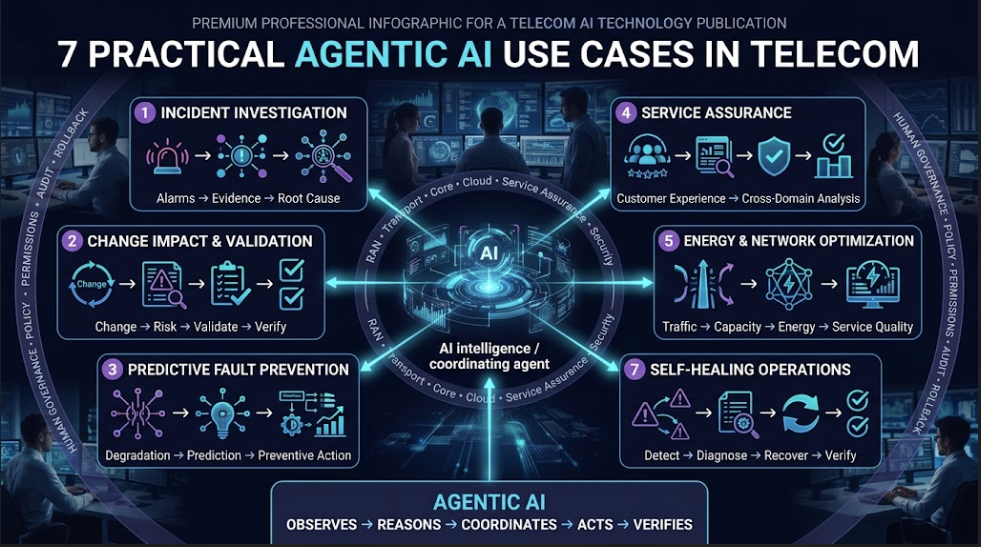
Use Case 1: Autonomous Incident Investigation
Incident investigation is one of the strongest potential applications for Agentic AI because the information required to understand a network problem is often distributed across multiple systems.
Consider a sudden degradation affecting thousands of mobile customers.
The NOC sees several symptoms:
RAN alarms → Transport packet loss → Core KPI degradation → Customer complaints
The difficult question is:
Are these four different problems—or four symptoms of the same problem?
An Agentic AI system could assign different tasks to specialized agents.
A RAN Agent checks cell alarms and performance changes.
A Transport Agent investigates congestion, interface errors and path changes.
A Core Agent examines session failures and service KPIs.
A Change Agent checks whether any recent configuration or software change matches the incident timeline.
A coordinating agent could then combine the evidence and build a probable incident story:
Recent transport change → Packet loss increases → RAN service degradation → Core sessions affected → Customer experience deteriorates
Instead of engineers manually searching several platforms, the system could present:
Probable Root Cause → Supporting Evidence → Affected Services → Recommended Action → Confidence Level
The engineer can then validate the evidence and decide whether the recommended action is safe.
MULTIPLE ALARMS → MULTIPLE AGENTS → SHARED CONTEXT → PROBABLE ROOT CAUSE → GOVERNED RESPONSE
Agentic AI becomes valuable when it can turn fragmented network evidence into an investigation engineers can verify and act upon.
Use Case 2: Change Impact Analysis and Validation
Many network incidents do not begin with hardware failure or an external attack.
They begin with a planned change.
A routing update, software upgrade, parameter modification or cloud configuration may complete successfully from a technical perspective—but still create unexpected service impact somewhere else.
Imagine a routing change is planned in the transport network.
Before execution, an Agentic AI system could coordinate several checks:
Change Agent → Understands the proposed configuration.
Topology Agent → Identifies affected network paths and dependencies.
Capacity Agent → Checks whether alternative routes have sufficient capacity.
Service Agent → Identifies enterprise, voice, 5G or other critical services using those paths.
Risk Agent → Reviews similar historical changes and previous incidents.
The system could then produce:
CHANGE → DEPENDENCIES → POSSIBLE IMPACT → RISK LEVEL → RECOMMENDATION
For a higher-risk change, the proposed action could also be tested through a Network Digital Twin before touching the live network.
But Agentic AI should not stop working once the change is executed.
It could compare network conditions before and after the change, checking latency, packet loss, alarms, traffic distribution and service KPIs.
If unexpected degradation appears, it could recommend a rollback—or execute an already approved rollback policy where appropriate.
BEFORE THE CHANGE: UNDERSTAND THE RISK
AFTER THE CHANGE: VERIFY THE OUTCOME
A successful change should not mean only that the command executed correctly. It should mean that the network remained healthy after it was executed.
Use Case 3: Predictive Fault Prevention Before the Outage
Some of the most valuable network incidents are the ones that never happen.
Telecom equipment often shows warning signs before a major failure: rising temperature, increasing optical errors, unstable power, repeated interface flaps, abnormal CPU utilization or gradually deteriorating performance.
The problem is that these signals may appear in different monitoring systems and at different times.
Imagine an optical transmission link begins showing increasing errors.
A traditional system may generate threshold alarms once conditions become serious.
An Agentic AI workflow could investigate earlier.
Performance Agent → Detects unusual degradation compared with historical behavior.
Transmission Agent → Checks optical power, errors and link performance.
Topology Agent → Identifies services and network elements dependent on the link.
Maintenance Agent → Reviews previous faults and maintenance history.
Capacity Agent → Determines whether traffic could safely use an alternative path.
The agents could combine their findings:
DEGRADING SIGNAL → FAILURE PROBABILITY → SERVICE EXPOSURE → AVAILABLE PROTECTION → RECOMMENDED ACTION
Instead of waiting for the equipment to fail, the operator might proactively reroute traffic, schedule maintenance or replace a deteriorating component during a controlled window.
The important distinction is that Agentic AI would not merely predict a failure.
It could help coordinate what should happen because a failure is predicted.
PREDICTION TELLS US WHAT MAY FAIL. AGENTIC AI CAN HELP DETERMINE WHAT WE SHOULD DO ABOUT IT.
The operational value of prediction appears when insight is converted into a safe action before customers are affected.
Use Case 4: Service Assurance Before Customers Complain
A network can look healthy while customers are already experiencing a poor service.
Traditional monitoring often looks at individual network domains. But a customer experiences the complete service journey.
Imagine enterprise customers in one area begin experiencing intermittent video and voice degradation.
There is no major outage.
RAN availability remains high.
Core systems appear healthy.
Transport utilization is within normal thresholds.
Yet customer experience is deteriorating.
An Agentic AI system could investigate the service across domains.
Customer Experience Agent → Detects unusual degradation in service-quality indicators.
RAN Agent → Checks radio quality, congestion and mobility behavior.
Transport Agent → Examines latency, packet loss and path performance.
Core Agent → Reviews sessions, signaling and service KPIs.
Change Agent → Searches for recent changes matching the degradation timeline.
The coordinating agent could discover that no single domain has crossed a major alarm threshold—but several small degradations are combining to affect the customer.
It could produce:
CUSTOMER IMPACT → CROSS-DOMAIN EVIDENCE → PROBABLE CAUSE → AFFECTED SERVICES → RECOMMENDED ACTION
This changes service assurance from waiting for:
CUSTOMER COMPLAINT → TICKET → INVESTIGATION
toward:
EXPERIENCE DEGRADATION → AI INVESTIGATION → EARLY ACTION → SERVICE PROTECTED
Agentic AI could help telecom operations investigate the service from the customer’s perspective—not only from the perspective of individual network elements.
Use Case 5: Intelligent Energy and Network Optimization
Reducing network energy consumption sounds simple until service quality, coverage and capacity are added to the equation.
Imagine traffic falls significantly across part of the mobile network during the night.
Some radio resources could potentially operate in a lower-energy state.
But switching resources off based only on traffic volume could create another problem if demand suddenly increases or neighboring sites cannot absorb the load.
Agentic AI could coordinate several perspectives before making a recommendation.
Traffic Agent → Predicts demand for the next period.
RAN Agent → Identifies resources that could potentially enter energy-saving mode.
Capacity Agent → Checks whether neighboring resources can handle additional traffic.
Service Agent → Protects critical services and customer-experience requirements.
Energy Agent → Calculates the potential energy benefit.
The coordinating agent could then evaluate:
ENERGY SAVING vs CAPACITY vs COVERAGE vs SERVICE QUALITY
For example, instead of simply deciding:
“Switch this resource off.”
the system could reason:
Traffic is low → Neighboring capacity is sufficient → No critical service risk detected → Energy-saving action is permitted → Monitor KPIs → Restore capacity automatically if demand changes
This is important because optimization rarely has only one objective.
The network may simultaneously need to reduce energy, maintain SLA performance, protect coverage and preserve resilience.
THE BEST OPTIMIZATION IS NOT THE ONE THAT SAVES THE MOST ENERGY. IT IS THE ONE THAT SAVES ENERGY WITHOUT COMPROMISING THE REQUIRED SERVICE OUTCOME.
Agentic AI becomes especially useful when the network must balance several competing objectives rather than optimize one KPI in isolation.
Use Case 6: AI-Powered Cyber Defense and Threat Response
Cybersecurity becomes more complex when a threat moves across several parts of the telecom environment.
Imagine abnormal traffic begins hitting an important service.
At the same time, unusual login activity appears, an API starts receiving unexpected requests and service latency begins increasing.
Individually, these events may generate separate alerts.
Agentic AI could investigate whether they are actually part of one coordinated security incident.
Security Agent → Analyzes threat indicators and abnormal traffic.
Identity Agent → Investigates suspicious accounts and access behavior.
Network Agent → Checks affected infrastructure and traffic patterns.
Service Assurance Agent → Determines whether customers or critical services are being impacted.
Change Agent → Checks whether suspicious configuration activity occurred during the same period.
A coordinating agent could combine the evidence:
ABNORMAL BEHAVIOR → CROSS-DOMAIN CORRELATION → THREAT ASSESSMENT → SERVICE RISK → RESPONSE OPTIONS
For a high-confidence, predefined scenario, controlled actions might include rate-limiting suspicious traffic, isolating a compromised component, blocking unauthorized access or rolling back an unsafe change.
But cybersecurity also demonstrates why Agentic AI needs strict governance.
An AI agent capable of protecting the network can itself become a risk if its identity, permissions, data sources and operational authority are not properly controlled.
THE MORE AUTHORITY WE GIVE AN AI AGENT TO DEFEND THE NETWORK, THE MORE CAREFULLY WE MUST SECURE THE AGENT ITSELF.
For a deeper explanation of this challenge, see our article on AI-powered cybersecurity in telecom.
Agentic cyber defense is not only about responding at machine speed. It is about responding at machine speed within boundaries the operator can trust.
Use Case 7: Self-Healing Network Operations
Self-healing is where many of the capabilities discussed in the previous use cases begin to come together.
Imagine a critical network service suddenly degrades.
The system must do more than detect an alarm.
It needs to understand:
What failed?
What services are affected?
What caused the failure?
What recovery options are available?
Which action is safest?
Did the action actually restore the service?
Agentic AI could coordinate specialized agents to answer these questions.
Detection Agent → Identifies abnormal network behavior.
Diagnosis Agent → Correlates alarms, KPIs, topology and recent changes.
Service Agent → Determines customer and business impact.
Recovery Agent → Identifies possible remediation actions.
Risk Agent → Checks dependencies, policies and potential side effects.
The coordinating agent could then build a controlled recovery path:
DETECT → DIAGNOSE → UNDERSTAND IMPACT → SELECT RESPONSE → VALIDATE → ACT → VERIFY
For a known, low-risk failure, an approved recovery action could execute automatically.
For an uncertain or high-impact situation, the system should provide the evidence and recommendation to an engineer for approval.
And there is one critical final step:
Verification.
Restarting a process, rerouting traffic or rolling back a configuration does not mean the incident is resolved.
The system must confirm that network KPIs recovered, alarms cleared and the affected service returned to the required level.
SELF-HEALING IS NOT “AI FIXED SOMETHING.” IT IS “THE NETWORK UNDERSTOOD THE FAILURE, RECOVERED SAFELY AND VERIFIED THE OUTCOME.”
For a deeper technical explanation, see self-healing telecom networks.
The closed loop is not complete when the action is executed. It is complete when the service outcome is verified.
Which Agentic AI Use Case Should Telecom Operators Implement First?
Not every use case should move to Agentic AI at the same time.
The best starting point is usually not the most futuristic use case. It is the operational problem where the operator already has good data, repetitive investigation work, measurable business impact and relatively safe actions.
For many NOCs, incident investigation could be a strong starting point.
Why?
The AI agent can initially work in observation and recommendation mode. It can gather alarms, KPIs, topology, logs and change information without being given authority to modify the live network.
Once its recommendations become reliable, operators can gradually progress toward more operational responsibility.
| Use Case | Potential Value | Implementation Complexity | Automation Risk | Good Starting Point? |
|---|---|---|---|---|
| Incident Investigation | High | Medium | Low | Yes |
| Change Impact & Validation | High | Medium | Medium | Yes |
| Predictive Fault Prevention | High | Medium | Low–Medium | Yes |
| Service Assurance | High | Medium | Low | Yes |
| Energy Optimization | Medium–High | High | Medium | Later |
| Cyber Defense | Very High | High | High | Controlled Pilot |
| Self-Healing Operations | Very High | Very High | High | Advanced Stage |
This is not a universal ranking. An operator’s starting point should depend on its network architecture, available data, operational pain points, automation maturity and governance capability.
START WHERE THE BUSINESS VALUE IS CLEAR AND THE OPERATIONAL RISK CAN BE CONTROLLED.
How Do You Implement Agentic AI Without Giving It Control Too Early?
Give the AI agent access to approved operational data such as:
Alarms → KPIs → Logs → Topology → Change Records → Service Information
The agent observes and builds context, but takes no operational action.
Stage 2 — Investigate
Allow the agent to correlate information, investigate possible causes and generate a probable root cause with supporting evidence.
Engineers compare its findings with their own investigation.
Stage 3 — Recommend
The agent begins recommending actions.
For example:
Probable transport congestion → Identify affected services → Evaluate alternate path → Recommend rerouting
The engineer still makes the decision.
Stage 4 — Human-Approved Execution
Once recommendations have been repeatedly proven, the agent may prepare or initiate an action—but execution requires engineer approval.
Every action should have clear permissions, audit records and rollback conditions.
Stage 5 — Controlled Autonomy
Only proven, low-risk and well-defined scenarios move toward autonomous execution.
The AI agent acts within predefined boundaries and immediately verifies the outcome.
If confidence is low, conditions change or verification fails:
STOP → ROLLBACK → ESCALATE TO HUMAN
OBSERVE → INVESTIGATE → RECOMMEND → HUMAN APPROVES → CONTROLLED AUTONOMY
Do not measure Agentic AI maturity by how much control the AI has. Measure it by how much operational responsibility it can handle safely and reliably.
Is Agentic AI in Telecom Still a Concept—or Is It Becoming Real?
Agentic AI in telecom is no longer limited to research discussions. During 2026, vendors, operators and industry bodies have increasingly moved toward real operational frameworks, products and trials.
For example, Ericsson describes an agentic network-intelligence approach where specialized agents can support root-cause analysis and impact analysis, using subscriber events, network data, historical tickets, topology and operational knowledge to help teams identify problems earlier and understand their likely impact.
Nokia has also introduced agentic AI capabilities for network operations. Its IP-network framework includes an AI-driven troubleshooting agent designed to accelerate root-cause analysis and provide guided, explainable actions within operator-defined policy and security boundaries.
The movement is also reaching autonomous-network architecture. TM Forum’s 2026 Autonomous Operations Target Operating Model positions AI agents as a bridge between business intent and technical execution, while providing a framework for trusted decision-making and orchestration across network, OSS/BSS and operational systems.
There are operator-level signals too. At DTW Ignite 2026, Vodafone and Google Cloud presented production-scale Agentic AI workflows spanning the network lifecycle, while TM Forum showcased projects involving Agentic NOCs, trusted AI agents, multi-agent network planning and autonomous operations.
This does not mean telecom networks have suddenly become fully autonomous.
It means the industry is moving from:
AGENTIC AI CONCEPT → OPERATIONAL USE CASE → CONTROLLED DEPLOYMENT → MULTI-AGENT OPERATIONS → INCREASING AUTONOMY
The question is gradually changing from “Can Agentic AI work in telecom?” to “Where can it create measurable value without introducing unacceptable operational risk?”
What Happens When an AI Agent Makes the Wrong Decision?
Agentic AI can accelerate network operations, but speed becomes dangerous when the underlying decision is wrong.
Imagine an AI agent detects congestion and decides that traffic should be rerouted.
The action looks reasonable.
But the agent does not know that the alternative path is carrying a critical enterprise service and has limited spare capacity.
The rerouting solves one problem—and creates another.
The failure was not necessarily the AI model itself.
The agent was missing network context.
Similar problems can occur when agents operate with:
Incomplete topology information
Poor-quality or delayed data
Incorrect service dependencies
Excessive permissions
Conflicting objectives
Outdated operational procedures
No validation or rollback mechanism
This is why giving an AI agent access to more tools does not automatically make it more intelligent.
An operational agent needs to understand not only:
“Can I execute this action?”
but also:
“Should I execute it, what else could it affect, and can I safely reverse it?”
For high-impact actions, operators may also use simulation or a Network Digital Twin to test the proposed change before touching the live network.
AGENTIC AI WITHOUT CONTEXT + GOVERNANCE + VERIFICATION CAN TURN AUTOMATION SPEED INTO OPERATIONAL RISK.
The safest AI agent is not the one capable of taking the most actions. It is the one that understands when it should not act.
Where Is the Business Value of Agentic AI?
Agentic AI should not be justified simply because it is a new technology.
For telecom operators, the business case must come from measurable operational improvement.
Consider incident investigation.
If engineers currently spend significant time collecting alarms, checking dashboards, reviewing changes and coordinating across RAN, transport and core teams, an AI agent that shortens this investigation can create measurable value.
Operators can track:
Mean Time to Identify (MTTI) — How quickly is the probable problem identified?
Mean Time to Repair (MTTR) — Does faster investigation lead to faster recovery?
Engineering hours — How much repetitive investigation effort is reduced?
Service-impact minutes — Are customer-affecting incidents resolved earlier?
Change failures — Can Agentic AI identify risky changes before implementation?
Prevented incidents — Can predictive agents help teams act before failures occur?
The financial model can then use the operator’s own historical data.
Annual Benefit = Reduced Engineering Cost + Avoided Service Impact + Reduced Incident/Escalation Cost + Prevented Operational Loss
ROI (%) = (Annual Benefit − Annual Agentic AI Cost) ÷ Annual Agentic AI Cost × 100
But there is another important measure:
How much operational responsibility can AI safely absorb?
An agent saving ten minutes but creating additional operational risk may provide little real value.
An agent that reliably reduces investigation time while keeping engineers in control can be much more valuable.
The business case for Agentic AI is not the number of agents deployed. It is the operational outcome those agents improve.
What Could the Agentic NOC Look Like by 2030?
Today’s NOC is largely organized around network domains, monitoring platforms and operational teams.
The future NOC may increasingly organize intelligence around problems, services and business outcomes.
Imagine a major enterprise service begins degrading.
Instead of one engineer manually coordinating several teams, specialized agents could begin working simultaneously:
Service Agent → Understands customer and SLA impact.
RAN Agent → Investigates radio conditions.
Transport Agent → Checks paths, congestion and failures.
Core Agent → Analyzes sessions and signaling.
Security Agent → Determines whether abnormal behavior has a cyber dimension.
Change Agent → Checks recent network modifications.
A coordinating agent could combine their findings and maintain a shared operational picture.
The next evolution could connect this directly with intent-driven operations.
Instead of simply asking:
“What is wrong with the network?”
the system could continuously work toward an operator-defined objective such as:
“Maintain premium enterprise service within the agreed SLA while protecting network resilience.”
AI agents could investigate threats to that intent, coordinate possible responses and recommend—or eventually execute—approved actions.
The NOC engineer’s interface could therefore evolve from thousands of individual alarms toward something more outcome-oriented:
SERVICE AT RISK → AI AGENTS INVESTIGATING → PROBABLE CAUSE IDENTIFIED → RESPONSE VALIDATED → ACTION APPROVED → SERVICE VERIFIED
But humans remain essential for defining objectives, policies, risk boundaries and accountability.
THE FUTURE NOC MAY NOT BE MANAGED BY ONE AI AGENT. IT MAY BE ORCHESTRATED THROUGH MANY SPECIALIZED AGENTS WORKING WITH HUMAN EXPERTS TOWARD SHARED NETWORK OUTCOMES.
Agentic AI could change the NOC from a place where engineers search for answers into an environment where intelligence continuously assembles the evidence needed for better decisions.
A Practical 90-Day Agentic AI Pilot for the Telecom NOC
Operators do not need to build a fully Agentic NOC to start.
Choose one measurable use case. For example:
Autonomous Incident Investigation
Days 1–30: Build the Operational Context
Connect the minimum information the agent needs:
Alarms + KPIs + Logs + Topology + Change Records + Service Context
Measure today’s baseline:
Investigation time • MTTR • Engineering effort • Escalations • Service-impact minutes
At this stage:
AI OBSERVES — ENGINEERS INVESTIGATE
Days 31–60: Shadow the Engineers
Allow the agent to investigate incidents independently.
For every incident compare:
AI Root Cause vs Engineer Root Cause
AI Evidence vs Engineer Evidence
AI Recommendation vs Actual Action
The objective is to prove whether the agent can produce reliable and explainable operational conclusions.
At this stage:
AI INVESTIGATES + RECOMMENDS — ENGINEERS DECIDE
Days 61–90: Introduce Controlled Action
Select only well-understood, low-risk scenarios.
Allow the agent to prepare or execute approved actions within strict policies.
Every action should include:
Authorization → Audit Trail → Rollback → Verification
If confidence is low or the situation falls outside policy:
STOP → ESCALATE TO ENGINEER
Day 90: Decide Whether to Scale
Ask:
Did investigation become faster?
Was root-cause accuracy acceptable?
Did MTTR improve?
Was engineering effort reduced?
Were recommendations explainable?
Did any AI action introduce additional operational risk?
Only then should the operator expand to another use case or increase autonomy.
ONE USE CASE → OBSERVE → SHADOW → PROVE → CONTROL → MEASURE → SCALE
The first Agentic AI project should prove trust—not autonomy.
From AI Assistance to Agentic Network Operations
Agentic AI could represent an important next step in telecom network operations—but its value will not come from simply adding AI agents to the NOC.
The real opportunity is connecting network data, operational context, specialized intelligence and controlled actions around problems that engineers deal with every day.
The seven use cases in this article show where that could happen:
Incident investigation. Change validation. Predictive fault prevention. Service assurance. Energy optimization. Cyber defense. Self-healing operations.
Some can begin today as AI-assisted workflows.
Others will require stronger automation, better data, clearer policies and much higher levels of operational trust before greater autonomy is appropriate.
The journey should therefore be gradual.
Start with a real operational problem.
Give the agent enough context to understand it.
Measure its decisions against experienced engineers.
Prove the value.
Then increase responsibility only when the evidence supports it.
Agentic AI should ultimately help telecom teams move from searching across fragmented systems toward making faster, better-informed and more coordinated network decisions.
The future of Agentic AI in telecom will not be decided by how many AI agents operators deploy. It will be decided by how reliably those agents improve real network outcomes.
START WITH THE PROBLEM → BUILD CONTEXT → PROVE THE DECISION → GOVERN THE ACTION → VERIFY THE OUTCOME → SCALE
How Ready Is Your NOC for Agentic AI?
Before deploying AI agents, operators need to understand whether their NOC has the required foundations.
That includes data and observability, automation, AIOps, decision intelligence, closed-loop operations and governance.
TelcoMind AI has created a free NOC AI Maturity Assessment to help telecom teams evaluate their current position and identify the capabilities they need to strengthen before moving toward more autonomous operations.
→ Take the Free NOC AI Maturity Assessment
Related TelcoMind AI Insights
1. Agentic AI in Telecom Operations: From AI Assistance to Autonomous Action
3. Self-Healing Telecom Networks: How AI Detects, Diagnoses and Recovers Network Failures
Leave a Reply