The Incident Is Open. The Engineer Has 10 Places to Look.
A critical service alarm appears in the NOC during the evening busy hour.
Within minutes, the engineer begins the familiar investigation — checking alarms, performance dashboards, recent changes, network logs, topology, trouble tickets and previous incidents.
The information exists.
The problem is that it exists everywhere.
One monitoring system shows the alarm. Another shows the affected network element. Performance data sits on a different dashboard. Configuration changes are recorded somewhere else. Previous incidents may be buried inside ticket history, emails or operational documents.
The engineer has the tools — but still has to connect the story manually.
“What changed? What is affected? Have we seen this before? And what should I check first?”
Now imagine the engineer asking those four questions directly to an AI assistant connected to the operational knowledge and approved network data.
Instead of opening multiple systems one by one, the engineer receives a structured response:
Likely affected service identified.
Relevant network changes found.
Similar historical incidents retrieved.
Recommended investigation steps prepared.
This is where Generative AI in the NOC becomes much more interesting than a chatbot.
The real opportunity for GenAI is not simply answering questions. It is helping engineers turn fragmented operational information into faster, better-informed decisions.
A Chatbot Can Answer. A NOC Copilot Must Understand Context.
Most people first experienced Generative AI through a simple interaction: ask a question and receive an answer.
That is useful, but a telecom NOC requires something much deeper.
An engineer investigating an incident does not need a generic explanation of what packet loss, congestion or signaling failure means. The engineer needs GenAI to understand the specific operational context of the network.
Imagine Asking the NOC This Question
“Why did customer data performance deteriorate in this region during the last 30 minutes?”
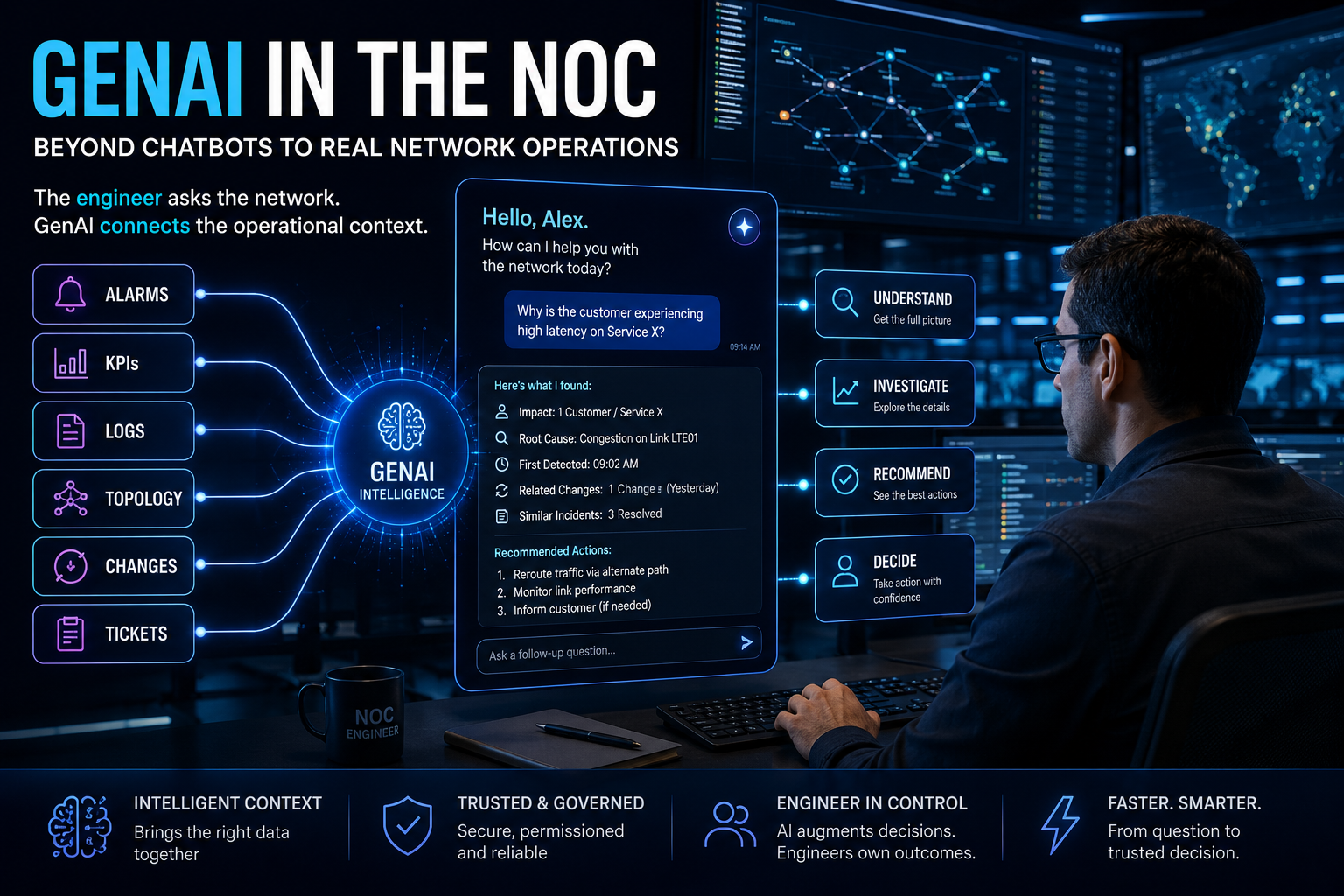
A useful NOC copilot should not immediately guess the answer. It should bring together the information available from approved operational sources — alarms, KPIs, topology, recent changes, logs, tickets and historical incidents — and help the engineer build the investigation.
It might respond with something like:
Service impact: Mobile data degradation detected across the affected area.
Network evidence: Increased latency and declining throughput observed.
Recent change: A relevant configuration change was completed before degradation began.
Historical context: Two similar incidents were found in previous operational records.
Recommended next step: Validate the suspected path and configuration before taking corrective action.
The difference is important.A normal chatbot provides information.A properly integrated NOC copilot provides operational context.
GenAI becomes valuable in network operations when it understands not only the engineer’s question, but also the network context behind that question.
Where GenAI Can Actually Help the NOC Engineer
The value of GenAI becomes clearer when we stop treating it as a general-purpose chatbot and place it inside real operational workflows.
During an incident, engineers spend significant time not only fixing the problem, but also finding information, interpreting technical data and connecting evidence from different systems.
This creates several practical opportunities.
1. Investigate Alarms and Incidents Faster
Instead of manually reviewing dozens of related alarms, the engineer could ask GenAI to summarize what happened, identify the affected network domains and highlight the events most relevant to the investigation.
2. Interpret Logs and Technical Information
Large logs, traces and configuration outputs can take time to analyze. GenAI can help summarize important patterns, explain unusual entries and direct the engineer toward areas that deserve deeper investigation.
3. Search Years of Operational Knowledge
Previous tickets, troubleshooting guides, vendor documents, known-error databases and incident reports contain valuable knowledge — but finding the right information during an outage can be difficult.
GenAI can make that knowledge conversational:
“Show me previous incidents with similar symptoms and how they were resolved.”
4. Support Change and Troubleshooting Decisions
Before implementing a corrective action, the engineer could ask GenAI to summarize the proposed change, identify known dependencies, retrieve similar historical changes and highlight potential operational risks.
5. Automate Operational Documentation
After an incident, GenAI can help prepare incident summaries, shift handovers, troubleshooting notes and management updates using verified operational information.
The first major productivity gain from GenAI in the NOC may not come from controlling the network. It may come from reducing the time engineers spend searching, interpreting and documenting information.
From Engineer Question to Operational Intelligence

But What Happens When GenAI Gets It Wrong?
A wrong answer from a normal chatbot may be inconvenient.
A wrong recommendation during a live network incident can be much more serious.
If GenAI incorrectly interprets an alarm, misunderstands a configuration, retrieves an outdated procedure or confidently suggests the wrong corrective action, it could increase rather than reduce operational risk.
The NOC Cannot Operate on Confidence Alone
For operational use, GenAI should be grounded in trusted and current network information. Engineers should be able to understand where a recommendation came from and verify the evidence behind it.
The system should clearly distinguish between what it knows from operational data, what it retrieved from approved knowledge sources, and what it is inferring.
In the NOC, a confident answer is not enough. The answer must be explainable, traceable and verifiable.
This becomes even more important as GenAI moves from simply summarizing information toward recommending operational actions.
The closer AI gets to changing the network, the stronger the requirements for validation, permissions, governance and human oversight become.
What Could a GenAI-Assisted Incident Look Like?
Imagine a high-priority service degradation appearing during the evening busy hour.
Instead of immediately moving between multiple tools, the engineer opens the NOC copilot and asks:
“Investigate the service degradation. What changed, what is affected, and where should I start?”
The GenAI system begins bringing together the available operational context.
1. It summarizes the incident
Relevant alarms, affected network elements and abnormal KPIs are brought into one view.
2. It checks recent changes
The system identifies configuration or software changes that occurred before the degradation started.
3. It searches previous incidents
Similar symptoms and their historical resolutions are retrieved from approved operational records.
4. It connects the service impact
Network symptoms are related to potentially affected services, locations or customer groups.
5. It recommends the next investigation steps
Rather than automatically changing the network, GenAI gives the engineer a prioritized set of checks supported by the evidence it found.
The engineer can then validate the recommendation, investigate deeper where necessary and decide what action should be taken.
The engineer remains responsible for the decision. GenAI reduces the time required to reach that decision.
Should GenAI Be Allowed to Touch the Network?
There is a major difference between asking GenAI to summarize an incident and allowing it to execute a network change.
A NOC copilot might confidently recommend:
“Traffic congestion is the probable cause. I recommend rerouting traffic through the alternate path.”
But before that recommendation becomes an action, several questions matter.
Is the diagnosis sufficiently reliable? Is the alternate path healthy? What services could be affected? Has this action been approved for automation? Can the change be rolled back safely if the result is unexpected?
Autonomy Should Increase With Evidence — Not With AI Confidence
A sensible progression could begin with GenAI simply explaining and summarizing operational information.
As trust develops, it can recommend troubleshooting steps.
For proven and repeatable scenarios, it could then prepare an action for engineer approval.
Eventually, selected low-risk use cases could allow the system to execute an approved action, verify the result and automatically roll back when predefined conditions are not met.
UNDERSTAND → RECOMMEND → APPROVE → ACT → VERIFY
Not every incident needs to reach the final stage. Critical services, unfamiliar conditions and high-impact changes may continue to require direct engineering approval.
The objective is not to give GenAI unlimited control of the network. It is to give it exactly the level of authority that the operational risk allows.
A GenAI NOC Copilot Is Only as Good as the Data Behind It
A powerful language model alone cannot understand a telecom network.
To provide useful operational guidance, the GenAI layer needs controlled access to the right network data, operational context and engineering knowledge.
The Intelligence Has to Connect to the Network
Depending on the use case, that context could come from alarm and event systems, performance management platforms, topology and inventory, configuration records, change-management systems, trouble tickets, service-assurance platforms and approved engineering documentation.
But connecting more data does not automatically create better intelligence.
The information must be current, trustworthy, correctly permissioned and relevant to the engineer’s question.
Without trusted operational context, GenAI is a language model. With the right context, it can become an engineering copilot.
This also means operators do not need to begin by connecting GenAI to everything.
A safer approach is to start with a clearly defined operational use case, connect only the required trusted data sources, measure the quality of the recommendations and expand gradually as confidence grows.
Start with one use case → connect trusted data → validate with engineers → measure results → expand carefully.
Does GenAI Reduce the Need for NOC Engineers?
It may reduce some of the repetitive work engineers perform today — searching documentation, collecting incident information, preparing summaries and moving between multiple operational tools.
But reducing repetitive work is very different from removing engineering responsibility.
The Engineer’s Role Starts to Shift
As GenAI becomes part of network operations, engineers may spend less time finding information and more time evaluating what the information means.
Their role can increasingly move toward validating AI recommendations, understanding service impact, assessing operational risk, approving higher-impact actions and improving the knowledge and rules that AI systems depend on.
The future NOC engineer may spend less time searching for the answer — and more time deciding whether the answer is right.
That requires something GenAI cannot simply inherit from network data: operational judgement.
An experienced engineer understands that two technically similar incidents may require completely different decisions because of customer impact, redundancy conditions, maintenance activity, business priorities or risks elsewhere in the network.
GenAI can accelerate engineering knowledge. Experience still determines how safely that knowledge is applied.
What Could the GenAI-Powered NOC Look Like?
The biggest change may not be another dashboard.
It may be a completely different way for engineers to interact with network operations.
Instead of opening multiple systems and manually building the operational picture, an engineer could begin with a simple question:
“Give me the three most important network risks right now and explain why they matter.”
The NOC copilot could bring together alarms, performance trends, recent changes, service impact and historical knowledge to create a prioritized operational view.
The engineer could then continue the investigation conversationally:
“Which customers and services are potentially affected?”
“What changed before this started?”
“Have we experienced this pattern before?”
“What are the safest recovery options?”
“Show me the evidence behind your recommendation.”
This could fundamentally change the NOC interface.
Rather than engineers adapting themselves to dozens of operational tools, the intelligence layer begins bringing the relevant information to the engineer in the context of the problem being investigated.
The future NOC may not be defined by how many dashboards engineers can monitor, but by how quickly they can move from a question to a trusted operational decision.
Beyond Chatbots: GenAI Becomes Part of Network Operations
The real opportunity for Generative AI in telecom is not putting another chatbot beside the NOC dashboard.
It is connecting natural-language intelligence with trusted operational data, engineering knowledge and existing network workflows so engineers can understand complex situations faster.
The journey will likely happen gradually.
GenAI may begin by searching knowledge and summarizing incidents. It can then support troubleshooting, explain network behavior, identify relevant historical cases and recommend next actions. For carefully controlled use cases, those recommendations may eventually connect with automation.
But intelligence should not be confused with authority.
The more closely GenAI becomes connected to live network operations, the more important verification, security, permissions, governance and human oversight becom
The future of GenAI in the NOC is not AI replacing the engineer. It is the engineer operating with a much more intelligent interface to the network.
And perhaps that is the biggest transformation.
Today, engineers often spend valuable time searching through systems to understand what the network is telling them.
Tomorrow, they may simply ask the network the right question — and receive the evidence needed to make the right decision.
How Ready Is Your NOC for GenAI-Powered Operations?
Introducing GenAI into network operations requires more than selecting an AI model.
The NOC needs the right foundation across data, observability, automation, operational processes, AI capabilities and governance before GenAI can safely become part of critical operational workflows.
TelcoMind AI has developed a practical AI-Ready NOC Maturity Assessment to help telecom professionals understand where their operations stand today and which capabilities may need further development.
Assess your NOC across 8 dimensions and 32 operational areas — from Data & Observability to AIOps, Closed-Loop Operations and Governance.
Take the Free NOC AI Maturity Assessment →
Continue Exploring Telecom AI
Agentic AI in Telecom Operations
AI-Powered AIOps in Telecom: From Alarm Management to Autonomous Network Operations
From Level 0 to Level 5: How Close Are We to Truly Autonomous Telecom Networks?
Leave a Reply