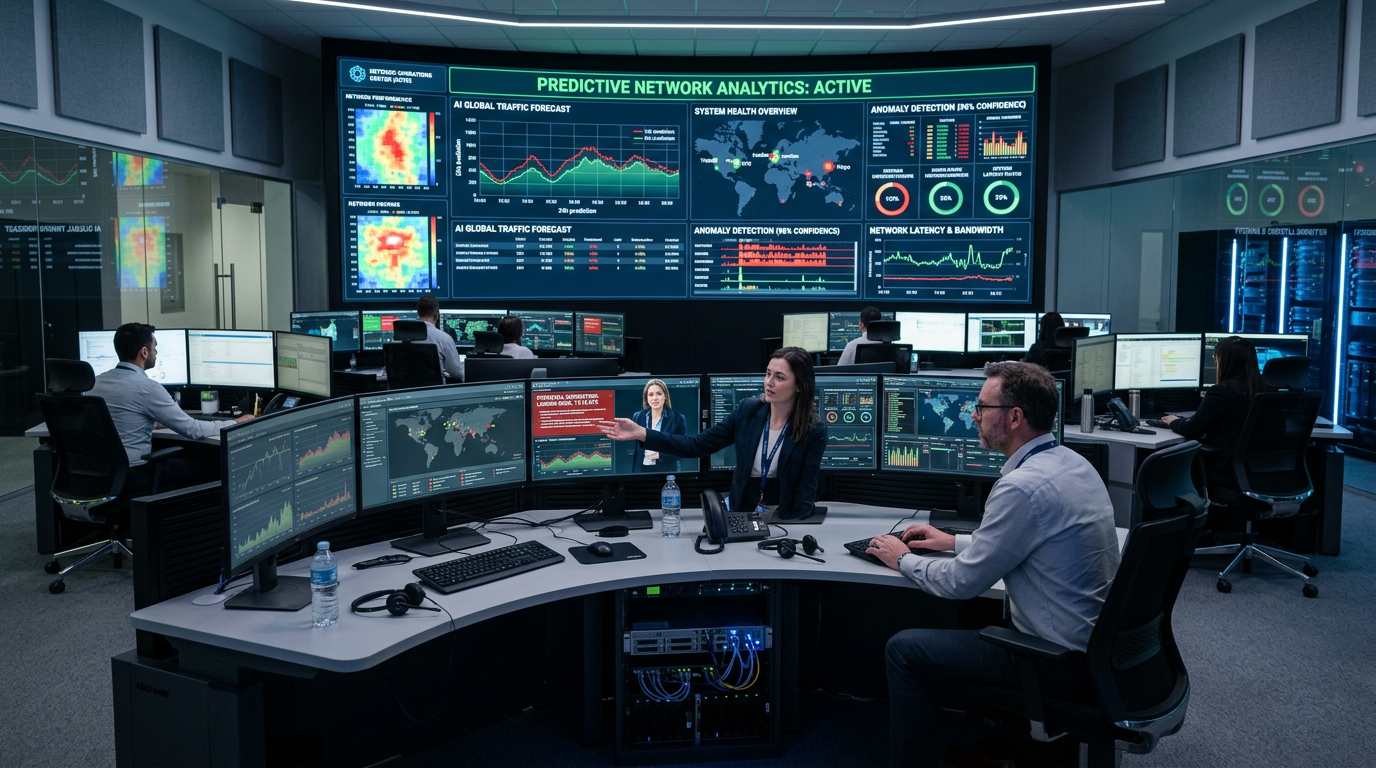
Telecom network operations are entering a fundamental transition. Traditional Network Operations Centers (NOCs) have largely been built around monitoring alarms, identifying failures and responding after service degradation occurs. Artificial Intelligence is changing this model by enabling telecom operators to detect patterns, anticipate network anomalies and support operational decisions before customers experience significant impact.
From Reactive Monitoring to Predictive Operations
For decades, telecom operations have followed a largely reactive model: an alarm is generated, the NOC identifies the affected network element, engineers investigate the root cause, and corrective action follows. This model remains essential, but modern networks are becoming too complex, dynamic and interconnected to depend entirely on human-led reaction. AI introduces a different operational capability: learning from alarms, performance indicators, logs, traffic patterns and historical incidents to identify abnormal behaviour earlier and help predict where service degradation may emerge.
The important shift is therefore not simply from manual operations to automation. It is a shift from “What has failed?” to “What is likely to fail next, why, and what action should we take before customers are affected?” That change fundamentally reshapes the role of the modern NOC.

How AI Enables Predictive Network Operations
AI-driven predictive operations combine network telemetry, performance indicators, alarms, logs and historical incident data to identify patterns that may indicate emerging service degradation. Instead of treating each alarm as an isolated event, AI can correlate signals across multiple network domains and help operations teams understand whether seemingly unrelated events are part of a larger network condition.
The real operational value appears when prediction is connected with decision support. Detecting an anomaly is useful, but identifying its likely impact, probable cause and recommended response makes the insight actionable. This allows the NOC to move progressively from monitoring events toward anticipating service risks and supporting intervention before customers experience significant degradation.
A Simple Operational Example
Consider a mobile network where packet loss begins increasing gradually while interface utilization, latency and retransmissions also start deviating from their normal patterns. A traditional monitoring system may generate separate threshold alarms only after individual KPIs cross predefined limits. An AI-enabled system can instead correlate these weak signals, compare them with historical behaviour and identify an emerging congestion pattern earlier.
The NOC engineer remains important, but the nature of the work changes. Instead of spending most of the time discovering what is happening, the engineer can focus on validating the predicted risk, understanding business impact and selecting the appropriate corrective action.
From Prediction to Autonomous Operations
Predictive capability is only one stage in the evolution toward autonomous telecom operations. The next step is connecting network intelligence with controlled automation. Once an emerging problem is detected and its likely impact is understood, the operational system can recommend or initiate an appropriate response based on predefined policies, risk levels and governance rules.
However, autonomy should not mean uncontrolled automation. Telecom networks carry critical services, and an incorrect automated decision can potentially create greater impact than the original problem. For this reason, the level of automation should depend on operational risk. Low-risk and repetitive actions may be automated, while high-impact changes should continue to require human validation and approval.
The Human Role Does Not Disappear
As networks become more autonomous, the role of the NOC engineer evolves rather than disappears. Engineers increasingly move from repetitive monitoring and manual troubleshooting toward validation, exception management, service-impact assessment and governance of automated decisions.
The future NOC therefore requires both technical expertise and intelligent automation. AI can process enormous volumes of operational data and identify patterns that humans may not detect quickly, while experienced engineers provide context, judgement and accountability. The strongest operating model combines both capabilities.
What This Means Inside a Real NOC
In a real telecom NOC, the journey toward predictive operations does not begin with full autonomy. It begins with improving visibility and connecting information that already exists across the network. Alarms, KPI degradation, traffic behaviour, change activities, customer complaints and historical incidents often provide different pieces of the same operational story.
Consider a major service degradation occurring shortly after a planned network activity. Traditional troubleshooting may require engineers to manually review alarms, logs, routing behaviour and recent changes while multiple technical teams work in parallel. An intelligent operations platform could correlate the timing of the change with abnormal network behaviour, identify the most probable affected domain and present the NOC with prioritized evidence for investigation.
The immediate value is not that AI makes the final decision. The value is that it can reduce the time between “something is wrong” and “this is where we should investigate first.” For critical telecom incidents, that reduction can directly contribute to faster restoration and lower customer impact.
The Path Forward
The transition from reactive NOCs to predictive and eventually autonomous operations will be gradual. Telecom operators need reliable data, strong observability, clearly defined operational policies and appropriate governance before increasing the level of automation.
The objective should not be automation for its own sake. The objective is a network operation that can detect earlier, understand faster, decide more intelligently and act with greater confidence.
The autonomous NOC is therefore not a NOC without people. It is a NOC where human expertise is amplified by machine intelligence.
Industry Perspectives & Further Reading
TM Forum — Autonomous Networks & AI-Native Operations
Industry frameworks and operator case studies on the progression toward higher levels of autonomous network operations.
ETSI — Zero-touch Network and Service Management (ZSM)
Standards and frameworks for closed-loop automation, AI-enabled network management and the evolution from automation toward autonomy.
ITU-T — Intent-Driven Telecommunication Operation and Management
A standards-based framework connecting intent, artificial intelligence and closed-loop management for autonomous telecom operations.
Predictive operations are only one part of the wider AI transformation taking place across telecom networks. AI is also being applied to alarm correlation, preventive maintenance, Agentic AI, Network Digital Twins, 5G optimization, energy efficiency, service assurance and increasingly autonomous network operations.
Explore the complete overview:
AI in Telecom: 10 Real-World Use Cases Transforming Network Operations in 2026

Leave a Reply