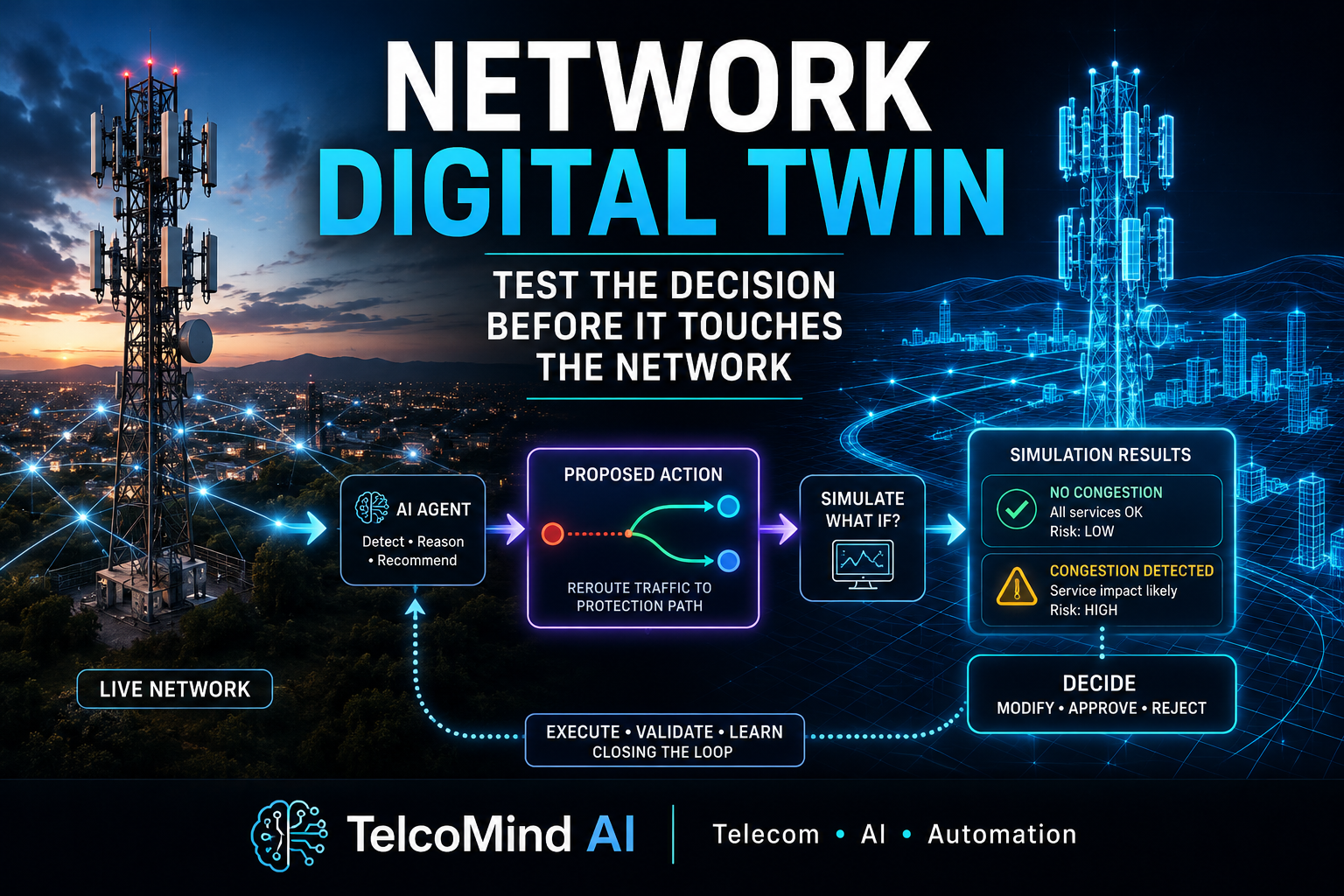
What if a telecom operator could test a network change before touching the live network?
A Network Digital Twin creates a continuously evolving virtual representation of the telecom network, allowing engineering and operations teams to simulate changes, analyze potential impact, identify risks and optimize decisions before implementation in the production network.
Combined with AI, real-time telemetry and network data, the digital twin can evolve beyond traditional simulation into an intelligent decision-support capability for increasingly autonomous telecom operations
One Network. One Decision. Two Possible Outcomes.
A transmission path is deteriorating.
Traffic is still flowing, but performance is moving in the wrong direction. Errors are increasing, packet loss has started to appear, and the operations team knows that waiting for a complete failure is not a good option.
Fortunately, the network has redundancy.
The protection path is available. Its status is green. Capacity appears sufficient.
The proposed action looks straightforward:
Move the affected traffic to the protection path.
It is the kind of decision telecom operations teams make every day.
But there is one question the dashboard cannot answer with certainty:
What will happen to the rest of the network after the traffic moves?
Instead of answering that question with theory, let’s follow the same network decision into two different futures.
Future A: Execute First
The traffic migration begins.
The affected traffic starts moving away from the deteriorating transmission path.
For the first few moments, everything looks good.
Packet loss on the original path begins to disappear. The alarms start clearing. Traffic stabilizes.
The decision appears successful.
Then another alarm appears.
But this alarm is not coming from the original link.
A downstream interface on the protection route is suddenly approaching its operational limit.
More traffic has entered the path than expected. Enterprise services already sharing part of that infrastructure begin experiencing increased latency.
The NOC has solved one problem—but another one is now developing.
The original diagnosis was not wrong.
The protection path was available.
The network did exactly what it was instructed to do.
What was missing was an understanding of what would happen elsewhere after the traffic moved.
The team solved the problem directly in front of them.
But the network responded somewhere else.
One technically correct action has created an unexpected consequence.
Now imagine something we normally cannot do with a live production network.
Rewind the decision.
Go back to the moment before EXECUTE.
Same network. Same degradation. Same proposed solution.
But this time, let’s test the future before we create it.
Future B: Simulate First
The same transmission path is deteriorating.
The same packet loss is developing.
The same protection path is available.
And the same recommendation appears:
Move the affected traffic to the protection path.
But this time, the engineer does not press Execute.
Nothing changes in the live network.
Instead, the proposed action is tested against a digital representation of the current network.
The model receives the affected topology, current traffic conditions, available capacity, configuration and the services depending on those paths.
Then the proposed traffic migration begins.
But only inside the model.
At first, the result looks promising.
Traffic successfully leaves the deteriorating path.
Utilization increases on the protection route—but remains manageable.
Then the simulation exposes something that was not obvious from the original dashboard.
A downstream interface begins approaching its operational limit.
The same secondary problem from our first future is developing again.
But there is one critical difference:
This time, no customer experiences it.
No enterprise service slows down.
No additional incident is created.
No emergency rollback is required.
The failure exists only inside the simulated environment.
The team modifies the plan.
Instead of moving all affected traffic through a single protection path, the load is distributed across two available routes.
The scenario is tested again.
This time, projected utilization remains within the defined operational limits.
Critical service dependencies remain protected.
No secondary congestion develops.
Now—and only now—the action is approved for the real network.
Traffic moves.
The deteriorating path is relieved.
Performance stabilizes.
And the second incident from Future A never happens.
Same network.
Same problem.
Same initial recommendation.
Different decision process.
In the first future, we discovered the consequence after changing the network.
In the second, we discovered it before changing the network.
And that difference brings us to the technology at the center of this article:
The Network Digital Twin.
The Network Digital Twin
What happened in our second future was not simply network simulation.
The proposed action was tested against a digital representation that understood enough about the current network state to show how the network might respond.
That is the idea behind a Network Digital Twin (NDT).
A Network Digital Twin can be thought of as a dynamic digital representation of a real telecom network, built using relevant information such as topology, configuration, traffic, performance, capacity and service relationships.
But the important word here is not digital.
It is twin.
A static network diagram may tell us how nodes are connected. A planning model may help us estimate future capacity. A Digital Twin aims to remain sufficiently connected to the state and behaviour of the real network that we can use it to understand conditions, explore scenarios and evaluate possible changes.
In simple terms:
The live network tells us what is happening.
The Digital Twin can help us explore what might happen next.
This becomes particularly interesting when combined with AI.
An AI agent may identify a problem and recommend an action.
A Digital Twin introduces another question before execution:
“What happens if we actually do it?”
That creates a potentially powerful operating sequence:
Observe → Understand → Recommend → Simulate → Decide → Execute → Validate
The objective is not to predict the future perfectly.
Telecom networks are too dynamic and complex for any model to guarantee that.
The value is more practical:
Discover more of the risk before the live network—and the customer—has to discover it for us.
                ONE NETWORK DECISION
                         │
                Move the Traffic
                         │
          ┌──────────────┴──────────────┐
          ▼                             ▼
     EXECUTE FIRST                 SIMULATE FIRST
          │                             │
          ▼                             ▼
   Problem Improves               DIGITAL TWIN
          │                             │
          ▼                             ▼
   Hidden Congestion              Hidden Risk Found
          │                             │
          ▼                             ▼
   Service Degradation             Plan Modified
                                        │
                                        ▼
                                   Test Again
                                        │
                                        ▼
                                  Safe Execution
A Digital Twin does not remove uncertainty. It gives us somewhere safer to discover it.
How Much Does the Twin Need to Know
Our Digital Twin successfully identified the congestion risk before traffic was moved.
But there is an important question hiding inside that success:
How did the twin know?
Imagine we give the Digital Twin only a network topology.
It can see Node A, Node B and two possible transmission paths.
It knows how everything is connected.
The proposed rerouting looks perfectly safe.
But topology alone does not tell the twin that the protection path is already carrying significant traffic.
So we give it capacity information.
Better.
Now it knows the maximum capacity of every relevant interface.
But capacity alone still does not tell it how much of that capacity is being consumed right now.
So we add real-time traffic and performance data.
Suddenly, the picture changes.
The twin can see that one interface on the protection route is already operating at relatively high utilization.
Now our simulation becomes much more useful.
But we are still not finished.
Suppose the path has enough technical capacity—but it carries a critical enterprise service with strict latency requirements.
Without understanding service dependencies, the twin may consider the rerouting acceptable while the customer experiences something very different.
Add configuration, and the twin understands how the network is currently designed to behave.
Add historical behaviour, and it can compare today’s condition with what happened under similar traffic patterns previously.
Add service relationships, and it begins to understand something far more important than individual links:
What does this network actually carry—and who could be affected if we change it?
From a Network Model to an Operational Twin
The usefulness of a Digital Twin therefore depends heavily on the quality, freshness and depth of the information behind it.
An operational telecom twin may progressively combine:
Topology — How is the network connected?
Configuration — How is it currently designed to behave?
Capacity — What can each resource support?
Real-Time State — What is happening right now?
Performance — How are the network elements behaving?
Traffic — Where is the load moving?
Service Dependencies — Which services and customers depend on those resources?
Historical Behaviour — What happened under similar conditions before?
The more complete this operational context becomes, the more meaningful a what-if simulation can potentially become.
But this creates another important reality:
A Digital Twin can only be as trustworthy as the network information feeding it.
If inventory is outdated, topology is incomplete, telemetry is delayed or service dependencies are missing, the twin may simulate the wrong reality with impressive confidence.
And in telecom operations, a convincing wrong answer can be more dangerous than an obvious unknown.
DIGITAL TWIN MATURITYTopology
↓
- Configuration
↓- Capacity
↓- Real-Time State
↓- Performance & Traffic
↓- Service Dependencies
↓- Historical Behaviour
↓
MORE OPERATIONAL CONTEXT
↓
BETTER WHAT-IF DECISIONS
Before we ask how intelligent the Digital Twin is, we should ask how accurately it understands today’s network.
When an Optimization Creates Another Problem
So far, our Digital Twin has helped us manage a transmission risk.
But telecom networks are not changed only when something fails.
Every day, optimization teams make decisions intended to improve coverage, capacity, quality and customer experience.
Now imagine a busy 5G cluster where traffic demand has been increasing steadily.
Several cells are experiencing congestion during peak hours, and users at the cell edge are beginning to see lower throughput.
An AI optimization engine analyzes the cluster and proposes changes to improve radio performance.
The recommendation looks promising.
Simulation based only on the target cells suggests:
Higher capacity. Better utilization. Improved user throughput.
From the perspective of those cells, the optimization looks successful.
But a radio network does not operate as a collection of isolated cells.
Change the behaviour of one part of the RAN, and neighboring cells may respond.
The Neighbor Nobody Asked About
Before the recommendation reaches the live network, it is tested against a Digital Twin representing the wider radio environment.
The proposed optimization is applied.
Performance improves in the target cells.
Then something unexpected appears.
A neighboring sector begins experiencing increased interference.
Cell-edge performance in another part of the cluster starts deteriorating.
The optimization has achieved exactly what it was designed to achieve—
but only where it was looking.
The Digital Twin allows the team to evaluate the change from a wider perspective.
What happens to neighboring cells?
How does traffic redistribute?
Does interference increase?
What happens to mobility behaviour?
Are handovers still performing as expected?
And most importantly:
Did we improve the network—or simply move the problem somewhere else?
The optimization parameters are adjusted.
The scenario is simulated again.
This time, the target cells still gain capacity, but the neighboring sectors remain within acceptable performance boundaries.
The recommendation is now stronger—not because AI produced a different idea, but because the consequence of that idea was explored across a broader network context.
This reveals an important role for Digital Twins in AI-driven telecom operations:
AI can search for the best action.
The Digital Twin can help test what that action might do to the network around it.
Together, they create something more useful than optimization alone:
Optimization with consequence awareness.
The best optimization is not the one that improves a single KPI. It is the one that improves the network without creating the next problem.
What Happens When AI Agents Meet Digital Twins?
In the previous article, we explored a different shift in telecom operations: AI moving from answering questions to investigating problems, reasoning across information and recommending actions.
That creates an obvious next question.
If an AI agent can recommend a network action, should that recommendation move directly toward execution?
Consider our transmission scenario again.
The AI agent detects the degradation.
It correlates alarms, topology, performance and service information.
It identifies the probable cause.
And it recommends:
Move the traffic to the protection path.
The recommendation may be technically sound.
But as we discovered earlier, a correct diagnosis does not automatically guarantee a safe action.
This is where the Digital Twin can become an important part of the decision loop.
Give the Agent Somewhere to Test Its Idea
Instead of moving directly from:
AI Recommendation → Network Execution
we introduce another stage:
AI Recommendation → Digital Twin → What-If Test → Risk Evaluation → Execution
The agent proposes the action.
The Digital Twin applies it to a representation of the current network.
The predicted consequences are evaluated.
If the scenario exposes congestion, service impact or another unacceptable condition, the action can be modified—or rejected—before touching production.
If the outcome remains within defined operational boundaries, the recommendation becomes a stronger candidate for execution.
And after the real action is taken, live network telemetry can tell us whether reality behaved as expected.
This creates something particularly interesting.
The Digital Twin is no longer just a planning environment.
It can potentially become a testing ground inside the AI decision cycle.
The AI Agent asks: “What should we do?”
The Digital Twin asks: “What might happen if we do it?”
The live network answers: “Did it actually work?”
Autonomy becomes more valuable when intelligence is combined with a way to test consequences before execution.
Is This Still a Concept—or Is Telecom Already Moving There?
The scenarios we have explored may sound futuristic, but the building blocks of Network Digital Twins are already appearing across the telecom industry.
Operators and vendors are increasingly combining network models, real-time telemetry, AI, simulation and automation to understand network behaviour before making operational decisions.
However, there is an important distinction.
Not every network simulation platform is a Digital Twin, and not every Digital Twin today has the maturity to represent an entire live telecom network in real time.
The industry is progressing in stages.
Some implementations focus on planning and optimization.
Others are being developed for network validation, fault analysis, capacity assessment and what-if simulation.
The longer-term direction is much more ambitious:
A continuously synchronized network representation capable of supporting increasingly autonomous operational decisions.
These examples point toward the same evolution.
The Digital Twin is gradually moving from a planning model toward something much closer to an operational decision environment.
And that transition matters.
Because as networks become more autonomous, the question will not only be whether AI can make a decision.
The bigger question may be whether we can safely understand the consequences before that decision reaches the live network.
From Concept to Real Networks
The direction toward Network Digital Twins is no longer limited to research papers and future-network discussions. During 2026, several major telecom players have started bringing the concept closer to operational networks.
KDDI — Building a High-Fidelity RAN Digital Twin
In June 2026, KDDI Research announced a collaboration with NVIDIA, Keysight and Samsung Research America to develop a high-fidelity RAN Digital Twin.
The objective is particularly relevant to our story: create a virtual representation of the radio network where AI-driven optimization and algorithms can be evaluated more safely before being applied to the real environment.
Google Cloud — Digital Twin as Part of Autonomous Network Operations
Google Cloud is taking the concept beyond a static network replica. Its autonomous-network architecture describes a Network Digital Twin as a dynamic temporal graph representing the network’s physical and logical state, including current performance and fault conditions as well as historical states.
This gives AI agents something extremely valuable: the ability to understand not only what the network looks like now, but also how conditions developed over time—supporting root-cause analysis and predictive operations.
NTT — Digital Twin for Optical Networks
Digital Twin development is also moving into transmission.
NTT is researching an optical-network Digital Twin in which the optical network is reconstructed in virtual space to support automated design, analysis and control for its All-Photonics Network.
This is particularly interesting because it brings the Digital Twin concept into the transport layer that quietly carries services across the entire telecom network.
These examples are different in scope and maturity.
They should not be interpreted as evidence that fully synchronized, end-to-end autonomous Digital Twins are already operating everywhere.
But they show something important:
The industry is beginning to build the environments in which AI can understand, test and eventually help control increasingly complex networks.
Ericsson describes a similar evolution: Digital Twins have traditionally supported planning and offline validation, but as AI begins making more network decisions, the twin can potentially become part of the operational control loop—allowing proposed actions to be evaluated against network conditions before reaching production.
That brings us back to the question we started with:
Before AI changes the network, should it test the decision first?
Increasingly, the answer may be:
Whenever the risk justifies it—yes.
What Could a Digital Twin Change Inside the NOC?
The real value of a Network Digital Twin will not come from creating an impressive virtual network.
It will come from the operational decisions we can make differently because that virtual environment exists.
Think about a normal day inside a telecom NOC.
A change is waiting for implementation.
A link is approaching congestion.
A cluster is showing unusual performance.
A recurring fault keeps returning.
Capacity needs to be expanded.
In each case, the operations team is ultimately trying to answer a similar question:
“If we do this, what happens next?”
A Digital Twin could give that question somewhere to be explored before the answer comes from the production network.
Six Decisions. One Virtual Testing Ground.
1. Change Management — Test Before Implementation
Before a high-risk network change reaches production, the proposed configuration could be applied to the twin first.
Instead of discovering an unexpected dependency during the maintenance window, the team may identify it during simulation.
Change → Simulate → Assess → Approve → Execute
2. Fault Management — Explore the Failure Before It Happens
What happens if this transmission link fails completely?
Where will the traffic move?
Which sites become exposed?
Does redundancy still work under current traffic conditions?
A Digital Twin could allow the NOC to explore the failure while the real link is still carrying traffic.
3. Capacity Management — See Tomorrow’s Congestion Today
Instead of looking only at today’s utilization, traffic growth can be applied to the virtual network.
The question changes from:
“Which link is congested?”
to:
“Which link is likely to become the next bottleneck?”
4. RAN Optimization — Look Beyond the Target Cell
As we saw earlier, improving one cell does not guarantee improvement across the cluster.
Proposed optimization can be evaluated against neighboring cells, mobility behaviour, interference and traffic redistribution before reaching the live RAN.
5. Preventive Maintenance — Test the Recovery Plan
Predicting that an asset may fail is only the first step.
The twin could help answer what happens when that asset is removed from service for maintenance.
Can the network safely operate without it?
6. Service Assurance — Follow the Customer, Not Just the Alarm
A network element can look healthy while a service still performs poorly.
By combining network state with service dependencies, a Digital Twin could help teams evaluate how a proposed network action may affect the end-to-end service, rather than only the individual node being changed.
These use cases may look different, but they share the same underlying idea:
Move part of the learning from the live network into a virtual environment.
The objective is not to eliminate operational risk.
It is to discover more of that risk before customers discover it for us.
The Digital Twin becomes valuable when it changes a real operational decision—not simply when it creates a digital copy of the network.
There is one uncomfortable truth behind everything we have discussed so far.
The real network never stops changing.
Traffic rises and falls.
Customers move.
Links fail and recover.
New sites are integrated.
Software is upgraded.
Configurations change.
Capacity is expanded.
Services are created and removed.
And thousands of network conditions can change while the Digital Twin is trying to represent them.
This creates perhaps the most important challenge for an operational Network Digital Twin:
How closely does the twin still represent the network it is supposed to protect?
Imagine the Twin Is Five Minutes Behind
Return to our original transmission scenario.
The Digital Twin receives the topology and evaluates the proposed traffic migration.
According to the twin, the protection path has enough available capacity.
The simulation passes.
Safe to execute.
But something happened in the real network five minutes earlier.
A large amount of traffic was already rerouted onto part of that protection path because of another network event.
The live network knows this.
The Digital Twin does not.
Its simulation may be mathematically correct.
Its recommendation may look convincing.
But it is solving yesterday’s network condition.
And that exposes an important principle:
A highly intelligent Digital Twin with stale data can still make a poor operational decision.
Building the Twin May Be Harder Than Building the Model
Telecom networks are particularly challenging because the information needed by a Digital Twin rarely comes from one place.
The topology may come from one system.
Configuration from another.
Performance counters from multiple vendors.
Traffic information from different network layers.
Service dependencies from inventory and orchestration platforms.
Customer experience information from assurance systems.
Historical incidents from yet another operational environment.
And in a multi-vendor network, even similar information may be represented differently across domains.
Creating the model is therefore only part of the challenge.
Keeping it accurate, synchronized and operationally trustworthy may be the harder problem.
Before a Digital Twin can influence critical network decisions, operators will need confidence in areas such as:
Data freshness — Is the twin seeing the current network?
Model accuracy — Does the simulation represent real network behaviour closely enough?
Multi-vendor consistency — Can information from different domains and vendors be interpreted correctly?
Service dependency accuracy — Does the twin know what actually depends on the resource being changed?
Scalability — Can complex scenarios be evaluated quickly enough to support operational decisions?
Trust and governance — Which simulated outcomes are reliable enough to influence—or eventually authorize—network actions?
This means the future of Digital Twins will not be defined only by how sophisticated the simulation looks.
It will be defined by how much operators trust the twin when the real network is at risk.
The question is not whether the Digital Twin can simulate the network. The question is whether we trust it enough to influence the network.
From Digital Twin to Autonomous Network
Now bring the pieces together.
The live network is continuously producing signals.
An AI agent observes those signals and identifies that something is changing.
It investigates the condition, connects information across systems and develops a recommended action.
But instead of immediately touching the production network, the recommendation enters the Digital Twin.
What happens if we execute it?
The twin simulates the proposed action against the current network context.
If the result exposes unacceptable risk, the recommendation goes back for adjustment.
If the outcome remains within defined operational boundaries, the action can move to the next stage.
Depending on the level of autonomy and the risk involved, that may mean engineer approval, policy-based authorization or controlled automated execution.
But even execution is not the end.
The live network must be observed again.
Did performance actually improve?
Did the expected traffic movement occur?
Did another service deteriorate?
Did reality behave the way the Digital Twin predicted?
That final comparison is extremely important.
Because every difference between predicted behaviour and actual behaviour provides an opportunity to improve the model.
The Closed Learning Loop
This creates something more powerful than simple automation.
A potential operational loop begins to emerge:
Observe → Understand → Recommend → Simulate → Decide → Execute → Validate → Learn
The AI Agent becomes the reasoning layer.
The Digital Twin becomes the testing environment.
Policies and operational controls define what is allowed.
Automation executes approved actions.
The live network provides the final evidence.
And the difference between prediction and reality can help improve the next decision.
This is where Digital Twin technology becomes particularly relevant to autonomous networks.
Autonomy should not simply mean:
“AI can make changes without humans.”
A more meaningful definition is:
The network can increasingly understand conditions, evaluate possible actions, operate within defined boundaries, verify outcomes and learn from what actually happened.
The goal is not automation without control. It is autonomy with consequence awareness.
And We Are Only at the Beginning
Fully synchronized, multi-domain Digital Twins capable of supporting autonomous decisions across an entire telecom network are still an evolving ambition.
But the direction is becoming clearer.
Network models are becoming more dynamic.
Telemetry is becoming richer.
AI agents are becoming more capable.
Automation is moving closer to closed-loop operations.
And Digital Twins could provide something increasingly important between AI reasoning and real-world execution:
A place to test the consequence.
Interestingly, this convergence is already appearing in current industry research. An IETF Internet-Draft published in August 2026 proposes an architecture combining Agentic AI and Network Digital Twins, where the twin can provide a risk-free environment for evaluating and refining AI-driven network strategies before deployment.
That does not mean autonomous telecom networks have arrived.
It means some of the architectural pieces are beginning to come together.
One Network. One Decision. A Better Way to Decide.
At the beginning of this article, we followed one network decision into two different futures.
In the first, the team acted on a technically reasonable recommendation.
The original problem improved.
But somewhere else in the network, another problem appeared.
In the second future, the network was never given the opportunity to surprise us.
The same action was tested first.
The hidden consequence appeared inside the Digital Twin.
The plan changed.
The scenario was tested again.
And only then did the decision reach the live network.
That difference captures the real promise of a Network Digital Twin.
It is not about creating a beautiful virtual copy of a telecom network.
It is about giving operators—and increasingly AI agents—a place to ask “what if?” before the customer experiences the answer.
As telecom operations move from predictive analytics toward Agentic AI and increasingly autonomous networks, the ability to make decisions faster will certainly matter.
But perhaps something else will matter even more:
The ability to understand the possible consequences before we act.
The future NOC may therefore not only ask:
“What is happening?”
or
“What should we do?”
It may increasingly ask:
“What happens if we do it?”
And that may be where the Network Digital Twin earns its place in autonomous telecom operations.
Before intelligence changes the network, give it somewhere safe to test the future. TelcoMind AI | Telecom • AI • Automation
Digital Twins Are Part of a Bigger AI Operating Model
Network Digital Twins provide an important piece of the journey toward autonomous telecom operations: a safer environment to explore the consequences of a network decision before execution.
But Digital Twins become even more valuable when connected with predictive operations, AIOps, Agentic AI, AI-RAN, service assurance and network automation.
Explore the complete picture:
AI in Telecom: 10 Real-World Use Cases Transforming Network Operations in 2026
Leave a Reply